








Editor’s note: This is the 7th chapter in Meridian Magazine’s Serialization of Jim Ferrell’s book, You and We: A Relational Rethinking of Work, Life and Leadership. To read the first chapter, CLICK HERE. To read the second chapter, CLICK HERE. To read the third chapter, CLICK HERE. To read the fourth chapter, CLICK HERE. To read the fifth chapter, CLICK HERE. To read the sixth chapter, CLICK HERE. To purchase You and We, CLICK HERE.
Chapter 7: Making Water
Let’s imagine that all of you in this room are split into two parts,” Ricardo said. “Let’s suppose that those of you to my left are hydrogen atoms, while you on my right are oxygen atoms. Okay? Hydrogen atoms to my left and oxygen atoms to my right.”
Everyone nodded.
“Now, you can continue forever in these two separate groups—as hydrogen and oxygen, respectively. That’s just fine. But consider what happens when these two different elements combine. If they open themselves to each other and converge, the combination of hydrogen and oxygen produces something entirely new and different from either of them—something far beyond what either of them could ever imagine. The result of one version of their union is water: One oxygen and two hydrogen atoms combine to produce a single molecule of water, which combines with other water molecules over and over to form all the water that sustains life on this planet.
“Interestingly, there is no such thing as a water atom. Water comes into being only through the relationship of hydrogen and oxygen. And hydrogen and oxygen have to maintain their differences, even while binding with each other, in order for the miracle of water to manifest. Sameness produces nothing new. If the oxygen atom possessed the ability to change itself and decided to become a hydrogen atom like its water molecule partners, the water molecule itself would immediately disappear. Its existence depends on maintaining difference.
“This is a profoundly important point that goes way beyond water in its application. Relation itself, as we will discover, requires and depends on difference. Again, isolation and sameness produce nothing new. It is only through the relation of differences that anything new emerges and that higher levels of development manifest.
“Now, let’s put this in more human terms. Eliza and Arlo, what is the Republican Party trying to make happen in every election cycle?” “We’re trying to win all the races, of course.”
“Dexter and Sam, how about the Democrats?”
“Same thing. We think our principles and positions are the right ones, and we’re trying to convince the electorate of that.”
“Fair enough,” Ricardo said. “Now, for a moment, let’s call the Republican Party oxygen and the Democratic Party hydrogen. So, Republicans are pursuing a Congress of nothing but oxygen, and Democrats are trying to realize a hydrogen-only Congress. My question for all of us in this room is, does that sound like a good plan? Should we want that?”
“I don’t want that,” Jorn said. “There are one-party systems around the world, and I certainly don’t want that here.”
“But there are differences within parties,” Cree observed, “even within single-party systems. Are you saying that no one in China is making water?”
“Well, no,” Jorn responded.
“You make a good point, Cree,” Ricardo said. “But is it not the same point we are making? Aren’t you saying that single-party systems can make water to the degree they include differing opinions within them?”
He thought about it for a moment. “I suppose that is what I’m saying, yes.”
“And, Jorn, I believe you were reacting to the idea that a Republicanor Democrat-only outcome would be bad for us precisely because it would cut down on differences—differences that are necessary in order to arrive at higher order solutions to our problems.”
“Yes, exactly.”
“Earlier, we considered how everything in the universe is comprised of smaller things in relation. The Fourth Law of Relation is about how that same developmental chain progresses upward. A fascinating body of work that can help us think about this is the work of the brilliant French paleontologist Pierre Teilhard de Chardin. Teilhard showed how the developmental process of everything in the universe, whether matter, life, or mind, always follows a three-part relational process. First, different things, like the oxygen and hydrogen atoms we have been discussing, compress against each other. Then they converge with each other through an internal openness to joining. You might think of this as a kind of horizontal bonding. And then, out of that convergence of difference emerges something completely new that could only come out of that relational combination—in this case, water. That is a vertical emergence of the new. This three-part process of compression, convergence, and emergence is the relational law of the universe according to Teilhard. It is the relational process that undergirds every development—not just of matter and organic life, but also the development of thought and complex human organizations.
“‘We can progress only by uniting,’14 Teilhard said. Which is why our future, he said, ‘depends on the courage and resourcefulness which [people] display in overcoming the forces of isolationism, even of repulsion, which seem to drive them apart rather than draw them together.’”15
Ricardo looked around the room. “My guess is that each of us here, whether from Congress, Bellweather, PERC, MIT, or the White House’s task force, knows something of the splintering and division that Teilhard was talking about, whether in our professional or personal lives.”
Zane thought about Laney, alone in her Georgetown apartment. He had stopped even attempting to reach out to her.
“If we are going to come together more fully and productively in our lives,” Ricardo continued, “it can’t be by coercion, which produces only what Teilhard called a superficial pseudo-unity. ‘It is inwardly that we must come together,’ he said—in our depths. ‘And in entire freedom.’16
“Which brings us to the Fourth Law of Relation: We progress by uniting.”
Ricardo turned on the screen to display all four laws of relation.
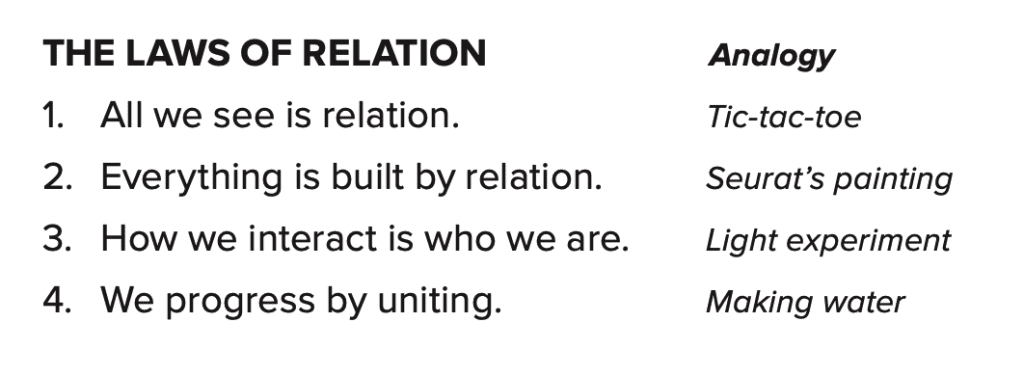
“And with that, we are ready to turn the floor over to Dot, who will begin exploring what all this means in practical terms—to us as individuals and to our organizations.”
“Wait!” Dot said. “Before you yield the floor, could you share with everyone your insight about remote work that follows from what you were just talking about?”
“Oh, sure. Ever since remote and hybrid work practices emerged and became popular, organizations have been struggling to figure out how to accommodate workers’ desire for work-from-home arrangements in ways that also work for companies. Teilhard’s work shows that most people are asking the wrong questions around this issue. The issue isn’t really between remote or in-person work. The real issue has to do with compression. Whether remote or in person, the vital question is: How can we organize ourselves and our work to promote the necessary compression, especially cross-functionally, that will generate convergence—the integration of separate parts into a highly functioning whole? But now I’m getting ahead of myself.”
“Not at all. That’s terrific, Ricardo,” Dot said. “Thank you.” As she walked to the front of the room, she added: “One thing that’s become obvious as you’ve shared, Ricardo, is that even if, as was suggested, being a great scientist doesn’t necessarily equip one to be a great leader, if you’re tuned into organizational issues, it certainly doesn’t hurt! What a ride you’ve taken us on. Thank you!”
Many in the room started clapping. “Oh, he’s not going anywhere!” Dot said. “You haven’t heard the last from Ricardo Bloom. But that’s nice of you.” She added her own ovation to theirs.
“So!” Dot said, addressing the group. “With our brains now fully warmed up, let’s start applying what Ricardo has shared about relation to leadership and to our work in our organizations and communities.
“Let’s learn how to make water.”
About the Author
Jim Ferrell is the founder of Withiii Leadership, a company devoted to helping individuals and organizations apply and operationalize the relational insights introduced in You and We. Prior to founding Withiii, Jim was a longtime managing partner of the Arbinger Institute. He has written a number of bestselling books, including the original versions of the international bestsellers Leadership and Self-Deception and The Anatomy of Peace, with millions of copies in print and each ranking among the all-time bestsellers in their respective categories.
Over his nearly three decades working with corporate and governmental leaders, Jim has developed a reputation as one of the world’s great innovators in the areas of leadership, culture change, conflict resolution, communication, and interpersonal connection. He has a unique ability to grasp complex ideas and translate them into elegantly clear models and applications. He is a regularly featured speaker at trade and corporate conferences and has mentored leaders and trained workforces of many of the most well-known organizations and brands in the world. Jim has degrees in economics and philosophy and is a graduate of Yale Law School. For years he taught a law school course on the topic of overcoming divides. He is the recipient of multiple awards on peacebuilding. Jim is originally from Seattle and currently resides in the Washington, DC, area. He is an avid cyclist and a longtime but decidedly average golfer. You can connect with Jim through the contact form on his company’s website at Withiii.com, by signing up for Withiii’s newsletter on all things related to connectivity and relational leadership, or by following him online.
What’s Next?
I founded Withiii Leadership to help individuals and organizations learn, apply, and operationalize the relational ideas introduced in this book. This means that if you are interested, you don’t need to tackle your story alone; we can work on these issues together. We have created a portal at YouAndWe.com to provide resources and help. On this portal, you will not only find bonus chapters to the book and a chance to get in touch with me about your experience, but you will also discover various resources and ideas to help you do any or all of the following:
- Continue to learn and grow on this path.
- Learn to “extend your du” more effectively and often.
- Practice relational leadership in both your professional and private life.
- Learn to apply what I call the “Seven Rules of Relation,” which are areas of practice that build upon the ideas in You and We.
- Engage with others who have embarked on the same relational leadership journey.
- Implement and utilize tools and resources to help you grow and keep these ideas front and center.
- Access four-dimensional, relational data on your organization, just as the organizations in the book received about theirs.
- Get 360-degree feedback about your relational leadership abilities.
- Empower your leadership team or organization to raise your collective relational scores and efforts and to operationalize these ideas across your group or company.
- Partner with me and my colleagues in this effort, anywhere around the world.
If you’re up for it, I’d love to continue our stories together. Join me and other fellow travelers at YouAndWe.com or at Withiii.com. I look forward to connecting with you there!
YouAndWe.com
Your portal for what’s next
To purchase You and We, CLICK HERE.