





The first time I stood before the Gates of Paradise at the BYU Museum of Art, I froze. I couldn’t move or speak.
A month earlier, I had been at a Latter-day Saints and Media Studies Symposium at BYU–Hawaii—ironically presenting just before Sharon Gray, whose discovery set this story in motion. Even now, her account feels almost unbelievable.
In 2015, while serving as a missionary at BYU–Hawaii, Sharon was given a seemingly simple assignment: clear out a cluttered storage room in the McKay building. Among dust, ceramics, and decades of neglect sat several large wooden crates no one had bothered with. When she opened one, pulling back the bubble wrap, she saw a face. Not just any face—a Renaissance face.
“I know what these are,” she thought. “Why are they here?”
Inside were gypsum casts of Lorenzo Ghiberti’s Gates of Paradise—the iconic bronze doors of the Florence Baptistery, begun in 1425 and completed over 27 years. So extraordinary that Michelangelo is said to have called them worthy of paradise. And somehow, a complete set had been sitting, forgotten, in a small town on the windward side of Oahu for more than thirty years.
Florence > Laie > Provo
Standing in disbelief, Sharon eventually called the BYU Museum of Art. Conversations began. Experts were brought in. Crates were opened in what participants described as an “Indiana Jones moment”—a careful unveiling of something both fragile and inconceivable. Despite decades in less than perfect storage conditions, the casts were salvageable.
That set in motion a decade+ effort that was one part art conservation and one part educational experiment. Led by museum professionals and leveraging a small army of students, the project quickly became a hands-on restoration lab. 13,000+ hours went into repairing surfaces, recovering lost detail, and eventually gilding each panel to closely mimic the brilliance of the original doors. White, dusty plaster had transformed into art that was both breathtaking and beautiful.
Discovery
At the symposium in Hawaii, Sharon showed images of crates, straw packing, and fragile surfaces. She spoke with a responsibility to “tell it correctly.” Literally weeks later, in Provo, I watched those same forms catch light.
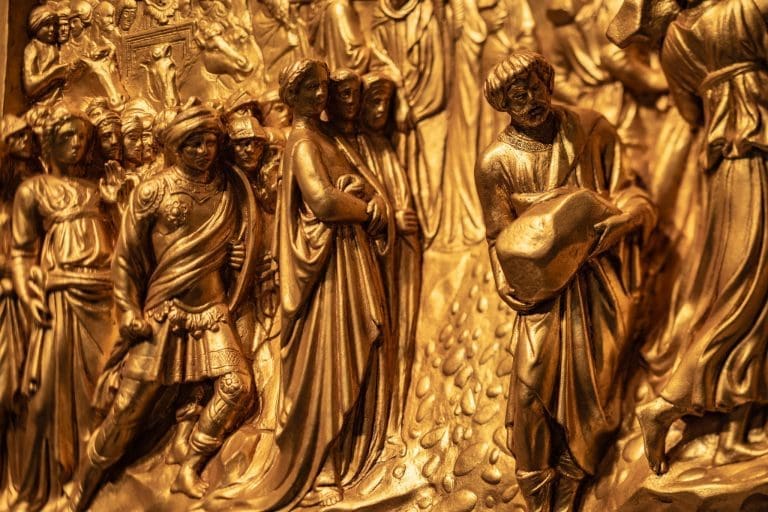
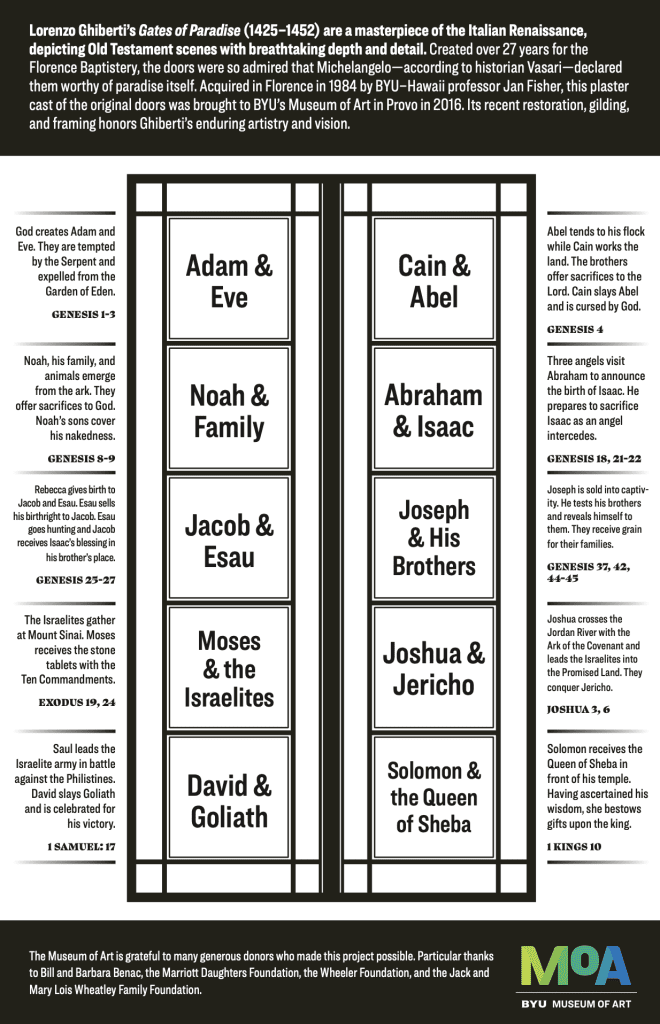
The museum installation doesn’t replicate the original doors’ function—they no longer swing open—but the design still carries that sense of threshold. Of encountering Deity. Each panel holds tentpole narratives from the Old Testament—Adam & Eve, Noah & Family, Jacob & Esau, Moses & The Israelites, David & Goliath, Cain & Abel, Abraham & Isaac, Joseph & His Brothers, Joshua & Jericho, and Solomon & the Queen of Sheba. All are rendered with a depth and perspective that helped define early Renaissance sculpture.
Standing close, I could see both the fingerprints of Ghiberti’s vision and the eager students who carefully restored these plaster surfaces centuries later. The Gates of Paradise, as they are at the MOA, are a collaboration across distance and time.
These doors, the originals created for a specific place and purpose in Florence, Italy, now have a new permanent home in Provo, Utah. It reminds me that transcendent art can and should adapt just as its depth of meaning endures.
Rediscovery
There’s a line Sharon shared that really impacted me: “I believe that our God is a God of found things.”
Maybe this story isn’t about rediscovered artwork; maybe it’s about initially overlooking value and about people—students, donors, curators, missionaries—choosing to recognize significance when they find it. And, maybe it’s also about timing.
The casts arrived in Hawaii in 1984—the same year Sharon studied in Florence. Decades later, she would be the one to uncover them. Decades after that, they would finally be seen. Standing in the museum, I considered that this convergence did not feel like coincidence.
View this post on Instagram
Restoration
As I left the gallery, I found myself doing what the exhibit subtly invites: slowing down and pondering. The educational materials, the 3D reproductions, the immersive design—all are incredible (as every BYU MOA exhibit tends to be).
For me, the true impact happened in silence, when it was just me and the Gates of Paradise. In that stillness, the panels spoke—of divine creation, and of divine restoration. My mind kept going back to that humid storage room in Hawai‘i—the crates and the forgotten plaster hidden under years of dust. And then . . .
The moment of discovery when the light broke through the first crate and the bubble wrap underneath, revealing the renaissance-era crafted faces. What was once overlooked and lost was found. What was fragile was carefully renewed. The dull and decaying plaster was gilded until its bright gold reflected the rays of heaven.
I realize that I’m not all that different from those plaster casts—broken here and there, worn by the decades, in need of the Master’s touch to be all I can and should be. Our Savior relentlessly pursues us, finding us in the hidden corners where we feel forgotten. He patiently restores us. His mercy strengthens what is broken, His love fills what is lacking, and His Atonement transforms us.
What was once tawdry and commonplace becomes sacred. This is the miracle of Christ—our Refiner and Redeemer—who restores us and reveals our true nature as His masterpieces.