





Editor’s note: This is the 5th chapter in Meridian Magazine’s Serialization of Jim Ferrell’s book, You and We: A Relational Rethinking of Work, Life and Leadership. To read the first chapter, CLICK HERE. To read the second chapter, CLICK HERE. To read the third chapter, CLICK HERE. To read the fourth chapter, CLICK HERE. To purchase You and We, CLICK HERE.
Chapter 5: The We Called Me
On break, Zane made a point of chatting up the four people from PERC, the Public Electric Reliability Corporation. They had been silent so far, so he didn’t have a feel for them. They were Jorn Whistler, CEO; Tim Costello, VP of Governmental Affairs; Pam Donaldson, VP of People and Culture; and Stuart Reddy, Chief Engineer. As a group, they were a bit reserved, Zane thought, except for Pam, whose personal energy seemed a good fit for her role in their organization.
He’d heard of PERC before and knew that they were involved with the nation’s energy grid, but he hadn’t known any details. He learned that they were a nonprofit regulator working with energy providers across the United States and Canada. Their mission was to ensure the reliability and security of North America’s power grids. They didn’t operate the energy assets themselves but had administrative oversight over those who did. As a potential conduit into all the big players in the energy sector, Zane thought they could become an important partner.
Winding up his conversations, he approached Seurat’s painting. It was a captivating piece, and quite large—a good ten feet wide and six or seven feet tall. Coincidentally, he actually knew of this painting, as his parents took him to a Broadway play about it when he was just a teenager. The play was called Sunday in the Park with George. As his first Broadway show, it left a big impression. He inched himself closer to take in the painting. Sam Alton, the Democratic congressman from California, was to Zane’s left, while Bellweather’s Cree Evans was to his right. They studied the painting in silence.
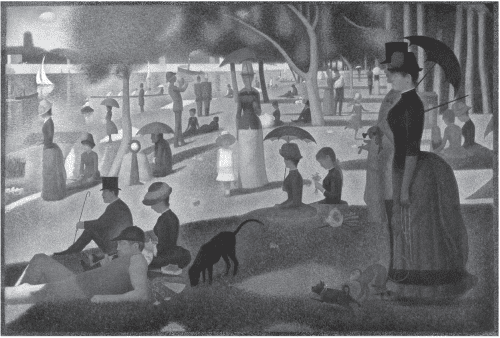
“Mighty impressive,” Sam said after a few moments. “Incredible what he’s done with all these dots. From a distance, you would never suspect it, but as you get close, the painting breaks up into a million little pieces.”
“Yeah, and do you notice that the colors change as you move back?” Cree asked. “Up close, you have all these different colored dots, but as you back away, those tiny splotches of color mix together. The differences somehow play together in a way that produces colors different from any of the ingredient ones.”
Zane’s eyebrows rose in surprise at that—both at the observation, and at the fact that it was conspiracy-theory Cree who had made it. “Hmm, I agree, Cree. That’s really interesting, actually.”
“But it’s also kind of an odd piece, don’t you think?” It was Pam Donaldson from PERC, who was standing right behind them.
“How so?” Sam asked, glancing back to look at her.
“It looks like everyone is kind of frozen in time.”
“Isn’t that true of every painting to some degree?” Zane asked.
“Not like this one,” Pam replied. “Look there, at the little girl above and to the right of center. She’s dancing, and you can see her flow and movement. And you can see movement in the animals too. By contrast, every other figure feels like a cardboard cutout. They are stiff—standing and sitting in almost impossibly correct postures—all except for that man in entirely different kind of clothing at the bottom left who is leaning back in a much more relaxed way. And, other than that man, everyone else seems way overdressed for a day off at the river. No one else seems to be enjoying themselves at all, except for the little dancing girl. And then you have that other girl just to the left of center whose white dress is glowing in the sun. She’s looking directly at us, which in a way tethers us to the scene as well, making it impossible just to keep it at a distance from us. Her eyes put us in the scene too.”
“Wow, you’re incredibly observant,” Sam said. “What was the name again?”
“Pam. Pam Donaldson. I’m with PERC.”
“Yes, of course. I’m Sam Alton.”
Pam smiled. “I recognize you from TV.”
“Yeah, what’s that all about?” Cree butted in. “You politicians are getting paid to go on those shows, I suppose?”
Zane rolled his eyes. “Don’t respond to that, Congressman,” he said, grabbing Cree by the arm and walking him away. “I think it’s time we gathered back.”
Within a couple of minutes, the group had collected in the meeting room. No one was sitting down, however, as the illusion out the window was so captivating.
“Okay, everyone,” Ricardo called out. “Let’s gather up.” They all quickly took their seats. 
“Okay, then! Let’s process Seurat’s painting for a minute. What did you see in it? And what, if anything, does it have to do with what we’ve been talking about?”
“Pam, you should share what you saw in it,” Sam said.
“Oh,” Pam said. “Sure, okay. What struck me most was how Seurat depicted most everyone in a rigidly stiff and almost lifeless way. They’re more like mannequins than people. With two exceptions, however—the dancing girl near the center of the painting and the slouching man at the bottom left of it, who actually looks comfortable and relaxed.”
“Yes, Pam,” Ricardo said. “That’s really perceptive. Notice how your observations point us to contrasts between different elements in the painting,” he continued. “It’s in these contrasts between elements—that is, in the relational differences between them—that the painting communicates meaning. The contrasts raise questions: Why do almost all the people seem so stiff? What’s different about those who are not? And what might those contrasts be saying? Relation between the elements is what brings the painting alive.
“And by the way,” he said, “did anyone notice how devoid of facial details most of the people are—except, that is, the man Pam zeroed in on at the bottom left and the couple standing behind him? We can clearly see that the three of them are looking directly across the river, connecting us to a scene that is out of the frame. It turns out that Seurat actually painted the scene of what was happening across the river. That painting is called Bathing at Asnières. And when you compare the two paintings, you discover a whole new layer of meaning to both of them—meaning that is not at all obvious in isolation. Which means that the painting we have been considering is itself in relation to something else.”
“Interesting,” Cree said, almost under his breath.
“What else did you notice in the painting that pertains to what we have been discussing?” Ricardo asked.
“I’ll take a crack at that, although without Pam’s level of insight.” It was Senator Wilkes.
“Great, Dexter, thank you.”
“Well, in terms of our discussion about relation, at the granular level, I find the painting to be a bit of a contradiction. On the one hand, you have all these little dots, which feel really separate. But then, when you pull back, they all kind of converge together. So, is the painting demonstrating togetherness or independence? Is it saying that all we see is relation, or is it saying that everything is separate after all?”
Pam raised her hand. “I actually wouldn’t say that the dots are separate. They are profoundly in relation, which seems to me to be the point of the entire composition.”
“Great observations by both of you,” Ricardo said. “Thank you. Playing off those observations, Seurat’s method for this painting illuminates something really interesting about the relational nature of reality that we haven’t yet mentioned. It is that everything in the world that looks like a single thing—like the painting, for example—is actually made up of other, smaller things in relation. This is true of everything in existence. Companies are made up of people in relation, for example. Sentences are made up of words in relation. Music is made up of sounds in relation. The cells of any living thing are made up of molecules in relation, which are made up of atoms in relation, which are made up of still smaller things in relation, and so on.
“These two relational truths about everything in the universe—that everything is both a whole made up of parts-in-relation while at the same time being a relational part of something even larger9 —is what holds all the parts and layers of the universe together, including people and our organizations, just as it holds Seurat’s painting together. Which brings us to the Second Law of Relation: Everything is built by relation.
“Seurat illustrates this point by his use of dots in relation. But what are we made of? What are the equivalent of Seurat’s dots for us? A third analogy, this one from a famous experiment with light, will yield an answer.”
(c) 2025 James Ferrell