










Editor’s note: This is the 3rd chapter in Meridian Magazine’s Serialization of Jim Ferrell’s book, You and We: A Relational Rethinking of Work, Life and Leadership. To read the first chapter, CLICK HERE. To read the second chapter, CLICK HERE.
Chapter 3: Surprises
“Hello, Zane.”
Zane hadn’t seen Dot since the day they signed papers finalizing her departure. They hadn’t interacted in any way since. He was thunderstruck, and momentarily speechless.
Regaining his form, he bounded down the stairs with his signature electric smile. “Dot! Wow! What an incredible surprise. How have you been?” The pitch of his voice rose unnaturally, as if squeezing the air through smaller pipes.
“I’ve been well, Zane,” she answered warmly, her brows creasing together the way they always did in conversation. “It’s good to see you. How about you? How have you been? How are Laney and the kids? And how’s the Bellweather team?”
“Ahh, we’re all good,” Zane lied. “It’s a crazy time with the move and all, but everything’s great.”
“That’s terrific to hear, Zane. I can’t wait to learn more over the next couple of days.” She patted him on the back.
“Welcome, everyone!” she said, as the rest were now descending the steps.
Judy and Rita, who had worked with Dot for years, called out her name almost in unison. “Dot!” They rushed to her and embraced.
“We’re here with you?” Judy asked. “How awesome is that!”
“I’m the lucky one, Judy. It’s wonderful to see you—Rita, you too.”
She then extended her hand in welcome to Cree. “I don’t think we’ve met. Dot Kessler. It’s really good to have you here.”
“Cree Evans. I’ve heard a lot about you, ma’am. Even the engineers tell the stories. You’re kind of a mythical figure around the company— like Zeus or something.”
“Oh, goodness.” Dot laughed. “I’m not sure it ended well for Zeus, did it? I’m not certain he’s still around.” She chuckled again and glanced with a smile at Zane. “Maybe I am a bit like Zeus, then.” She looked back at Cree. “But please, call me Dot.”
Zane fidgeted. But he knew he wasn’t the only one feeling anxious. Dot, effortlessly smooth and carefree in normal circumstances, had a tell when she was feeling nervous. Her right hand came to her face, sometimes just brushing her nose or wiping at the side of her mouth. And she just did that. He stepped in to take control.
“The others are here?” he asked.
Yes, everyone arrived over the last 30 minutes or so. Although no one quite like you,” she added. She smiled warmly again. And no hand to her face.
“Yes, well, it seemed like a good idea,” Zane said.
“Oh, for sure! You’re in DC, why not travel like the president? When in Rome, you know! I try to hop a ride on Marine One whenever I can.”
Zane looked at her. He wasn’t sure she was joking.
Dot fell into conversation with the others as they walked toward the entrance. The straight-lined modern architecture and gray-colored stone of the complex rose and fell in blocks against the sky. It was a striking sight against the waving grasses, plants, and trees of the natural surroundings. But Zane took almost no notice of any of it. He was focused on one thing and one thing alone: What is Dot Kessler doing here? Is this her program? Is Mikél in cahoots with her? And have I been set up?
In the entrance hall, Dot asked them to stop and take note of the words etched prominently on the wall in front of them:
Substance so stirred at its depth
To result in a change in essence
Opening a path for transformation
From solitariness
To synthesis5
“What do you get from those words?” Dot asked them.
After a moment’s silence, Judy spoke up. “Not much, actually. It’s talking about change, I suppose, but I’m not sure what to make of the rest of it. It reads like science that’s trying to make itself into poetry. Not sure it works.”
The others nodded.
“Over the next few minutes before we begin,” Dot said, “I invite you to ponder how this verse might apply to you, even if it strikes you as strange. And how, collectively, it might also apply to Bellweather.”
Zane glanced at the words again before turning for the stairs. Dot sidled up next to him. “I’m not much into poetry, Dot,” he said as they walked. “And I’m not sure what those words have to do with Bellweather, either, to be honest.”
She nodded. “Anyone as serious about music as you are, Zane, has poetry in their soul. I’ll be interested in what you have to say about those words by tomorrow.”
“Yeah, maybe,” he demurred.
They reached the bottom of the stairs.
“Maybe think about it this way,” she said. “How does the verse illuminate how your current strategies at Bellweather are going to fail?”
Zane stopped in his tracks. “! That’s what you think, Dot? That we’re going to fail?” He chuckled. “I’d suggest you’re way too far away at this point to know.”
“Too far away.” Dot nodded with a calm but serious expression. “That’s exactly why you are currently set up to fail, Zane. And failure, given what Bellweather potentially has to offer, is something that vital sectors of the economy, not to mention this nation and other nations, can’t afford to have happen.”
Zane was incredulous. “You couldn’t be more wrong. Everything we’re doing—moving here to DC included—is about getting closer to who we need to be close to.”
“Proximity is not closeness, Zane. After working together for years, that should be clear to both of us, don’t you think?” She smiled in a way that unnerved him. “But don’t worry. There’s nothing we’re going to talk about that doesn’t apply as much to me as to you. And, though you may not believe it now, I’m rooting for you. Counting on you, actually.”
Somehow, Zane didn’t take any comfort in that.
Resuming walking, they turned a corner to a long hallway. The left wall was entirely glass all the way down, looking out onto a huge internal courtyard of ponds and tall grasses. They came to the end of the hall and bent to the right around a short corner. A din of conversations pulled them into a room to the left.
The room was like none Zane had ever seen before. There was no wall to the outside, just an empty threshold, the other side of which was the breezy landscape of the museum’s hundreds of acres. It was a spectacular setting. But there’s no breeze, Zane realized. He walked over to the threshold, and then he saw it was another huge pane of glass extending the entire length of the room. It had been engineered and placed in such a way as to create an illusion of intimate connection to the outside. Zane wasn’t easily impressed, but the effect was almost bewitching. The space was both a room and not a room, at the same time.
“Zane Savage.” Zane turned to the voice.
It was Senator Arlo Summers, Republican of Maryland, and ranking member of the Senate’s Armed Services Committee.
“Hello, Senator,” Zane said, beaming. “What a pleasure!”
“If I could have everyone’s attention for a moment,” Dot called out.
“Thank you so much for coming! We’re going to begin in five minutes. Until then, I would invite you to please circulate the room and learn as many of each other’s names as you can. Five more minutes of conversation, okay? Then we’ll get started.”
People complied good-naturedly. The conversations were brief but cordial, and most everyone was able to at least exchange greetings. For his part, Zane concentrated on those who seemed most important to him—Senators Summers and Wilkes, Congressman Alton, and Congresswoman Schuler. He hadn’t had time to meet the rest and didn’t know who they were.
“Please be seated, everyone,” Dot called out again. “Anywhere you’d like is fine.”
Within a minute or so, all were seated and ready. A curious silence settled in the room.
“Welcome to Glenstone,” Dot said warmly. “What an amazing group you are!” She glanced at Zane when she said this, unnerving him once again. “In this group, we have four leaders from my former company, Bellweather Labs, including my successor as CEO, Zane Savage, four members of Congress, and four executives from PERC—Public Electric Reliability Corporation—who are responsible for ensuring the reliability of the nation’s power grid.”
Zane looked around the room to locate the PERC executives. He wanted to make sure he got to know them. They needed what Bellweather had to offer.
“You are all doing really important work,” Dot continued, “work that affects not only you and the lives of your employees, but that potentially affects people across the country in very profound ways.
“Which brings us to why we are here. The short answer is that we are part of an experiment, commissioned by the White House, to see how we can build bridges within and across different sectors of the economy and community. There is concern, shared by many across the political and economic spectrums, that the fabric of society is breaking down. The economic data shows that figuring out how to bring people together is as critical for national strength and security as are technological innovation on the one hand and strong defense capabilities on the other. !at’s why forces from outside the country are investing so heavily in disinformation and other tactics designed to drive wedges between people and groups to splinter and weaken our society. There is a concerted effort to cause our sociopolitical system to implode, and the situation is far more serious than most people know. What we’re doing here is part of a multi-pronged initiative to increase dialogue and connections across societal divides, and to strengthen key sectors and organizations within the economy in an effort to equip them—inoculate them, even—against forces that might otherwise divide them and undermine their commercial and social efforts.”
“So, this is kind of a vaccine, then,” Cree said. “You’re giving us some kind of shot.” Zane rolled his eyes. Don’t go crazy on me here, Cree, he pleaded to himself.
Dot broke out into a big grin. “No, Cree. No vaccines here. Of any variety. Just a lot of honest thinking, open dialogue, and practical learning. The stakes are high. We have a lot to do.”
“What’s the objective for these two days?” Judy asked.
“By the end of tomorrow,” Dot replied, “we hope you will not only understand why pulling together across divides is crucial for your economic survival, but that you also will have begun a transformation into leaders who can overcome the fissures that are weakening your organizations and our nation.”
“Why us in particular?” Judy asked, repeating the question she had earlier asked Zane. “Out of all the people in the DMV, why us 12 instead of others?”
“This is the first of what we hope will be many cohort groups,” Dot answered, “so you aren’t alone, Judy. But we’ve started with you for two reasons. First, your work has been classified as essential for national security reasons. The second reason is because your organizations are fraying, and that collective weakness is a major threat.”
“Excuse me?” Zane spoke up, his face beginning to flush. “I agree that Congress is a mess—no offense to our esteemed legislators here,” he said, glancing around the room. “Capitol Hill is broken; we all know it. And for the good of the country, we all hope you can get your acts together. Again, no offense.” He looked back toward Dot. “I might say the same thing about the White House, Dot. But Bellweather is in great shape. I don’t know where you’re getting your information from, but we’re not fraying at all, and I resent the accusation that we are.”
Zane shrunk back into his seat upon hearing the tone of his voice. He had a prodigious temper. In most cases, he found it helped in getting people to do as he wished, and he actually considered it an asset. In this moment, however, although frustrated by what Dot had implied, he chided himself for failing to keep his cool.
Rita snickered. “I’m sorry, Zane, but if you don’t think we’re divided, you’re not paying attention.”
Zane was now hyperconscious of his surroundings. He wanted to quell this and tried to put on a calm demeanor. “I actually don’t see us that way, Rita. But that’s probably a longer conversation. Let’s talk about it later today—on a break or something. I want to understand your view.”
“Do you?”
“Yes, of course.”
“Well, I’ll just say this much now, then: I used to feel valued at the company—the whole manufacturing division did, in fact. But not anymore. We’re treated more like subcontractors than valued team members now. When Dot was here,” she said, gesturing toward her, “she visited and consulted with us all the time. You, on the other hand, haven’t visited any of our manufacturing facilities since the day you took over Dot’s job. Not one time. That doesn’t sound like division to you?”
Zane’s neurons were now fully firing, but in two entirely different directions. On the one hand, he couldn’t allow Rita’s outrageous insubordination to go unchallenged. On the other hand, he had to maintain his composure to preserve his own and his company’s reputation in the minds of everyone else in the room. But since Rita had made her statements in front of the group, he felt he had to respond in front of the group as well.
He put on his professor voice. “Point taken about visiting the factories, Rita. I have spent most of the last three years pivoting Bellweather into a new direction in quantum computing—a direction that will require a very different manufacturing base than we currently have. I admit that I’ve probably seemed absent to you and your colleagues in the factories. That’s actually been by design as I haven’t wanted to distract any attention away from our legacy business. It sounds like you’ve interpreted my absence in the factories as me not caring, when, in fact, it actually means that I trust you and what you are doing.”
Rita didn’t respond immediately, and Zane counted that as a win. He meant what he said about not wanting to distract the team from the legacy business. But he didn’t trust Rita and was regretting that he hadn’t already fired her.
“I’m not sure I totally agree with you, Zane,” Judy spoke up.
Not now, Judy! he thought. Let it go!
“I know that we haven’t wanted to disrupt the current operations,” she continued, “and I think that’s been the right strategy. But I think we could find ways to be more transparent about our plans and to help those who aren’t yet involved in our 2.0-level efforts to still feel highly valued.”
“Zane, Rita, Judy,” Dot said, “thank you for sharing these initial thoughts. I really appreciate the transparency. If it’s okay with you, I’d like to park this discussion for now and perhaps come back to it when we have more insights to leverage. Would that be all right with you?”
“Absolutely,” Zane said, grateful to have the spotlight removed. “Let’s move on.” The others agreed.
“Okay, then. Everyone, if you would, please take out the cards where you listed words describing how you are in two different relationships in your life.”
Zane pulled his out of his pocket.
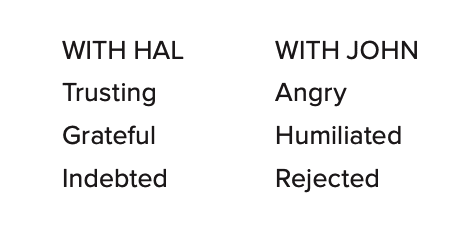
“My question for each of you is this: Are the words you chose to describe Relationship 1 the same words you chose for Relationship 2?”
Everyone in the room shook their heads.
“So, your lists are completely different?”
People nodded.
“Isn’t that to be expected?” Zane asked. “Is the difference supposed to mean something?”
“As we’ll discover together, Zane,” Dot answered, “it means that the world isn’t at all what we think it is.”
(c) 2025 James Ferrell






Cynthia Carlson CarlsonDecember 9, 2025
I'm really excited about this, and already hooked! I deeply enjoyed "Leadership and Self-Deception" and "The Anatomy of Peace." Ferrell's books are so readable and relevant. I'm ordering now, for me and Christmas gifts. Thank you! I might have missed this one!