






Do you ever feel like you’re falling short in “keeping the commandments” because you aren’t perfect? Many sincere disciples carry that quiet burden. Years ago, on the day my sister was baptized, my father found her later in the afternoon sitting alone, looking discouraged. When he gently asked what was wrong, she sighed, “It’s hard to be perfect.”
Her words capture a feeling many of us know well. When we think of all the things we are commanded to do—or to avoid—the list can feel overwhelming. The very phrase “keep the commandments” can sound like an impossible standard, a lifelong test we are destined to fail.
As we study the Law of Moses found in the books of Exodus, Leviticus, Numbers, and Deuteronomy, we recognize that while many of its specific ancient regulations no longer apply to us, we are still bound by the sacred covenants we renew each week in the sacrament, including the promise to keep the commandments. In the modern Church, we are often confronted with commandments that range from the deeply spiritual to the seemingly mundane.
The Bible frames commandment-keeping primarily as covenant stewardship rather than error-free performance.
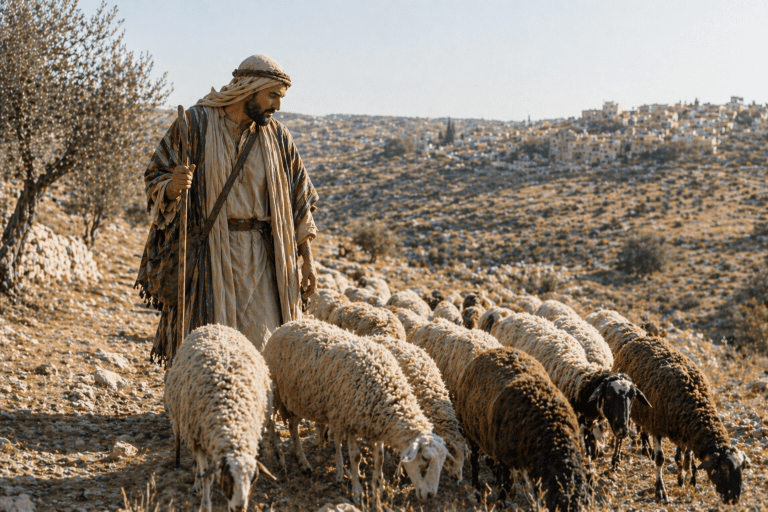
However, the Hebrew Bible invites us to see this obligation in a hopeful way. It suggests that keeping the commandments is less like checking off boxes on a list, and more like tending a garden, or watching over a flock of sheep. In other words, the Hebrew Bible frames commandment-keeping primarily as covenant stewardship rather than error-free performance.
The word most often translated as “keep” in phrases like “keep the commandments” is the Hebrew word shamar (שָׁמַר). While it certainly includes what we do and what we refrain from doing, it does not simply mean flawless performance. It carries the sense of guarding, watching over, preserving, and caring for something precious.
The first time shamar appears in scripture sets the tone. In Genesis 2:15, Adam is placed in the Garden of Eden “to dress it and to keep it.” In keeping the garden, he is not merely obeying a checklist. He tends, nurtures, and protects.
The same word appears when Cain asks, “Am I my brother’s keeper?” (Genesis 4:9), and when Jacob agrees to “keep” Laban’s flocks (Genesis 30:31). Joseph uses it when he counsels Pharaoh to “keep” grain in storage against famine (Genesis 41:35).
In each case, shamar describes stewardship and care, not spotless observance.
Other Hebrew words reinforce this broader picture. The word natsar (נָצַר), also translated “keep,” similarly conveys the idea of guarding or preserving. In the Psalms, the word natsar (נָצַר) is translated as “keep” where it reads, “Depart from me, ye evildoers: for I will keep the commandments of my God” (Psalm 119:115). However, the word natsar is also used in the book of Job where Job calls God a “preserver [natsar] of men” (Job 7:20). It is used in 2 Kings 18:8 to refer to watchmen on a tower [natsarim].
The scriptures do not only ask us to “keep” God’s commandments; they testify that God is a “keeper” over us.
Similar to the instruction to Adam to dress and keep the Garden of Eden, Proverbs tells us, “Whoso keepeth [natsar] the fig tree shall eat the fruit thereof” (Prov. 27:18). And in Isaiah 42, we read, “I the Lord have called thee in righteousness, and will hold thine hand, and will keep [natsar] thee, and give thee for a covenant of the people, for a light of the Gentiles” (Isa. 42:6). This same idea appears in the priestly blessing upon Israel: “The LORD bless thee, and keep [shamar] thee” (Num. 6:24). Here, God’s “keeping” of His people clearly means watchful, sustaining care. The scriptures do not only ask us to “keep” God’s commandments; they testify that God is a “keeper” over us.
By contrast, when scripture speaks of “keeping” feasts–ritual actions performed in a prescribed way–a different word appears: chagag (חָגַג), meaning to celebrate or observe a festival. The distinction is telling. Commandments are not primarily framed as rituals to execute, but as relationships and responsibilities to guard. Where ritual requires correct performance, covenant requires faithful presence.
Taken together, these words expand our understanding. “Keeping the commandments” is not reduced to checking every box without fail. It is living attentively before God: listening, guarding, tending, and returning when we stray.
This does not diminish obedience; it deepens it. A gardener may make mistakes. Weeds may invade the garden. Fruit may die from lack of water. But the faithful gardener does not abandon the garden. Some sheep may stray. Wolves may attack. But the shepherd does not abandon the flock. In both cases, the work continues. The commitment endures.
So it is with discipleship. Like the shepherds of Israel described in the Psalms, covenant-keepers remain responsible even when sheep wander.
When we sin, we repent. When we fall short, we return. In that sense, we do not cease “keeping the commandments” every time we err. Rather, to “keep the commandments” is to continue to shamar: to guard and tend our covenant relationship with God, precisely by turning back to Him.
This understanding of “keeping” as covenantal fidelity rather than error-free compliance helps illuminate how Christ advocates for us before the judgment bar of God. In Doctrine and Covenants 45, Christ is not portrayed as an attorney who is arguing that our sins were not so bad, or that our sins should be overlooked because of all of the good things we did that balanced out the bad things. Instead, we read:
3 Listen to him who is the advocate with the Father, who is pleading your cause before him—
4 Saying: Father, behold the sufferings and death of him who did no sin, in whom thou wast well pleased; behold the blood of thy Son which was shed, the blood of him whom thou gavest that thyself might be glorified;
5 Wherefore, Father, spare these my brethren that believe on my name, that they may come unto me and have everlasting life.
In pleading our cause, Christ does not claim that we are without sin. Instead, we can be saved from spiritual death because He did no sin, if we will believe on His name and remain faithful to the covenant relationship we enter into through ordinances.
It also may be significant that the next verse does not call on us to “obey” (sometimes shama in the Hebrew Bible). Instead, we are called on to “listen,” and “hear” (the more frequent English translations of the word shama): “Hearken, O ye people of my church, and ye elders listen together, and hear my voice while it is called today, and harden not your hearts.”
Christ does not stand as a strict auditor of our failures. He stands as our keeper, our Shomer (שׁוֹמֵר), pleading our cause, preserving our path, and making it possible for us to continue in the covenant even when we falter.
To “keep the commandments” is to remain engaged in a living relationship of trust, care, repentance, and return.
To “keep the commandments,” then, is not merely to carry out a list of instructions without fault. It is to remain engaged in a living relationship of trust, care, repentance, and return. It is to guard something precious, our covenant relationship with God, and to let Him guard us in return.
In that light, keeping the commandments is less like getting everything exactly right and more like tending a garden. As long as we keep returning, repenting, and trusting Him, we have not failed.





Steve Densley, Jr.April 28, 2026
Great comment, Nathaniel. I agree that the Lord’s instructions matter. Without them, we wouldn’t know how to be good “keepers of the flock” or “tenders of the garden.” In exploring the meaning of shamar, I hoped to show that commandments are part of that tending: they guide us, shape us, and help us know how to act. At the same time, the purpose of the article was to open a broader perspective. As I wrote about keeping the commandments, “While it certainly includes what we do and what we refrain from doing, it does not simply mean flawless performance.” The line between tending and neglect isn’t measured by perfect execution but by the direction of the heart and the willingness to keep returning. I love what D&C 82:8–9 teaches: Commandments are God’s directions for our good. When we follow them, we avoid unnecessary sorrow and experience greater joy. More importantly, as we follow them, we become more Christlike. And because we all fall short, it’s reassuring to remember that we haven’t failed as long as we keep tending, keep returning, and keep growing.
JuelApril 28, 2026
I was raised in the 1940's and 50's farmland of SE Idaho, and my teachers, secular and Church, were honorable people, but taught a harsher, more judgmental, Old Testament view of god. Fortunately, i had a wonderful mother who taught me a softer side. She was one of the most kind, merciful, forgiving, and charitable people I've known, and my paradigm of my Heavenly Parents is that of my parents, only perfect. Apostle Gong said God doesn't look for loopholes to punish us, but to save us. I believe that and appreciate this article.