


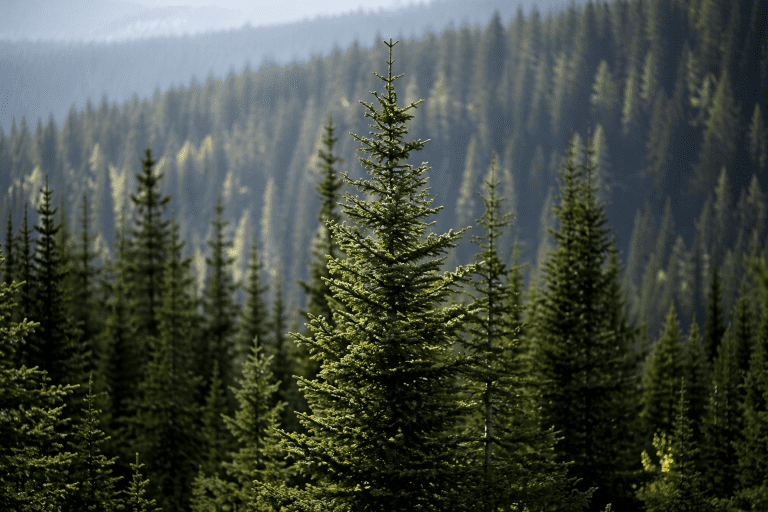


The attack begins quietly. A cluster of bark beetles pierces the outer bark of a spruce, tunneling inward where sap once flowed freely. To a passerby, nothing seems amiss. The tree does not cry out, sway, or fall. Yet inside its tissues, alarms are already sounding. Volatile organic compounds rise through the trunk and into the air, while deeper still, another message travels more urgently—downward, into the roots, and outward through microscopic fungal filaments woven through the soil like living threads. The wounded tree is calling for help.
Within this underground network, neighboring trees receive the signal. Some begin producing defensive chemicals that make their bark hostile to the insects. Others divert carbon and nutrients toward the injured spruce, strengthening it against the invasion. What appears above ground as a solitary tree under siege is, in truth, a communal struggle. As the Apostle Paul wrote, “whether one member suffer, all the members suffer with it.” Long before humans understood the science, creation itself was already living that truth.
Scenes like this reveal how astonishing the secret life of trees truly is. Far from passive, isolated organisms locked in silent competition, trees participate in a dynamic system of communication, cooperation, and mutual care—one that functions largely beyond human sight. Beneath the forest floor lies an intricate biological infrastructure often called the wood wide web, formed by symbiotic fungi known as mycorrhizae. Through this network, trees exchange chemical signals, water, carbon, and minerals, responding collectively to threats and sustaining one another through stress, disease, and scarcity.
I’ve recently been reading about the growing scientific understanding of how trees communicate and share resources—as in the example above. I was both amazed and astonished by what I see as the hand of our creator in the phenomenon. This led me to thinking about how the example of trees actually offers a meaningful analogy for how communities of Saints are invited to live and care for one another.
Researchers describe forests not as collections of isolated organisms but as living networks, where trees are connected through underground fungal systems allowing them to exchange nutrients, send warning signals, and sustain weaker members of the grove. This wood wide web challenges older assumptions about competition as the primary driver of survival and instead highlights cooperation, interdependence, and long term stewardship. For Latter-day Saints, this picture resonates deeply with gospel teachings about unity, covenant responsibility, and the quiet but essential ways disciples strengthen one another.
In a forest, mature trees often play a crucial role in the health of the whole. Through underground networks, they can direct water, carbon, and minerals to saplings growing in the shade or to trees damaged by disease or drought. These older trees do not thrive by hoarding resources. Their strength is expressed by sharing what they have so the forest as a whole can endure. In the restored gospel, a similar pattern appears in the Lord’s vision of Zion. The Saints are taught in Moses chapter seven that they should be of one heart and one mind and there should be no poor among them. This unity is not merely emotional agreement. It is practical, lived support, where those with greater strength, experience, or resources lift those who are still growing.
The wood wide web also reveals communication in a forest is often subtle and unseen. Trees send chemical signals through their roots and fungal partners to warn neighboring trees of pests or environmental threats. The exchange is not loud or dramatic, yet it can mean the difference between resilience and collapse. In a ward or branch, much of the most important ministering happens in similar ways. A quiet text message, a meal left on a doorstep, a listening ear after a long day, or a prayer offered in private can transmit spiritual nourishment and reassurance.
Doctrine and Covenants Section 42 teaches Saints are to care for the poor and the needy, administering to their relief both spiritually and temporally. This charge does not always require public recognition. Like the forest network beneath the soil, covenant care often works best when it is steady, humble, and motivated by love rather than visibility.
Another striking aspect of tree communication is it does not erase individuality. Each tree remains distinct, with its own shape, species, and role within the ecosystem. Cooperation does not require uniformity. Instead, diversity strengthens the system, since different trees contribute different resources and respond differently to stress. The Church of Jesus Christ of Latter-day Saints is likewise composed of individuals with varied backgrounds, talents, and testimonies. Paul’s teaching that the body has many members, each with a necessary function, aligns well with this natural pattern. When Saints recognize not everyone gives or receives in the same way, they can better appreciate how the Lord weaves diverse contributions into a unified whole.
The science of forest networks also underscores the cost of disconnection. When land is over harvested or the fungal networks are damaged, trees become more vulnerable to disease and environmental extremes. Isolation weakens them. For Saints, spiritual isolation carries similar risks. President Russell M. Nelson has repeatedly emphasized the importance of ministering and covenant belonging, especially in a world where loneliness and fragmentation are increasing. When members withdraw from one another, whether through neglect, judgment, or simple busyness, the community loses channels through which faith, hope, and resilience flow. Rebuilding those connections requires intention, patience, and sometimes repentance, much like restoring a damaged ecosystem requires time and care.
There is also a lesson in how trees support those that appear least productive. Some trees that no longer produce leaves or seeds may still receive nutrients through the network, remaining alive for years. Scientists suggest these trees can still contribute structurally or ecologically in ways not immediately obvious. In the gospel context, this challenges Saints to reconsider how they view worth and contribution. Individuals who struggle with illness, doubt, age, or disability may not fit common expectations of productivity, yet their presence, prayers, and quiet endurance can bless a ward in profound ways. The Savior’s ministry consistently affirmed the value of those on the margins, and the covenant community is strongest when it honors the same principle.
Seeing the forest through the lens of cooperation rather than competition invites Saints to reflect on stewardship. Trees do not consume endlessly without regard for others. Their survival is tied to the health of the whole environment. Likewise, the law of consecration, whether lived formally or informally, calls members to see their time, talents, and resources as entrusted by God for the blessing of His children. Supporting one another is not an optional kindness. It is a covenant expression of discipleship. As King Benjamin taught, service to others is inseparable from service to God.
The wood wide web does not replace faith or doctrine, yet it offers a powerful natural parable. God often teaches through His creations, and the interconnected forest stands as a living example of life flourishing through shared strength. For communities of Saints, this scientific insight affirms a gospel truth. We are not meant to stand alone. Through covenants, ministering, and daily acts of care, the Lord binds His people together, allowing spiritual nourishment to flow where it is most needed. Like a healthy forest, a healthy community of Saints grows resilient, compassionate, and enduring when each member is willing to share light, strength, and sustenance with those around them.