










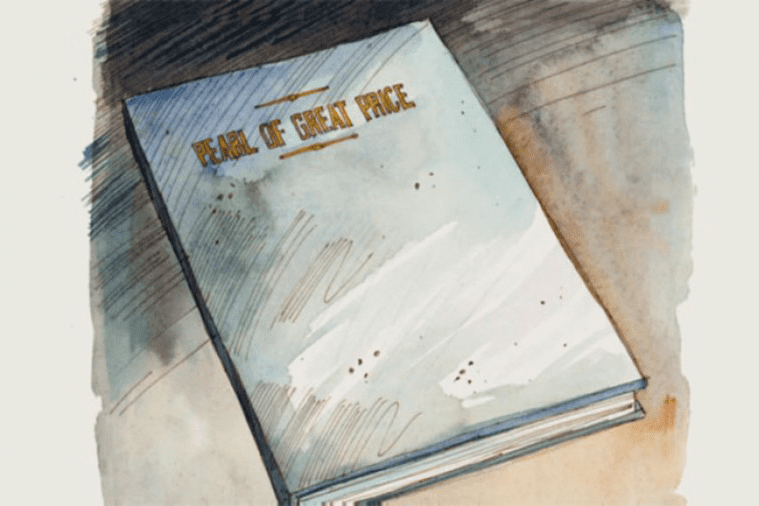


Cheering for the underdog is a common theme in movies such as Hoosiers, Remember the Titans, Facing the Giants, and Cool Runnings. When I watch sporting events from little league to professional, if my favorite team is not playing, I root for the underdog. Today, I am cheering for the scriptural underdog, the Pearl of Great Price.
The Pearl of Great Price qualifies as the underdog of scripture because it does not have its own year in the four-year, “Come, Follow Me,” rotation. In Sunday School we study the Old Testament, New Testament, Book of Mormon, and Doctrine and Covenants. If you ask why it does not have its own year, your question will be sidelined with the explanation that Moses and Abraham are included in Old Testament years, Joseph Smith—Matthew in New Testament years, and Joseph Smith—History and the Articles of Faith in Doctrine and Covenants years. The reasoning is that “it is studied by context, rather than having a year specifically devoted to it on its own” (https://www.fairlatterdaysaints.org/blog/2019/12/19/book-review-the-pearl-of-greatest-price-mormonisms-most-controversial-scripture, italics added).
Sounds reasonable, but here are the facts: Old Testament years, the books of Moses and Abraham, along with Genesis references, are part of reading assignments for six weeks in January and February as they pertain to the Creation and Fall. In New Testament years, Joseph Smith—Matthew is cited one week in May. In Doctrine and Covenants years, Joseph Smith—History is part of the reading assignment for two weeks in January and one week in February. In Book of Mormon years, the Pearl of Great Price is not part of any reading assignment.
Further, the Pearl of Great Price is an underdog because the other two volumes of Restoration scripture, Book of Mormon and Doctrine and Covenants, have labels of distinction: Joseph Smith said the Book of Mormon is “the keystone of our religion” and President Ezra Taft Benson said the Doctrine and Covenants is “the capstone of our religion” (https://www.churchofjesuschrist.org/study/ensign/2009/01/treasuring-the-doctrine-and-covenants?lang=eng).
I searched for a similar label for the Pearl of Great Price but found nothing. Then thinking that keystone and capstone end with stone, I scanned a list of types of stones. When I saw “lodestone,” it seemed to jump off the page. Lodestones are natural magnets and were used as compasses for sea travel by ancient civilizations—Olmec, Chinese, and Greek (https://en.wikipedia.org/wiki/Lodestone). Likewise, the Pearl of Great Price is magnetic, a guiding force on our earthly journey. It draws readers to Jesus Christ.
I didn’t realize how often a name of Jesus is found in the Pearl of Great Price until I counted: Only Begotten (26); Son of Man (15); Man of Holiness (2); Son of God (2); Jesus Christ (8); Lord God (41); Messiah (3); Creator (1); Man of Counsel (1); King of Zion (1); Rock of Heaven (1); Chosen (2); Savior (4); Lamb (1); Righteous Judge (1); Beloved/Beloved Son (2); Endless and Eternal (1). That is 112 times in 61 pages. I think the Pearl of Great Price qualifies, like the Book of Mormon, as Another Testament of Jesus Christ.
Yet another reason I want to advertise this scriptural underdog is because in recent years the Book of Abraham has been hammered with negativity. Satan’s forces have worked overtime to disparage it. Denigrating any part of the Pearl of Great Price, Doctrine and Covenants or Book of Mormon is an open invitation to question all of Joseph’s revelations and teachings.
This is nothing new. Before the Book of Mormon was published in 1830, residents in and around Palmyra, New York, successfully organized a boycott of the Book of Mormon. Because sales did not meet projected income, Martin Harris had to sell 151 acres of his farm to pay the $3,000 owed to Egbert Grandin. In today’s money, that is around $90,000, which was about half of Martin’s wealth. Thirteen years later, when Joseph’s early revelations were being printed in Missouri, a mob destroyed the press and the pages that were already printed. In 1842, almost immediately after the book of Abraham began to be circulated, Egyptologists of the time claimed Joseph’s translation was fabricated because the three facsimiles that were made public are scenes from common funeral texts, not Abraham’s autobiography.
The rhetoric increased when a professor of Middle East studies found eleven fragments of the papyri in 1966. Many saw this as another evidence that the Book of Abraham is fiction. If you have been confused about this, please consider that the Book of Abraham is not a translation but a revelation received directly by the gift and power of God, just as Joseph received the Book of Mormon, Doctrine and Covenants, and Book of Moses. Rather, I encourage you to read Abraham’s words that “tell… more about Abraham’s day than Joseph Smith could have known” (fairmormon.org/perspectives/fair-conferences/2009-fair-conference/2009-the-larger-issue).
Abraham said: “I desired to be a greater follower of righteousness… to possess a greater knowledge… to be a father of many nations, a prince of peace… to receive instructions… to keep the commandments of God…. I sought for mine appointment unto the Priesthood.” He explained that the priest of Elkenah was going to kill him because he would “not bow down to worship gods of wood or of stone.” When “the priests laid violence upon me, that they might slay me, I lifted up my voice unto the Lord my God, and the Lord hearkened and heard, and he filled me with the vision of the Almighty, and the angel of his presence stood by me, and immediately unloosed my bands.” Then he heard: “Abraham, Abraham, behold, my name is Jehovah, and I have heard thee, and have come down to deliver thee” (Abraham 1:2, 4, 11-12, 15-16).
Another reason to advertise the Pearl of Great Price is because it is short, only 61 pages, compared to over 2,000 pages for the rest of the Standard Works. I asked AI how long it would take to read the Pearl of Great Price. It wrote: “It takes approximately four to five hours to read the entire Pearl of Great Price, which contains roughly 68,000 words. Based on an average reading speed of 250 words per minute, this foundational text of The Church of Jesus Christ of Latter-day Saints—comprising the Books of Moses, Abraham, and other writings—can be comfortably read in a few sessions or in under 10 hours of focused study.” What the Pearl of Great Price doesn’t have in quantity, it makes up for in quality. It reads like bullet points—dense, deep, and compact.
What I didn’t realize until recently is that the books of Moses and Abraham might have been longer. The title of Moses begins: “Selections from the Book of Moses,” and Abraham begins: “Selections from the Book of Abraham” (italics added). Perhaps if the Prophet Joseph had been less harassed and persecuted, he might have had time to receive additional revelation. Both books end abruptly, almost mid-storyline, Moses at chapter eight and Abraham at chapter five. I’m always left wanting more.
The exception to the Pearl of Great Price being the scriptural underdog is that historically the number one most-quoted verse in general conferences comes from Moses 1:39: “For behold, this is my work and my glory—to bring to pass the immortality and eternal life of man” (Moses 1:39). However, this verse of revealed truth is not an outlier or anomaly but one of hundreds of similar pearls in the Pearl of Great Price. I think of Ruth gleaning in Boaz’s field for wheat. In the Pearl of Great Price, you glean pearls of “wisdom and great treasures of knowledge, even hidden treasures” (Doctrine and Covenants 89:19).
The Pearl of Great Price comes with a testimony bonus. If you have a testimony of the Book of Mormon, you don’t need a separate one for The Pearl of Great Price. They come as a package. W. W. Phelps understood this fact before the book of Abraham was translated. Brother Phelps wrote to his wife, Sally: “These records of old times, when we translate and print them in a book, will make a good witness for the Book of Mormon” (Robert L. Millet and Kent P. Jackson, Studies in Scriptures, Vol. 2, The Pearl of Great Price, Salt Lake City, Utah: Deseret Book, 2011, 164).
The Pearl of Great Price delivers added value and bonus features. When Elder Franklin D. Richards compiled the book in 1851, he said it was a collection of “choice materials touching many significant aspects of the faith and doctrine of the Church” (Introduction to the Pearl of Great Price). Here is a sampling of a few of hundreds of questions that the Pearl of Great Price answers:
- Do prophets speak to God face to face? (Moses 1-2; Abraham 3:11; Moses 6-7; Joseph Smith—History 1:17);
- Do the books of Moses and Abraham have accounts of the Creation? (Moses 2-3; Abraham 3-5);
- Is more revealed about Satan in fewer words than anywhere else in scripture? (Satan’s name is found 33 times in Moses.)
- Is more revealed about Enoch in more words than anywhere else in scripture? (See 110 verses in Moses 6-7);
- Does Joseph Smith—Matthew have specific information about the signs of the Second Coming?
- Is there additional information about baptism? (Moses 6:64-68; 7:11; 8:23-24; Joseph Smith-History 1:69-71).
- Where is a list of beliefs and doctrine of the Church of Jesus Christ of Latter-day Saints that were different from mainline Christianity in 1842 and still are unique today? (See the Articles of Faith 1:1-13.)
In addition to these internal evidences for the Pearl of Great Price, there are external evidences. Specifically for the Book of Abraham, you can learn more at Gospel Topics and Questions (https://www.churchofjesuschrist.org/learn?lang=eng). I, also, recommend past Meridian articles: https://latterdaysaintmag.com/how-we-got-the-book-of-abraham/; https://latterdaysaintmag.com/wilford-woodruff-and-the-book-of-abraham/; https://latterdaysaintmag.com/dealing-with-friendly-fire-on-the-book-of-abraham/.
I am not sure how I became an ardent fan of the Pearl of Great Price. It just speaks to me. I have listened to Hugh Nibley’s lecture series on the Pearl of Great Price several times throughout the years. In 2017, I typed the text of the Pearl of Great Price because I wanted to learn it better. In 2020, I wrote a book about what I learned by typing it. In 2023, I taught a 12-week Zoom class on it, and often, when I can’t sleep, I listen to it.
I hope my enthusiasm is contagious. It is a book of hidden treasures of knowledge, gospel pearls, an endless well, a lodestone for our lives and religion.







IreneMay 12, 2026
it truly is a Gem