












PART ONE. Neutrality — In Context
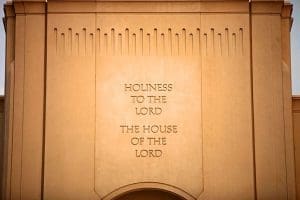
I begin with a story. When our youngest son Jared was about nine years old, he was in the back seat with his brothers while Julie and I drove down the road from Oak Hills in Provo that goes along the north side of the Provo temple. The view of the valley is quite commanding there. As we looked out of the expanse of Utah County and of Utah Lake and the mountains to the West, the sky was very dramatic, with great contrasts of light and darkness and displaying various shades of red and purple. Jared was clearly impressed. He sat upright to have a better look and exclaimed: “Holy cow! Don’t tell me it’s the Second Coming!” He then added, with hardly a pause, out of concern for our neighbors to whom he delivered daily newspapers: “I feel bad for those people who paid ahead on their subscriptions!”
For us Latter-day Saints, our view of politics and of public affairs more broadly may depend significantly on how we situate ourselves eschatologically, that is, in relation to the “Last Things” prophesied in scripture. Especially when politics is increasingly divisive, confusing and unpleasant, it is comforting to remember that the world is ultimately in God’s hands and that it is not up to us to decide the final outcome.
The problem is that if we follow that logic, then we might fail to take responsibility for many things that still depend upon us and upon how we exercise our agency. If we want to help make our world better – or at least help prevent it from becoming much worse – then we must care about the laws, policies, and shared purposes that drive political life. It is comforting to imagine that the unpleasant world is of little concern to us and can be safely left to those who have a taste for such things. Unfortunately, though, politics matters; indeed, there is evidence that it matters more and more every day, for better or for worse. The world and its end are indeed in God’s hands, and knowing that should moderate our political expectations and passions. But He has not left us without responsibility for making this mortal existence as good as possible, as conducive as possible to lives open to truth and governed by moral law:
For behold, it is not meet that I should command in all things; for he that is compelled in all things, the same is a slothful and not a wise servant; wherefore he receiveth no reward.
Verily I say, men should be anxiously engaged in a good cause and do many things of their own free will, and bring to pass much righteousness;
For the power is in them, wherein they are agents unto themselves. And inasmuch as men do good they shall in nowise lose their reward.
But he that doeth not anything until he is commanded, and receiveth a commandment with doubtful heart and keepeth it with slothfulness, the same is damned. (D&C 58:26-29.)
Until we are told we can stop living providently and exercising foresight – or stop paying our newspaper subscription a month in advance – we remain agents responsible for making the best future we can for ourselves and our communities. Keeping in mind both our ultimate dependence on Higher Powers for what matters most and our moral responsibility do what good and to prevent what evil we can, let us consider these two religious statements concerning politics:
The Manhattan Declaration: A Call of Christian Conscience (2009; excerpt)
… freedom of religion and the rights of conscience are gravely jeopardized by those who would use the instruments of coercion to compel persons of faith to compromise their deepest convictions. … we affirm 2) marriage as a conjugal union of man and woman, ordained by God from the creation, and historically understood by believers and non-believers alike, to be the most basic institution in society … We pledge to each other, and to our fellow believers, that no power on earth, be it cultural or political, will intimidate us into silence or acquiescence. It is our duty to proclaim the Gospel of our Lord and Savior Jesus Christ in its fullness, both in season and out of season. …
Latter-day Saint Statement on Neutrality (excerpt)
The work of The Church of Jesus Christ of Latter-day Saints includes sharing the gospel of Jesus Christ, strengthening individuals and families, and caring for those in need. The Church does not seek to elect government officials, support or oppose political parties, or, generally, take sides in global conflicts. The Church is neutral in matters of politics within or between the world’s many nations, lands and peoples. However, as an institution, it reserves the right to address issues it believes have significant moral consequences or that directly affect the mission, teachings or operations of the Church.
The Manhattan Declaration is a straightforward argument for the importance of religious truth in political life. The Latter-day Saint statement on neutrality expresses a desire to keep the church out of politics as much as possible. The question, of course, is just how far such a neutral stance is indeed possible. The exception to the posture of neutrality enters in immediately as soon as “significant moral consequences” are at stake. We are led to ask, then, whether moral questions can for the most part be kept separate from political questions.
Consider the following two apparently contrasting views on the bearing of morality on society:
Every country has a sexual constitution: a set of laws and opinions, which use shame and honor to shape and guide sexuality…. We currently live under the Queer Constitution, which claims to—and in fact does—reject the Straight Constitution. …It moved from gay rights in the 1970s, to proclaiming “Gay Pride” a virtue in the 1990s, …, to constitutionalizing same-sex marriage in the 2010s, to protecting gender identity under the civil rights laws in the 2020s, to practically banning intellectual and legal opposition to the Queer Constitution on speech platforms. …The live-and-let-live attitude, hoped for by conservatives and promised by revolutionaries, cannot in principle hold. Indeed, the move from legal tolerance to public celebration is perfectly logical. – Scott Yenor, Boise State University
In so many relationships and circumstances in life, we must live with differences. Where vital, our side of these differences should not be denied or abandoned, but as followers of Christ we should live peacefully with others who do not share our values or accept the teachings upon which they are based. The Father’s plan of salvation, which we know by prophetic revelation, places us in a mortal circumstance where we are to keep His commandments. That includes loving our neighbors of different cultures and beliefs as He has loved us. – Pres. Dallin Oaks, “Loving Others and Living with Differences (October 2014)
Certainly, there is no question that people must live with differences in a political community and especially in a democratic and pluralistic community. But just how radical can these differences be? And is Scott Yenor correct that We have moved from legal tolerance of differences to public celebration of what Christians not long ago considered to be perversity?
“Fairness,” “Tolerance,” and the Common Good
We hope to avoid bitter public conflict over such sensitive moral issues by organizing political life in terms of an idea of “fairness” rather than with reference to a substantive moral agreement. “Fairness” is a pragmatic substitute for moral agreement. But can we agree on meaning of “fairness”? Can “fairness” be defined apart from some broadly shared understanding of the common good, of our common purposes? And can our understanding of the common good be severed entirely from the philosophical and religious questions of human nature and the human good? Can we define “human rights” apart from some substantive understanding of human decency and human flourishing?
James Madison wrote in Federalist 51: “Justice is the end of government [&] of civil society. It ever has been and ever will be pursued until it be obtained, or until liberty is lost in the pursuit.” But again, our idea of “justice” is necessarily interwoven with our understanding of human purposes. For example, how can “fairness” be defined without reference to the question of our national “sexual constitution” as referenced by Scott Yenor above? Tocqueville wrote, in Democracy in America:
There is hardly any human action, however private it may be, which does not result from some very general conception men have of God, of His relations with the human race, of the nature of their soul, and of their duties to their fellows. Nothing can prevent such ideas from being the common spring from which all else originates.
If Tocqueville is right (and I think he is), then the concept of “fairness” will not save us from hard questions about how we understand the common good – about our nation’s “sexual constitution,” and its moral constitution more generally. Elder Christofferson has explained very clearly why morality is not a purely private or purely religious (as distinct from more widely social) concern:
The societies in which many of us live have for more than a generation failed to foster moral discipline. They have taught that truth is relative and that everyone decides for himself or herself what is right. Concepts such as sin and wrong have been condemned as “value judgments.” As the Lord describes it, “Every man walketh in his own way, and after the image of his own god” (D&C 1:16). As a consequence, self-discipline has eroded and societies are left to try to maintain order and civility by compulsion. The lack of internal control by individuals breeds external control by governments. “Moral Discipline,” October 2009
“Tolerance,” like “fairness,” may seem to offer an easier, less burdensome alternative to our public responsibility for a wholesome understanding of human nature and human purposes. But, as Pres. Oaks has explained (in a speech at BYU, “Truth and Tolerance”), citing Pres. Packer, “The word tolerance does not stand alone. It requires an object and a response to qualify it as a virtue. . . Tolerance is often demanded but seldom returned. Beware of the word tolerance. It is a very unstable virtue.” Tolerance is unstable and often in fact duplicitous, I would say, because our view of the scope of tolerance – the range of behaviors and policies deserving of acceptance – always depends upon some more substantive moral convictions.
“Tolerance” is often wielded as a weapon against more traditional moral viewpoints, but the morality – and the view of humanity – behind the deployment of “tolerance” is never itself question. All too often, tolerance is meant to apply to my opinions and practices, but not to yours.
“Neutrality”: Context and Limits
How, then, are we to understand the Church’s emphasis on political neutrality, fairness, and tolerance, and apparent disinclination in the present political and social context to take a strong public stand on matters of substantive morality such as is expressed in the Manhattan Declaration?
To begin to explore this question, it is important to see that, while these teachings are in part explicitly grounded in the fundamental Christian virtue of charity or love, it is also reasonable to postulate that they are intended to address current political and social circumstances of the Church in North America in a practical way. It is natural and right that the Church should attend first and foremost to its own interests – that is, to its divine mission of saving souls – of showing the way to Eternal Life to the living and of binding together the generations and redeeming the dead through temple ordinances. In a time of the weakening of shared moral and social norms and of increasing ideological extremism, the Church’s first political priority must be to secure its right to pursue its religious purposes. Implicit in the background of such practical political judgments is of course the question raised by my son’s apocalyptic response to a dramatic skyscape: just what time frame are we working with here? Are longer-term political considerations (our concern for a sound shared morality adequate to support a self-governing society) to be devalued in view of the imperatives of the last days?
However much weight we give to such millennialist considerations, we can understand why Latter-day Saint involvement in public debates such as the lost battle against the redefinition of marriage to include homosexual couples has, at least for now, apparently, been sacrificed to a rhetoric of morally “neutral” fairness and tolerance with a view to securing in exchange a general recognition of rights of religious free exercise. Rather than hoping to contribute to the common good of society by participating in public debates over issues of fundamental social morality, we hope, at least for a time, for example, to be allowed to continue employment practices in Church education which many now would hope to abolish as “discriminatory,” not to mention to continue to uphold norms in our temple ceremonies that increasingly violate the deepest moral or ideological sensibilities of a powerful block of public opinion, especially elite opinion. While there will always be costs as well as benefits to such rhetorical and political choices, it is not difficult to imagine a reading of our current political and social circumstances that would explain and justify the now dominant posture of “neutrality” or “fairness for all.”
Whose Neutrality? The Church and its Members
That said, it is important to recognize that the Church’s stated and official policy applies to the Church as an institution and is not being advanced as the one true political stance to be adopted by the general membership. It is not clear, moreover, that the public-relations posture that dominates Church communications is the best stance for all of its members to take in their public engagements. And, speaking of the membership, another important motive in the Church’s messaging regarding politics seems to be a determination to lower the temperature of politically related debate in our own congregations. It is possible to acknowledge the importance of responsible engagement by Latter-day Saints in the difficult issues that roil our public life while seeing that it is a high priority to preserve peace and brotherhood among ourselves. This is certainly an important purpose in Pres. Nelson’s very forthright call, echoed by other Church leaders, for us all to be “peacemakers:”
You have your agency to choose contention or reconciliation. I urge you to choose to be a peacemakers, now and always.”
Anger never persuades. Hostility builds no one. Contention never leads to inspired solutions. Regrettably, we sometimes see contentious behavior even within our own ranks.”
Now, I am not talking about “peace at any price.”18 I am talking about treating others in ways that are consistent with keeping the covenant you make when you partake of the sacrament. You covenant to always remember the Savior. In situations that are highly charged and filled with contention, I invite you to remember Jesus Christ. Pray to have the courage and wisdom to say or do what He would. As we follow the Prince of Peace, we will become His peacemakers.
Pres. Nelson then interjected, many will recall, the genial observation that “at this point you may be thinking that this message would really help someone you know.” And of course the tendency to weaponize even the idea of peace-making is a very real problem. As Pres. Packer once said of tolerance, “peace-making” can perhaps also be an “unstable virtue.” Everyone wants peace on his or her own terms, especially when he is not even aware that he is setting terms. Thus Pres. Nelson’s apparently casual aside is in fact very significant: “I am not talking about ‘peace at any price.’”
…………….
In what cases might the price of neutrality be considered too high? That is the question we will pursue in the second part of this two-part article.






Corey D.November 12, 2023
Excellent article, very well said and certainly thought provoking. Seems like everyday in all the different forms of media something is being said or commented on about how " contentious" public and political discourse has become. Many religious leaders from various churches have brought it up, certainly has been a subject in recent general conferences. The article subtly mentions it but here is what the difference is between now and any other time, what is going on in society, politics, education, even in churches/religions is not just a difference of political, social, economic views, etc., it is a total change of moral values and that always has and is and will cause problems, particularly for good Christians who believe there is a god given mandate to stand up for what is morally correct, no matter the price one has to pay. And certainly for members of the church of Jesus Christ of Latter Day Saints that is considered a sacred duty.
DRobNovember 8, 2023
Would like to see your citations (Madison's Federalist 51 and Tocqueville's Democracy in America, etc.). There may have possibly been one visible as "18" near the end of Part One. I appreciate your thoughts about a very critical topic for our day.