





How We Learn to Be Strong and of Good Courage–Come Follow Me Podcast, Joshua 1-8, 23, 24

Scot
The story of the Abrahamic covenant is your family story. Kerry Muhlestein says, “We don’t often think of it in that manner.” But our grandfather Abraham grew up in a turbulent time, where “his own father was steeped in idolatry. He saw his immediate family involved in horrible practices, including human sacrifice, but he knew there was a better way. Records had come down from his forefathers and foremothers, from Adam and Eve, Seth and Enoch, and Abraham reached for the heavens hoping to join his ancestors in the covenant. “Then one starry night, God came to him, putting His hand over him, opening his eyes, and pouring out the power and blessings of the covenant upon him, welcoming Abraham and Sarah into the community of God and those who were bound to him. They had sought God and now they had found him.” These are the covenants offered to you.
Maurine
Today in Joshua we come to a new phase of our study as God seeks out those who will be his covenant children. God has taken the children of Israel out of bondage, and borne them on eagle’s wings. They have had 40 years of wandering in the wilderness and they are now ready to enter the promised land. The book of Joshua is a sequel to the Torah, much like Acts is a sequel to the gospels. So with this book we enter a new phase of the covenant story.
Scot
Hello, we’re Scot and Maurine Proctor, and this is Meridian Magazine’s Come Follow Me Podcast, where today we study Joshua chapters 1-8 and 23,24 and the challenges associated with obtaining the promised land. There’s an old saying, “It’s not enough to leave Egypt, you have to enter the Promised land.”
Abraham was given the land of Canaan as a promised land, but the Lord told him this about his posterity. “Know of a surety that thy seed shall be a stranger in a land that is not theirs, and shall serve them and they shall afflict them four hundred years (Gen 15:13) This land, of course, was Egypt—and in scripture Egypt is always the symbol of the world. For four hundred years Abraham’s seed will be in bondage in the world. “But in the fourth generation they shall come hither again; for the iniquity of the Amorites is not yet full. (Gen. 15,16).
Maurine
Note this important point. The Lord would not let the Children of Israel come to battle against the various nations in Canaan until they were ripe in iniquity. As long as there is any hope for them, God will restrain destruction, but when societies corrupt every area of worship with their violent idolatry, and no innocent baby could grow up there with any chance, the Lord will give the people another chance in a different sphere.
Let’s give you just a sense of some of the idols the various Canaanite nations worshipped or would come to worship. Asherah was associated with a living tree set up as an object of worship. The word is often translated “green trees” or “grove.” This nature worship became associated with gross immorality. There’s Baal the Phoenician Sun god, associated with the male or generative principle in nature. It become utterly abominable from its associations.
There was Chemosh, the god of Moab, worshipped with human sacrifices. There was Molech, the abomination of the children of Ammon, a fire god, worshipped by passing children through or burning them in fire.
Scot
Getting a small sense of their idols makes it clear that these were a very fierce and utterly corrupt people. As Joshua chapter 1 opens, it talks about the death of Moses. The Bible suggests that Moses was not allowed into the Promised Land, because he took credit unto himself when the water miraculously flowed out of the rock. That’s incorrect. Latter-day scripture tells us better. We know that Moses was translated before he entered the promised land because he had work to do that would require a translated body. In October, some six months before the Savior’s death, Jesus took Peter, James, and John to the Mount of Transfiguration. There appeared Moses and Elijah, to give them the priesthood keys they held. Since Christ had not been resurrected yet, it was necessary for Moses and Elijah to come as translated beings so they could physically transfer these keys.
In our own dispensation, Moses and Elijah came to the Kirtland Temple to pass on their keys to Joseph Smith in this new dispensation.
Maurine
Nonetheless, the mighty Moses who led with such strength is gone, but the Lord has carefully schooled Joshua to be ready to lead. Andrew C. Skinner and D. Kelly Ogden note, “
“Joshua was the son of a man named Nun, pronounced like our English word noon (Exodus 33:11). Originally, he was called Hoshea, meaning ‘salvation,’ but Moses changed his name to Jehoshua, or Joshua, meaning ‘The Lord saves’ (Numbers 13:8, 16). The Greek form of the name, Iesous, became Jesus in English (Matthew 1:21). It became a popular and well-loved name in Jesus’ day, owing to widespread feelings of messianic expectation at the time.
“Joshua was Moses’ trusted assistant. He was known as ‘a man in whom is the spirit’ (Numbers 27:18).
Scot
“He lived during the period of Israel’s Egyptian bondage and was a firsthand witness to God’s majesty, miracles, and power on Israel’s behalf. He saw the waters of the Red Sea parted and the deliverance of his people. He was among those who saw the Lord on Mount Sinai (Exodus 24:9–10). He was selected from the tribe of Ephraim to be one of the twelve spies, or scouts, sent to reconnoiter the land of promise. He was a military leader, a statesman, a prophet, and a deliverer. He was, above all, a type and foreshadowing of Jesus Christ”.
It is noteworthy that 38 years earlier when a representative from each of the tribes was chosen to go into the promised land, that ten of them came back terrified. They said, “And there we saw the giants, the sons of Anak, which come of the giants and we were in our own sight as grasshoppers, and so we were in their sight” (Numbers 13:33) Only Joshua and one other gave a positive report, undaunted by what they had seen.
Maurine
“As the record opens, Joshua has already been chosen as Moses’ successor, according to the pattern described in Numbers 27:18–23. In the first recorded revelation to Joshua as Israel’s leader, the Lord instructed him to take Israel into the promised land. There were conditions in order to have success and prosperity.
“The boundaries of the promised land were laid out. The dimensions vary from text to text in the Old Testament, but these, in verse 4, represent the farthest extent of the boundaries.
“In the face of such a daunting leadership challenge, Joshua was assured the same help and support Moses was given from the Lord.” Verse by Verse, The Old Testament Vol. 1 & 2 by Andrew C. Skinner, D. Kelly Ogden
Scot
When the Children of Israel were considering entering the Promised Land before, they were coming from the south. Now they are entering from the east at a place we know well. The Jordan River flows out of the Galilee, and as it passes Jericho and is about to enter the Dead Sea, we are at the lowest place on earth in a burning desert. The surface of the Dead Sea is 1300 feet below sea level and the Children of Israel crossed somewhere there just before the Jordan River runs into the Dead Sea.
The Lord tells Joshua, “as I was with Moses, so I will be with thee: I will not fail thee, nor forsake thee” (Josh. 1:5) What a promise. Having made that promise, we have a scripture that is one of our favorites—which we learned long ago. “Have not I commanded thee? Be strong and of a good courage; be not afraid, neither be thou dismayed: for the Lord thy God is with thee whithersoever thou goest” (Josh. 1:9) We have repeated that scripture often when life looks perilous, when bad news comes in waves, when the easiest thing to do is to would be to avoid the difficulty.
Maurine
But it is clear that the Lord wants us to be strong and of a good courage. We can’t fulfill our missions in life if we are fearful and cowering. Life is scary and surprising, and it is worth all that we have to learn to trust the Lord and not to resist Him. We must rely on Him, be carried by Him. We are drawn and bonded to him, held and encouraged by Him. It is often when we have to draw upon our courage and strength that we learn that it is really his courage and strength that brings us through. I can be bold and strong and of a good courage, only if God is with me. Don’t we want to the Lord to be with us, whithersoever we go? Left alone in our strength is a terrible place to be.
Scot
“Have not I commanded thee? Be strong and of a good courage; be not afraid, neither be thou dismayed: for the Lord thy God is with thee whithersoever thou goest” (Josh. 1:9)
Here’s how Sharon Lee, one of our writers on Meridian described those times in life when we can be strong, only because the Lord is strong for us and is with us.
She wrote: “I learned a few things the year Eliza started kindergarten. One afternoon, Eliza’s teacher made her way to the car a few minutes before my three children arrived. I rolled down the window. Mrs. Hudner was a seasoned kindergarten teacher. She had been teaching 5-year-olds for nearly 25 years. When she said, “Something happened today with Eliza that I have never seen in all of my years of teaching, I thought you should know about it,” she definitely had my attention. I was not sure what to expect.
“The children were seated at their tables when I began to pass out simple math worksheets to the class. When I handed the worksheet to Eliza, she looked at me intently and said politely, ‘No thank-you,’ and handed the worksheet back. What most kindergartners don’t really comprehend, but somehow Eliza instinctively realized… I can’t make her do anything. I encouraged her to try, and handed the sheet of problems back to her. She repeated, ‘No thank you,’ and placed the paper on top of my pile in my hands. I then left the sheet of paper right next to her and began to move to the next table. Eliza said sweetly, ‘Thank you, Mrs. Hudner, but this isn’t my paper. It’s still yours,’ while handing it back to me a second time…”
Maurine
Sharon continued, “Oh, aside from her independent thinking, you’ll be happy to know, she has very good manners. Until today, I thought I had seen it all.” She then smiled and said good-bye, as I thanked Eliza’s teacher for sharing the story, I honestly didn’t know what to do with it.
“While I waited for Eliza to come to the car,” she said, I thought about my 5-year old daughter and the paper with the problems the teacher handed out to the class. How many times have I been handed a set of problems that I simply wanted to hand back while saying, ‘No thank you?’
“When I was handed a worksheet full of health challenges, I too wanted to say, ‘No, thank you.’ When I was given bad news or when I was faced with uncertainty; when my husband’s dad was fighting cancer, or when I saw the ravages of addiction rage through my own family, how desperately did I want to say, ‘These problems aren’t mine. This assignment doesn’t have my name on it?’ When faced with the challenges of a parent with Alzheimer’s, when my brother was killed in a horrific accident, when the person I love most in the world is barraged with relentless criticism; when I have a lack of clarity; more than anything, I too, want to hand the problems back to my teacher and simply say, ‘No thank you.’ How often do we wish we could politely say, ‘Not mine. Not today. Not for me. These problems are for everyone else?’
Scot
Sharon continued, “How was I supposed to explain to Eliza that it’s a good idea to work on the problems the teacher hands out to her? I instinctively knew that to be true. But I felt somewhat insincere in my reasoning. I kept thinking of what her teacher said to me. ‘I can’t make her do anything.’ It framed the concept of free agency so profoundly.
“We don’t attend school to stay in kindergarten.
“We all have to move up a grade.
“When Eliza got into the car, I looked at her sweet face framed by long brown pony tails and I thought about the innocence of age. Life was easy at 5. At the same time, her feelings about the worksheet were real. I understood how she felt. Mortality is a tough sell.” Sharon Lee, When my Child Said Something her Teacher hadn’t Heard in 25 Years, https://latterdaysaintmag.com/when-my-child-said-something-her-teacher-hadnt-heard-in-25-years/
Maurine
We don’t get to say “No thank you to our challenges, but we have something better. We are strengthened to meet them.
“Have not I commanded thee? Be strong and of a good courage; be not afraid, neither be thou dismayed: for the Lord thy God is with thee whithersoever thou goest” (Josh. 1:9) The Lord knows your name. He knows every tear you’ve shed and why. He comforts you. He comforts those who love you. He is there to bear you on eagle’s wings.
I used to have a sign on my desk that said, “I can do hard things.” I exchanged it for I can do all things through Christ who strengthens me.”
President Henry B. Eyring was reading the Book of Mormon on a plane once and came to these verse “which seemed to appear in bold print.
But behold, I say unto you, the kingdom of God is not filthy, and there cannot any unclean thing enter into the kingdom of God; wherefore there must needs be a place of filthiness prepared for that which is filthy. [1 Nephi 15:34]
Scot
“That set me to pondering,” said President Eyring. “I thought of you and of me. We have a problem. We live in a world where there are voices competing for our belief. They claim the authority of truth. Some are clearly lying and some are not. And you and I need to know what is true and what is not, out of far more than curiosity. We need to know. And we need to be sure.
“Some of those voices—some of the loudest—tell you that the questions which matter will yield to reason. And they even warn you that those who purport to answer questions without using their rules of rational analysis are to be distrusted and even despised.
“Your common sense and experience tell you something else. So does mine. Let me illustrate for you what I know about the questions that matter and how they are answered by telling you about the last conversations I had with my father.
Maurine
President Eyring continued, “He was suffering through the end of a long struggle with bone cancer. He still weighed enough and was in such pain that it was hard work to move him from a chair to his bed. Others far more heroic than I spent the months and the days caring for him. But I took some turns on the midnight to dawn shift.
“The effects of disease had removed the powers of reason he’d used to make a mark that is still visible in science. He seemed to me almost like a child as we talked through the night. Most of his memories were of riding across the range together with his father in Old Mexico. But sometimes even those happy pictures could not crowd from his mind the terrible pain.
“One night when I was not with him and the pain seemed more than he could bear, he somehow got out of bed and on his knees beside it—I know not how. He pled with God to know why he was suffering so. And the next morning he said, with quiet firmness, ‘I know why now. God needs brave sons.’
Scot
President Erying continues: “Now, when someone tells you the questions that matter yield only to some rational analysis, remember that the stunning achievements of reason over the past three hundred years have sprung from what is called the ‘scientific method.’ I hope you’ll also remember, as I always will, the scientist Henry Eyring on his knees, when the questions that really mattered yielded to the method for finding truth he’d learned as a little boy at his mother’s knee in Old Mexico. This was long before he took the train to Tucson, and Berkeley, and Madison, and then on to Berlin and Princeton to use the scientific method to create theories that changed the scientific world. What he learned on his knees brought him peace and changed my life.
“It changed my life, but hearing this story today will change yours only if you know that the answer to his prayer was true. And you can only know that the way he did, and the way I do—by the gentle voice of the Holy Ghost speaking to your heart.” President Henry B. Eyring https://speeches.byu.edu/talks/henry-b-eyring/going-home/
Maurine
Now, having been reminded three times to be courageous in face of the daunting task before them, Joshua readied the Children of Israel to enter the Promised Land.
Joshua sent two men to Jericho to spy and search out the country who entered Rahab, the harlot’s home. The King of Jericho asked Rahab where the two men were who had entered her house, but she had hidden them on the roof of the house among the stalks of flax, which she laid on her roof.
Scot
We get a view of the people who know the Children of Israel are coming and led by the Lord from what Rahab tells the spies.
9 And she said unto the men, I know that the Lord hath given you the land, and that your aterror is fallen upon us, and that all the inhabitants of the land bfaint because of you.
10 For we have aheard how the Lord dried up the water of the bRed sea for you, when ye came out of Egypt; and what ye did unto the two kings of the cAmorites, that were on the other side Jordan, Sihon and Og, whom ye utterly destroyed.
11 And as soon as we had aheard these things, our bhearts did melt, neither did there remain any more courage in any man, because of you: for the Lord your God, he is cGod in dheaven above, and in earth beneath. (Joshua 2: 9-11)
Maurine
Rahab begs them, when they come, to spare her and her family, and finally lets them out the back on a scarlet thread. That same thread will be what she leaves in her window to mark her house for rescue.
So the day has finally come for the Children of Israel to enter the Chosen Land. And Joshua said unto the people, “Sanctify yourselves for tomorrow the Lord will do wonders among you.” By this they may know that the living God is among them and will “without fail” support them.
Scot
They were to choose a man of every tribe to carry the ark into the Jordan River, which at this spring time of year had far over come its banks.
13 And it shall come to pass, as soon as the soles of the feet of the priests that bear the ark of the Lord, the Lord of all the earth, shall rest in the waters of Jordan, that the waters of Jordan shall be cut off from the waters that come down from above; and they shall stand upon an aheap. (Joshua 3: 13).
17 And the priests that bare the ark of the covenant of the Lord stood firm on dry ground in the midst of Jordan, and all the Israelites passed over on dry ground, until all the people were passed clean over Jordan.(Joshua 3: 17).
This is a day never to be forgotten in Israel.
Maurine
Joshua places 12 stones to commemorate the crossing of the Jordan.
6 That this may be a sign among you, that when your achildren ask their fathers in time to come, saying, What mean ye by these stones?
7 Then ye shall answer them, That the waters of Jordan were cut off before the aark of the covenant of the Lord; when it passed over Jordan, the waters of Jordan were cut off: and these stones shall be a memorial unto the children for ever and ever. (Josh. 4: 6,7)
How important in our spiritual lives is the place of memory? It is critical. It is so easy to revise our history until we don’t remember what we once knew or that the Lord has been with us.
We need something that brings us to the memory that God is in our lives and that we have seen His hand. We have our journals to remind us, monuments to memory of the sacred past, rituals and traditions. but remember that you cannot assume that the rising generation will know what you know because they haven’t seen what you saw. You may forget what you once clearly knew.This monument stood as a memory that the Lord had been with the Children of Israel, even unto crossing into the promised land on dry ground.
“I will be your God and you will be my people.”
Scot
Now, much of the book of Joshua is about Israel’s campaigns to establish themselves in the land, but one story particularly stands out. The Lord said unto Joshua that he had given Jericho to Israel, but they must do exactly as God instructs.
And a side note here, Jericho still considers itself the oldest city in the world. In Joshua’s time, it was clearly an important center of idol worship.
So back to these instructions. Joshua is told that seven priests, bearing seven trumpets, before the ark of the Lord should walk around the city seven times, continually blowing on their trumpets. These trumpets would have been shofars, which are ram’s horns so they had great significance to Israel.
Maurine
The first time we see shofars mentioned in the Bible is in Exodus 19:19, which reads: “And when the voice of the trumpet sounded long, and waxed louder and louder, Moses spake and God answered him by voice.” Among the many things that the shofar symbolizes is opening the heavens with your prayers.
I think it is also noteworthy that these are ram’s horns, and it a ram, caught in a thicket that that Abraham sacrificed instead of Isaac. That sense of covenant deliverance will always be associated. Abraham is rescued by a ram, and so will his posterity be.
The children of Israel continue their walk each of seven days around Jericho, and the seventh day, it is as the first, seven times.
Scot
Finally the people shouted, for the Lord had given them the city and we read in Joshua 6:20.
20 So the people shouted when the priests blew with the trumpets: and it came to pass, when the people heard the sound of the trumpet, and the people shouted with a great shout, that the awall fell down flat, so that the people went up into the city, every man straight before him, and they took the city.
What is critical here is that the Children of Israel are instructed not to take any booty, not to be attracted by brass or gold or any treasure. Some things of worth would be taken into the treasury of the Lord, but it was cursed for any in Israel to take something for themselves.
Maurine
Now in Joshua’s farewell speech to his people in Joshua 23 and 24, he is very clear. Do not follow the idols and Gods of these nations in Canaan, Do not intermarry with them. “But cleave unto the Lord your God, as ye have done unto this day” (Josh. 238).
Joshua said, “Ye know in all your hearts and in all your souls, that not one thing hath failed of all the bgood things which the Lord your God spake concerning you; all are come to pass unto you, and not one thing hath failed thereof” Josh 23, 14.
Scot
Joshua gathered the people together at Shechem and reminded them of all the Lord has done for them. God had plucked Abraham out of an idolatrous world to give him the covenant. God had brought their fathers out of Egypt. God had put darkness between Israel and Egypt that Israel might leave. God had brought them through the wilderness safely. God had given them this land.
Then Joshua made it clear that they should not forsake the Lord or serve strange gods—especially after all that God has done for them. He called God “a holy God” and “a jealous God” (Joshua 24:19) Why would he say that God was a jealous God?
Maurine
It is because He is the God who can save us. He is the only one who can save us. Your husband or wife can’t save you, however much you adore them. Your child cannot save you. You certainly cannot save yourseIf. Politics cannot save you. It is the Lord, and Him only who can save you.
His beloved children go to after Baal or Molech or worship immorally in groves, they are turning away from the one place where they can be saved.
During the Lord’s ministry and after the Bread of Life sermon where many of Christ’s followers left, he turned to Peter and asked:As the Lord asked Peter during his eartly ministry, “
“Will ye also go away?” Peter responded: “Lord, to whom shall we go? thou hast the words of eternal life. And we believe and are sure that thou art that Christ, the Son of the living God” John 6:68.
Scot
God begs his children to stay the course, for if they go another direction, they do not know what they give up. They will dance around an idol that will never talk back to them standing silent and wooden before their needs.
No wonder Joshua pled with them, “Put away…the strange gods which are among you, and incline your heart unto the Lord God of Israel” (Josh 24).
Joshua makes it clear, “Choose you this day whom ye shall serve…but as for me and my house, we will serve the Lord” (Josh. 24: 15).
Maurine
I have loved that verse since I was in primary where a poster of it stood on the wall. Which day do you choose to serve the Lord? This day. Putting off becoming a more devoted covenant keeper and follower of Christ until tomorrow is an excuse to keep putting off the most important thing for something much less important. Now is a moment in eternity and now is the time to choose God. What other time could possibly be better? You say to yourself, “I am a devoted disciple of Jesus Christ. What’s more I will always be a devoted disciple of Jesus Christ. I have made my choice and I am empowered by my choice. I will never be moved another direction.
When we see the corruption of these idol worshippers in the Old Testament and their civilizations that fall, it is good to remember that God is a successful parent. He knows just what to do for each of his children, except for the tiniest minority, to give them a kingdom of glory.
The Lord knows how to bring them along.
I choose the Lord not only because I love Him, but I can see how He loves us all.
Scot
That’s all for today. We’re Scot and Maurine Proctor and this has been Meridian Magazine’s Come Follow Me Podcast. Next week we’ll study Judges 2-4, 6-8, and 13-16. Thanks to Jenny Oaks Baker for the music and to Michaela Proctor Hutchins who is our producer.
“Come, Thou Fount of Every Blessing” Performed by Jenny Oaks Baker. Used with permission © 2003 Shadow Mountain Records
“You Can Have What You Want or Something Better”–Come Follow Me Podcast #20: Num. 11-14, 20-24, 27

Scot
Welcome to Meridian Magazine’s Come, Follow Me podcast. We are Scot and Maurine Proctor and we are delighted to be with you today. We’re going to be studying Numbers chapters 11 through 14, and chapters 20 through 24 and 27
Now this is the only opportunity we have to study the Book of Numbers in the Come Follow Me curriculum. I was thinking, Maurine, about something that we have seen a number of times in Israel that is one of the most exciting things, I think, that’s ever been discovered. It’s called the Priestly Blessing, and it is located in the sixth chapter of Numbers verses 24 through 26. But the thing that was fun about this is archaeologist Gabriel Barkay working in the southern part of the valley of Hinnom, just south of Jerusalem. He didn’t have any budget at all. so, he was employing 12- and 13-year-old boys to work with him. One of the boy’s names was Nathan and he had a hammer that he just happened to find.
Professor Barkay was saying, ‘would you kind of go on your way, maybe go over in that tomb over there and just work a little bit’ and he didn’t realize the boy had a hammer. So, he got kind of bored and he started pounding on the floor of this of this tomb and he broke a hole in it and he brought a perfectly preserved pot over to the archaeologist, and they found that there was this repository of all these sacred items.
One of them was the priestly blessing from numbers and it was 2800 years old. So, it became, and is to this day, as far as I understand, the oldest scriptural text that we have. It dates to 800 B.C. And it’s so exciting, because oftentimes they will have it on display in the Israel Museum.
The verse is ”The Lord bless thee and keep thee,” you recognize these verses, “the Lord make his face shine upon thee and be gracious unto thee. The Lord lift up his countenance upon thee and give thee peace.” We’re all familiar with this. But there it is on this silver scroll, rolled up in a very tight thing that was found back in 1979. It’s one of the great treasures of Israel. Now we have a special guest with us today.
Maurine
Yes, John Hilton III was born in San Francisco and grew up in Seattle. He served a mission in Denver and got a Bachelor’s Degree from Brigham Young University. While there, he met his wife Lani and they have six children. They have lived in Boise, Boston, Miami, Mexico, Jerusalem and China
John has a master’s degree from Harvard and a PhD from BYU, both in education and he is a professor of religious education at Brigham Young University. John has published several books with Deseret Book, including Considering the Cross: How Calvary Connects Us with Christ. He is also the author of the video course and podcast, Seeking Jesus. And we run that podcast on Meridian every week. We just love it. We look forward to it when we see it. So, we’re so glad to have you here today.
And let’s first of all give a little overview for the Book of Numbers. Why is it called Numbers and what is this book about?
John
First of all, thank you Scot and Maurine for letting me join you. It’s a real pleasure to be here. I’ll be honest and a little autobiographical; I took a seminary for Old Testament in ninth grade and unfortunately, I do not remember anything from that year except one time I was naughty and got kicked out of class. And the other thing I remember is that we had a substitute teacher come one day and he suggested that a better title for the Book of Numbers would be “In the Wilderness”. I think we’re calling it the Book of Numbers because of the Census that takes place in the Book of Numbers. But that might kind of turn some of us off to think, “I don’t really like math. I’m going to skip the Book of Numbers.”
No, don’t skip the Book of Numbers because this is the story of what’s happening to the Children of Israel in the wilderness.
Maurine
Well, what’s interesting about the covenant people is the Lord seems to thrust them into the wilderness a lot. We can think of a lot of groups that are cast into the wilderness. Of course, these Children of Israel that we’re studying right here in Numbers, but Lehi and Nephi and their family go into the wilderness.
Actually, all the patriarchs go into the wilderness, the Mormon pioneers went into the wilderness. So, what is there that is so important about a wilderness, that the Lord would have his people spend time there?
John
Well, that reminds me of another group too; the Jaredites who are out in the wilderness. I think sometimes there are lessons to be learned that you can’t learn at home, in your own comfort of your own house.
We are going into the wilderness metaphorically, because maybe that’s a way that God is stretching us or helping us to grow and learn things that we probably couldn’t learn any other way.
Maurine
It’s fascinating to me that the Lord really intends for his covenant people to have his qualities so that they can enter his presence. That is the essence of the covenant. We are one with him. He is our God. We submit ourselves to his training because we don’t want to stay as we are. We want to be something more.
But the wilderness is a very harsh place to be.
Scot
I think one of those lines that I love from the wilderness journey of Lehi and his family, is that the Lord says to them, “and ye shall know that it is by me that your led.” I think that that’s one of the key elements of the wilderness journey is that we come to know that it is God who leads us along and who He is–if he’s not with us, we are left in our own strength and we have pretty much nothing going for us.
But when he is with us, we can do all things. And I think that’s one of the great lessons, at least that I observe, in the wilderness journey.
Maurine
I think in the simplest form, the wilderness journey starts at home where there’s some kind of problem. For our people here, the Children of Israel were in bondage.
For Lehi and his family, Babylon is about to destroy Jerusalem. So, they are also needing to leave and the Lord will pull the righteous out. He’ll send prophets, in most cases. In Egypt, of course, he sent Moses to free them from bondage, but he is working to save his people by getting them out of the circumstance they’re in and lead them to the promised land. But you can’t inhabit the promised land, you can’t be a citizen of the promised land if you are not a sanctified person, and so, the wilderness seems to be that opportunity to become sanctified.
But it is a tough, tough place to be. John, what are some of the things we see in our very first chapter here, of our reading in Numbers 11, about how tough the wilderness is to be in?
John
Let’s just take a look at the first verse in Numbers 11: “And when the people complained, it displeased the Lord, and the Lord heard it.” And they’re complaining about the food that they have to eat. If you remember they’ve been having manna, which seems like it was an amazing blessing.
But then in verse five, we read the Israelites saying, “we remember the fish we did eat in Egypt freely, the cucumbers, the melons, the leeks, the onions and the garlic.”
And I think that there’s some interesting lessons that we see, just right off the bat. One is that today’s miracles can turn into tomorrow’s entitlements.
When they first had manna, this was a miracle, they were grateful for it. It’s amazing. But now it’s like, ‘I’m sick of this mana every day. I wish I could get those delicious foods back in Egypt.’
And maybe that’s one reason why sometimes we go into the wilderness because we’ve forgotten how good we have it. So, the Lord is trying to help us see some of the blessings that maybe we’re starting to take for granted.
I also just think it’s so interesting how it says, “the people complained and the Lord heard it”. And that makes me think about my own life. Am I complaining about certain things and the Lord’s hearing that saying, ‘Really John? You’re really complaining about that?’ So, those are just a couple of some initial thoughts that I have. What are some of your thoughts?
Maurine
Well, I do agree with that entitlement idea. I think we want the Lord to respond a certain way–our way–to our prayers, to our wishes, to our desires. We want Him to make the road sometimes straighter and easier than it is for us. We want to be simply lifted from whatever hardship we have, immediately.
He always hears, but he doesn’t always lift those things from us because enduring well; being strengthened by his spirit; being held to a higher level of responsibility, is so important for our own growth. We would be babies if we got everything we wanted when we wanted it.
John
One of the quotes that has really stuck out to me in recent years came from elder Richard G. Scott, who gave a general conference talk in 2009. And he shared some of the trials that he’s had and I’ll just be a little bit of excerpt from this talk. He says,
“Fourteen years ago, the Lord took my wife beyond the veil. I love her with all my heart, but I have never complained because I know it was His will. I have never asked why but rather what is it that He wants me to learn from this experience.”
I believe that is a good way to face the unpleasant things in our lives, not complaining but thanking the Lord for the trust He places in us when He gives us the opportunity to overcome difficulties.
And then he goes on to talk about the death of a child. After he talks about the death of that child, he says, “We should never complain, when we are living worthily, about what happens in our life.”
I just think it’s powerful to see over and over again. He shares these challenges that he’s had, but then says, I have never complained. Don’t complain. And it’s a reminder that sometimes these trials–although we don’t seek for them–in the long run, can be for our blessing and to teach us and help us grow.
Scot
One of the things that strikes me about the wilderness experience, here, with the Children of Israel, is that this is a miracle that they’ve been provided for. I mean, this is a large group. We learned in numbers that there are more than 600,000 footmen. Now, we don’t know what that translates to as far as numbers. Some estimated two plus million people that are going through the wilderness. I have to say, I’ve taken scout trips into the wilderness with 16 boys and that is plenty. And I think with hundreds of thousands, even over a million over two million people in that kind of wilderness experience–first of all, the miracle of the manna is an unfathomable miracle, because the Lord is feeding this entire population every night. He provides this that comes as the dew and they gather it, and they have food sufficient for their nutritional needs in that particular environment. That just blows me away. It’s so exciting. That environment is extremely harsh.
Maurine
We’ve spent some time in the Sinai desert and all the way up to Jordan. And it is harsh in the Sinai desert itself. There is simply no vegetation except for acacia trees that have that single taproot that goes way, way down to gather any water that could be there.
But it is a difficult, difficult place to be, and I can’t imagine what would be required. It would be impossible without the Lord’s beneficent giving and generosity to them.
But here they are complaining. We want what we want, and we want to advise God on what he should give us. We know, in theory, that he has a wonderful plan for us; that it’s just absolutely as it should be. But in our day-to-day lives, it’s very tempting to be like the Children of Israel and just say, ‘I’d rather have ice cream than manna.’
In their case, they’d rather have the fruits of Egypt. It’s so odd, because don’t they remember the bondage they were in in Egypt?
No, they just have erased that and they’re longing for different food.
John
I think you can really sympathize with Moses as he’s trying to deal with this situation. So, in verse nine, there’s the manna comes on the ground and in verse 10, Moses heard the people weep throughout their families, every man in the door of his tent and the anger of the Lord was kindled greatly and Moses was displeased. So, in verses 11 through 14, Moses basically offers a prayer and says, ‘Lord, am I like a father to all these babies? Like I’m having to nurse them all? This is impossible. There’s so much complaining, I can’t do this.’
Actually, that’s going to lead in verse 16, to the Lord telling Moses to gather 70 men who will then be helping him and assisting him, in the work. But again, I think we can see some of the struggles of leadership. You guys have both had many different leadership positions and sometimes there’s a lot of complaining and that makes it challenging as a leader.
I think Moses is a great example of working through and turning to the Lord, even when you’re faced with these types of difficulties in leadership.
Scot
I’m very taken by the fact that the Lord offers the same spirit that’s been upon Moses to each of these 70 men. So, he places that same mantle upon them. They have the mantle of stewardship, but they have the commensurate spirit to help them in their now very large responsibilities.
Maurine
So, I think it’s so interesting that Joshua comes to Moses and he wants him to forbid these others from having the Spirit and doing some prophesying. Moses says this incredible thing. He says, “enviest thou for my sake? Would God that all the Lord’s people were prophets and that the Lord would put his spirit upon them.” So, what does he think that means?
John
That kind of reminds me of the story when John the Baptist’s disciples come to John the Baptist and they say, ‘Hey, Jesus is starting to baptize.’ You can tell they’re kind of jealous on his behalf but they’ve missed the point, John the Baptist says he must increase, but I must decrease. Here, Joshua appears to be jealous on Moses’ behalf and he’s saying ‘no, I actually want everyone to rise up and to have the same type of spirit and power so that all can be drawing closer to God.’
So, in response to their complaints about the manna, the Lord sends quail. In fact, quail that is three feet deep in this desert. It says, “a wind blows” and brings these quail in. And it’s interesting to see their response again.
John
Yeah, Moses at first, can’t believe that the Lord will do it. The Lord says, ‘I’m going to send you so much meat, it’ll last you for a month.’ And he was like, ‘I don’t know if you can do that.’ In verse 23 the Lord says, “is the Lord’s hand waxed short?” I love these powerful one-liner phrases. The Lord is telling Moses, ‘no, I can do anything.’
Here it seems like sometimes you’re sorry when you get what you ask for. The people have all this meat, but then that brings a plague upon them. So, by the time we end chapter 11, this round of complaining is over, but we don’t have to go very far before we get more complaining in chapter 12.
Maurine
I think it’s really interesting how the Children of Israel are described as a “mixed multitude”. That mixed multitude means that there are rebels among them. There are people of different dispositions among them regarding the covenant, and the Lord really is trying to create a people who can ultimately live the laws of Zion. He’s bringing them to the promised land for a completely different experience that is more than this world can offer.
Yet, even among them as they’re crossing through the wilderness, there is this rebel, a mixed multitude. I find it fascinating that you can’t plant and get a good harvest with mixed seed. It’s the same thing with this mixed multitude in terms of their desires for righteousness.
Scot
I just read the book The Mill on the Floss by George Eliot, who’s actually Mary Ann Evans, and one of the things she said was just a very short sentence. She said, “mixed seed, mixed harvest.” This is what we’re seeing here. Even Aaron and Miriam start to complain against Moses because of his marriage.
I love the insight that is given here in chapter 12 verse three: “Now the man Moses was very meek, above all the men which were upon the face of the earth.” That really gives us a sense.
Sometimes we think Moses is harsh to the people because he’s very black and white about the commandments or perhaps he’s too strict or whatever. But he’s said here as the most meek of all the men that were upon the face of the earth.
It’s worth exploring meekness a little bit here, because obviously all these scriptures are for us. We don’t want to just look at all of the Children of Israel or at Moses and say, “I sure don’t want to be like the Children of Israel, and those guys were sure dumb”, or “they were sure slow to respond to the Lord.” But what does that mean to me?
John
I love Elder Bednar’s recent general conference talk on weakness and that would be a great resource for listeners to go and take a look. Just a little portion of that talk, he said,
“Meekness is a defining attribute of the Redeemer and is distinguished by righteous responsiveness, willing submissiveness, and strong self-restraint.” And there’s a reminder that meekness is not weakness but it does have a kind of connection to humility. But yet a powerful speaking with boldness is needed.
Maurine
I really like that too. And it seems critically important to understand that God is a God of high expectations and it’s for our sake. It is because living with the weaknesses that are inherent to mortals, would never make us happy eternally. We think it’s kind of nice when not much is expected of us, but we don’t become what we can become and the Lord is about high expectations in this. So, meekness, in what Elder Bednar said, this righteous responsiveness, what a wonderful term. What does that mean?
John
For me, righteous responsiveness has to do with the willingness to do God’s will. Part of that meekness is that I’m going to do what God says, even if it’s hard, even if it’s challenging, I will respond not in a way that is defiant or arrogant, but spiritually powerful.
I think it’s interesting here that Miriam and Aaron have found some pretext, some excuse to argue against Moses. It makes me think that it’s very dangerous territory to start complaining about a prophet, or picking and choosing what you will follow that a prophet says. And that seems to be much the mode these days. There do tend to be people who say, “well, I like this, but I don’t like that.”
What’s wrong with not being all in behind the prophet? Or with the prophet, maybe that’s a better term.
Scot
One of the things this brings to my mind, Maurine and John, is that in the preface to the Doctrine and Covenants, we see clearly how the Lord feels about this. He says, “what I the Lord have spoken, I have spoken and I excuse not myself, and though the heavens and the earth pass away, my words shall not pass away, whether by my own voice or the voice of my servants, it is the same.”
So, if we decide that we’re going to complain against the prophet were really essentially complaining against God himself.
John
Scot, since you mentioned a verse in the Doctrine and Covenants, maybe one other one is Doctrine and Covenants 21 where the Lord says in verse four, “thou shalt give heed to all his words and commandments, which he shall give”. So, clearly following the prophet is a key belief and it is easy to complain. And we see that even Moses’ own brother is complaining against him. But there’s an opportunity for us to learn from that experience and then say ‘Lord, is it I? How can I not follow that example?’
Maurine
It’s an interesting implication here, because it implies that somehow, we know better;
Our very limited experience, and are very limited exposure to ideas, versus what God has told the prophets. That seems pretty pathetic when you line it up like that as if we know so much, but we don’t know so much. We know a very tiny amount of what there is to know. We can hardly see beyond our time and place. If you follow trends, you’ll find that some things are very popular at one point and then they’re unpopular at another.
Like is salt good for your diet? You look that up and you’ll find yes for a certain number of years and no for the next number of years and yes again. And it’s just interesting how we trust in the trend of the time and repeat it and become that. Whereas the prophets teach about something that comes from the Lord and has a perspective that we cannot match in any way.
John
Well maybe we can turn to Numbers 13. This is one of my favorite accounts and I never heard this story—probably because I was a naughty seminary student—until my mission when my mission president just gave us what I thought was a beautiful explanation of Numbers 13 and 14. Just to summarize the story, they’re about to enter the promised land, and they need to spy out the types of inhabitants of the land and find out are there fewer or many? Are the people weak or strong? What is the fruit thereof? Is it big or small?
And so, in Numbers chapter 13, Moses sends 12 spies, one from each of the 12 tribes into the land to spy these things out. So, the 12 spies go out and 10 of them come back and they give a somewhat mixed report.
In verse 27, they say, ‘well, the good news is the land flows with milk and honey. This is the fruit of it. Nevertheless, ‘here’s the bad news. ‘The people are strong, their cities are walled, they’re very great.” And in verse 33 they say, “We looked as though we were grasshoppers compared to them.”
So that’s the report of the ten. But there’s two; Caleb and Joshua, who give a positive report. In verse 30 Caleb stilled the people and said, “Let us go at once. We are able to overcome it.” I think this gives us a really great perspective in our own lives. Are we the ten or the two? All 12 spies saw the same thing. They saw the same good fruit, but also the wild cities and the dangers and some focused on the positive and others focused on the negative.
It reminds me of a story, you might remember, President Uchtdorf told in General Conference a couple of years ago. It was the story of a waiter who asked a customer if he had enjoyed the meal. The man said, “Oh, it was great, but it would have been better if you had given me more than two slices of bread.” The next day, when the man came to eat again, the waiter gave him four pieces of bread. The man still wanted more.
So, the next day the waiter gave him eight pieces, but the man still wasn’t satisfied. So finally, on the fourth day, the waiter was so excited, he took a nine ft long loaf of bread, cut it in half, served it to the customer with a big smile. But then the man looked up and said, “Well, the food was good as always. But I see now we’re back to only two slices of bread.”
And you know, it’s just this idea of whatever is going to happen to us is going to happen and what really matters is how do we see it.
We can choose to see the good fruit or we can choose to see the wild cities. We can choose to see, oh, it’s only two pieces of bread, or its two giant pieces of bread. We can be like the 10 or we can be like the two. And I think that’s a really powerful lesson from these chapters here in Numbers 13 and 14.
Maurine
A companion lesson to me there is that those two trusted the Lord because the Lord has been telling them that He is taking them to this promised land and that He would accompany them and be their watchword in this promised land.
Instead, the ten say, “Oh we’re nothing. We can’t even have this land because it already is full of giants.” Whereas the two, have some trust in the Lord and they say, ‘well, the Lord has said that this will be ours”’basically. There’s the assumption behind it. I think that so often, we are in a position to decide whether we trust the Lord or we don’t trust the Lord because trusting the Lord, it will not always look like the best course necessarily to us.
It will look scary sometimes. It will look like it demands too much of us. It might even seem counterintuitive, what the Lord asked us to do. But I think one of the great things about our experience on earth is if we trust the Lord, He’ll teach us how to trust him more. So, we get to the point of this loving, trusting relationship that sees us through. But it’s a process for sure.
Scot
I just wanted to explore the context, for a second, of one of the parts of this report that this was a land flowing of milk and honey. Sometimes we think, what does that mean? Is that the rivers of milk and honey?
I think from being in the Middle East a lot and understanding the tribal view of this, it really means a land that has place for goat herds and there are lots of date palms. Date palms are the sweetest thing in the desert. They are just, in fact, if you try the dates in Jericho, I’ve never had dates better than the Jericho dates and that’s right down in that Jordan River valley and the places for goats to be, that causes them to have much milk for their people. So, sometimes we think a land flowing with milk and honey is something different than what it really is. It’s a place where goat herds can be raised and where there are lots of date palms.
Maurine
Well, I’m really interested that at this point in Numbers 14, the Children of Israel are murmuring to the point that they start to want to go back to Egypt. It’s not just that they want the food of Egypt. Now they want to go back. It’s interesting what they say in verse three, “and wherefore hath the Lord brought us unto this land to fall by the sword, that our wives and our children should be a prey. Were it not better for us to return unto Egypt?” And it’s really interesting to me that fear has to be overcome in our covenant journey as well. So, if we can’t overcome that fear, then fear becomes our God.
If we can worship God, then he can help us learn to abandon fear and they are just full of fear now before these ‘giants in the land.’
John
One of the things that’s sad in this story is that–in most of our stories when we have this fear, we’re struggling, we can repent, we can return to God–but in this case, there have been so many times that the Israelites have done this that the Lord says, ‘You know what? We’re kind of out of chances here.’
So, if we jump over to verse 22 the Lord says, because those men which have seen my glory and my miracles which I did in Egypt in the wilderness–you saw these 10 plagues, you saw us cross the Red Sea–but now 10 times you haven’t hearken to my voice. Wherefore they shall not see the land which I swear to their fathers, and as a result of this experience in Numbers 13 and 14; that’s why the Children of Israel are going to wander in the wilderness now for decades until everyone has died from this adult generation until the only two that are left are Joshua and Caleb and then those who are younger at this time. So, it is a reminder that sometimes there are real consequences to our choices.
Scot
I come back to that whole thing about learning to trust the Lord, learning and knowing that it is by Him that we are led. It kind of brings me actually to the Book of Mormon for a second. And that is, when Enos was out praying and praying into the night. And then finally, he hears the voice of the Lord and he’s trying to retain a remission of his sins and the Lord’s voice speaks to him and says, “Enos, my son, thy sins be forgiven me.”
And I love what he says now he says. “And I, Enos, knew that God could not lie. Wherefore my guilt was swept away.” So, this whole idea of trust is so important. It’s one of the attributes of God, He is absolutely trustworthy. He cannot lie. And if we can exercise faith in that alone, that He absolutely will not and cannot lie then our whole faith increases, and that’s what’s not happening here with the Children of Israel. It takes this whole generation to die off, the older generation, for them to be able to enter the promised land. It’s a big trust issue in the Lord.
Maurine
It’s interesting to me too that in the covenant, learning to trust the Lord is a critical part of that path, of that covenant journey, because fear is always easy. We feel fear over all kinds of things every day of our lives; one thing or another. We’re concerned about the future; We’re concerned about our health; We’re concerned about our loved ones; We’re concerned about our wellbeing; many, many things kind of leave us with tension and worry and fear.
And the Lord is basically saying, ‘trust me, you’re not insecure, you only think you are’.
John
And I think, for me personally, one of the most important things is going back to this idea of the 10 and the two, is where do I place my focus? If I place my focus on the challenges of family members or the challenges of the economy, if that’s what I’m seeing and looking at, then the fear will grow. But in a later chapter, which we’ll talk about in a few minutes; the Children of Israel, when they focus on the brazen serpent symbolizing Jesus Christ, then they’re healed. And so, in my life, if I focus on the Savior, then I will find the healing.
I think that’s one important way to be like the two is, not only just seeing the positive in life, but remembering the ultimate positive of Jesus Christ.
Scot
That really brings us to that whole scene; the Lord sends a plague upon the people of these fiery flying serpents.
Now we’ve been in the Middle East, and in the deserts of the Middle East, a lot. I remember one time, we went to the place where Nephi built the ship in Oman. Now this is quite a ways from the Sinai, but it’s a similar kind of environment and Maurine and I had been there for about a day and a half, and we were very tired and Maurine suggested that we just take a nap. Right before the nap she said, “Do you think there are any snakes around here?”
I said, “Oh I don’t know, there might be. And as soon as she said that I thought, my job is to protect her during this nap and so, during that nap, I did see a cobra that went by. That was kind of exciting, to say the least.
But these snakes that were coming upon the people Maurine, what kind of snakes were they? Do you do we have a clue from the environment, the indigenous snakes that are living in this area?
Maurine
Well, there are many candidates. People have worked on this for a long, long time and, of course, just come up with speculations, but one of the candidates is the deadly Egyptian cobra. And you have to remember that this is an area that’s very rocky that they’re traveling over now.
It’s in the Valley Arava, probably, and it’s very rocky, very difficult to traverse. They’re exhausted. And then you add to this these serpents. So, one possibility is this Egyptian cobra and the Egyptian cobra is well known because it is, not only deadly, but it would be a symbol of Egypt still plaguing them, which is interesting.
But the idea that the Egyptian cobra could be interesting, but there are also more deadly snakes even than that in that area. And some of those snakes will cause your blood to coagulate. So, it is a slow death. It’s a painful, slow death and their bites cause that fiery stinging sensation on your skin, as well as, it could be a description of the snakes themselves. So, it’s pretty fascinating that whole idea of the snakes.
Scot
Well, there is the saw scaled viper and the puff adder and the Asian cobra and Russell’s viper. Those are all indigenous to that area. And we’ve seen a number of these vipers and they’re very, very aggressive. But nevertheless, the more important thing is, John, what does Moses do and how does this heal them?
Saw scaled viper.
Puff adder.
Russell’s viper
John
So, the Lord tells Moses to put a brazen serpent on a staff and lift it up and whoever looks will be healed. I think it’s interesting that if all we had was the Old Testament, we wouldn’t see Jesus Christ in this story. He’s not directly mentioned in the Old Testament itself, but in John chapter three, the Savior references this event. In verse 14 He says, And as Moses lifted up the serpent in the wilderness, even so must the Son of Man be lifted up.
John often uses this phrase lifted up as a reference to Christ’s crucifixion. Then Jesus continuing says, “That whosoever believeth in him should not perish but have eternal life. For God so loved the world, he gave his only begotten son. That whosoever believeth in him should not perish but have everlasting life.” I think that’s one of the most famous verses in the Bible and it’s in the context of this episode we’ve been discussing, that Jesus was lifted up on the cross, and as we look to him, we find everlasting life. This also appears several times in the Book of Mormon.
Let me just read one verse from Helaman chapter eight, Nephi is speaking to the people, and he also references this event. He says this in Helaman 8:14-15.
“Yea, did he not bear record that the Son of God should come? And as he lifted up the brazen serpent in the wilderness, even so shall he be lifted up who should come.
“And as many as should look upon that serpent should live, even so as many as should look upon the Son of God with faith, having a contrite spirit, might live, even unto that life which is eternal.”
One of the things that I’ve been just thinking about as I’ve been preparing for this podcast opportunity with you is, what does it mean to look upon Christ for you and me today? In this experience with Moses, it’s pretty obvious right? You know, you go and maybe if you might have to walk a little ways, if you’re in the back of the wilderness camp, but there you can go and you can see this staff, but what does it mean for you and me to look to the son of God?
This is actually a phrase that appears multiple times in scriptures; “Look unto the Son of God.” “Behold, behold him, Jesus says, look unto me in every thought, doubt not fear not.” And I’d love any thoughts that you guys have of, what do you think it means for us today to look unto the son of God?
Scot
One thing that I am reminded of too, you referenced Helaman 8:14-15. I also look at 1 Nephi 17, when Nephi is talking to his brothers and he refers to this as well, and he said, “the Lord sent fiery flying serpents among them and after they were bitten, he [the Lord] prepared a way that they might be healed, and the labor which they had to perform was to look and because of the simpleness of the way, or the easiness of it, there were many who perished.” So, we do have reference to the fact that there were many who just wouldn’t look.
They said, “I can’t, there’s this snake, I’ve got this snake bite, I’m starting to feel sick. No I can’t, I can’t. I’m just worried about my snake bite,” and then they would perish. So, it just makes me think, how many things do we have in our own lives that we focus on that are keeping us from looking to the Lord. Looking to the Lord means that we look to Him and follow him that we look to Him and obey Him, that we look to Him, and follow His prophets. That we look to him and go to the temple; all of these things are part of looking to him.
Maurine
I’ve often thought too, that if they are indeed fiery flying serpents that the Children of Israel were spending their time maybe trying to keep them away or feeling like they needed to look down and if they looked up or came from the back of the camp to see the staff, maybe that they would be exposed to more snakes who were there and constantly upon them. It reminds me of all the distractions that we have in our lives that keep us from looking to Christ. And that looking to Christ changes everything. Everything is more calm. Everything is less dangerous.
You feel somehow altogether better if you can look to Christ by having His word in your mind; by taking it very seriously to come to know Him; by having those private times with Him in prayer; and by trusting what He lets you experience in this life instead of complaining, or being quick to complain, which I think we do sometimes.
John
Scot, Maurine, I’m enjoying our conversation and I could probably continue for another couple of hours. There are so many interesting things in this chapter, but maybe this is a good spot for us to end on, with this question of what does it mean to look?
I love both your insights, Scot, that if we look at what Nephi said, maybe it’s easy. It’s not complicated. I don’t need to think of as complicated formula of how I can look to the Son of God. It’s going to be some easy methods.
Maurine, I love your insight on distractions and maybe I could just think in my own life; Okay, well I’m going to spend some time listening to my 80s playlist today, can I also spend some time listening to a playlist centered on Jesus Christ? Maybe I’ll watch a movie with my kids this weekend, but will I spend some time watching a movie or something else with my kids that’s focused on the Savior?
Maybe it’s as simple as just trying to do some rebalancing in our lives to see is the focus of my life really on Jesus? Or is Jesus more at the periphery? And the more I can bring a focus on the Savior to the center, to really look to Him in every thought, then the greater peace and healing I’ll find in my life.
Maurine
I think too, you begin to feel His presence and of course through the Holy Ghost you begin to feel it more often. You feel it as something solid and warm and light inside of you that comes over time with really truly seeking. But there it is, He will be found of us.
So, it’s a beautiful thought that we need to look unto Christ and get to look unto Christ. What a rejoicing thing.
Scot
We have delighted being with you today in this Come, Follow Me podcast. This is Scot and Maurine Proctor, and we’ve been here today with John Hilton III, a BYU professor and a dear friend. We’re grateful to have this time together.
Next week, we’ll be studying Deuteronomy 6-8; 15; 18; 20-24 29-30 and 34 in a lesson entitled “Beware lest thou forget the Lord.”
We’re always grateful to Jenny Oaks Baker for the music, which accompanies this podcast, and we’re grateful to our producer, Michaela Proctor Hutchins.
Have a great week, and we’ll see you next time.
“Come, Thou Fount of Every Blessing” Performed by Jenny Oaks Baker. Used with permission © 2003 Shadow Mountain Records
“All Things Point Us to the Savior’s Atonement”–Come Follow Me Podcast #19: Exodus 35-40; Leviticus 1; 4; 16; 19
Maurine
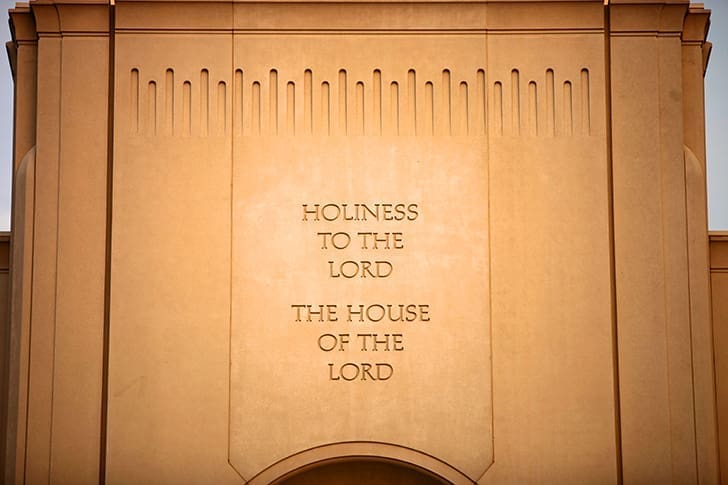
In a world that is steadily growing darker and more tumultuous. The Lord’s voice speaks to the tumult and says in Leviticus chapter 19 verse two, “Ye shall be holy, for I the Lord your God am holy.” That’s quite a commandment for his Children in a fallen world. But we know that the Lord knows how to do His work and he wants His people to be holy.
Scot
Welcome to Meridian Magazine’s Come, Follow Me podcast, we are Scot and Maurine Proctor and we are delighted to be with you again this week as we discuss Exodus, chapters 35 to 40 and Leviticus chapters 1, 4, 16, and 19.
Today, we are going to have the immense privilege of listening to an interview that we did four years ago with Brother Tad R. Callister, who left us in October 2025. Since these chapters in the Old Testament that we are studying are particularly on the atonement, he was the perfect choice for this interview. His book The Infinite Atonement has become a beloved classic. He has also written a number of other books including The Blueprint of Christ’s Church, A Case for the Book of Mormon, America’s Choice: A Nation Under God or Without God, and Teaching with Power.
Let’s join this earlier podcast from 2022.
—
Brother Callister, welcome to this podcast. We’re so honored to have you with us.
Brother Callister
And it’s an honor for me to be with the two of you, that are such scholars and have done so much good for building the kingdom. Thank you.
Scot
Now, some of these lessons in the Old Testament are harder than others, and the reading in this week’s assignment may have seemed like one of those. But we have found over the years in our studies of the Old Testament, that if you’re looking for Jesus Christ and His atoning sacrifice in all that you read, and the covenants which bind us to him; then our minds begin to open up more than ever before.
Brother Callister, you quote Elder Bruce R McConkie in the first part of The Infinite Atonement and I want you to comment on that quote, which is this:
Now, the atonement of Christ is the most basic and fundamental doctrine of the gospel, and it is the least understood of all our revealed truths.
Many of us have a superficial knowledge and rely upon the Lord and his goodness to see us through the trials and perils of life.
But if we are to have faith like Enoch and Elijah we must believe what they believed, know what they knew, and live as they lived.[1]
What does that mean for us in our studies of the Old Testament?
Brother Callister
Well, thank you for that question. I think the doctrine of the atonement is like a 1,000-piece jigsaw puzzle, and many of those pieces are put in the Book of Mormon. But some very key pieces to that atonement come from our understanding of the atonement as taught in the Old Testament.
For example, we first learn about the fall of Adam in the Old Testament and then it makes this very significant statement in Genesis 3:22, “and the Lord God said, behold, the man has become as one of us,” meaning that because of the fall and the subsequent atonement,
We now have the opportunity to become like God and then we have in the Old Testament, of course, the great story of Abraham and Isaac. And without that we might never learn of the depth of the Father’s love and the sacrifice He made in connection with the atonement as we parallel that with Abraham’s sacrifice.
We learn about Joseph, who was a symbol of the deliverer, who delivered the people from physical hunger, just as the Savior delivers us from spiritual hunger or famine.
We learn much about symbolism that hopefully we’ll talk about more, about the temple and those ordinances, and how they apply to the atonement. And then we learn some beautiful insights from Isaiah, who tells us, “though your sins be as scarlet, they shall be white as snow”, in Isaiah 1:18. It helps people know that no matter what the degree of sin, it can be cleansed.
To me, perhaps the most beautiful scripture on the atonement, is in Isaiah 61, where he says that he will give unto us beauty for ashes; that even though our life may be in ashes, completely destroyed, He can not only restore it, He can make it beautiful once again.
And I think from the Old Testament, we learn about what the word atonement means. We learn about the symbolism of the atonement, and we learn how the ordinances and covenants relate to the atonement of Jesus Christ and help us become holy.
Maurine
In fact, I think it’s interesting about the number of times that atonement is mentioned in the Old Testament versus the New Testament. Can you tell us a little bit about that?
Brother Callister
Well, I haven’t counted the number of times, but it is numerous times in the Old Testament.
It’s once in the New Testament. And the actual word English word atonement means to be “at one ment.” It means to be not only at one with God, but also at one like God and I think the celestial room of the temple reminds us that we can become at one with God.
But when we go into the sealing room and are sealed to our spouses, it reminds us that there because of that ordinance we can become at one like God. And that’s why the 132nd section of the Doctrine and Covenants, verse 20 says, if we honor those covenants, then we shall be as gods. Why? Because we have all power and the angels themselves are subject unto us.
Maurine
So, with this group of Children of Israel, that the Lord is taking through the wilderness to a promised land, He intends to create a holy nation. But what is holiness? What does that mean? I can comprehend it somewhat, at least when we’re talking about God, I can understand that He is holy, but it’s when I think about God making us holy, that it becomes more difficult to understand. Can you help us understand what it would mean to be a holy person or part of a holy nation?
Brother Callister
Every time we acquire an attribute of Godliness, we become holy. And it’s interesting that one of the names for God is Man of Holiness. And the whole purpose of the Plan of Salvation is not just to return to God’s presence, but our Church teaches it has another purpose. It is not only to return to His presence, but become like Him. Then Lehi tells us the reason it’s to become like Him, is so that we might have a fullness of joy; “man is that he might have joy” in 2 Nephi 2:25.
And I think in the Sermon on the Mount, the culmination really, the high point of the Sermon on the Mount is when the Savior says, “be ye therefore perfect even as your Father, which is in heaven is perfect,” meaning being holy like him. And some people, not of our faith, believe that the word “be ye therefore perfect” in that phrase really means to be complete or mature.
But even if you substitute those words, complete or mature for perfect, you have to finish the rest of the phrase that says, be therefore complete or mature, even as your Father, which is in heaven is perfect.
And if you can become perfect like him in one attribute, why not perfect like him in all attributes?
In fact, to show how complete the Lord wants us, to become perfect, in Ephesians 4:12-13, He talks about the purpose of the church and He says, “for the perfecting of the saints”, and then He goes on to say, ‘what degree of perfection are we talking about?’
He says, “unto a perfect man, unto the measure of the stature of the fullness of Christ.” In other words, that’s the standard for perfection for holiness. And that’s why Paul says in Philippians 3:14-15, he said,
“I press toward the mark for the prize of the high calling of God in Christ Jesus.”
That’s what I’m striving for is the prize of Godhood or perfect holiness. And then he says,
Let us therefore, as many as be perfect, be thus minded.
Let’s all have that goal to be perfect like God, or holy like the Man of Holiness. That’s what holiness means, is to be perfect as God is perfect.
Maurine
What’s interesting to me about that is, try as I may, I have noticed that life as a perfected being is not a “do it yourself” project. This is something that the Savior carries for us, because I can hardly imagine being a holy person based on my own efforts, right? It’s just impossible.
We’re talking about the Savior’s atonement working in us, and on us, and with us, and I love this incredible gift because I can’t even imagine how to do the slightest thing well and whole, let alone become holy as the Lord is holy.
Brother Callister
I think you bring up a very good point, that sometimes we focus on the Savior’s Atonement is to redeem us from sin and redeem us from death. We forget the other half of the Atonement, that is to perfect us. It’s not just to cleanse us, but to perfect us. The Lord’s enabling powers of the atonement are unleashed in multiple ways.
One is through the ordinances, which of course are symbolic of the atonement, because it is the power of the atonement that gives them power. And also through the spiritual gifts. Every time we acquire a gift of the spirit, we acquire an attribute of Godliness. Fortunately, the atonement is not only a redeeming power, but an enabling power that does what you just said, helps us overcome our mortal shortcomings, and become more like God.
Scot
I think we see this in this week’s readings and also last week’s readings. At the end of Exodus 34, we saw that when Moses came down from the mount, I don’t think he even realized—In fact, it says he “wist” not; it means he didn’t know that he was. His face was full of light. We see that Moses had been in the Lord’s presence, and his face began to be full of this luster of light; so bright that the people couldn’t look upon him, he had to veil his face. Now, we can look at that as a once-in-a-lifetime experience, or once in the scriptures experience, but it’s actually in a number of places.
I was especially interested in the fact that in the early days of the church, the prophet Joseph Smith often had that same experience, where his face became bright or full of light. We have some of those accounts. It might be worth us going through two or three of those. As we look at one of them that I’m especially impressed with, Wilford Woodruff said His face–Joseph’s face—was clear as amber; the room was filled with consuming fire. And Philo Dibble said Joseph seemed to be dressed in an element of glorious white, and his face shone as if it were transparent.
And Lorenzo Snow said at times, Joseph was filled with the Holy Ghost, speaking as with the voice of an archangel and filled with the power of God. His whole person shown and his face was lightened until it appeared as the whiteness of the driven snow.
Now, those are just fascinating to me because we see that Moses-like experience.
Brother Callister
Well, if I could just comment on that. I think we’ve highlighted Moses’ experience and Joseph Smith’s experience, but I think we see many people in our own lives that just radiate light and goodness. We don’t have to come down from Mount Sinai to radiate light and goodness. I think we see so many people within the Church and without the Church who do good deeds, who have pure thoughts and they just radiate a light and a countenance.
And sometimes you just say to yourself, or I say to myself, “wow, that person just radiates goodness. That person radiates light.” I think every time we take a step towards holiness, there’s a light that shines from us that we can see not only with our natural eyes, but with our spiritual eyes.
And so, I think Moses and Joseph Smith reached the pinnacle, but we see many people who are taking steps along the way to get there. In fact, the two of you radiate light as I’m seeing it on the video. I know people are hearing an audio but your smiles radiate light and as you’re smiling right now–that radiates a light and goodness to me.
Scot
I have to just make one other comment or read one other account that Truman Madsen gave. I love this because it brings this closer to us. This is again from Dr. Truman G. Madsen.
“I will give you an example, recently my phone rang and President McKay said, come in.”
(This is actually talking about Hugh B. Brown.)
“So, I left my office and went into his. ‘President Brown,’ he said, ‘I’ve been searching for a counselor.’”
(And this is after the death of President Henry D. Moyle.)
“‘I have been praying, but I have not received an answer. I’m going over to the temple. I’m going to that sacred room and I’m going to get my answer.” My inference was that he wanted President Brown to pray for him, but he did not say that specifically.
President Brown continued, “Sometime later, my phone rang again. President McKay said, ‘Come in’. I went to the door and it was partly ajar and I could see him sitting behind his desk.”
Then President Brown said, “You know that when Moses descended from the mount his face shone and he wist not, which is to say, he did not know that it shown? I saw that on the face of David O McKay when I sat down. He said, ‘President Brown, it has been made known to me in as clear a manner as anything I’ve ever received of the Lord, that Nathan Eldon Tanner is to enter the first presidency. What do you know of him?’”
But I think that’s exciting because there was President McKay, full of light, and of course all of us who knew President McKay, I seemed to see that every time I saw him. He just seemed like a prophet’s prophet; that shock of white hair. But his face just always seemed to glow. But we see that in all the prophets, it is an amazing experience.
Brother Callister
Well, we do see all the prophets, and on one occasion President Kimball put his arms around my father and said “Reid, I love you.” And I remember my dad saying to me, “Tad, I would do anything for that man.”
And I think that’s how we feel about the Savior as we get to know him and we feel His embrace around us. We hopefully say, ‘I would do anything for the Savior’ and hopefully cheerfully so
Maurine
Well, you know, even light shines from the BYU students who are studying at the BYU Jerusalem Center there because when we’re walking through the Old City, my goodness, you can spot those kids all the way down the path. They just show up with their goodness. It is really interesting that the Spirit does begin to fill you in a different way.
So, Brother Callister, the Lord’s going to take this massive camp of Israel and help them become a holy people and He uses some very specific vehicles to do that. Can you talk about those?
Brother Callister
Well, it is interesting in Exodus 35 at the very beginning, the Lord tells them that they need to keep the Sabbath day holy. And I think that was a means; the important point was not just keeping the Sabbath day holy. The important point was, if we keep the Sabbath day holy, it will help make us holy.
Then in these scriptures, we go on to read about the temple, that the temple is a holy place, but the important part is not just that it’s a holy place, it’s a vehicle or means to help make us holy.
Then we read in these chapters that the Lord has ordinances and the ordinances are designed to unleash power to help make us holy. It talks about covenants throughout all of the Old Testament, particularly in these chapters as well; that is we make covenants, they help make us holy.
Sometimes I like to use the example of—suppose you were to track meet and you’re watching the high jump, and all of the sudden you realize that there’s no high jump pit. The official says to the high jumpers, ‘just go out there and jump your highest and we’ll have a laser gun that will measure it’. If you were a high jumper, you would say, ‘what is he talking about?’
We know that that bar extracts from you every last bit of spiritual energy and strength you have. Covenants are like spiritual bars; they extract from us every last bit of spiritual energy and we have and stretch us to our limits so that we might make that pathway back to God.
All of those are vehicles that we read about in the Old Testament to help us become holy.
Scot
Well, I love that, that gives us something to hold onto. Sometimes—I would hope that we don’t do this—but I think sometimes, the Sabbath is taken lightly as that vehicle. We think that once we’ve been to our block of meetings on Sunday, then we can do whatever we want.
But I loved what Isaiah says in Isaiah 58. He says if you will not do the things that you normally do, if you would put away the things that are your other six days activities, and call the Sabbath a delight, then it really does become that vehicle for making us holy.
I love how you said the temple, the sabbath, the covenants, they all are vehicles to make us holy.
Brother Callister
I think one of the things I can say is that the Lord gave a very simple principle for the Sabbath Day, He said to keep it holy. To me that shows God’s trust in us, that He didn’t have to give a list of all the rules on the Sabbath Day to people who had the Gospel of Jesus Christ.
Unfortunately, people who couldn’t live that principle to keep it holy, he had to start giving rules. So, we see the mosaic law develop into 613 rules and commandments, many of which applied to the Sabbath Day. But when we get to the New Testament and the law of Moses is superseded by the law of Christ, we see one principle; keep the Sabbath Day holy.
I used to have missionaries in the mission field that would say to me, “Well, can I do this on preparation day or can I do this?”
I would say, “what’s the purpose of preparation day?”
“Well,” they say, “it’s to prepare you physically and spiritually and intellectually for the rest of the week.”
I said, “if this activity does that, go ahead.” I said, “we don’t have to have a list of all the things you can do and can’t do on preparation day. The goal or principle is; do those things that will prepare you to teach the gospel effectively, the rest of the week.” Hopefully as parents, we can teach our children the principle; “Does this show, if you want to watch it on TV, keep us holy? Does it make us more like the Savior?” And if it does, do it.
If it doesn’t, then you need to back up to the law of Moses and have a few rules until they’re mature enough to live the principle.
Scot
Let’s focus just for a moment again on this camp of Israel. They are there in the wilderness and the Lord gives this commandment to Moses to build a Tabernacle, which is really this temple in the wilderness. We learn an interesting thing from Don Parry; he says,
“The prophet Joseph restored the temple as a Jesus Christ-focused institution. The importance and significance of sacred space; the concept of gradational sacred space; a large receptacle of water, situated on the backs of 12 oxen; the temple as the Lord’s house; moral qualities for temple entrance; gestures of approach and much more.
“President Russell M. Nelson taught Adam and Eve, Noah and his wife, Abraham and Sarah, Lehi and Sariah, and all other devoted disciples of Jesus Christ, since the world was created, have made the same covenants with God. They have received the same ordinances that we, as members of the Lord’s restored Church today have made; those covenants that we receive at baptism and in the temple.”
So, here the Lord has perhaps 1 to 2 million people who are there in the wilderness and He places in their midst this Tabernacle. Let’s talk about that for just a moment and how that brings us and brings them to holiness.
Brother Callister
Well, of course, the Tabernacle was a form of temple; prototype of our temples today. It had gradations of holiness and had the outer court where the sacrifices took place, which were symbolic of the atonement of the Savior. It had the laver that was to wash us and make us clean or holy. The vestments as you would go see, the drapes, the carpets were–their colors were interesting–were blue and purple and scarlet. They’re mentioned 14 times in these chapters. Those colors symbolic of the blue or heavenly approval; the purple or the royalty of Jesus Christ as our king, and the scarlet, of course, symbolic of the blood that He would shed.
Then we go into the Tabernacle and there’s the holy place. And then you go to the most holy of all places, symbolic of the gradations of leaving the world, coming closer to God, and ultimately entering into His presence and becoming like Him.
So, the temple has these gradations of holiness. It has these ordinances that are designed to help us remember the Savior and become like Him. Covenants that lift us up to become like Him and symbolism to remind us that the atonement of Jesus Christ is what makes this all possible, to become like our Father in Heaven and our Savior, Jesus Christ.
Maurine
So, you’re suggesting that everything, of course, about temples, but also about that Tabernacle in the wilderness was about the atonement. Is that what I’m hearing?
Brother Callister
I think the whole focus of the temple and the Sabbath day, and the ordinances and the covenants, is Jesus Christ, recognizing that He’s the means and the vehicle that makes it possible for us to become like Him and truly achieve holiness, like the Man of Holiness that we honor and worship.
Scot
Let’s look at some of the parallels between the ancient and modern temple or Tabernacle, because we too have these temples in our midst. We kind of forget sometimes when the pioneers came out here to the west—and I say “out here” because we live in Utah—but when they came to the west, and they came into the valley, within a very short time, Brigham Young put his cane in the sand and he said, “Here we will build a temple to our God.” That would become the center place of the Salt Lake Valley.
Now it’s not the geographical physical center of the valley, but all the addresses–those of you who do not live in Salt Lake or do not understand the address system of Salt Lake–every address in the Salt Lake Valley ties itself to the temple. If you’re on 16th east and 94th south, that means you’re 16 blocks east of the temple, and 94 blocks south of the temple.
The temple really was meant to be the center of our lives, and in the time of the Children of Israel, the Tabernacle was placed in their midst and the tribes were to have their tents around the Tabernacle, and to face the Tabernacle. Just as we see in King Benjamin’s speech in Mosiah chapters two through five, we see that they all placed their tents around the temple with their entrances facing to the temple. And that’s also a type that we should keep our lives facing towards the temple. But let’s look at some of these parallels between the Tabernacle in ancient times and the temple in our time.
Well, even in early times, there were moral qualities for entrance to the temple. We had to be recommended to go into the Tabernacle or into the temple. You had to be clean to be able to enter the temple.
Brother Callister
It was also interesting that you said that the Tabernacle was in the midst of the people, just as the temple today is in the midst of the people, but also it’s interesting in the Garden of Eden, what it says about the Tree of Knowledge of Good and Evil. It was “in the midst” of the garden. So, the Lord has these focal points that are important for the people to look upon and hopefully it will cause them to want to make changes in their life to become more like God.
Maurine
Another thing that’s very much in common with this ancient Tabernacle and our temples is the idea of Holiness to the Lord, which was written in Hebrew on the High Priest’s crown and we know it’s written on the exterior of every temple that we build, “Holiness to the Lord, the House of the Lord.”
It reminds us again that it is only the pure; those who have been cleansed, who can enter. The Lord is about making us pure by entering and participating in this experience.
I also think it’s really interesting that the Holy of Holies was also in the Temple of Solomon, and the priest could only go in there one time a year on the day of Atonement, Yom Kippur. And if he should die in there, they always had a rope around his ankle to pull him back out because nobody could enter that sacred space, without fearing for their life, because it was so sacred.
There was every sense that this was a growing and growing sacred place as you got further and further in.
Scot
I was especially struck by this Holiness to the Lord. Of course, we see it as you mentioned, Maurine, written on the temples, and the House of the Lord. But when we were at the dedication of the San Antonio temple, I remember specifically because there was an angle I could get with my camera, where I could see it written three times and I could capture that in the picture; Holiness to the Lord, Holiness to the Lord, Holiness to the Lord. I thought, what a great reminder as we’re going into the temple, that that is the focus of our minds and hearts.
Brother Callister
I think it’s also an interesting parallel that when the Tabernacle was finished, it tells us that the glory of the Lord filled the Tabernacle. We remember that happening very dramatically in the Kirtland temple, as the Lord’s signifying that this house was now acceptable to Him and a holy place as He designed it to be.
Scot
I do want to quote that, Brother Callister, specifically. It’s so very pointed in Exodus 40:34:
“Then a cloud covered the tent of the congregation, and the glory of the Lord filled the Tabernacle.”
And that really is like that Kirtland experience you just referred to.
Maurine
I also love that in the Old Testament, the Hebrew word kpr “k p r,” which really in our language means, “covering,” appears about 80 times associated with the Tabernacle and the temple. And that again, is a direct response to the atonement as a covering of our sins; a covering of our fragility, a covering of our vulnerability, and our sins. It’s like the Lord embraces us and takes us into His arms.
That’s a beautiful image we see all the time in the Book of Mormon. So, there it is right in these verses, reminding us again that this is all about the atonement.
Brother Callister
And I think as you talk about the necessity of reminding us about the atonement, President Kimball said perhaps the most important word in the scriptures is remember; to remember the Savior.
It’s interesting, of course, to the ordinance of sacrifice, it focuses on the atonement. The ordinance of baptism focuses on the death, burial, and resurrection of Jesus Christ; the atonement. The sacrament focuses on the bread for his flesh and the water for his blood. And, of course the temple; the ordinances, the tokens, the covenants, the rooms, and the ultimate ability to enter into the presence of God in the celestial kingdom and feel His glory, are all designed to focus on the atonement of Jesus Christ.
That’s perhaps why in Leviticus 19, 16 times, in that one chapter, it says, in essence, I am the Lord thy God. In other words, the priority in your life is God. It’s not our hobbies, it’s not our interests, it’s not our sports, it’s not our locations, that above everything else in life, our priority is God. If He is our priority, and if He is our focus, and we remember Him, then I think naturally we become like Him. And He’s given us all these vehicles to help us in that process.
Maurine
What a kindness to remind us in so many ways about Him, because we are very critical of the Children of Israel, we say, “Oh my goodness, how could they forget they’ve seen so many miracles?” They’ve seen the presence of God in this Tabernacle in the wilderness. Why do they complain and moan and are such a burden to Moses and to the Lord, because they just cannot fully engage themselves in this task to become holy. And yet, we’re so much the same.
There’s so much else that grabs our attention in this life, and it really is a kindness of the Lord to have Him help us put Him first because we need it. There’s something about mortality that distracts us and ‘prone to wander, Lord, I feel it.’ And I love that He helps us by reminding us.
Brother Callister
I think it’s helpful to us to know that there are people, mortals, not just the Savior, but mortals who became holy. The whole city of Enoch became holy. The people of Melchizedek became holy. The people at the time that the Savior came to the Nephites became a holy people. It tells us “not one was lost”. That phrase resonates with me with my own family. We want not one to be lost.
Then the Book of Mormon tells us that there were many holy men, and I’m sure women, who came among them. So, we have examples of mortals who have become holy that can give us hope that we too can become holy. It’s not just reserved for the Savior and our Father in Heaven.
Scot
It gives me hope that in the 93rd section, it says “the Lord did not receive a fullness at the first, but it was line upon line and precept upon precept that he received that fullness.” And so it is for us.
It really does give me hope, a perfect brightness of hope that I can, over time, by and by, teaching upon teaching, lesson upon lesson, temple attendance upon temple attendance, scripture reading upon scripture reading, service upon service, little by little, over time, I can receive a fullness, And I’m certainly not even close, but I do have hope that, someday, through his atoning sacrifice, I can become like him. That really is a powerful teaching in the restored Gospel of Jesus Christ.
We’ve talked about all these wonderful things in this week’s reading. We’ve seen how the Lord places this Tabernacle in the midst of His people in this wilderness place. We’ve talked about the importance of keeping the Sabbath Day holy, and how that will be an instrument to help make us holy. We’ve talked about covenants. I guess in conclusion, Brother Callister, we’d love to know how you feel about the atonement and what the atonement really means to you personally.
Brother Callister
Well, thank you for that. And it caused me to reflect upon the last week of the Savior’s life and He knew what a tough life it would be, a week. You knew that Judas would betray him. He knew that Peter would deny knowing him on three occasions. He knew that He would be rejected, would be spit upon. He would be reviled. He would have the moments in the Garden of Gethsemane, He would have the cross, He knew all of that.
And yet he could say in John 16:33, “in the world ye shall have tribulation, but be of good cheer, I have overcome the world.” To me that means that once the atonement was performed, he put us in the driver’s seat as to our exaltation. Once the atonement was performed, there’s no external event–there’s no divorce, there’s no loss of life, there’s no loss of job, there’s no depression, there’s no illness, that can prevent you from returning to God and becoming like Him, because of the atonement of Jesus Christ. And I’m so grateful to Him that He loved us enough that He made that possible.
But I hope also, I don’t forget our Father in Heaven in all of this. And you think, as Abraham raised the knife to plunge it, who is making the greater sacrifice, Isaac? Or Abraham? What father would not take the place of his son if he could?
But our Father in Heaven couldn’t take the place of his Son and that’s why He said, “for God so loved the world, He gave his only begotten Son” and I’m grateful for that love of a Father and a Son that made exaltation possible for each of us.
Maurine
This was a podcast worth remembering and we remember Tad Callister for his enduring love of the Savior’s gift to us.
Next week we’ll be studying Numbers chapters 11 through 14 and 23 through 24, in a lesson entitled, “Rebel Not Ye Against the Lord, Neither Fear.” As always, thanks to Jenny Oaks Baker for the music that accompanies this podcast and thanks to our producer, Michaela Proctor Hutchins.
Have a wonderful week and see you next time.
“Come, Thou Fount of Every Blessing” Performed by Jenny Oaks Baker. Used with permission © 2003 Shadow Mountain Records
“What Is Required to See the Face of God?”—Come Follow Me Podcast: Exodus 19-20, 24, 31-34

Scot
Welcome to Meridian Magazine‘s Come Follow Me podcast. We’re Scot and Maurine Proctor, and we’re thrilled to be with you again this week as we discuss Exodus chapters 19-20, 24, and 31-34, a very important and wonderful part of the Old Testament.
Now, as you’ve been seeing, we have some special guests that we have invited to be with us in these podcasts, and we welcome another one this week that we think you’ll be very excited to have join us.
Maurine
Kerry Muhlestein is one of our favorites, because we love his books so much. He’s written many, but we have favorites. We love, Let God Prevail, which is all about the covenant in the Old Testament and, of course, his prolific work on the Book of Abraham. He is an Egyptologist, a professor at BYU, but most of all, we are impressed with his passion to make what people consider the hard things of the Old Testament easier. So, welcome, Kerry. We’re so glad you’re with us.
Scot
Now, Kerry, I have a question for you. The Lord says an interesting thing in the first part of chapter 19. He says you’ve seen what I did to the Egyptians, and how I bear you on eagle’s wings and brought you unto myself. Do you have any thoughts about this bear you on eagle’s wings, because Isaiah uses that same kind of language later, and I just, I love that concept.
Kerry
I love the phrase, and it does seem like Isaiah is intentionally borrowing from it here and they’re both just drawing on imagery that is fantastic. So, the Lord is saying, look what I’ve done to the Egyptians, and he has specifically set up things, I believe, in terms of the plagues, and the deliverance from Egypt to demonstrate to Israel, Egypt, and all the world, that He, was the one who was really God, not Pharaoh, not Pharaoh’s god, not anyone else. God is God, and he’s the deliverer.
He’s the one with power and that message seems to have been received loud and clearer by the Israelites, although they will forget from time to time. So he’s reminding them of that, and he’s going to remind them frequently because they do forget. But he also wants to do it in a way that they understand, because of this covenant relationship that they have, that the way he has taken care of them, he will continue to take care of them. So this phrase is beautiful, but what more could you want than if you’re going to go across this terrible desert, then to be carried on eagles’ wings? Right? It’s just a beautiful phrase.
This notion, the idea of the deliverance, will become the thing that God and his prophets remind Israel of again and again and again. Whenever they doubt, whenever they’re wondering, whenever they’re kind of wavering, He says, remember how I delivered you in Egypt, and it becomes the symbol of deliverance par excellence.
Maurine
Then I think it’s really interesting that He says, very specifically, what He wants to do with Israel. He wants to make a covenant with them and make them to be a peculiar treasure. So, this God of high expectations, also, is a God who has the power to make us new people. What is he about here? And what is the Lord thinking that he can accomplish through this covenant in this instance?
Kerry
That’s a great question. I talked quite a bit about this in my book, Let God Prevail, but the idea is that really the purpose of the covenant is to help us become transformed, as you said, to become the kind of people that are capable of a closer relationship with God. The ultimate expression of that will be for us to become Christlike or godly, so that we can have a full communion with him.
But, of course, there will be steps along the way; we don’t become Christ like overnight. That’s really the purpose of the covenant is to change us, to give us access to the transformative power of Christ’s atoning sacrifice so that we can be changed.
As we even start into that, just initially, when we enter into the covenant with it, and that could be Israel, at Mount Sinai, or us, at the baptismal font, immediately, there are changes that come, and that will make us, as you said, that the phrase is in verse 5, you then you shall be a peculiar treasure unto me above all people, for all the earth is mine.
Now this Hebrew word segulah, here means that it’s something that is valuable because it’s rare. So that’s why we put the peculiar in the treasure in there. In terms of commodities, that’s what determines something’s worth: the more rare it is, the more value it has, right?
That’s what God is trying to say, really, is that he wants us to be different than everyone else. We’re not supposed to be the same as the world, and yet we have this desire to fit in. We have this desire to be like everyone else. It’s kind of fun watching teenagers, because they both want to be individual and unique, and be like everybody else at the same time.
I say it about teenagers, but it turns out to be true of all of us in many ways, and God is telling us, no, don’t be worldly. Don’t be like the world. I want you to be like me. I want you to be godly. That’s going to happen in two ways. One. I’m giving you a set of ways to act, a set of commandments. That’s the primary obligation under the laws, to keep the commandments, first commandment, and love God, and so on. So that’s the way that we need to act, but the covenant itself gives us access to the transformative power of Christ that will change who we are. So both of those things come together, to change who we are, and thus we are more godly, less worldly, which makes us a peculiar treasure different than everyone else, and more godly, so that we become so precious in God’s sight, because the relationship is heightened, and in some ways, that sums up what the covenant is all about in a nutshell, this idea that we become a peculiar treasure to God.
Scot
Now, Kerry, we’ve all been to the Sinai a number of times, and I’m sure have hiked the mount, the traditional mount Sinai. Why would God bring his people into such difficult circumstances, and then have them camp before this mountain? Then Moses goes up, and there’s all of this fire and smoke, and Moses is meeting with God face to face, as one friend meets with another. What is this for us now, that we come to this mountain? Is this the temple? What’s going on here? Tell us more, and bring us to Sinai, because you’ve been there many times.
Kerry
I think so, and I don’t know. I think there’s a decent chance that the traditional site is the right spot, but if not, it’s got to be something somewhat similar, right? I think it’s absolutely a temple setting. The symbolism is the same.
In fact, the temples are really recreations of holy mountains. Typologically, the temple is a holy mountain. Maybe instead of us saying that Mount Sinai is a temple, we can say temples are Mount Sinai, but what it is, is it brings Israel away from the world, away from everything else. I think it’s intentional, that it’s not an easy path. It’s not a place where they can survive on their own. They have to rely on God to survive here. That’s part of the purpose because in the end, if we’re going to be exalted, well have to rely on God. It’s not terrain we can traverse on our own. It’s not a journey we can survive on our own. And so what’s happening, physically, literally, is also a symbolic journey, and that’s the beauty of the Old Testament is that there are so many things that happen literally, but they’re always symbolic, and sometimes I don’t know if it’s literal or not, but it’s always symbolic.
They’re being brought out of the world, learning to rely only on God, so that they can come to this place where the symbolism of temples, steeples, mountains, altars all of this, is that if the world is the flat thing down below and heaven is up above, then it’s something that will connect you. A mountain connects you with heaven, a steeple does an altar does. It’s that symbolic connection with God.
They come to this mountain that can raise them up closer to being with God, and God wants to come down. That’s the fantastic symbolism. For example, in Egyptian temples, as you get further and further in the temple and closer and closer to the holiest space, you keep ascending up, but the ceiling keeps coming down. By the time you get to the holy place where the statue of the God was, there’s not a lot of room between the floor and the ceiling. You’ve come towards God. He’s come down to you.
That’s what’s happening at Mount Sinai, is that Israel has come up, relying on God through the wilderness, out of the world, and God is going to come down to Sinai, and He wants for everyone to see Him. His goal is for everyone in Israel to come to see Him and be in his presence face to face. That’s what he wants and that’s what he promises He can make happen, that they can see him.
To begin with, to come into his presence, they have to prepare. Right? They are told to wash themselves. They set a boundary so they don’t come into the sacred place before they’re ready. They do all these things to try and prepare themselves.
In the meantime, they can see that God is preparing himself to come down. There’s light and thunder and all sorts of stuff up on the mountain. They’re all getting ready for this actual meeting, but then they don’t go through with. The sad tragedy of the Sinai experience is that Israel has this opportunity, and then they choose not to do it.
Maurine
The idea of the peculiar people is really part of the covenant notion, but it is difficult for some people to hear that in a world we live in that talks about equality for all, and should there be some who have a closer relationship with God? You want to discuss that a little bit?
Kerry
That’s really worth thinking about because really, it is equality. Remember that part of the obligation of the covenant is to carry the covenant to everyone else? You don’t get that in the Old Testament. You have to read the book of Abraham to get that aspect of it. I think that Satan was successful in getting it taken out. But that’s part of the covenant that we share with everyone. Part of the purpose of the House of Israel, is that we need to take the covenant to the entire world.
President Nelson has been fairly emphatic about that and it’s not just to the entire world on this side of the veil. It’s to everyone who’s ever been on the world on either side of the veil, right? Everyone is not only invited, but encouraged, begged, and pled with to be part of this covenant. God wants to have a closer relationship with all of his children. You have to self select it out of it.
Anyone can be part of the House of Israel. Now, it doesn’t turn out that way practically in this story because sometimes the Israelites forgot that that’s how it was supposed to happen. They became fairly elitist at times and non-inclusive. They lost sight of that, but what it’s supposed to be is that everyone can be part of the covenant. You only aren’t, if you choose not to be, because we’re trying to get you to be.
I think that’s worth thinking about, that God wants, first of all, to have all of Israel come into His presence and then He’s going to send them out to get everybody else to join the covenant and come into His presence. He’s delegating. He’s going to have Moses send out some people, and then they’ll send out other people, and they’ll send out other people, the way Christ does with His apostles. They send out people, (they are the 70) and they get sent forth, and we’re seeing the same thing happening today. In the end, everyone is invited to come. The question is whether you will come or not.
In this story, even Israel chose to not fully come. They hear this lightning and the thunder, and sometimes we miss this because you have to read this version in Deuteronomy chapter 5, but it becomes clear that they all hear God giving the Ten Commandments. This isn’t just Moses. Everyone hears God’s voice.
They know who’s up there; they know what’s going on. God teaches them to get ready for this, but at the end, we see in Exodus chapter 20, verse 19, well, let’s go to verse 18 first, “And all the people saw the thunderings, and the lightnings, and the noise of the trumpet, and the mountain smoking, and when the people saw it, they removed and stood afar off.”
It’s overwhelming to them. This is scary, too. And they said to Moses, “Speak with us, and we will hear, but let not God speak with us, lest we die.” You see their fear, and to me, there’s something really profound and instructive about this. Their fear is that they can’t come into God’s presence and survive. Now, that’s a reasonable fear, because if God doesn’t change your nature, that ends up being true. You can’t survive God’s presence in your fallen, sinful state. It just isn’t going to happen.
But God has told them that he will bring them into his presence. So what you have to do is believe that God has the ability and the desire to change you, to transform you, so you can come to His presence, and then step forward in faith, knowing that as you start to step forward, you’re not worthy, but believing that as you finish that step, God will change you and save you. Israel is too full of fear and not full of faith enough to make the step, to make the change or to trust that God will change them.
They say instead, Moses, you go talk with God, we’ll stay back here, you be the intermediary. Joseph Smith teaches us that this is the reason that they get the lower law. I think that the golden calf has something to do with it, but this is the primary reason that they get the lower law, because they refused to come to God’s presence when God invited them to come.
I think it has to do with this lack of trust in the transforming power of Christ, and his atoning sacrifice, which is something that we still struggle with mightily today in modern Israel. We see our own flaws, we see how good everyone else is. We see how good God is, and whatever else. We believe that God can save other people, but when we look at our own shortcomings, our own lack of perfection, then we start to struggle to believe that He can save us and change us and bring us into His presence, which means that we’re not different than our Israelite ancestors. We have the same struggles and the same answer is to trust when he says to them, “Fear not,” which is what he says to them here. Fear not. We just have to reject our fear, give into our faith, and take that step and fall on God.
Scot
You know, as you’re talking, Kerry, it reminds me of the whole setting in the premortal world when there’s this grand council, and God is really trying to see if they will do all things whatsoever he commands them. And he’s going to give them these commandments, which Moses comes down with.
Maurine
Why do you think it’s so hard for us to trust the Lord? Why is that such a difficult journey? Fear and trust seem to be pulling us in both directions simultaneously. We want to trust the Lord, but sometimes that’s difficult.
Kerry
I agree, and I can’t profess to understand all the reasons different people struggle with it, but I think that there are a couple things that are fundamental that we all struggle with. One of them is that we’re very aware of our own shortcomings, right? I know my own faults better than anybody, and I know that not only is it sometimes because I didn’t do as well as I should have, but it’s sometimes because I didn’t want to do well at that moment, right? We know our motives better than anyone else does.
Knowing that, it’s hard to believe that a perfect being would say, it’s okay. I’ve got you covered on that, right? There’s a tone there that means to cover. That’s what he’s saying is, I’ve got you covered.
It’s hard to also hard to believe that someone has the ability to change us when sometimes we’re not working as hard. No one is working as hard as they should at changing themselves, right? Nobody at all. And since we know that about ourselves sometimes, then it’s hard to believe that someone else can and would change us. But that’s what we have to do.
We have to believe it, and that’s part of why God is going to keep reminding them of the Exodus story to say, do you remember when it seemed absolutely impossible that you could come out of Egypt? And do you remember when the largest, most powerful army in the world was coming down on you and it seemed like it was impossible to escape? Then do you remember that I delivered you in ways that you could have never imagined and that seemed impossible? If I could do that, if I could split the Red Sea, breathe fire down to stop the Egyptian army, and bring you through on dry ground, I can change your little old self.
One of the things I like to tell my students is, you’re not a match for the atonement. You may feel like your sins are going to overpower the atonement, but, they’re not. You’re not good enough at sinning to be more powerful than the atonement is. Or I should say than the atoning sacrifice of Christ is, Christ really, really can change us. Sometimes it’s hard to feel, and sometimes it’s hard to believe, but we just have to look at the history as salvation history, we could call it. The history of Him saving, and then we can believe that if He can do that, He can change me.
Scot
I’m thinking about this first commandment that the Lord gives, of the ten. I mean, there’s many other commandments, but of the big ones, apparently, the big ones, thou shalt have no other gods before me. Right before that, he says, “I’m the God who brought you out of Egypt.” So there is some tie to Egypt here. This is the people who’ve been in Egypt for generations. Describe why this is such an important commandment to begin with.
Kerry
It becomes clear from some things Joshua says, and some other things, that Israel has picked up some idolatrous practices while in Egypt. In fact, I’m not sure they’d ever fully gotten rid of them. You know, we have Rachel and Leah coming down from Syria, right? from Laban’s household, where they were idolatrous, and Rachel’s bringing idols with her.
It’s clear they’ve come to worship Jehovah, but I don’t know if they ever fully stopped worshiping other gods and worshiped only Jehovah. When Jacob is told to take his family to Bethel, the first thing he does is, he says, can you please get rid of these gods? We need to get these little gods gone, and they bury them under a tree.
So maybe he’s successful at that point and when they go down to Egypt, there’s no idolatry, but I kind of think that some of his children were probably still struggling with idolatry a little bit. Whether they were or not, it’s pretty clear that in Egypt, where there’s so much idolatry, it’s hard to avoid, right? However much you can think of idolatry, it’s there. There are hundreds and hundreds of gods to choose from. They seem to have picked this up.
So as they’re coming out, God is telling them, you’ve got to get rid of this. And it almost seems to me like he’s taking them where they are, and taking them another step. I’m not sure of this, but it feels like when he says, “don’t have other gods before me,” that this could be taken two ways, and it’s probably intentionally two ways. One way is, right now, you believe in lots of gods. Let’s start with worshiping me and not anyone else. And eventually that becomes worship me because there isn’t anyone else, right?
We know there aren’t really any other gods, but it seems like it’s stated in a way that it can take the Israelites where they are and get them to where they need to be.
Maurine
It seems to me that that is reinforced in the idea that God says he’s a jealous God. What does jealous mean there? I’m struck that the reason God gives this commandment is because no other God or idea of God can possibly save you. No other God or idea of God can possibly transform you. No other God can, because there is no other God, can’t comfort you. This is such a commandment for our well being. not about worshiping me, because I need your attention, or I’m a glory monger, or something like that. God is nothing like that.
He is this God who wants to give us gifts, if we will not worship other gods. And I think that we think we, personally, in our society today, are free of idolatry, because we don’t have little things, little images, in our home that we bow to, but I think that whatever we hold as the most important thing in our life becomes a kind of god to us. So I’m interested in your reflection on that.
Kerry
This is a really important point. So let’s first of all start out with this idea that we are clearly idolatrous today—that there’s no doubt of it. The idols have changed, and for us, only in some ways, right? It’s really still whatever the world is telling us, we should look to. So that’s why the Israelites were turning to Ra or whatever god they were turning to later, it’s Ba’al and so on. It’s because the world is telling them that’s where you should turn and look for value for safety or whatever else. That’s where you should turn.
Today, the world is telling us different things. It’s telling us power and prestige. We have all these social ideas. I think that, actually, the greatest idol that Latter-day Saints ae struggling with today is that they have learned to think about things the way the world has taught them to think about things. So when it comes to social issues, all sorts of other issues, issues of who our identity is, or what’s valuable, and what’s important, we let the world tell us how to think about these things. Then when a prophet says something different, we’re really quite bothered by it. That’s because the world’s way of thinking has become our idol.
I’s interesting what you said, Maurine, about how the reason God wants us to not worship anything else is because nothing else will save us. This takes us all the way back to the idea of the Abrahamic sacrifice. I believe the reason Abraham had to go through an Abraham sacrifice—and the reason all of us will—is because if there is something we love more than God, then we will trust in that more than God and look to it more than God, but nothing else can save us.
I’ve often said, as good as my wife is for me, and she absolutely is, good for me, she makes me a better person. She helps me come to God. As good as she is for me, she can’t save me. I know she’d like to, but we both know she can’t. Only God can save me, and so if I love even my wife more than God, I’m not going to be saved, not because God needs me to love him more, but because whatever I love more, I trust more, and I’ll be trusting in the wrong thing, and I won’t be saved.
So that whole idea of the Abrahamic sacrifice ties into this first commandment. The idea that we love God more than anything else, so we worship God and God only because only God can save us, and you better be ready to jettison everything else, because that’s the only way to be saved.
Scot
I think that this whole idea of this jealous god is interesting, because we always take that as a negative. But, you know, that Hebrew word, isn’t it, is it pronounced Hana? It’s kind of q-a-n-n-a-h, and it means possessing sensitive and deep feelings. You know, I’m a sensitive God. I have deep feelings. I am one who possesses the deepest of feelings for you, and so instead of taking it so negatively that he’s jealous as we kind of have underlined the word jealous and as a negative quality, I think there’s something about this, we can learn that he’s actually a pretty amazing god.
Kerry
I absolutely agree with you, but I would say it has this element in it that we’re letting the world determine how we think, right? So we’re assigning meaning to this that shouldn’t be assigned. I think we could say it this way. God is saying, I love you more than anything else and I want you to love me more than anything else. There’s a reason for that. It’s not because he’s just so in need of love. It’s because if we don’t love Him more than anything else, He can’t save us. But that is what it means. Don’t love something more than me. That causes me and you to have a problem. So it is jealous in those terms, that he doesn’t want us to love something else.
It is also what you’re saying. It comes from this strong and deep love that he has for us, and that he knows we need to have for him if we are going to be safe.
Maurine
It seems to me, like the commandment that says that we should not take the Lord’s name in vain, is also much larger than we sometimes think of it. We think of it as swearing, and it’s much bigger, I think. What would you respond to that?
Kerry
Yes, I would agree. Really, what he’s saying is that don’t take it in emptiness; don’t take it and use my name in a way that has no power or authority behind it. So that means all sorts of things. It’s not just not taking His name in vain. I try and think about who I’m talking about. You’ll find I don’t use the word Jesus very much. I know some people are just throwing it out there all the time, and I’m not saying that that’s wrong. But for me, at least, I’m not going to say that word, that name, without thinking about and trying to feel deeply about it, because I don’t want it to be an emptiness.
I’m also not going to bear testimony without thinking and closing in that name without thinking about what it means. I certainly don’t want to give a prayer or a blessing. unworthily or without that real power behind it. I think it means don’t do this in the way the world does it. Do this with me really behind it.
Maurine
I think it’s really interesting, when we’re in a rush, we get to the end of our prayer, and then just really quickly say, and then rush the closing out quickly. What we should be doing with the prayer is putting Christ’s atonement really upon it, you know? He is the advocate before the Father for us, and we just flip that phrase out without even thinking, and it’s huge phrase. It means so much and is so sacred.
Scot
As we open the first chapter in Exodus 24, it sounds like the Lord wants us to see His face. And as you study the gospel in all of the standard works, there is a common theme that, first of all, God is not far from us, but second, he really, really does want to reveal Himself to us. Now, if our faith is only strong enough that he reveals himself through his Holy Spirit, that’s not a bad thing. I mean, having the Holy Spirit testify of him is about as real as it gets. But interestingly enough, in this Exodus 24, he’s really inviting a visitation like unto the First Vision. Tell us about this setting.
Kerry
And I love what you said, too. I think that the plan is that the initial step, and for most of us, that will probably be the step we spend our lives in. But the initial step is to come into God’s presence by coming into the presence of a member of the Godhead and that’s the Holy Ghost, whose job it is to reveal the Son to us and the Son’s job is to bring us to the Father.
That’s the first step, but God does not want that to be the final step for any of us. He wants us all to actually come back to be with him fully in his presence.
He wanted all of Israel to literally come into his presence. The phrase is often, “ Behold, my face,” or “Come into my face.” That’s the word you use or the way you talk about someone being before you or in front of you. In Hebrew, you should talk about it in front of your face or before your face. But he wants them to come into his presence.
They decide they’re not going to do that. They’re afraid that they can’t survive God’s presence. Joseph Smith teaches us that’s why they get the lower law. As a result, instead what is going to happen is that God is going to say, okay, I still want representatives of Israel to come into my presence. There are some people who believe enough or who have enough faith and are willing enough to come into my presence, so let’s do that. Whoever can, let’s do that. So you’re going to get Aaron and Moses and Nadab and 70 of the elders of Israel. It seems like this is where the idea of a 70 comes from. But 70 of the elders of Israel are all going to come literally and physically into God’s presence and enjoy the blessings that he wanted to give everyone, that eventually he will give everyone who is willing.
Scot
I was thinking, as you were talking, that since you did this book, I Saw the Lord, which is the compilation of the nine accounts of Joseph Smith of the First Vision,” I wondered if you’re working on the 70 accounts of the 70 here. I would love to see that in one nice, big book. Wouldn’t that be wonderful?
Kerry
So would I.
Maurine
But isn’t it interesting how many people in the beginning of this dispensation were able to behold the face of God, with Joseph in the school of the prophets. The meeting in January, before the Kirtland Temple was dedicated. There were incredible outpourings. So, this is not unique. What we’re seeing here, It’s Sinai. We have experienced this in our own restoration.
Kerry
Yes, and it is true that we find often, at the beginning of a dispensation, a greater outpouring of this opportunity, and it seems to be a little bit like we saw in the book of Moses. Adam and Eve have personal experiences with God, and that allows them to testify of God in a way that is important for all of their family after that.
So we have Moses and the 70 being able to testify of that. We have a whole bunch of people at the beginning of our dispensation, and then we can read those accounts and have the spirit bear witness to us of their truth. That is always based on someone’s firsthand experience with God, the witness of God.
Scot, you’ve actually inspired me. I did do an article once on Old Testament accounts of seeing God, but we, it might be worth doing a thing, just doing scriptural accounts of coming into God’s presence and what we can learn from those who do.. Maybe we’ll have to work on that together. That be fun.
Scot
That would be awesome.
Maurine
It’s so interesting that there are all these accounts, of seeing God face to face, and yet in the New Testament, we hear that no one has ever seen God. and lived. And that is an interesting, contrary set of statements.
Kerry
Yes, and of course, Joseph Smith changes that a little bit, right? The idea is, though, exactly what we were talking about, that our nature is so incompatible with God’s nature, that if God does not change our nature, we cannot survive his presence. He is so glorious in comparison with us. But thank goodness, because of the atoning sacrifice of his son, we can, and that you actually see that reflected here at the beginning of chapter 24, if it’s all right if we could jump in and look at a couple of these things, because it is the covenant.
We have been and will talk about the covenant a lot this year. Covenant is extremely important in the Old Testament in all of scripture, and I think President Nelson wants us to realize that. but so this covenant idea is so important, and we’re going to see that covenant is always entered into via sacrifice. That’s how you enter into a covenant. And it’s important. There’s a dual set of symbols there. Because when you sacrifice, you’re giving up something, and I think in the end, what you have to give up is yourself and then, you partake of Christ’s sacrifice. The sacrifices in the temple where you enter into the covenant, our temple or their temple, or the sacrifice we’re reading here.
Mount Sinai is a temple, as we’ve talked about before. It really, truly is a temple. They symbolized both what we sacrifice and are partaking of Christ’s sacrifice. You can see that when we get in chapter 24, verse 3, Moses came and told the people all the words of the Lord, and all the judgments, so that this is the covenant he’s talking about and the people answered with one voice and said, all the words which the Lord has said will we do?
I think that’s the name of the Come Follow Me lesson. “All the words of the Lord we will do.” Moses writes these words and he builds an altar under the hill, 12 pillars, according to the 12 tribes of Israel. This is symbolic of covenant for all of Israel. In verse 5, he sent young men of the children of Israel, which offered burnt offerings and sacrificed peace offerings of oxen unto the Lord.
Now, this is really wonderful. Those are two different kinds of offerings. The burnt offering is something that is wholly consumed by the fire. No one eats anything from that burn offering. It’s all given to the Lord and there’s some great symbolism in there, again, that we have to completely give of ourselves, fully consecrated, and also that Christ fully went through the Atoning sacrifice and was completely consumed in that.
Then we have the peace offerings. Peace offerings are shalom offerings, are offerings that make you whole or full. Those you partake. You eat most of that offering. That is kind of an offering that’s designed for you to eat. What you have is a ritual meal taking place here and that’s wonderful.
There’s some symbolism that runs throughout the ancient Near East and the idea is that as you bring someone into your house, these hospitality laws that we talk about often. When someone comes to you, they become part of your household. The way you signify that is by washing them, washing their feet and so on. You give them something nice and clean to wear and then you feed them. Eating dinner with your family, and we do that right in our day. Have a family dinner with us. That makes you feel like you’re part of our family. You’re really part of the family iwhen you’ve eaten with them.
So here is what, in essence, is God’s house, Mount Sinai. They have a meal with God. He has invited them in. They are now part of His family. I think we see echoes of both elements of this in the sacrament today, where it’s symbolic of Christ’s sacrifice and we partake of that sacrifice, but we’re also having a meal in the Lord’s house, and we’re becoming part of his family—week after week after week, which I think is beautiful stuff.
Maurine
What’s interesting to me about this is that the Israelites say that they will do all that they’re asked—will do it. That’s repeated a couple of times, and I think they fully intended to do it. I think they wanted to do it. But it is interesting that in that process of coming close to the Lord, and keeping your covenants, you mentioned a burnt offering that is utterly consumed. That means that there are weaknesses and inclinations and ways of looking at things that have to die inside of us that have to be utterly consumed. And C.S. Lewis, again, said that it is hard for us to give up our favorite weakness, that our favorite weakness stands in the way of that road back to heaven.
I think that it is interesting that when part of us dies, that is not unpainful. I mean it’s glorious in the end because you are free from a burden you didn’t even know you were carrying. But in the short term, it can be really challenging.
I tell you a quick story. Scot and I were on a cruise with a doctor, and one day at dinner, he said, “Maurine, how’s your health? And I said, “My health is great. I am doing well. Everything is wonderful.” He said, “No you’re not.”
“Oh, really?”
He said, “You have a severe sinus infection, and I think you probably even need surgery.” I said, “Oh”, you know, and he said, “I’ll do the surgery for you if you can come to my house.” And that was two states away, if you can come up to where I operate. In other words. And I’ll do it for free. But you don’t feel well.
First of all, I was amazed that he noticed that I didn’t feel well, and secondly, I really didn’t want to go through surgery, and sinus surgery is very close to your eyes and your brain and I wasn’t sure about it. But finally, it got so that we took him up on that offer, and we went up and had this operation.
He had done 3,000 of these operations. They were supposed to take only a couple of hours, but when I came out four hours later, he said, “You were one at the top three worst cases I’ve ever seen, and your bone had grown very thin on your sinus, to your brain. You were on your way to a brain infection.” So he really saved my life in some ways, and I didn’t even know I was sick. He said, “You’re sick. You need some help,” and I think that’s what the Lord does to us.
We accommodate to being as we are, and we don’t even know that there are parts of us that need to change. So, yes, children of Israel say, we’ll do it, and then they can’t pull it off, because that road can sometimes be humbling and difficult. and freeing in the end.
Kerry
That’s so beautifully said. The sacrifice of ourselves is so absolutely necessary. It’s Lewis, who said, God wants to kill the natural self in us. But that’s painful, you know, these phrases we get, like he’s going to purge us, that doesn’t sound nice. does it? But, it’s what’s necessary, and as you said in the end, is so freeing and beautiful because what it gives us again, C.S. Lewis, is His self. Right? He gets rid of the natural self and gives us himself instead. That’s a beautiful replacement.
Scot
I’m fascinated by the commandment about keeping the Sabbath day holy. We sometimes take it lightly in our times because in this workaday world, it’s just another day for many people. I remember when I was growing up in Rolla, Missouri, there was a little shopping center, the Hillcrest Shopping Center, and I remember this so clearly because they had a shoebox that had a hole cut in the top of it, kind of like one of those Valentine’s boxes, and it was right by what we would now call the service desk. It had a question on it. Should we open on Sundays? We’re taking a poll, and you had to write out your feelings about it and fold it in half and drop it in.
Now, I was, like, maybe seven years old when I noticed this, but I remember it set deep in my soul because I thought, why would they ever open on Sunday? Isn’t Sunday a special day? And within a few weeks after that poll, they opened on Sunday, and because they opened it, Hillcrest Shopping Center, well, A & P had to open as well, and Kroger’s, of course, they’re not going to be staying closed while everyone else is open on Sunday and making money. So Kroger’s opened.
We didn’t have a big town, but it was a university town. We had a sophisticated audience there. All of a sudden, everything changed. I noticed the same thing today. I noticed that, all of a sudden, our mail gets delivered on Sundays. I mean, certain packages. We have FedEx delivery or an Amazon delivery on a Sunday. I think, Why are we not paying attention to this? And why did the Lord set this up, that there was a Sabbath that Israel should keep? And there’s something about it that blesses them, but also tells us about that a little bit.
Kerry
This idea that we need a day where we unplug from worldly things and worldly ideas, and are completely and fully plugged into the things of God. Because the world is clamoring and is loud all the time. And I think even more so in our day than in Moses’s day. There’s so much that’s jumping to get into our ears and in front of our eyes. Just really hammering us to hear more from the world and think more like the world and so on and so on.
As President Nelson pled with us in October 2021 General Conference, please spend a little less time with that, right? Don’t have all your information coming from social media and other sources, he says. And instead, have more of it coming from God. And so we need a day where we rest from the world.
It doesn’t say we just rest, we rest from the world, and instead, we infuse ourselves with God’s ideas, with godliness is what we should say. We are infused with godliness, and thus we can avoid some of the traps of becoming so worldly, and instead become more what we are trying to be.
Scot
I think that’s what he’s saying in Exodus 31, verse 17. It is a sign between me and the children of Israel forever. This sign of keeping the Sabbath day, holy. This is how he recognizes his people. Are they willing to set aside a day a week to focus on Him? Because it changes us, and we become more like Him. We’re purified little by little, line upon line, precept upon precept, lesson by lesson, interaction by interaction. Over time, we become different people, and the Lord recognizes us, and this is the sign between us that he knows us, is that we are keeping His Sabbath.
Maurine
We know that in one of these trips up Sinai, Moses is there for 40 days and 40 nights and there is clearly glory on top of the mountain, like a devouring fire. The eyes of the children of Israel are upon this. Moses is gone for a really long time. Do we know anything about the nature of the experience that Moses is having?
Kerry
We don’t. I wish we knew more, so we do get that at the end of this chapter 24, where he goes up with Aaron and Nadab and Joshua and the 70 elders, and they all see God, and they have a hard time describing how amazing God is. Then everyone else goes back except for Moses and Joshua. They go further up into the mountain, and the cloud covers them so no one else can see what’s going on, and the glory of the Lord comes down, and it says the cloud covered it 6 days. (We’re in verse 16 of chapter 24.)
The seventh day He called into Moses out of the midst of the cloud. So Moses has a week of sitting there being prepared. He’s preparing himself spiritually for a week to have more. He just saw God. That is a pretty good experience. But he has to get prepared to see God even more, which is amazing to me. Seven days of preparation to have a greater experience with God. That’s when we get at the end of that chapter that he’s going to be there for 40 days and 40 nights.
While we don’t know what happens there, I’m sure there’s some teaching. Maybe this is where some of the story of Moses chapter one happens, but I don’t think so because in Moses chapter one, he is being told that he’s going to deliver Israel from Egypt and he’s already done that by the time we get to, to Exodus 24.
So I don’t think that’s it, but I don’t know what all happens there, but we do get a little clue that he has this long experience with God, whatever is happening there, he has to be transfigured and his nature has changed so significantly. We know he was transfigured in the experience. It’s in Moses chapter one. I’m going to assume I can’t see any other way other than to say that they’re all transfigured when they see him at the beginning of Exodus 24.
In this 40 days and 40 nights, (which probably means a long time, I don’t think it means exactly 40 days and 40 nights. It’s a way of just saying, this was a long time), but he has changed so significantly that when he comes back down, his nature doesn’t immediately change back to a worldly nature. His face is so bright that he’s incompatible with the children of Israel, and he has to veil his face because they can’t take being in his presence. It takes a little while for that glory to kind of wear off and him to become worldly enough.
I don’t think he’s hoping to become more worldly, but I think we’re just talking about his physical nature has been changed so significantly that it takes a while for it to become more like the rest of Israel so that they can stand being in his presence because initially they can’t take it and he has to veil his face.
That gives you just a clue that whatever experience he’s having, it’s transformative literally. It is a transformative experience. It’s just great and wonderful stuff.
Maurine
So it’s another example of that darkness that is in us, because we’re in a fallen world. and we’ve learned fallen things, is gradually transformed to be light. In Moses’ case, because of his experience and because of who he was, his face shines, and I suppose that in the long run, that is why, with more and more experience with the Lord, we see angels like Moroni, who come, and are shining. There’s something different that has happened.
It’s interesting, we see Abinadi’s face, also shines like this, but we also have several accounts from church history where Joseph Smith’s face is shining after he’s receiving revelation.
Kerry
I agree. It’s fascinating stuff, and maybe I’ll just recommend, I’m just kind of halfway through listening to it right now, and I can’t remember the author, but there’s this great new book called, um, The Spiritual Physics of Light, that just gives you a lot of interesting stuff to think about in these terms. I’m really enjoying listening to that book in any case. So some fascinating stuff.
Maurine
Yes, I’ve read it too. I like that book. So meanwhile, Moses is having this transcendent experience, and the children of Israel below are frightened, and they’re losing faith, and they want to make a golden calf. I think it’s so fascinating, the part that fear plays in stopping our progression, because we become fearful of anything we don’t know. We become fearful of a more dedicated path. We think that there’s something that we’re going to have to give up that’s going to really hurt.
In their case, I think they were just frightened that they had lost Moses on the top of the mountain, that this glorified fire burning on the top of the mountain looked threatening and fearful and, boy, let’s turn quickly to something familiar.
Kerry
Yeah, I agree. Remember that they were afraid to begin with, and we talked about this last time. They were afraid that they would die if they came into the presence of God. and so it just plays naturally into the fears they already have. Again, that would be accurate if God didn’t have the capability of changing them, which he can do because of the atoning sacrifice of his Son.
But, they have this realistic fear that is only realistic if you don’t believe God can save you. But they have that fear. So the fact that Moses isn’t coming down plays into their fear. They’re like, oh, see, we knew you couldn’t really spend time with God and survive it.
So Moses is gone. We need to have a plan B. I think again, it’s just, as you said, it plays into that lack of faith and fear, and remember, fear and faith can’t exist in the same place. So they’re going to start to go spiritually sideways and immediately start to break the first commandment, which they’ve been given, right—not having other gods and not having graven images. They’re trying to find a way to wiggle their way through this.
We don’t usually just jump from one thing to the other. We start to rationalize. We start to wiggle our way around, really coming to God. I think that’s what we see happening with the Children of Israel and with Aaron.
Scot
I find that I am not the least bit attracted to worshiping a calf of any kind, or a bovine of any kind, but why would the children of Israel turn to some graven image like this? Was Egypt still in them?
Kerry
I think that there’s kind of a middle ground they’re trying to find. It is common in the ancient Near East for any god to have a sacred animal associated with it. And that’s really true of ancient Egypt, especially. For example, Amun is associated with a ram, and you get these ram-headed sphinxes as you go up to the temple of Amun at Karnak. A bull is associated with a number of gods, especially Ta, sometimes other gods. We have depictions of El, a Canaanite god, who is associated with the bull. We have depictions of him standing on a bull.
But in Egypt, you ought to just depict the animal. So again, Horus is associated with the falcon. So sometimes you just picture the falcon and it’s supposed to remind you of the god. That’s something that they are accustomed to. Now, I’m also going to say that I think that they have some problems with idolatry. Joshua makes it pretty clear. Are you going to worship those gods you had over there? I wonder if they were ever fully not idolatrous. I think that Jacob is not idolatrous at all, but he goes up and he marries Rachel and Leah, and they’re in a household where they are worshiping Jehovah and other gods.
Remember, that’s why Abraham left that family behind. because they kept worshiping idols. They’ve been raised in this family where they have other gods. Rachel takes idols with her when she leaves, and we see just a little while later when Jacob is trying to get his sons to go to Bethel with him, to be able to have an experience with God there, he tells them, we’ve got to get rid of these idols. Let’s get rid of the idols and they can finally give them their idols and he buries it under a tree. You get this sense that maybe they had never fully…Maybe Rachel and Leah and Bilhah, uh, Zilpah had, never fully gotten rid of a little hint of idolatry. When they go down to Egypt, where there are so many gods that, as a professional Egyptologist, I can’t keep track of how many gods there are. That’s how many, I mean, there are just so many gods. And they seem to bring some of that out with them.
So they have a tendency towards idolatry anyway. Then they have this idea that you can depict an animal and it will remind you of the god that you are trying to think of. And I think that’s what they do. They build this calf, right? And we know that there’s some symbolism that associates calves with God because you sacrifice young bullocks as part of a sacrifice that represents Christ. They seem to be trying to find that kind of middle way of starting back towards their idolatry, but feeling okay about it.
Aaron is going to tell them these are the gods which brought you out of Egypt. So they’re pointing towards Jehovah, but they’re doing it in exactly the way he said not to, and in a way that it surely will lead to idolatry. I think so often we do that. To your point, Scot, yeah, I my grandpa raised beef cattle. I was part of that birthing process and castration, all that stuff enough. I have zero desire to worship any cows, right? I think they’re stupid animals. They’re tasty but stupid. So, I have no desire for that.
I think our tendency is to point to our Israelite ancestors and say, what was wrong with them? When, really, we should say, okay, they are ancestors, we probably have the same proclivity. Not what was wrong with them and not even “do I do the same thing they do?” The question should be, how do I do it? We have modern day idolatry. There is no doubt in my mind, every single one of us struggles with modern day idolatry. And I think we probably do it in the same way they do it. Where they’re saying, well, I’m worshiping Jehovah, so it’s just fine. My guess is that we worship Jehovah, and some ways we worship him in a way that is really worldly, but we feel great about it because Jehovah’s in the mix. Right?
We’re going to church and I want to go to church and when I’m at church, I want to worship God this way. You know, and I want to tell the prophets, actually, you’ve got the wrong policy on same-sex marriage or on whatever it is. And so I’m just going to tell you the right way to worship God because I know and really what we’re doing is we’re just being influenced by Egypt, right? By the world. Our way of thinking, our values, are so influenced by the ways of the world that we try to worship Jehovah in a worldly way, and the ideas of the world influence so much of what we do that I am convinced that we’re idolatrous without even recognizing it. We’re so happy because we’ve got Jehovah somewhere in there.
Maurine
Well, idols are also very handy, because they comfort us, and we make them demand nothing of us, and they are easy to use as justification for whatever it is we believe. Now, because my idol doesn’t really talk back to me, but I do think it is an interesting challenge for us in this modern world, as we pray to a God we cannot see. And we feel him, but we cannot see him. I think that that’s why it’s so easy for people to turn to other things, that just simply look more tangible. but aren’t.
Kerry
Well, and as we said earlier, we hear so much more from the world than from God. Even someone who is trying to be as godly as possible, if you have to have a full time job and you have to manage life, you’re going to hear from the world more than God. It’s easy for that to become the focus. Although there’s an interesting image, and I love what you said, Maurine, that at least initially, it seems like our modern idols, whatever that be, prestige, wealth, having being accepted by those around us, whatever that idol is, initially, it seems like it’s not asking much of us. And God clearly does ask a lot of us. In fact, as we said, he’s asking for us. Right? That what he’s asking for. Give me your whole self. That’s a lot. Now, it’s a good lot, and in the end, if we take his burden upon us, it becomes light, right?
Isaiah has this really interesting image where, and he’s talking about something literal, but it’s clear he has a symbolic intent as well. Where he talks about hauling the idols of Babylon, and he’s probably making reference to when Persia conquers Babylon, and they take their idols and they haul them back to Persia. But he talks about taking these big idols and putting them in a wagon and hauling them back, but they’re so heavy that eventually it becomes a burden that’s heavier than the wagon can bear. And I think that’s exactly what happens with us.
We feel like, okay, if your idol is to be accepted by the world, so you’re going to think the way the world thinks and value the way the world values, initially that feels like there’s no burden, but in reality, this is a burden that will weigh heavier and heavier upon you until it becomes more than you can bear. But no one is going to help you carry that burden. Satan’s not going help you carry that burden. He wants it to become more burdensome. Whereas if you are following God, he takes the burden on himself. That’s a beautiful contrast.
Scot
I’m fascinated by Section 84 of the Doctrine and Covenants, where, starting in verse 21, “Without the ordinances thereof, and the authority of the priesthood, the power of godliness is not manifest unto men in the flesh. For without this, no man can see the face of God, even the Father, and live.” Now, in verse 23, this “Now, Moses plainly taught to the children of Israel in the wilderness and sought diligently to sanctify his people that they might behold the face of God.” We’ve talked about that, “But they hardened their hearts and could not endure his presence. Therefore, the Lord in his wrath, for his anger was kindled against them, and swore that they should not enter into his rest while in the wilderness, which rest is the fullness of his glory.”
Now, this kind of comes to the point where Moses is coming down and he has a set of tablets. And this contains the higher law, and then he comes right upon them as they’re in this series of rituals or worshiping this golden calf, and he himself, Moses, is really upset by this, and just tell us about this process of him coming down and what he finally came down with after a while.
Kerry
I don’t know that I can fully solve exactly the order of the sequence of how this works. Typically, we say, okay, it’s the calf incident. He comes down with higher law, and he sees the calf, and that’s when, okay, we’re going to destroy these tablets, and we get the lower law. But as you said, in section 84 and elsewhere, Joseph Smith teaches us that they get the lower law because they refuse to come and see God when he asked them to come see him. That would suggest that maybe Moses, during those 40 days and 40 nights, is getting the lower law and he comes down and he’s so upset. I don’t know exactly how that works, but somewhere, probably a combination of all of this is going to make it so that Israel will receive the lower law rather than the higher law. And basically what’s happened is God has said, “Okay, it is clear, you are not ready for all that I want to give you, so let’s give you training wheels, right?”
It’s a little bit like if you were going to teach a young child to ride their bike and after a while you figure, okay, they’re not old enough for whatever—not coordinated or something. Let’s just give them some training wheels for a while, and that will help them get them ready for when they are can ride the bike without these extra training wheels. The lower law is basic. It’s a schoolmaster to Christ, is how Paul puts it, but it’s a set of training wheels to help them be prepared to then receive the higher things of the gospel so that they can come into the presence of God.
When I say “they,” I also mean “we.” We’re a part of the house of Israel. We’re in the midst of taking the training wheels off and doing this for real and hopefully coming into the presence of God and being a true Zion society.
Maurine
So, the children of Israel are at Mount Sinai for almost a year. Then it will be time for them to go forward into the promised land, and going forward into the promised land is filled with difficulties. It a wilderness journey. The Lord promises that he will go with them. In what way is his presence felt?
Kerry
Well, there’s this amazing and beautiful symbol that will be drawn on throughout all the scripture, including the Doctrine and Covenants. It is drawn on everywhere, that God provides for them exactly what they need in a wilderness. So this is a desert wilderness, the kind of place where it’s way too hot during the day, and yet by night, it gets quite cold, right? And it’s very dark. So at night, he has a pillar of fire which provides light and warmth, and by day he has a cloud, which provides shade from an overwhelming light and coolness. So, they can see his presence is with them and I love that the way the Lord organizes this. It’s going to be where the tabernacle is. So they’ve had, in this reading, we get the directions, right? They’ve had Mount Sinai as a temple, a place that allows them to experience God’s presence and while on Mount Sinai, they’re given instructions how to build a portable temple, that’s the tabernacle, and they have these inspired artisans who, I think, in Egypt, were actually trained in how to build very similar structures and features, things that they carried around statues on that would be like the Ark of the Covenant, so on. So they know how to do it and then God inspires them how to do it in a way that will give them the real tabernacle, right? A real temple to God.T
They build this portable thing they can take with them so they can still experience God’s presence when they leave Mount Sinai, which is a temple. They now have a temple, they can continue to experience it. When they make camp, the Tabernacle is to be at the center of camp. They arrange the twelve tribes around, but it’s at the center of camp. This is fantastic symbolism of the temple being at the center of our lives, but that’s not good enough.
The temple can become an idol in and of itself. If we’re focusing on the temple. Remember, the temple is about the presence of God. So it’s God’s presence that is the center of their lives and the center of our lives. Then that is symbolized by this cloud by day or a shade by day and a pillar of fire by night, so that if we can, they can see God is with them, and he is being what they need when they need it. That’s a fantastic symbol for what God is in our lives. Hopefully the center of our lives, being our fire by night and our cloud by day, when in the blistering heat of some elements and moments in our lives, and in the freezing cold, that’s the darkness of some portions of our lives, God is what we need Him to be and can be that presence in the center of our lives.
We have been delighted to be together today in this joint podcast with Dr. Kerry Muhlestein. You’ve been with Scot and Maurine Proctor, with Meridian Magazine’s Come Follow Me podcast. This has been absolutely delightful. We will be studying Exodus chapters 35 to 40, and Leviticus chapters 1, 16, and 19. in a lesson entitled Holiness to the Lord. Thank you all for joining us. We’re grateful to Jenny Oaks Baker for the music, which accompanies this podcast, and to our producer, Michaela Proctor Hutchins. Have a wonderful week and see you next time.
“Come, Thou Fount of Every Blessing” Performed by Jenny Oaks Baker. Used with permission © 2003 Shadow Mountain Records
When We Are Up Against a Red Sea—Come Follow Me Podcast, Exodus 14-18
Maurine
Welcome. We’re Scot and Maurine Proctor, and this is Meridian Magazine’s Come Follow Me podcast, where today we’ll study Exodus chapters 14 through 18 at the miraculous moment in the history of the children of Israel, where the Lord parts the Red Sea, and they pass through on dry ground in an ultimate triumph for the Lord over Egypt. Now, we have with us today Jeffrey M. Bradshaw. He has a PhD in cognitive science, but is particularly known by Latter-day Saints for his detailed commentaries on the Old Testament, the Pearl of Great Price, and temple themes in scriptures. He and his wife, Kathleen, are the parents of four children and many grandchildren, and have served missions in the Democratic Republic of Congo both in the mission office, and in the Kinshasa Temple. If Jeff writes anything, we always want to read it, and we’re so glad to have you with us today, Jeff. Welcome.
Jeff
There’s just tons of questions there that we could explore in Exodus, but for some reason, this afternoon, partly, I think, out of the influence of a wonderful essay I read that Maurine shared with me earlier, I’ve just been more focusing on the personal side. So I think we’ll post some articles on that. in the coming weeks about Exodus, and I would recommend one book to you if you really want to find something that has the latest scholarship on the Exodus, but is also, I think, from fairly believing folks. It’s called Five Views on the Exodus. Historicity, chronology, and theological implications, and the editors are Jansen and Gundry, and it’s got some great scholarship in their perspectives on the exodus.
Leaving that aside, I guess one of the things I just thought of an hour ago, that I really like to share with you, is from Ralph von Williams, Wonderful, 1906 English hymnal. And he’s my favorite 20th century composer, but he didn’t write the words, but to me, the words are very meaningful, when we were thinking about the Exodus.
“Father, hear the prayer we offer,
Not for ease, that prayer shall be,
But for strength, that we may ever
Live our lives courageously.
“Not for ever in green pastures
Do we ask our way to be,
But the steep and rugged pathway,
May we tread rejoicingly.
“Not forever, by still waters,
Would we idly rest and stay,
But would smite the living fountains
From the rocks along our way?
“Through our strength and hours of weakness
In our wanderings be our guide,
Through endeavor, failure, danger,
Father, be thou at our side.”
I think the thing that stands out to me most, when I think about the Exodus, is that one—not forever by still waters, would we idly rest and stay. Boy, we sure wish sometimes for those tranquil times of our childhood, those of us who had that privilege. But I like the image, instead of waiting by the water, of smiting the living fountains from the rocks along the way.
That takes faith, to just say, I’m going to forge ahead, with Abraham. You know, the rough translation that Nibley gave to Genesis chapter 12 of the beginning of Abraham’s stories, Lech lecha, which can be translated as, “Get up and get going.” I always think of Elder Oaks statement: “Revelation most often comes when we’re on the move. There’s just something about moving forward in faith that’s invigorating.
I’m hoping today that we can talk about the invigorating era in which we’re living right now, because I think we’re being forced to just move ahead into the unknown nearly every day, where hardly anything is constant, and everything’s on the move. in bad ways and sometimes in good ways. requires faith, and that faith brings such a vibrance to life, and, because that faith is confirmed when we exercise it, I think it also is a great strength to us as we move forward.
Maurine
It’s interesting that when we exercise great faith, it’s usually because we’re moving into some kind of a wilderness. For the Children of Israel, it was a very real wilderness, with little vegetation, I guess, a few acacia trees, scarce water, and when they start, they think that Pharaoh has finally decided to let them go, but we see in the beginning of Exodus chapter 14, he has changed his mind. yet again. So here they are camped before the Red Sea, and the chariots of the Egyptians are coming upon them and they fear. I think it’s so interesting that as we read it from the comfort of our armchairs, we feel a little superior to the Children of Israel. We say, Come on, the Lord brought you out with a strong hand from Egypt. He’s shown you every kind of miracle you could ever imagine, and yet, here you are, trembling as this army is coming. I think it’s interesting, that the Children of Israel have moved from treading in mud and slops to make bricks, to seeing the greatest power in the ancient world brought to its knees on their behalf. If that’s not enough to demonstrate that God is with them, He leads them with a cloud by day and a pillar of fire by night. This is, after all, impressive stuff.
Still, when the destructive army, with blood in its heart, comes pounding toward them, the children of Israel are simply terrified, and they yelled, “Because there were no graves in Egypt, hast thou taken us away to die in the wilderness? Wherefore, hast thou dealt thus with us to carry us forth out of Egypt? Is not this the word that we did tell thee in Egypt, saying, Let us alone, that we may serve the Egyptians? For it had been better for us to serve the Egyptians than that we should die in the wilderness.”
We think, ho, ho, ho, from our armchairs, and we’re not in the wilderness ourselves when we’re reading this, and we think, “How could you be so silly as to forget that the Lord is with you?” But it’s a different thing in our own lives when we are suddenly thrust into these very threatening situations, where we have a Red Sea before us and an army coming at us, and we know that—I‘m using that here as a metaphor—but we have those times that we are simply full of anxiety when we would like to be full of faith. How can we be full of faith at those times?
Jeff
Well, I have one thought on that, and again, another… one of my favorite sayings is coming to mind. I can’t tell you the author of it now, but, essentially, it’s in French, it says, “La foi est un doute qui va de l’avant”, which means, more or less in English, faith is doubt that forges ahead, sure, to find the truth. So I think the answer there, at least for me, is just to plunge ahead and I think the reason my faith has grown when I plunge ahead, just don’t get paralyzed by doubt or uncertainty, is because that faith has been confirmed time after time. I’m so grateful for that.
I find that when I move ahead with faith, somehow, to use a metaphor of President Packer, that headlight, the shining in front of me, maybe 5 or 10 feet, keeps shining ahead of me five or 10 feet as I move forward, and I can see enough to take the next few steps. It’s not anything profound or anything fancy, but, I have found, through experience, that when we move ahead in faith and do the best we can, rather than just wondering what we should do, that light will keep ahead of us, and our faith will be confirmed.
Maurine, I like what you said about our armchair observations of the Children of Israel, because sometimes we’re pretty critical of them in going right back to fear when they’ve seen all these miracles. Now we sit here and read it in a book, and we’ve read it all of our lives, and we know these stories, but they’re in the midst of it and they forget all the miracles. I have to say, okay, now, do I do the same thing sometimes? If I’m facing a very, very difficult challenge, or I’m feeling depressed or dark or discouraged, do I forget all the miracles the Lord has extended to me? Do I forget all the blessings that I’ve received? Do I forget all those amazing prayers that were answered over the years?
The answer is sometimes yes. That is what brings about fear, is forgetting. So I think that’s what we’ve talked about many times in our marriage, that important word that President Kimball talked about in the scriptures, that most important word is “remember.” So, there the Children of Israel were. It wasn’t really that long since the miracles, but they’re already forgetting, and, boy, does that bring about fear if you forget. Well, and fear is such an overpowering feeling. It’s hard to remember anything else.
Maurine
I use the word “fear” to encompass, stress, anxiety, all the sorts of negative emotions that paralyze us, hold us back, bring us pain, because they hurt, and they’re real, and they’re very powerful, and to remember, at that time, is critically important. In fact, I found, in my own life, that if I’m in one of those storms of fear, that I’m also being filled with lies about the nature of my life, or the nature of my experience, or I am catastrophizing what is about to happen. So, I stop, and I tell myself true things that I absolutely know. I fight the lies with the truth, and I say, “Well, I may be afraid right now, but I absolutely know that God lives. I absolutely know that I have seen Him answer my prayers again and again. I know He loves me because I have felt that in my past. I can remember that.
It’s interesting, as I say to myself these true things, these little glimmers of light, these thoughts of light, the darkness begins to go away. Because fear is a kind of cloud that is self-generating. gets worse and worse as we sit there and stay, instead of move back into the light in our thinking.
Jeff
When I think about remembering, and I think that’s really powerful, what Scot said, and what you said about remembering the truth rather than the lies, to me, my favorite friend is the scriptures. In Shadowlands, C.S. Lewis says, “I read to know that I’m not alone.”
To me, my go-to place isn’t just my own thoughts. My recourse is, of course, to prayer, but I love the scriptures because I find that when I’m feeling quite alone, there are people there going through things that resonate with me, and I say, you know, I recognize what they’re going through, because that’s exactly what I feel. It’s not exactly necessarily what I’m going through because they’ve gone through much greater things than I’ve ever experienced. I especially love Genesis and Exodus, because I feel so close to the characters that are there. They just touch me to my heart and when I read them, I don’t feel alone because they feel so real to me.
They feel real to me in a paradoxical way, not, because, I have ultimate trust in the history, but because spiritually, I can say, I know that the experiences that they describe in their accounts of scripture are real. I can trust them.
Scot
I am especially moved by the faith that has come to other members of God’s family throughout the scriptures as they reflect on the exodus of the Children of Israel, especially Nephi. He is constantly saying things like, “Let us be strong, like unto Moses,” and when he’s trying to remind Laman and Lemuel to stop, murmuring so much, he reminds them of all the things that they know from their childhood. They’ve known these things all their lives. Nephi tells them, “You know that Moses put forth his hand, and the Lord parted the Red Sea, and they did walk across the Red Sea on dry ground,” and “You know all these things.”
In our dispensation, the Lord refers to this specifically in section 8, and he puts it in a very interesting context, because he says, “For behold, I will tell you in your mind, and in your heart, by the Holy Ghost, which shall come upon you, and which shall dwell in your heart, now behold,” and then he describes, this is the definition, this is the spirit of revelation. Then he says, this is the spirit by which Moses brought the children of Israel through the Red Sea on dry ground. So he’s tying in the whole definition of revelation with Moses, bringing the Children of Israel through the Red Sea.
I’d be interested in your thoughts about that, Jeff, because that’s always moved me, and I think there’s something to that that we can all learn.
Jeff
Well, do you mind if I share a personal experience on revelation and going through the desert? I guess I’ll just say by way of preface, I don’t want to compare anything I’ve done to what they went through in the desert, but in fact, the desert, for me, has always been a comforting place. I love the Utah deserts, especially not far from where I grew up in Salt Lake, and we’d love to spend my time down there.
So it was kind of natural back in 2006, when I had a chance to go a little ways north from Oman into the empty quarter, the Rub’ al Khali and we made a short stop there. The specific location we were at is a fairly remote place. There’s a place called Ubar there that’s reputed to have gone back to about 3000 BC, a crossing of two trails that was only discovered in the early 1990s by NASA looking at satellite maps. So we took the trail, I say we, because I took a guide who’d been recommended to me named Ahmed, and we took our car out in the desert. The whole way out there, we joked and talked about stories. He’d heard about people who got lost out there, some who’d lost their lives, some whose car got stuck or they’d been attacked by people, and we were kind of laughing them off, and I said, “Okay, it’s about time to go back.”
We were out there about 30 miles somewhere. off the road, and I said, I just want to go out here and walk for a while. I want to walk for a while, just where I see sand in all directions, and nothing else. So I got out of sight of the car, and everything else, and fortunately, I found my way back to the car, but there was Ahmed digging underneath the tire, letting some air out, and he’d gotten stuck. The car had gotten stuck. We just couldn’t move it. We couldn’t budge it. In fact, the sand was so doggone hot, we could hardly dig.
We decided the only thing to do was to walk out. Fortunately, there was a road we were on, that we found, and started walking, but we were a long ways away for such a walk. We walked pretty well until about the sun went down, and then we continued. About the time the moon disappeared, we somehow lost the road. It was just impossible to see. Ahmed started getting tired, and I’d say, “Let’s keep going,” and he’d say, “I just want to rest a little while.” These five or ten minute naps, every half hour, meant we were losing time. One time, I walked back half an hour to find him there, because he hadn’t caught up with me. Finally, I just felt prompted, “You better keep moving,” and it was kind of crazy. I thought about staying near where I was, because I was kind of near the road that way, I really wasn’t sure which way to go, but I just kept feeling prompted.
I needed to move ahead, partly with the thought that when the sun came out, we had basically drunk all our water, and being that far away from civilization, it wouldn’t take long to be just dried up, dried up and shrivel away, especially if I was moving the wrong direction. I fancied at one point that I could see just a little faint glow off in the distance. At that point, I was a little bit delirious, and I wasn’t sure if it was real or not, but I, thought, “lead kindly light.” I was too hoarse to sing it, but it ran through my mind in strange ways. I just said, I’ve got to keep moving forward. I’ve got to keep moving forward,” and to keep going in that direction.
The problem is, you know, if you’re 20, 25 miles out, and you’re just a few degrees off course, and the only town, of any consequences, is Ubar, then you could miss it very easily and just keep going. I could have been going the opposite direction for all I knew. You know, we all heard, Elder Uchtdorf’s talk about walking in circles, how people tend to walk in circles, especially with no landmarks. That’s the way it was. Beautiful, though.
Anyway, make a long story short, I really felt… guided. It was the complete absence of any landmarks that led me to a total reliance on God. Finally, I got to one point, and I felt I had to stop, you know. I thought about Jacob out there in the wilderness, laying my head on the stones, and I slept for about half hour, and then I thought—it was about 4 a.m. there—and I thought, I’ve got to keep moving, because once the sun comes up, there’s going be nothing in any direction. I’m not going to be able to get anywhere besides I’ll just dry up and blow away like a tumbleweed. About 5 a.m., I started to hear a little hum and it turned out, there were some generators out there in the desert. I thought, oh, it could just be a power plant, or who knows what? Maybe unmanned. But it turned out to be a little village. It was almost sunrise. Our beautiful Muslim friends are going be getting up for the sunrise minarets. If I actually get to this little village and can lay down on the sidewalk, they’ll find me, and that’s about as much strength as I had. Then I heard the most beautiful thing I’ve ever heard in my life—sure enough, that beautiful, beautiful sound calling them to prayer. It finally sounded, and one of the families came over, saw me lying on the sidewalk, and then ran back to the house, and got me a gallon jug of water, and then they went off to prayer, and I drowned that thing so fast, you couldn’t believe it. I just lay on the sidewalk and was full of joy.
I don’t know why I went through that experience, except for that really taught me, because the desert had never been that unfriendly to me, and I’d probably never been quite that lost in my life before. I’ve had a few other situations where my life has flashed before my eyes. But I really, I really learned for myself that when we have no other landmark that God can guide us. I don’t think that was a physical light I was following, at least not at first. I certainly didn’t hear anything, at least not till the last hour. But I knew that God was leading me along. I think in some ways, I’ve never been the same since.
So, my own experience, I’m sure, not so daunting, is sort of the experiences of deserts and terrible trials that people go through, especially those people who are suffering things every day of their life. It’s very small. But, I know that God is real and that his faith can lead us when we have nothing else to direct us, and that has changed me. When you have that kind of experience that is so sacred, and you’ve relied on the Lord, and He’s been there for you, it helps you understand in those times when you pray, and it feels like you’re not getting any answer, and your problem is very complex before you, that he really is still there.
Maurine
If he remembers you in the empty quarter, he remembers you in your empty bedroom, as you were praying with all your heart, for a child, or a grandchild, or something that lies before you, that is truly frightening, because you’re not sure it will work out at all. Scot, we had a wonderful experience when a lot was at stake. When we were trying to get into Oman, the first time we went to the best candidate for Nephi’s Bountiful, we needed to get in because we were taking photographs for a book we were doing, and it just didn’t look like we were going to possibly get in.
We talked to someone in Jerusalem who was in travel, and they said, We can’t get you a visa here to get into Oman. You’ll have to fly to Cairo and so we did.
Scot
If you want to talk about a wilderness experience, just be in the traffic in Cairo. The first thing we did was go to the United States embassy, and they said there was absolutely no way you’ll get into Oman. In those days, this was 30 years ago. They only issued 8,000 visas a year, and 6,000 of them were for Arab-speaking people, and the other 2,000 were mainly for Africans and Europeans. So we just really were told, you cannot get a visa, but they gave us a letter that said that we had permission to at least try to obtain a visa. We got into this taxi from our hotel to go to the Omani embassy, and it was amazing what happened, because, first of all, our taxi driver was dressed in white, and he had a white skull cap. This is not uncommon in that country, but he seemed almost like from another world. He was very calm and very spiritual, it seemed. And we told him we were going to the Omani embassy, and he started driving, and the traffic was just horrible. But at that moment, the Spirit whispered to both of us, didn’t it, Maurine, that we were feeling absolutely calm, and that everything would work out, and then the Spirit told you a most interesting thing.
Maurine
Well, the spirit was really kind in this, and it was interesting that there was such noise and cacophony around us with this traffic. It was horns blaring, and all kinds of ruckus, and you wouldn’t think that would be a moment where you’d feel the Spirit calm you, but we were very nervous about going to this embassy, because we knew it was just almost impossible to get a visa, and we really needed to. This huge calm that came over us, and the Spirit said that when we went into the embassy, that we should not take no for an answer, and that I should respond culturally like an Arab woman. In other words, I shouldn’t go up and assert myself and fill out my own form, and that kind of thing, that I should hold back a little when we went into the embassy, which is not my natural tendency.
Scot
At all. So, we went in there, and we went to the man in charge, and he was sitting there at his desk, and he said, “May I help you?” And we said, “Yes, we would like to obtain visas.” I always slow down and kind of put a little accent into my voice.
Maurine
Of course it’s not the right accent. It’s just whatever comes.
Scot
“We would like to get visas for your country, for Oman”, and I handed him our passports and said, “If that would be possible.” He said, It is impossible, and he handed the passports back to us, and that was the end of the conversation.
But we also had the impression, at that point, that it wasn’t going to be the end of the conversation, and so we just sat across from his desk on the couch and looked at him, and we just kept staring at him. We stared at him for probably 30 or 40 minutes, and he started fidgeting, and he started getting nervous. Finally, he kind of motioned us to come up, and he said, “Perhaps I can give you visas next Tuesday, Inshallah,” which means, according to the will of God, and so in our minds, we gave each other a high five because we knew that it was His will that we get in. Sure enough, next Tuesday we came in, and the visas were stamped for us, and we were able to get into Oman, which was a great miracle and led to all kinds of amazing things.
But I do know what you’re saying, Jeff, that the Lord can direct in any situation. He can give revelation. He can put ideas into your mind. He can give you that light that you think that you’re seeing, or he can give you that sound that you heard so that you could continue forward. He really does take care of his children in the wilderness, and he gives them revelation and understanding that they need for that specific situation. In our situation, in that embassy, He just gave us the calm that this was absolutely going to happen even though we’d just been told it was impossible.
Maurine
We felt that calm so keenly, we went and booked non-refundable tickets to get into Oman, knowing that we were going to be able to go, even though all the signs said no. I think that is what the Lord can do for you. You don’t just spend your life looking at the outward signs that are right there, because so often they look threatening, they look like, “No, no, no, things aren’t going to work out well.” The Lord knows how to quietly make things work out well. That was a very significant trip for us and opened all kinds of doors.
Scot
Jeff, I’m fascinated by the fact that every time the crossing of the Red Sea is mentioned in scriptures, it always has that little phrase that says “on dry ground,” What is the Lord telling us? Is it just that it’s not a sloppy miracle? It’s a really nice miracle, or what have you thought about that? Because it’s always there with that account.
Jeff
I’ve never thought about it, so I don’t have anything deep to say about it, except for, I think, it’s, like many other literary beauties in scripture that it’s a very nice literary construct that kind of is almost hyperbole. We know that the ground wasn’t completely dry, right? It was wet under their feet, no matter whether there was one inch or two inches or minus one inch there. But I think it’s trying to say, to develop the contrast between the Egyptian chariots and the Israelites who had faith, that one was, you the rock that stood firm, and the other was washed away.
Maurine
One thing that interests me in this whole account is the development of Moses. He tells the Lord so often that he’s inadequate, that he can’t do it, that this is too much for him, and then, he develops to the point that he can raise a rod and part the Red Sea. What interests me about that is what the Lord can do with pretty raw material in terms of sanctifying us, helping us grow in confidence and ability and understanding.
It seems like a perfect type of what can happen to the Children of Israel, who are murmuring and wavering all over the place, if they’ll really put their trust in the Lord. This development of Moses is a promise for what can happen to us, that we can become a different people than the weak and sometimes fearful people that we are.
Jeff
Let me tell you another story about some of the people I love in the Democratic Republic of Congo and Africa. I think I’ll use them as an example of developmental strength, compared to us, I think, many times when I look at the problems that they face in many parts of the world, including in the Congo, I think that the Lord has granted them such great faith and miracles, as I think we all feel, because they have, in short, conquered the challenges they have.
A brother, by the name, I’ll call him a brother, he wasn’t a member of the church at the time, but he feels like a brother to me named, lived with his family in a remote region of what was then Zaire, what is now the Democratic Republic of the Congo. In 1975, he began looking for a new church. There were troubles in his church, that he and others, in neighboring villages, had been attending, and people were scattering, some here and some there, and he really went to the Lord and wanted to know what to do. So, talk about in a desert, remote place, the Lord, knowing him and helping him, it was there. He decided to fast and pray for three days. One night, during his fast, he had a dream where he was given the answer to his prayer. He saw the names of three churches mentioned in his dream. I don’t know exactly what it looked like, but somehow those three churches were names were given to him.
He chose a scriptural way of getting an answer to his prayers. We sometimes don’t think about this, and I’m not sure I can recommend it, but he said, “I’m going to cast lots.” So, you know, you submit several options to the Lord and let him choose. That’s actually in Proverbs 16:33, I think it says, “The lot is cast into the lap, but the disposing thereof is from the Lord.” He had enough faith to believe that. So he got all the men gathered inside this little grass hut and all the women and children outdoors. That was just the way it was done, in their culture, and he wrote the names of the three churches on three pieces of paper. He threw up in the air, and they landed on the ground, face down, and then he called a young man from the outside. He came in, and it had to be that innocent child who came and picked one of them, and on it was the name of our church.
They did that three times, and each time it was the name of our church. So, they decided that they were going to name themselves, The Church of Jesus Christ of Latter-day Saints. At that time, The Church of Jesus Christ of Latter-day Saints, was not in the Congo. There weren’t any missionaries there until 1986. Yet, he didn’t even know if there was such a church out there. But, they formed a church, and it wasn’t until a couple years later, according to the version of the report that I got that a Catholic nun wandered by and said, “Oh, that’s the church in Salt Lake City.”
They said, “Where’s Salt Lake City?” They wrote a letter to President Kimball at that time and got a reply from President Faust I think, the reply came in 1979. They wanted to have some church materials and things, and Elder Faust’s letter said, “I advise that the church is not now organized, and your part of the world, and we are unable to say at this time whether or not whether we will be able to have any activity organization in the future. I pray the Lord will bless you in your interest in the gospel of Jesus Christ.” End of story.
Seven years later, after they continued meeting through all that time, a mission president said he was coming to a city that was only 800 kilometers away, so he wrote him a letter and said, “Please come and meet me at the airport.” Of course, my friend didn’t get the letter until long after he’d come, so he didn’t get to meet him or any other church representative, but his group just kept on meeting.
In 1991, the mission president sent an expedition up there to see if anybody was still there. They had more than 500 people who were meeting together in about a dozen villages, reading the Book of Mormon in little Sunday school classes each week. I think it was the Book of Mormon that kept him going. The brother who went up there wrote a report, and they were immediately forgotten again.
Really, the only other word we have from them in the next two decades was two other brothers who wandered out into a district conference and came from nowhere in 2013, several hundred kilometers in ragged clothes, and a couple bicycles They were ordained to the priesthood and probably sent back. None of the other people had been baptized, even. Now, in 2021, we heard these accounts and wanted to find out if they were still there.
So just through a set of miracles, two missionaries who spoke their dialect, who had just come home from their missions went out to this very remote area. They made a two-week journey by boat and raft and sleeping on the top of a banana truck. And lo and behold, these congregations were still meeting, the third and fourth generations, the founders having long passed away.
You know, you think of the scripture in Hebrew, right? “These all died in faith, not having had the promise, but saw it from afar.” A few, maybe a handful, had made it to some city and been baptized, but the rest were waiting. One thing I’m excited about is next month, I get a chance to go out there with a counselor from the mission presidency. We’re renting a little private plane and going out there to that remote area. And the nearest branch is now only 200 kilometers away. Well, it’s group, not a branch. I’m thinking about those people who are begging, according to the missionaries who were sent out there, begging to be baptized, begging to have the blessings of the temple, which they’ve heard about, but never seen, blessings of the priesthood, so they can bless their children and who are sharing the Book of Mormon.
One young man, who the missionaries found was asked on a video, “Have you ever read the Book for Mormon?” And he said, “Yes,” just very modestly. They said, “Well, how many times?” He just said so sweetly, “So many times, I can’t count.” Here they were being tested for their faith.
Sometimes, I guess my thought is this: sometimes the miracle of faith and wandering in the wilderness alone may take decades for some of us. I’m really praying, along with some of our other friends, that they don’t have to wait much longer to have their prayers answered, and to receive the gospel, which they love and value so much.
The Lord never forgets any of his saints in the end, though he sometimes makes them wait a long time.
Maurine
I love that story, and I wonder how we can become more constant friends of the Lord. It’s so easy to have fear overwhelm us, or take stock of the popular trend of the day and distance ourselves from the Lord. What do we do to be constant, to be as they would say, all in? Because that’s where miracles are found. That’s where you begin to feel Him in a different way. I think that fear and hard times and times when you’re not hearing an answer are hard to live with if you haven’t, at one point, made a decision that no matter what, you’ll stand by him, because fear is very corrosive to your spirit, and murmuring is very corrosive to your spirit. Any thoughts on that, Jeff?
Jeff
The answers are so, so simple that it sounds almost trite but I find strength in scripture study and prayer. I find that if I do that every day, I just feel the Lord speaking to me throughout the day. I feel like I drift through life unaffected. I just don’t feel the corrosive influences when I remember to do those simple things.
Scot
I absolutely agree, and as you were talking, Maurine, and then, as you commented, Jeff, I was thinking about the children of Israel and how the Lord sent manna to them every day, and we have, later, the teachings of the Savior in the Sermon on the Mount, as he taught us what we refer to as the Lord’s Prayer, where we say, give us this day our daily bread. There’s a kind of a reference to the manna, and we think, well, that doesn’t happen today because we don’t go out and gather this manna from the ground, like they did in those days, but we do receive daily bread from the Lord, and we also come to realize that that daily bread is the bread of life, and it comes from our daily reading in the scriptures.
To me, this whole thing is connected with receiving manna every day in the wilderness: “Give us this day our daily bread,” and as we read the scriptures, study them every day, and have our prayers, we really do receive the things that we need, and the Lord never leaves us wanting, as we are absolutely faithful in this thing. I am a firm believer in receiving that daily bread from the word every day. I really am.
Jeff
Okay, could I add something? I guess what impels me to hold on to the iron rod is the fact that I see what God has done and is doing in the world as real. I think it was Neal A. Maxwell who quoted from the works of a British writer, who said, “If men could see the work of God and His kingdom as brightly and as much of a reality as they see Fleet Street, they would hardly have a feeling for any other motive than to give their lives to God.”
It sort of comes down to, to me, in what is more absolute and real and foundational in life. Is it these transitory goals that take our attention every day? Or is it the supernal realities of eternity? When those things are firmly in view, then the corrosive and terrible influences of life fade away, and the goodness and the opportunities to do God’s work in the world becomes paramount and becomes more real, and all the fading glory of man’s achievements.
Maurine
I think having a true understanding of God’s attributes is really important, because some of us think of him falsely as a vending machine. We say a prayer, we want a certain outcome, a certain thing to happen, and we expect to see it immediately. That’s not the God we have. He is working on a much larger project, which is our souls and fitting them for heaven, fitting them for his presence. I think if we can trust that, instead of saying, Why didn’t this happen to me? And when it should have. I had a young friend, I was talking to, who said to me, “I thought that when I graduated from college, I’d have a husband and a good job, and I have neither a husband nor a good job. Therefore, God doesn’t love me.” That seems to me to come from a very false understanding of what he’s about. Because what he’s about is our feasting on this word, and coming to understand things from a completely different point of view about what’s important, what matters, and to feel his love in some real ways, even when things are really tough for us. We can feel him in powerful, powerful ways.
Scot
We have delighted today being with Jeffrey Bradshaw, as he has joined us in this podcast, and we thank him for sharing his thoughts and his testimony today. As always, we thank Jenny Oaks Baker for the music which accompanies this podcast, and we’re grateful to our producer, Michaela Proctor Hutchins. Have a wonderful week and see you next time.
Easter Podcast with Elder Bruce C. Hafen: “God Sent His Son into the World Not to Condemn the World”
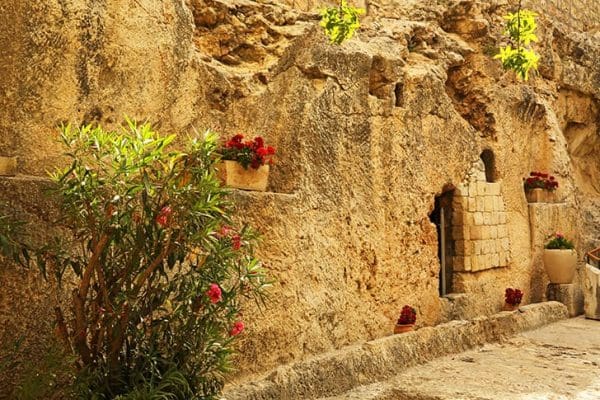
Maurine
Hello, we’re Scot and Maurine Proctor and this is Meridian Magazine’s “Come Follow Me” podcast, where today we celebrate Easter. We remember well those events and carry their magnificent hope with us. One night Scot and I were trying to photograph an olive tree on the Mount of Olives, not far from Gethsemane, to represent the Savior in the garden. It was dark and gradually a hush and then silence fell over our world where we worked alone. Because it was dark, these photographs took several minutes, and we worked alone on that mount for nearly three hours, hoping to capture a stunning photograph. We remembered how Elder Jeffrey R. Holland had described the Savior’s atonement. “We celebrate the gift of victory over ever fall we have ever experienced, every sorrow we have ever known, every discouragement we have ever had, every fear we have ever faced — to say nothing of our resurrection from death and forgiveness for our sins.”
Scot
As we consider the Savior’s atonement today we have invited Elder Bruce C. Hafen to join us, whose book The Broken Heart: Applying the Atonement to Life’s Experiences and Covenant Hearts has helped so many understand the atonement more thoroughly.
Bruce Hafen grew up in St. George, Utah. After serving a mission to Germany, he met Marie Kartchner from Bountiful, Utah at BYU. They were married in 1964.
Elder Hafen received a bachelor’s degree from BYU and a Juris Doctor degree from the University of Utah. After practicing law in Salt Lake City, he went to BYU in 1971 as a member of the original faculty of BYU’s new Law School. He taught and published research on family law and constitutional law.
He served as the President of BYU-Idaho from 1978 to 1985. Then he was Dean of the BYU Law School and later served as the Provost — the second in command – at BYU. He was called as a full-time General Authority in 1996, serving in area presidencies in Australia, North America, and Europe. He also served at Church headquarters as an adviser to the Priesthood Department, the general auxiliary presidencies, Church History, and the Temple Department. He became an Emeritus General Authority in 2010 then served as president of the St. George Temple. More recently he served as Chairman of the Utah LDS Corrections Committee, overseeing the Church branches in Utah’s state prisons and county jails. He is the author of several books on gospel topics, including the biography of Elder Neal A. Maxwell, and books on marriage, the temple, and the Atonement — including The Broken Heart: Applying the Atonement to Life’s Experiences and Covenant Hearts and most recently, a book called Faith Is Not Blind, which is a wonderful book for those who are struggling with their faith or having a faith crisis. It’s an excellent book. We highly recommend it.
The Hafens have seven children and 46 grandchildren.
Welcome. We’re so pleased to have you with us.
Maurine
When I think of Easter, I think of a bright morning after a long, dark night because everything that is hopeful for us in our lives are caught up in the Savior’s atonement and resurrection. This is a hard time for a lot of people. The circumstances in the world are so difficult and discouraging. We went from COVID to war to feeling personally in our pocketbooks challenges, shortages, worries about people in our own family. There’s so much to think about and yet here is this hopeful Easter with these beautiful centerpieces of the Savior’s atonement and resurrection. Respond to that, how can we find hope when we need it so badly?
Elder Hafen
Thank you, Maurine, just hearing you talk about that prompts a memory, since you mentioned St. George, of an Easter experience that is my equivalent of what you described. Just an image, a feeling. I was a teenager in St. George a long time ago and on an Easter Sunday, our stake had a fireside for all of the youth and young adult in the St. George Stake. I was one of about eight young people, four boys and four girls, who were invited to go inside the St. George temple, climb up some stairs to some back rooms that I didn’t even know existed and we wound our way until we were out on the little balcony at the very top of the St. George temple. We were outside the temple on the little balcony, looking out to see the whole world. The rest of the kids in our stake were right below us, sitting on the lawn in chairs. It was a “morningside,” as we’d call it now. We could just see the sun coming up east of us. I remember seeing the color streaks of Zion National Park way off in the east, with the sun coming up over it. Our role was to sing a song, and that song has stayed with me ever since.
It came to mind as I was thinking about Easter and as I’ve heard what you’ve said. It goes this way, I wish I could bring all those kids back to sing it for all of us, “God so loved the world that He gave his only begotten Son that whoso believeth in Him should not perish, but have everlasting life. For God sent not His Son into the world to condemn the world, but that the world, through Him, might be saved.” That is Easter morning for me. It’s hope. I love the part about the Lord came not to condemn. That connects to some ideas about the basic framework of Atonement doctrines for me. You know that Marie and I have been interested in trying to understand this doctrine together for a long time. At one point, we found it helpful for us to simply see the framework doctrinally and practically for the blessings of Atonement. Because the blessings go far beyond forgiveness and resurrection. That’s where we start. We ended up just making a little list and I’d like to put what you’ve asked about in the right place in this list as we’ve looked for this doctrinal framework.
We start with the purpose of the Atonement and then we look at the unconditional blessings. Everybody receives these blessings, whether they deserve them, whether they even want them or not. They’ll all be resurrected. We are cleansed from the effects of Adam’s sin unconditionally. Then there are conditional blessings; if we are faithful. The three conditional blessings are: 1) redeeming blessings, 2) strengthening blessings, and 3) perfecting blessings.
Your comment about today’s world has drawn my mind to strengthening blessings. I remember when President Dallin H. Oaks talked about the strengthening blessings of the Atonement in a general conference. It was a beautiful, thoughtful talk and there’s a place in the Old Testament — and we’re studying the Old Testament this year in Come, Follow Me, so it wouldn’t be a bad idea to think about it in that context — Moses had led his people out of Egypt and he was really concerned about where they were going. His people had carried so many burdens and he was personally burdened.“What am I supposed to do now?” must have been his constant prayer. And the Lord came to him when Moses needed it.
For example, notice the Lord’s language in talking to Moses. “God heard their groaning and He remembered His covenant with Abraham, with Isaac, and with Jacob and God said, ‘I have seen the affliction of my people, I know their sorrows.’” And then after he crossed the Red Sea, the great miracle that then protected and freed the Children of Israel to keep going, the Lord said to Moses, “you have seen what I did to the Egyptians and how I bear you on eagles’ wings and brought you to myself, therefore if you will obey and keep my covenants, ye shall be unto me a holy nation.” That captures this personal relationship between God, that was Jehovah, the God of the Old Testament, Christ. He brought them to Himself.
One more place that my mind turns to, as I look at those scriptures is some verses of one of our favorite hymns. It was even known in the first hymn book, it was in that book. We should sing the latter verses more often than we do. I think of these verses and I think of the world you’ve just described, Maurine, which is kind of stunned and disoriented, all of us. The Lord says to us,
When through the deep waters I call thee to go,
The rivers of sorrow shall not thee o’erflow,
For I will be with thee, thy troubles to bless,
And sanctify to thee, and sanctify to thee,
And sanctify to thee thy deepest distress.
When through fiery trials thy pathway shall lie,
My grace, all sufficient, shall be thy supply.
The flame shall not hurt thee; I only design
Thy dross to consume, thy dross to consume,
Thy dross to consume and thy gold to refine.
To me that makes it pretty clear that God understands us. The Savior understands us. He’s the one who’s talking here. “Flame will not hurt thee,” “I call thee to go,” “I will be with thee, thy troubles to bless.” If we were all in one group, everybody who is listening today, maybe we could sing that song because the very familiar music is stirring. That’s one we could all sing when it’s time to sing a hymn.
Scot
I think one of the things that really moved me about what you just quoted, was that the God of the Old Testament, who is Jesus Christ, had seen their affliction and sorrows. Sometimes my view of the Savior or of our Heavenly Father is that He sees my mistakes and my sins, but doesn’t see my afflictions and my sorrows. The latter, the afflictions and sorrows view, seems to be one of great compassion, and one who looks upon me with love and with desire to help me through those circumstances.
Elder Hafen
One of the reasons I think the Lord can look at us that and we can be close to Him, with deep understanding and gratitude that He knows what we’re going through, is that He’s been through it all. Elder Maxwell referred to this part of the Savior’s experience, which is really part of that Easter season and those tremendous, earth-shattering moments of the final days of Christ’s life. In Gethsemane, and with everything that he experienced there; far beyond our ability to comprehend, He felt what we had been through. There are some scriptures that say, I think this is somewhere in the Book of Mosiah, He saw His people. We can see Him. I think it’s possible to reflect on him without understanding what He was doing. The result of all of that, as Elder Maxwell put it, is the Savior’s earned empathy. He empathizes with us because He has been there. He knows it all and we can have total confidence that, even though we don’t see how anybody could go through what we’re going through and survive it, He has been there. He knows.
Maurine
When I was a child and would think about the Atonement, I thought that the Savior was paying in my behalf for a sin here and a sin there. And then as I grew older and saw that my life; as all of our lives are in this mortal, fallen experience; is full of error and challenge and sometimes heedlessness and blindness in relationship to the way we act and are; and I realized that the Lord must have lived my entire life with me. Because as long as we are sinful and mortal, these are all things that the Lord experienced with us and paid for us. And it made it so much more meaningful for my understanding.
Elder Hafen
You’d hope that as we grow, our spirits would grow, our minds would grow, and we would all come to that. I think especially today’s Church, we’re getting better at that. Richard Bushman gave a talk at BYU, it was one of the Easter conference messages at BYU in the last year or two. The title of his talk there was, “The Atonement Then and Now.” And he actually said some things similar to what you just said, Maurine. When he was young, even as a young bishop, he saw the Atonement in the ways you have described. And he would counsel people in those ways. But then he went on to talk about how his life has developed, how society has become more difficult and he has seen growth in the way we, in the Church, understand what the Atonement is about. It is for healing. It is for strengthening. It blesses and helps us. It becomes so much more personal in the way that attaches our thoughts about the Atonement to our personal relationship with Christ. I think that’s really helpful so that we don’t start seeing the Atonement as some new spaceship up in the sky that is a new source of blessings that isn’t part of our doctrine. It’s very central to our doctrine. It’s what the sacrament prayer talks about: if we always remember Him, if we are willing to be witnesses of His name, He will then link us to Him in a relationship that gives us access to Him. His Spirit will always be with us. It’s a relationship with Him. It’s not just some separate idea.
President Nelson gave a wonderful message about that once; about how “the Atonement” is “the Atonement of Christ,” it’s not some new, separate power. I hear some people talking about it as if it were an independent source of emotional and spiritual power that kind of fits the day in which we live; it’s the electronic version. It goes far beyond what normal tools and experiences can get for us. He emphasizes the importance of developing that relationship.
Thinking about something you said does help me. In one of the really strong, beautiful, memorable experiences in the Book of Mormon about what we’re discussing, you may remember this, in Mosiah 24 where we learn about the experience of Alma and his people when they were held captive by Amulon. The people couldn’t pray out loud because they were in bondage. And in those circumstances, the Lord said to Alma and his people, “I, the Lord God, do visit my people—” Notice that, my people, not the people, “I do visit my people in their afflictions.”
“Lift up your heads and be of good comfort, for I know of the covenant which ye have made unto me; and I will covenant with my people and deliver them out of bondage” (Mosiah 24:13).
What covenant is He talking about?
The covenants of baptism, the covenants of the temple; and that’s what make us His. In fact, the ultimate expression of that is in the fifth chapter of Mosiah after his people have listened to his great sermon on the Atonement of Christ and they rejoice and they say they have no more desire to do evil, but to do good continually. That’s an important prerequisite for all of this to happen. It develops, it’s not all at once. But if you keep reading in chapter 5, Benjamin says, “This day hath he (the Savior) begotten you” and you are becoming the children of Christ.
Then Benjamin tells them they’ve entered the path of following Christ, the Savior. President Nelson has really picked up on this and is helping all of us understand it. He talks about the covenant path, stay on the covenant path. It is the path that is marked out for us when we keep the covenants that we’ve made in the temple and in our baptism, and then we keep going. And again, using Benjamin’s phrase, if ye are “steadfast and immovable, always abounding in good works,” so, keeping moving on that covenant path. Then the last part of chapter five of Mosiah right after that phrase, if we keep going, “Christ will seal you His.”
So, that relationship that starts off that we are the children of Christ, we’ve made covenants with Him, where is that going? He will seal you His. That’s a temple word. That’s worth some reflection, I think, for all of us. What would it mean to be sealed to Christ in some way? We’ve grown from being the children of Christ to being full grown men and women of Christ. That’s the quest of a lifetime, really. That’s what the covenant path is about. It’s where we can go.
And incidentally, in today’s world, I’m reminded even as I say the phrase about “Christ will seal you His,” there’s another place in the Book of Mormon, I think it’s in Alma 34, where Amulek is talking and he’s talking about Satan and the power he seeks to have over us. As Amulek describes the influence of Satan, he says words to this effect, if we follow the path that Satan marks out for us than “he doth seal you his.” That is just chilling to me. He wants to take us off the path to follow him on his path. The world is so full of it today, but it has a destination. We will become children of the devil, just as we can become the children of Christ and grow into that full relationship.
Scot
I’m glad you brought up President Nelson’s teachings because one of the things that came to mind as you were talking there, Elder Hafen, was this quote: “Too many people consider repentance as punishment — something to be avoided except in the most serious circumstances. But this feeling of being penalized is engendered by Satan. He tries to block us from looking to Jesus Christ, who stands with open arms, hoping and willing to heal, forgive, cleanse, strengthen, purify, and sanctify us.”1 So, obviously Satan is going to try to block us from having access to that power of the Atonement of Jesus Christ and repentance is part of that process; daily repentance. It is a process, not just an event.
Elder Hafen
Right, and hearing you say that, Scot, reminds me of when I realized that the purpose of the Atonement is to help us grow and learn. It’s not just one and done with baptism or saying we believe in Christ. It’s the process that helps us grow and develop. Other Christian churches don’t believe that that’s what their version of baptism does for people. It’s to be cleansed of Adam’s sin. But when we see that the Atonement has a developmental purpose, then we begin to see our sins, our inadequacies, our mistakes, all of those things, we see them as part of that growth process. We’re on this path of learning and that’s why repentance is really a process of seeing what we’ve done that we could do better. And we welcome the critique instead of hearing the Brethren at conference, or hearing our wife or husband, or hearing from any source about something we need to pay attention to, and do better. It’s just like listening to a good coach help an athlete strengthen his skills. Only a really foolish athlete would say, “Coach, don’t talk to me like that, that makes me feel bad.” If that’s how you feel, then you will never develop the skill, the strength that you would seek to have by even having a coach.
Maurine
I think it’s interesting when you talk about development and how we see it. It isn’t just enough to be forgiven of our sins, though that is huge, but something else needs to happen. I think about the example, let’s say there’s a woman who is praying during the sacrament because she is angry at a family member who she has felt misused and betrayed by. It’s not a small hurt, but a big one. But she doesn’t want to be angry, because she notices that anger divides her from the Spirit and divides her from what she wants. It is wonderful and lovely to be freed from that anger toward that one person, but the Lord wants to take us further to be freed from anger as a way of living, as a way of thinking about other. And then the Lord wants to take us further, He wants us to replace that anger with love, which is his bestowal, His gift. And all of those things are part of the Atonement; it is not only forgiveness of the sin, but that development.
I think it’s so generous because one of the things that hurts us the most are our weaknesses, whether we see it or not. And the Lord is saying, “I’m here to lift these things from you, if you will but completely align yourself with my will, if you will let God prevail. We together can lift these.” And I think it’s so interesting that sometimes if we don’t see all that the Lord is willing to do for us, through his Atonement. We beat ourselves up and we think, “I’m not enough,” “I can’t do enough,” “I fall into error,” “I’m not compassionate enough,” “I don’t see other’s point of view,” “I don’t love enough.” I mean there are so many “not enoughs” that we can add into our thinking. And the Lord says, “Don’t go there, we’re on a journey together and all you need to do is give your very best and rely on this beautiful gift of the Atonement.”
It lifts from us this sense of insecurity and misery that so many of us travel with. We’re on a journey with His presence with us, just like the Children of Israel had His presence with them. We’re on this journey and our destination is His presence and He helps us make that journey. It’s not something we can be casual about, like we say, “Oh, it doesn’t matter if I do this because I can repent tomorrow.” That is a very flippant way of looking at something so holy and gracious. The truth of the matter is, you do have to give your entire heart, but what the Lord gives back is a sense of ease to your soul, a sense of joy that you didn’t have before, hope that you need. These are all His gifts to us through this mighty sacrifice of the Atonement.
Elder Hafen
Thank you for bringing that into our conversation, Maurine. Your insight takes me back to the little list that I offered about categories of blessings to understand the parts of the Atonement. If we are faithful, then following our baptism, we’ve done that part — as one person has said, we get the weeds out of our lives — then once the weeds are out, our land is clear, and we can plant flowers in the place where we had the weeds. That’s the positive part about the Atonement. The little framework that I mentioned suggest that in that part of our growth and following the Savior, we receive redeeming blessings, strengthening blessings, and then perfecting blessings. And what you were just describing about the woman in Church and what she was wanting to go through, it’s really the gift of charity which is an ultimate perfecting blessing. When we receive it as a spiritual gift, if we have been true and faithful in all that that means, then we become as He is. The love that Christ has for other people, the pure love of Christ, when we feel that, we can be completely consumed and changed. The fruits of that kind of repentance and that process of growth and really abundant.
This goes back a few years: I was serving in an area presidency and we received information that someone in our area had been disciplined by a Church council. He had been excommunicated and he was appealing that decision to the First Presidency and the First Presidency sent us the file and asked for a review and a recommendation. We didn’t know this brother and we didn’t know the people in his stake, but the Brethren wanted our input as the general authorities who were really close to that part of the world. And as we looked into what had happened, we learned that the man who had been excommunicated had gotten into an argument with the other man.
It had started at a low level of disagreement and it grew to frustration and finally it became really raging anger. These two men were just so angry with each other that they were worried about what one was saying to other people about them and it kind of got out of control. This led to a disciplinary council. The one man who felt especially hurt, even though he was kind of out of control, he demanded that the other man be excommunicated. Without going into the details, the council (the Stake presidency and High council) decided “Ok, he should be,” but then the other man was so angry that he appealed the decision. They were going to keep venting their anger, bordering on hatred, to the highest court. So, the Brethren sent it back to us and we reviewed it and then had the assignment to call the Stake President who was new. He had not been a Stake president at the time of the decision, but as we talked, he told me how this had happened, that it had all began with a misunderstanding and because of this unwillingness to forgive each other, it grew and grew and got out of control.
So, we finally decided to recommend, and the First Presidency sustained it, that they should start over and have another disciplinary council, which seemed like a strange resolution. We weren’t going to go back in to the facts and arguments and all that. They would start over. Then the Stake President called me a few weeks later, after we’d counseled together and he’d agreed to hold another disciplinary council. He told me what had happened. On the evening of this second council, when these two brethren were in the same place sometime earlier, and the place was probably still fuming with the anger they had brought before, they sat smoldering in the waiting area as their stake leaders discussed the issues and what to do. And then suddenly, one of these men got up, went over to the other man, knelt down in front of him and said, “What are we doing to each other? Can you ever forgive me for this?”
And the other man started to cry. And they began talking softly. And then they embraced and they talked more and within a few minutes, they knocked on the door of the room where the others were deliberating. The Stake President opened the door and he saw these two men arm in arm, with the tears running down their cheeks. He was stunned. “What has happened?” They came into the room and when the other Stake leaders saw them, everybody in the room started to cry.
It was a clear witness to me of what happens when the Lord brings His charity into a room where it is needed. These men were ready for this to happen and they responded to it. Sometimes that energy is there and we don’t hear it, we don’t feel it, we’re not open to it; we’ve shut all those doors. But these two still had enough of the milk of human kindness; they still cared about the Lord enough to reach out and hear Him. I think they possessed that charity from then on.
Scot
Elder Hafen, we appreciate so much that story, that really moves us. I want to ask another question about something that we have noticed that many people are dealing with in our world today and that is, this whole idea of perfectionism.
I remember when I read your book years ago, I think I’ve read it two or three times — the one on The Broken Heart — you had a chapter in there that really caught my attention and I think if I remember correctly, the title of the chapter was “Two Cheers for Excellence.” I was very interested in that because I see this all around me with people feeling like excellence is the most important thing. Perfectionism is what we have to seek for all the time. In fact, we even misconstrue the meaning of “Be ye therefore perfect” and we just don’t get it right. But can you comment on that “Two Cheers for Excellence”?
Elder Hafen
That was a long time ago that you read that chapter, Scot. Yeah, I remember that. What I was concerned about then and what I am still concerned about in the world we live in, is that western society have become consumed with competition against one another. It just goes really contrary to what we’ve been talking about — the desire to come to the Lord and have Him see our weaknesses. I guess I was thinking in general terms. It was kind of a plea for charity because if we’re not open to the Lord’s direction and willing to come to Him and show Him our weaknesses, then He’s not going to strengthen us. I guess it was in Ether Chapter 27 where the Lord says to Moroni — Moroni’s pretty frustrated, I think he’s feeling that he wouldn’t do too well in the Stake writing competition. He says, “the gentiles will mock my words” and so what does the Lord say to him? “I give unto men weakness that they may be humble and if they will come unto me and acknowledge the weakness, I will show unto them.” He’ll tell us more.
That’s why I’ve sometimes thought when we’re feeling very distressed and discouraged and seeing all the things we don’t do well at and we aren’t going to compete in whatever ways we feel we need to. When we are seeing our weaknesses, that’s not necessarily a sign or a clue that the Lord doesn’t care about us anymore. On the contrary, it might be evidence that he’s closer to us than He’s been before. He wants to help us see our weaknesses. Then he will help us overcome them.
“I give unto men weakness that they may be humble; and my grace is sufficient for all men that humble themselves before me; for if they humble themselves before me, and have faith in me, then will I make weak things become strong unto them.”
Those are all words related to the perspective on the Atonement that we have been alluding to. It is all about our learning and growth and when we get so glued to the world and its competitiveness, we can tune out all the signals that are trying to help us, what’s wrong, what do we need to work on. Only wanting to do better compared to other people is just contrary to the Spirit of the Gospel. In addition, it really interferes with the growth process that we are engaged in if we understand the covenant path. The covenant path is not a place where we dash to finish line and see if we get ribbons for the first three places and everybody else has failed. So, that’s probably what I was thinking.
Maurine
We live in a time where many are having faith crises and it seems to be fed by the internet, where they can talk to other people who are having faith crises and they begin to see one flaw after another and then they find themselves in turmoil. I know you’ve been very concerned about this and have written a wonderful book called Faith Is Not Blind addressing this. I’m just wondering if you can talk a little bit about that and connect it to what we’ve been saying here about the Atonement.
Elder Hafen
As I reflect on our conversation today, this Easter day, and reflect on the Atonement, we’ve been describing what the Atonement does to mark the path. “He marked the path and led the way and every point defines.” That applies today and one of the dark clouds that makes things so difficult and disturbing everywhere that we see is the crisis of faith, loss of confidence in each other. There is a way to process the experiences we’re having by recognizing how we’ve going from innocence and good feelings that don’t run that deep, to crises that are really wrenching and difficult — if we persist and we understand a little of what’s going on and have some faith about getting through it — the Lord will help us get through this. And the darkness can change into light if we will allow Him to help us.
When we learn from what we’ve gone through and we come out of the clouds of that darkness into the clear valley of the light of the simplicity beyond complexity — it’s a journey. It’s just like the one we’ve discussed about the Atonement. The Atonement has a lot to do with this, it’s another manifestation of how the Lord works with us through a process of learning from experience until we’re more like Him and we’ve had to struggle through some things that were hard. He helps us.
Scot
We have so appreciated this time together with Elder Bruce C. Hafen. This is Scot and Maurine Proctor. We are excited to continue to study the Old Testament in the coming weeks. Our great thanks again to Jenny Oaks Baker for the music that accompanies this podcast and to our producer, Michaela Proctor Hutchins. Have a great week, a joyous, wonderful Easter and see you next time.
1. https://abn.churchofjesuschrist.org/study/general-conference/2019/04/36nelson?lang=eng&adobe_mc_ref=https%3A%2F%2Fwww.churchofjesuschrist.org%2Fstudy%2Fgeneral-conference%2F2019%2F04%2F36nelson%3Flang%3Deng&adobe_mc_sdid=SDID%3D710306E62D1C46B8-5F176D7DAE5A06D2%7CMCORGID%3D66C5485451E56AAE0A490D45%2540AdobeOrg%7CTS%3D1649400043
We See How the Lord Works in Joseph of Egypt’s Life – Genesis 42-50

Maurine
When Joseph became vizier of Egypt, second only to Pharoah and wearing his ring of authority, he also got a new name that doesn’t exactly roll off our English-speaking tongues. It is Zaphnath-paaneah and what it lacks in clarity, it more than makes up in its meaning which is “savior of the world.” Yes, his starving family will come from Canaan, hoping to buy the corn that Joseph has stored in Egypt, but his name signifies even more than that. We’ll tell you today.
Scot
Hello. We’re Scot and Maurine Proctor and welcome to Meridian Magazine’s Come Follow Me podcast where today we’ll study Genesis 42-50 about Joseph saving his family in Egypt. The transcript for this podcast is at latterdaysaintmag.com/podcast, that’s latterdaysaintmag.com/podcast. While you are there check out the remarkable content on the magazine. Meridian is updated Monday through Friday with articles from some of the top Latter-day Saint writers. You’ll find scripture insights, inspiring stories and learn about your fellow Latter-day Saints’ lives. If something new happens in the Church, we’ve got it! Tell your friends about our podcast and Meridian Magazine. You can sign up for the daily executive summary of the magazine that will come to your inbox each day for free.
Maurine
The seven-years of plenty that Joseph had described from Pharoah’s dream were now at an end, and for two years the world had been in the desperate plight of famine. Joseph opened the granaries of Egypt, and surrounding nations came for food, including some familiar faces from Canaan—ten of Joseph’s brothers. The last time he had seen them was when he was the anguished 17-year-old sold as a slave to Egypt. Joseph was now forty years old, when his brothers “came, and bowed down themselves before him with their faces to the earth” (v. 6), a fulfillment of the dreams Joseph had as a youth.
We will tell this story in more detail in a few minutes, but something beyond the story details begs to be mentioned. We have talked in former podcasts that the stories of Abraham, Isaac, and Jacob are specifically crafted to teach us about the power, protection, prosperity, and much more about the covenants—as if history was designed to demonstrate the unique blessings of being bound to the Lord in covenant. I will be your God, and you will be my people. Let us show you what that means in the lives of Abraham, Isaac and Jacob.
Scot
Joseph’s story gives us another key to understanding the Old Testament. Scripture is written with types and shadows. What does that mean? If you cast a bright light on an object, it will cast a shadow that looks very much like it. It won’t have every detail of the original, of course, but will be similar enough that you can see something of what the original is. You will get a sense that it points to something larger and more tangible.
Types are patterns, templates or molds that repeat themselves through scripture and also point to larger spiritual realities. Types and shadows point to Christ and his doctrine.
In Moses 6:63, we read, “And behold, all things have their likeness and all things are created and made to bear record of me, both things which are temporal, and things which are spiritual; things which are in the heavens above, and things which are on the earth, and things which are in the earth, and things which are under the earth, both above and beneath; all things bear record of me.”
Maurine
Reality and history are organized to bear record of him. The more you understand that scriptures are told in types and patterns, the more they jump out at you. You can see that events, people, places and more all resonate together to invite you to see a larger picture of the way things really are. They testify of Christ.
Let’s look at a couple of those patterns. A pattern that undergirds so much of scripture is departure from home, a mission abroad and then a happy homecoming. We know, of course, that that is our story, but it is also the story of Abraham, Isaac, Jacob and Joseph. We left the protection and shelter of our heavenly home to undertake a mission whose difficulties would be designed to purify us, and we head back to home, sanctified and changed. Abraham, Isaac, Jacob and Joseph have stories that mirror this idea—only with Joseph, home comes to him.
Scot
Another type that we have seen is that when Abraham is asked to sacrifice Isaac, it will be a similitude of what will happen in the future when God, the Father, allows his Son to atone and be crucified. This event also demonstrates God’s goodness, who provided a ram in the thicket as a means of deliverance. We see here that both the ram and Isaac were types of Christ. The Bible makes it clear that the righteous are protected again and again, in every type of situation.
Elder Dallin H. Oaks noted, “Bible stories such as these do not mean that the servants of God are delivered from all hardship or that they are always saved from death. Some believers lose their lives in persecutions, and some suffer great hardships as a result of their faith. But the protection promised to the faithful servants of God is a reality today as it was in Bible times.
“All over the world, faithful Latter-day Saints are protected from the powers of the evil one and his servants until they have finished their missions in mortality. For some the mortal mission is brief, as with some valiant young men who have lost their lives in missionary service. But for most of us the mortal journey is long, and we continue our course with the protection of guardian angels.” (Dallin H. Oaks, “Bible Stories and Personal Protection” https://www.churchofjesuschrist.org/study/general-conference/1992/10/bible-stories-and-personal-protection?lang=eng )
Maurine
So, types, shadows and repeated patterns in scripture are powerful to see and understand, because they reveal the underlying meaning of reality. Ask when you are reading the scriptures: Is this idea part of a larger pattern? Is there something this teaches me that I have seen in other scriptures? Are these all just random stories, or is there a message or thread that is continuous?
We have to work to think this way, because unlike other generations, symbols and types are not a natural language for us.
One of my great personal discoveries came when I was contemplating Joseph and wondering if his life in some way was a type of his posterity, was a type for me. Many church members learn in their patriarchal blessings that they are of the lineage of Ephraim or Manassah, so Joseph is their grandparent. Does his life prefigure ours in some way?
It was one of those moments when the answer leaped at me, a moment of true revelation. I could see it all at once. Joseph had been sent away from home, to a land where he was a stranger, in order to later save his family, the Children of Israel, when the world was starving. If he had not been sold away, he would have not had the power to save his family later. The Children of Israel and their covenant promise to bless the world through their lineage would have been nullified in the arms of death and starvation.
Scot
Joseph acknowledges this to his brothers when they are fearful in his presence.
“And Joseph said unto his brethren, Come near to me, I pray you. And they came near…Now therefore be not grieved, nor angry with yourselves, that ye sold me hither: for God did send me before you to preserve your life…to preserve you a posterity in the earth and to save your lives by a great deliverance” (Gen. 45: 4,5,7).
Joseph is not tangled in resentments and anger, but has been given, obviously through revelation, the bigger picture, the grand view. He was called to be a “savior of the world.”
Maurine
What I saw is that the posterity of Joseph have a similar calling. When Jacob blesses all the brothers, he gives Joseph this special blessing, “Joseph is a fruitful bough, even a fruitful bough by a well; whose branches run over the wall” (Gen. 49: 22). Joseph is told, “The blessings of thy father have prevailed above the blessings of my progenitors unto the utmost bound of the everlasting hills” (v. 26).
The term “whose branches run over the wall” refers to Joseph’s posterity, Lehi, and his family, who are called to leave their homeland and make a journey 2/3 of the way around the globe to a promised land. This sturdy branch will run over the wall—that is, in this case, the ocean, and they will keep records of their dealings with God, and this record will be the Book of Mormon.
Those, in the last days, who are the posterity of Joseph and who have Joseph’s record—the Book of Mormon-have the same calling as Joseph. They were sent away to save a starving world with their record. We, too, are to use this book to save a starving world.
Scot
How is the world starving? In this time, when so many of us deal with the problems of abundance, it may be hard to think of us as starving, but we do have our own kind of famine and it is just as grievous, if not more so. We have lost our way. We have lost our moorings. We have lost the ability to hear the Lord—and we are starving. Amos said it this way:
“Behold the days come, saith the Lord God, that I will send a famine in the land, not a famine for bread, nor a thirst for water, but of hearing the words of the Lord: And [people] shall wander from sea to sea, and from the north even to the east, and shall run to and fro to seek after the word of the Lord, and shall not find it” (Amos 8:11-12).
Joseph’s life prefigures ours. We are to bring a starving world the word of God.
Maurine
Joseph’s life is also a type of Christ. Joseph Fielding McConkie in his book Gospel Symbolism listed 28 similarities between Joseph and the Savior. We’ll quote him on these:
1. Both Jesus and Joseph are granted a new name. Zaphnath-paaneah was Joseph’s new name. For Jesus, “Christ” constituted a divinely given title.
2. Both were good shepherds. Joseph, of course, was a shepherd, and became the recipient of the hatred of his brothers. “In this he can be likened to the Good Shepherd who was hated of the world because he testified that their deeds were evil.
3. “Both were known as the most loved of their father. Few verses in the Old Testament seem more strangely inconsistent with the great patriarch Jacob serving as a model to emulate than the announcement that he “loved Joseph more than all his children” (Genesis 37:3) and that Joseph was favored above his brothers. Those lacking spiritual insight have freely criticized Jacob for this behavior, yet it perfectly represents the favoritism shown by the eternal Father to his firstborn, of whom he has repeatedly said, ‘Thou art my beloved Son’ (Mark 1:11; 9:7; 3 Nephi 11:7; JS-H 1:17).
Scot
4. “Both were clothed in authority and power by their father.” Joseph was given the “coat of many colors”, which is apparently a priesthood garment. The authority and power of Jesus also came from his father.
5. Both were revelators. In Joseph’s case he dreamed dreams that revealed the future to his family and Christ taught of future events.
6. “Both were fully obedient to the will and wishes of their father and responded to their call to serve, saying, ‘Here am I.’ The type is rather remarkable. Joseph‘s brothers were tending their father’s flock, yet they had broken off communication with him. Joseph was sent with word from their father, only to find that they had wandered from Shechem (“the place of the burden”) to Dothan. Such was the experience of Christ, who found that those of his brothers charged with tending his Father’s flock, the children of Israel, had also wandered far from their original pastures.”
Maurine
McConkie reminds us:
7. “Both were promised a future sovereignty. It may be worthy of notice that the two recorded dreams of Joseph hinted at a double sovereignty. The first dream concerned ‘the field” (Genesis 37:7), thus pointing to an earthly dominion; the second dream was occupied with the sun, moon, and stars (Genesis 37:9), suggesting a heavenly rule. This would be in imitation of Christ’s ultimate triumph, which will be both temporal and spiritual.
8. “Both were betrayed by their brothers. It was essential to the story that Joseph’s brothers in their betrayal first strip him of the coat or garment given him by his father. Be it remembered that Christ was also stripped of his seamless coat, which was the symbol of his high priestly office.
9. “Both were cast into a pit—Christ to the world of spirits, Joseph into an empty cistern, where he remained according to Jewish tradition for three days and three nights (Ginzberg, Louis. The Legends of the Jews. 7 vols. Philadelphia: The Jewish Publication Society of America, 1909.2:14; Genesis 37:24; Isaiah 24:22).”
Scot
10. “Both were betrayed with the utmost hypocrisy. “Let us sell him to the Ishmeelites,” said Joseph’s brothers, “and let not our hand be upon him” (Genesis 37:27). When Pilate told the Jews to take Christ and judge him according to their law they responded, “It is not lawful for us to put any man to death” (John 18:31).
11. “Both were sold. It was Judah that sold Joseph for twenty pieces of silver (Genesis 37:26-28), as it was Judas (Greek for Judah) who sold Jesus for thirty pieces of silver (Matthew 26:15).
12. “The blood-sprinkled coat of each was presented to his father. “And they took Joseph’s coat, and killed a kid of the goats, and dipped the coat in the blood; and they sent the coat of many colours, and they brought it to their father” (Genesis 37:31-32). The blood of Jesus Christ as the blood of a scapegoat, a sin offering, was symbolically presented to the Father.”
Maurine
13. “Both blessed those with whom they labored in prison (Genesis 39:21-23; Isaiah 61:1; D&C 138).
14. “Both were servants, and as such all that they touched were blessed.
15. “Both were tempted with great sin and both refused its enticements (Genesis 39; Matthew 4:1-11).
16. “Both were falsely accused: Joseph by Potiphar’s wife, Christ by false witnesses. (Christ did not defend himself against the false charges, and there is no record of Joseph doing so, either.)”
Scot
17. “Both stood as the source of divine knowledge to their day and generation. All the wisdom of Egypt had failed to interpret the king’s dreams before Joseph was sought and successfully did so. So it was with Christ—in him and him alone were the truths to be found by which man could be saved.
18. “Both were triumphant, overcoming all.
19. “Both were granted rule over all. To Joseph, Pharaoh said, “According unto thy word shall all my people be ruled: only in the throne will I be greater than thou” (Genesis 41:40). Christ, in like manner, was welcomed in the royal courts on high, where he sits on the right hand of the Father with “angels and authorities and powers being made subject unto him” (1 Peter 3:22).
Maurine
20. “Both were thirty years old when they began their life’s work. “And Joseph was thirty years old when he stood before Pharaoh king of Egypt” (Genesis 41:46). And of the time when Christ commenced his public ministry we read, “And Jesus himself began to be about thirty years of age” (Luke 3:23).
21. “Both were saviors to their people, giving them the bread of life.
22. “The rejection of both brought bondage upon the people. ‘Just as a few years after his brethren had rejected Joseph, they were forced by a famine (sent from God) to leave their land and go down to Egypt, so a few years after the Jews had rejected Christ and delivered Him up to the Gentiles, God’s judgment descended upon them, and the Romans drove them from their land, and dispersed them throughout the world’ (Pink, Arthur W. Gleanings in Genesis. Chicago: Moody Press, 1950., p. 391).”
Scot
23. “Both were unrecognized by their people. When Joseph’s brothers came seeking the bread of life, they failed to recognize that it was Joseph who extended the blessing that they sought. Only after he had identified himself did they know him. ‘I am Joseph,’ he said. ‘Come near to me…(Genesis 45:3-5). Do not our scriptures prophesy of that day when the Jews shall look upon the Savior and say: ‘What are these wounds in thine hands and in thy feet? Then shall they know that I am the Lord; for I will say unto them: These wounds are the wounds with which I was wounded in the house of my friends. I am he who was lifted up. I am Jesus that was crucified. I am the Son of God. And then shall they weep because of their iniquities; then shall they lament because they persecuted their king.’ (D&C 45:51-53.)
24. “Both would be recognized and accepted by their brothers only at the ‘second time.’ Such was the testimony of Stephen, who declared to a corrupt Sanhedrin that it was only ‘at the second time Joseph was made known to his brethren’ (Acts 7:13); and so it would be with Christ.”
25. “As Joseph’s brothers bowed to him in fulfillment of prophecy, so all will yet bow the knee to Christ (Genesis 43:26-28; D&C 76:110).”
Maurine
26. “Through both, mercy is granted to a repentant people. As Joseph’s brothers sought forgiveness of him, so Christ’s brothers will eventually seek forgiveness of him. In both instances the mercies of heaven are freely given.
27. “After the reconciliation, Israel is gathered. Having manifest himself to his brothers, Joseph charged them to return and bring their father and families to Egypt. So it shall be in the last days. After Israel have returned to their God, they, like Joseph’s brothers, shall be given a change of raiment (Genesis 45:22) and sent to bring all the family of Israel into the kingdom ruled by Christ.
28. “To ailing Jacob, then nearly blind, the Lord said: ‘Joseph shall put his hand upon thine eyes’ (Genesis 46:4). Through him you shall see, through him you shall be gathered, through him you shall be introduced to the king and granted a land from whence you shall increase endlessly.”
Scot
Again, we thank Joseph Fielding McConkie and his book Gospel Symbolism for these parallels between the life of the Savior and the life of Joseph. Aren’t they striking? This pattern of types and shadows, and comparing a life or an event to the Savior, is one of the most salient features of scripture. It is your pattern for understanding the Old Testament.
Now, in the beginning of Genesis 42, we see that Joseph’s ten brothers come to Egypt to buy corn. Their position is truly humble. In fact, they bow to the ground before Joseph in seeking his mercy. They are starving and Joseph has storehouses full of grains.
Are they humbled just because they are compelled to be by their circumstances? Joseph really needs to know. At heart, are they still the murderous brothers who almost slayed him, but sent him off as a slave instead?
Maurine
Alma tells us in the Book of Mormon, “Yea, he that truly humbleth himself, and repenteth of his sins, and endureth to the end, the same shall be blessed—yea, much more blessed than they who are compelled to be humble because of their exceeding poverty” (Alma 32:15).
So have these brothers been compelled to be humble or have they, instead, changed and repented at their very core? Have they spent a lifetime, watching their father, Jacob, mourn away his years, grieving for the loss of Joseph, and known with guilt how wrong they had been to bring such sorrow to their family and wish somehow they could make amends?
It is clear from Joseph’s life and his spiritual power in the Lord, that he has not spent his lifetime boiling with anger toward his brothers, but frankly forgiven them a very long time ago. Remember he reminds them. “Be not grieved nor angry with yourselves, that ye sold me hither: for God did send me before you to preserve life” (Gen. 45:5). Two points are interesting here: 1) that our sins do not thwart the work of God, and that He can even use them for his greater purposes and 2) Joseph, who is a type of Christ, urges that they forgive themselves. Surely the Lord insists that we do the same.
Scot
Elder Jeffrey R. Holland said, “There is something in us, at least in too many of us, that particularly fails to forgive and forget earlier mistakes in life—either mistakes we ourselves have made or the mistakes of others. That is not good. It is not Christian. It stands in terrible opposition to the grandeur and majesty of the Atonement of Christ. To be tied to earlier mistakes—our own or other people’s—is the worst kind of wallowing in the past from which we are called to cease and desist…”
He said, “Let people repent. Let people grow. Believe that people can change and improve. Is that faith? Yes! Is that hope? Yes! Is it charity? Yes! Above all, it is charity, the pure love of Christ. If something is buried in the past, leave it buried. Don’t keep going back with your little sand pail and beach shovel to dig it up, wave it around, and then throw it at someone, saying, “Hey! Do you remember this?” Splat!
“Well, guess what? That is probably going to result in some ugly morsel being dug up out of your landfill with the reply, ‘Yeah, I remember it. Do you remember this?’ Splat.
“And soon enough everyone comes out of that exchange dirty and muddy and unhappy and hurt, when what God, our Father in Heaven, pleads for is cleanliness and kindness and happiness and healing.”
Maurine
If this is necessary in the world, how much more necessary it is within the bounds of our own families where our long knowledge of each other and our proximity makes hurting each other a likely possibility. As covenant people, we are to follow our covenant father, Joseph, who forgave in the most difficult and impossible circumstances. If you have a child who forsakes the Church, and tramples on the values you taught them, we must forgive. If your most heartfelt political idea is trampled on by your brother-in-law, we must forgive them. The Lord can give us the strength to do that, even if we can’t find one cell of forgiveness in our body toward one who has deeply wronged us.
If we are divided, neighborhood by neighborhood, block by block, mile by mile from those who have hurt us, we will eventually live in a world of empty streets with only a light showing here and there where someone lives, as we seek to make distance between us. God wants more than that for us. He wants Zion.
When Joseph’s brothers came, they did not recognize him. He was 40, no longer 17. He was the vizier of Egypt, dressed, undoubtedly with the trappings of his high position, and he spoke in Egyptian to them. To prove that they have truly repented, he accuses them of being spies. This becomes a complicated ruse, which reminds the brothers at every turn that the difficulty they find themselves in might be God’s punishment to them for selling their brother, Joseph.
Scot
They say to themselves, “We are verily guilty concerning our brother, in that we saw the anguish of his soul, when he besought us, and we would not hear; therefore is this distress come upon us” (Gen. 43:21). Joseph, who did not let them know he understood their language. listened to their conversation and sometimes turned and wept. He had lived that anguish of his soul.
Joseph tells them that to prove they are not spies, they should return with Benjamin, their younger brother, whom Jacob had kept at home lest some evil should befall him. He took Simeon, bound him, and kept him. Then their sacks were laden with corn and they left for home. Yet, oh, the distress when they realize that each of them also had their original money in their pack.
Jacob is agonized at the request to take Benjamin to Egypt. “Me ye have bereaved of my children: Joseph is not, and Simeon is not, and ye will take Benjamin away: all these things are against me” (v. 36). But Reuben steps forward and says “Slay my two sons, if I bring him not to thee” (v. 37). This is a pledge of fidelity and loyalty, and we see here a changed Reuben from the man he once was.
Maurine
The famine worsens, and at last there is no choice. They surely must go again to Egypt for food, and they have been told not to come without Benjamin. Judah steps forward to guarantee the boy’s safety with his life, saying that if he brings Benjamin not home, “let me bear the blame forever” (Gen.43: 9). So they leave with their brother Benjamin, bearing gifts for the Egyptians, and double the money, that they might pay back what was in their pack.
They were brought into Joseph’s own house, treated with great hospitality, and Joseph asked, “Is your father well, the old man of whom ye spake? Is he yet alive?” (v. 27). Looking at Benjamin, he asked, “Is this your younger brother, of whom ye spake unto me?” (v. 29). This is a revealing scene that moves our souls all these centuries later. “And Joseph made haste; for his bowels did yearn upon his brother: and he sought where to weep and he entered his chamber and wept there” (v. 30).
The next day, the brothers are sent away, laden with food, but Joseph secrets a silver cup and money into Benjamin’s sack. Joseph sent men after them, saying that a cup is missing, and why have they returned evil for good? The brothers answered to search their bags, and “with whomsoever of thy servants it be found, both let him die, and we also will be my lord’s bondmen” (Gen.44:9).
Scot
Of course, the silver cup is found in Benjamin’s sack and the entire group is brought back to Joseph. Judah—that same Judah who had suggested that Joseph be sold into Egypt—steps forward to plead. He speaks of their father, who is an old man, and that if something should happen to Benjamin, he would die of shock and grief. Judah spoke of what the loss of Joseph had meant to their father, and one more loss, according to Jacob, “will bring down my gray hairs with sorrow to the grave” (v. 29). Judah says “let the lad go up with his brethren” (v. 33) and he would take the punishment instead. His repentance and change of heart is complete. He is not the same brother who sold Joseph away.
Maurine
Now Joseph can’t step away to weep. He cries. He wails, so loud that “the Egyptians and the house of Pharoah heard” (Ge. 45: 2). Joseph tells his brothers who he is and that “God did send me before you to preserve life” (v.5)…to preserve you a posterity in the earth and to save your lives by a great deliverance. What a scene—this reuniting of a broken family, this profound forgiveness of a great soul. Since this is only the second year of a famine that will last seven years, Joseph invites them to go get their father and bring the entire family to Egypt to preserve their lives. “And there I will nourish thee,” (v. 11) Joseph said. Pharoah says to Joseph’s family, “the good of all the land of Egypt is yours” (v. 20).
When Jacob and the 70 souls of the Children of Israel come to Egypt, Joseph takes a chariot out to meet his father and “he fell on his neck, and wept on his neck a good while” (Ge. 46: 29). His family is settled in the prime land in the Nile delta called Goshen.
Scot
With these scenes in our mind, let’s tie back to the Book of Mormon, which we sometimes refer to as the stick of Joseph. Remember in Alma 46 how Moroni rents part of his garment and raises it as a title of liberty with this writing on it: “In memory of our God, our religion, and freedom, and our peace, our wives, and our children” (Alma 46:12). The people rally to him, joined together to defend themselves against the evil Amalickiah. They are doing this in the name of the covenant and say, “We covenant with our God”. In this they are calling upon those covenant promises of protection in their promised land, and they know that with it comes their obligation to Let God Prevail in their lives. They rent their “garments in token, or as a covenant, that they will not forsake the Lord their God: or, in other words, if they should transgress the commandments of God, or fall into transgression, and be ashamed to take upon them the name of Christ, the Lord should rend them even as they had rent their garments” (V. 21). It’s like saying, may we be trampled if we break our covenants.”
Maurine
Then Moroni says a curious thing. “Behold, we are a remnant of the seed of Jacob; yea we are remnant of the seed of Joseph, whose coat was rent by his brethren into many pieces; yea, and now behold, let us remember to keep the commandments of God, or our garments shall be rent by our brethren, and we be cast into prison, or be sold, or be slain” (v. 23). In other words, this story of Joseph’s coat being torn by his brothers is topmost in their minds, and, they see it as a symbol for their covenants. If they don’t keep their obligations in the covenant at this crucial juncture when so much is at stake, they will be rent as Joseph’s coat.
What’s more, they also see themselves as a remnant of Joseph. Just as a remnant of his coat was brought back to Jacob by his brothers when he was sold into Egypt, so they are a remnant of his posterity who have survived in a new promised land.
Scot
They say: “Yea, let us preserve our liberty as a remnant of Joseph; yea, let us remember the words of Jacob, before his death, for behold, he saw that a part of the remnant of the coat of Joseph was preserved and had not decayed. And he said—Even as this remnant of garment of my son hath been preserved, so shall a remnant of the seed of my son be preserved by the hand of God, and be taken unto himself, while the remainder of the seed of Joseph shall perish, even as the remnant of his garment” (Alma 46:24).
This refers back to an old story that is in an ancient document, but not in the Bible. It is written by Thaclabi, according to Hugh Nibley, and this is what he says. “And when Joseph made himself known to his brethren, he asked them about his father. ‘What happened to our father, Jacob?’…They said, ‘He lost his eyesight from weeping.’ Then Joseph gave them the garment so their father would know he lived. He had the good half of the garment with him…it never rotted” or decayed. The other which the brothers took to their father when Joseph was sold into Egypt was smeared with blood, became rotten and perished. (See Hugh B. Nibley, “Teachings of the Book of Mormon, Vol. 3, Lecture 62.)
This story is not like this in the Bible, but clearly Moroni’s people had access to information on Joseph’s coat, that we don’t have, but is still preserved in ancient documents. Here’s another bullseye for the Book of Mormon and demonstrates also the great impact of this story on the sensibilities and covenant understandings of the Nephites.
Maurine
Which leads us to two interesting questions—one easy and one hard. For their scriptures, the Nephites had the Plates of Brass. What language were they written in? That’s easy, because the Book of Mormon tells us they were written in Egyptian. They were bigger and more inclusive than our current Old Testament. This might give us a clue for the second question which is, who wrote them? Who could have supervised the making of them? Here’s a strong possibility. Perhaps is was our Joseph of Egypt, whose many words are recorded on them. He was in Egypt for 93 years, coming when he was 17 and dying at age 110. Serving in the courts of Pharoah, he had access to the wealth of Egypt. He could have done anything, including easily ordering the forging of plates upon which holy records would be inscribed. He was completely faithful to God, and like Nephi, taught in both Hebrew and Egyptian.
What do we know for certain is that when Lehi blessed his son, Joseph, he told him that Joseph of Egypt “truly saw our day.” He had seen his posterity, the Nephites, and knew both that they would obtain a promised land and that they would raise up a righteous branch of the house of Israel.
Scot
His vision expanded further, right into our day to latter-day covenant Israel. When Joseph Smith was born Dec. 23, 1805, in a freezing Vermont winter, this event had been anticipated and seen by Joseph of Egypt. This ancient Joseph had his eye on our day.
“For Joseph [of Egypt] truly testified, saying: A seer shall the Lord my God raise up, who shall be a choice seer unto the fruit of my loins…and he shall be esteemed highly…and unto him will I give commandment that he shall do a work for…his brethren, which shall be of great worth unto them, even to the bringing of them to the knowledge of the covenants which I have made with thy fathers…
Maurine
“Behold, that seer will the Lord bless, and they that seek to destroy him shall be confounded; for this promise, which I have obtained of the Lord…shall be fulfilled. Behold, I am sure of the fulfilling of this promise.
“And his name shall be called after me; and it shall be after the name of his father. And he shall be like unto me; for the thing , which the Lord shall bring forth by his hand, by the power of the Lord shall bring my people unto salvation” (2 Nephi 3: 7, 14-15)
Thus we have access to the ancient covenants today because the Lord restored them through Joseph Smith, that the whole world may be saved and blessed if they would. Joseph of Egypt saw this and knew this—and so his story is fresh to us. His prophecy ties that ancient world to this very moment.
Scot
That’s all for today. Thanks so much for joining us. We’re Scot and Maurine Proctor and this has been Meridian Magazine’s Come Follow Me podcast. Transcripts are available at latterdaysaintmag.com/podcast. Come visit Meridian Magazine daily for articles you’ll love and the latest news on the church. Thanks to Paul Cardall for the music and to Michaela Proctor Hutchins, our producer. See you next week.
Joseph: The Story You Know Well and May Have Never Seen–Come Follow Me Old Testament Podcast #11, Genesis 37-41
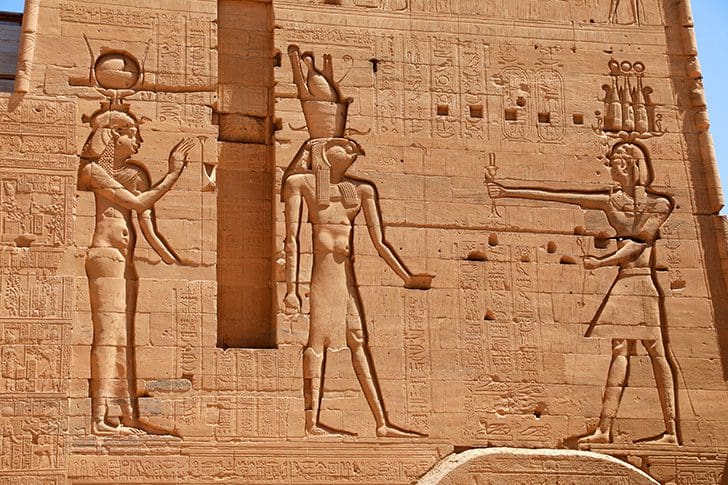
Children can tell the story of Joseph being sold into Egypt. We know it well, with nasty brothers, slave dealers, false accusations, pits of despair and drama galore. What’s most important about this story, however, may not be obvious, and that’s what we are talking about today.
You can also find the podcast on the following platforms: Anchor, Apple Podcasts, Spotify, Breaker, Castbox, Overcast, Pocket Casts, PodBean, RadioPublic, and Stitcher .
Scot
Children can tell the story of Joseph being sold into Egypt. We know it well, with nasty brothers, slave dealers, false accusations, pits of despair and drama galore. What’s most important about this story, however, may not be obvious, and that’s what we are talking about today.
Maurine
Hello, we’re Scot and Maurine Proctor. Welcome to Meridian Magazine Come Follow Me podcast where today we talk about Joseph of Egypt—the story you know well and yet may have never seen before. We will cover Genesis chapters 37-41.
If you are not familiar with Meridian Magazine, now’s the time to find us online. Meridian is updated every day with the best Latter-day Saint content. Remarkable insights on scripture, inspiring stories you’ll never forget, the church and world news of the day, a look at the world through our values as Latter-day Saints. Find Meridian Magazine at latterdaysaintmag.com. That’s mag as in magazine. Again, that’s latterdaysaintmag.com. You’ll find all the transcripts for these podcasts there as well.
Scot
Maurine, you and I go to Egypt every year leading a tour, and we tell the friends we bring with us that Egypt is another Holy Land. This is where some of the events from the lives of Abraham and Sarah happened, where Joseph came as a slave and became second only to Pharoah, where Moses led the children of Israel out of bondage, where Jesus came to escape Herod.
Maurine
Yet, we especially think of Joseph when we are there, because he is our grandfather. We are part of his family. We love to tell our Egyptian tour guide, Hany Tafeek, that we belong here because we are Joseph’s children.
Scot
Then when he came to Salt Lake and went on a tour with us of Welfare Square and saw the warehouses stacked with food as Joseph stored grain in Egypt, he said you really are Joseph’s grandchildren.
Maurine
Let’s start with some context. In our last lesson we learned that Jacob was given a new name, which was Israel, meaning “Let God Prevail.” This is a covenant name, affirming the reality that the essence of the covenant is “I will be your God and you will be my people.” With his wives, Jacob, or now Israel, has 12 sons, so the Old Testament will be the story of this posterity with their ability or failure to live the covenant and the events described will portray that. When the Children of Israel live the covenant, they will be prospered and given very specific promised blessings and, when they do not, they falter, fail, are conquered or scattered. If we miss this underlying thread which ties the Old Testament together, we miss its meaning.
Scot
We use the term “Israel” in various ways, so let’s stop to clarify that for a moment. Israel, as we mentioned is Jacob’s name, and his posterity are the Children of Israel. The Children of Israel is the lineage through which the covenant is carried, and all the faithful are either born into this line or adopted when they make their covenants. When Moses led Jacob or Israel’s descendants out of Egypt, the entire group was called the Children of Israel. Later, after the reign of Solomon, when Israel divided, the southern kingdom around Jerusalem contained two of the tribes and was called Judah. The northern kingdom, where ten of the tribes lived was called Israel. Finally, the word today also refers to the sovereign nation of Israel. We don’t want to get our “Israels” confused.
Maurine
We said that Joseph’s life was more than a story. One the one hand, it is a vivid illustration that “all things work together for good to [those] who love God’ (Rom 8:28). But we will see more as we are told again and again that God is with Joseph. Why is He with Joseph, and Joseph prospers even when the situation looks impossibly dire? It is because being prospered and protected are both covenant blessings. God is not only stronger than any circumstance, but He has perfectly orchestrated events long in advance to bless His covenant son, Joseph, and through him all the Children of Israel. The scripture here is not just to tell us an intriguing story, but one designed to teach us something of God’s attributes. He can and does engineer events to bless Joseph and all of the Children of Israel. Note this. He who has all power and is “more Intelligent than they all” can and does orchestrate events to bless and prosper his covenant children. He does the same for His loyal covenant keepers now. With the Lord things work out.
You may have seen this saying painted on to a piece of home décor. “Everything works out in the end. If it hasn’t worked out yet, then it’s not the end.”
Scot
As Genesis chapter 37 begins, “Israel loved Joseph more than all his children” undoubtedly, in part, because he had also loved Rachel, who had died giving birth to Benjamin. His father gave to Joseph “a coat of many colors” (v. 3). Now, it is easy to trivialize this and say, no wonder the brothers were jealous of him. His father favored him and he got this great outfit.
Of course, there is much more to it. Though we have sung about it and pictured it for years, the “coat of many colors” is a mistranslation. Hugh Nibley calls it “an invention,” that is found in no ancient source. He says, instead of “many colors”, it is a garment of certain marks. “This garment had belonged to Abraham, and it already had a long history…because it went back to the Garden of Eden.” There is only one, and nothing else like it.
Maurine
“Coat of many colors” is a translation from the Hebrew word ketonet passim, which means a long garment which reaches to the wrists and to the ankles. The Latin vulgate refers to it as a garment “worked very subtly with extra threads” or “special embroidery, special technique.” Nibley notes, however, that this garment has marks on it, and Jacob recognized it, though he was nearly blind, at the end of our story, when he felt the marks and recognized it as belonging to his son Joseph. (See Hugh B. Nibley, Teachings of the Book of Mormon, Vol. 3, Lecture 62).
Scholar Don Parry says that Jewish tradition “provides us with some interesting stories concerning the fate of the original priesthood garment of Adam, along with some insights into the magical properties attributed to it two millennia ago.” For example, the Book of Jasher says that Adam’s original garments were given to Enoch, and when he was taken up to God, Noah took them and brought them into the ark. When they left the Ark, Ham stole them and hid them from his brothers, and eventually they ended up with the wicked Nimrod. In the tradition, Esau battled Nimrod, killing him, took the garment and ran away.
Scot
Now, Don Parry says that “The stories of the preservations of Adam and Eve do not agree in the line through which they were transmitted,” but this is how the story goes.
“Abraham passed the garments to his son Isaac and he to his eldest son Esau. When Jacob received from Isaac the blessing intended for Esau, ‘Rebecca took the favorite clothing of her elder son, Esau, which was with her in the house. And she put it on Jacob.’ Isaac then blessed him, noting, among other things, ‘May nations serve you, and the people bow down to you. Become a lord to your brothers, and may your mother’s sons bow down to you.’ The blessing reminds us of the tradition that people bowed down to Nimrod when they saw him arrayed in the garments of Adam.
“Early Jewish commentators saw evidence that Jacob was arrayed in the garment of Adam in Genesis 27:27, where we read that Isaac ‘smelled the smell of his raiment, and blessed him, and said, See, the smell of my son is as the smell of a field which the Lord hath blessed.’ Origen reflected this view, when he cited the Genesis passage and used the term “divine garments.’” (Don Parry, Temples of the Ancient World, Rituals and Symbolism, Salt Lake City: Deseret Book).
Maurine
Hugh Nibley said, “When they placed [the garment] upon the face of Jacob, he smelled also the smell of the Garden of Eden. For behold there is not in all the earth another garment that has that smell in it.” (Nibley, Ibid.)
No matter what pieces and parts of these traditions we can rely on, what is certain is that this special garment given to Joseph from Jacob, was a one-of-a-kind and signified both birthright and covenant blessings bestowed upon him, with the attendant powers, prosperity, protection that would follow. This was not a small gift, and the brothers knew it.
It is intriguing too, that when Jacob wore the garment, the very blessing he received was that nations would serve him and that he would become a lord to his brothers, and that his mother’s sons would bow down to him.
Scot
Yes, this mirrors exactly the dreams that Joseph had. Genesis 37 notes when Joseph said:
7 For, behold, we were binding sheaves in the field, and, lo, my sheaf arose, and also stood upright; and, behold, your sheaves stood round about, and made obeisance to my sheaf.
8 And his brethren said to him, Shalt thou indeed reign over us? or shalt thou indeed have dominion over us? And they hated him yet the more for his dreams, and for his words.
9 ¶ And he dreamed yet another dream, and told it his brethren, and said, Behold, I have dreamed a dream more; and, behold, the sun and the moon and the eleven stars made obeisance to me.
We will see how prophetic these dreams are, for both on a temporal level—when Joseph is next to Pharoah in power in Egypt—and on the spiritual level—Joseph’s assignment to spiritually gather Israel, his brothers will bow to him.
Maurine
Is their anger and boiling resentment toward Joseph justified—especially at this level? It certainly does give us a disturbing snapshot of the character of these sons. Also, the birthright and covenant blessings were significant and life-changing and many among them may have considered themselves the rightful heir to these. Reuben, born to Leah, was the firstborn of the sons, but an act of immorality disqualified him for that role, though he may not have entirely accepted that.
Scot
Simeon and Levi, the two born next to Leah, may have desired the birthright, but their massacre of the Shechemites ruled them out. Judah could have argued that since Reuben, Simeon and Levi were not eligible, he could have been the one for the blessing.
Maurine
Because his mother Bilhah was considered Rachel’s property, Dan could have claimed he was Rachel’s firstborn. Gad, who was the firstborn of Zilpah, could have claimed that he had the birthright after Reuben lost it.
So the scene is set. Envy has done its work. Joseph’s brothers want to eliminate him as the source of pain and irritation in their lives. They conspire against him. Israel sends Joseph to see if all is well with them. It is a journey of about 85 miles from Hebron to Shechem, and then he must go on to the fertile and beautiful Dothan, just south of the Jezreel Valley to find them and their flocks.
You can hear the malice in their words: “Behold, this dreamer cometh. Come now therefore, and let us slay him, and cast him into some pit, and we will say, Some evil beast hath devoured him: and we shall see what will become of his dreams. ” (vv. 19,20).
Scot
Reuben spared him from being immediately slain by his brothers, but, while he is gone, the others stripped Joseph of his coat of many colors and cast him into a pit. We saw one movie portraying this scene which was heart-rending as Joseph in the pit is crying and pleading and shouting to his brothers to pull him out.
Yet, what looks like an absolute tragedy is also the perfect timing of the Lord, for just then some Ishmeelite merchantmen, heading for Egypt pass by. Judah has an idea; they can profit if they sell him as a slave, and for the price of twenty pieces of silver, they do. When Reuben returns, he rents his clothes in anguish, saying, “The child is not; and I, whither shall I go?” (v. 30)
Jacob is agonized when the brothers return without Joseph. He, too, rents his clothes in grief and announces, “For I will go down into the grave unto my son mourning” (v. 35).
Maurine
Imagine Joseph’s feelings at this point. He knows he is utterly despised of his own brothers, who watched callously as he must have screamed and cried to be carried away as a slave. Did the cruel treatment continue with the slave traffickers who had him? What were his prospects? What bottom-line despair he might have hit? After all, at this point he doesn’t know the end of the story as we do. Nobody told Joseph, sold into Egypt as a slave, that he would stand next to Pharoah one day as a ruler. Instead, the present bore upon him with all its weight and difficulty as it does on all of us. Did Joseph think God had utterly forsaken and forgotten him? Why hadn’t God reached out a hand to save him? Couldn’t God’s spirit have touched one of his brothers and made him hesitate and think “don’t do this.”
We don’t know, of course, what he thought, but the point is that we grow up hearing that if you follow the commandments, you will be blessed. That’s true. Yet, also true, is that even for the most righteous, those who go down in history for their integrity, righteousness and obedience, life can be difficult and unjust, and the Lord does not arrest the wicked to stop their actions. Joseph sees the cruelest of injustice at this moment and he will again, when we see him next in Potiphar’s house.
Yet all this was preparing him to later save his family, the Children of Israel from certain death. He had the ability to faithfully persist, firm and unshaken, through the darkest days, while all the time the Lord was leading him to a greater destiny.
Scot
Potiphar was an influential and wealthy man, the captain of the guard. When Joseph is sold to Potiphar, we are reminded again and again of the covenant blessings that are upon him. Remember the blessings of the covenant can be captured in six words that begin with “p”. These are promised land, posterity, priesthood, protection, prosperity and the presence of the Lord.
Whenever you see these words or these ideas in the Old Testament, the text is about the power of the covenant. So, Genesis, chapter 39 drives home the point. “The Lord was with him,” meaning Joseph. In verse two, the “Lord was with him” and put him with “a prosperous man”. We are told in verse three that Potiphar “saw that the Lord was with him, and that the Lord made all that he did to prosper in his hand.” We learn again that Joseph was so trusted that he became overseer in Potiphar’s house and all that he had. We’re told in verse 5 “that the Lord blessed the Egyptian’s house for Joseph’s sake and the blessing of the Lord was upon all that he had in the house, and in the field.”
Could the writer of this story make the reality clearer? Joseph is being blessed with extraordinary covenant blessings even when he is a slave.
Maurine
Clearly, Joseph was a man of spectacular integrity and character. That people could immediately see. What’s more remarkable, is whatever devastation the hatred and betrayal of his brothers had wreaked, Joseph’s soul had not become cankered or corrupted, and he still utterly trusted in the Lord. What this suggests is that this utter trust in the Lord and His promises, fundamentally alters the tragedy and challenges we might face along the way. You want to have a better life? Trust the Lord and don’t resist the challenges you face. He will hold your hand and walk you through.
Yet, now there is a malevolent twist to the story for Potiphar’s wife had eyes for young Joseph for the scriptures reminds us that “he is a goodly man and well-favored.” (v. 6). She seeks to seduce him, not once, but day after day. This again is an interesting note, because our temptations don’t come just once. The Adversary wants to wear down our resolve piece by piece and strand by strand. What we can resist at first may be much harder with incessant temptation, especially at a place where we are vulnerable.
Scot
Joseph, who is so trusted, tells Potiphar’s wife, “There is none greater in this house than I; neither hath he kept back any thing from me but thee, because thou art his wife: how then can I do this great wickedness and sin against God?” One day she is even more aggressive, and as he flees from her, she grabs his garment and it is left behind.
This is one of those seminal moments in scripture that tells how to be. We must not court temptation, or play with it, or suppose that everyone else is doing it, so why can’t I? Like Joseph, instead of falling we must flee. We must run from any power that would corrupt or undermine our souls, which are so precious. I had a bishop in college who described this as the “Get the heck out of there principle,” only he used a stronger word. When you are tempted, be as Joseph and get out.
Maurine
This reminds me of an experience you had when you were a teenager living in Turkey.
Scot
Yes. My friends and I traveled from Turkey to the Holy Land for two weeks together to see the wonderful sites and significant places in the area. One Friday evening, which was the eve of the Sabbath, we wanted to find some really fun place to visit in Jerusalem. This is before I knew much about what Shabbat eve meant to the Jews, and, of course, everything was closed and there was apparently nothing to do. So the ten of us went walking, looking for a place to go. It was late and it was very dark that night. We were in a new place to us and we didn’t know where we were going and we were a little bit scared.
In our wandering we went around the south end of Jerusalem, outside of the city walls where we had been told that there was this amazing Tibetan teahouse, that was supposed to be really fun and still open. As we walked, every time there was a little rustling in the weeds or a wind came up and moved a branch of the tree, the girls screamed and all of us were getting nervous because we didn’t know where we were or where we were going. We walked perhaps three miles in the fearful dark of a strange place.
Finally, the ten of us were met by an Israeli who was driving a military jeep. He stopped because he saw that we were out late at night, and he didn’t think it was particularly safe. He said, “Where are you going?” We answered that we had heard there was a Tibetan tea house somewhere near by in this village, but we could not find it. He said, “I know right where it is, and I’ll take you there.”
So all ten of us hopped in the back and on the sides of his military jeep, and he drove us to the Tibetan teahouse. We got out of the jeep, thanked the Israeli soldier and made our way to the door, which was a series of curtains or beads. Inside, many people were sitting on rugs on the floor with hookahs and smoke filled the room. In the corners, various couples were entwined with each other. I knew immediately that I was not supposed to be there.
None of my friends were members of the Church, so this was a very awkward situation for me. We sat in a circle on one of these rugs, and everyone was ordering tea. I ordered a Schweppes orange. But the thing that was happening to me, nobody knew. My heart was pounding, and I knew had to leave. Everything about that place bespoke darkness. Everything said this is not the place that a good member of The Church of Jesus Christ should be. I was 17-years old, and I wondered if I could walk all the way back to our youth hostel in Jerusalem by myself. It had been a long and scary walk to get there, and I just wasn’t sure I could make it all the way back alone or find my way there without directions. But I knew without any doubt that I had to leave.
As soon as the drinks came, I quickly drank my orange soda and I whispered to the girl next to me that I was going to leave and I would meet them back at the youth hostel. This was a brave thing to do and I felt utterly alone and frightened as I stepped out in this dark, moonless night. I
hadn’t gone far when I was accosted by a very large black dog coming right toward me. I prayed, “Please help me and let this dog not notice me.” The dog walked right by me, and even brushed up against the side of me, but he didn’t snarl or growl or even turn his head when he walked by. I felt like the Lord had made me invisible to him.
I continued until I found the main road that was on the eastern side of the walls of Jerusalem, but by this time I was so frightened that I stopped and said a prayer. I looked up in the heavens and I saw all the stars. I had often prayed to the clear skies at night when I was growing up on my farm in Missouri, and so I prayed again. “Heavenly Father, I felt a strong impression that I needed to leave this place, and now because I followed my impression, I need to be helped and blessed with courage and with strength to overcome the fear of being alone. I closed that simple prayer in the name of Jesus Christ, Amen, and the second I said amen the most amazing feeling of peace came over me. It started at the top of my head and went all through my body, and I started to feel so happy. I started to sing songs from Fiddler on the Roof and also songs from our hymn book. The more I sang, I started dancing in the street because there were no cars that late at night, and I looked up in the heavens and I felt the most amazing overwhelming feeling of peace. It was just a glorious experience. I found my way back to the youth hostel. It took me well over an hour, but I was truly blessed and I felt like following that prompting was one of the great lessons of my life.
Maurine
Joseph set the example by running from temptation, but the consequences were dire. The wife falsely accused Joseph to Potiphar, and he was immediately taken and put in prison. You would think with this accusation, that Joseph would have been put to death instead of sent to prison, but I’ve often thought, Potiphar knew the character of both his wife and Joseph, and there was such a stark contrast between them in integrity. I assume that Potiphar was not fooled, but had his hands tied in sending Joseph to prison.
Now, of course, the covenant promise is still with Joseph, as it always will be. Note how it is said in Genesis 39. “But the Lord was with Joseph, and shewed him mercy and gave him favour in the sight of the keeper of the prison” (v. 21). Joseph was put in charge of the prisoners and, of course, we are reminded again—in case we missed it, “the Lord was with him, and that which he did, the Lord made it to prosper” (v. 23).
These are stories and scriptures for covenant people. This is who you are, says the Lord, and this is what I will do for you.
Scot
Joseph has a gift to interpret dreams and when the king’s butler and the baker have offended him and are thrown into prison, this will be supernally important. Of course, this is a spiritual gift given to Joseph specifically for the events ahead.
The butler and the baker each dream a significant dream, which no one can interpret. The butler dreams of three vines, which bring forth ripe grapes, and he took the grapes and pressed them into Pharoah’s cup. Joseph tells him that this means that in three days he will be restored to his place in Pharoah’s court. The baker’s dream, unfortunately, does not have such a happy ending. The baker dreamed that he had three baskets on his head filled with bakemeats for Pharoah and the birds came and ate them. Pharoah is going to put the baker to death.
Joseph asks the butler to please remember him when he is back in court, but, he is forgotten until Pharoah himself has a significant dream.
Maurine
The scriptures remind us that some dreams are revelations, and this is sometimes the method God uses to talk to us. The Lord spoke to Lehi in a dream and warned him to take his family and leave Jerusalem. To protect the Christ child, Joseph was given a dream that he must take Mary and the baby and flee to Egypt. That pattern is sure.
Here is a story from an article Anne Pratt wrote on Meridian Magazine, “While on his mission, Jason Campbell had a revealing experience with an investigator who had a stunning dream. He writes,
“On my mission to Argentina we met a good man at his door, and he asked what church we were from and if we were Mormon. Before I could answer yes, my companion stuck his arm out to stop me and said, ‘The Mormon church does not exist. We are from the Church of Jesus Christ!’ The man got very excited and invited us in and we had the most amazing discussions with him because he was so spiritually prepared.
“He told us that two years earlier he had had a dream where an angel had come to him and told him that two missionaries from the true church would be sent to his home and he was to ask what church they were from and if they said anything but the Church of Jesus Christ he was not to let us in. He had waited for two years for us to arrive. He embraced the gospel, was baptized along with several of his daughters.”[2]
This dream so touched this man that he watched and waited until his dream was fulfilled and was gathered into the Gospel ‘net.’” https://latterdaysaintmag.com/profound-and-prophetic-dreams-sent-to-help-gather-israel/
Scot
Joseph was 17 years old when he was sold into Egypt, and now he is 30. He has spent a combined 13 years working in Potiphar’s house and being in prison. It must have felt like a lifetime. I can think of no better example of spiritual greatness than Joseph, falsely accused, thrown into prison and, believing that is his lot for life, waits patiently on the Lord without bitterness or blaming, resentment or resistance to God. But God had a plan.
Two years after the butler was returned to his place, Pharoah had a dream that disturbed and weighed upon him and for which all the wise men of the kingdom had no interpretation. It is surprising that this priestly caste in Egypt could not have devised a logical explanation.
Maurine
Pharoah dreamed of seven fat and well-favored cows that came out of the river to feed in the meadows, followed by seven ill-favored and lean-fleshed cows that ate the seven fat ones. Next, he dreamed of seven good ears of corn that grew up on a stalk, followed by seven thin ears that were blasted by the east wind. Then the seven thin ears devoured the seven full ones.
When the Pharoah was so troubled that he did not know the meaning of the dream, at last the butler remembered the man in the prison who had the gift of dream interpretation. Joseph was brought before Pharoah who asked the meaning of his dream. In all these 13 years, Joseph has not forgotten from whence his blessings came. He told Pharoah, “It is not in me: God shall give Pharoah an answer of peace” (v. 16).
Scot
Joseph explained that this dream was of primal importance. There would be seven years of plenty followed by seven years of famine and “it shall be very grievous” (Genesis 41:31). If famine hasn’t been in our experience, we can hardly imagine it. I remember seeing a baby who was dying of starvation in Haiti after the earthquake, so weak he couldn’t cry. Famine is grievous, but there was a way to prepare for this by storing grains during the seven years of plenty. Pharoah recognized the significance of what he must do.
“And Pharaoh said unto his servants, Can we find such a one as this is, a man in whom the Spirit of God is?
“And Pharoah said unto Joseph, Forasmuch as God hath shewed thee all this, there is none so discreet and wise as thou art“(v. 38,39).
Maurine
Joseph is installed as second only to Pharoah. “And he made him to ride in the second chariot which he had; and they cried before him, Bow the knee and he made him ruler over all the land of Egypt” (v 44). Joseph is given a new name which is Zaphnath-paaneah, which means among other things, “savior of the world,” the “giver of the nourishment of life,” and “revealer of a secret.” (See Alonzo Gaskill, The Lost Language of Symbolism, Salt Lake City: Deseret Book).
He is also given Asenath, the daughter of the priest Potipherah to marry. Together they give birth to twins Ephraim and Manassah.
Scot
Now Asenath matters to us, because for many she is also our grandmother. Who was she? That question has been debated for centuries. There are two Rabbinic traditions about Asenath’s descent. The first is that she is an ethnic Egyptian who converted to the Lord and raised her children in the faith. The other is that she is not Egyptian, but a member of the family of Jacob, being the daughter born to Dinah after she was abused by Shechem, son of Hamor. In this tradition, Jacob’s sons wanted to kill the infant, but Jacob brought a gold plate and wrote God’s name on it and hung it around her neck, and she was brought by an angel to the home of Potiphera, whose wife was barren and she raised Asenath as her own daughter. The point is, in either tradition that all was foreseen and planned by God.
So when the famine spread over “all the face of the earth” Joseph opened all the storehouses “and all countries came into Egypt to Joseph for to buy corn; because that the famine was so sore in all lands” (v. 57). Joseph, who withstood real hardship, with such spiritual power had been moved into place to save the Children of Israel.
Maurine
That’s all for today. Find the transcripts for these podcasts at latterdaysaintmag.com/podcast. Next week we’ll study Genesis 42-50. Thanks to Paul Cardall for the music and to Michaela Proctor Hutchins, our producer for this show.
“I Will Be Thy God”—Genesis 28-33
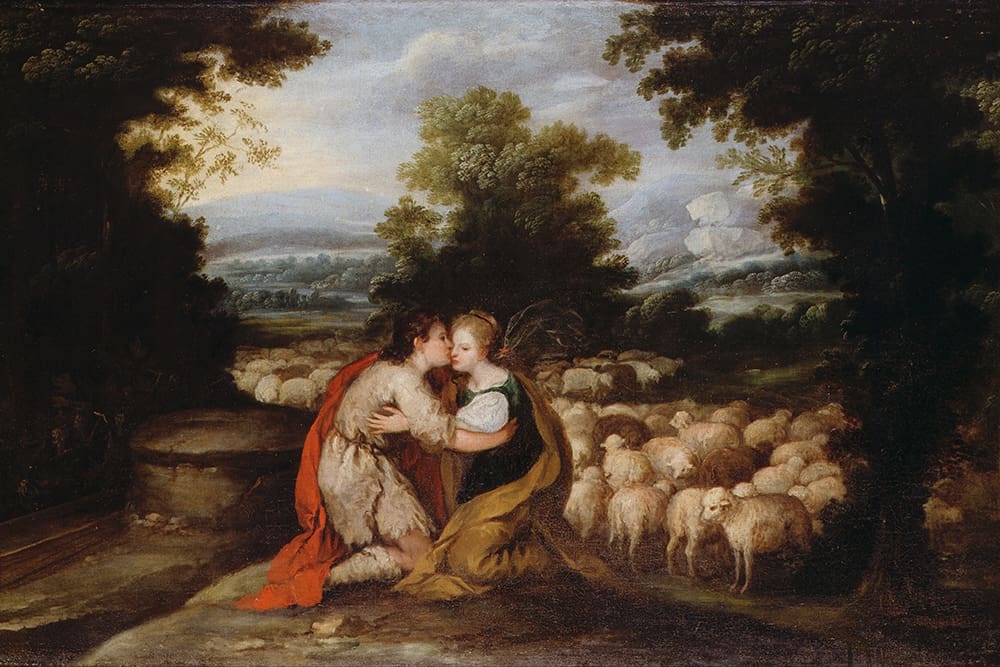
Scot
The story of Jacob in the Bible has all the elements of high drama. True love thwarted, family division, a deceiving father-in-law, a tight escape. If it was a movie you’d want to watch it, but it’s much better than a movie because over arching all, it is the story of the covenant in the lives of real people.
Maurine
Hello, we’re Scot and Maurine Proctor and this is Meridian Magazine’s Come Follow Me podcast, where today we’ll talk about Genesis 28 through 33, titled “Surely the Lord is in This Place”
The Bible covers two thousand plus years of history in 12 chapters and then zeroes in on Abraham, Isaac and Jacob and their posterity for the rest of the 1, 184 pages for this reason. The Old Testament is about the covenant blessings and obligations as they play out over generations. The idea is to teach us what this covenant is, what it means, and the consequences of purposely turning your back on it. We hear of the blessings of Abraham, Isaac and Jacob, and the God of Abraham, Isaac and Jacob, but we could say instead: the God of Abraham, the God of Isaac, and the God of Jacob, because the renewal of the covenant was made afresh with each one. Even if you are born in the covenant, it is not an entitlement. Ultimately this is a promise that each has to choose and live worthy of.
Scot
The covenants we make in the temple are consistent with these ancient covenants. Though the delivery may have been modified somewhat, our covenants have these ancient origins. That is what makes the Old Testament so particularly relevant to Latter-day Saints. We understand the power and blessing of covenants better as we see them play out in the lives of individuals and nations.
The new and everlasting covenant existed before the creation of the world. When we understood that to advance meant that we would be cut off from God’s presence, it is the new and everlasting covenant, through the atonement of Jesus Christ, that would allow our return in a higher and holier state. This is why the covenant is everlasting.
Maurine
Kerry Muhlestein notes, “Once they lost the presence of God, [Adam and Eve] must have felt an immediate and keen need for assurance that they could once again regain it in some way….It is powerful and striking to realize that so soon after separation from Humankind, God was willing to bind Himself to us.” Take note of that. Here we are in a fallen world, where the influences we swim in are corruption, misinformation, and we can’t remember who we are, but the Lord says, “I will take your hand.” This is just like you would do with a child when you came to a busy road. You would take their hand and safely walk them across.
Muhlestein said, After Abraham’s day there is an iteration to the covenant. “Anyone who wanted to be part of the covenant would have to become part of Abraham and Sarah’s seed. Covenantal blessings would focus around Sarah and Abraham’s descendants [or those who were adopted in] from this time forward.” (Kerry Muhlestein, Let God Prevail, Salt Lake City: Deseret Book).
Scot
As with Abraham and us today, Jacob seems to have received the covenant blessings in stages or steps. Remember that when Rebekah was about to give birth to twins, Esau and Jacob, the children were struggling in her womb, and she sought the Lord to understand. He told her that “Two nations are in thy womb, and two manner of people shall be separated from thy bowels; the one people shall be stronger than the other people; and the elder shall serve the younger” (Gen. 25:23). She knew by revelation that Jacob was to receive the covenant blessing.
They were very different sons. Esau was red and hairy and “a cunning hunter” and “Jacob was a “plain man, dwelling in tents” (Gen. 25:27). Isaac preferred Esau, and since he was the older of the twins, intended to give him the birthright blessings. In this case, Rebekah received a revelation that Isaac had not received, and remember in chapter 27, she creates an elaborate ruse to assure that Jacob receives the blessing. The wives of the patriarchs played a responsible role in assuring that the son God had chosen received the birthright as well as the blessings of the covenant.
Maurine
Though in many ways, Esau seemed to disregard the birthright blessings, and was willing to sell them for a mess of pottage, still there is a plaintive moment when Esau learns that Jacob now has both the birthright and this covenant blessing. Esau cries with “a great and exceeding bitter cry, and said unto his father, “Bless me, even me also, O my father” (Gen 27:34). He feels twice cheated. Esau hates Jacob and resolves to kill him. This is the set up to understand today’s lesson, but first an aside.
There are some interesting parallels in the covenant stories of Abraham, Isaac and Jacob, and the story of Joseph fits some of these as well. First, the oldest in the family is to be the birthright son, yet, traditions tell us that Abraham was a younger son, so was Isaac, and so was Jacob. This fits Joseph as well, who was the oldest son of Rachel, but not the oldest son of Jacob. Second, in every case, there was a threat to their lives. Abraham’s father, Terah tried to have him sacrificed, Isaac was taken to be sacrificed, and Jacob’s brother purposed to kill him. Of course, Joseph’s brothers tried to kill him. Third, each of them found refuge in a foreign land. Fourth, Abraham, Isaac and Jacob all had wives who were barren, which was a great irony considering that the covenant blessings were to go through the family line. Fifth, in each case the wives finally conceive through the power of God. Finally, the wife designates the birthright son. This is because the matriarchal line is as important as the patriarchal line and, Sarah, Rebekah, Leah and Rachel were also specifically chosen by the Lord.
Scot
Of course, we know that the importance of the birthright going to the first born was that this was in similitude of the Lord Himself, who is the firstborn of the Father. How can we explain, then, that Abraham, Isaac, and Jacob were not their father’s firstborn sons?
James Ferrell makes an intriguing point about this: “The rule itself can be thought to be in similitude of Christ’s spiritual role and identity. By contrast, exceptions to the rule can be thought to be in similitude of Christ’s temporal role and identity. That is, the one who would come as Messiah would not come in the way most would expect. He would not be mighty in appearance or in political or military power. He would be a Savior who to the spiritually undiscerning would appear unable to save even himself—one whom Isaiah described as having ‘no form nor comeliness; and when we shall see him, there is no beauty that we should desire him . . . despised and rejected of men . . . esteem[ed as] stricken, smitten of God, and afflicted.’ In short, the Savior of the world would not be great in the eyes of the world. He would come in a form that was unexpected, and his lowly station in life would hide his divine origin and mission from those who were without faith. He was, as it were, in the eyes of the world, the younger son—one without station or claim to position or greatness.”
Maurine
Ferrell continues: “One reason the eldest son, birthright rule may have been created was to emphasize the exception to the rule, in order to communicate a central truth about the Lord’s identity. The exception also communicates a central truth about our own identity: Exaltation does not come as a matter of right, whether by physical birth or by religious affiliation. Using the birthright convention metaphorically, being an ‘eldest son’—either because one comes from a certain lineage, for example, or simply belongs to a certain faith—does not entitle one to the blessings of the firstborn. Such blessings come through being born again in Christ, whereby we become members of the ‘church of the Firstborn,’ and therefore become joint-heirs with him.
“Failure to understand the relevance of the exceptions to the rule led many at the time of Christ both to miss who he was and to misunderstand who they themselves were. Mere membership in the family of Abraham did not entitle them to his blessings. The blessings of heaven did not come then, nor do they come now, merely by blood or paper membership in any lineage or church. Rather, the blessings of heaven come to those who, to the best of their abilities given the knowledge they possess, come unto Christ.” (James L. Ferrell, The Hidden Christ: Beneath the Surface of the Old Testament, Salt Lake City: Deseret Book).
Scot
As Genesis 28 begins, Jacob is leaving his home in Canaan to travel north to Haran, to find a wife among his mother’s family. He has been charged specifically by his father, Isaac, “not to take a wife of the daughters of Canaan” (Gen 28.1), and with this discussion of the covenant, we can see why this matters so much. Through his family, through all his posterity, the covenant has to be carried, and so he cannot marry outside of the faith. On his parting, this time without being tricked, his aged, and nearly blind, father, Isaac, offers this blessing: “Give thee the blessing of Abraham, to thee, and to thy seed with thee; that thou mayest inherit the land wherein thou art a stranger, which God gave unto Abraham” (Gen. 28:4).
Yet, it is not just to marry that Jacob leaves. He also has to escape his brother Esau’s wrath because he has vowed to kill him. Jacob’s life is endangered and he must escape.
Maurine
On his journey, Jacob gets to make his own personal and conscious choice to be a part of the covenant. One night he took a stone for a pillow and lay down to sleep when he had a dream of a “ladder set up on the earth and the top of it reached to heaven: and behold the angels of God ascending and descending on it” (Gen 28: Gen. 28: 12). This is a symbol of the way from earth to heaven that consists of steps, gradually leading to the presence of God. It is a symbol of the temple experience where knowledge is given and commitments are made, line upon line, so that participants can become eligible to be with God again.
Jacob understood the covenants he made with God were the rungs on the ladder and to obtain the promised blessings, he too would have to climb. The Lord and Jacob exchanged covenants as we still do in our modern temples.
Joseph Smith connected Jacob’s revelation to the experience of Paul, the Apostle. He said, “Paul ascended into the third heavens, and he could understand the three principal rounds of Jacob’s ladder—the telestial, the terrestrial, and the celestial glories of kingdoms, where Paul saw and heard things which were not lawful for him to utter.” (Joseph Smith Papers, “History, 1838–1856, volume D-1,” 1556).
Scot
The Lord promises Jacob as part of the covenant, “I am with thee, and will keep thee in all places whether thou goest…I will not leave thee, until I have done that which I have spoken to thee of” (Gen. 28:15), and Jacob answers, “If God will be with me, and will keep me in this way that I go…then shall the Lord be my God” (Gen. 28:20). If you really want to understand what a covenant is, there is the very center point, the very essence. God says “I am with thee…I will not leave thee” and the one who covenants, “Then shall the Lord be my God.” The covenant foremost is about your connection to God. When you promise to let Him prevail in your life, He reshapes and transforms you to dwell with Him.
With that promise, if you have made covenants, you have no need to feel unsafe, alone or neglected in a dangerous world. You are in a safe place. Maurine always says, “You are not insecure. You only think you are.” If we could only truly comprehend and believe this covenant promise from the Lord, “I am with thee…I will not leave thee,” our entire lives would be different.
Maurine
When Jacob arose the next morning he said, “Surely the Lord is in this place; and I knew it not.” Sometimes we could say, “Surely the Lord is in my life, and I knew it not.” Jacob exclaims, “How dreadful is this place” (Gen. 28:17). By this he means, how awe-inspiring or holy is this place. It is the very “gate of heaven”. He sets up that stone he had slept on for a pillar, “poured oil upon the top of it” (v. 18), and calls the name of the place Bethel. In Hebrew, “Bet” means house and “el” is the name of God. He calls this sacred place the house of God, or the temple.
Jacob paid a tithing, as did Abraham before him, demonstrating just how ancient this practice is.
An interesting side note is that in legend, Jacob’s stone, sometimes called Jacob’s pillow or the Stone of Scone [pronounced Skoon] made its way to Ireland, Scotland and finally to Westminster Abbey, where it was stolen and now is back in Scotland again. Ancient Gaelic kings were crowned sitting on this stone so great waves of mystery surround it. Could this stone, now held in Edinburgh castle be the real one? Despite all the lore around it, the answer is probably not.
Scot
Jacob continues his journey and finally comes to the well of Laban, his mother Rebekah’s brother and son of Bethuel. A well is the center of life and camaderie in any ancient land, and it was a back-breaking job to water the animals. Water rights were protected by covering the well with a heavy stone which usually required the heft of several men to move it.
Now a scene unfolds that deserves to stay alive through history as Rachel comes to the well, and we have the sense that Jacob fell quickly for this “beautiful and well-favored” young woman. Jacob gives her a kiss, as any kinsman would do, but it seems probable that he was a homesick young man who felt gratified that the Lord had led him to this very well and a kinsman.
Significant meetings at a well recur in scripture. Of course, we think of the meeting of Abraham’s servant with Rebekah; Moses’s meeting with the daughters of Jethro, where he will find his bride, and we remember the Savior meeting with the Samaritan woman at a well. A well symbolizes a source of life. Christ is the living water, so, of course, these life-giving events happen there.
Maurine
As is the case with many of these encounters with women at the well, the hero of our story, Jacob, is brought to Laban’s home. Unlike Abraham’s servant who had come before with camels laden with gifts to find Rebekah for Isaac, Jacob is essentially on the run from his own country and penniless. The contrast is clear.
He works for Laban a month and then a deal is struck. Here are the romantic, yearning ways the scripture describes it. “And Jacob loved Rachel; and said, I will serve thee seven years for Rachel thy younger daughter…And Jacob served seven years for Rachel; and they seemed unto him but a few days, for the love he had to her. (Genesis 29:18)
Here is a story among our covenant parents of devotion and loyalty. Stephen C. Walker wrote, “It’s easy not to notice; there’s much more than we’re see in those twenty-one simple words condensing seven years. But the force of that titanic tribute to the attractiveness of Rachal and the gallantry of Jacob and the power of the human soul for enduring loyalty is almost totally missed if you miss the unwritten detail between those lines, if you fail to put ourself imaginatively in Jacob’s sandals herding goats and sheep in some place…for seven long sun-withered, wind-blasted, grit-flavored, sheep-stinking, backbreaking years of your own ardently impatient youth.” (Steven C. Walker, “Between Scriptural Lines.” Ensign, Mar. 1978, (62-73).
Scot
Life was about to become more complex, because Rachel had a sister named Leah, and a father who found a way to go back on his word.
Camille Fronk Olson said, “Ancient Jewish commentary “claims the girls were fraternal twins and that their marriages to their twin cousins Esau and Jacob were arranged by Rebekah and Laban from the time of the girls’ births. . . . Another Jewish tradition explains that Leah’s ‘tender’ or weak eyes were the result of continual weeping over a marriage contract that promised her to the wicked Esau. . . . The Bible gives no suggestion that any jealousy existed between the two sisters before their marriages. The implication is that Leah and Rachel were close confidantes who shared hopes and dreams for their future families” (Olson, Women of the Old Testament, Salt Lake City: Deseret Book, 67).
Suitors had apparently come for Rachel previously, but we see no indication that any had come to pay the bride-price for her less attractive sister, Leah.
Maurine
Somehow, you feel to weep for both of them as we know what happens. After all this love, all this devotion, all this sweaty, uncompromising work from Jacob, on the bridal night, Leah is switched for Rachel. Olson comments, “The week-long wedding celebration began with a feast attended by members of the larger clan and community. The scriptural narrative does not furnish any clue for whether Leah had the role of bride all week long or just before the official ceremony. Most likely, the dark of night and the bride’s veil prevented Jacob from detecting Laban’s strategy of substituting his elder daughter for the younger as the bride until after their first night together.
“The biblical text reports Jacob’s anger and dismay when he discovered the deception, but no mention is made of the response of Leah or Rachel (Genesis 29:25). What did they think about their father’s marriage schemes for them? Why did the sisters go along with the plan? Did they have a choice?”
Scot
This deception that Laban thrust on Jacob, Rachel and Leah will produce untold pain, division and complexities in this family. Two points intrigue us here.
First, When Jacob learned that Laban had given him Leah instead of Rachel, he says, “What is this thou hast done unto me? did not I serve with thee for Rachel? Wherefore then has thou beguiled me? (Gen. 29:25). Jacob answers him very tellingly, “It must not be so done in our country, to give the younger before the firstborn” (Gen. 29:26).
Jacob has been deceived, and the point here is around the idea of “first born”. Rebekah had it revealed to her that Jacob was to receive the birthright and covenant blessings, but she and Jacob had accomplished it by trickery, though Isaac later confirms his blessing. Now the deceiver is himself deceived, which is indeed a bitter lesson. Jacob had resorted to a ruse, unwilling to let the Lord give him his blessing in His own time and way. With his mother, he had taken matters into his own hands. Was that wrong or inspired? I have always thought it was inspired, but it brings up an interesting parallel.
Maurine
Robert Alter comments: “It has been clearly recognized since late antiquity that the whole story of the switched brides is a meting out of poetic justice to Jacob—the deceiver deceived, deprived by darkness of the sense of sight as his father is by blindness, relying, like his father, on the misleading sense of touch. The Midrash Bereishit Rabba vividly represents the correspondence between the two episodes: “And all that night he cried out to her, ‘Rachel!’ and she answered him. In the morning, ‘and,…look, she was Leah.’ He said to her, ‘Why did you deceive me daughter of a deceiver? Didn’t I call out Rachel in the night, and you answered me!’ She said: ‘There is never a bad barber who doesn’t have disciples. Isn’t this how your father cried out Esau, and you answered him?’”
Second, Nahum Sarnia points out “retributive justice is not the only motif. Just as Jacob’s succession to the birthright was divinely ordained, irrespective of human machinations, so Jacob’s unintended union issued Levi and Judah, whose offspring…[sustained] the two great institutions of the biblical period, the priesthood and the David monarchy.” Most important is that from Leah, through Judah, would come the lineage of the Savior. The Lord’s plan is not thwarted. (Jeffrey M. Bradshaw, “What are We to Make of Jacob’s Apparent Deceitfulness.” https://latterdaysaintmag.com/what-are-we-to-make-of-jacobs-apparent-deceitfulness/).
Scot
Camille Fronk Olson notes, “Written marriage contracts were customary throughout the ancient Near East. Before the wedding day, the groom and the bride’s father (or his representative) signed the contract containing all the accepted negotiations. Consequently, Jacob held a solid legal claim against Laban for failing to meet his commitments in the contract and therefore could have been released from his marriage to Leah. Reflecting his weakened position, Laban proposed an appealing solution the moment Jacob accused him of duplicity. If Jacob would give Leah her due attention during the full bridal week, he could also marry Rachel. Furthermore, Laban did not require Jacob to wait until the negotiated seven additional years of labor were completed before relinquishing his second daughter to him, again indicating Laban’s awareness of his vulnerable position.”
“The only evidence of dowries for Leah and Rachel from their father at the time of their weddings was the gift of a handmaid to each of them. Laban gave his servant Zilpah as a handmaid to Leah and his servant Bilhah to Rachel (Genesis 29:24, 29). No mention is made of any inheritance for them. Years later, when Jacob and his family finally left Haran, Leah and Rachel’s lack of inheritance became an important issue.” (Olson, Women of the Old Testament, Salt Lake City: Deseret Book).
Maurine
This family will have to live with the high emotions of the deception. Jacob and Rachel are sweethearts and Leah is an obligation. Remember that the Lord had told Jacob, “I am with thee, and I will keep thee,” which is exactly what He says to us through our temple covenants. It’s clear, however, that this doesn’t mean that Jacob’s life is without the most wrenching challenges.
It is good to realize that the Lord can be with us, accomplishing his purposes with our lives, and we may still wade through heart-breaking realities. He does not always soften his necessary schooling, but He will hold on to our hand if we submit.
Now we have two sisters, as well as Jacob, who are pulled crosswise by family dynamics. We have no indication that the sisters had been at odds before, but now we have this crack based on a withering reality. Jacob loved Rachel more than Leah. The scriptures suggest that “the Lord saw that Leah was hated”, and so he “opened her womb” (Genesis 29: 30-32).
Scot
“Hated” is a strong word, which may be overstated here. What seems to be true is that he discounted her, valued her less, ignored her, was blind to her. Olson notes: “In this way, Leah represents those whom God loves, even if no one else seems to. Others may not have been sensitive to Leah’s rejection, but God certainly was. His compensatory care and blessing led her to deeper faith and greater reliance on Him. Leah eventually bore six sons and one daughter. The names she chose for her sons reflect her growing realization that she needed the Lord’s grace and enduring love more than her husband’s attentions and an elevated position in the family. Her sons’ names also serve as reminders of our need for Christ, the Son who opens our communication so that God hears us, joins us to the Father with His At-one-ment, and deserves our eternal praises for His sacrifice on our behalf.
“By contrast, the beautiful Rachel was surrounded by Jacob’s love and attention but bore no children. Her cry, “Give me children, or else I die,” gives painful reality to the void in her life (Genesis 30:1). Her husband’s love and visible gifts did not provide an escape from serious disappointment and trials of faith. As He did for Leah, the Lord would also lead Rachel to where only He could help her. Jacob’s angry response to his beloved wife indicates his realization of the same truth (Genesis 30:2). Rachel, Leah, and Jacob all endured uncertainties and adversities which led them to acknowledge that God was their foundation.”
Maurine
Two words are juxtaposed in this story. The one is barren, which in this case means Rachel has not been able to have children. But the hard, dusty, bewildering struggles of our lives can make us all feel barren. We can become barren of hope, barren of faith, lonely and unable to find solutions to the problems before us. The complexities of life dash us and sometimes when we need to know the Lord has heard our prayers, we only hear an echo of our prayer coming back to us in a hollow room. We feel barren and dashed when what we want the most is what escapes us, when the miracle we need right now is undelivered and we are left with ashes. Rachel struggled with barrenness, but so did Leah. Feeling unloved is being barren.
When a woman who hopes to be a mother is barren, her disappointment rains upon her regularly, monthly. She is dashed to weeping regularly. But other kinds of barrenness have that same effect. Barrenness leaves you thirsty and withered in waves of heat that break upon your well-being. In Rachel’s case, she believed that the Lord had purposely withheld this blessing from her, that perhaps she was unworthy.
So the word that goes with “barren” here is “wrestled.” The King James version of the Bible quotes Rachel saying, “With great wrestling have I wrestled with my sister”, but many other translations take it farther. They write that Rachel said, “The wrestlings of God have I wrestled with my sister.” She seems to be expressing here an inner conflict, not understanding why the Lord is withholding a blessing from her. This wrestle to come to know God and how and when He gives and doesn’t, how and when he reveals and doesn’t, is common to a life where our thoughts and understandings are so different than His. Just talk to me, we sometimes plead. Will thou just talk to me? Relieve me. Help me.
Scot
From our vantage, reading these ancient stories we want to say, “Oh Rachel. Have faith and hold on. From you will come Joseph who will save and bless the entire House of Israel.” And “O Leah, you are remembered. You are the mother of the sons from whom spring so much of the House of Israel. From your son Judah, the Messiah will be born.” But when you are in that minute, you don’t know the big picture or see God’s purposes.
Peter said of Christlike attributes, “For if these things be in you, and abound, they make you that ye shall neither be barren nor unfruitful in the knowledge of our Lord Jesus Christ” (2 Peter 1:8). Sometimes it is only the need from that very barrenness that awakens us to know God. Our barrenness can be a blessing to drive us to Him as we realize no one else can really help.
Maurine
After Jesus’s birth, when Herod killed the children of Bethlehem, we see that the longing of Rachel still touches the racial memory of Israel generations later. In Matthew 2: 18, we read, “In Rama was there a voice heard, lamentation, and weeping, and great mourning, Rachel weeping for her children, and would not be comforted, because they are not.”
Olson notes, “For the patriarchs, a son was the assurance of the continuation of God’s covenant with Abraham…Rachel’s plea, ‘Give me children, or else I die’ (Genesis 30:1) was more than an instinctive maternal desire but was a profound longing to fulfill her responsibility to continue the Abrahamic covenant.”
Scot
In this quest for children, Leah would ultimately give Jacob her servant Zilpah and Rachel, would give her servant Bilhah to be additional wives. Between the four of them they would give birth to twelve sons whose posterity are the Children of Israel. We have this tender verse describing when Rachel conceived, “And God remembered Rachel.” So much tenderness is expressed in that. The scriptures say, “God hearkened to her and opened her womb.” When she gave birth to her son she named him “Joseph”, which means “He shall add,” or even more significantly, “He shall gather.” We love those moments when we feel that God has remembered us. In reality, He does not need to remember, because He is always with us.
Jacob was with Laban 20 years, 14 years working to obtain his wives and another six working for Laban taking care of his flocks. We get a glimpse that Laban was a sly character in that he changed Jacob’s wages 10 times, and not in his favor. It was time for Jacob to leave, “Send me away, that I may go unto mine own place, and to my country,” Jacob said, but Laban resisted. “I have learned by experience that the Lord hath blessed me for thy sake” (Gen. 30: 25, 27). Still, Laban agrees to give Jacob his wages.
Maurine
Jacob proposed that his wages shall be all the “speckled, spotted, and ringstraked animals”, in other words the animals of abnormal color and more of a rarity. He goes through the flocks and separates those out, keeping Laban’s flocks separate. But God is with him and Jacob flourishes as his cattle and herds grow in strengths and numbers. This not only angered Laban’s sons, we are told that “Jacob beheld the countenance of Laban, and behold, it was not toward him as before.” The Lord tells Jacob, “Return unto the land of thy fathers.” It is time to go. (Gen. 31: 1-3).
Jacob came empty-handed to see Laban, but he leaves flourishing, both in family and in wealth. Just as God opened the womb of Rachel so she could deliver a child, so did God prosper Jacob. An angel came to him in a dream and told him exactly what to do to prosper with the flocks and herds. This story is clearly about the covenant blessings. Covenants will not erase hardship and real struggle from life. Our covenant father, Jacob, had to take an arduous journey, put himself at risk often, the journey was part of God’s purifying and sanctifying way for him. But the covenant children are blessed and sanctified by their hardships. They are prospered and changed. God even prepares Jacob’s way by sending an angel to Laban’s dream, warning him, “Speak not to Jacob either good or bad” (Gen. 31:24).
Scot
Imagine that journey south toward home in Canaan. Jacob has flocks and herds, wives and children, men and maid servants, and some anxiety.
Now, Jacob must face Esau again. Is Esau still boiling in anger? Does he still want to kill him? Jacob beseeches the Lord, “Deliver me, I pray thee, from the hand of my brother, from the hand of Esau: for I fear him, lest he will come and smite me, and the mother with the children” (Gen. 32:11). This is surely the most impassioned prayer of his lifetime. He is instructed to send great presents to appease Esau, but he can’t be sure of the outcome and while he waits, alone and uncertain, “he wrestled a man with him until the breaking of day” (Gen. 32: 24).
What does this mean? Andrew Skinner notes:
- Jacob wrestled all night for a blessing in the face of great trial, in which he, his family, and the fulfillment of the covenant all faced annihilation.
- Jacob was asked for his name, and he disclosed his own given name to a divine messenger or minister.
- Jacob was then presented with a new name.
- Jacob was next given an endowment of power, which would be recognized in the eyes of both God and men.
- Jacob was finally given an additional blessing, and the divine minister was not heard from again.
“Jacob is being ushered into the presence of God to have every promise of past years sealed and confirmed upon him.”
Maurine
This is clearly a temple experience. Another scholar writes:” The Hebrew word for “wrestled” is yea’abek, which can also mean “embrace.” This leads us to believe that there is, in this fragmentary text, the suggestion of ritual embrace, new name, priestly and kingly power bestowed, which has a parallel in the holy endowment. The man had power to change Jacob’s name, and from this struggle Jacob (“he shall supplant”) emerged as Israel (“let God prevail”). Some see a real change in his nature and way of life from this time on.” (Andrew C. Skinner, D. Kelly Ogden, Verse by Verse, The Old Testament Vol. 1 & 2. Salt Lake City: Deseret Book).
Scot
Jeffrey Bradshaw writes, “We learn from the story of Jacob that rough-hewing of one’s own ends, trying to leave God out of the picture, is a tedious, sometimes painful, and always futile pastime.
“Man proposes, but God disposes.”[xc] No human folly is more common or more destructive than the attempt to wrest our future from the hand of God so we may place it, as we suppose, securely into our own hands. After the inevitable disaster that follows an awakening from the illusion of exclusive self-reliance, those wise enough to listen will hear the kind, corrective voice of the Father, ‘I am the gardener here, and I know what I want you to be.’ (Jeffrey M. Bradshaw, What are We to Make of Jacob’s Apparent Deceitfulness? https://latterdaysaintmag.com/what-are-we-to-make-of-jacobs-apparent-deceitfulness/
Maurine
When Esau and Jacob see each other again, Esau responds with largesse. There is forgiveness and old divisions are buried. The Lord has blessed their wounds and healed them.
That’s all for today. We’re Scot and Maurine Proctor and this has been Meridian Magazine’s Come Follow Me podcast. Next week we’ll study Genesis 37 through 41. Thanks to Jenny Oaks Baker for the music and to Michaela Proctor Hutchins our producer. Sending our love. See you next week.
“Come, Thou Fount of Every Blessing” Performed by Jenny Oaks Baker. Used with permission © 2003 Shadow Mountain Records
The Patriarch’s Story that Stars a Woman–Old Testament Podcast: Genesis 24-27
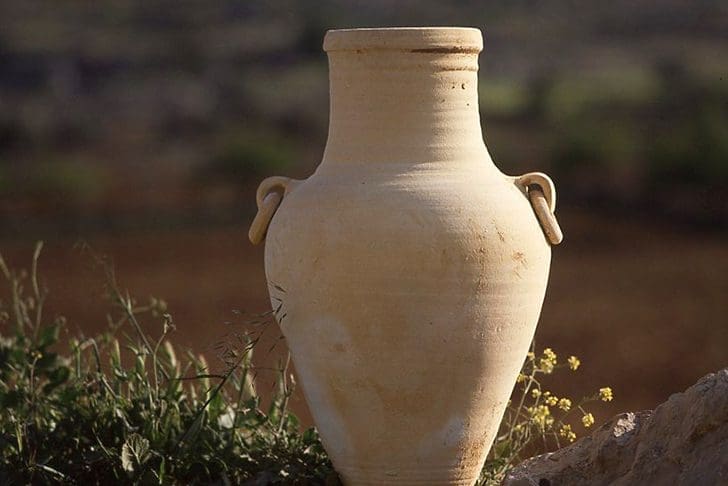
Maurine
In the chapters in Genesis that should be about Isaac, he hardly shows up. He plays a surprisingly passive role, which leads you to think how much we’re missing in his story. After all this is the son, who willingly went with Abraham to be sacrificed and therefore was a similitude of the Savior. This is the son his parents longed for through decades, and then, when we might get a chance to meet him, he is whisked off the stage.
Scot
Hello. We’re Scot and Maurine Proctor and welcome to Meridian Magazine’s “Come Follow Me” podcast where today we’ll talk about Genesis chapters 24 through 27. Remember you can find the transcript for this podcast—and all of them–at latterdaysaintmag.com/podcast. We’d also love it if you’d tell a friend about this podcast.
As chapter 24 begins, we are reminded that to this family, their covenant with God is everything. We are told that Abraham is getting old, “and the Lord had blessed Abraham in all things” (Gen. 24. 1). If his posterity is to be a blessing to the whole earth, Isaac must marry someone who can carry on that covenant line, and frankly, the woman available in Canaan can’t do that. He must look far away. As the very last thing we hear Abraham say in the scriptures, he calls his loyal servant to him, who “ruled over all that he had”, and gave him a sacred and responsible mission, which indicates just how much Abraham trusted him. He is told “Thou shalt go unto my country, and to my kindred, and take a wife unto my son Isaac” (v. 4). Abraham asks the servant to put his hand under his thigh makes the servant swear by “the Lord, the God of heaven, and the God of the earth” (v. 3) that he won’t find a Canaanite woman for Isaac’s wife.
In this image of hand under the thigh as it appears in the Bible, the usual explanation is that the custom that the oath was so important because it pertained to Abraham’s posterity. In the Joseph Smith Translation, the word “hand” replaces the word “thigh”, suggesting almost a handshake to seal the importance of this sacred responsibility.
Maurine
This servant, who is not given a name, but is most likely the steward named Eliezar, deserves that trust, for he becomes the exemplar of everything a good steward should be in his devotion to carrying out his duty. He is utterly trustworthy in every detail, and Abraham knows that he will perfectly reflect and act upon his will. Eliezar’s name means “God is my help”, and he is promised for this important responsibility that “the Lord God of heaven” “shall send his angel before thee” (v. 7).
The servant will travel 850 miles north to Nahor, which is or is close to Haran. This is where Abraham’s brother Nahor is from and where his son Bethuel lives with his children Laban and Rebekah.
He brings with him ten camels, which is an impressive caravan, and they are laden with treasures that are a reflection of Abraham’s wealth and generosity, and the servant’s responsibility to distribute this and act in all things in Abraham’s name. This is an arduous and responsible journey he has been sent on to perfectly accomplish the most important goal as if he were Abraham himself.
Scot
When the servant arrives at the well at his destination, he makes the camels to kneel, and then he prays. “O Lord God of my master Abraham, I pray thee, send me good speed this day,and shew kindness unto my master Abraham.” Note, as the perfect steward, he can also pray in the name of Abraham. It as if Abraham has said, “You are an extension of me.”
A well is a gathering spot Then the steward sets a test so that he can recognize Isaac’s future bride from among all others at the well, who the Lord has chosen to be the mother of the covenant posterity. His test is this:
“Let it come to pass, that the damsel to whom I shall say, ‘Let down thy pitcher, I pray thee, that I may drink and she shall say, Drink, and I will give thy camels drink also: let the same be she that thou hast appointed for thy servant Isaac; and thereby shall I know that thou hast shewed kindness unto my master” (v. 14). Here’s that stewardship idea again. In answering the steward’s prayer, the Lord is showing kindness to his master. Wouldn’t we all love someone of such loyalty acting in our behalf?
Maurine
Let’s look at that idea of stewardship for a moment. The Lord gives His covenant children stewardships as His way of sanctifying and expanding them. Through the responsibility of stewardship, He is inviting us to reach up and beyond ourselves. In this way, He is in the process of transforming us. The covenant path is always one of stretching until we are no longer the small and constricted souls we once were. His stewardships are an invitation for upward growth and expansion so that He can fulfill His covenant promises to us. We have to be more than we are to be able to receive the blessings He wants to give us.
Of course, we have stewardships in our roles as mother, father, daughter, son, grandparent, sister, brother or friend. We have stewardships in our callings. Since our stewardships are designed for changing us through the covenant to prepare us for His presence, it shouldn’t be surprising that sometimes they are very hard and may even seem impossible. We may want to say, “My assignment is what?”
Scot
Yet the Lord gives us real things to do, even if they are tough. He puts people in our way who will depend on us. We are asked to save our dead, and who else will do it? We have children, and our influence will be felt in their lives for an eternity. These assignments are not minor, and God doesn’t whoosh in and move us aside and take over. The Lord works through giving us stewardships that mean something and our fidelity and complete trustworthiness to them have important consequences. If Abraham’s servant had been less loyal, he could have gone some place close, found any woman and brought her back, instead of making his wilderness journey.
How would you like to be Joseph Smith and given the charge to build the Kirtland Temple, when the Latter-day Saints were completely impoverished, living several families to a house, many unskilled in construction and without an architect? Yet Joseph Smith said, he learned this: “When the Lord commands, do it,” and he did! How would you like to be Nephi, called on as his stewardship, to go get the plates from a recalcitrant and thieving Laban? Or how would you like your family’s lives depend on your finding the materials to make a bow? Since stewardships, well performed lead to more stewardships that demand more of our eternal possibility, it was making the bow that qualified Nephi to build a ship to take his family across the great deep.
Sometimes our stewardships are not roles or callings, but what the mighty Lord with his perfect love and perfect intelligence allows to be put in our path. We may be given a stewardship for a physical trial, an emotional pain, discouragement, or chronic pain, and the way we handle that stewardship may impact our eternal life.
Maurine
Perhaps, in the face of the stewardship of trial, we should say, “I can do this with thy help”, instead of “poor me.” Sarah Burton’s story shows how this works, and we will share it here in her own words:
“During 2015, the constant back pain that I had experienced for the prior 8 years, rose to a level of pain that I hadn’t experienced before. I saw lots of doctors, had lots of tests, tried lots of therapies, and even had surgery in hopes that I would figure out “the cure.” (We did not know then what it took about 6 years to understand– that I had a hip deformity combined with scoliosis and arthritis…without a clear fix. My doctors told me that I and other chronic pain patients tended to be difficult puzzles to figure out.
“Anyway, as the pain (and some of the judgment) continued, in July 2015, I remember an undercurrent of bitterness welling up for about 2 or 3 weeks. I would go to the temple and come home with a little bitterness creeping in about how I was trying to do all of the right things—Temple, church, serving my family, scripture study, serving in callings—and yet I was in pain.”
Scot
Sarah said, “And I started to compare my situation with others’. I thought about friends my age (I was 41) and even about my delightful visiting teaching companion (age 75) who could sit in a chair, happy as a clam, talking for 2 hours at a visit, while I constantly shifted in my seat in pain, as a 41 year-old who regularly exercised and ate healthy and who was trying everything possible medically.
“I started to notice for these 2-3 weeks that maybe I was feeling the Spirit withdraw, which is not something I was accustomed to. I normally had felt the undercurrent of the Spirit throughout my life. It scared me to feel like I was getting bitter and starting to feel tempted to be angry right at God. I had never done that before and knew that doing so would cross a line that I didn’t want to cross. I was starting to feel vulnerable and knew I would not be under the same protection of the Spirit if I crossed that line.
“So, I decided that I did not want my disappointment (that sometimes had verged into bitterness) to become full-blown anger. I knew that I had to get serious, exert more faith, and do the spiritual and emotional work necessary to find meaning in the pain that I realized was going to be my long-term companion.”
Maurine
Sarah said, “It took months of processing and imperfect attempts (over and over), but in general I kept trying to stop looking left and right and comparing my situation to others. I tried hard to just look up and try to hear God’s voice to me and to realize that everyone has their own plan, and I had mine. And then I would metaphorically look down, bowing my head in an effort to force my stubborn self to submit and accept whatever was in store for me.
“Of course, I kept trying to do whatever was in my power to try to improve my health situation, but I did so with more patience and with an acceptance that God was ultimately in control. I also took a lot of time to think and to write about the nature of suffering and (surprisingly) the joyous things that can come of it.
“After months of pondering and deliberately and actively practicing faith, Dan gave me a blessing in January 2016. I was so excited and expected that my months of choosing faith would result in a miraculous answer of what would be the key to my healing. But the blessing came out with the feeling of a loving parent bearing what seemed to be bad news—that my chronic pain would remain long-term and that it was actually part of my education that God willed for me.”
Scot
She said, “By now, I have spent 7 years of emotional processing, taking walks and pondering, and writing in my journal. I have come up with a list of mini-sermons that I preach to myself and to motivate myself about the “upside of suffering.” And about every 6 months, a new one seems to formulate in my mind, and I add it to the list. 3 of my favorites are: 1) that suffering gives you special needs that result in special manifestations of the spirit, 2) you become more able to empathize with others who have bitter, long-term problems, 3) and you get the chance to prove your friendship to the Lord by giving the gift of obedience, which can be even more sacred when it is offered in a context of suffering (like the widow who Jesus talked about in the New Testament, who threw into the treasury her last mite). I feel passionate about the chance to show Jesus that I am His friend, and that no suffering will make me leave His side—that’s one that really motivates me when I preach my silent sermons to myself.
“But as spiritually enriching as these 7 years of pondering and writing has coming to know God better has been, I will not pretend that it has been a direct, perfect, straight course. There have been times when thoughts of bitterness creep in and rear their ugly head, and I have to swat them away by silently rehearsing to myself all of the powerful mini-lessons about the blessings of suffering. I will tell my knees to bend, and I will tell my mouth to pray, and I will force my brain to think through those silent sermon that I have written until those words become not just words in my head but feelings in my heart.” (Personal correspondence with Sarah Burton).
Maurine
What I love about what Sarah says here, is that she doesn’t just follow the natural man emotion to become angry with the Lord or bitter about the pain that never leaves her and never will in this life. She has chosen not to let her pain divide her from God. Instead, she has become intentional and has processed through her response, and has chosen faith. “I will tell my knees to bend, and I will tell my mouth to pray.”
Another of her mini-sermons is the combination of two scriptures.
“ . . . ye receive no witness until after the trial of your faith” (Ether 12:6)
And “by small and simple things are great things brought to pass . . . “ (Alma 37:6)
For Sarah this has become one mini-sermon she repeats to herself:
“When we strive as imperfect beings
to obey in ‘small and simple’ ways,
after the ‘trial of our faith,’
a ‘great thing”– a great “witness”–
will be “brought to pass.”
I want to be as trustworthy and aligned with the Lord as Abraham’s servant is with him. I want to be as true to the Lord and intentional in my thoughts when I have the stewardship of trials as Sarah Burton. It is moving to me, and I won’t forget it the next time things are tough.
Scot
Remember, Abraham’s servant has asked the Lord for a sign to indicate Isaac’s bride that she should step forward to give him a drink and volunteer also to give drink to the camels. Now at least twice a day, the well for a village is a lively place as women from the surrounding areas—perhaps as much as two or three or more miles away, come to draw water for their washing, cooking, cleaning and drinking. It is a back-breaking and heavy job both to draw water and carry it away. Camille Fronk Olson said that Josephus recorded that many maidens at the well were drawing water at the time Abraham’s servant arrived but that the others all refused to give the stranger any water before Rebekah came forward “in an obliging manner” (Antiquities, 1.16.2).
The scriptures tell us that Rebekah “was very fair to look upon” and a “virgin” (v. 16), but, what is most impressive is that without calculation or the desire to impress a stranger, she steps forward with vitality, compassion and the Spirit at the right time and the right place to answer the plea of the servant of Abraham. “Let me, I pray thee, drink a little water of thy pitcher” (v. 17). Not only does she quench his thirst, but, then, surprisingly, volunteers “I will draw water for thy camels also, until they have done drinking” (v. 19). (Camille Fronk Olson, Women of the Old Testament).
Maurine
Olson noted, “She “hasted” to give the visitor water after he requested a drink (Genesis 24:18), volunteered to water all his camels and then “hasted” and “ran” until she completed the task (vv. 19–20), and finally “ran” to notify her family of the stranger’s coming (v. 28). Much more important than her beauty, she exemplifies the values of the Abrahamic covenant of hospitality, kindness and a loving welcome to the stranger.
Another covenant word is used to describe this interchange. “And the man wondering at her held his peace, to wit whether the Lord had made his journey prosperous or not” (v. 21). That word prosperous is part of the covenantal promise. Remember when Alma addressed the people of Ammonihah, he reminded them of the promise to their fathers, “Inasmuch as ye shall keep my commandments, ye shall prosper in the land” (Alma 9: 8,13). We may think immediately that the phrase “prosper in the land” refers to material well-being, but it means that the covenant keepers are blessed with the Lord’s strengthening and supporting presence. It means fortunate, more than wealthy. In this case, being led by the Lord to find Rebekah was prospering. Scot, in our own lives, though, it is fascinating how often things “just work out.” We are given ideas or nudges to find solutions to the things we face. That too is being prospered.
Scot
Just a note here about camels. Offering to water 10 camels is an enormous, sweaty, even unpleasant task. Camels are not the easiest animals to hang out with. They can be stubborn, smelly and make the most horrible noises. You and I, Maurine, have ridden a lot of camels in our time. Here’s my experience. I was riding a camel into the desert by the pyramids, that was, in his own mind, done for the day. To even get him to move, the owner was not so gently encouraging him. He resisted and strained at every move, and then he bucked me off. You should know, it’s a much longer way to fall of a camel than a horse.
Maurine
My camel, on that same ride, had decided he was done, so when we turned for home, the camel broke into a gallop. At full-out speed, we raced across the desert. Since it was so high, and since camel saddles have no stirrups, I was flung around on that camel’s back and holding on for dear life, mentally writing my last will and testament.
Scot
But camels are remarkable in the desert. They can carry 400 to 600 pounds, travel one hundred miles a day, go without water up to 15 days and then guzzle 25 to 30 gallons of water in a single session. That’s 250 to 300 gallons. For Rebekah to water those camels would have taken as many as 50 pitchers full. What a woman. After this Herculean task, she invites the servant home.
Abraham’s servant has brought a bride-price for her in the form of a substantial amount of “precious things” for her and her family. This was customary and was both a compensation to the family and a proof that the groom could support her and their family to come. Olson notes, “The two bracelets or bangles given to Rebekah were “a pair” of bracelets (v. 22), a symbolic wedding gift signifying a man and woman becoming bound in marriage. The weight in gold of these initial gifts was the equivalent of several years’ wages. For example, the ten and a half shekels’ weight of gold jewelry the servant gave Rebekah could have purchased five slaves. By offering these lavish gifts, the servant promised the family that Rebekah would be generously accommodated in her marriage to Isaac.”
Maurine
The servant gives gifts to Rebecca and, of course, the bride price to the family. When the servant is first invited into her home, Laban immediately recognizes the significance of his presence and says, “Come in, thou blessed of the Lord…for I have prepared the house, and room for the camels” (vs. 31). This goodly servant, however, will not eat or rest until he has performed his duty and struck the marriage agreement. He acknowledges that his way has been prospered, coming to the very woman, from the very lineage that God has chosen for Isaac. The servant asked the family’s permission, but, they in turn ask Rebekah saying, “We will call for the damsel, and enquire at her mouth” (v. 57). It is significant that her opinion is the final one.
A deal is struck, but Rebekah’s brother and mother said, “Let the damsel abide with us a few days, at the least ten, after that she shall go.” This seems like a reasonable request, but the servant has a higher purpose. He says, “Hinder me not, seeing the Lord hath prospered my way; send me away that I may go to my master” (v. 56).
Scot
Clearly, all the events have made it obvious that this proposal is the Lord’s will, and Rebekah’s answer reflects that. She simply says, “I will go” (v. 58), which is yet another reflection of her testimony and understanding. Surely she might have liked a few days to get ready or say goodbye to her family. But no, the Lord has called her, and she is essentially giving the covenant answer. “Here am I.””I will go”. “I am ready”. If the servant is a hero in this story, so is Rebekah, whose every action and response rings with power and demonstrates that she is fit for the high covenantal role she is about to play. “I will go and do the things which the Lord hath commanded,” says Nephi (1 Nephi 3:7).
In her parting Rebekah is blessed to be the “mother of thousands of millions” (v. 60), reflecting what, in fact, will happen.
Maurine
When Rebekah arrived back in the south country, Isaac had gone out “to meditate in the field at the eventide: and he lifted up his eyes and saw the camels coming” (V. 63) She alit from her camel and covered herself with a veil.
This meeting reminds us of the return of the prodigal son, when his father met him on the road, while he was yet afar off. What had led the father to know his son was coming and come out to meet him? Why did Isaac happen to be there just as Rebekah was coming?
We get a glimpse of the bond between them. “And Isaac brought her into his mother Sarah’s tent, and took Rebekah, and she became his wife; and he loved her: and Isaac was comforted after his mother’s death” (v. 67).
Scot
Isaac was forty when he married Rebekah, and, according to the custom of the time, she was probably a young girl of 14 or so. For twenty years they are married, and she is barren, unable to have children. We don’t have any record of the agonizing sense of loss they both must have felt, or the irony for Rebekah who had been promised to be the mother of “thousands of millions”, but just like Sarah and Rachel, the other covenantal mothers, it is the Lord who finally blesses them to conceive.
She is expecting twins and in her womb the children “struggled within her” (Gen. 25: 22), so she enquires of the Lord and learns that there are two nations within her and “two manner of people” and “the one people shall be stronger than the other people; and the elder shall serve the younger” (v. 23). Thus, she knows before Esau’s and Jacob’s birth that Jacob is to receive the covenantal blessings.
Here is a moment in the Bible that points to pre-mortality, for how could one twin have come to earn or receive a birthright blessing instead of the other, unless these spirits had demonstrated different levels of faith in an earlier world.
Maurine
Elder Bruce R. McConkie said, “Rebekah is one of the greatest patterns in all the revelations of what a woman can do to influence a family in righteousness [Genesis 25:22]….
“Now note it well. She did not say, ‘Isaac, will you inquire of the Lord. You are the patriarch; you are the head of the house,” which he was. She went to inquire of the Lord, and she gained the answer: [Genesis 25:23]. “That is to say, ‘To you, Rebekah, I, the Lord, reveal the destiny of nations that are to be born which are yet in your womb.’…“Rebekah—truly she is one of the most noble and glorious of women!” (McConkie, Ensign, Jan. 1979, 62).
In this heartfelt prayer, Rebekah exemplifies what all mothers need to do, especially in these tumultuous days. Elder Holland compares a mother to a Savior when he says, “Prophesying of the Savior’s Atonement, Isaiah wrote, “He hath borne our griefs, and carried our sorrows.”1 A majestic latter-day vision emphasized that “[Jesus] came into the world … to bear the sins of the world.”2 Both ancient and modern scripture testify that “he redeemed them, and bore them, and carried them all the days of old.” A favorite hymn pleads with us to “hear your great Deliv’rer’s voice!”
Scot
“Bear, borne, carry, deliver. These are powerful, heartening messianic words,” Elder Holland said. “They convey help and hope for safe movement from where we are to where we need to be—but cannot get without assistance. These words also connote burden, struggle, and fatigue—words most appropriate in describing the mission of Him who, at unspeakable cost, lifts us up when we have fallen, carries us forward when strength is gone, delivers us safely home when safety seems far beyond our reach. ‘My Father sent me,’ He said, ‘that I might be lifted up upon the cross; … that as I have been lifted up … even so should men be lifted up … to … me.’
“But can you hear in this language another arena of human endeavor in which we use words like bear and borne, carry and lift, labor and deliver? As Jesus said to John while in the very act of Atonement, so He says to us all, ‘Behold thy mother!’
“Today,” Elder Holland said, “I declare from this pulpit what has been said here before: that no love in mortality comes closer to approximating the pure love of Jesus Christ than the selfless love a devoted mother has for her child. When Isaiah, speaking messianically, wanted to convey Jehovah’s love, he invoked the image of a mother’s devotion. “Can a woman forget her sucking child?” he asks. How absurd, he implies, though not as absurd as thinking Christ will ever forget us.” (Elder Jeffrey R. Holland, “Behold thy Mother”)
Maurine
President Russell M. Nelson pled with women to realize their priesthood power. He said: “We need women who know how to make important things happen by their faith and who are courageous defenders of morality and families in a sin-sick world. We need women who are devoted to shepherding God’s children along the covenant path toward exaltation; women who know how to receive personal revelation, who understand the power and peace of the temple endowment; women who know how to call upon the powers of heaven to protect and strengthen children and families; women who teach fearlessly. (President Russell M. Nelson, “A Plea to My Sisters”) Rebekah’s first child was named Esau, from a Hebrew root meaning “hairy” and his descendants were called Edom, which in Hebrew means “red.” The second son was named Jacob from a Hebrew idiom means “he shall assail, overreach or supplant,” an apt name since his mother knew he would receive the birthright blessing instead of the first child. As they grew, Esau is described as “a cunning hunter, a man of the field; and Jacob was a plain man, dwelling in tents.”
Scot
D. Kelly Ogden and Andrew C. Skinner, note, however, “The translators could have used a more illustrious adjective than “plain,” as the Hebrew word used here has the same root as that used in describing Noah in Genesis 6:9 and Abraham in Genesis 17:1, where it is translated ‘perfect’ in both of those cases.” (Andrew C. Skinner, D. Kelly Ogden, Verse by Verse, The Old Testament Vol. 1 & 2).
At any rate, the boys were very different in nature, and Isaac favored Esau, while Rebecca favored Jacob. This is a paradox for Isaac, because like his father Abraham, before him, the covenant will be renewed through him with all its attendant promises, but Esau dismisses his birthright and it, apparently means very little to him.
We see the famous story of Esau coming in from the field, faint, while Jacob is eating lentil soup. Esau asks for some soup or pottage, and Jacob responds, “Sell me this day, thy birthright.” Esau agrees, saying, “Behold, I am at the point o die: and what profit shall this birthright do to me?” (Gen. 25: 31,32).
Maurine
Skinner and Ogden note: “Esau must have exaggerated his condition of hunger upon returning from the hunt when, upon smelling Jacob’s lentil soup cooking, he reasoned, ‘I am at the point to die, and what profit shall this birthright do me?’ A person generally dies from hunger after a long period of emaciation, rather than dropping over suddenly from strongly stimulated appetite! The writer was impressed, according to verse 34, with the fact that Esau must have ‘despised his birthright’ to trade it for a bowl of soup. There is no question that Jacob took advantage of the opportunity to bargain for the birthright, but to characterize him as a hard, cruel man who would not feed a starving, dying brother without compensation hardly fits the picture.
Scot
Ogden and Skinner continue: “Esau’s passing off his birthright was certainly not just for hunger; the real reason was that intrinsically it meant nothing to him… In modern times an English idiom has been used from this biblical episode to describe something that means little or nothing to us: ‘selling our birthright for a mess of pottage.’
“The picture or even caricature of Esau that emerges at this stage of his life is of the older brother who was worldly—thinking of physical concerns before spiritual matters—dull, and easily outwitted on an empty stomach. Like some young people today, Esau recognized the value of what he lost only after it was gone.”
Maurine
Susan Bednar said to the students at BYU-Idaho,”Everything to which Esau was entitled he sold for something as insignificant as a piece of bread and a can of soup. Why? Were the promised blessings associated with the birthright too far away? Did he forget in that moment that he was the firstborn son? Did he really intend to give up the birthright, or was it just a casual maneuver to satisfy his hunber? Was he thinking, “I can give it away now and get it back later? What series of events, circumstances, and prior choices would have brought Esau to this tragic moment? From our own experience, I believe we can conclude that a grave outcome such as Esau selling his birthright is not usually the result of a sudden impulse, but rather the consequence of small, incremental decisions made day by day.” (Susan K. Bednar, “Covenant Blessings and Responsibilities”)
He further demonstrates his indifference to birth right and covenantal blessings when he breaks his parent’s hearts and causes them “grief of mind” by marrying Hittite women, who were Canaanites and descendants of Ham. The covenant of Abraham could not continue through this posterity, and Esau didn’t care.
Maurine
It is concerning to see so many today who are willing to “sell their birthright for a mess of pottage.” When we hear that people are leaving the Church, particularly the young people whom we know and have heard bear testimony in the past, from our hearts we cry out, “Don’t do it. You have no idea what you are giving up.” “If you have felt to sing the song of redeeming love…can ye feel so now?” (Alma 5:26).
So now we have a scene that, I think must be understood, in the context of Rebekah’s revelation about the twins before they were born. The Lord has told her who is to receive the birthright and the blessings of the covenant. Is this a knowledge that gives her responsibility to act or is she to sit back in faith, because the Lord already has it in His hands? Has she discussed it with Jacob? Is this something he has known his entire life? Had she told Isaac about her revelation? Have they discussed it?
We have missing details so we can’t answer any of these questions.
Scot
Nonetheless, when Isaac is old and quite blind, he calls Esau to him, asks him to go hunting for some venison and bring Isaac some savory meat. When he does this, Isaac will give him his blessings. Rebekah, hearing this, and having known since the twin’s birth which son should receive the covenant blessings, feels she must change the course. She calls Jacob, has him fetch her “two good kids of the goats”, makes this food, and Jacob brings it to his father as if he were Esau. Since Esau is hairy and Jacob is not, the ruse is completed by Jacob wearing some of Esau’s clothing and putting goat skin on his arms. He says to Isaac, “I am Esau thy first born…Sit and eat of my venison, that thy soul may bless me” (Gen. 27:19).
Isaac is not so easily fooled. He wonders how the food could have been delivered so fast and why this son feels and smells like Esau, but has Jacob’s voice. Nevertheless, the blessing is given to Jacob and when Esau learns of this he wails, “Bless me, even me also, O my father.” Isaac blesses him with a goodly blessing, but it is not the birthright or covenant blessing. Later in chapter 28, more of the covenant blessings are bestowed upon Jacob, and we learn that Esau wants to kill his brother. Jacob must leave.
Maurine
Camille Fronk Olson notes, “Rebekah hoped that Jacob would be away in Haran only “a few days” (Genesis 27:44). In actuality, it would be a lengthy twenty years. The Bible narrative reports that Isaac was living in Hebron upon Jacob’s return (Genesis 35:27), but no mention is made of Rebekah.”
[This is particularly noteworthy in that Isaac had said “I know not the day of my death,” implying it was close before Jacob left.]
“Did [Rebekah] ever see Jacob again? Did she see her numerous grandchildren and further hope of her family’s marriage blessing that she would be a “mother of thousands of millions”? (Genesis 24:60). Perhaps most important, did she see her two sons reconciled and commencing the creation of two remarkable nations? The biblical account tells us nothing more about Rebekah except to report that she was buried in the cave of Machpelah, alongside Abraham, Sarah, and Isaac (Genesis 49:31)” (Camille Fronk Olson, Women of the Old Testament).
Scot
That’s all for today. We’re Scot and Maurine Proctor and this has been Meridian Magazine’s “Come Follow Me” podcast. Next week we’ll find out more about what happens to Jacob in Genesis chapters 28-33. Don’t forget to tell a friend about our podcast. Thanks to Jenny Oaks Baker for the music and to Michaela Proctor Hutchins, our producer. See you next week.
Come, Thou Fount of Every Blessing” Performed by Jenny Oaks Baker. Used with permission © 2003 Shadow Mountain Records