



Lamb of God at the Met: A Night Where Music Was Testimony
Lamb of God is not just a loved oratorio, it is a transporting one, whose notes seem like they come from a transcript from heaven—and now it has been performed in one of the world’s greatest concert halls.
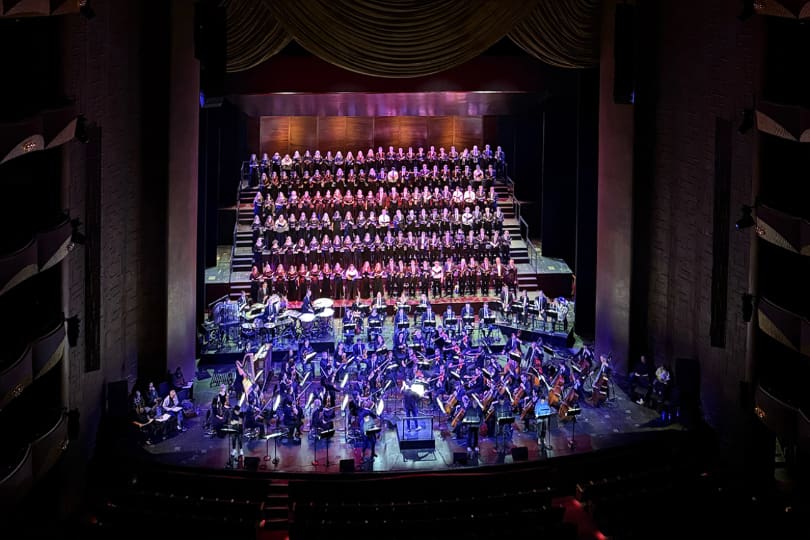
On Monday, March 30, in one of the world’s most revered performance halls, something more than music unfolded. At the Metropolitan Opera House at Lincoln Center in New York City, Lamb of God—the sacred oratorio by Rob Gardner—made its New York debut in a performance that felt as much like testimony as it did art.
Gardner’s work, centered on the final days of the Savior’s life—His suffering in Gethsemane, His crucifixion, and His Resurrection—has, since its debut in 2010, spread across continents. But this performance carried a distinct weight. It brought together world-class soloists, a full symphony orchestra, and the combined voices of the Brigham Young University Singers and Concert Choir in a setting where excellence is expected—and where, on this night, something more was delivered.
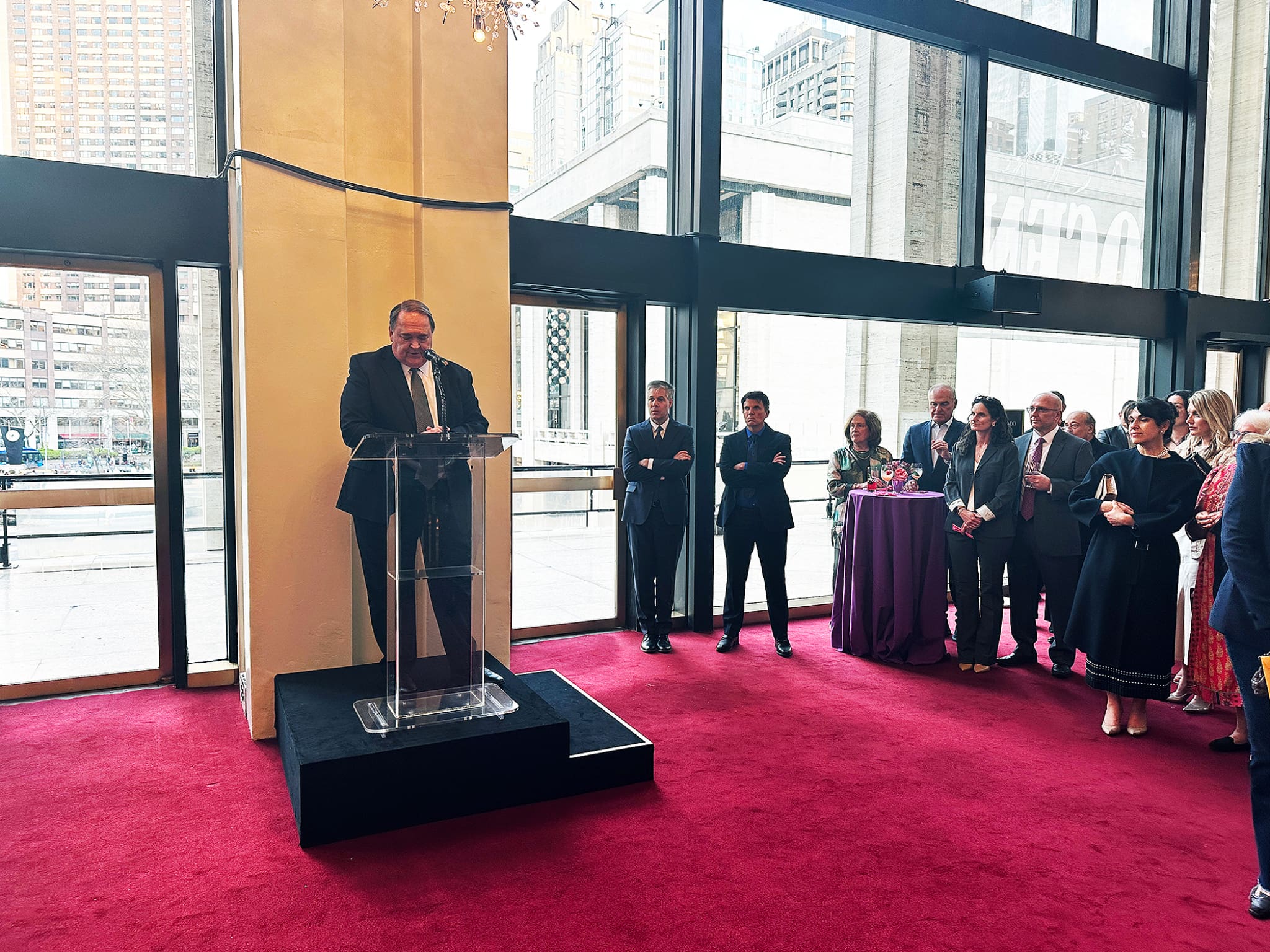
At a reception preceding the performance, Elder Allen D. Haynie reflected on the meaning behind the production. Quoting the Savior’s words, “Greater love hath no man than this, that a man lay down his life for his friends,” he said, “During Holy Week, Jesus Christ perfectly embodied that greater love—in Gethsemane, on the cross and through His Resurrection. ‘Lamb of God’ brings those sacred events to life in a powerful and moving way.”
That greater love was not simply spoken of—it was carried in every voice on the stage.
The distinguished cast of soloists brought emotional clarity and depth to the narrative: Jessie Mueller as Mary, Santino Fontana as John, Joy Woods as Martha, Norm Lewis as Pilate, Anna Zavelson as Mary Magdalene, Alex Joseph Grayson as Thomas, Brandon Victor Dixon as Peter, Zachary Noah Piser as Judas, Thom Sesma as Onias, and Katherine Alexis Thomas as Mary of Bethany. Each performance added dimension and humanity to the story, allowing the audience to feel not only the events of Holy Week, but the individuals who lived them.
Yet even with such remarkable talent, the performance never became a display of individual brilliance. Instead, it became a unified witness.
At the heart of that unity stood the 135-voice combined choirs from Brigham Young University. Their sound—precise, powerful, and reverent—filled the hall with a sense of both majesty and devotion. Gardner specifically requested their participation, noting that “BYU is known for and consistently has one of, if not the best, choral programs in the country… you step on the stage and you’ve already got musicality.” 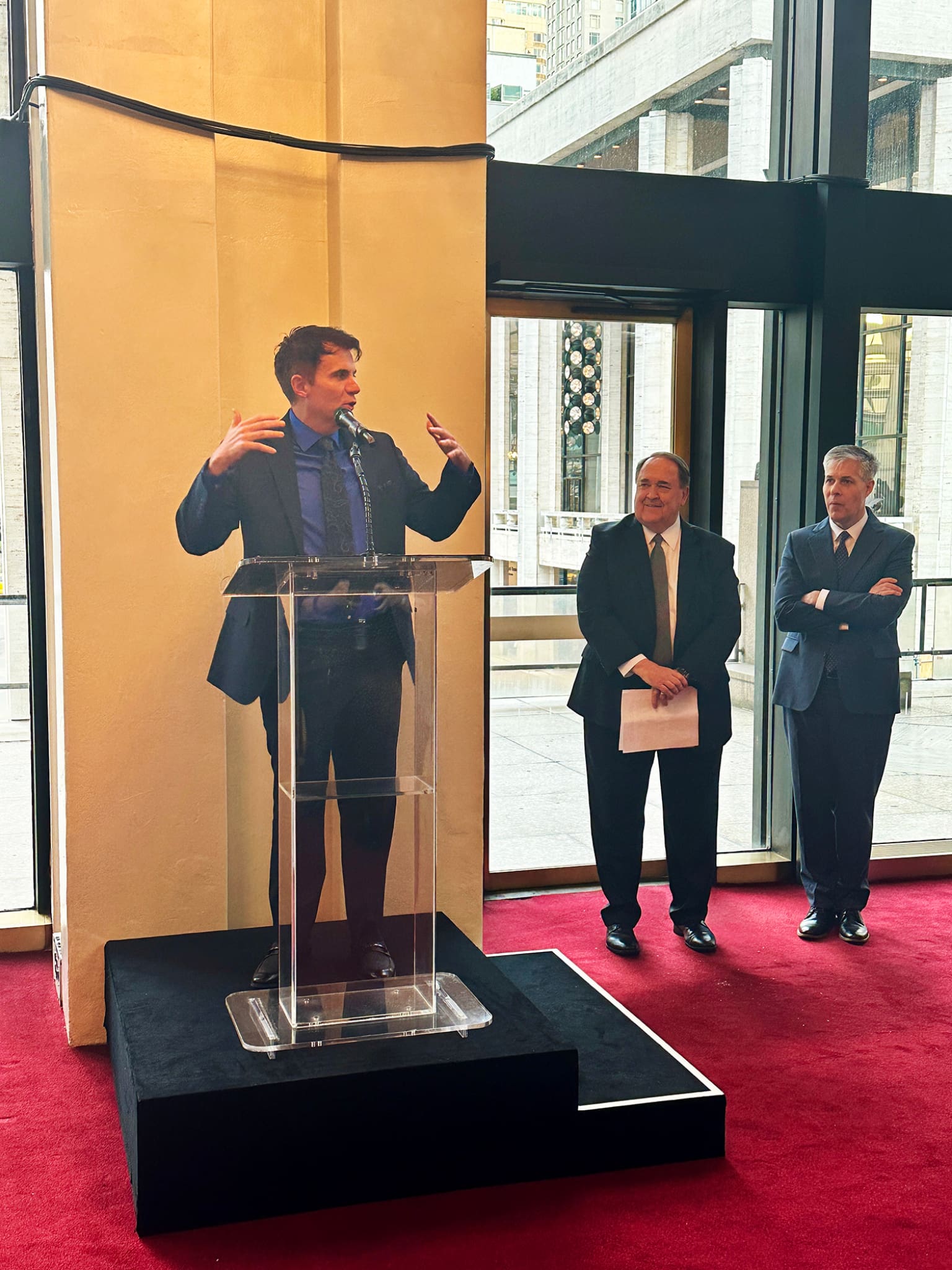
But he also pointed to something deeper: “There’s also a connection religiously… which isn’t necessary to do beautiful music, but it certainly helps.”
That connection was unmistakable.
For many of the choir members, the experience was not merely artistic—it was devotional. “Doing ‘Lamb of God’ at the Met is a great opportunity for us… to testify of Jesus Christ to the whole world,” one participant said. Another added, “I connect with others best through music… I’m grateful for the chance… to share our conviction and our testimony, especially because this is Easter.”
Gardner himself described the guiding word behind the oratorio: “hope.” “As you leave,” he said, “my prayer is that… you will feel a greater sense of hope.”
That hope resonated throughout the evening.
“One of the most powerful statements of hope is the resurrection itself,” said Eugene F. Rivers, founder of the Seymour Institute for Black Church and Policy Studies in Boston. “Jesus gives hope to the world.”
Audience members felt it as well. “It’s a mind-blowing experience… We felt the love tonight,” one attendee shared. Another described the finale as the culminating moment: “The ending… is what makes it all worthwhile—the feeling that there is hope because Christ gave His life for us.”
The Metropolitan Opera House, long known for its artistic prestige, became on this night something more—a place where sacred narrative and musical excellence met in full harmony. As Gardner observed, “New York is an art city, and the best of the best are there.” And on this evening, that standard was met not only in performance, but in purpose.
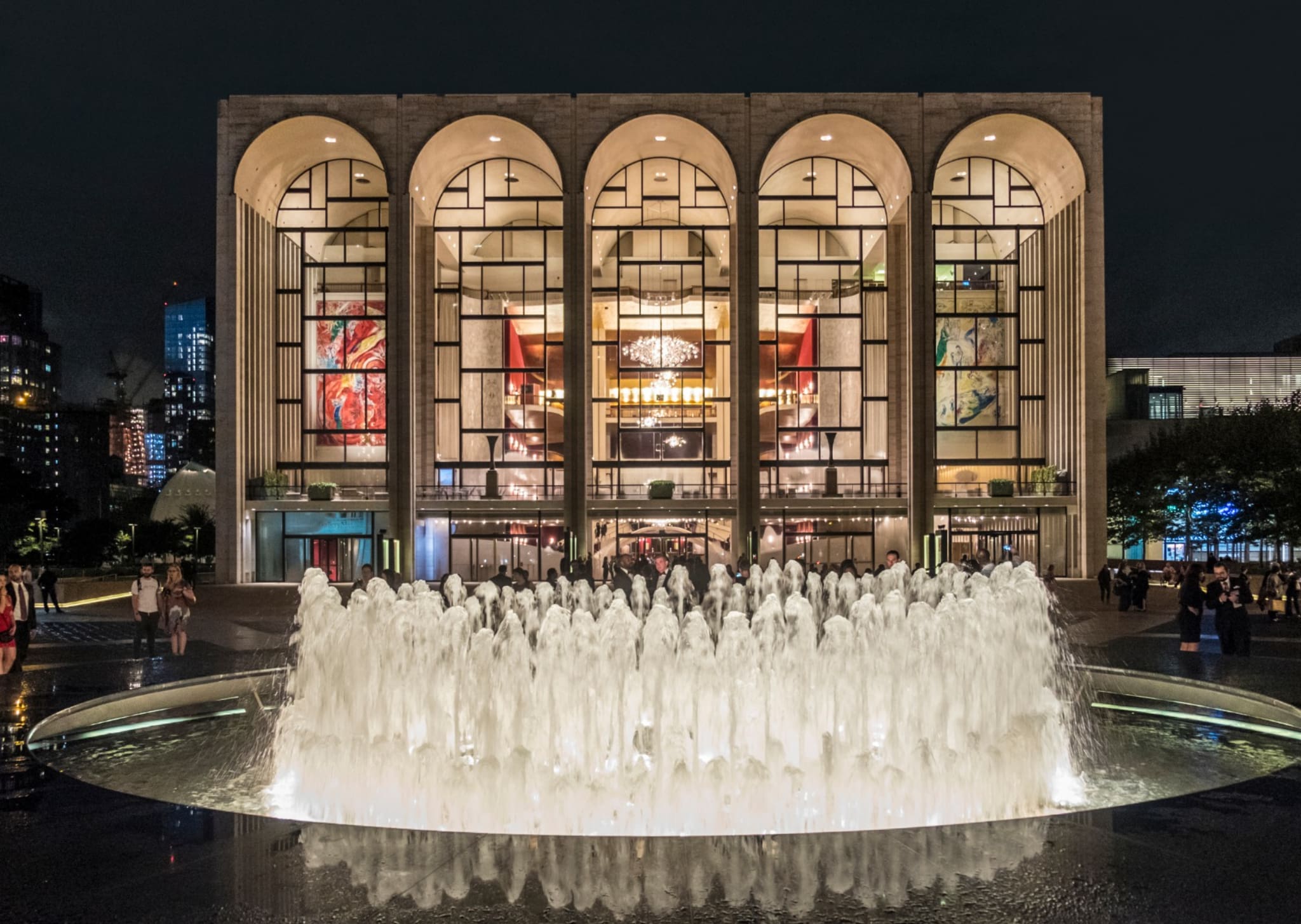
Since its first appearance, Lamb of God has been performed across the world, gathering thousands into its message. Yet this moment at the Met felt like a milestone—not because the work has reached its end, but because its reach continues to expand.
As one soloist reflected, “‘Lamb of God’ is a story that is alive. It continues… and it is our responsibility to tell that story… in our lives.”
And perhaps that is the true measure of the evening.
The music does not end when the final note fades. It continues—in memory, in testimony, and in the quiet invitation it leaves behind.
Elder Haynie concluded with that invitation: to “‘seek this Jesus of whom the prophets and apostles have written.’” And with a promise both simple and profound: “If you do, you will find Him—because He is already seeking you.”
The Solitary Savior: Finding Restoration in the Silence of Single Life

For many singles, loneliness is not a constant roar, but a persistent, low-frequency hum. It is the cumulative weight of “small silences” that build up over weeks and years. I remember one time in my first year of mid-single life realizing that I had never truly lived alone. Growing up, I lived with my parents. When I left for my mission, I had companions. In college, I had roommates until I got married. So, until I separated from my former spouse, I had never known the silence of living alone. That silence sometimes felt unbearable.
This oppressive silence is the echo of an empty house where no one asks, “How was your day?” or notices if you’ve arrived home safely. It is the invisible burden of a triple load—logistical, financial, and emotional—that must be borne by a single set of shoulders. Logistically, there is no “backup” for the mundane tasks that prove vital when they remain undone.
Financially, a single adult navigates a world built for two incomes, where every emergency threatens your financial foundation. Emotionally, the lack of a daily witness to your life—someone to share a small victory or a burnt dinner—can lead to a profound sense of invisibility. We often feel like observers in a world designed for pairs, whether we are sitting alone in a church pew, at a dinner party, or during holiday celebrations. When the phone remains silent, the weight of being “unseen” can feel like a heavy shroud. (Have you ever sat for a couple of hours looking at Facebook, just thinking about who you might be able to chat with—just for a little company?)
Holy Week offers a profound, almost jarring irony to the experience of being lonely. We might call this the Gethsemane Paradox. The most important and universal act in human history—the Atonement of Jesus Christ—was performed in absolute solitude. Centuries before Jesus went to Gethsemane, the prophet Isaiah recorded the Messiah’s own description of His coming moment—perhaps the most visceral acknowledgment of divine loneliness in holy writ: “I have trodden the winepress alone; and of the people there was none with me” (Isaiah 63:3).
In the ancient world, treading a winepress was a communal, rhythmic task—a harvest celebration involving many hands and joyful songs. But the Savior’s “harvest” was different. To truly suffer for everyone, He had to be separated from everyone. In Gethsemane, when He asked His closest friends to “watch with [Him],” they fell asleep. Even in His moment of greatest agony, those who loved Him most could not comprehend His burden. He was physically surrounded by people yet, emotionally and spiritually, He was in a vacuum.
The irony deepened on the cross when Jesus experienced the ultimate human fear: the withdrawal of a loving Father who had always been there to comfort and protect Him. His soul cry, “My God, my God, why hast thou forsaken me?” (Mark 15:34), was the moment He became the ultimate patron of the lonely. Jesus didn’t just observe loneliness. He fully entered it. He did this so the single person sitting alone in a quiet room, feeling forgotten, may have the sincere comfort that only the understanding borne of experience can deliver. You are not talking to a God who looks down on you with pity, but a Savior who sees you with the experiential insight of one who has been there and will never forsake you–who will walk to Gethsemane and back with you in your moment of maximum loneliness and despair. And you are never more in His fellowship and embrace than when you feel utterly alone.
While the “Saturday” of our lives can feel like an eternal waiting room, the scriptures promise that restoration is a central, literal law of the universe. Consider the woman who had suffered for twelve years with a blood issue. She had spent everything she had on doctors, but none had cured her. She must have been spiritually exhausted. Her society branded her as perpetually unclean, and she was isolated. No one would have wanted to touch her! She was “fearing and trembling” when she realized that Jesus had sensed her touch. Yet the moment she touched the Jesus’s robe, she was “straightway” healed (Mark 5:29). Perhaps the most profound moment of her restoration was not the physical healing, but the words Jesus spoke next. He called her “Daughter.” Jesus didn’t just mend her body. He welcomed her into the family of God, replacing her twelve years of isolation and loneliness with an immediate and eternal sense of belonging. Twelve years of suffering and despair ended in a single second.
Similarly, Job’s story reminds us that long seasons of loneliness and loss do not dictate the speed of recovery. After a grueling trial of isolation, where even Job’s friends turned against him, the Lord “turned the captivity of Job” and “also, the LORD gave Job twice as much as he had before” (Job 42:10). His restoration was a double blessing that arrived as a divine gift—not a relentlessly slow climb that He had to make alone.
The Resurrection itself is the ultimate example of an “overnight” transformation. On Saturday, the cause seemed lost as the tomb had been sealed. By Sunday morning, the entire direction of the world had shifted forever. Restoration doesn’t always have to be a slow, agonizing crawl. It can come like a thief in the night—sudden, miraculous, and total. The message of Holy Week is that morning is coming, and it has the power to restore everything loss and despair took away.
Deep inside, I have understood this truth for a very long time. I think, in a large sense, virtually everyone has known the loneliness of feeling misunderstood, forgotten, or dismissed.
As a newly returned missionary, I wrote the following poem— before knowing the lonely darkness of rejection by a wife I loved; before watching my beloved 17 year-old brother suffer and die a horrific death from brain cancer; before a second divorce; and before the loss of my sweet 24-year-old son in a tragic rock climbing accident—then burying my mother only four months later. Life has been harder than I might have thought when I wrote this poem. But I have held close the promise that, “Weeping may endure for a night, but joy cometh in the morning” (Psalm 30:5), and that has made all the difference.
Joy Cometh in the Morning
Life began, for Adam, in sweet innocence,
But it didn’t endure very well,
For Eden reigned but one shining moment,
And shortly gave way to pure hell.
Days can be filled with sweat on our brows,
And the pain and sorrows of life.
Headlines read of murder and drugs,
And of international strife.
In humanity’s quest for the good things of life,
Everything got all mixed up.
It turned from a charming garden of God,
To a relentless bitter cup.
So, what of the sorrow and all the despair,
That seems our common lot?
Of the hopeless depression,
The lifeless shame of every negative thought?
For they seem to canker the souls of many,
With bitterness and with gloom.
An existence that is not really life,
Is the poison of Satan’s doom.
Yet in the beginning God made a plan,
To renew and refresh and redeem,
To give each soul some hope for itself,
And a little courage to dream.
God called the light day, and the darkness night,
And gave laws to govern their dawn,
And with the dawning of each new light,
Comes new courage and strength to go on.
As the sun descends in the death of the day,
And the chill of twilight is born,
God’s children lie down to the death we call night,
No more their sorrows to mourn.
Then morning comes, first in one golden strand,
Later in brilliance clear,
And with the night flees the desperate sorrow,
With all its burdens and tears.
The soul is renewed in each new morn,
With new mercy and grace from above,
For God wants to lift the spirits of all,
To eternal temples of love.
As one walks through this veil of tears,
Forgotten by all his friends,
And feels forsaken by God himself,
Approaching a bitter end,
Morning’s dawn heals the broken heart,
And makes new the wounded soul,
And gives strength to bear mortality’s cross,
With an eye on eternal goals.
Let us take hope in a gift that is real,
To see and taste and hear and feel…
All the wonders of each new day,
And of every sunlit golden ray…
Which gives a heart the hope to believe,
That after that very darkest eve…
When the Prince of life hung on the cross,
And the depths of hell he knew,
That His morning of resurrection came,
And eternal hope was renewed!
Resource:
Intentional Courtship can help in this journey.
About the Author
Jeff Teichert, and his wife Cathy Butler Teichert, are the founders of “Love in Later Years,” which ministers to Latter-day Saint single adults seeking peace, healing, and more joyful relationships. They are co-authors of the Amazon bestseller Intentional Courtship: A Mid-Singles Guide to Peace, Progress and Pairing Up in the Church of Jesus Christ of Latter-day Saints. Jeff and Cathy each spent nearly a decade in the mid-singles community and they use that experience to provide counsel and hope to mid-singles and later married couples through written articles, podcasts, and videos. Jeff and Cathy are both Advanced Certified Life Coaches and have university degrees in Family & Human Development. They are the parents of a blended family that includes four handsome sons, one lovely daughter-in-law, and two sweet little granddaughters.
Purchase Jeff & Cathy’s book Intentional Courtship:
Connect with Jeff & Cathy:
Website: http://www.loveinlateryears.com/
Podcast: https://anchor.fm/loveinlateryears
YouTube: https://www.youtube.com/c/loveinlateryears
Facebook: https://www.facebook.com/groups/LoveInLaterYears
Instagram: http://instagram.com/loveinlateryears/
Email: [email protected]
The Minefield of Mortality and the Lord Who Helps Us Through It

Adapted from a talk given in a sacrament meeting on Palm Sunday.
I’ve spent the last 50 years trying to get to know Jesus. We have the greatest tools: scriptures, prayer, living prophets. Have you ever wanted to have a vision, yourself? What were people doing when they’ve had visions: they asked great questions and pondered the Savior and His atonement, and even imagining His presence. Will you imagine with me?
I want to take you back, before this world was, to a conversation you had with your Heavenly Parents, Parents who are pure light, who love you more than words. They ask you, “What is wanted? What do you really want?”
“Father, I want to be with you! I want to be like you!”
“Oh good! That’s what I want, too!”
“How do we do that?” you asked.
“My child, I’m going to make a game world called “Minefield” where everything will break. Your body will break. Your mind will probably fail you at some point, your heart will break, and your faith might even break. Your memory of this conversation will be no more than a whisper.”
Do you think you said, “This sounds amazing! When do I start?”
No. At this point, you’re feeling pretty raw, hopeless, asking, “Is there no other way?”
“My child, everything will break. But I will come and offer healing for it all. Right in the meridian, or middle of it all, I’ll send my Son to fix all the brokenness. All of it—for those who will accept it.”
“So I’m in this game world – how many lives do I get?”
“One.”
“I get one life? One shot?”
“Yes, one.”
“But I’ll fail. I won’t remember you – Everything will be breaking – I’ll be breaking! I’m going to fail!”
“How about this: When you feel ready, I’ll make a promise with you, give you the name of Jesus, and make you whole. I’ll even send my second in command, the Holy Ghost, to be with you always.”
“Oh good! Then I’ll be done with the game?”
“No.”
“But, Father, I’ll keep failing because I’ll keep forgetting you!”
“I know. Once a week, I will sit with you, and break bread and drink with you so you can remember my Son. And I’ll wash and anoint you as often as you fall. I’ll even make a covering for you to wear to remember Jesus’ name.
I’ll have a home on earth with 2 altars in it: One where you promise to give everything you have to me, and another where I promise to give everything I have to you. I’ll give you signs and tokens that point you to Jesus and His sacrifice for you. Then, at the end, I will personally take you by the hand and bring you through the veil, back into my presence. Then, together, we will partake of eternal life and exaltation.”
Now, I share that story because I know what that ‘Minefield’ feels like. I have stood in the hospital room with a 14-year-old son burned by fireworks, and I have sat in the quiet of an empty room praying for children who have walked away from their covenants. I know that in this life, ‘everything breaks.’ But because I know that in breaking, I have had to find the Healer. And that Healer is why we are here today.
Today we begin the most sacred week in human history. It began with “Hosannas” and palm branches strewn in the dusty streets of Jerusalem. But we know—that the path led from the cheers of the crowd to the solitude of a garden, the rending of a veil, which represents Jesus Christ, and ultimately, the breathtaking triumph of an empty tomb.
The Garden and the Altar
When we speak of the Atonement of Jesus Christ, we are speaking of an act so expansive it defies the limits of our vocabulary. But for a moment, I want to speak of the cost. We sometimes skip too quickly to the “Alleluia” without lingering long enough at the “Eloi, Eloi, lama sabachthani” which is: “My God, my God, why hast thou forsaken me?”
In Gethsemane—a garden that mirrors Eden where the Fall began—the Savior of the world stepped into a darkness that was not His own. He took upon Himself the staggering, crushing weight of every sin, every sorrow, and every bitter disappointment. He knelt at the ultimate altar of sacrifice, offering not the blood of lambs or goats, but His own life’s blood. He bled at every pore—not from a physical illness, but from a spiritual pressure so immense that the human frame could scarcely endure it.
He stood in a solitude we will never have to face, precisely because He faced it. He was abandoned so that you and I would never, ever have to be.
Passing Through the Veil
Then came Friday. We call it “Good Friday,” though at the time, it must have seemed like the catastrophic end of everything. They watched the Light of the World go dark. But as the Savior drew His last breath, something miraculous happened in the temple: the veil was rent in twain from the top to the bottom.
That was no mere architectural accident. It was a profound, cosmic declaration that because of the Lamb of God, the way back into the presence of the Father—the Holy of Holies—was now open to every son and daughter of God.
He became the divine co-signer of our souls, the One who put His own life up as collateral to ensure that every promise made to us by the Father would be kept, regardless of our own bankruptcy. He is the Way, the Truth, and the Life; no man or woman comes back to the Father but by Him. He has invited us to be clothed in His righteousness, to wear white robes of His holy priesthood because He wore reminding red robes.
The Power to Bind and Loose
If Gethsemane and Calvary were the payment for our debts, the Resurrection was the receipt, written in the indelible ink of an empty sepulcher. Because He rose, the grave has no victory.
The Resurrection is not just a metaphor; it is a literal, physical reality. Because of Him, the sealing power of the holy priesthood is not just a nice idea—it is an eternal law. Because of that empty tomb, the mother who has buried a child will hold that child again. The husband and wife who have been “bound on earth” by the power of God will find that they are “bound in heaven.” No grave can hold what God has sealed, and no death can permanently sever the hearts of those who have entered into His holy order.
To the One Who Struggles
Now, I know there are some of you sitting here today who feel that the Atonement is a grand plan for “everyone else,” but perhaps not for you. You feel your mistakes are too repetitive or your heart too weary for grace to reach.
To you, I say with all the fervor of my soul: Please, do not believe that. Do not suggest that the reach of the Almighty is shorter than your mistakes. The Atonement is not a prize for the perfect; it is the provision for the penitent. He isn’t waiting for you to get “better” before He helps you; He is waiting to help you so that you can get better. He wants to lead you by the hand through every veil of doubt and every gate of despair.
My Witness
I close with my own witness. I know Him. I know that Jesus is the Christ. His relentless redemptiveness exceeds our recurring wrongs. I know that on that first Easter morning, when Mary Magdalene stood weeping and heard her name spoken by a familiar, beloved voice, the future of the entire human family was rewritten.
He lives! He is a resurrected, glorified Being with a heart of infinite compassion.
Let us remember the covenants we have made and the promises He has kept. May we walk through this week with awe for the One who died that we might live, and who rose that we might never truly die. In the sacred name of Him who is the Resurrection and the Life, even Jesus Christ, amen.
“Father”: The Son’s First Word and the Last
A Temple Pattern in the Life of Christ
Most biographies begin with ancestry and end with accomplishment. The Savior’s life begins and ends with a word. And that word is Father. Other lives are measured by what they achieve; His is measured by Whom He loves.
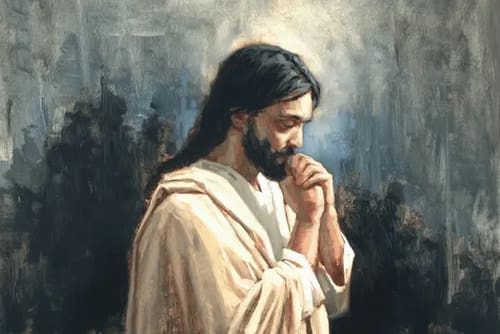
In the premortal council, the Beloved Son steps forward and speaks: “Father, thy will be done, and the glory be thine forever” (Moses 4:2). The first recorded utterance we hear from Him is not self-regarding. It is filial, worshipful, turned wholly toward Another. He introduces Himself to the universe by looking away from Himself. The first movement of divinity is deference. In Abraham’s account of that same council, His voice is equally ready: “Here am I, send me” (Abraham 3:27).
And if the Joseph Smith Translation preserves for us His final words upon the cross, “Father, into thy hands I commend my Spirit; thy will is done” (JST, Matthew 27:54), then the whole of His mortal ministry is framed in the same orientation. His first word is Father. His last word is Father. Between those two invocations stands everything He came to do. All else is stone and timber raised between those pillars. The miracles are masonry; the obedience is architecture. The Messianic Psalm had already anticipated this interior order: “I delight to do thy will, O my God: yea, thy law is within my heart” (Psalm 40:8).
The will of the Father is not a cage but a country, and the Son moves through it with the joy of a man who has come home.
Notice the verb. Delight. Not endure, not tolerate, not grimly execute. The Son delights in the Father’s will the way a master cellist delights in Bach; the constraint of the score is precisely what sets the music free. This is the paradox that governs everything that follows: the will of the Father is not a cage but a country, and the Son moves through it with the joy of a man who has come home.
The Architecture of Filial Fidelity
If one listens carefully, that phrase, the will of the Father, resounds through every room of His ministry. “I came down from heaven,” He declared, “not to do mine own will, but the will of him that sent me” (John 6:38). It shapes how He understands His gospel, how He eats, how He prays, how He defines family, how He describes the kingdom, how He endures agony, and how He introduces Himself in resurrected glory. The pattern never wavers. He does not drift from it by a single degree. If there is a straight line in history, it is the line of the Son toward the Father. The rest of us move in zig-zags, loops, and the occasional confident shortcut that turns out to be a swamp. He is the only one who walked as though He actually knew where the front door was — and never once checked the map, because He had written it.
The risen Lord has already given His Nephite disciples hours of theology. Then comes the question: what is your gospel? One might expect a summary, a creed, a careful distillation of the preceding hours. Instead, He offers a sentence about a Son and a Father: “I came into the world to do the will of my Father, because my Father sent me” (3 Nephi 27:13). The lecture collapses into a relationship. He came because He was sent, and He went because He loved the One who sent Him — which turns out to be the whole of it. President Russell M. Nelson has taught that “our Father knows that when we are surrounded by uncertainty and fear, what will help us the very most is to hear His Son,”1 and that invitation directs us again to the only place where the theology becomes a Person.
Mortality is not accidental. We are here on assignment. The endowment quietly requires that we remember why we came. Christ never forgot.
In Latter-day Saint temples, we learn that mortality is not accidental. We are here on assignment. The endowment quietly requires that we remember why we came. Christ never forgot.
Sustenance in the Disputed Territory
In the first-century Holy Land, there existed what might be called an unpleasant arithmetic: Jew plus Samaritan equaled defilement. Hatred, having failed to destroy its rival, had contented itself with drawing maps. When men cannot conquer, they redraw the borders — and then, in time, mistake the map for the truth.
Yet John tells us that “he must needs go through Samaria” (John 4:4). The phrase is curious. From a purely geographical standpoint, He did not need to. There are necessities that do not appear on maps, roads drawn not by terrain but by obedience. Christ walked straight through disputed territory because obedience makes a straighter road than fear. He had a habit of ignoring the “No Trespassing” signs erected by human spite. To the Pharisees, Samaria was a spiritual landfill; to Jesus, it was simply a place where a woman was thirsty. He did not need a passport to enter a country His Father had already made.
At Jacob’s well He meets a Samaritan woman, and the conversation that follows has nourished readers for two thousand years. When the disciples return with food and urge Him, “Master, eat” (John 4:31), He replies with a sentence that startles them: “I have meat to eat that ye know not of” (v. 32). This hidden sustenance is nothing less than the “will of him that sent me” (v. 34). While the disciples were haggling over the price of barley—preoccupied with the perishable manna of the marketplace—He had been feasting on something the world cannot bake. He stood by the well looking like a man who had just finished a seven-course meal, while holding nothing but a conversation. We suspect obedience is a fast; Christ reveals it is a banquet where the Father picks up the tab.
We suspect obedience is a fast; Christ reveals it is a banquet where the Father picks up the tab.
Here is the paradox the world misses entirely. The world suspects obedience of being a starvation diet for the soul. Christ reveals the opposite. Alignment with the Father is sustenance. The One who had fasted forty days in the wilderness speaks here as a man well-fed, because He is. As Elder D. Todd Christofferson has observed, the Savior’s “moral discipline was rooted in His discipleship to the Father,”2 a discipleship so complete that doing the Father’s work became His literal nourishment. Heaven’s bread is heavier than it looks.
The Lord’s Prayer: Tutoring the Human Heart
This same orientation shapes the prayer He gives to His disciples. In what we call the Lord’s Prayer, the petition rises early: “Thy will be done in earth, as it is in heaven” (Matthew 6:10).
Heaven, in that brief phrase, is described without ornament: it is the place where no one argues with love. Hell begins wherever love is treated as a suggestion. Earth is invited to learn the same music. The discord is ours; the melody is already written. The prayer is not a list of demands left on a divine doorstep; it is a tuning fork. We do not say “Thy will be done” to inform God of His duties, but to remind ourselves of our own. We are asking to be bent into harmony, which is often a painful process for those of us who prefer our own off-key solos.
The Father’s will is not an inscrutable decree imposed from above. It is the eternal order of love, the grain of reality as it truly runs. King Benjamin invited his people to “consider on the blessed and happy state of those that keep the commandments of God,” who are “blessed in all things” and “received into heaven” (Mosiah 2:41). To pray “Thy will be done” is not to ask for domination. It is to ask that our lives be brought into alignment with what is ultimately life-giving. In the temple, the structure and sequence of ordinances tutor us in what it means to live that prayer. There the Lord has promised that “my glory shall rest upon it; yea, and my presence shall be there” (D&C 97:15–16). Christ does not merely instruct us to pray this way. He embodies the prayer from Bethlehem to Calvary.
The Covenant Circle and the Household of Faith
His devotion redefines even the most intimate human bonds. In Matthew 12, when told that His mother and brethren stand without, Jesus stretches forth His hand toward His disciples and declares, “Whosoever shall do the will of my Father which is in heaven, the same is my brother, and sister, and mother” (Matthew 12:50).
There is nothing dismissive in this gesture. It is an enlargement of the hearth. The circle widens beyond bloodline into the vastness of covenant, a widening that makes room for the whole worn, wandering human family. You are His brother when you face the same way He faces. Kinship is not first a matter of blood but of direction. We belong most truly to those toward whom we are walking.
There is a world of difference between a man who can recite the recipe and a man who has flour on his hands.
The same principle governs the gates of His kingdom. “Not every one that saith unto me, Lord, Lord, shall enter into the kingdom of heaven,” He warns, “but he that doeth the will of my Father which is in heaven” (Matthew 7:21). The repetition of “Lord” suggests a sincerity that remains perched upon the lips, like a bird that will not come indoors. The Kingdom requires a devotion that has moved in, rearranged the furniture, and refuses to leave. There is a world of difference between a man who can recite the recipe and a man who has flour on his hands. President Dallin H. Oaks teaches that “the gospel of Jesus Christ is not a checklist of things to do; rather, it is a plan that shows us how to become something.”3 We obey to become the kind of children who are finally at home in the Father’s presence — not guests who have memorized the house rules, but heirs who have learned to love the house.
The Gethsemane “Nevertheless”: Consecration on the Altar
If this theme sounds serene in Galilee, it becomes something else entirely in Gethsemane. Under the weight of approaching agony, the Savior prays, “O my Father, if it be possible, let this cup pass from me” (Matthew 26:39). The plea is honest. There is no theatrical stoicism here. The cup is bitter — not metaphorically bitter, the way we call a Monday bitter, but bitter the way blood is bitter when you taste it in your own mouth. Luke tells us that His sweat became as great drops of blood (Luke 22:44). President Russell M. Nelson has testified that “in the Garden of Gethsemane, our Savior took upon Himself every pain, every sin, and all of the anguish and suffering ever experienced by you and me.”4 The agony was not performative. The cup could be refused; every bitter drop was visible to Him. Love did not remove the choice. It made the choice radiant.
And then comes the word that steadies the cosmos: “Nevertheless not as I will, but as thou wilt.”
That nevertheless holds within it the redemption of worlds. History turns upon that hinge. A single surrendered will outweighed all the empires of self. It signals neither reluctance nor resignation, but consecration. The human will of Jesus Christ is not merely offered; it is laid upon the altar of the Father’s love. Whether in the simple bread and water of the sacrament or the sacred altars of the temple, the pattern is the same: we bring our nevertheless to the Father, discovering that the altar is not a place of loss but the site where our will is sanctified and returned to us, enlarged.
What temples teach in symbol, He enacts in blood. Abinadi foresaw this moment when he taught that the Redeemer would be “led, crucified, and slain, the flesh becoming subject even unto death, the will of the Son being swallowed up in the will of the Father” (Mosiah 15:7). His will is not coerced into harmony. It is freely one with the Father’s. What appears as surrender is, in truth, the revelation of who He eternally is.
On the cross, the pattern remains unbroken. “Father, forgive them,” He prays (Luke 23:34). And at last, according to the inspired rendering preserved by Joseph Smith, “Father, it is finished; thy will is done” (JST, Matthew 27:54; cf. Matthew 27:50–54).
The shift in tense is as quiet as it is consequential. In the premortal council: “Father, thy will be done.” Upon the cross: “Father… thy will is done.” The space between those two verbs, between the be and the is, is the space of a human life. It is the distance between a promise made in heaven and a promise kept in blood. The Savior’s final breath was not a sigh of relief that the pain was over. It was a final report of mission accomplished to the One who sent Him.
Resurrection Light and the Final Accounting
One might imagine that after resurrection the emphasis would shift. Yet when He appears among the Nephites in Bountiful, His introduction resounds with the same devotion: “Behold, I am Jesus Christ… and I have drunk out of that bitter cup which the Father hath given me, and have glorified the Father… in the which I have suffered the will of the Father in all things from the beginning” (3 Nephi 11:10–11).
From the beginning. The phrase gathers premortal council, mortal ministry, Gethsemane, and Calvary into a single, seamless obedience. Resurrection does not eclipse submission; it reveals its glory the way morning light reveals the builder’s work.
Justice, in such hands, is mercy with a backbone—the kind of love that refuses to call a lie a truth for the sake of keeping the peace.
Even His role as Judge is cast in these terms. “I can of mine own self do nothing,” He declared. “As I hear, I judge: and my judgment is just; because I seek not mine own will, but the will of the Father which hath sent me” (John 5:30; see also D&C 19:2). We often picture judgment as a cold accounting, as if God were a celestial actuary with a green eyeshade. But in the Son’s hands, judgment is the fierce protection of a Home. He is not looking for a reason to lock the door; He is looking for children who actually want to live in the house. Justice, in such hands, is mercy with a backbone—the kind of love that refuses to call a lie a truth for the sake of keeping the peace.
The Holy House
The foundation is laid in heaven: “Father, thy will be done.” The walls rise through mortal ministry, each stone set in obedience. The altar stands in Gethsemane. The veil trembles at Calvary. Glory crowns the structure in resurrection light.
For those who worship in temples today, the invitation is both sobering and sweet. In a world that prizes self-assertion, we kneel in a quiet room and practice the ancient art of facing the right direction. President Russell M. Nelson has declared that “the covenant path is the only path that leads to exaltation and eternal life.”5 Elder Neal A. Maxwell taught that “the submission of one’s will is really the only uniquely personal thing we have to place on God’s altar. The many other things we ‘give’ are actually the things He has already given or loaned to us. However, when you and I finally submit ourselves, by letting our individual wills be swallowed up in God’s will, then we are really giving something to Him. It is the only possession which is truly ours to give!”6
The first word of the Son was Father. The last word was Father. Eternity opens and closes with that address. To follow Christ is to enter the same temple of obedience, until our own lives, however humbly, echo His: Thy will is done. And in that echo, we find at last that the will of the Father is not the loss of ourselves but the finding of our true name. For the only self worth keeping is the one given back to us by God.
Footnotes
1 Russell M. Nelson, “Hear Him,” Ensign or Liahona, May 2020, 88–92.
2 Todd Christofferson, “Moral Discipline,” Ensign or Liahona, November 2009, 105–8.
3 Dallin H. Oaks, “The Challenge to Become,” Ensign, November 2000, 32–34; see also “Kingdoms of Glory,” General Conference, October 2023.
4 Russell M. Nelson, “The Correct Name of the Church,” Ensign or Liahona, November 2018, 87–90.
5 Russell M. Nelson, “The Temple and Your Spiritual Foundation,” Liahona, November 2021, 93–96.
6 Neal A. Maxwell, “Swallowed Up in the Will of the Father,” in Ensign, November 1995, 22–24.
President Russell M. Nelson 101: The Atonement of Jesus Christ
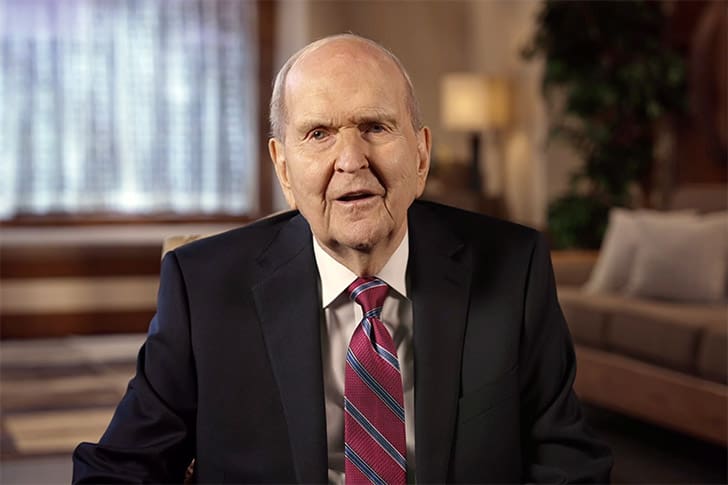
As we approach September 9, 2025, we joyfully join with members of The Church of Jesus Christ of Latter-day Saints—and friends across the world—in celebrating the 101st birthday of President Russell M. Nelson. Over more than a century of life, and especially since his calling as an apostle and now as the prophet, seer and revelator, President Nelson has shared an unshakable witness of Jesus Christ, a profound love for God’s children, and a vision for how we can rise to our highest potential.
In honor of this milestone, we are publishing a series of articles we’ve titled President Russell M. Nelson 101—short, powerful explorations of his teachings, each focused on a particular theme. Like attending a masterclass in spiritual insight, each article offers a rich but brief collection of his quotes, complete with sources, so that readers can both study further and be deeply inspired.
This first installment turns our souls to the heart of the gospel: the Atonement of Jesus Christ. In his teachings, President Nelson reminds us that the Savior’s infinite sacrifice is more than an event in history—it is His personal, living power by which our sins, sorrows, and weaknesses can be healed. It is His gift that brings us hope, peace, and eternal perspective. As you read, let yourself feel the depth of God’s love and the power of Christ’s redeeming grace.
Happy birthday, President Nelson. We are profoundly grateful for your life, your example, and the light of Christ you continue to bring into the world.
“His Atonement is infinite—without an end. It was also infinite in that all humankind would be saved from never-ending death. It was infinite in terms of His immense suffering. It was infinite in time, putting an end to the preceding prototype of animal sacrifice. It was infinite in scope—it was to be done once for all. And the mercy of the Atonement extends not only to an infinite number of people, but also to an infinite number of worlds created by Him. It was infinite beyond any human scale of measurement or mortal comprehension.”
(The Atonement, General Conference, October 1996)
“The Creation required the Fall. The Fall required the Atonement. The Atonement enabled the purpose of the Creation to be accomplished. Eternal life, made possible by the Atonement, is the supreme purpose of the Creation. To phrase that statement in its negative form, if families were not sealed in holy temples, the whole earth would be utterly wasted.”
(The Atonement, General Conference, October 1996)
“He who, under direction of the Father, had created the earth, subsequently came into mortality to do the will of His Father and to fulfill all prophecies of the Atonement. His Atonement would redeem every soul from the penalties of personal transgression, on conditions that He set.”
(The Creation, General Conference, April 2000)

Just outside the Garden Tomb in Jerusalem.
“I plead with you to come unto Him so that He can heal you! He will heal you from sin as you repent. He will heal you from sadness and fear. He will heal you from the wounds of this world. Whatever questions or problems you have, the answer is always found in the life and teachings of Jesus Christ. Learn more about His Atonement, His love, His mercy, His doctrine, and His restored gospel of healing and progression. Turn to Him! Follow Him!”
(The Answer is Always Jesus Christ, General Conference, April 2023)
“Jesus Christ took upon Himself your sins, your pains, your heartaches, and your infirmities. You do not have to bear them alone! He will forgive you as you repent. He will bless you with what you need. He will heal your wounded soul. As you yoke yourself to Him, your burdens will feel lighter. If you will make and keep covenants to follow Jesus Christ, you will find that the painful moments of your life are temporary. Your afflictions will be ‘swallowed up in the joy of Christ.’”
(The Lord Jesus Christ Will Come Again, General Conference, October 2024)
“Each person who makes covenants in baptismal fonts and in temples—and keeps them—has increased access to the power of Jesus Christ. Please ponder that stunning truth! The reward for keeping covenants with God is heavenly power—power that strengthens us to withstand our trials, temptations, and heartaches better. This power eases our way. Those who live the higher laws of Jesus Christ have access to His higher power. Thus, covenant keepers are entitled to a special kind of rest that comes to them through their covenantal relationship with God.”
(Overcome the World and Find Rest, General Conference, October 2022)

Ancient olive tree in the Garden of Gethsemane.
“The Lord will bless you with miracles if you believe in Him, ‘doubting nothing.’ Do the spiritual work to seek miracles. Prayerfully ask God to help you exercise that kind of faith. I promise that you can experience for yourself that Jesus Christ ‘giveth power to the faint; and to them that have no might he increaseth strength.’ Few things will accelerate your spiritual momentum more than realizing the Lord is helping you to move a mountain in your life.”
(The Power of Spiritual Momentum, General Conference, April 2022)
“The pure doctrine of Christ is powerful. It changes the life of everyone who understands it and seeks to implement it in his or her life. The doctrine of Christ helps us find and stay on the covenant path. Staying on that narrow but well-defined path will ultimately qualify us to receive all that God has. Nothing could be worth more than all our Father has!”
(Pure Truth, Pure Doctrine, and Pure Revelation, General Conference, October 2021)
“Please know this: if everything and everyone else in the world whom you trust should fail, Jesus Christ and His Church will never fail you. The Lord never slumbers, nor does He sleep. He “is the same yesterday, today, and [tomorrow].” He will not forsake His covenants, His promises, or His love for His people. He works miracles today, and He will work miracles tomorrow. Faith in Jesus Christ is the greatest power available to us in this life. All things are possible to them that believe. Your growing faith in Him will move mountains—not the mountains of rock that beautify the earth but the mountains of misery in your lives. Your flourishing faith will help you turn challenges into unparalleled growth and opportunity.”
(Christ Is Risen; Faith in Him Will Move Mountains, General Conference, April 2021)
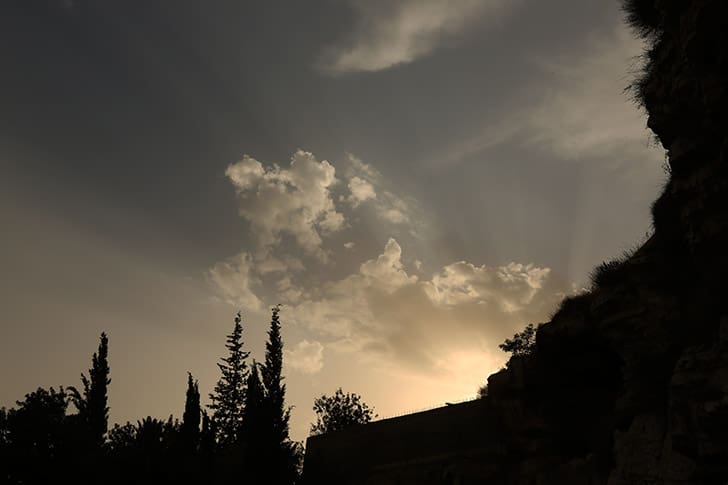
Beneath Golgotha as the sun sets.
“There is no limit to the Savior’s capacity to help you. His incomprehensible suffering in Gethsemane and on Calvary was for you! His infinite Atonement is for you! Jesus Christ took upon Himself your sins, your pains, your heartaches, and your infirmities. You do not have to bear them alone! He will forgive you as you repent. He will bless you with what you need. He will heal your wounded soul. As you yoke yourself to Him, your burdens will feel lighter. If you will make and keep covenants to follow Jesus Christ, you will find that the painful moments of your life are temporary. Your afflictions will be “swallowed up in the joy of Christ.”
(The Lord Jesus Christ Will Come Again, General Conference, October 2024)
“Because of Jesus Christ’s infinite Atonement, our Heavenly Father’s plan is a perfect plan! An understanding of God’s fabulous plan takes the mystery out of life and the uncertainty out of our future. It allows each of us to choose how we will live here on earth and where we will live forever. The baseless notion that we should ‘eat, drink, and be merry, for tomorrow we die; and it shall be well with us’ is one of the most absurd lies in the universe. Here is the great news of God’s plan: the very things that will make your mortal life the best it can be are exactly the same things that will make your life throughout all eternity the best it can be!”
(Think Celestial, General Conference, October 2023)
“If we as a people and as individuals are to have access to the power of the Atonement of Jesus Christ—to cleanse and heal us, to strengthen and magnify us, and ultimately to exalt us—we must clearly acknowledge Him as the source of that power. We can begin by calling His Church by the name He decreed.”
(The Correct Name of the Church, General Conference, October 2018)

Golgotha just outside the walls of Jerusalem.
“Under the Father’s great eternal plan, it is the Savior who suffered. It is the Savior who broke the bands of death. It is the Savior who paid the price for our sins and transgressions and blots them out on condition of our repentance. It is the Savior who delivers us from physical and spiritual death. There is no amorphous entity called ‘the Atonement’ upon which we may call for succor, healing, forgiveness, or power. Jesus Christ is the source. Sacred terms such as Atonement and Resurrection describe what the Savior did, according to the Father’s plan, so that we may live with hope in this life and gain eternal life in the world to come. The Savior’s atoning sacrifice—the central act of all human history—is best understood and appreciated when we expressly and clearly connect it to Him.”
(Drawing the Power of Christ into our Lives, General Conference, April 2017)
“The gift of resurrection is the Lord’s consummate act of healing. Thanks to Him, each body will be restored to its proper and perfect frame. Thanks to Him, no condition is hopeless. Thanks to Him, brighter days are ahead, both here and hereafter. Real joy awaits each of us—on the other side of sorrow.”
(Jesus Christ—The Master Healer, General Conference, October 2005)
“Rich meaning is found in study of the word atonement in the Semitic languages of Old Testament times. In Hebrew, the basic word for atonement is kaphar, a verb that means ‘to cover’ or ‘to forgive.’ Closely related is the Aramaic and Arabic word kafat, meaning ‘a close embrace.’ … References to that embrace are evident in the Book of Mormon. One states that ‘the Lord hath redeemed my soul … ; I have beheld his glory, and I am encircled about eternally in the arms of his love’ [2 Nephi 1:15]. Another proffers the glorious hope of our being ‘clasped in the arms of Jesus’ [Mormon 5:11]. I weep for joy when I contemplate the significance of it all. To be redeemed is to be atoned—received in the close embrace of God with an expression not only of His forgiveness, but of our oneness of heart and mind. What a privilege! And what a comfort to those of us with loved ones who have already passed from our family circle through the gateway we call death!”
(The Atonement, General Conference, October 1996)

The Garden Tomb as the sun rises.
“Because of the Savior’s sacrifice, we have access to His healing power. He will heal our hearts, give us strength when we are weak, enable us to do things we never could do on our own, and heal us from sin when we repent. The Atonement of Jesus Christ can help us cope with grief, sadness, weakness, fear, anxiety, all of those things that are part of mortality’s trials.”
(The Happiest Place on Earth, Devotional in Orlando, Florida, June 9, 2019, unpublished)
“As I have wrestled with the intense pain caused by my recent injury, I have felt even deeper appreciation for Jesus Christ and the incomprehensible gift of His Atonement. Think of it! The Savior suffered ‘pains and afflictions and temptations of every kind’ [Alma 7:11] so that He can comfort us, heal us, rescue us in times of need. Jesus Christ described His experience in Gethsemane and on Calvary: ‘Which suffering caused myself, even God, the greatest of all, to tremble because of pain, and to bleed at every pore’ [Doctrine and Covenants 19:18]. My injury has caused me to reflect again and again on ‘the greatness of the Holy One of Israel’ [2 Nephi 9:40]. During my healing, the Lord has manifested His divine power in peaceful and unmistakable ways.”
(Think Celestial, General Conference, October 2023)

Gethsemane by an ancient olive tree.
“I urge you to devote time each week—for the rest of your life—to increase your understanding of the Atonement of Jesus Christ. My heart aches for those who are mired in sin and don’t know how to get out. I weep for those who struggle spiritually or who carry heavy burdens alone because they do not understand what Jesus Christ did for them.”
(The Lord Jesus Christ Will Come Again, General Conference, October 2024)
*****
Stay tuned as tomorrow’s President Russell M. Nelson 101 will be on The Temple: Where the Spirit Teaches Us to be Disciples of the Savior
Finishers Wanted

In April 1972, then Elder Thomas S. Monson shared a story that has been constantly on my mind of late. He said,
One Wednesday I paused before the elegant show window of a prestigious furniture store. That which caught and held my attention was not the beautifully designed sofa nor the comfortable-appearing chair that stood at its side. Neither was it the beautiful chandelier positioned overhead. Rather, my eyes rested upon a small sign that had been placed at the bottom right-hand corner of the window. Its message was brief: “Finishers Wanted.”
The store had need of those persons who possessed the talent and the skill to make ready for final sale the expensive furniture that the firm manufactured and sold. “Finishers Wanted.” The words remained with me as I returned to the pressing activities of the day.
The words have remained with me too, since I heard them a few weeks ago. I have no problem being a starter. The first blush of a new idea is one of the most exciting things in the world to me, but it takes a different kind of diligence to see things through to their end. It is that kind of diligence that I was earnestly seeking this past week when I found myself holding out a pencil as far as my arm would reach, trying to draw a careful line, while 30 or so wasps circled my head.
You see, one of the great symbols of my need to become a finisher is the giant, half-built woodfire pizza oven that has been haunting my backyard for over a year. We had a bit of urgency at the outset. A historic general store in Lindon that my great grandfather co-ran was demolished and we wanted the chance to use some of the brick before it was all cleared away. So determined was I to use this brick for the non-heated parts of this project that I developed carpal tunnel in the process of carefully cleaning and preparing each brick.
We moved forward. We poured a foundation, we built the brick walls (and learned firsthand why bricklaying is an actual expert craft and DIYing it is terrible), we made ready to add a countertop and then we stopped.
There were some elements of making a level countertop on non-standard sized historic bricks that were confusing and a little overwhelming and the children were calling for us and the bills needed to be paid and the floors needed to be mopped and mopped again and life went rushing onward as it is wont to do, and the pizza oven began to blend into the background of the urgent current of all that life demands.
Then my mother told me about this talk over the phone and said those fateful words “Finishers Wanted”.
Within that week, I painted my front door that had had paint swatches on it all summer, I finished a rough cut of the film I’m directing, and I bought all that was necessary to put that countertop on that pizza oven. Taking next steps on so many earnestly waiting projects has shown me just how empowering it is to move forward past your mental stumbling blocks and find the version of you that is bigger than they are.
I was keenly aware, as we set out to make the forms ready for a concrete pour, that we could not get deterred because it is all too easy to just let things go by the wayside. But the cinder block portions that provide the bulk of the structure had become an inviting place for multiple wasps’ nests over the course of our time away from the project. We had sprayed them, waited for a time, and sprayed some more. And now our backerboard blocked the holes where the nests had been, but as the sun began to set, the wasps that had been away from the nest for the day began to come back to a home that they now could not find.
I do not necessarily recommend the path forward that I took, except symbolically. As I sat under the backer board tracing the shapes of the cinderblock columns, an increasing number of wasps circled and swarmed. I knew our time was limited and the task I had to finish was finite to be able to move forward. I pushed forward because I had to, but couldn’t help thinking how much of life we spend swarmed by stray thoughts and distractions and demands that seem so urgent, but are somehow not actually important.
Sometimes we invite the distraction because when we set out on our life’s projects, we encounter the first great difficulty and don’t want to have to find a way through it. It’s easier to only stay for the fun parts and walk away when it’s too hard, but as President Monson said of those who push through, “Their ranks are few, their opportunities many, their contributions great.” And,
From the very beginning to the present time, a fundamental question remains to be answered by each who runs the race of life. Shall I falter or shall I finish? On the answer await the blessings of joy and happiness here in mortality and eternal life in the world to come.
We poured the countertop. We got over that big hurdle, but many more steps remain before we can call it truly finished. We will have to rally and push again and again. Life is the same way.
President Monson said the marks of a finisher are these:
- The Mark of Vision
- The Mark of Effort
- The Mark of Faith
- The Mark of Virtue
- The Mark of Courage
- The Mark of Prayer
I invite you to click through and study what he said about each once, but I want to specifically discuss his thoughts on the first two marks: Vision and Effort.
It has been said that the doorways of history turn on small hinges, and so do people’s lives. We are constantly making small decisions. The outcome determines the success or failure of our lives. That is why it is worthwhile to look ahead, set a course, and at least be partly ready when the moment of decision comes. True finishers have the capacity to visualize their objective.
But he goes on to say that,
Vision without effort is daydreaming, effort without vision is drudgery; but vision, coupled with effort, will obtain the prize.
Needed is the capacity to make the second effort when life’s challenges lay us low.
“Stick to your task ’til it sticks to you;
Beginners are many, but enders are few.
Honor, power, place and praise
Will always come to the one who stays.
“Stick to your task ’til it sticks to you;
Bend at it, sweat at it, smile at it, too;
For out of the bend and the sweat and the smile
Will come life’s victories after a while.”
—Author Unknown
Making that second effort when life’s challenges lay us low is hard. Making the sixtieth effort is even harder, but it is what life demands of us. In C.S. Lewis’ wonderful book, The Screwtape Letters (a correspondence between two devils on how best to tempt humans), Screwtape says that [the Lord] allows a disappointment to occur at the threshold of every human endeavor. “It occurs when the boy who has been enchanted in the nursery by Stories from the Odyssey buckles down to really learning Greek. It occurs when lovers have got married and begin the real task of learning to live together. In every department of life, it marks the transition from dreaming aspiration to laborious doing.”
The text says that [the Lord] takes this risk because he has the “curious fantasy” of making us like Him and prepared to come back to live with Him.
Screwtape says,
Desiring their freedom, He therefore refuses to carry them, by their mere affections and habits, to any of the goals which he sets before them: He leaves them to ‘do it on their own’. And there lies our opportunity. But also remember, there lies our danger. If once they get through this initial dryness successfully, they become much less dependent on emotion and therefore much harder to tempt.
Of course, we know that there are many times that the Lord does carry us through our most painful times, but he won’t let the current of our natural man instincts just effortlessly lead us to what we need to be. I have often lamented that my particular weaknesses seem to be standing exactly in the way of my greatest desires, but if the Lord sent us here to learn to turn to His help to make weak things strong, of course what we want most would lie on the other side of the parts of ourselves we have to overcome. Our great weaknesses will never just lie at the end of a side road, irrelevant to our path and conveniently signposted “There be Dragons”, they will be the stumbling blocks dead ahead which cannot be got over without the outstretched hand of the Master.
The greatest Finisher of all is, of course, Jesus Christ, who in Hebrews 12 is referred to as “the author and finisher of our faith.” He truly showed what it means to endure to the end even when that endurance demands something bitter.
In the increasing suffering of Gethsemane, he called out to his father and said, “Father, if thou be willing, remove this cup from me: nevertheless not my will, but thine, be done” The pain of finishing was just beginning, but he proceeded because he was a finisher and he was there to do his Father’s will.
“And being in an agony he prayed more earnestly” I have said those words many times as a narrator of Lamb of God, but not until the very moment of writing this, realized the significance of being in an agony and responding to that with an increase in prayerful devotion, not a decrease.
Like that little boy who fell in love with the Stories of the Odyssey, but then perhaps lost a little of his shine when he grew up and sat down to actually learn Greek; many of us build our testimonies in childhood simplicity. We pray that our dog will come back or that Dad will find the keys and when that prayer is answered, we believe in prayer. But then we get older and prayer becomes more complex, the questions we ask aren’t so simple, nor are their answers.
When we face the inevitable trials of our faith and the wasps circle, when we find ourselves in an agony, will we pray more earnestly? Or will we question whether prayer really is as powerful as we thought and choose to find out by not doing it anymore?
President Monson beautifully stated:
Though Jesus was tempted by the evil one, yet he resisted. Though he was hated, yet he loved. Though he was betrayed, yet he triumphed. Not in a cloud of glory or chariot of fire was Jesus to depart mortality, but with arms outstretched in agony upon a cruel cross. The magnitude of his mission is depicted in the simplicity of his words.
To his Father he prayed, “… the hour is come. … I have glorified thee on the earth: I have finished the work which thou gavest me to do.” (John 17:1, 4.) “… into thy hands I commend my spirit. …” (Luke 23:46.)
Mortality ended. Immortality began.
Times change, circumstances vary, but the true marks of a finisher remain. Note them well, for they are vital to our success.
I don’t know how many inquiries came from that “Finishers Wanted” sign in the furniture store window all those years ago, but the windows of eternity bear the same message and anxiously await our call and our commitment.
Gethsemane: How a Precious Truth was Lost and Found

Sign up for Meridian’s Free Newsletter, please CLICK HERE
As Latter-day Saints, we believe that what happened in Gethsemane was essential to the Atonement of Jesus Christ. As True to the Faith explains, “Jesus’s atoning sacrifice took place in the Garden of Gethsemane and on the cross at Calvary. In Gethsemane He submitted to the will of the Father and began to take upon Himself the sins of all people … The Savior continued to suffer for our sins when He allowed Himself to be crucified—‘lifted up upon the cross and slain for the sins of the world’ (1 Nephi 11:33).” (True to the Faith: Atonement).
It was in Gethsemane that Christ began His Atonement and it was on the cross that he completed his suffering as “all the infinite agonies and merciless pains of Gethsemane recurred” (McConkie, Ensign May 1985). Truly, it was a “perfect atonement” wrought out “through the shedding of his own blood” in both Gethsemane and on the cross (D&C 76:69).
When sharing these beliefs with other Christians, many Latter-day Saints are surprised to find out that our belief in the role of Gethsemane is not a common belief shared with most other Christians. Typically, they believe the Atonement of Christ took place exclusively on the cross and that the events in Gethsemane were just in prayerful preparation and anticipation for that suffering. Even more surprising is the fact that a key scriptural passage supporting our view of Gethsemane has been removed by many modern translations of the Bible. What happened to cause this plain and precious truth to be lost and what we can learn from it is an important topic for Latter-day Saints to consider.
The Case of Luke 22:43-44
After Christ’s earnest prayer to have the bitter cup of His atoning suffering removed and his expressed submission to do the will of the Father, Luke records these words, “And there appeared an angel unto him from heaven, strengthening him. And being in an agony he prayed more earnestly: and his sweat was as it were great drops of blood falling down to the ground” (Luke 22:43-44). Latter-day Saints recognize these simple words as doctrinally important because they describe the suffering that Christ endured for our sins in Gethsemane.
Unfortunately though, for years these two verses have been disputed by scholars because they are not found in some of the early manuscripts of the Bible. Many have assumed that this meant they were added as “interpolations” to the original text and many modern Bible translations have left out this passage or put it in brackets to identify it as questionable. More recent scholarship, however, proposes the opposite explanation. It suggests that these verses were actually deliberately removed from the text. Some of the evidence for this is that the passage is found in the earliest extant fragment of Luke, it was known by many of the early Christian writers of the second century, and it does not begin to disappear from the text until later in the third and fourth centuries (L. H. Blumell, “Luke 22:43-44: An-Anti-Docetic Interpolation or an Apologetic Omission?”, TC: A Journal of Biblical Textual Criticism 19 (2014):1-35.).
There are several reasons why well-intentioned but misinformed men would seek to remove this passage in early Christian history. One reason is that this passage was a favorite of early Anti-Christians who mocked the idea that a divine being would be weak enough to suffer and ask for help. Many early Christians may have been embarrassed by this attack and found it easier to remove the passage rather than defend or explain it to critics (L. H. Blumell, “Luke 22:43-44: An-Anti-Docetic Interpolation or an Apologetic Omission?”, TC: A Journal of Biblical Textual Criticism 19 (2014):1-35).
Another compelling reason some might have removed it is that Christ’s suffering seemed to contradict ideas from the Nicene creed about Christ’s humanity and capacity to truly experience mortal suffering and temptation. The best evidence for this happening is that one early Christian literally witnessed it and wrote about it! He reported that “orthodox” supporters of the Nicene Creed were removing verses from the Bible and specifically listed Luke 22:43-44 as among those verses. He described that they “being afraid and not understanding the meaning and power of the passage [Luke 22:43-44], have expunged it” (Epiphanius, Firmly Anchored One, in Holl, Epiphanius, 31.4-5; see Lincoln H. Blumell, “Rereading the Council of Nicaea and its Creed”,” in Miranda Wilcox and John Young (eds.), Standing Apart: Mormon Historical Consciousness and the Concept of Apostasy. Oxford: Oxford University Press, 2014, 191–212).
Fortunately, the passage remained in enough manuscripts that it was not completely erased and survived to the modern era. But even with the passage included in many Bibles, because of diminished support and misunderstanding of its significance, it has often been interpreted as figurative and downplayed as just referring to Christ sweating profusely in anticipation for the suffering on the cross. The full weight of what took place in Gethsemane was largely lost from Christianity.
The Loss of Plain and Precious Truths
The loss or removal of important doctrine from the Bible is not surprising for Latter-day Saints. Nephi reported in vision seeing that “many plain and precious things … have been taken out of the book, which were plain unto the understanding” and that this textual tampering has caused many to stumble (1 Nephi 13:29). The story of Luke 22 helps us better understand how this tampering may have taken place. Often it was deliberate and intentional not accidental or indiscriminate. It was also not necessarily done with malicious intent but at least some tampering was done by “orthodox” Christians who were sincerely trying to “improve” the text based on their misunderstandings or to defend the text from the attacks of critics. However well-intended and sincere they may have been, such tampering with the word of God still had lasting consequences on our ability to understand and interpret the Bible correctly (see JS-H 1:9-12).
What happened with Luke 22 also helps us better understand what Joseph Smith meant when he proclaimed that “we believe the Bible as far as it is translated correctly” (A of F 1:8). Often we read the word “translated” and think only of the process of changing one language to another, but this account makes it clear that a bigger problem in translation was the transmission and interpretation of text. The best translators in the world can’t translate words if they are no longer in the text and the words in the text will likely be misunderstood if they are subjected to centuries of uninspired interpretation. In other words, to be “translated correctly” the Bible must be “transmitted correctly” and “interpreted correctly.” This use of the word “translation” to include transmission and interpretation is consistent with the way Joseph Smith used the term in his “translation” of the Bible which was not an attempt to change the language from English but the inspired effort to restore lost texts and clarify existing texts to help the Bible be understood more plainly.
Restoring Plain and Precious Truths
The solution to this problem of Bible tampering was also shown to Nephi in vision. He witnessed the coming forth of the Book of Mormon and “other books” of scripture in the latter-days that would serve three important purposes. First, they would “establish the truth” of the Bible by confirming and correctly interpreting the truths that it already contains. Second, they would restore or “make known the plain and precious things which have been taken away” from the Bible. And third, these additional scriptures of the Restoration would join with the Bible in testifying that Jesus Christ “is the Son of the Eternal Father, and the Savior of the World” (1 Nephi 13:39-40).
Again, the case of Luke 22 illustrates exactly what Nephi described. In the Book of Mormon and Doctrine & Covenants we find statements that confirm, interpret, and (if it were necessary) restore the truths Luke recorded about Gethsemane. These verses provide an additional modern witness of the Atonement of Jesus Christ. For example, the Nephite prophet King Benjamin taught that Christ would “suffer temptations, and pain of body, hunger, thirst, and fatigue, even more than man can suffer, except it be unto death; for behold, blood cometh from every pore, so great shall be his anguish for the wickedness and the abominations of his people” (Mosiah 3:7 emphasis added).
Perhaps the greatest scripture we have on the subject though comes from the Lord Jesus Christ himself who intimately explained what he experienced for us in Gethsemane. He revealed to Joseph Smith that “I, God, have suffered these things for all, that they might not suffer if they would repent; But if they would not repent they must suffer even as I; Which suffering caused myself, even God, the greatest of all, to tremble because of pain, and to bleed at every pore, and to suffer both body and spirit—and would that I might not drink the bitter cup, and shrink— Nevertheless, glory be to the Father, and I partook and finished my preparations unto the children of men” (D&C 19:18-19). These verses make it clear that Christ began his atoning sacrifice in Gethsemane and that his suffering caused him to literally sweat blood. As latter-day Saints, we do not need to question the authenticity or interpretation of the passage in Luke because it has been confirmed to us by modern revelation—Christ himself explained it to us.
Conclusion
The doctrine of Gethsemane is just one of the many reasons to be grateful for the Restoration of the gospel of Jesus Christ through the Prophet Joseph Smith. Although “no mortal mind can conceive the full import of what Christ did in Gethsemane,” through modern revelation and living prophets we know the following:
“We know he sweat great gouts of blood from every pore as he drained the dregs of that bitter cup his Father had given him.
“We know he suffered, both body and spirit, more than it is possible for man to suffer, except it be unto death.
“We know that in some way, incomprehensible to us, his suffering satisfied the demands of justice, ransomed penitent souls from the pains and penalties of sin, and made mercy available to those who believe in his holy name.
“We know that he lay prostrate upon the ground as the pains and agonies of an infinite burden caused him to tremble and would that he might not drink the bitter cup.
“We know that an angel came from the courts of glory to strengthen him in his ordeal, and we suppose it was mighty Michael, who foremost fell that mortal man might be.
“As near as we can judge, these infinite agonies—this suffering beyond compare—continued for some three or four hours…
“And now, as pertaining to this perfect atonement, wrought by the shedding of the blood of God—I testify that it took place in Gethsemane and at Golgotha, and as pertaining to Jesus Christ, I testify that he is the Son of the Living God and was crucified for the sins of the world. He is our Lord, our God, and our King. This I know of myself independent of any other person.” (Elder Bruce R. McConkie, Ensign May 1985, emphasis added)
Truly, these are things we know independent of any other person or church, for they are not beliefs we share in common with other Christian churches. We know them because Jesus Christ revealed and restored them through the prophet Joseph Smith. May we forever be grateful for what has revealed in our day and share it with all who desire to know more about the Atonement of Jesus Christ.
The Director of Gethsemane
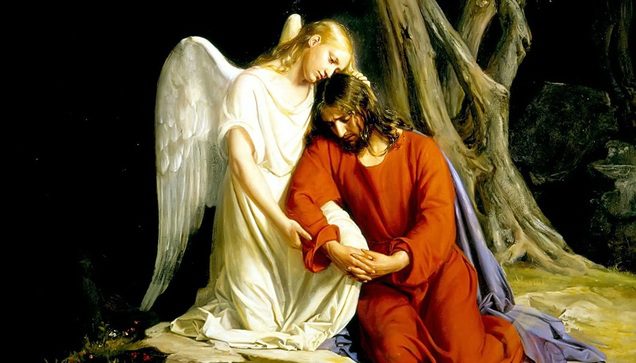
The last two weeks I have been singing in a production called Lamb of God, by composer Rob Gardner, which portrays the life and mission of Jesus Christ. This is my third year participating in it and it is my new favorite way to celebrate Easter.
One of the pieces of this masterful orchestration is entitled “Gethsemane.”
As I have performed this song, the Spirit has given me a glimpse of the depth of what went on in Gethsemane. A glimpse I have never had, even when I lived in Jerusalem and went to this garden many times a week. Even when I had a very sacred physical experience in Gethsemane, there was no music to make what I felt there come to life.
Now there is.
There are impressive soloists representing Peter, John, Thomas, Judas, Mary Mother of Jesus, Mary Magdalene, Pilate, and a few others. But the composer chose not to have a soloist represent the Savior. He chose a cello. Here is a low quality video of what this song sounds like without the choir:
There is a moment in this song after the cello personifies the expressions of the Savior during the atonement where the choir takes over and starts to sing the words of the Savior as He pleads that the bitter cup be taken from him. A moment when I cannot let myself think about the meaning of what we are portraying, or I lose my composure and with it my ability to perform. It is a sacred, powerful and intense moment.
The Abba moment.
The orchestra and choir mesh to produce an indelible expression of music that portrays the infinite suffering. Suffering of a God, made human, for this very moment. The music starts in piano (very soft) and grows over about ten measures at which point the orchestra is nearly snapping their strings and the choir is all but screaming.
Every time this moment happens, I look at the director who is flexing virtually every muscle in his body as he rips this sound from the collective soul of the choir and orchestra.
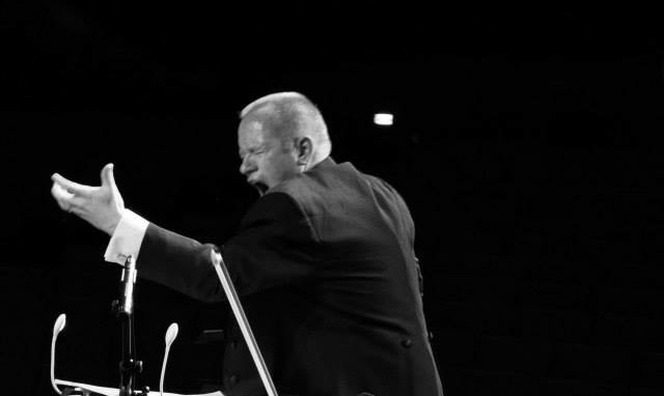
Jason Robison, this year’s conductor, directing the Abba moment during the song Gethsemane. PC Bob Church.
There isn’t a time that I have performed this where I haven’t been impressed by the director’s excruciating expression, even during rehearsal. It looks as if he is in deep, but necessary pain. After the Abba cry, there is absolute silence. Everyone feels it. It pierces every soul in the audience, choir and orchestra to the center. And though they may not fully comprehend what just happened or the Aramaic words, the central self of each individual knows that what just happened is something of profound significance. Here are the words in the language Jesus would have spoken:
ABBA, AVI, EHVAR MANEE KASAH HANAH —Father, take away from me this cup
ALA LO TSAVANI, ANT TSAVANACH ——- But not my will, Thy will
O ABBA! ——- O Father!
I know what happened in Gethsemane was real and it was unimaginably difficult. To the point where a God cried out for help from his Daddy. He cried louder than any combined choir and orchestra. He called out to His Abba, and to your Abba. It was a cry of complete desperation because though He was the literal Son of the literal God, there were inklings of mortal humanity within Him and this atonement caused Him to become awestruck.
Even amidst this Abba cry and the awful and amazing expiation of the sins of every living soul in the universe, He was the Director.
The Director of Gethsemane.
At any moment, Jesus of Nazareth could have put the baton down and stopped the awful and infinite music of the wrath of the atonement. He could have chosen not to go through with it. But He didn’t. He kept the music going to the bitter end.
“—how sore you know not, how exquisite you know not, yea, how hard to bear you know not. For behold, I God, have suffered these things for all, that they might not suffer if they would repent;…which suffering caused myself, even God, the greatest of all, to tremble because of pain, and to bleed at every pore, and to suffer both body and spirit—and would that I might not drink the bitter cup and shrink—” (D&C 19:15-19).
Glory be to the Father and thanks be to God that He partook and finished His preparations to all of us. I know that He is, like He said, “the greatest of all”. How grateful I am that Jesus is the Christ, the certainty of my uncertainty, the completion of my incompletion, the finisher of my faith, the Director of Gethsemane.
FEATURES