




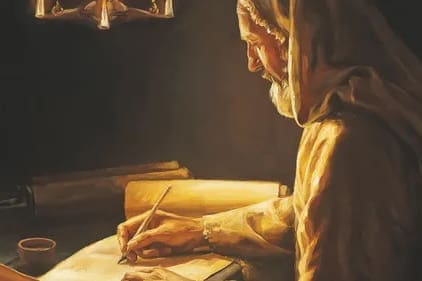


In late July 1832, Joseph Smith returned to translating the Old Testament after completing his work in the New Testament. On March 7, 1831, the Lord had instructed Joseph to turn his attention to the New Testament. (D&C 45:60-62) As commanded, on March 8, 1831, Joseph began translating Matthew chapter 1, only returning to the Old Testament after completing the book of Revelation 16 months later. He had also adopted a shorter methodology for transcribing his inspired alterations.

Deut. 34:5-6 showing one method Joseph used to mark his bible. Several types of marks were used to indicate changes to be made, including dots, check marks, and lines both vertical and horizontal.
In the beginning, scribes wrote out complete books, including chapters, verses, and Joseph’s alterations. After he had worked his way through John 5, he began to use a shorter and quicker process. He would mark his bible wherever changes needed to be made, then have his scribes write only the reference and a few sentences or the changed words within the verses. This new process of transcribing the scriptures made the translation move more quickly, but it had the effect of leaving us to occasionally wonder what the Prophet was considering.

Deut. 34:5-6 transcription at the top of the manuscript page.
The new method of transcribing the Prophet’s words coincided with fewer changes being made to the New Translation, or the Joseph Smith Translation (JST) as we refer to it. Why fewer changes were made after John 5 is not totally clear. Perhaps the Lord’s intent for Joseph being instructed in D&C 45 to move to the New Testament in order “61 …that ye may be prepared for the things to come. 62 For verily I say unto you, that great things await you;” had generally been accomplished. It was during this period that most of the sections of the Doctrine & Covenants were received, some as a direct result of the JST.
It is also possible that altering many of the remaining books and verses were, for the most part, not germane to the understanding of those scriptures. Perhaps the overwhelming task of getting a newly established Church up and going made the JST much more difficult to complete. Whatever the reason might have been, once the Prophet finished John 5, the changes to the JST are markedly fewer in number.
It is abundantly clear that publishing the New Translation was never far from Joseph’s mind. Emma Smith the Prophet’s wife stated that just prior to his martyrdom Joseph was still concerned that the JST had yet to be published. She further indicated that immediately prior to his death, as his time permitted, Joseph had continued to work on the translation to prepare it for the press. Joseph himself stated that the publication of the JST for the Saints was important to produce a more correct reading of the Holy Bible.
When you consider the book of Moses was separated from the corresponding Genesis chapters in the Old Testament manuscript, the overwhelming majority of changes to the Old Testament occurred within the Genesis story. It is not known exactly how or even when the book of Moses was first received. There is some indication it may have been received prior to Joseph’s work with the JST. Another very interesting fact about the JST is what Joseph did not add to it. Nowhere does the JST refer to Zenos or Zenock, Old Testament Prophets important in the Nephite record as given in The Book of Mormon. He did expand the story of Enoch substantially.
Among the books of Numbers, Leviticus, and Deuteronomy there are only 9 chapters to which Joseph made any alterations. Many of the changes were simple word changes such as “do” being changed to “speak”. However, there are a few alterations that continue to provide us with additional understanding. Those alterations appear in the following verses.
Numbers 16:1-11
1 Now Korah, the son of Izhar, the son of Kohath, the son of Levi, and Dathan and Abiram, the sons of Eliab, and On, the son of Peleth, sons of Reuben, took men;
2 And they rose up before Moses, with certain of the children of Israel, two hundred and fifty princes of the assembly, famous in the congregation, men of renown;
3 And they gathered themselves together against Moses and against Aaron, and said unto them, Ye take too much upon you, seeing all the congregation are holy, every one of them, and the Lord is among them; wherefore then lift ye up yourselves above the congregation of the Lord?
4 And when Moses heard it, he fell upon his face;
5 And he spake unto Korah and unto all his company, saying, Even to morrow the Lord will shew who are his, and who is holy; and will cause him to come near unto him; even him whom he hath chosen will he cause to come near unto him.
6 This do; Take you censers, Korah, and all his company;
7 And put fire therein, and put incense in them before the Lord to morrow; and it shall be that the man whom the Lord doth choose, he shall be holy; ye take too much upon you, ye sons of Levi.
8 And Moses said unto Korah, Hear, I pray you, ye sons of Levi;
9 Seemeth it but a small thing unto you, that the God of Israel hath separated you from the congregation of Israel, to bring you near to himself to do the service of the tabernacle of the Lord, and to stand before the congregation to minister unto them?
10 And he hath brought thee near to him, and all thy brethren the sons of Levi with thee; and seek ye the High Priesthood priesthood also?
11 For which cause both thou and all thy company are gathered together against the Lord; and what is Aaron, that ye murmur against him?
In these verses found in Numbers 16, we find an interesting event that the JST brings more clearly into focus. The JST in verse 10 makes clear that the issue was not simply priesthood, but the “High Priesthood”. Remember that prior to the golden calf incident, the High Priesthood, Holy Priesthood, or as we now call it the Melchizedek Priesthood had been prevalent among the children of Israel since the days of Adam. The loss of the High Priesthood, its covenants and ordinances, and the restrictions imposed by the lessor or Aaronic Priesthood would have been understood by many of the Israelites. Among those who were Levites and “princes of the assembly” those restrictions were probably well understood. Yet they observed that Moses had and continued to function with the High Priesthood. This became an obvious sore point among Israel’s elite, and most especially among the Levites who were tasked with the duties of the Tabernacle/Temple.
Numbers 22:20-21
20 And God came unto Balaam at night, and said unto him, If the men come to call thee, rise up, and go with them; but yet the word which I shall say unto thee, that shalt thou speak. do.
21 And Balaam rose up in the morning, and saddled his ass, and went with the princes of Moab.
The preceding verses, 20-21, relate to the Balaam incident wherein he was asked by Balak, the King of Moab to call down a curse from God on the Israelites. The only alteration of any consequence in this story is that Joseph made a clarification by showing the Lord commanded Balaam what he should “speak” as opposed to what he should “do”.
Deuteronomy 2:30
30 But Sihon king of Heshbon would not let us pass by him; for he the Lord thy God hardened his spirit, and made his heart obstinate, that the Lord thy God he might deliver him into thy hand, as he hath done appeareth this day.
In Deuteronomy 2:30 we once again find the Prophet correcting the King James (KJV) text regarding who is responsible for the hardening of people’s hearts. It calls back the incident with Pharoah when he hardened his heart about letting the children of Israel leave Egypt.
Deuteronomy 10:1-2
1 At that time the Lord said unto me, Hew thee two other tables of stone, like unto the first, and come up unto me upon into the mount, and make thee an ark of wood.
2 And I will write on the tables the words that were on in the first tables which thou breakest, brakest, save the words of the everlasting covenant of the Holy Priesthood, and thou shalt put them in the ark.
These two verses in Deuteronomy 10 substantially help us to understand that the Lord was prepared to allow the children of Israel to participate in the Holy Priesthood, had they not disqualified themselves. We find here a stark reminder that “Amen to the priesthood or the authority of that man” (D&C 121:37) among us who unrighteously neglect or misuse the priesthood. With Israel the Holy Priesthood was placed out of their reach along with the power it had through the covenants and ordinances pertaining to it. As individuals we can also lose that priesthood power when we act unrighteously. If our actions are too contrary to the Lord’s commandments, we could even become subject to the general loss of priesthood in our lives.
Deuteronomy 14:21
21 Ye shall not eat of anything that dieth of itself; thou shalt not give it unto the stranger that is in thy gates, that he may eat it; or thou mayest not sell it unto an alien; for thou art an holy people unto the Lord thy God. Thou shalt not seethe a kid in his mother’s milk.
Verse 21 above is another example of Joseph’s correction to the KJV. The verse makes more sense when you realize it is telling the Israelites to “not give it unto the stranger” and to “not sell it unto an alien [foreigner]”. This incidence pertained to things “that dieth of itself” or in other words things that die naturally.
Deuteronomy 34:5-6
5 So Moses the servant of the Lord died there in the land of Moab, according to the word of the Lord.
6 For the Lord took him unto his Fathers, and he buried him in a valley in the land of Moab, over against Bethpeor; therefore but no man knoweth of his sepulchre unto this day.
Verses 5-6 are interesting concerning Moses’ death. We learn the “Lord took him unto his Fathers”. Since the resurrection had yet to occur, we could be left to wonder if Moses died or was taken up like Enoch and his city. However, since it states, that Moses died and “therefore but no man knoweth of his sepulchre unto this day”, we must presume Moses had the normal separation of his body from his spirit as happens in death.
The few verses we have explored here are the most significant alterations Joseph Smith made to the books of Numbers, Leviticus, and Deuteronomy. The nature of those books may have played a part in so few changes. However, the few verses recited as shown from The Joseph Smith Translation, Red-Letter Edition, Old Testament clearly allow us to see the magnificent work of Joseph Smith, Prophet, Seer, Revelator, and Translator.