






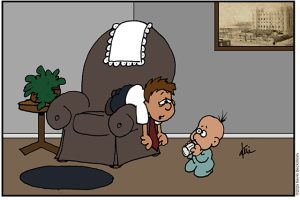






Our culture runs on exchange. We are trained from childhood to hear the cash register beneath the music: buy, sell, trade, owe, settle. We do it so constantly that the shape of the transaction quietly sets the shape of nearly every relationship we have. Even, sometimes, the one we have with God. So when a sentence reaches the ear that promises blessings and divine help to those who exercise faith to serve Him, we hear it as a kind of contract. You do X. God does Y. Faith rendered, service performed, blessings dispensed. Dress it up however you like, the picture underneath is commercial. God becomes a sort of celestial shopkeeper, and we His anxious clerks, licking our pencils over the ledger of our virtues, making sure the change comes back exact.1
I don’t think that is what such sentences mean. But it’s easy to hear them that way. We bring the marketplace with us into the chapel and are surprised when even the hymnbook begins to sound like an invoice.
The trouble lies deeper than the sentence. It lies in a picture we carry. The picture says God and I are two separate things negotiating across a gap. I put faith-coins in the slot, pull the proper lever, and wait for mercy to clatter into the tray, preferably in exact change. There’s a quiet violence in the picture. It puts God on the outside of His own gifts, as if He stood at a distance mailing parcels to the faithful, who then thanked the stamp.
Faith has no slot for coins.
The gospel breaks the machine. Grace is forever jamming the mechanism. Faith has no slot for coins, no tray where mercy clatters down after the proper lever is pulled. Faith is the open hand, the turned face, the child already standing in the doorway because he has heard his Father’s voice, not the child submitting an expense report for being home. Blessing does not arrive like a parcel left on the porch with heaven’s address in the corner. The shared life grows real. The joining deepens. The door opens from the inside.2
None of this makes obedience less necessary. It makes obedience less mercenary. Obedience is what happens when the nearness of God begins to take human shape. It is not the price of His presence; it is the practice of it.
This still leaves the puzzle of how scripture itself talks. It keeps speaking in if-then form. “If ye keep my commandments, ye shall prosper.” “Draw nigh to God, and he will draw nigh to you.” “Ask, and it shall be given you; seek, and ye shall find.” Read through the shopkeeper’s lens, these sentences sound like wages earned, terms agreed, balance owing, with heaven squinting over the receipt to see if we remembered the sales tax.
Drawing near to God is already the beginning of finding Him near.
But scripture has not been haggling in the marketplace all along. Its ifs are the ifs a farmer uses, or a sailor, or a man lighting a fire. If you sow, you reap. If you set the sail, the wind takes you. If you strike the match, the room is no longer dark. Step into the river and you will be wet. Open the shutters and the room will be full of morning. Drawing near to God is already the beginning of finding Him near. The sun has not been waiting to shine. We have been in the cellar. Daylight has never grown more generous. We have only, at last, come upstairs.3
Not a Cosmic Vending Machine
Elder D. Todd Christofferson has named this danger with almost comic precision. Some, he says, “misunderstand the promises of God to mean that obedience to Him yields specific outcomes on a fixed schedule.” A missionary imagines faithful service must produce marriage and children on command. A student keeps the Sabbath and expects good grades to arrive like obedient pigeons. A tithe-payer may expect the wanted job to appear as if heaven had received the purchase order.
But when life doesn’t “fall out precisely this way or according to an expected timetable,” Elder Christofferson warns, we may feel betrayed by God. We were right to expect God to bless obedience. We were wrong to picture blessing as machinery. “We ought not to think of God’s plan as a cosmic vending machine,” he says, “where we (1) select a desired blessing, (2) insert the required sum of good works, and (3) the order is promptly delivered.”4
This matters especially when we come to a passage like this one: “There is a law, irrevocably decreed in heaven before the foundations of this world, upon which all blessings are predicated—and when we obtain any blessing from God, it is by obedience to that law upon which it is predicated.”5 I have heard that passage read almost like a spiritual engineering manual, as if Zion were a machine with a troubleshooting appendix. First decide which blessing you want or need. Then identify the law that produces it. Then live that law precisely enough, and the blessing must arrive. The scripture becomes a heavenly transaction chart. Obedience goes in, blessing comes out, and discipleship is reduced to pushing the correct spiritual button, as if sanctification were an elevator and we merely needed the right floor.
There’s something appealing about that reading because it seems to make life manageable. It gives us a project. It hands us a clipboard in the storm and lets us believe the thunder can be managed by checking boxes. But thunder is notoriously bad at paperwork. More seriously, it also quietly changes our relation to God. Law turns into leverage, obedience into acquisition, blessings into products, and God, once again, into the warehouse clerk with the only key.
The Law Is the Shape of the Blessing
Perhaps the law is the shape of the blessing itself, the form of life in which the blessing can be received. Peace is predicated on the law of peace because peace cannot be baked out of resentment, deceit, and war with God. Charity is predicated on the law of charity because love cannot be obtained by practicing contempt. The companionship of the Spirit is predicated on the kind of life in which the Spirit can dwell. God is not stingy with His presence; a dove does not settle on clenched fists, however orthodox the fists may be. Law, in this sense, names the intelligible order of communion with God. No lever, no mechanism, no leash. The Lord is not a tame lion, and He is certainly not a tame appliance.6
You cannot plant thistles and harvest wheat.
That does not make the law less irrevocable. It makes it more so. The law is irrevocable with the trustworthiness of seedtime and harvest under God, not with the stubbornness of a cashier guarding the till. You cannot plant thistles and harvest wheat. You cannot cultivate envy and receive charity as its fruit. You cannot flee communion and obtain communion as your reward. The law is irrevocable because God is not arbitrary, and because the life He offers us is not imaginary.
The Blessing Is His Presence
So the help He promises comes with His own presence. He arrives as the help.7
That phrase won’t stay folded like a clean handkerchief in the drawer. Himself given as help. It wants to be opened in the actual rooms of a life.
Sometimes peace where fear would have ruled us. Sometimes courage to take a step we have been refusing for years. Sometimes a hard correction that cuts through a lie we had been feeding ourselves. Sometimes a burden that does not lift, and yet there is new timber in the spine. Sometimes the strange grace of seeing another person as more than the worst thing they did to us. Sometimes the quiet remembering of Christ in the exact second we were about to forget Him again. Sometimes a steadiness no circumstance can explain.8
God is not absent from what He gives.
The gift, then, is larger than the thing without making the thing less real. Bread is still bread, healing still healing, deliverance still deliverance. Each becomes the shape His presence takes. Every true gift is more than itself, because God is not absent from what He gives. We are always tempted to mistake the wrapping for the Gift, because wrapping can be folded, labeled, and put away. A living Lord keeps walking into the room.
No Receipts, No Ledger
Repentance lives in this same world. “Return unto me, and repent of your sins, and be converted, that I may heal you.” It can sound like payment owed before mercy is dispensed. Coin in the box, healing in the hand. But repentance is the turning that makes healing possible. If I will not show the wound, the Physician has not left the room. I have simply kept the bandage wrapped around the infection and called it modesty. A bandaged lie is still an open wound. He is calling us to stop fleeing the table where the wound can be touched without pretense. We call it exposure. He calls it surgery.9
Ordinances belong in this same country. They are not religious receipts, stamped to prove we paid. They are the bodily way we walk into a life where God can be known. God made us with knees and mouths and hands. He saves embodied souls, not ghosts pretending to be holy. We kneel, speak, wash, eat, and are touched. In them, His nearness takes form in water, in bread and water, in hands laid on a head, in names spoken aloud, in promises kept. Baptism is a going down and a rising with Christ. The sacrament is a real receiving, so that we remember Him and so have His Spirit with us. No tally, no ledger.10 Memory here is the soul turning its face toward the Host who has already set the table. Bookkeeping has nothing to do with it. The temple is a placing of our lives inside a given order, where we are clothed, named, bound, and sent.11
So when the sacrament prayer says that those who take His name, remember Him, and keep His commandments “may always have his Spirit to be with them,” it isn’t setting a price. It is naming the kind of life in which the Spirit is at home. The Spirit is not at home in a soul that keeps all the windows nailed shut. He is the breath by which remembrance wakes. As we receive Him, memory opens its eyes.12
Holiness looks less like a stocked pantry and more like a hearth with a living fire.
Christ’s own image makes the whole thing plain. “Abide in me, and I in you. As the branch cannot bear fruit of itself, except it abide in the vine; no more can ye, except ye abide in me.” The branch does not earn fruit. No one pins apples to a tree for excellent branchmanship. The branch bears fruit because it lives in the vine. The fruit is the life of the vine showing itself in the branch. So with us. What we call help shows up as love, joy, patience, gentleness, courage, truth. These come as His life made visible in ours, never as goods we have stockpiled. Holiness looks less like a stocked pantry and more like a hearth with a living fire.13
Before, Beside, Within, Around
You can see it in Alma’s people in the land of Helam. The burden is not taken away at once. The Lord eases their burdens so that they cannot feel them upon their backs, and they bear them with cheerfulness and patience. He gives Himself as strength inside the weight. Sometimes the load stays heavy, and the miracle appears in the shoulders. Deliverance comes later, and when it comes it is not only escape. It is a deeper knowing of God.14
Or the brother of Jared, climbing his mountain with stones in his hands. Light is not handed to him as a separate commodity, packaged and labeled. The Lord touches the stones he has brought, and they shine. The stones remain stones. That is the wonder: the stone remains, and now it is luminous. Grace does not despise the ordinary. It sets it burning. That is how God so often helps. He enters what we already hold in our hands and gives it a brightness it did not own.15
And when the Lord says to His servants, “I will go before your face. I will be on your right hand and on your left, and my Spirit shall be in your hearts, and mine angels round about you, to bear you up,” He is not offering payment for service rendered. He is describing a life soaked through with His company. Before, beside, within, around. No voice calling help from a distant balcony, and no empty chair at the table.16
The harder question is punishment. Scripture does not hide it. The disobedient are warned and rebuked, and at times struck hard. Covenant people who refuse covenant life find promised blessings withheld, and worse besides. Even here, though, much of what we call punishment is the taste life takes on when we refuse communion with the source of life. “Wickedness never was happiness” has the plainness of gravity, and is just as difficult to bargain with. He names the cliff while we are still calling it a road. To turn against love and truth and our neighbor is already to live in a kind of misery, even when it is dressed up as power or pleasure. Sin is a beggar wearing a stolen crown, forever surprised that it cannot command breakfast. And even when God warns, rebukes, or chastens, He is love refusing to call death by the name of life.17
If you abide in Christ, His life bears fruit in you.
So the if of scripture is the if of lungs and air, of seed and soil, of the way a door behaves when you actually push it. If you turn toward Life, you live. If you abide in Christ, His life bears fruit in you. If you refuse Him, you taste the loneliness and the disorder that refusal carries with it. The sentences haven’t changed. The idol behind them has fallen over, and we can see at last what was always standing there: a Father, not a till; a home, not a hardware store for holiness.
The help He promises bears His face. He gives Himself as help. We asked for supplies and found bread. We asked for directions and met the Way. We asked for rescue and were met by the Savior. He comes as peace when fear would have ruled us, as strength when the burden stays put, as light when the way is dark, as correction when the lie has become comfortable, as deliverance when the chains must break, as company when the room seems empty, as joy even under a terminal diagnosis.18
His life, made livable in ours. And our lives, at last, made alive in His.







RosieMay 28, 2026
Never the less, I will have faith in his promised blessings, that come in His own time; which keeps me humble and reflective like a child hopeful of his benevolent parent who always remembers. Respectfully your words are enlightening but not scripture.
Heather SmurthwaiteMay 27, 2026
Dear Brother Degn, You've outdone yourself on this one. You are our modern Isaiah. How pertinent and deeply true, and deliciously expressed is this truth to our generation who is expressly assigned to come out of Babylon and build Zion! You have our great appreciation.