











Walk into a house on moving day and you will see foundations, outlets, pipes, drywall. Come back the evening the family moves in, and you will not see the house at all. You will see a home. The child’s lamp on the nightstand. The mother’s apron hung near the stove. The father at the head of the table. The walls have not changed. What has changed is that the house is now inhabited by the people for whom it was made. A house is a fact. A home is a confession. The difference is not in the lumber but in the love.
Modern readers often open the first pages of scripture as if they had been handed a construction manual. We ask how the world was put up, what the foundations are made of, whether the load-bearing walls could survive peer review. The ancient Israelite was not concerned with that question. He was asking who was moving in, and when.1
This distinction between a House Story and a Home Story is the hinge on which Exodus 40 swings. The final chapter of Exodus records the moment the Tabernacle is finished, the cloud comes down, and the glory of the Lord fills the tent. Read as the close of a building project, it is a curious anticlimax. Why should a book of fire and plague and parted seas end with upholstery? Read as the completion of the story that began in Genesis, it is the quiet thunder of God at last moving in.
Genesis 1: The Macro-Temple Inauguration
The Hebrew verb bara, rendered “create” in Genesis 1:1, does not mean what a modern factory means by “produce.” It names a divine act of assigning function within an ordered whole.2 When Moses writes that “the earth was without form, and void” (Genesis 1:2), he is describing tohu, a condition of non-order, a place where nothing yet does what it is for. A chair no one sits in is not a broken chair; it is not yet fully a chair either. So with the pre-creation earth. The matter was there. The meaning was not. A pile of bricks is only a rumor of a house.
Consider the difference between a bricklayer and the lord of the manor. The bricklayer raises walls. The lord opens the doors and calls the hall to order. Bara is closer to the second act than the first. Students of the ancient Near East have long noticed that the seven-day account does not read like a warehouse inventory. It reads like a temple inauguration.3 On Days One through Three, God settles the great functions of human life: time, weather, food. On Days Four through Six, he installs the functionaries who will administer those spheres. The sun and moon to govern time. The birds and fish to fill sea and sky. The beasts of the field. And at last the human being, the high priest of creation, made in the image of the One whose house this is. Creation is not finished until God dwells in it.
Day Seven is the climax, and it is not a nap. In the ancient world, a god’s rest was the sign that his house was ready and his rule had begun.4 To rest was to be enthroned. The weary modern reader has done something like the reverse: he has kept the furniture of the week and lost the feast. Creation is not finished until God dwells in it, which is to say, the seventh day is not a period at the end of a sentence. It is the sentence.
The Visionary Blueprint: Moses 1
Before Moses could build the Tabernacle below, he had to see the Tabernacle above. The book that bears his name in the Pearl of Great Price opens with an ascent. Moses is “caught up into an exceedingly high mountain” and there “saw God face to face, and he talked with him” (Moses 1:1–2). The pattern is old and deep. The prophet goes up, the veil is drawn back, and the patterns of heaven are shown him that he may shape their likeness below.5 The same sequence holds for Enoch’s rapture in Moses 7, for Abraham’s sight of the premortal council in Abraham 3, for Nephi’s vision of the tree and the temple in 1 Nephi 11. Pattern goes before performance. A sanctuary built from human imagination alone is not a house of God; it is a self-portrait. A sanctuary built from the imitation of a thing truly seen is something else entirely: a window, not a mirror.
Before a single board is cut, the Lord names the reason a house is to be raised at all. What Moses sees on the mount is the Owner’s own intent, stated plainly: “For behold, this is my work and my glory, to bring to pass the immortality and eternal life of man” (Moses 1:39).
In the language of our metaphor, this is the Father saying why He is building the house in the first place. The walls are for the sake of the people inside them. Every curtain, every acacia board, every lamp and basin and bowl of consecrated oil later fashioned below is only the timber-work of nearness. Each piece of the Tabernacle is ordered to one homely end: that the Father might at last sit down at the table with His children.
Exodus 40: The Micro-Temple Completed
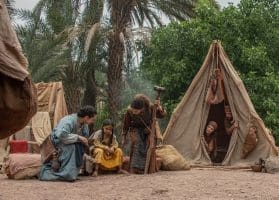
By the time we reach Exodus 40, the wilderness is full of sawdust and hammered gold. The instructions have run for sixteen chapters. What remains is obedience. And obedience, in the final chapter of Exodus, takes a shape we have seen before.
Seven times the text records that Moses did “as the Lord commanded him” (Exodus 40:19, 21, 23, 25, 27, 29, 32). The count is deliberate. Moses is keeping a sacred rite, a rhythm whose shape is already given and whose one requirement is faithfulness. He is not improvising. The seven-fold as the Lord commanded is Moses’s Amen, said with his hands. The refrain chimes across the canon with the seven-fold ordering of Genesis 1, so that the finishing of the Tabernacle becomes a small copy of the finishing of the cosmos.6
The Tabernacle is the cosmos in little.
The verbal echo is still more precise. Of the seventh day of creation we read that “God ended his work which he had made” (Genesis 2:2). Of Moses at the end of Exodus we read, “So Moses finished the work” (Exodus 40:33). The same verb. The same cadence. The same quiet gladness of a Maker whose making is done.7 Creation and Tabernacle rhyme the way a great tune rhymes with its reprise. You recognize it before you can say why. The Tabernacle is the cosmos in little. What God did on the scale of galaxies, Moses did on the scale of goat’s-hair curtains and acacia boards.
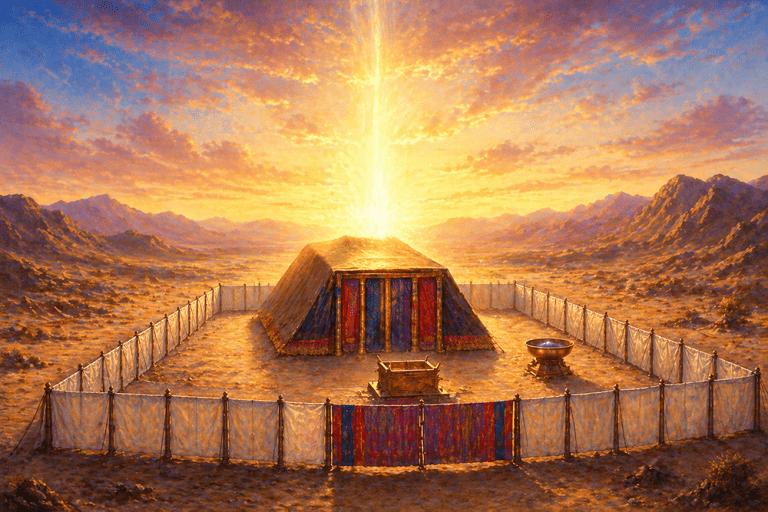
Then comes the moment toward which the whole book of Exodus has been leaning. “Then a cloud covered the tent of the congregation, and the glory of the Lord filled the tabernacle” (Exodus 40:34). The house is a home. The Owner has moved in. This is not the end of a book. It is the housewarming of a world. Immanuel, God with us, is not a New Testament innovation. The New Testament borrowed it from the cloud.
The Restoration Bridge: A House of Order
If Moses received the pattern once, the Lord restored it again in the latter days. In December of 1832 the Prophet Joseph Smith was given a commandment that reads like a quiet reprise of Genesis 1. “Organize yourselves,” the voice says, “prepare every needful thing, and establish a house, even a house of prayer, a house of fasting, a house of faith, a house of learning, a house of glory, a house of order, a house of God” (Doctrine and Covenants 88:119).
A house of God.
Organize is the Restoration’s word for bara: not making from nothing, but assigning each thing its proper room. Seven attributes are named. The seventh is the crown: a house of God. The list is not an abstraction but a set of instructions for making a place holy. Prayer hallows the tongue. Fasting hallows the body. Faith and learning hallow the mind. Glory and order hallow the common life. The house of God stands last in the verse because holiness is not the first ingredient; it is what you get when the other six have been kept long enough.
A few years later, at the dedication of the Kirtland Temple, the Prophet Joseph prayed that the Lord’s house might be his “resting place,” and that the Lord’s “holy presence may be continually in this house” (Doctrine and Covenants 109:12). The ancient theology of divine rest is so easily misread as divine dozing. But for a king, to rest is not to retire; it is to reign. Rest is rule. The resting God is the reigning God. The temple is the throne room of his watchful care for a covenant people.
The Covenant Path: A Tour of the Temple Furnishings
A building, however, is not the final point. The point is the people who walk through it. Nephi, writing more than half a millennium before Christ, takes his reader on a tour of the Tabernacle without once naming it, and calls the tour the doctrine of Christ.
“Wherefore, ye must press forward with a steadfastness in Christ, having a perfect brightness of hope, and a love of God and of all men” (2 Nephi 31:20). Read that verse against the floor plan of the Tabernacle and the layers disclose themselves. Repentance and the broken heart answer to the altar of sacrifice, where the beast is slain at the threshold. Baptism answers to the laver of cleansing, where the priest washes before entering the holy place. The gift of the Holy Ghost, with its “perfect brightness of hope,” answers to the Holy Place itself, lit by the seven lamps of the menorah. And charity, which Moroni later calls “the pure love of Christ” (Moroni 7:47), is the veil through which the faithful pass into the presence of the Father.8
The pilgrimage mirrors the covenant path.
The ordinances are given in a sequence. The baptismal font is not set at the veil. The altar is not set at the end. The shape of the sanctuary mirrors a pilgrimage, and the pilgrimage mirrors the covenant path. The altar, the laver, the veil: three thresholds, each one narrower, and each one kinder. To leave out a station is to break the tour. The Fall was the road down from the garden, away from the tree and away from the presence. The Atonement of Jesus Christ is the road back up, and He is both the road and the Gardener waiting at its end. The ordinances of the gospel are not arbitrary rites invented to occupy a pious afternoon. They are the map of the road home, iter ad arborem vitae, the way of the Tree of Life.
A Personal Tabernacle
If all of this is true, the message of Exodus 40 is not only archaeological. It is personal. The God who ordered a cosmos, and then folded that cosmos into a tent, wishes also to dwell in a household, a heart, a life. Every disciple is being made into a tabernacle. This is the doctrine the scriptures have been building toward from the beginning. The cosmos is a temple. The Tabernacle is a smaller temple. The chapel and the home are smaller still. And inside the smallest temple of all, the human body and the human heart, the same cloud longs to come down.
Paul will later tell the Corinthians that their bodies are temples (1 Corinthians 6:19), but the idea is older than Paul and wider than the body. Our hearts, our homes, our hours, our words are the timber from which the next Tabernacle is being hewn. The question is whether we will do as Moses did, seven times over, as the Lord commanded. Whether we will take the time and the care to set the rooms of our small lives in such order that the Owner would wish to live there.
In an age that has largely forgotten how to hallow a space, the Latter-day disciple is asked a strange and counter-cultural thing. He is asked to treat his home as the Israelites treated the wilderness tent. He is asked to believe that the dining room can be holy ground, that a back porch can be a tent of meeting, that a casserole dish left soaking in the sink is not evidence of the profane but raw material for the sacred. A kitchen table, after all, is only an altar that has learned to hold casseroles.
This is why the small work of keeping a home is never small. When a mother sets a table of scarred oak and calls her children to prayer, she is doing in kitchen linen what Moses did at Sinai. When a father mends a broken chair rather than throwing it out, he is practicing bara in sawdust. When a family fasts and studies and sings together on a Monday evening, they are walking the seven-fold path of Doctrine and Covenants 88 in the plain speech of the week.
The cloud has waited before. It hung over a formless deep for longer than we can count, and it was not impatient. It filled a tent of goat’s-hair and acacia wood and called it glory. It can manage a kitchen. What it waits for is a house finished enough to be called a home, and a heart, perhaps, unfinished enough to let it in.







Joni HiltonMay 1, 2026
I wish the whole world could read this. “Oh that I were an angel… “
Jessica RamptonMay 1, 2026
Wow. I’ve read this out loud twice to help me further embedded into my heart and soul. There’s so much to ponder on, and the Spirit is resting upon me as a tearfully finish studying this. I’ve taken a few notes to brew ruminate on throughout the day— this article is outstanding. Thank you.!