







As we approach the anniversary of American Independence this year, references to the 250th birthday of the United States are increasingly common. And understandably so. For any human creation to survive over a quarter of a millennium is no small achievement; two and a half centuries of republican government, freedom, and human rights, however imperfect, are well worth celebration.
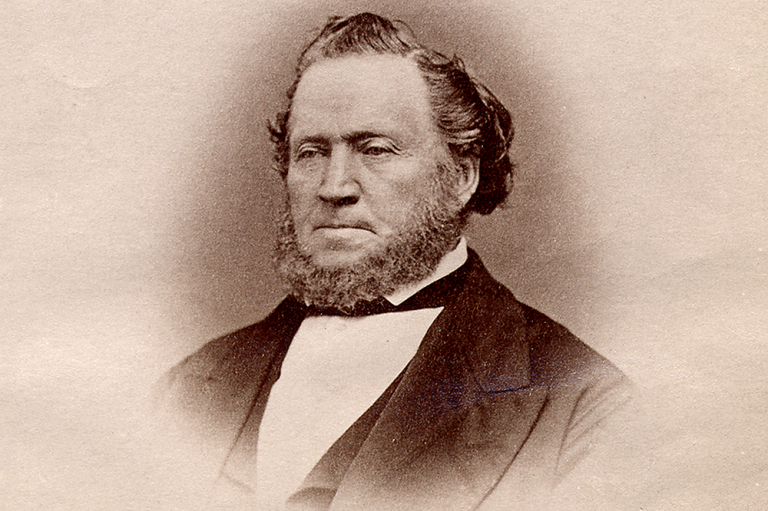
Much less widely known, even among active members of the Church, is the fact that Monday, 1 June 2026, will be the 225th anniversary of the birth of Brigham Young, the second (and longest-serving) president of the Church of Jesus Christ of Latter-day Saints. In other words, Brigham Young was born slightly less than twenty-five years after the signing of the Declaration of Independence. He was a true child of the early Republic, born in Vermont, home of the Green Mountain Boys and of the famous farmer-soldier Ethan Allen.
Let that sink in. It’s easy to forget that Brother Brigham was so close in time to colonial America and the War of Independence. George Washington had died only a year and a half before Brigham was born and Thomas Jefferson was less than three months into his presidency. Young Brigham grew up among veterans of the American Revolution and of the subsequent War of 1812, which some called the Second War of American Independence.
One way of marking Brigham Young’s 225th birthday during this year of celebrating America is to note a link between the great Latter-day Saint leader and the famous Samuel Langhorne Clemens, who, under his pen name of “Mark Twain,” is often considered the nation’s greatest writer and, very arguably, its most quintessentially American literary figure. To do so, I’ll draw on Twain’s 1872 travel memoir Roughing It. First, though, a bit of background:
By at least 1860, Orion Clemens (1825-1897), Samuel’s older brother, had concluded that slavery was morally wrong, and so he worked for the election of the Republican presidential nominee, Abraham Lincoln. Following Lincoln’s inauguration as president, Clemens was appointed Secretary to the new government of the Territory of Nevada, where he would sometimes even function as acting chief executive of the Territory in the absence of its governor. His twenty-five year-old younger brother Sam—which is to say, Mark Twain—accompanied him out to Nevada in the summer of 1861. Such a trek westward was a great adventure in the period just before the Civil War and the Transcontinental Railroad, and their journey is the subject of Roughing It, which, like everything from Mark Twain, is well worth reading. I’ll confine myself to some selected passages about the two brothers’ visit to Salt Lake City, which had been founded less than fifteen years before they arrived:
“We had a fine supper, of the freshest meats and fowls and vegetables—a great variety and as great abundance. We walked about the streets some, afterward, and glanced in at shops and stores; and there was fascination in surreptitiously staring at every creature we took to be a Mormon. This was fairy-land to us, to all intents and purposes—a land of enchantment, and goblins, and awful mystery. We felt a curiosity to ask every child how many mothers it had, and if it could tell them apart; and we experienced a thrill every time a dwelling-house door opened and shut as we passed, disclosing a glimpse of human heads and backs and shoulders—for we so longed to have a good satisfying look at a Mormon family in all its comprehensive ampleness, disposed in the customary concentric rings of its home circle. . . .
“Next day we strolled about everywhere through the broad, straight, level streets, and enjoyed the pleasant strangeness of a city of fifteen thousand inhabitants with no loafers perceptible in it; and no visible drunkards or noisy people; a limpid stream rippling and dancing through every street in place of a filthy gutter; block after block of trim dwellings, built of “frame” and sunburned brick—a great thriving orchard and garden behind every one of them, apparently—branches from the street stream winding and sparkling among the garden beds and fruit trees—and a grand general air of neatness, repair, thrift and comfort, around and about and over the whole. And everywhere were workshops, factories, and all manner of industries; and intent faces and busy hands were to be seen wherever one looked; and in one’s ears was the ceaseless clink of hammers, the buzz of trade and the contented hum of drums and fly-wheels.”
Twain was impressed by the industriousness of the place, favorably contrasting its beehive symbol—“with the bees all at work!” he exclaimed—to what he portrayed as the dissolute drunkenness of his own home state, Missouri.
“Salt Lake City,” Twain wrote, “was healthy—an extremely healthy city. They declared there was only one physician in the place and he was arrested every week regularly and held to answer under the vagrant act for having “no visible means of support.””
Twain and his brother Orion visited the foundations of the Salt Lake Temple, still nearly three decades from completion, and enjoyed a long conversation with Heber C. Kimball, Brigham Young’s lifelong friend, a member of the original modern Quorum of the Twelve Apostles as well as a pioneer missionary to England, and, by this time, first counselor in the First Presidency of the Church. President Kimball seems to have favorably impressed Twain, who described him as “a mighty man of commerce” and, although Heber was actually born in Vermont and baptized in upstate New York, as a “shrewd Connecticut Yankee.” (Many years later, a similarly shrewd man is the hero of Twain’s 1889 novel A Connecticut Yankee in King Arthur’s Court.)
On their second day in Salt Lake City, Orion and Sam (Mark Twain) met Brigham Young. Twain’s description of that notable meeting between a great American writer and a great American religious leader is worth quoting:
“We . . . put on white shirts and went and paid a state visit to the king. He seemed a quiet, kindly, easy-mannered, dignified, self-possessed old gentleman of fifty-five or sixty, and had a gentle craft in his eye that probably belonged there. He was very simply dressed and was just taking off a straw hat as we entered. He talked about Utah, and the Indians, and Nevada, and general American matters and questions, with our secretary and certain government officials who came with us. But he never paid any attention to me, notwithstanding I made several attempts to “draw him out” on federal politics and his high handed attitude toward Congress. I thought some of the things I said were rather fine. But he merely looked around at me, at distant intervals, something as I have seen a benignant old cat look around to see which kitten was meddling with her tail.
“By and by I subsided into an indignant silence, and so sat until the end, hot and flushed, and execrating him in my heart for an ignorant savage. But he was calm. His conversation with those gentlemen flowed on as sweetly and peacefully and musically as any summer brook. When the audience was ended and we were retiring from the presence, he put his hand on my head, beamed down on me in an admiring way and said to my brother:
““Ah—your child, I presume? Boy, or girl?””
One of America’s wittiest writers, Twain obviously felt that, in their one encounter, Brigham Young had gotten the best of him.
Now, though, to complete my brief “Americanist” appreciation of Brigham Young for his 225th birthday, I turn to Bernard DeVoto. Although he is often overlooked today and was, quite understandably, not much appreciated in his home state, DeVoto remains one of the foremost writers and most powerful cultural forces to have emerged from Utah. He was a major figure in American intellectual life from about 1930 to his death in 1955.
I first encountered Bernard DeVoto as a high school student in Southern California reading about Mark Twain, on whom he was an expert. His 1932 book Mark Twain’s America remains important reading still today. One of America’s most fully-American intellectuals, he was powerfully attracted to the very American Twain. It was only considerably later that I learned that DeVoto was born and raised as a Catholic in Utah, to a Catholic father and a nominally Latter-day Saint mother. He eventually graduated from Harvard and essentially spent the rest of his life in the American East; particularly in his younger years, he seems to looked back upon his provincial origins with (possibly defensive) contempt. In particular, especially in his earlier writings, his attitude toward the dominant religion of his native state was often marred by sharp and often unfair criticism, sarcasm, derision, and exaggeration. He rarely failed to express his dislike for the doctrines and the origin story of the Church of Jesus Christ of Latter-day Saints. He especially disapproved of Joseph Smith, who, he thought, would have destroyed the Church had he not been murdered.
The recipient of four honorary doctorates, DeVoto published a monthly column in the then-premier journal Harper’s and edited both the Harvard Graduates’ Magazine and the Saturday Review of Literature. Further, among many other essays, articles, and reviews, he wrote five novels and three books devoted to the history of the West (for which he won the Pulitzer Prize, the Bancroft Prize, and the National Book Award).
Over much of his life, though, Bernard DeVoto devoted a notable portion of his creative energy to writing about “Mormonism,” and he later came to regret the tone of his earlier writing on the topic. Particularly noteworthy is his admiration for Brigham Young, whom he describes as, uniquely, the Church’s “great man,” and to whose acumen, good judgment, and administrative skills he continually pays tribute. Brigham is “the foremost American colonizer,” with a “genius of leadership, of foresight, of command, of administration, of effective will.” “He was a great man, great in whatever was needful for Israel.”
And DeVoto wanted his countrymen to appreciate the achievements of the Latter-day Saints as he himself had finally come to appreciate them:
“The story of the Mormons,” DeVoto wrote, “is one of the most fascinating in all American history, it touches nineteenth-century American life at innumerable points, it is as absorbing as anything in the history of the trans-Mississippi frontier and certainly the most varied, and it is a treasure house of the historian of ideas, institutions and social energies.”
Bernard DeVoto sought to establish the place of the Latter-day Saints and, yes, of Brigham Young, within the larger setting of the United States during the Church’s one-hundred-year history to that point. It is, I think, a place that remains underappreciated even in our day.
“Here was a story which I had known all my life, which I knew better than any other in American history. It held as much as any novelist could ask of farce and tragedy, melodrama, aspiration, violence, ecstasy—the strongest passions of mankind at white heat; the Kingdom of God and mob cruelty and martyrdom; bigotry and superstition and delusion; mystical exaltation and the purity of faith; ambition and its overthrow, persecution and social revolt—and all bound up . . . completely and comprehensively . . . with the sweep of a full century of American life.”
In the end, DeVoto concluded that the story of the Restored Church—which, of course, he would never, ever, have described as such—is so overwhelmingly dramatic and grand that no novel could ever begin to do justice to it.
On 1 June 2026, it’s appropriate to give a thought to Brigham Young, and to his contributions to the Church and to the nation in which he lived and died—and to recognize their part in the national symphony that we celebrate in this 250th anniversary-year of the birth of the United States.
**
For my discussion of Bernard DeVoto, I’ve drawn extensively from Leland A. Fetzer, “Bernard Devoto and the Mormon Tradition,” Dialogue: A Journal of Mormon Thought (1971) 6/3: 23-38.
For an ongoing series of mini-documentaries on Brigham Young and his times, accessible at no charge, please go to becomingbrigham.com.