




The Relief Society of The Church of Jesus Christ of Latter-day Saints will celebrate its 169th birthday March 17! Usually, local units around the globe host a birthday party in remembrance of the founding of Relief Society on March 17, 1842, in Nauvoo, Illinois. From the 20 sisters gathered in the upper room of Joseph Smith’s Red Brick Store, membership has grown to nearly six million sisters. It is the now largest women’s organization in the world.
At that organizational meeting, the Prophet Joseph explained that the “object of the Society” was “to provoke the brethren to good works in looking to the wants of the poor—searching after objects of charity, and in administering to their wants—to assist by correcting the morals and strengthening the virtues of the community.”i At a later meeting, he told them they were “not only to relieve the poor, but to save souls.”ii The purpose of Relief Society—to build testimonies of the Savior and to render service—has not changed in 169 years.
Emma Smith, chosen by her peers as the first president, told the sisters: “We are going to do something extraordinary. When a boat is struck on the rapids with a multitude of ‘Mormons’ on board, we shall consider that a loud call for relief; we expect extraordinary occasions and pressing calls.”iii
Relief Society is synonymous with service. Sisters, as individuals, as visiting teachers, and as members of a ward or branch Relief Society, perform countless acts of service in ministering to the physical, spiritual, and emotional wants of those in need. They’re noted the world over for their loaves of freshly baked bread, funeral potatoes, handmade quilts, and service projects.
Today, I choose to focus on some of the great service that sisters united in the general organization of Relief Society have accomplished.
Beginning in 1876, the Relief Society, under the direction of Emmeline B. Wells, began to gather and store wheat. Women gleaned wheat from fields and along fences and ditch banks after the harvest. More than 10,000 bushels were stored the first year and much more in succeeding seasons. The Relief Society donated wheat to the poor and loaned or sold it to farmers for spring planting. With hundreds of thousands of bushels in storage, the Relief Society’s wheat was given to residents in southern Utah following a severe drought and to survivors of the 1906 San Francisco earthquake and fire. The Relief Society sold 100,000 bushels to the United States government during World War I. The money from this sale was then dedicated to improving health, maternity, and child welfare services. One such entity that benefitted was the Cottonwood Maternity Hospital.
The Relief Society established the Deseret Hospital in 1882. A number of women had studied medicine in schools in the East and returned to Utah desiring to improve health care. Eliza R. Snow served as the first president of the hospital and was assisted by Zina D. H. Young and Emmeline B. Wells. All three women served as Relief Society general presidents. This hospital operated until 1896. The Relief Society also offered nursing classes for a time. When the LDS Hospital was opened in 1905, the Relief Society general board purchased the linens for patients and asked sisters to sew them.iv
In planning for the Relief Society’s Sesquicentennial in 1992, the presidency and general board of Elaine L. Jack, wanted the thrust to be celebrating through service. Elaine felt that “service projects beyond our own borders” would be beneficial to the sisters and to the communities in which they lived. She explained: “Every local unit determined what service would be best suited to their community. The services varied so much. In Samoa, sisters painted the clock tower and planted flowers. In Africa, they swept a path to the waterhole. In South Africa, they made lap rugs for the elderly. Myriad homeless shelters were painted and fixed up. Books were collected. In one area of California when a Relief Society president asked community leaders what kinds of projects would benefit the community, one leader said, ‘You mean to tell me that 18,000 units are each going to give service in their local communities?’ She said yes. ‘Then you’ll change the world.’ I think we did.”v
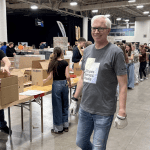
Mary Ellen Smoot, who was called as general president in 1997, wanted to find new ways to expand the reach of Relief Society sisters. As co-sponsors of the BYU Women’s Conference, the presidency suggested organizing large-scale service projects during the May 1999 two-day event. Besides attending sessions, 18,000 women assembled hygiene kits, school supplies, newborn kits, and made quilts and leper bandages. The result was, as Elder Merrill J. Bateman, BYU president, described it, “the largest humanitarian event the Church has ever been involved with in one setting.”vi I was privileged to be on the organizing committee for this project; it was an extraordinary experience to hear the enthusiastic responses when I asked sisters ahead of time to help out in various stations, to watch as the women worked together that day, and to feel the love that pervaded the entire event.
Several months later, Presiding Bishop H. David Burton asked the Relief Society to provide 30,000 quilts for Kosovo refugees. Sisters throughout the Church enthusiastically responded. The Relief Society quit counting after 350,000 quilts had been donated. When given that assignment, Mary Ellen commented, “We are so happy that the Relief Society has been asked to help with this project. I have found that our sisters have a great desire to serve. . . . This is the mission of Relief Society. That is what we are: a relief society.”vii
And what an extraordinary society we are!
i Relief Society Minutes, March 17, 1842.
ii Relief Society Minutes, June 9, 1842.
iii Relief Society Minutes, March 17, 1842.
iv Jill Mulvay Derr, Janath Russell Cannon, and Maureen Ursenbach Beecher, Women of Covenant: The Story of Relief Society (Salt Lake City: Desert Book, 1992), 167.
v Interview with Elaine L. Jack, December 14, 2006.
vi “For LDS Women, the Sky’s the Limit,” Church News, May 8, 1999, 10.
vii Gerry Avant, “Quilts to Ward Off Chill in Kosovo,” Church News, August 7, 1999, 6.