






What did Jesus do that finally tipped the Pharisees into conspiring to crucify him? What act was so heinous, so threatening, so terrible to them that they could no longer stand is presence in their nation?
Ironically, it was a miracle that they couldn’t stand. The light and power that awakened Lazarus from the tomb made them convinced that they had to put Jesus into one.
Raising someone from the tomb who had obviously been there four days was their breaking point. “If we let him thus alone, all men will believe on him,” they said. Raising the dead, healing the blind, lifting the broken heart, these were the offenses that kindled their anger and threatened their position.
So let’s go to that scene of Lazarus.
Raised from a Tomb
Mary and Martha sent an urgent message about their brother to Perea where Jesus was teaching: “Lord, behold, he whom thou lovest is sick.” When Jesus heard of Lazarus’ sickness, He said, “This sickness is not unto death, but for the glory of God,” and He turned and continued His work two more days at Perea with the calm assurance of divinity, knowing that He would arrive in proper time.
After two days, He told the disciples that Lazarus was dead, but He said, “Let us go into Judaea again.” This was a dangerous suggestion, prompting Thomas to say, “Let us also go, that we may die with him,” for “they feared lest the Jews should take Jesus and put him to death, for as yet they did not understand the power of God.”
As Jesus traveled on the road near Bethany, the news came that Lazarus had already lain in the grave four days, and heartbroken Martha, hearing that Jesus was coming, went out sorrowing to meet Him. “Lord,” she exclaimed, “if thou hadst been here, my brother had not died.” How often during that heavy four days since Lazarus’ death Mary and Martha must have discussed this very thing. “If only Jesus had come, if only He had been here.” Still, she had no complaining word for Jesus, no murmuring; she just affirmed, “But I know, that even now, whatsoever thou wilt ask of God, God will give it thee.”
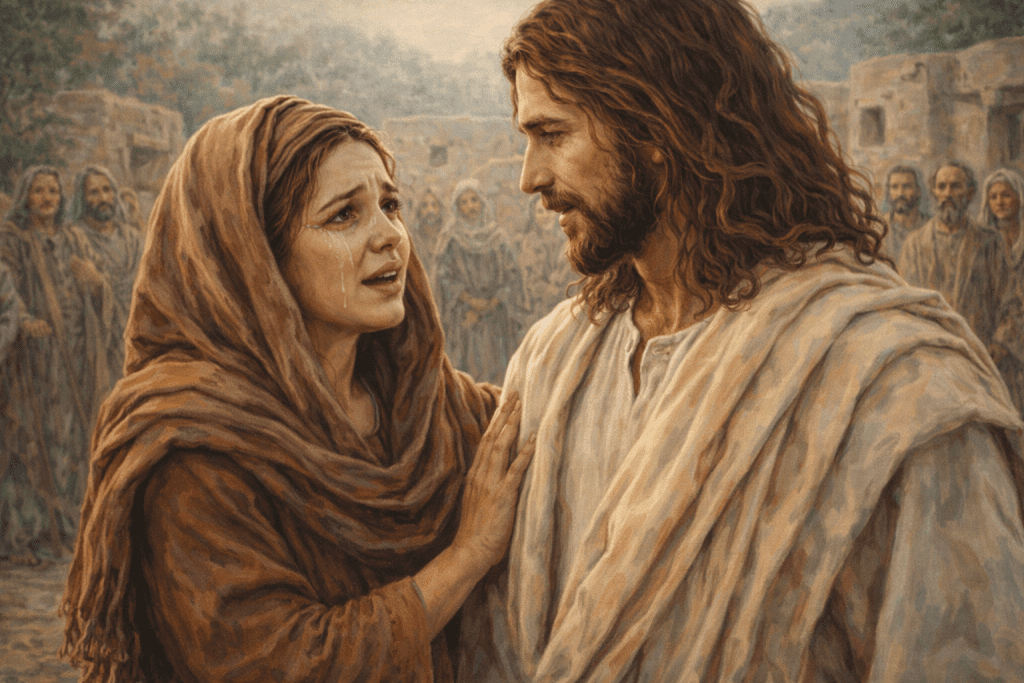
Jesus answered, “Thy brother shall rise again,” which Martha misunderstood, saying, “I know that he shall rise again in the resurrection, at the last day.” Jesus explained further, “I am the resurrection, and the life: he that believeth in me, though he were dead, yet shall he live: . . . Believest thou this?” Then Martha affirmed with loving faith, “Yea, Lord: I believe that thou art the Christ, the Son of God, which should come into the world.”
Next, Martha went quickly to her sister with words every believer would long to hear: “The Master is come, and calleth for thee.” Oh, He had come!
As Mary left the home, perhaps with couches and chairs tossed over in the Jewish form of mourning, the mourners followed her, thinking she went to the grave to weep. Instead, she came to the Lord and fell at His feet.
Jesus asked, “Where have ye laid him?” to which they answered, “Lord, come and see.” Then, “Jesus wept,” not apparently because Lazarus had died, for He knew that in moments His friend would rise. He wept, instead, for love and compassion, for the grief that tore the heart of His friends, for the bruises and scars of mortality, for all that hurts.
At the place of burial, Jesus asked the people to roll away the stone from the cave entrance where Lazarus lay. Martha demurred: “Lord, by this time he stinketh: for he hath been dead four days.” Jewish belief was that a body began its corruption on the fourth day.
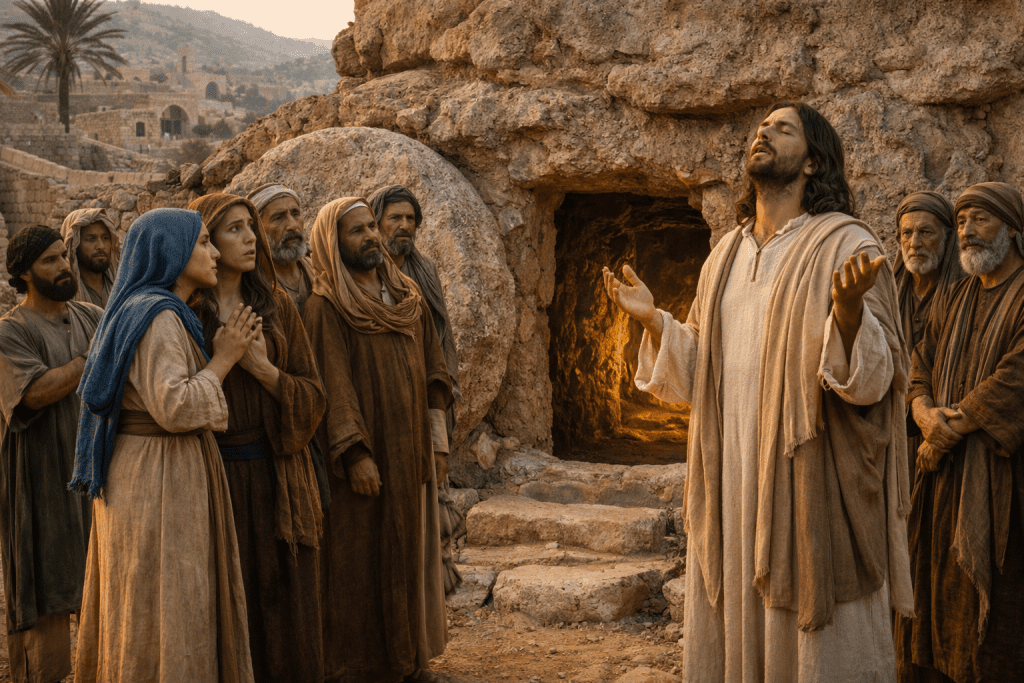
“Then they took away the stone from the place where the dead was laid. And Jesus lifted up his eyes, and said, Father, I thank thee that thou hast heard me.
And I knew that thou hearest me always.”
Those last words rings in our ears, “I knew that thou hearest me always.” We might talk ourselves into believing that God is distant in some far away place, deaf to our yearnings and pleas, but if we could follow Christ’s example, as believers, we would have to acknowledge, “thou hearest me always.” It is an affirmation of assurance and faith, knowledge and joy.
Then in a loud voice that must have shaken the listeners to the marrow, He cried, “Lazarus come forth.” And “he that was dead came forth, bound hand and foot with graveclothes.” “Then from that day forth [the Pharisees] took counsel together for to put [Christ] to death.”
Mine Hour Hast Come
Jesus had told his mother Mary when she had asked her for help at the wedding at Cana, “Woman, what wilt thou have me to do for thee? that will I do; for mine hour is not yet come.”
Now His hour had come. Behind Him were the green hills of Galilee, the great crowds gathering on the grass to hear His word, the lap of waves on a blue sea. Ahead lay Jerusalem, the arrogant city on a hill, tense in its self-conceit, where already in their supreme blindness in the name of religious piety, plotters were scheming to kill the Lord Himself.
Offended by His healing touch, by His words that cut to the heart of their hypocrisy, the Roman and Jewish rulers gathered in the high halls of the chief priest and conspired against Him. Raising Lazarus from the dead so that all the countryside was full of the talk of it was Jesus’ final offense that had challenged their dominion. “If we let him thus alone, all men will believe on him,” they said. Raising the dead, healing the blind, lifting the broken heart, these were the offenses that kindled their anger and threatened their position.
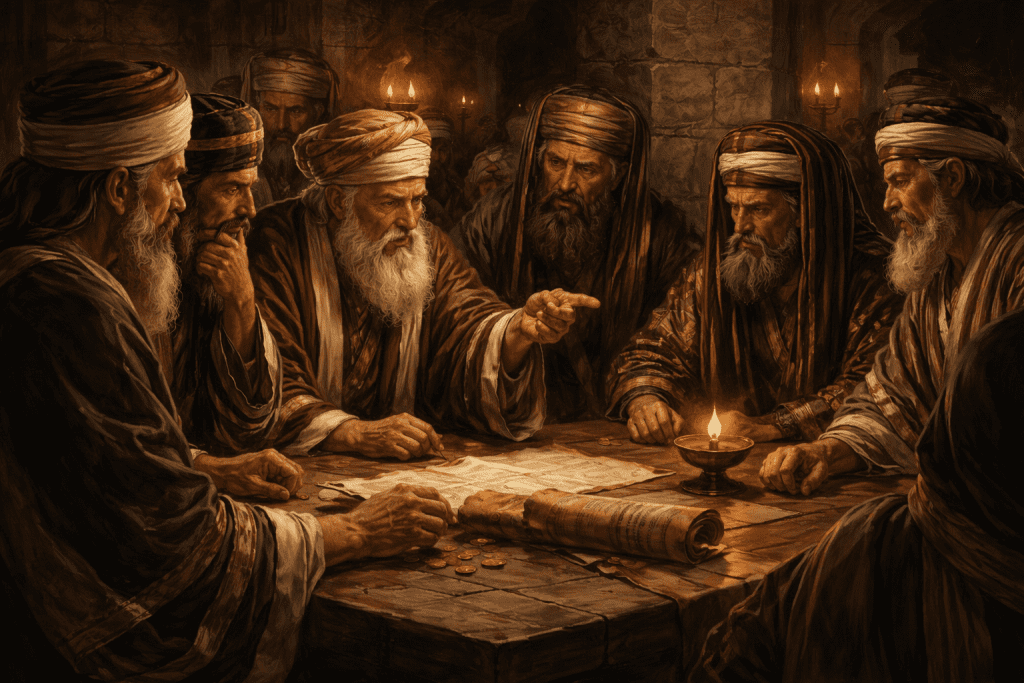
Still, their fanatical hatred did not stop Jesus from coming to Jerusalem for Passover with the certain knowledge of what He would face. Bitter contempt, insult, and death waited for Him along the shadowed roads of Jerusalem, often from the very people who claimed they represented God. What superb irony!
Jesus said, “What shall I say? Father save me from this hour: but for this cause came I unto this hour.”
In Bethany, just over the hill from Jerusalem, Mary, sister of Martha, anointed His feet with a precious oil that she had saved “against the day of [his] burying,” and He patiently told apostles who could not understand that He would submit Himself to be mocked, scourged, and spat upon. He would overcome the world, but not before it appeared to all those who loved Him that the world had overcome Him. They must face His humiliation before they saw His triumph.
He would suffer that others would not have to suffer, face agonies beyond description to do His Father’s will: “For I have not spoken of myself; but the Father which sent me, he gave me a commandment, what I should say, and what I should speak.”
Waving Palm Leaves
On that Sunday in spring, as Jesus and His band of followers went from Bethany to Jerusalem for the Passover celebration, He instructed two of His disciples to go into a village, where they would find a young colt. On this meek animal He would ride for His triumphal entry into Jerusalem, coming not as a proud king with conquests of war but rather in the rule of peace.
His riding a donkey had great symbolic meaning for the Jews. In this way, Jesus was saying to them that he was the legitimate king. God had made a covenant with David that his throne would be established forever and that a future king (the Messiah) would reign in righteousness. In Zechariah 9:9 it reads, “Behold, thy King cometh unto thee…lowly, and riding upon an ass.” War kings rode horses, which were symbols of conquest. Peaceful rulers rode donkeys or mules. Tellingly, when Solomon was declared king, he rode David’s own mule.
At Passover, the population of Jerusalem swelled with people coming to celebrate. Word of Jesus’ coming had spread among the festive pilgrims gathered in the city, especially among His own Galileans, who had heard of His miracles, and as the fire spread from heart to heart, they rushed out to meet Him, making a rough carpet by unloosing their cloaks and throwing them in His path.
Bethany is not far from Jerusalem, just over the Mount of Olives from the great city. As Jesus rode on that steep and winding road down the Mount of Olives, directly across from the eastern wall of Jerusalem, this is where the people gathered palm leaves to wave them in triumph and love for the Messiah.
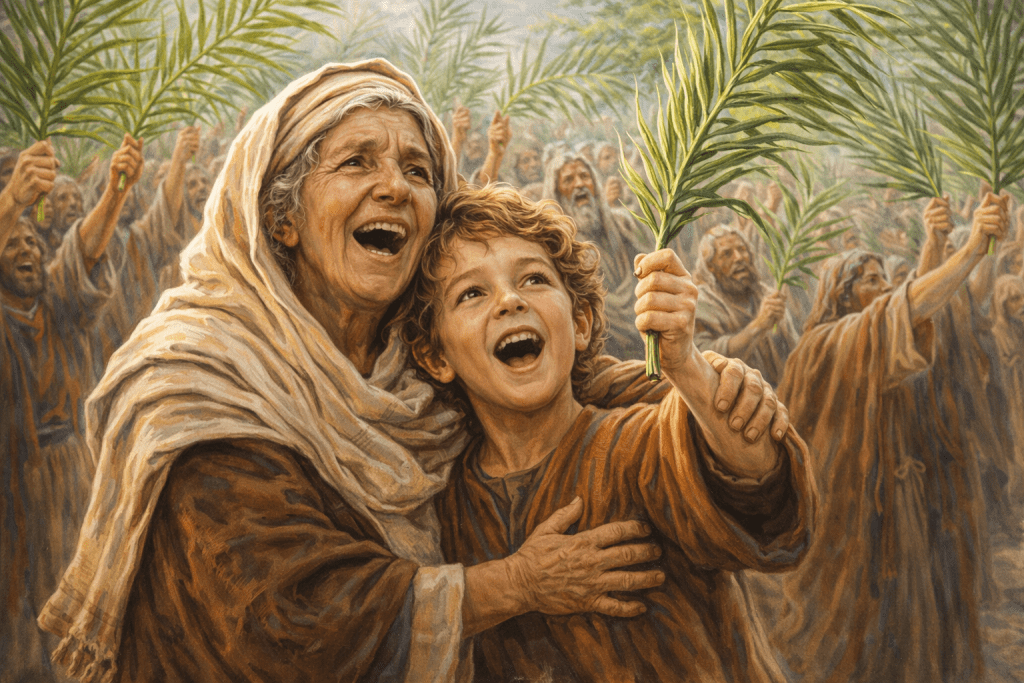
Here was the promised Son of David, and now surely the kingdom was at hand! Waving palm leaves, they shouted hosannas: “Blessed be the King that cometh in the name of the Lord.”
The word hosanna, writes Elder Bruce R. McConkie, is “a word of Hebrew origin, meaning literally, save now, or save we pray, or save we beseech thee – is both a chant of praise and glory to God and an entreaty for his blessings.”_
Elder McConkie explains that the word, hosanna, hearkens to Psalm 118: “Save now, I beseech thee, O Lord: O Lord, I beseech thee, send now prosperity. Blessed be he that cometh in the name of the Lord: we have blessed you out of the house of the Lord.”_
Taylor Halverson further explained, “Hosanna is a beautiful Hebrew word that is formed from two other Hebrew words. The hosa portion of the word means “to save” and is actually in the command form meaning “save!” Na means “please!” So the express meaning of hosanna is “please save!” or “please save us!”
“What I love about this word is that the Hebrew name hosa is the foundational word for these names:
- Joshua
- Josh
- Hosea
- Hoshea
- Elisha
- Elishua
- Isaiah
“And, most significantly, JESUS!
“So when in joy we shout hosanna we are actually shouting ‘Jesus please!’ or ‘Jesus please save us!’”
Whole-Souled Praise
Larry Barkdull added, “Anciently, during the Feast of the Tabernacles, when the Jews were commanded to gather to the temple, a priest would daily recite this psalm during a processional around the altar. The covenant people had been commanded to ‘rejoice before the Lord,’_ and on the seventh and last day of the feast, which was called the Great Hosanna, they would stand before the temple with trumpets sounding, wave palm branches and shout hosanna over and over.
“Essentially, the Hosanna Shout is simultaneously ‘whole-souled’ praise ‘given to the full limit of one’s strength’ and a cry for the Lord to come and save us now. We stand in the holy sanctuary that we have erected to his name, praise him, and plead for him to come and rescue us. By doing so, we fulfill ‘the instruction to bless the name of the Lord with loud voices and ‘with a sound of rejoicing,’ with ‘hosanna to him that sitteth upon the throne forever.’”
Disgruntled Pharisees
Disgruntled and knowing full well that the people were proclaiming Jesus the Messiah, the Pharisees made a desperate appeal to Him to stop the commotion. He answered that if the people held their peace, the very stones would cry out.
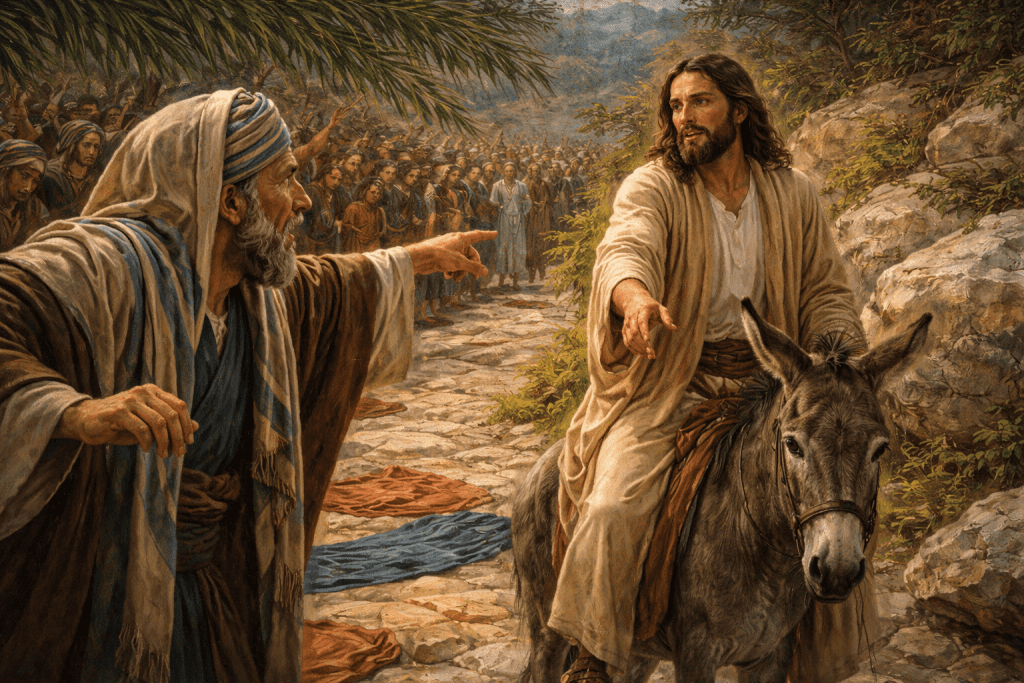
As Jesus first caught sight of Jerusalem, that city of palaces and ivory towers, of terraces and magnificent gardens, He wept. Though the multitude cheered as He began His descent down the Mount of Olives, He moaned in deep lamentation.
“The contrast was, indeed, terrible between the Jerusalem that rose before Him in all its beauty, glory, and security, and the Jerusalem which He saw in vision . . . with the camp of the enemy around about it on every side.” For with God’s view, He saw that in A.D. 68, but a few years hence, the Romans would besiege the city until the temple would be left without one stone upon another, until the city would be tumbled to the ground, its former beauty in ashes.
Scene after scene must have arisen before His eyes, the gory bodies of Jerusalem’s children among her ruins, the famine that drove mothers to snatch food from their infants, the thousands crucified outside the city walls. He said that in those days the daughters of Jerusalem would say, “Blessed are the barren, and the wombs that never bare.” “Then shall they . . . say to the mountains, Fall on us; and to the hills, Cover us” — all of this because they had rejected their God.
Where Were Those Who Had Shouted Hosanna?
From this distance of centuries, the question lingers. Where were all those people waving palm leaves and shouting hosanna just five or six days later when Pilate asked the crowd which prisoner he should release from a certain death warrant Jesus or Barabbas? What did the crowd cry out? “Barabbas.” They cried out for the release of a violent rebel who had murder and bloodshed on his hands instead of the Messiah they had recognized so clearly on that Palm Sunday.
What happened? The conjectures are many. Perhaps it was the swell of Galileans, the rural people of the north who had supported Jesus, not the citizens of Jerusalem. Perhaps, as we have seen so often today, crowds were assembled by pay. They shouted for Jesus to be crucified for a “mess of pottage.” Or maybe it was just enough to stir up rumors and fears about this meek and powerful Messiah.
All we can know for sure is that in our time, we can wave our palm leaves at his triumph and make every prayer a hosanna as we plead with whole-soul devotion, “Lord, save me.”