


General Conference by the Numbers: When Conference and Holy Week Converge
I remember watching the opening session of general conference on Saturday, April 1, 2023—the day before Palm Sunday. Elder Gary E. Stevenson gave the first talk, and one sentence immediately caught my attention. He spoke of a growing effort among Latter-day Saints to make Easter more Christ-centered, including a greater recognition of Palm Sunday and Good Friday, similar to traditions observed by other Christians around the world.
That moment stayed with me. In decades of listening to conference, I could hardly remember hearing Palm Sunday mentioned at all. Yet during that single conference, it was referenced in 9 talks. The Church has always been centered on Jesus Christ, but something felt different. There seemed to be a new willingness to focus more deliberately on the events of Holy Week and the Savior’s Atonement.
Now, in 2026, that trend reaches a remarkable moment. General conference once again falls on Easter Sunday—a rare occurrence—and it comes during a time when Church leaders have been placing increasing emphasis on centering more completely on the Savior at Easter, His Atonement, and the sacred events leading to the Resurrection.
This article will take a by-the-numbers look at 1) the Church’s increasing emphasis on Holy Week and 2) the convergence of general conference, Easter and April 6.
For those interested in taking a closer look at the data, it is available at searchgeneralconference.com.1
Easter Sunday General Conferences
Since 1980, there have been 45 April conferences – 10 of those have been on Easter.2 In 1980, a rare triple convergence occurred when general conference was held on Easter Sunday, April 6. The next time this will happen is April 6, 2042.
Here is a timeline that shows when general conference has occurred on Easter:
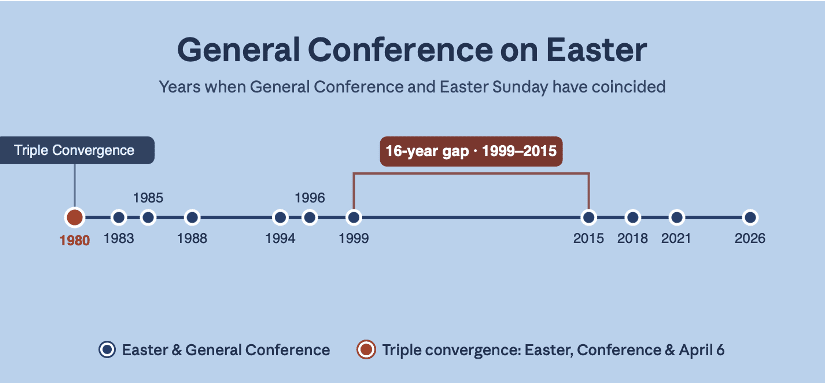
Since 1980 there have been 195 general conference talks that reference Easter. Nearly half of those—98 talks—were given on Easter Sunday itself. Most of these include a brief acknowledgment of the holiday, but some go further, reflecting on the deeper meaning of the Resurrection and, occasionally, on the significance of holding general conference on that sacred day.
A few conferences stand out:
1980 — A Rare Triple Convergence
April 6, 1980, marked an extraordinary moment in Church history. That day was:
- Easter Sunday
- The 150th anniversary of the organization of the Church
- The anniversary of the Restoration
President Spencer W. Kimball opened the Sunday morning session from the reconstructed Peter Whitmer farmhouse in Fayette, New York—the very place where the Church had been organized on April 6, 1830. Portions of the conference were broadcast from that sacred site while other sessions continued from the Tabernacle on Temple Square.
President Kimball testified:
“Of this I testify this beautiful Easter Sunday, on this great anniversary of the restoration and organization of the Church on this very spot 150 years ago… He is the risen Lord, the Great Presiding High Priest, and he stands at the head of the Church.”
That weekend linked the Resurrection of Jesus Christ with the Restoration of His gospel in a powerful and memorable way.
1994 — Remembering the Prophet
The year 1994 marked the 150th anniversary of the martyrdom of Joseph and Hyrum Smith. Speaking on Easter Sunday that year, President Gordon B. Hinckley reflected, “This year we commemorate the 150th anniversary of the death of the Prophet Joseph Smith, on the sultry afternoon of 27 June 1844.” He then reminded listeners of the Prophet’s profound sacrifice, quoting John Taylor’s well-known tribute: “Joseph Smith, the Prophet and Seer of the Lord, has done more, save Jesus only, for the salvation of men in this world, than any other man that ever lived in it…”
The message connected the sacrifice of the Prophet with the greater sacrifice of the Savior.
2018 — Worshipping the Risen Lord
When conference again fell on Easter in April 2018, President Russell M. Nelson said:
“What a glorious privilege it has been to celebrate Easter with you on this Sunday of general conference! Nothing could be more fitting than to commemorate the most important event that ever occurred on this earth by worshipping the most important being who ever walked this earth.”
President Henry B. Eyring likewise expressed gratitude for the opportunity to speak during “this Easter season,” reminding listeners that the purpose of conference is to draw closer to the Savior.
Mentions of Palm Sunday and Good Friday
Historically, references to Palm Sunday and Good Friday in general conference have been very rare.
Since 1980:
- 19 talks mention Palm Sunday – 14 of those since 2020 and 9 in 2023
- 4 talks mention Good Friday – all of them since 2020
There has been a clear change in emphasis since 2020. What was once seldom mentioned is now becoming part of the language of Latter-day Saint worship.
A Growing Emphasis on Holy Week
The April 2026 conference will be the eleventh time since 1980 that general conference has taken place on Easter Sunday, but this time the connection is being openly acknowledged. Church announcements have highlighted the significance of Easter weekend, and members worldwide have been invited to hold special Palm Sunday sacrament meetings centered on the Savior.
Although the shift has become more noticeable in recent years, the trend has been building for decades.
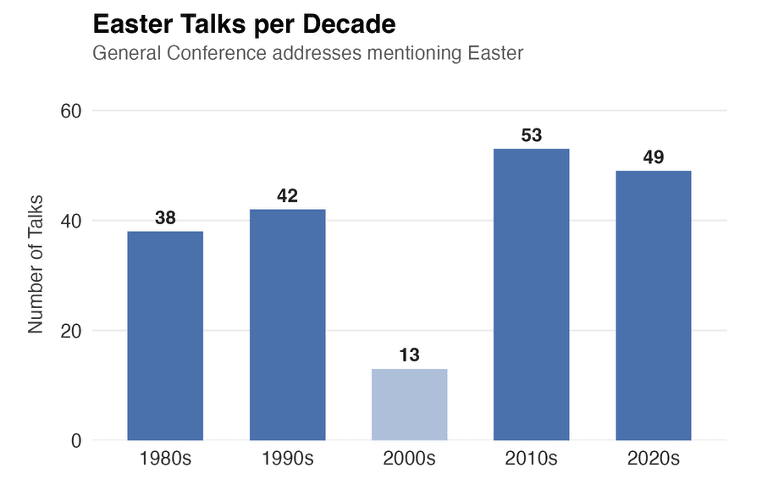
One interesting pattern appears in the 2000s, when relatively few conference talks mentioned Easter. A likely explanation is that from 1999 to 2015 general conference never fell on Easter. Nearly half of all Easter references occur when conference actually takes place on Easter Sunday, so the absence of overlap naturally reduced the number of mentions.3
A Cultural Shift Toward Remembering Holy Week
Near the end of the 16-year gap from 1999 to 2015, several influences began to shape Latter-day Saint culture in ways that encouraged a deeper focus on the Savior’s final week.
In 2010, Rob Gardner’s oratorio The Lamb of God premiered. What began as a single performance has grown into a worldwide Easter tradition. Each spring, thousands of volunteer musicians perform the work in chapels, concert halls, and large venues—including the Salt Lake Tabernacle and even the Metropolitan Opera House in New York City—helping audiences relive the events of Holy Week through music and testimony.
In 2015, Emily Belle Freeman published Celebrating a Christ-Centered Easter, a book that has become widely used by families and teachers. By telling the story of Holy Week through the eyes of those who were there, the book has helped many members experience the Savior’s final days in a more personal way.
President Russell M. Nelson’s ministry has also reinforced this Christ-centered focus. After becoming President of the Church in 2018, he repeatedly taught that Jesus Christ must be at the center of our worship, our doctrine, and our lives.
In October 2018, he emphasized the importance of using the full name of the Church, reminding us that the Savior Himself stands at its head.
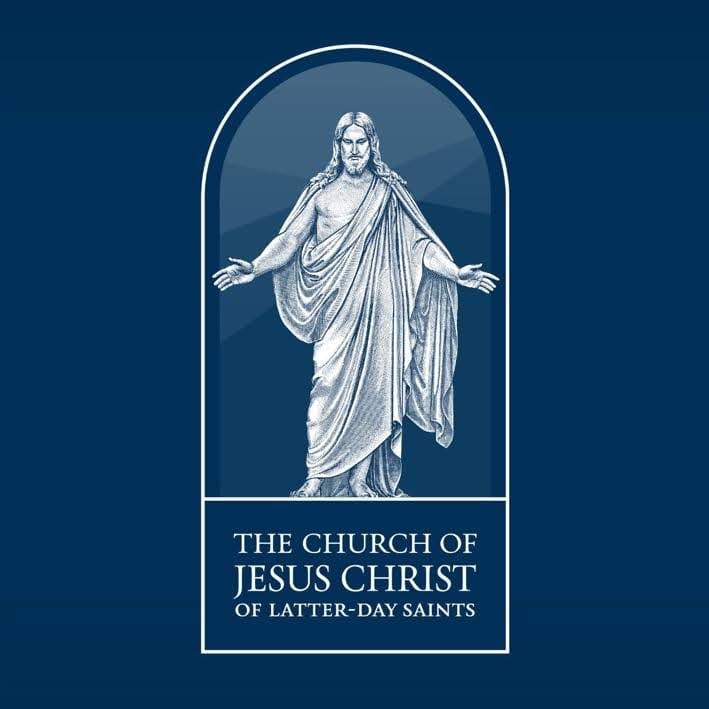
In 2020, the Church logo changed to place the image of the resurrected Christ at its center:
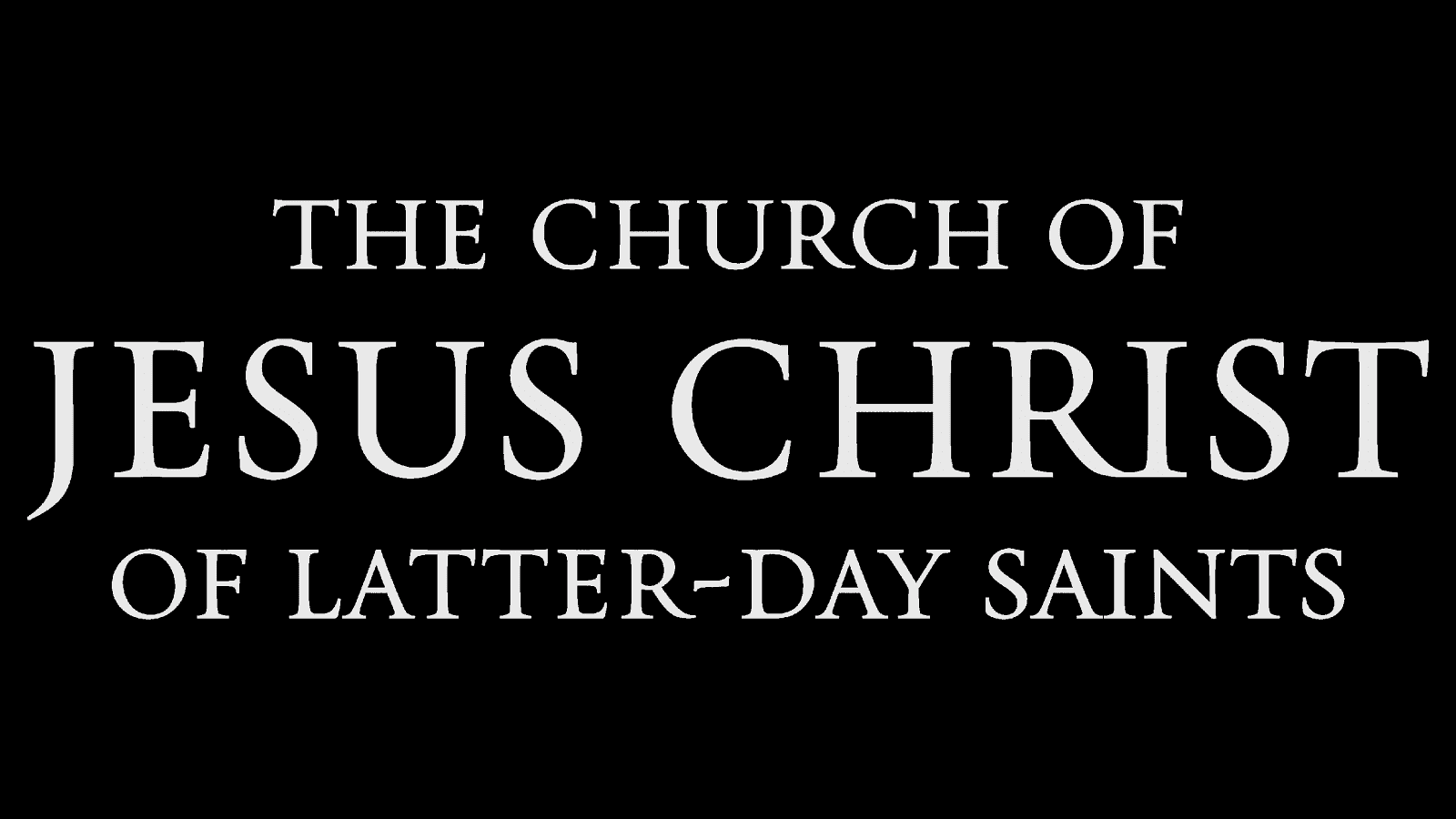
to this
In the April 2020 conference, President Nelson invited a worldwide fast on Good Friday. He said “I invite all, including those not of our faith, to fast and pray on Good Friday, April 10, that the present pandemic may be controlled, caregivers protected, the economy strengthened, and life normalized.”
In March 2021, President Russell M. Nelson released a short video message titled The Peace and Hope of Easter, where he invited people worldwide to focus on Jesus Christ during the week leading up to Easter. He said:
“On this Palm Sunday, I invite you to make this coming week truly holy by remembering—not just the palms that were waved to honor the entrance of Jesus into Jerusalem—but by remembering the palms of His hands.” (Isaiah 49:16: “Behold, I have graven thee upon the palms of my hands.”) He continued: “After all that Jesus Christ did for you, I invite you to do something this week to follow His teachings. … This Easter, I encourage you to focus on the Savior.”
In April 2023, Elder Gary E. Stevenson spoke of the growing effort among Latter-day Saints to recognize Palm Sunday and Good Friday more thoughtfully. He said:
“I observe a growing effort among Latter-day Saints toward a more Christ-centered Easter. This includes a greater and more thoughtful recognition of Palm Sunday and Good Friday as practiced by some of our Christian cousins. We might also adopt appropriate Christ-centered Easter traditions found in the cultures and practices of countries worldwide.”
In April 2025, Elder Gerrit W. Gong taught that the timing of Easter and general conference should not be seen as accidental:
“Their convergent proximity is not by coincidence or accident; it is sacred and symbolic.”
The 2026 Come, Follow Me manual also includes a Holy Week study guide, inviting members to reflect on the Savior’s final days and His Resurrection, including His appearance to the people in the Book of Mormon.
The increasing emphasis on Holy Week does not appear to be the result of cultural trends alone. Rather, it reflects prophetic invitations to place Jesus Christ more deliberately at the center of our lives.
The Rising Emphasis on the Atonement
Alongside the growing attention to Holy Week, references to the Atonement in general conference have steadily increased for more than fifty years. In the early 1970s, about ten talks per year mentioned the Atonement. Today the number is closer to thirty-five.
One of the clearest explanations of the atonement was given by then Elder Dallin H. Oaks in his October 2015 general conference address Strengthened by the Atonement of Jesus Christ. Elder Oaks taught that because the Savior descended below all things, He understands every sorrow, every weakness, and every burden we carry. His Atonement not only forgives—it strengthens, heals, and lifts.
A Sacred Weekend Ahead
This Easter weekend, millions of Latter-day Saints will gather for general conference while Christians around the world remember the Savior’s victory over sin and death.
The invitation to focus on Palm Sunday, the growing number of conference messages about the Atonement, and the increasing attention given to Holy Week all point in the same direction.
The convergence of conference and Easter is more than a calendar coincidence.
It is an invitation.
An invitation to remember the Savior’s final week.
An invitation to reflect on His sacrifice.
An invitation to rejoice in His Resurrection.
Because He lives, we live.
Because of His Atonement, we can be healed.
Because of the Restoration, we know the fulness of His gospel.
He is risen.
Hosanna to God and the Lamb!
——-
[1] searchgeneralconference.com is a free, publicly available search service that indexes every general conference address since 1971 and allows anyone to explore trends, keywords, and patterns in prophetic teachings.
[2] In February 1977, the First Presidency announced significant changes to the format of general conference, effective with the April sessions that year. Previously, the April general conference had traditionally spanned three days (and sometimes more) and was deliberately scheduled to include April 6—the anniversary of the Church’s organization in 1830—regardless of what day of the week that date fell on. This often meant sessions occurring on weekdays, which created challenges for attendance by members who had work or school commitments, as well as logistical difficulties for broader participation.
[3] To address these practical considerations and better accommodate the growing worldwide membership, the conference was standardized to a consistent two-day weekend format: the first Saturday and first Sunday of April (and similarly for October). This shift eliminated the rigid tie to April 6 as a required session date, though April 6 continues to be commemorated in other ways, such as through messages or events when it aligns naturally with the weekend schedule. The change was part of a broader effort to streamline proceedings while maintaining the sacred purpose of gathering the Saints to receive guidance from living prophets. (See the First Presidency announcement in the February 1977 Ensign: General Conferences to Be Two-Day Conferences.)
Bringing Your Empty Cup to Christ

What if the very week you’re supposed to feel closest to Christ… you feel the farthest away? In this honest Holy Week episode, Michaela shares what it looks like to come to Christ feeling spiritually empty. Through the widow’s mite, Palm Sunday, and a personal reflection on the Resurrection, she offers a simple, freeing truth: even your smallest offering is seen, accepted, and made enough through Him.
The Minefield of Mortality and the Lord Who Helps Us Through It

Adapted from a talk given in a sacrament meeting on Palm Sunday.
I’ve spent the last 50 years trying to get to know Jesus. We have the greatest tools: scriptures, prayer, living prophets. Have you ever wanted to have a vision, yourself? What were people doing when they’ve had visions: they asked great questions and pondered the Savior and His atonement, and even imagining His presence. Will you imagine with me?
I want to take you back, before this world was, to a conversation you had with your Heavenly Parents, Parents who are pure light, who love you more than words. They ask you, “What is wanted? What do you really want?”
“Father, I want to be with you! I want to be like you!”
“Oh good! That’s what I want, too!”
“How do we do that?” you asked.
“My child, I’m going to make a game world called “Minefield” where everything will break. Your body will break. Your mind will probably fail you at some point, your heart will break, and your faith might even break. Your memory of this conversation will be no more than a whisper.”
Do you think you said, “This sounds amazing! When do I start?”
No. At this point, you’re feeling pretty raw, hopeless, asking, “Is there no other way?”
“My child, everything will break. But I will come and offer healing for it all. Right in the meridian, or middle of it all, I’ll send my Son to fix all the brokenness. All of it—for those who will accept it.”
“So I’m in this game world – how many lives do I get?”
“One.”
“I get one life? One shot?”
“Yes, one.”
“But I’ll fail. I won’t remember you – Everything will be breaking – I’ll be breaking! I’m going to fail!”
“How about this: When you feel ready, I’ll make a promise with you, give you the name of Jesus, and make you whole. I’ll even send my second in command, the Holy Ghost, to be with you always.”
“Oh good! Then I’ll be done with the game?”
“No.”
“But, Father, I’ll keep failing because I’ll keep forgetting you!”
“I know. Once a week, I will sit with you, and break bread and drink with you so you can remember my Son. And I’ll wash and anoint you as often as you fall. I’ll even make a covering for you to wear to remember Jesus’ name.
I’ll have a home on earth with 2 altars in it: One where you promise to give everything you have to me, and another where I promise to give everything I have to you. I’ll give you signs and tokens that point you to Jesus and His sacrifice for you. Then, at the end, I will personally take you by the hand and bring you through the veil, back into my presence. Then, together, we will partake of eternal life and exaltation.”
Now, I share that story because I know what that ‘Minefield’ feels like. I have stood in the hospital room with a 14-year-old son burned by fireworks, and I have sat in the quiet of an empty room praying for children who have walked away from their covenants. I know that in this life, ‘everything breaks.’ But because I know that in breaking, I have had to find the Healer. And that Healer is why we are here today.
Today we begin the most sacred week in human history. It began with “Hosannas” and palm branches strewn in the dusty streets of Jerusalem. But we know—that the path led from the cheers of the crowd to the solitude of a garden, the rending of a veil, which represents Jesus Christ, and ultimately, the breathtaking triumph of an empty tomb.
The Garden and the Altar
When we speak of the Atonement of Jesus Christ, we are speaking of an act so expansive it defies the limits of our vocabulary. But for a moment, I want to speak of the cost. We sometimes skip too quickly to the “Alleluia” without lingering long enough at the “Eloi, Eloi, lama sabachthani” which is: “My God, my God, why hast thou forsaken me?”
In Gethsemane—a garden that mirrors Eden where the Fall began—the Savior of the world stepped into a darkness that was not His own. He took upon Himself the staggering, crushing weight of every sin, every sorrow, and every bitter disappointment. He knelt at the ultimate altar of sacrifice, offering not the blood of lambs or goats, but His own life’s blood. He bled at every pore—not from a physical illness, but from a spiritual pressure so immense that the human frame could scarcely endure it.
He stood in a solitude we will never have to face, precisely because He faced it. He was abandoned so that you and I would never, ever have to be.
Passing Through the Veil
Then came Friday. We call it “Good Friday,” though at the time, it must have seemed like the catastrophic end of everything. They watched the Light of the World go dark. But as the Savior drew His last breath, something miraculous happened in the temple: the veil was rent in twain from the top to the bottom.
That was no mere architectural accident. It was a profound, cosmic declaration that because of the Lamb of God, the way back into the presence of the Father—the Holy of Holies—was now open to every son and daughter of God.
He became the divine co-signer of our souls, the One who put His own life up as collateral to ensure that every promise made to us by the Father would be kept, regardless of our own bankruptcy. He is the Way, the Truth, and the Life; no man or woman comes back to the Father but by Him. He has invited us to be clothed in His righteousness, to wear white robes of His holy priesthood because He wore reminding red robes.
The Power to Bind and Loose
If Gethsemane and Calvary were the payment for our debts, the Resurrection was the receipt, written in the indelible ink of an empty sepulcher. Because He rose, the grave has no victory.
The Resurrection is not just a metaphor; it is a literal, physical reality. Because of Him, the sealing power of the holy priesthood is not just a nice idea—it is an eternal law. Because of that empty tomb, the mother who has buried a child will hold that child again. The husband and wife who have been “bound on earth” by the power of God will find that they are “bound in heaven.” No grave can hold what God has sealed, and no death can permanently sever the hearts of those who have entered into His holy order.
To the One Who Struggles
Now, I know there are some of you sitting here today who feel that the Atonement is a grand plan for “everyone else,” but perhaps not for you. You feel your mistakes are too repetitive or your heart too weary for grace to reach.
To you, I say with all the fervor of my soul: Please, do not believe that. Do not suggest that the reach of the Almighty is shorter than your mistakes. The Atonement is not a prize for the perfect; it is the provision for the penitent. He isn’t waiting for you to get “better” before He helps you; He is waiting to help you so that you can get better. He wants to lead you by the hand through every veil of doubt and every gate of despair.
My Witness
I close with my own witness. I know Him. I know that Jesus is the Christ. His relentless redemptiveness exceeds our recurring wrongs. I know that on that first Easter morning, when Mary Magdalene stood weeping and heard her name spoken by a familiar, beloved voice, the future of the entire human family was rewritten.
He lives! He is a resurrected, glorified Being with a heart of infinite compassion.
Let us remember the covenants we have made and the promises He has kept. May we walk through this week with awe for the One who died that we might live, and who rose that we might never truly die. In the sacred name of Him who is the Resurrection and the Life, even Jesus Christ, amen.
A Miracle, a Plot, and a King’s Triumphal Entry: Taking You to Palm Sunday
What did Jesus do that finally tipped the Pharisees into conspiring to crucify him? What act was so heinous, so threatening, so terrible to them that they could no longer stand is presence in their nation?
Ironically, it was a miracle that they couldn’t stand. The light and power that awakened Lazarus from the tomb made them convinced that they had to put Jesus into one.
Raising someone from the tomb who had obviously been there four days was their breaking point. “If we let him thus alone, all men will believe on him,” they said. Raising the dead, healing the blind, lifting the broken heart, these were the offenses that kindled their anger and threatened their position.
So let’s go to that scene of Lazarus.
Raised from a Tomb
Mary and Martha sent an urgent message about their brother to Perea where Jesus was teaching: “Lord, behold, he whom thou lovest is sick.” When Jesus heard of Lazarus’ sickness, He said, “This sickness is not unto death, but for the glory of God,” and He turned and continued His work two more days at Perea with the calm assurance of divinity, knowing that He would arrive in proper time.
After two days, He told the disciples that Lazarus was dead, but He said, “Let us go into Judaea again.” This was a dangerous suggestion, prompting Thomas to say, “Let us also go, that we may die with him,” for “they feared lest the Jews should take Jesus and put him to death, for as yet they did not understand the power of God.”
As Jesus traveled on the road near Bethany, the news came that Lazarus had already lain in the grave four days, and heartbroken Martha, hearing that Jesus was coming, went out sorrowing to meet Him. “Lord,” she exclaimed, “if thou hadst been here, my brother had not died.” How often during that heavy four days since Lazarus’ death Mary and Martha must have discussed this very thing. “If only Jesus had come, if only He had been here.” Still, she had no complaining word for Jesus, no murmuring; she just affirmed, “But I know, that even now, whatsoever thou wilt ask of God, God will give it thee.”
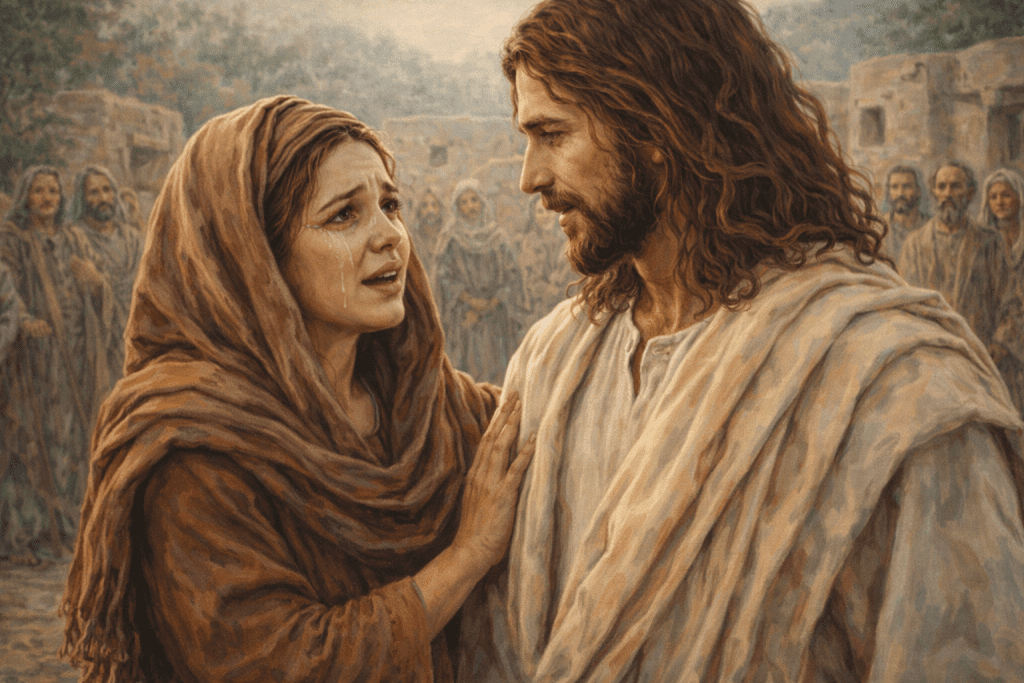
Jesus answered, “Thy brother shall rise again,” which Martha misunderstood, saying, “I know that he shall rise again in the resurrection, at the last day.” Jesus explained further, “I am the resurrection, and the life: he that believeth in me, though he were dead, yet shall he live: . . . Believest thou this?” Then Martha affirmed with loving faith, “Yea, Lord: I believe that thou art the Christ, the Son of God, which should come into the world.”
Next, Martha went quickly to her sister with words every believer would long to hear: “The Master is come, and calleth for thee.” Oh, He had come!
As Mary left the home, perhaps with couches and chairs tossed over in the Jewish form of mourning, the mourners followed her, thinking she went to the grave to weep. Instead, she came to the Lord and fell at His feet.
Jesus asked, “Where have ye laid him?” to which they answered, “Lord, come and see.” Then, “Jesus wept,” not apparently because Lazarus had died, for He knew that in moments His friend would rise. He wept, instead, for love and compassion, for the grief that tore the heart of His friends, for the bruises and scars of mortality, for all that hurts.
At the place of burial, Jesus asked the people to roll away the stone from the cave entrance where Lazarus lay. Martha demurred: “Lord, by this time he stinketh: for he hath been dead four days.” Jewish belief was that a body began its corruption on the fourth day.
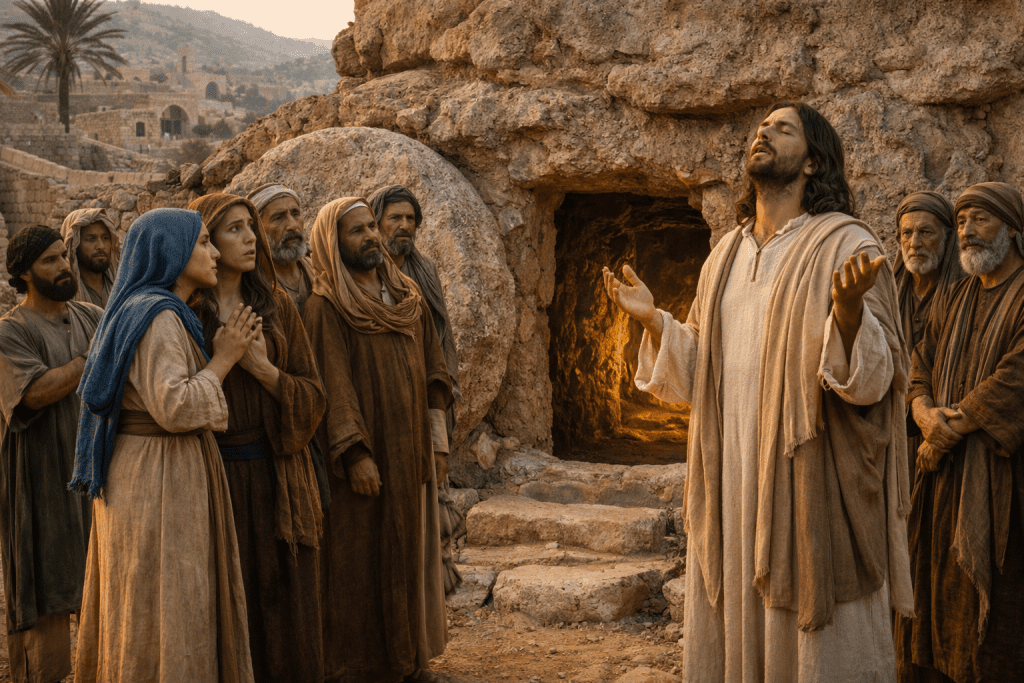
“Then they took away the stone from the place where the dead was laid. And Jesus lifted up his eyes, and said, Father, I thank thee that thou hast heard me.
And I knew that thou hearest me always.”
Those last words rings in our ears, “I knew that thou hearest me always.” We might talk ourselves into believing that God is distant in some far away place, deaf to our yearnings and pleas, but if we could follow Christ’s example, as believers, we would have to acknowledge, “thou hearest me always.” It is an affirmation of assurance and faith, knowledge and joy.
Then in a loud voice that must have shaken the listeners to the marrow, He cried, “Lazarus come forth.” And “he that was dead came forth, bound hand and foot with graveclothes.” “Then from that day forth [the Pharisees] took counsel together for to put [Christ] to death.”
Mine Hour Hast Come
Jesus had told his mother Mary when she had asked her for help at the wedding at Cana, “Woman, what wilt thou have me to do for thee? that will I do; for mine hour is not yet come.”
Now His hour had come. Behind Him were the green hills of Galilee, the great crowds gathering on the grass to hear His word, the lap of waves on a blue sea. Ahead lay Jerusalem, the arrogant city on a hill, tense in its self-conceit, where already in their supreme blindness in the name of religious piety, plotters were scheming to kill the Lord Himself.
Offended by His healing touch, by His words that cut to the heart of their hypocrisy, the Roman and Jewish rulers gathered in the high halls of the chief priest and conspired against Him. Raising Lazarus from the dead so that all the countryside was full of the talk of it was Jesus’ final offense that had challenged their dominion. “If we let him thus alone, all men will believe on him,” they said. Raising the dead, healing the blind, lifting the broken heart, these were the offenses that kindled their anger and threatened their position.
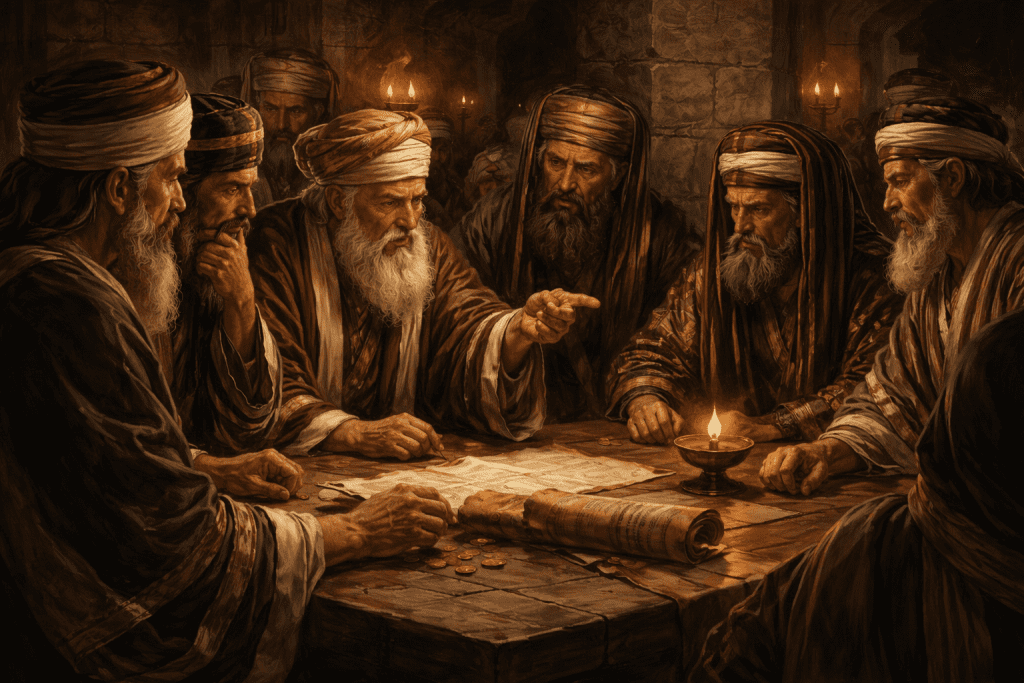
Still, their fanatical hatred did not stop Jesus from coming to Jerusalem for Passover with the certain knowledge of what He would face. Bitter contempt, insult, and death waited for Him along the shadowed roads of Jerusalem, often from the very people who claimed they represented God. What superb irony!
Jesus said, “What shall I say? Father save me from this hour: but for this cause came I unto this hour.”
In Bethany, just over the hill from Jerusalem, Mary, sister of Martha, anointed His feet with a precious oil that she had saved “against the day of [his] burying,” and He patiently told apostles who could not understand that He would submit Himself to be mocked, scourged, and spat upon. He would overcome the world, but not before it appeared to all those who loved Him that the world had overcome Him. They must face His humiliation before they saw His triumph.
He would suffer that others would not have to suffer, face agonies beyond description to do His Father’s will: “For I have not spoken of myself; but the Father which sent me, he gave me a commandment, what I should say, and what I should speak.”
Waving Palm Leaves
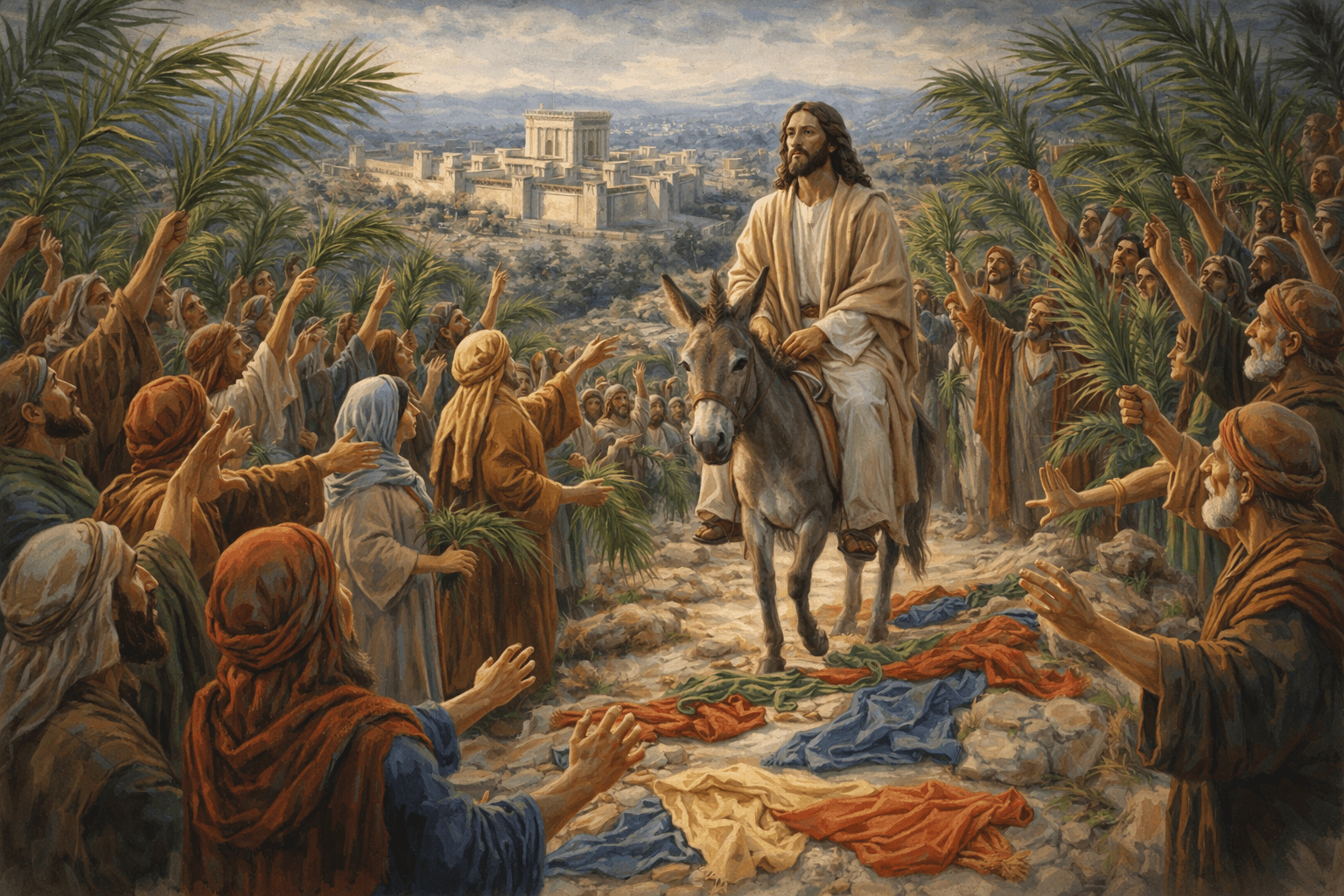
On that Sunday in spring, as Jesus and His band of followers went from Bethany to Jerusalem for the Passover celebration, He instructed two of His disciples to go into a village, where they would find a young colt. On this meek animal He would ride for His triumphal entry into Jerusalem, coming not as a proud king with conquests of war but rather in the rule of peace.
His riding a donkey had great symbolic meaning for the Jews. In this way, Jesus was saying to them that he was the legitimate king. God had made a covenant with David that his throne would be established forever and that a future king (the Messiah) would reign in righteousness. In Zechariah 9:9 it reads, “Behold, thy King cometh unto thee…lowly, and riding upon an ass.” War kings rode horses, which were symbols of conquest. Peaceful rulers rode donkeys or mules. Tellingly, when Solomon was declared king, he rode David’s own mule.
At Passover, the population of Jerusalem swelled with people coming to celebrate. Word of Jesus’ coming had spread among the festive pilgrims gathered in the city, especially among His own Galileans, who had heard of His miracles, and as the fire spread from heart to heart, they rushed out to meet Him, making a rough carpet by unloosing their cloaks and throwing them in His path.
Bethany is not far from Jerusalem, just over the Mount of Olives from the great city. As Jesus rode on that steep and winding road down the Mount of Olives, directly across from the eastern wall of Jerusalem, this is where the people gathered palm leaves to wave them in triumph and love for the Messiah.
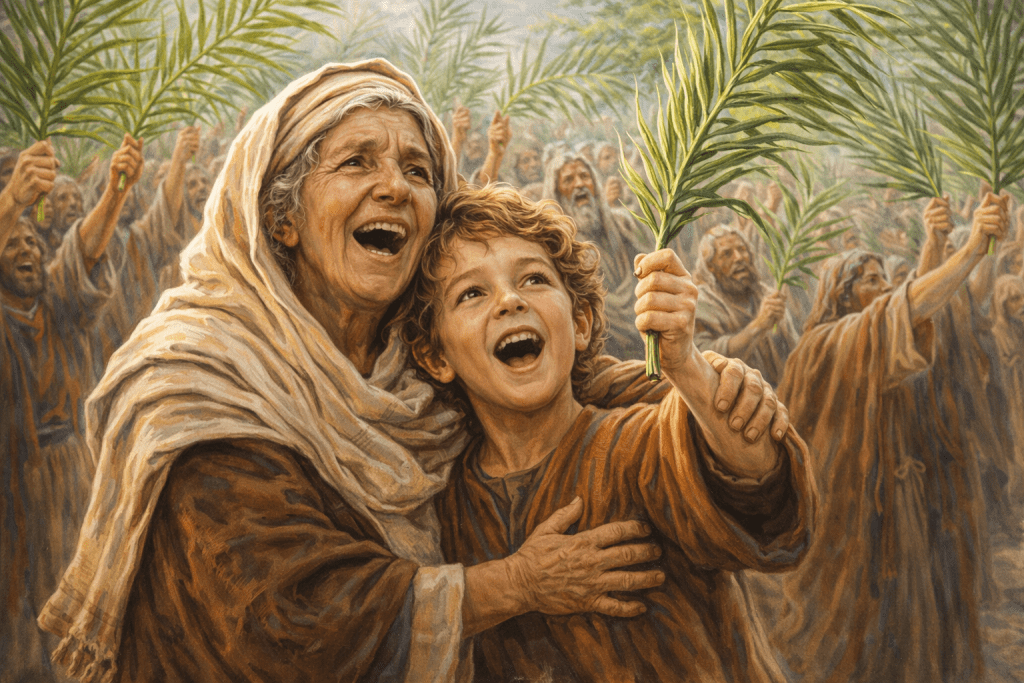
Here was the promised Son of David, and now surely the kingdom was at hand! Waving palm leaves, they shouted hosannas: “Blessed be the King that cometh in the name of the Lord.”
The word hosanna, writes Elder Bruce R. McConkie, is “a word of Hebrew origin, meaning literally, save now, or save we pray, or save we beseech thee – is both a chant of praise and glory to God and an entreaty for his blessings.”_
Elder McConkie explains that the word, hosanna, hearkens to Psalm 118: “Save now, I beseech thee, O Lord: O Lord, I beseech thee, send now prosperity. Blessed be he that cometh in the name of the Lord: we have blessed you out of the house of the Lord.”_
Taylor Halverson further explained, “Hosanna is a beautiful Hebrew word that is formed from two other Hebrew words. The hosa portion of the word means “to save” and is actually in the command form meaning “save!” Na means “please!” So the express meaning of hosanna is “please save!” or “please save us!”
“What I love about this word is that the Hebrew name hosa is the foundational word for these names:
- Joshua
- Josh
- Hosea
- Hoshea
- Elisha
- Elishua
- Isaiah
“And, most significantly, JESUS!
“So when in joy we shout hosanna we are actually shouting ‘Jesus please!’ or ‘Jesus please save us!’”
Whole-Souled Praise
Larry Barkdull added, “Anciently, during the Feast of the Tabernacles, when the Jews were commanded to gather to the temple, a priest would daily recite this psalm during a processional around the altar. The covenant people had been commanded to ‘rejoice before the Lord,’_ and on the seventh and last day of the feast, which was called the Great Hosanna, they would stand before the temple with trumpets sounding, wave palm branches and shout hosanna over and over.
“Essentially, the Hosanna Shout is simultaneously ‘whole-souled’ praise ‘given to the full limit of one’s strength’ and a cry for the Lord to come and save us now. We stand in the holy sanctuary that we have erected to his name, praise him, and plead for him to come and rescue us. By doing so, we fulfill ‘the instruction to bless the name of the Lord with loud voices and ‘with a sound of rejoicing,’ with ‘hosanna to him that sitteth upon the throne forever.’”
Disgruntled Pharisees
Disgruntled and knowing full well that the people were proclaiming Jesus the Messiah, the Pharisees made a desperate appeal to Him to stop the commotion. He answered that if the people held their peace, the very stones would cry out.
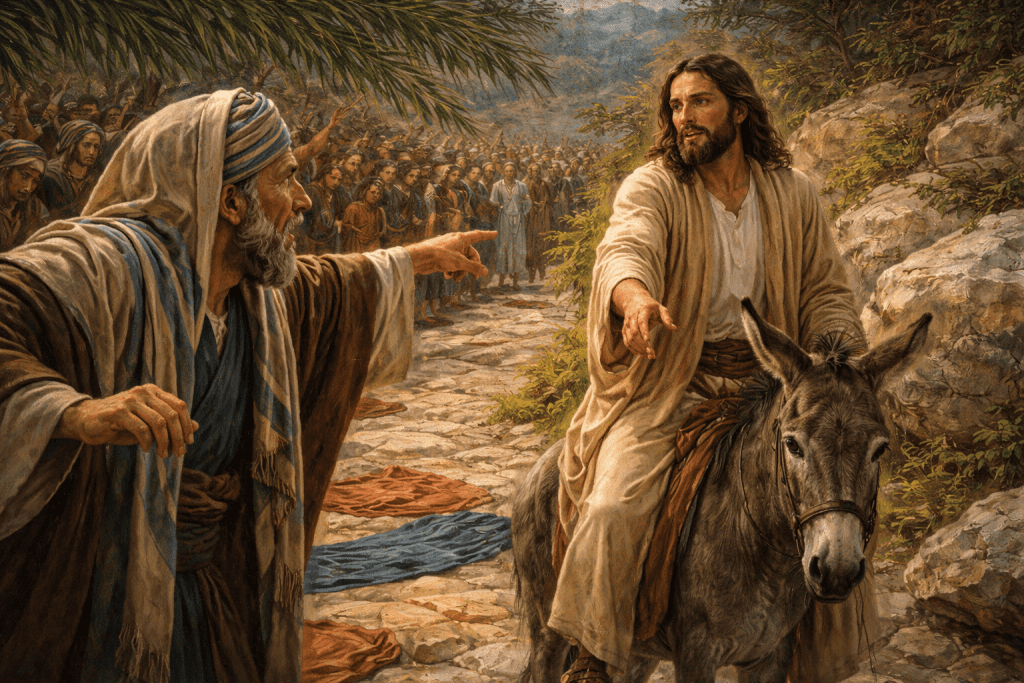
As Jesus first caught sight of Jerusalem, that city of palaces and ivory towers, of terraces and magnificent gardens, He wept. Though the multitude cheered as He began His descent down the Mount of Olives, He moaned in deep lamentation.
“The contrast was, indeed, terrible between the Jerusalem that rose before Him in all its beauty, glory, and security, and the Jerusalem which He saw in vision . . . with the camp of the enemy around about it on every side.” For with God’s view, He saw that in A.D. 68, but a few years hence, the Romans would besiege the city until the temple would be left without one stone upon another, until the city would be tumbled to the ground, its former beauty in ashes.
Scene after scene must have arisen before His eyes, the gory bodies of Jerusalem’s children among her ruins, the famine that drove mothers to snatch food from their infants, the thousands crucified outside the city walls. He said that in those days the daughters of Jerusalem would say, “Blessed are the barren, and the wombs that never bare.” “Then shall they . . . say to the mountains, Fall on us; and to the hills, Cover us” — all of this because they had rejected their God.
Where Were Those Who Had Shouted Hosanna?
From this distance of centuries, the question lingers. Where were all those people waving palm leaves and shouting hosanna just five or six days later when Pilate asked the crowd which prisoner he should release from a certain death warrant Jesus or Barabbas? What did the crowd cry out? “Barabbas.” They cried out for the release of a violent rebel who had murder and bloodshed on his hands instead of the Messiah they had recognized so clearly on that Palm Sunday.
What happened? The conjectures are many. Perhaps it was the swell of Galileans, the rural people of the north who had supported Jesus, not the citizens of Jerusalem. Perhaps, as we have seen so often today, crowds were assembled by pay. They shouted for Jesus to be crucified for a “mess of pottage.” Or maybe it was just enough to stir up rumors and fears about this meek and powerful Messiah.
All we can know for sure is that in our time, we can wave our palm leaves at his triumph and make every prayer a hosanna as we plead with whole-soul devotion, “Lord, save me.”
Resources to Experience, Share Jesus Christ’s ‘Greater Love’ This Easter
This spring, members of The Church of Jesus Christ of Latter-day Saints are invited to lean into a deeper, more intentional celebration of the Savior. The First Presidency has highlighted Palm Sunday, Easter, and General Conference as pivotal moments to reflect on the Atonement and Resurrection of Jesus Christ.
In a unique alignment of the calendar, Easter Sunday falls on the same weekend as General Conference—April 4-5—offering a rare opportunity to bridge the ancient miracle of the empty tomb with the modern guidance of living prophets.
Expanding Our Easter Focus
Much like the Christmas season, there is a growing movement within the Church to treat Easter as more than just a single Sunday. By extending our focus across a “Holy Week,” we can better emulate the “Greater Love” described in John 15:13.
The 2026 Easter initiative centers on the promise that through Christ, “all will live again.” Whether through the new “Greater Love for You” video (released March 1) or personal study, the goal is clear: to ensure no one feels forgotten and that everyone has the chance to experience a fullness of joy.
First Presidency’s Easter Message
In their recent Easter message, the First Presidency extended an invitation to “seek this Jesus of whom the prophets and apostles have written” (Ether 12:41) during the Easter season.
Key Dates for Your Calendar
The journey through this sacred season follows a beautiful arc of worship and study:
-
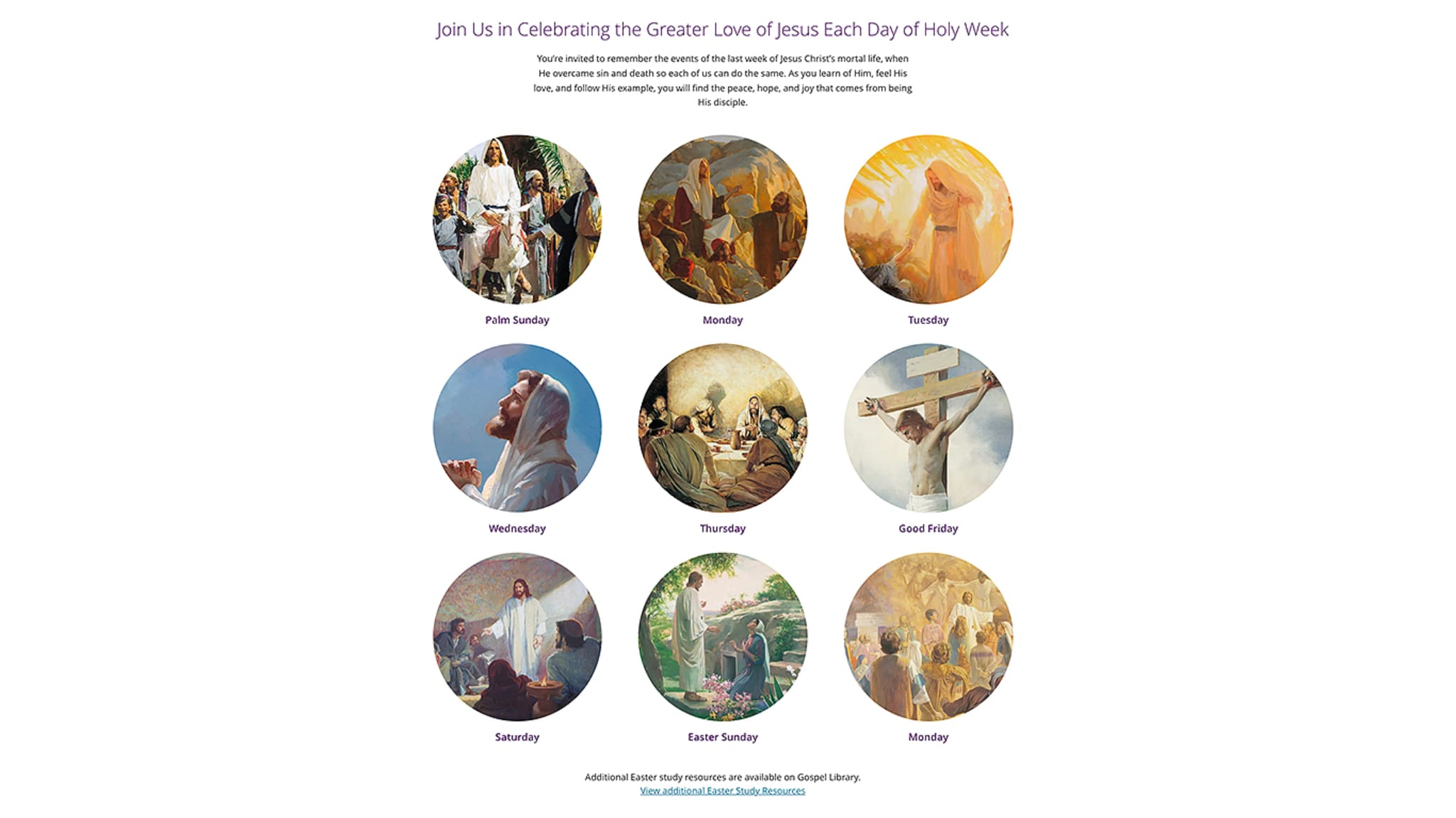
Palm Sunday (March 29): Wards worldwide will host a special one-hour worship service focused entirely on the Savior. This is designed as a “visitor-friendly” event, perfect for inviting friends and neighbors to join in a Christ-centered meeting.
- Holy Week (March 29 – April 5): A time for deep immersion into the Savior’s final teachings during His mortal ministry.

Holy Week study experience available on Easter.ChurchofJesusChrist.org focuses on the Savior’s teachings during the last week of His mortal ministry. This resource is also highlighted in Gospel Library and linked in “Come, Follow Me.”
-
General Conference (April 4–5): This year’s conference marks a historic milestone. We will participate in a solemn assembly to sustain a new First Presidency and two new members of the Quorum of the Twelve Apostles: Elder Gerard Caussé and Elder Clark Gilbert. We will also hear the first conference address from President Dallin H. Oaks as President of the Church.
Note: Per the November 2025 announcement, starting this April 2026, General Conference will no longer include a Saturday evening session.
Resources for Sharing and Study
As requested, here are the official resources provided by the Church to help you enhance your personal experience and invite others to learn more:
-
Easter.ChurchofJesusChrist.org: Launched February 22 in 10 languages, this site is the hub for Christ-centered Easter content, including music, videos, FAQs, and children’s resources.
-
Seasonal Resources for Leaders: Accessible via the main Easter site, leaders can find Palm Sunday service ideas, invitation templates, and tools for customized meetinghouse banners.
-
Social Media: Look for the “Greater Love for You” video on official Church channels to resharing on your personal or organizational pages.
-
Meetinghouse Signage: To help visitors understand why buildings may be empty during the April 4-5 weekend, councils can download a specific poster (available on the resource site) to display on chapel doors.
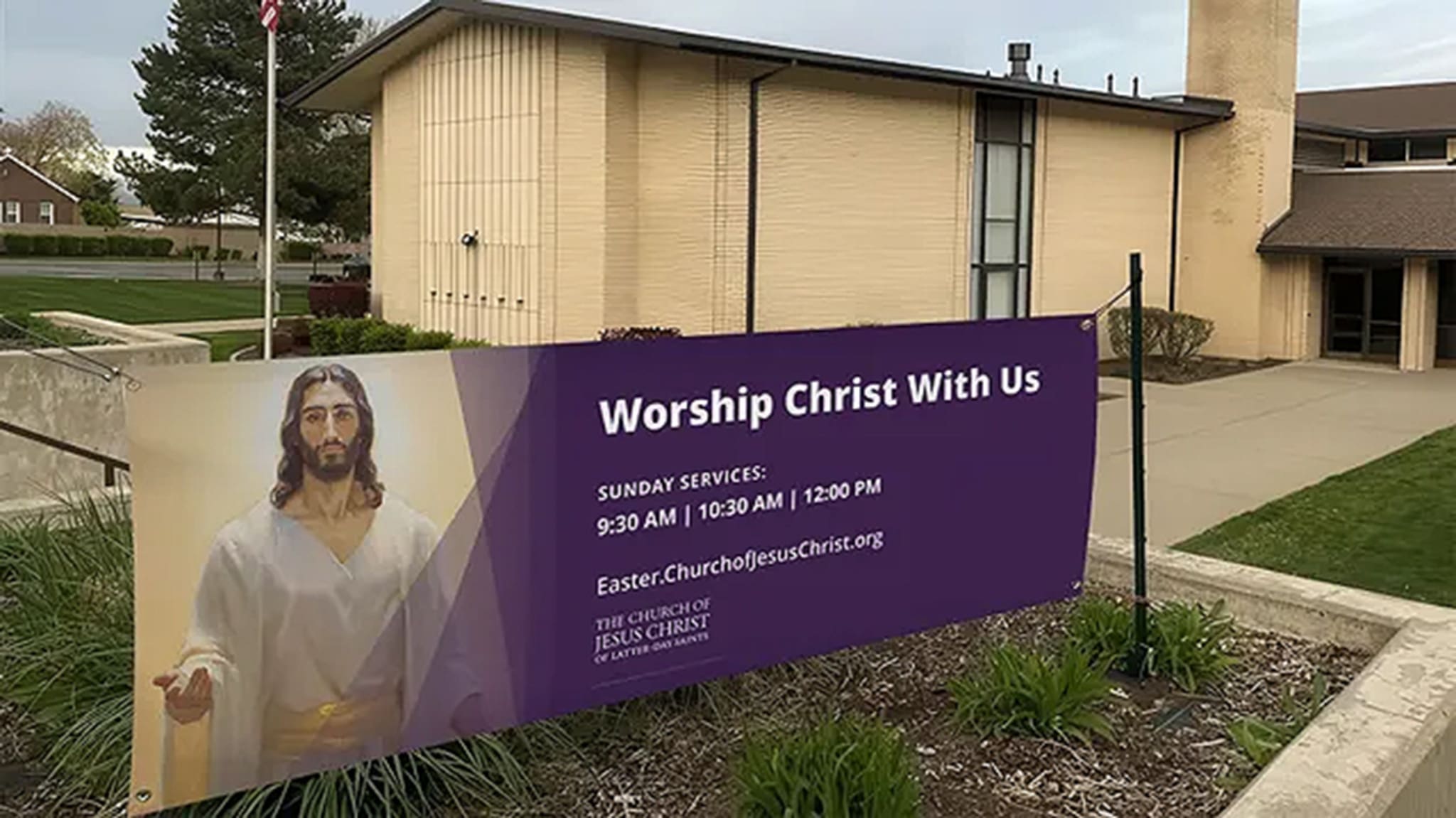
An example of a meetinghouse banner used to invite community participation with local worship services.
-
Outdoor Banners: The online tool allows wards to create customizable outdoor signage with specific meeting times and languages to welcome the local community.
-
Activity Sharing: Stake and ward leaders can use the Activity Sharing tile in the Member Tools app to update their public-facing ward web pages with local Easter activities.
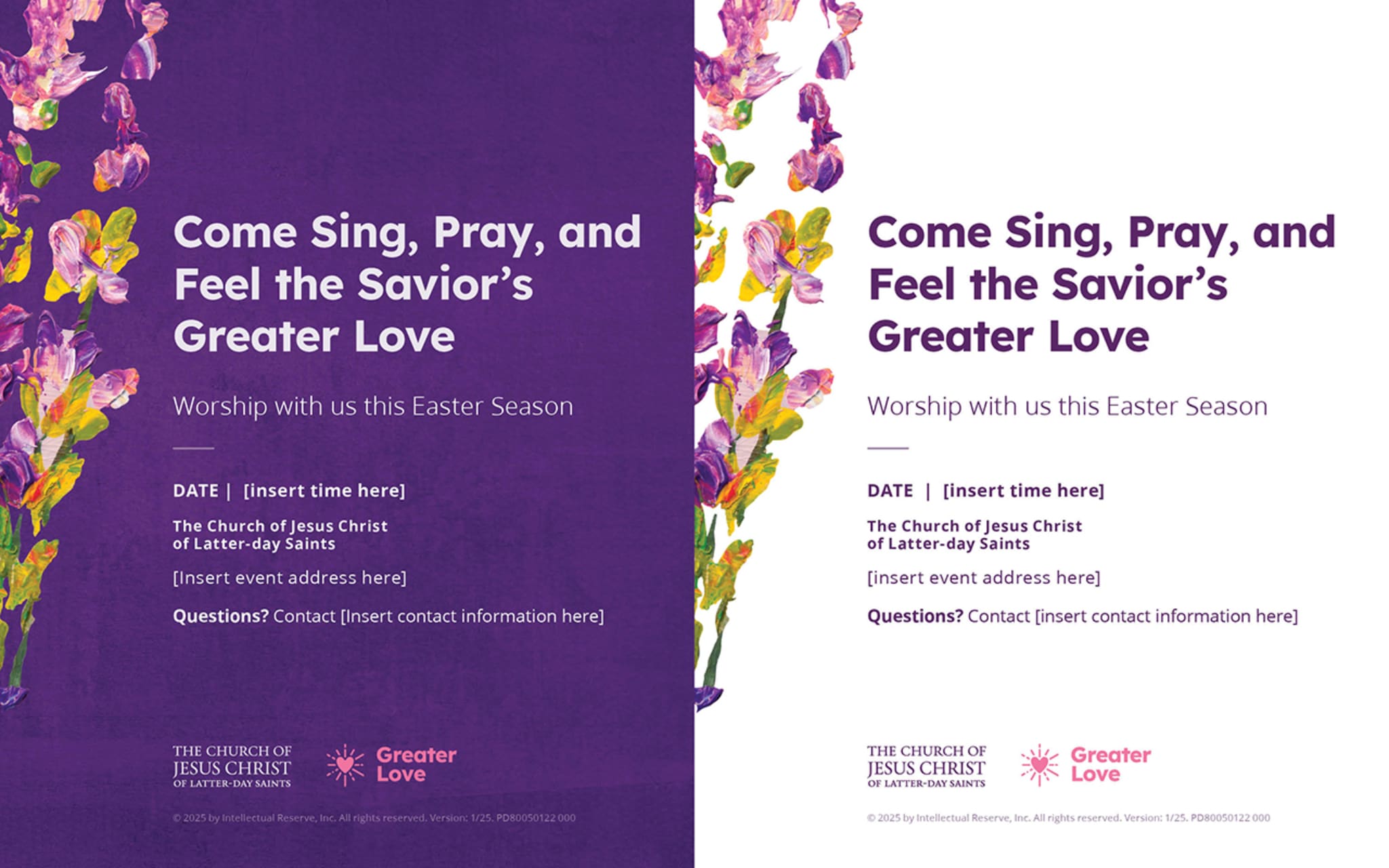
An example of a fillable Easter invitation available to local leaders for inviting others to participate in various Easter activities.
Understanding Jesus’ Triumphal Entry into Jerusalem
Sign up for Meridian’s Free Newsletter, please CLICK HERE
Cover image via LDS.org.
The Triumphal Entry of Jesus into Jerusalem the Sunday before the Savior’s crucifixion and resurrection––Palm Sunday––is a time in our beloved Savior’s life that marks the beginning of his last week in mortality. Even though it is a triumphant entry indeed, filled with tremendous fervor and rejoicing, it is also a time of great sadness for the Lord.
As Jesus approaches Jerusalem he wept over the city, its wickedness and the travail and destruction that would soon come upon it. The apostle John tells us that Jesus became troubled and prayed:
“Now is my soul troubled; and what shall I say? Father, save me from this hour: but for this cause came I unto this hour. Father, glorify thy name. Then came there a voice from heaven …The people therefore, that stood by, and heard it, said that it thundered: others said, An angel spake to him” (John 12:27-29).
It is the Sunday before Passover when all paschal lambs are being brought into Jerusalem from the fields of Bethlehem for sacrifice. How fitting that Jesus, the Perfect Lamb, also birthed in Bethlehem and possibly watched over by some of the same shepherds that now deliver these lambs, enters into Jerusalem that very same day.

Jesus’ Triumphal Entry into Jerusalem cannot be fully comprehended by our mortal minds, but it was planned and carried out with full intent and purpose by the Lord. By now Jesus and his many miracles were well known, all in fulfillment of Messianic prophecies and to bear witness of his Divinity.
According to Elder James E. Talmage “The occasion of Jesus’ entry into Jerusalem was no accidental or fortuitous happening. He knew well beforehand what he wanted to have happen and what he would do. It was no meaningless pageant; but the actual advent of the King of Kings into His royal city. He now, with full public acceptance of the nation’s homage and rejoicing, proclaimed his acceptance of both Kingly and Messianic titles” (James E. Talmage, Jesus The Christ, p. 480).
There are six happenings in Jesus’ Triumphal Entry into Jerusalem that are rich in Messianic symbolism and prophecy. Each plays a part in witnessing Jesus as Israel’s promised Messiah.
1. Jesus sends two of his disciples to bring him a donkey.
Luke tells us that straight away as Jesus entered the Mount of Olives, he tells two of his disciples “Go ye into the village over against you; in the which at your entering ye shall find a colt tied, whereon yet never man sat: loose him, and bring him hither” (Luke 19:29-34).
So one might ask what significance does this request from Jesus have as a witness that he is the promised Messiah? The answer comes from one of the earliest Messianic prophecies found in Genesis.
“Binding his foal unto the vine, and his ass’s colt unto the choice vine; he washed his garments in wine, and his clothes in the blood of grapes” (Genesis 49:11).
For the Jews who were longing for the Messiah and constantly studying every Messianic prophecy, the never ridden tethered colt would hold great significance. Especially for the two unnamed disciples that were on the Lord’s errand.
2. Entering Jerusalem on a donkey.
By riding this colt into Jerusalem Jesus was presenting himself as the promised Messiah who they had been waiting for, as prophesied by Zechariah.
“Rejoice greatly, O daughter of Zion; shout, O daughter of Jerusalem: behold thy King cometh unto thee: he is just, and having salvation; lowly, and riding upon an ass, and upon a colt the foal of an ass” (Zechariah 9:9).
Jesus also deliberately planned his entry into Jerusalem after King Solomon’s royal entry into Jerusalem––from the Mount of Olives and on The Kings Mule. By riding in on a donkey, amidst the shouts of praise and jubilation of the people, Jesus is proclaiming––to all of Israel––he is King of Judah, the prophesied heir to the throne through the Davidic line. This is evidenced by the crowds referring to Jesus as ‘Son of David’ a title that only belonged to King Solomon and the prophesied Messiah (see 1 Kings1:33; James E. Talmadge, Jesus The Christ p. 478)!
Lastly, Jesus riding into Jerusalem on a donkey proclaimed he came in peace as opposed to Rome’s grand display and parade of magnificent horse driven chariots at the beginning of every Jewish festival. A deliberate display of power meant to subdue and oppress the Jews.
It is interesting to note that the same people who praised and honored him as the long awaited Messiah, would later reject him and call for his crucifixion because he didn’t suddenly turn into this powerful deliverer and military leader; even though he entered Jerusalem on a donkey, symbolic of establishing a kingdom of peace.
3. The Mount of Olives
The Mount of Olives was more than just some random or convenient place Jesus chose to begin his descent into Jerusalem. The Mount of Olives held well known Messianic implications. The Old Testament prophet Ezekiel wrote about a vision he had where he saw the glory of the Lord coming to Jerusalem from the East, entering Jerusalem from the Mount of Olives. The prophet Zechariah also prophesied about the coming of the Messiah … “And on that day His feet will stand on the Mount of Olives” ( Ezekiel 43:11; Zechariah 14:4).

Now we can better understand why such large and raucous crowds gathered around Jesus as he made his descent from the Mount of Olives into Jerusalem. The people knew from prophecy that when the Messiah came He would come from the Mount of Olives riding a donkey! So it was not coincidental that Jesus began His Triumphant Entry into Jerusalem from the East at this very location.
4. The praises of the people
In the gospel’s accounts of this event we read that as Jesus traveled the road that goes down from the Mount of Olives unto Jerusalem, a very great multitude began to gather around Jesus, singing and dancing, spreading clothing and branches of myrtle and palm fronds before him.
Great shouts of praise resounded across the Kidron Valley “Hosanna, Hosanna! Hosanna to the Son of David: Blessed is he that cometh in the name of the Lord; Hosanna in the highest … Blessed be the King that cometh in the name of the Lord; peace in heaven, and glory in the highest” (see Matthew 21:1-9, Luke 19:37-38, John 12:12-13)!
These shouts of praising God should ring familiar and bring to mind the beautiful account found in Luke 2 of the “multitude of heavenly host praising God, and saying, Glory to God in the highest, and on earth peace, good will toward men.”
All of the prophetic chants and praise calling Jesus “Son of David … Lord and King” is further evidence that the people believed Jesus was the promised Messiah; for these were sacred titles reserved only for the Messiah.
As this jubilant and boisterous parade approached Jerusalem, declarations of honor and glory fell upon the ears of jealous leaders who were threatened by the potential power of Jesus and his followers. The adulation of Jesus was so great that the Pharisees declared “… behold the world is gone after him” (John 12:19).
5. The spreading of clothes and palm fronds in Jesus’ path.

A detailed account of people spreading clothing under the feet of a King, is recorded in the Old Testament when Elisha the prophet anointed Jehu as King of Israel. We read: “They quickly took their cloaks and spread them under him on the bare steps. Then they blew the trumpet and shouted, Jehu is king!” Thus indicating their willingness to bow before the King and yield all that they had to him and his rule. Likewise is the case at the royal anointing and coronation of King Solomon (see 1 Kings 1:28-53; 2 Kings 9:13).
Therefore the crowds spreading clothing and palm fronds before Jesus was deeply rooted in Israel’s history in the coronation of a King; symbolic of honor, submission and willingness to bow before him and yield up their possessions to him and his rule.
Thus this gesture from the people is evidence they accepted Jesus as King!
6. Jesus enters Jerusalem and the temple by way of Sheep’s Gate.
This last event is actually unsubstantiated but one that I feel is worth considering.
Jewish historians record that the passover lambs were brought into Jerusalem from the fields of Bethlehem to the south, then through the north-east gate of the city, by the pool of Bethesda, called “Sheep’s Gate.” This was the gate for the sheep and lambs that were to be used for temple sacrifice entered.
It is in Nehemiah, Chapter 3, where we learn bout the sheep’s gate; that it was actually doors that were built by the high priests and sanctified for a holy purpose. Then in John 10:7-9 we find Jesus referring to himself as “the door of the sheep” by which if any man enter he shall be saved and shall find pasture.
The fact that the road Jesus traveled from the Mount of Olives to Jerusalem led to Sheep’s Gate, and considering all the symbolism discussed regarding Jesus’ Triumphant Entry into Jerusalem; I don’t think it is too far afield to assume the Savior, The Lamb of God, entered the holy temple grounds via Sheep’s Gate, then into the temple where we know he concluded his journey for the day (see Mark 11:11).
I can easily imagine the Savior entering in those beautifully carved, sanctified doors, perhaps even with the lambs as they were being herded through. Jesus walking with them, the Good Shepherd who giveth his life for the sheep, cradling in his loving arms a lamb or two. Knowing that soon He would be the Ultimate Sacrifice … The Lamb of God, who taketh away the sins of the world! My heart is filled with overwhelming love and gratitude as I ponder all of this.
Spiritually Preparing for Easter

Sign up for Meridian’s Free Newsletter, please CLICK HERE
Cover Image: He is Not Here by Walter Rane.
When I was growing up, the week before Easter was a major focus of worship for my Episcopalian teacher and friend, Vera. She and her family called it “Holy Week.” I’m missing her today; she died several years ago. I’m also missing hearing her tell about her Easter preparations. Something deep inside me is longing to be more aware, worshipful, and focused on the wonder and meaning of Christ’s Atonement, death, and resurrection.
The book The Infinite Atonement gave me so much more understanding of the vast importance of the events we celebrate this Easter Season. With Tad Callister’s permission, I want to share some quotes from Chapter 7, which he called, “The Consequences If There Had Been No Atonement.”
“What might have been, even for the ‘righteous’ If there had been no atoning sacrifice, stirs the very depths of human emotion.
“First, there would be no resurrection, or as suggested in the explicit language of Jacob: ‘This flesh must have laid down to rot and to crumble to its mother earth, to rise no more’ (2 Nephi 9:7).
“Secondly, our spirit would become subject to the devil. He would have ‘all power over you’ and ‘seal you his’ (Alma 34:35). In fact we would become like him, even ‘angels to a devil’ (2 Nephi 9:9).
“Third, we would be ‘shut out from the presence of our God’ (2 Nephi 9:9), to remain forever with the father of lies.
“Fourth, we would be without hope, for ‘if Christ be not risen, then is our preaching vain, and your faith is also vain. . . . If in this life only we have hope in Christ, we are of all men most miserable’ (1 Corinthians 15:14).
“. . . If there had been no Atonement, the rising of every sun would be a reminder that for us it would one day rise no more, that for each of us death would claim its victory, and the grave would have its sting. Every death would be a tragedy, and every birth but a tragedy in embryo. The culmination of love between husband and wives, fathers and sons, mothers and daughters would perish in the grave, to rise no more. Without the Atonement, futility would replace purpose, hopelessness would be exchanged for hope, and misery would be traded for happiness. If there were no Atonement, Elder Marion G. Romney declared, ‘The whole purpose for the creation of earth and our living upon it would fail.’ (Conference Report, Oct. 1953, 34.) (Tad R. Callister, The Infinite Atonement, Deseret Book, Salt Lake City, Utah, 2000, 54-57.)
Is there any way we can comprehend the importance of what Jesus did for us? Is there any way we can sufficiently express our gratitude?
Palm Sunday and Lent
On “Palm Sunday,” the Sunday before Easter, many Christians celebrate the triumphal entry of Jesus into the city, the day when the multitude waved palm branches and shouted Hosannas. I want to wave palm branches and shout Hosannas too! I want to focus my thoughts and study on the Risen Lord.
Because of my positive experiences with Vera, I was motivated to go online and research Christian traditions for the preparatory celebrating of Easter.
Here are some of the things I read:
1) Holy Week begins with Palm Sunday and continues through Holy Thursday—when the Sacrament was instituted at the Last Supper—and Good Friday, when Jesus was tried, crucified, and buried.
2) Scripture reading: When facing temptation in the desert, Jesus relied on scripture to counter the wiles of the devil. It is a formidable weapon for us as well.
3) Lent (the 40-day period before Easter Sunday) is to be a season that includes fasting (which is usually defined as having only one meal a day), self-denial, spiritual growth, conversion, and simplicity.
Lent comes from the Teutonic (Germanic) word for springtime. I loved the idea that it can be viewed as a spiritual spring cleaning: a time for taking spiritual inventory, and cleaning out anything which could hinder our relationship with Jesus Christ and our service to Him. Lent is a time of stripping down to essentials, as each Christian focuses on his or her individual relationship with God. Lent represents a spiritual training time to overcome evil. The goal is to transform the entire person: body, soul, and spirit, to become more like Christ. (Surely this is a fitting goal for any of us!)
Many traditions associated with Lent have a long history, such as fasting, almsgiving (which they define as service of any kind), reading the scriptures, and prayer. (Again, all practices which are not only appropriate, but also essential to all of us.
Author Dennis Bratcher had some interesting thoughts on Lent and Easter. He said that Lent is a way to place ourselves before God in a humbled state, a way to empty ourselves of false pride and rationalizations that blind us to the beam in our own eyes.
He indicates that through prayer we can hear anew the call “Come unto me!” We can recognize and respond afresh to God’s presence in our lives and in our world. As we place our needs, our fears, our failures, our hopes, our very lives in God’s hands, again we can come to worship Him on Easter Sunday with a fresh victory and hope. (Dennis Bratcher, © 2010.)
The Vital Importance of Experience
Stanley E. Winchester, in his manuscript His Grace is Sufficient, said, “I think the difference between Jesus’ pre-Atonement knowledge and post-Atonement knowledge was physical and emotional experience. He already knew everything intellectually, but He had not physically or emotionally experienced our sins, sorrows, and pains until Gethsemane and Golgotha. Even though Jesus knew exactly what was coming in Gethsemane He prayed that He might not have to actually experience it, but as always He submitted to the Father’s will. So, even though Jesus is all-knowing, He still had to experience all in order to ‘[finish His] preparations unto the children of men’ (D&C 19:19)!
“In my mind and heart I know Jesus somehow was able to take upon Himself our individual life experiences, including all the pain, sorrow, suffering, and sins in the sacred Garden of Gethsemane and in so doing He began the process of overcoming hell by descending into the very depths of hell.”
No amount of intellectual knowledge comes close to the impact of actual experience; it is so important that the Lord said to Joseph Smith, “if the very jaws of hell shall gape open the mouth wide after thee, know thou, my son, that all these things shall give thee experience, and shall be for thy good” (D&C 122:7). To know that the Lord Jesus Christ has experienced it all can give us the most solid trust in Him.
The Powerful Contradictions the Savior Suffered
Mike, a Meridian reader, shared in an e-mail, “The Savior voluntarily took upon himself not only the cumulative burden of all sin and transgression, but also the cumulative burden of all depression, all loneliness, all sorrow, all mental, emotional, and physical hurt, and all weakness of every kind that afflicts mankind. He knows the depth of sorrow that stems from death; he knows the widow’s anguish. He understands the agonizing parental pain when children go astray; he has felt the striking pain of cancer and every other debilitating ailment heaped upon man. Impossible as it may seem, he has somehow taken upon himself those feelings of inadequacy, sometimes even utter hopelessness, that accompany our rejections and weaknesses. There is no mortal condition, however gruesome or ugly or hopeless it may seem that has escaped His grasp and suffering. No one will be able to say, ‘But you don’t understand my particular situation.’”
This is but a glimpse of His awful load, the immense, unimaginable burden the Savior bore. (See Isaiah 53:4; Isaiah 63:9; D&C 133:53; Alma 7:11; Mosiah 3:7.)
President Ezra Taft Benson taught, “There is no human condition—be it suffering, incapacity, inadequacy, mental deficiency, or sin—which He cannot comprehend or for which His love will not reach out to the individual.”
The scriptures are emphatic on this point – “He comprehended all things” because “He descended below all things” (D&C 88:6; 122:8).
Joseph Smith said, “[Jesus] descended in suffering below that which man can suffer; or, in other words, suffered greater sufferings, and was exposed to more powerful contradictions than any man can be.” (Lectures on Faith, 5:2.)
Mike commented about “the powerful contradictions” the Savior suffered. He said, “After thinking and wondering about what these “contradictions” could be for a long time, even years, the answers came while I was driving home one evening, pondering the question yet again. Suddenly, ideas came to my mind, one at a time, clearly, like bullet points – completely formed. As each one came, it seemingly overwhelmed my mind, like waves in the surf…I would just reach the surface, only to have another wave of thought overpower me.
“I came home and wrote the thoughts I could remember:
- He who loves us with perfect love – suffered the combined results of all hatred, malice, evil intent, bigotry, persecution
- The Great Healer or Great Physician, who brought about the Resurrection for us – suffered the pain and indignity of all disease and illness, physical and mental; murder, torture, starvation, addiction, suicide
- The Great Creator and Prince of Peace – suffered the torment of war and violence, fear and death, mangled bodies and lives, families and nations torn asunder, great pollutions, pestilence, environmental disasters, holocausts, floods of refugees seeking safety after being separated from homes and loved ones
- He who delights in purity and chastity – suffered the disgusting insults of rape, incest, pornography, homosexuality, prostitution, adultery and all other unspeakable perversions
- He who loves Children, His little ones – suffered the sorrow and consequences of abortion and crack babies, child abuse of all kinds, divorce, loneliness, neglect
- He who was willing to give all, even His perfect life for us, unworthy creatures – suffered the combined effects of selfishness, greed, avarice, poverty, materialism
- The Great Liberator – suffered the effects of slavery, captivity, bondage, false accusation, unjust imprisonment, secret acts of violence and evil in countless dungeons over millennia
- The Master Teacher – suffered the effects of ignorance, stupidity, superstition, deceit, lies, fraud, incorrect traditions
- The Author and Giver of the Law – suffered the injustice of broken law, prejudice, abuse of power, mobs, secret combinations, evil conspiracies, all criminal misdeeds & lawlessness
- The Only Perfect One – suffered the consequences of all error, miscalculation, failure, omissions, misunderstanding, bad choices, inadequacy, improper judgment, humiliation, and rejection.
“If you can get your arms around it, He suffered all this and more, more than we could suffer or experience collectively, so that we might have hope in and through Him….that we might know He can reach us wherever we are and heal us if we will but believe, repent, and obey.”
The Lord is so compassionate that He even rewards our desire to have more faith. Remember when the father of the stricken son “cried out, and said with tears, Lord, I believe; help thou mine unbelief.” This limited faith was rewarded with the miraculous healing of his son. (Mark 9:17, 24; see also verses 17-29.) Alma confirms this when he said, “But behold, if ye will awake and arouse your faculties, even to an experiment upon my words, and exercise a particle of faith, yea, even if ye can no more than desire to believe, let this desire work in you, even until ye believe in a manner that ye can give place for a portion of my words.” (Alma 32:27; see also verses 27-43.) Our Savior wants to bless us; He wants to heal us, and because of His Atonement He knows when our faith is sufficient.
Summary
I’m so grateful to know that the Savior understands, truly understands. I’m so grateful for all He has done for us. I know that Jesus, the Son of God, was sent not only to wash away our sins but to also bear our grief and wipe away our tears. When I walked through the valley of the shadow of death and grieved with deep sorrow when loved ones have died, I felt the great solace of the Comforter. I give thanks for the assurance of a glorious resurrection and reunion. I know that my Redeemer lives and that His resurrection broke the bands of death for all of us. His resurrection assures each one of us a glorious resurrection. That is the message of Easter!
When I feel the pain of recognition of my sins, I can yet rejoice and give thanks for the knowledge that as I repent the Savior not only forgives my sins; He also heals my heart. I know, because, line upon line, precept upon precept, here a little and there a little, He is doing that for me—in spite of my glaring inconsistencies, in spite of my faults and failings and personal weaknesses. And that is the message of Easter!
These are saving truths; these are precious gems confirmed to my soul by the Holy Ghost and offered to you with a humble prayer that they may be confirmed in yours.
FEATURES