










Cover image via Gospel Media Library.
I own a first edition copy of the Book of Mormon. Yes, it is a treasure; yes, it is a replica. In comparing my replica with a $3.20 current copy, 2013 edition, I found many changes.
The 1830 Edition
Cover: Bound in brown calfskin. Blank cover.
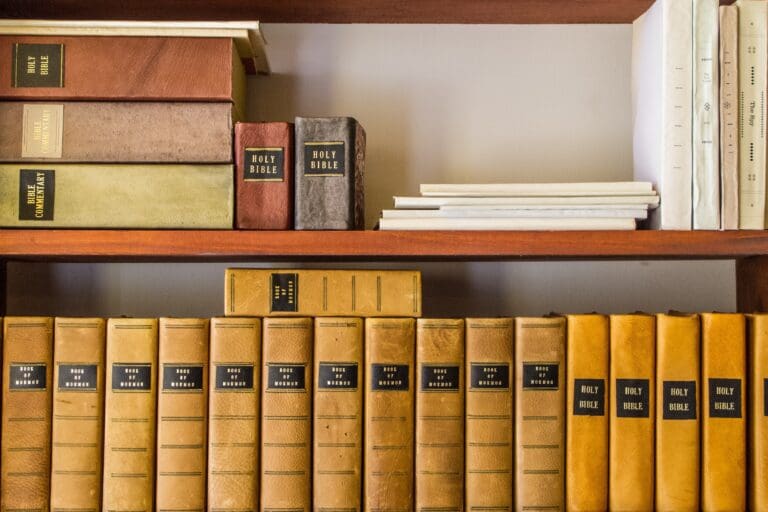
Spine: As seen above, the title BOOK OF MORMON appears on a black background with seven gilded double-bands, giving the book a formal look. The dimensions of the book are 7½ × 4¾ × 1¾ inches (19 × 12 × 4 cm).
First Page: Upon opening the cover, on the right-hand side, there is a blank page save for Joseph Smith’s signature at the bottom. (I believe this is an add-on for the replica edition, but I’m not sure.)

Title Page:
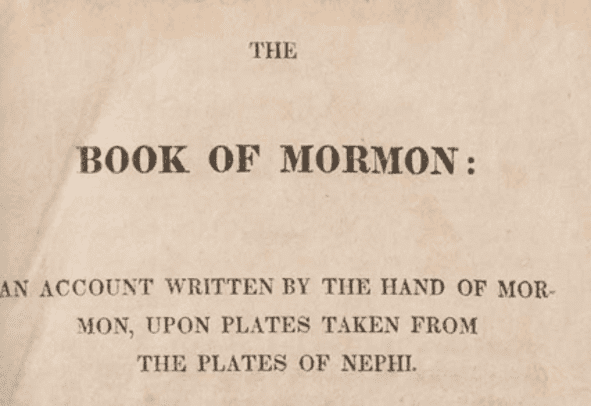
The title page is the first page of print. The top third is exactly like our current Book of Mormon except there is no colon after “MORMON” and the second “MOR-MON” is not hyphenated.
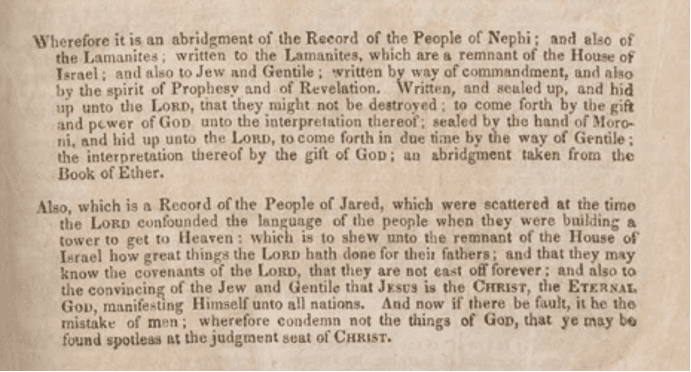
In the middle segment, there is a paragraphing mistake. John Gilbert, the employee of E. B. Grandin who punctuated the book, did not realize that the last line of the first paragraph, “an abridgment taken from the Book of Ether,” should be the first of the second paragraph because the Book of Ether is the record of the Jaredites. Also, if you compare today’s edition, you will see the punctuation has been modernized with dashes for ease of reading.

The third segment is completely different. The 1830 edition reads: “By Joseph Smith, Junior, author and proprietor,” while today’s edition reads: “Translated by Joseph Smith Jun.” In 1830, copyright laws required an author. Who was Joseph to list as the author or authors? Mormon and Moroni and the other ancient prophet/historians? It is clear that Joseph knew he was not the author. In his preface he states, “I would inform you that I translated… by the gift and power of God.” The testimonies of the Three and Eight Witnesses also attest to this fact. Joseph changed “Joseph Smith, Junior, Author and Proprietor” for the 1837 edition.
Book of Mormon Central clarifies: “At first glance, this might seem like Joseph made contradictory claims about his role in bringing forth the Book of Mormon. This conclusion, however, is not warranted for many reasons. It has long been recognized that designating Joseph Smith as the “author and proprietor” of the Book of Mormon in the first edition was done to conform to copyright law” (https://knowhy.bookofmormoncentral.org/knowhy/was-joseph-smith-the-author-of-the-book-of-mormon).
(As a sidenote, the statement that Joseph translated the record is less than accurate. He didn’t translate from one language to another. He did not learn Reformed Egyptian, the language of the plates. Rather, he used the Urim and Thummim, which is above and beyond any human-devised tool, to translate the Book of Mormon into English which Joseph read and dictated to a scribe. It would generate many good questions if “translated by” were changed to “read on the Urim and Thummim by Joseph Smith and dictated to a scribe.”)
Legal Copyright Page:

The legal explanation as to how copyright was obtained is on the back of the copyright page. This page is not included in our current Book of Mormon because that information is unnecessary for modern readers. The document begins “Northern District of New York, to wit: Be it remembered, that on the eleventh day of June, in the fifty-third year of the Independence of the United States of America, A. D. 1829, Joseph Smith Jun, of said District….” The second paragraph begins: “In Conformity to the act of the Congress of the United States, entitled, an act for the encouragement of learning, by securing the copies of Maps, Charts, and Books….” It is signed by R. R. Lansing, Clerk of the Northern District of New York.
Incidentally, the fact that it had been fifty-three years since the Declaration of Independence shows how very significant July 4, 1776 was to Americans at that time. The Book of Mormon was copyrighted in June 1829, just fifty-three years after the Declaration was signed! It is interesting to note that George Washington was president from 1789-1797, and Joseph’s parents were married in 1796. George Washington died on December 14, 1799 and Joseph Smith was born December 23, 1805. The establishment of the nation and the Church happened one right after the other. In comparison, fifty-three years ago, Richard Nixon was president of the United States, which may not seem all that long ago to many Meridian readers.
This also helps to explain why the Founding Fathers were upset that their temple work had not been done. In 1877, Wilford Woodruff said: “The spirits of the dead gathered around me, wanting to know why we did not redeem them. Said they, ‘You have had the use of the Endowment House for a number of years, and yet nothing has ever been done for us. We laid the foundation of the government you now enjoy, and we never apostatized from it, but we remained true to it and were faithful to God.’ These were the signers of the Declaration of Independence, and they had waited on me for two days and two nights” (Discourses of Wilford Woodruff, 161-66). They had been waiting 101 years.
Preface:
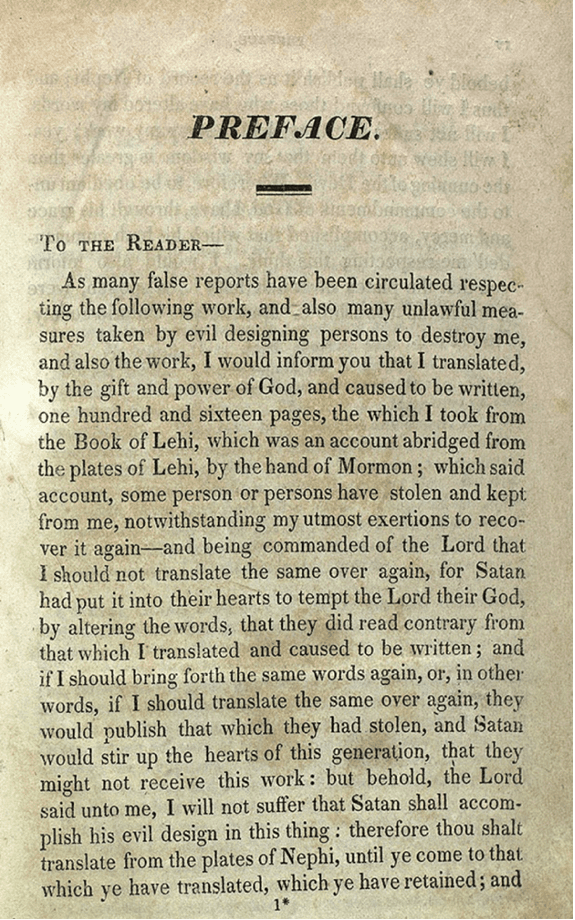
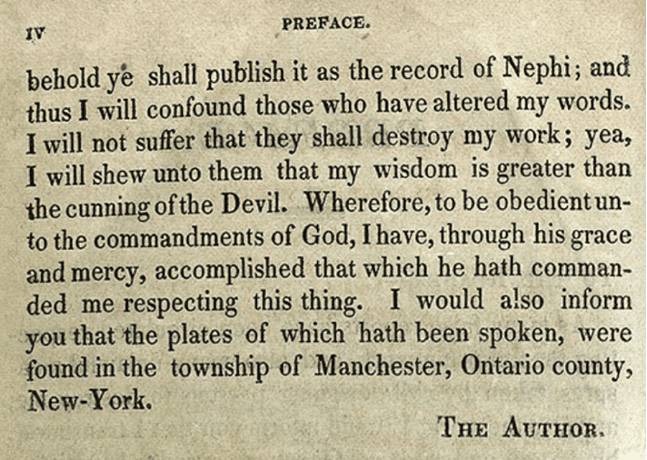
The Preface to the Book of Mormon is not in our current Book of Mormon. It seems Joseph wrote it to clarify certain facts for the people of his time, specifically about the loss of the 116 pages. He began: “TO THE READER—As many false reports have been circulated respecting the following work, and also many unlawful measures taken by evil designing persons to destroy me, and also the work….” He then explained the loss of the 116 pages: “Some person or persons have stolen and kept from me, notwithstanding my utmost exertions to recover it again.” Next, he said that God told him not to retranslate the 116 pages because Satan had put it into their hearts to alter the words. “And if I should bring forth the same words again, or, in other words, if I should translate the same over again, they would publish that which they had stolen.” Joseph then quoted the Lord, “I will not suffer that they shall destroy my work; yea, I will shew unto them that my wisdom is greater than the cunning of the Devil.” Joseph added one more fact: “I would also inform you that the plates of which hath been spoken, were found in the township of Manchester, Ontario county, New-York.”
In the 1830 edition, the Preface is the last of the introductory pages.
Testimony of Three and Eight Witnesses

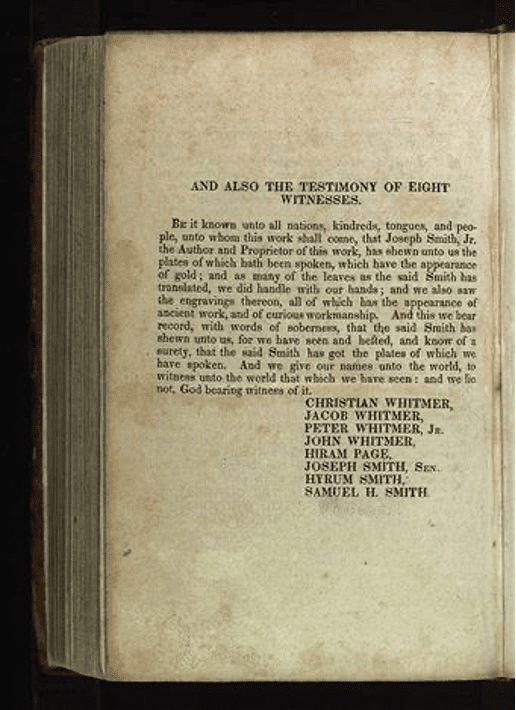
These essential testimonies are in the 1830 edition but not where you would expect to find them. They are at the very end, pages 589-90.
Book Summaries:
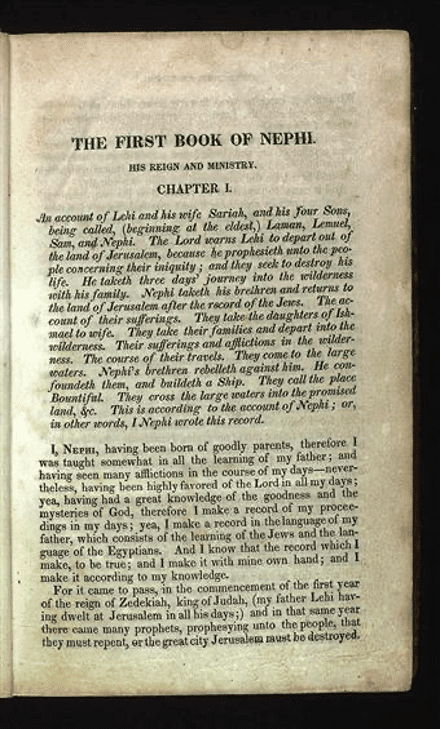
The first page of the Book of Mormon itself begins with “THE FIRST BOOK OF NEPHI, HIS REIGN AND HIS MINISTRY, CHAPTER 1.” The italicized text on the top half of the page was written by Nephi. Of the fifteen books in the Book of Mormon, seven have similar introductory summaries—1 Nephi, 2 Nephi, Jacob, Alma, Helaman, 3 Nephi, and 4 Nephi. There is no question as to who wrote the summary of 1 Nephi. The concluding words are “I Nephi wrote this record.” I assume the authors of the other books wrote the pertinent summaries. These book summaries were on the gold plates and should not be confused with the chapter headings, which have been written and revised since the early editions by apostles and by other scholars. (In today’s edition, the book summaries are in the same typeset as the text of the Book of Mormon and the chapter headings are in italics, indicating that they were not on the gold plates.)
The 2013 Edition
As mentioned, for this comparison I am using the paperback 2013 edition. It is black with gold lettering. Its dimensions are almost exactly those of the replica 1830 edition given above.
Cover: In 1982, the Book of Mormon received a subtitle. The cover reads: “THE BOOK OF MORMON, and in a smaller font size: “ANOTHER TESTAMENT OF JESUS CHRIST.”
Spine: In gold lettering reads: “THE BOOK OF MORMON ANOTHER TESTAMENT OF JESUS CHRIST.”
First Page: Blank. No Joseph Smith signature.
Title Page: The full title is at the top of the page. At the bottom of the page is: ‘Published by The Church of Jesus Christ of Latter-day Saint, Salt Lake City, Utah, USA.”
Reverse side of the title page reads: “First English edition published in Palmyra, New York, USA, in 1830. Please submit feedback or suggestions to [email protected]. or mail to Scriptures Coordination, 50 East North Temple Street Room 2455, Salt Lake City, Ut 84150-3220 USA 1981, 2013 by Intellectual Reserve, Inc. All rights reserved Printed in the United States of America 12/2017. English approval 3/15
Title Page: The same as the 1830 edition but without the third section as shown above.
Abbreviations page: Lists abbreviations for books in the Old Testament, New Testament, Book of Mormon, Doctrine and Covenants, Pearl of Great Price, and a few others.
Contents:
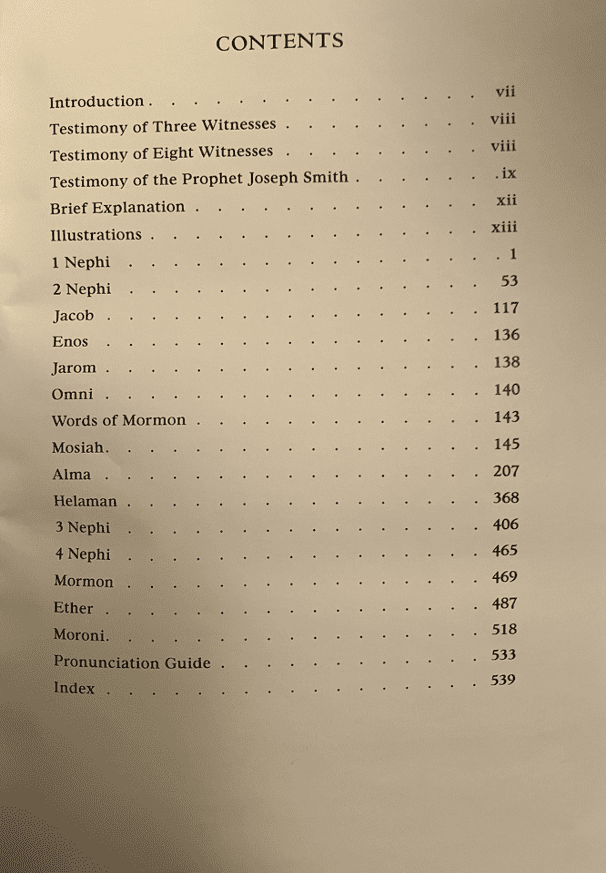
You can see in the Contents that a Pronunciation Guide and an Index have been added to enhance learning of words and people in the Book of Mormon. The Index is 233 pages long—convenient and helpful.
Introduction: The Introduction is nine paragraphs long. Here is a brief summary:
Paragraph 1 tells readers that the Book of Mormon is a volume of holy scripture comparable to the Bible, a record of God’s dealings with the ancient inhabitants of the Americas, and that it “contains the fulness of the everlasting gospel.”
Paragraph 2 explains that ancient prophets wrote the book, that there were two great civilizations—Jaredites and Nephites, that all were destroyed except for the Lamanites (a group that had separated from the Nephites), that the Lamanites are among the ancestors of the American Indians, and that Mormon, a prophet/historian abridged the record.
Paragraph 3 tells that Jesus Christ appeared in person to the Nephites, taught them His gospel, and organized His Church.
Paragraph 4 introduces Mormon’s son Moroni who completed the record and hid it in a hill. It tells that fourteen hundred years later, Moroni, a resurrected being, appeared to Joseph Smith, showed him where he had buried the record, and instructed him about his future responsibilities.
Paragraph 5 states that Joseph Smith translated the record by the gift and power of God.
Paragraph 6 quotes Joseph Smith as stating that the Book of Mormon was the most correct of any book and the keystone of our religion.
Paragraph 7 explains that eleven men saw the plates and where to read their testimonies (page viii).
Paragraph 8 is an invitation to read the Book of Mormon and ask God if it is true. Moroni explains how to do this on page 529, Moroni 10:3-5.
Paragraph 9 assures that those who gain a testimony can also know by the power of the Holy Ghost that Jesus is the Savior, Joseph Smith is His prophet, the Church of Jesus Christ of Latter-day Saints is God’s kingdom, and the Church has been established in preparation for the Second Coming.
Testimonies of Three and Eight Witnesses: The same as the 1830 edition, except it is found in these introductory pages.
Testimony of the Prophet Joseph Smith: An excerpt from Joseph Smith’s history. This segment is about the coming forth of the Book of Mormon (History of the Church, Vol. 1, Chapters 1-5; Joseph Smith—History in the Pearl of Great Price). The addition of Joseph’s testimony brings the number of witnesses in these introductory pages to twelve—three plus eight plus one.
A Brief Explanation about the Book of Mormon: Tells of the different plates from which Mormon and Moroni took the record.
Illustrations: Full-page paintings including: “The Lord Jesus Christ,” by Heinrich Hofmann; “The Prophet Joseph Smith” by Alvin Gittins; “Lehi discovers the Liahona” by Arnold Friberg with scripture citation; “Lehi and his people arrive in the promised land,” by Arnold Friberg with scripture citation; “Alma baptizes in the waters of Mormon” by Arnold Friberg with scripture citation; “Samuel the Lamanite prophesies,” by Arnold Friberg with scripture citation; “Jesus Christ visits the Americas,” John Scott with scripture citation; “Moroni buries the Nephite record,” by Tom Lovell with scripture citation.
Summary of changes to the 2013 edition:
Spine—omitted: double gold bands
Cover— added: “The Book of Mormon” and “Another Testament of Jesus Christ”
First Page—omitted: Joseph Smith signature
Title page—updated
Legal copyright page—omitted
Preface—omitted
Contents—added
Introduction—added
Testimonies of Three and Eight Witnesses—moved
Joseph Smith Testimony-–added
Brief Explanation—added
Illustrations—added
When you turn the page after the illustrations, the text of the Book of Mormon begins: “THE FIRST BOOK OF NEPHI” followed by “THE SECOND BOOK OF NEPHI” and on through thirteen more books to the end of the Book of Mormon on page 531. There are many more changes within the text itself, which will be the subject of an upcoming article. If you cannot wait, read “Evidence 8: Four Thousand Changes” in my new book on evidences for the Book of Mormon, titled Resurrecting The Book of Mormon: 65 Days of Miracles, available both in paperback and on Kindle from Amazon.




Wanless SouthwickJanuary 9, 2024
It is very likely that the introductory summary for the First Book of Nephi was written by Mormon not Nephi. Mormon used introductory summaries to briefly describe the content, source, and authorship of each major section of the abridgement he was making of his people’s historical records. When Mormon found the Small Plates of Nephi among his library records, he appended it to his abridgement and logically followed his practice of adding an introductory summary to it. In the first sentence of the Small Plates of Nephi, Nephi personally declared his authorship by writing "I Nephi,... make a record of my proceedings in my days" (1 Nephi 1:1). Mormon’s introductory summary testifies to that authorship by simply paraphrasing Nephi’s words: “This is according to the account of Nephi; or in other words, I, Nephi, wrote this record.” (1 Nephi Preface:Heading)