







Nearly all Christian tourists who visit Jerusalem make the center of their pilgrimage the Church of the Holy Sepulchre. Approximately 1.3 billion Catholics consider this the holiest of Christian sites. This 4th century church is built over what many consider Calvary’s Hill and the Tomb where Jesus’ body was laid. Now, they say it’s bad luck to walk under a ladder—let’s take that superstition to the extreme.

The Church of the Holy Sepulchre in Jerusalem, one of Christianity’s holiest sites, where millions visit Calvary’s Hill and Jesus’ tomb each year.
The Church of the Holy Sepulchre was first constructed under the encouragement and direction of Queen Helena, mother of Constantine, in the 4th Century. Though little of that original building remains, it is still an extremely historic and significant site. When Helena made her pilgrimage to the Holy Land, she was determined to find all the holy sites, including the birthplace of Jesus, the Hill Golgotha, and any of the sites connected to Mary, the mother of Jesus.
Helena is reputed by some at that time to be the one who discovered the “true cross of Jesus,” though it had been 300 years since the crucifixion. The Church of the Holy Sepulchre was built over the supposed holy sites of the crucifixion and the tomb where Jesus body was laid by Joseph of Arimathea. Helena died in the year 330 AD in Constantinople. Her legacy was to create traditional holy sites so that millions of people could come and walk in the footsteps of Jesus. She was also creating an economic model for these pilgrimage sites.
Over the centuries, care over the church itself has been shared and is shared to this day by no less than six denominations. The primary custodians are the Greek Orthodox, Armenian Apostolic, and Roman Catholic Church with minor or lesser duties shared by the Coptic, Ethiopian, and Syriac Orthodox churches. The whole edifice is parceled into sections, some being commonly shared while other belonging strictly to another sect.

The ancient door of the Church of the Holy Sepulchre, locked and unlocked daily by the Muslim Neseibeh family since the 7th century.
The key to the door of the church has been in the hands of the Muslim Neseibeh family since the seventh century. Every morning and night, a member of that family comes, as Muslims and neighbors, to lock and unlock the ancient doors of the church. Everyone gets along with the holders of the large keys to the door, but there is tension over much of the rest of the care and ownership of the church.
Once a man was sitting in his chair on his sect’s side of the line in contemplation and study. As the sun grew hot and he was not in the shade, he moved his chair just 20 cm (less than 8 inches) to get in some shade and his chair crossed a line and a major fight erupted with eleven people ending up in the hospital from the physical blows.
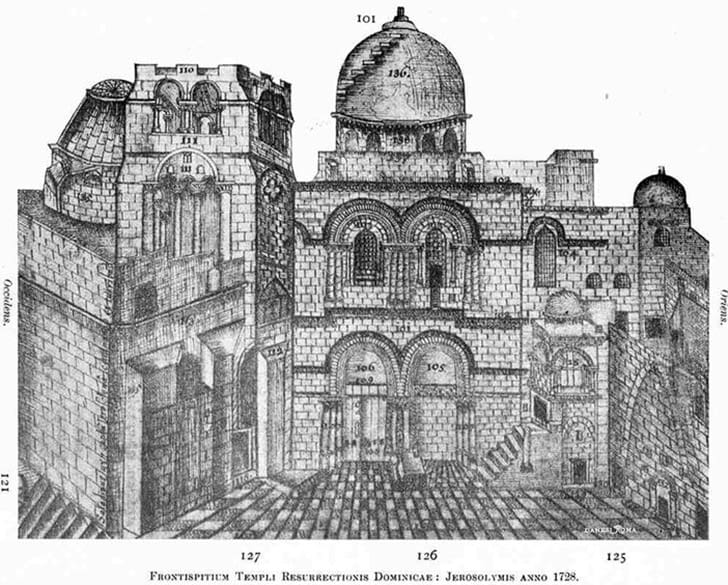
One controversy has become almost comical (unless you are a priest or a member of one of the resident caretaker sects of the church). Sometime before 1728, a ladder was placed against the right window on the second tier of the façade of the Church of the Holy Sepulchre, perhaps to clean the windows or work on a windowsill or do some other small repair. We don’t know. We know the approximate placement of the ladder because of the above engraving by Elzéar Horn, marked and dated 1728.

The ladder rests on a ledge and is attached to a window owned by the Armenian Apostolic Church. No one can come or has come to agreement as to who can even touch, let alone move this now immovable ladder.

So, the ladder has remained in place for nearly 300 years, and millions of people have walked under it, most of whom never even knew it was there.
And now you can picture this.