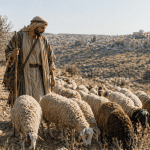








Cover image: Devastating Weight of 116 Pages, by Kwani Povi Winder.
Some people look for evidence that those sustained as prophets, seers, and revelators can make serious and long-lasting errors as they lead the Church. According to this view, even if they cannot exactly lead the Church “astray” (a concept that is defined in different ways by different people),[i] they can at least lead the Church very differently from how the Lord wants it led. They can make decisions that are seriously wrong, and their effects can be enduring.
Sometimes the episode with the 116 pages is raised as an example. Giving the pages to Martin Harris hasn’t resulted in leading the Church astray—it wasn’t the worst possible mistake—but, so it is thought, it is at least evidence that prophetic leaders can make mistakes with long-term negative consequences. In fact, that is actually something we should expect.
It is true, of course, that this episode demonstrates that prophets aren’t perfect. Joseph Smith wanted something that the Lord clearly did not want. Nevertheless, two features of this event provide an important perspective on its meaning for understanding prophets.
First, it is important to remember that Joseph Smith actually received the Lord’s permission to deliver the pages to Martin Harris. The Lord said “no” the first two times Joseph approached him, and the Prophet didn’t proceed. He asked a third time, though, and this time the Lord did give his permission.[ii]
The Lord was able to do so, however, because he had already arranged to more than compensate for this loss centuries in advance. Not only did he provide for firsthand accounts by Nephi and Jacob to replace what would be lost from Mormon’s abridgment,[iii] but Mormon, who added the material, treasured it, describing the contents as “choice unto me” (Words of Mormon 1:6). And the Lord himself said that “there are many things” in these writings that “throw greater views upon my gospel” (D&C 10:45). The substitution actually resulted in a net gain for the Church.
Second, this incident has served as an important cautionary tale ever since it occurred. In fact, it seems that this might have been the plan all along. After all, the Lord could have continued to tell Joseph “no”—in which case there would have been no loss of the 116 pages in the first place. But the Lord didn’t do this. Instead, he relented—just as he had prepared to do centuries earlier—and allowed Joseph to learn through actual experience—anguishing experience—about the importance of trusting in the Lord, even when he was convinced about the rightness of his own thinking. The episode taught the Prophet that he didn’t know as much as he thought he knew, and it was a lesson he learned through actual experience, not merely by being told.
And in addition to that, all of us—millions of us—have vicariously learned the same thing through this experience. As a profound lesson to us all, the Lord prepared for, and allowed, a mistaken desire to be fulfilled—while simultaneously working centuries in advance to turn that mistaken desire into an advantage.
More than anything, then, this episode seems to be an example of how the Lord is able to create “back-up” plans to ensure that his work is not frustrated in spite of the weaknesses of men. Indeed, he can actually find ways to teach us a lesson and make things better—and all at the same time! Far from an example of how leaders can cause serious harm to the Church, the episode with the 116 pages is a much better example of how they can’t.
*****
Duane Boyce and Kimberly White are father and daughter. Learn more about modern prophets in their new book, The Last Safe Place: Seven Principles for Standing with the Prophets in Troubled Times.

[i] For example, it is sometimes said that the Brethren aren’t allowed to “teach soul-destroying doctrines,” that they can’t actually “destroy” the Church, that they can’t change the very “path” of the kingdom, that they can’t lead the Church “entirely” astray––and so forth. These are different attempts to define the concept of “astray,” but all of them assume that the Brethren can make wrong decisions that fall just short of whatever they mean by this term.
[ii] An accessible account of this episode is found in Saints—The Standard of Truth: 1815–1846 (Salt Lake City, Utah: The Church of Jesus Christ of Latter-day Saints, 2018), 50–55.
[iii] As is well known, Mormon included these items in his plates, as prompted by the Lord (Words of Mormon 1:3–7), after Nephi had been prompted to make them in the first place (1 Nephi 9:2–6). Neither knew the reason. The Lord talks about the situation with Martin Harris and the substitution of Nephi’s record for Mormon’s abridgment in D&C 10, particularly verses 6–45.