






Now that I’ve had a chance to catch my breath, after attending this year’s March 26-27 BYU Computerized Genealogy Conference, I’m excited to tell about some new developments highlighted there.
In the opening session Steve Olsen, managing director of the Family and Church History Department, brought us up to date with his presentation about “LDS Church History Online.” His many responsibilities include the Church Museum of History and Art and the Church Historical Library and Archives.
Launched Overland
He explained that a soft launch of this site has operated for about a year, but now full-text information, the result of many years’ intensive collaboration, is available. This is the most complete listing of individuals and companies in which Mormon pioneer emigrants traveled west to Utah from 1847 through 1868. Some 40,000 pioneer names can be found on this site-about two-thirds of those who came to the Valley (some rosters have not been found for all companies). The site also identifies sources we can research to learn more about the experience of each company.
We can search for a specific person by going to lds.org, then clicking on “Church History,” a link on the left, in the navy-blue column. That takes us to the Mormon Pioneer Overland Travel icon. Click on that, and we can then insert our pioneer’s name, using the search form available, or browse the list of companies alphabetically or chronologically.
Not Just Names!
I first typed the surname “Tracy” into the search field and almost instantly got a list of all members of the family who crossed the plains. I was advised that my direct ancestors, Moses and Nancy (Alexander) Tracy crossed in the Benjamin Hawkins Company, in 1850. Also listed was their son, Helon Henry, also my ancestor, who was then only an infant, so crossed the plains in their arms. How exciting it was to find five source links to information about his mother Nancy, including some of her journal accounts! The site even told me she was thirty-four years old when she made the arduous trek, burying a son along the way.
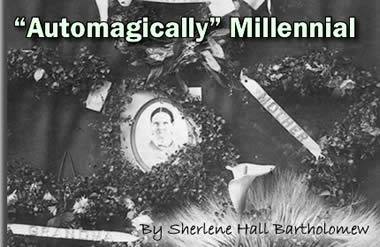
Seeing all this makes me want to share information I additionally have about my Tracys, including a recently discovered photo of the coffin wreathing at Nancy’s funeral. A cousin of mine, Julie Ann Johnson, contacted me, as referred by another cousin, about six years ago. She had become trustee to a box of her mother’s genealogy materials that few in the family even knew existed. Though of course reluctant to let such treasures out of her hands, she invited us to visit her and see what might interest us.
Dan and I made the long drive to her home and were not disappointed-what a treasure trove of information! Julie agreed to go with us to Walmart, so we could make prints of some photos and other documents. Through the miracle of modern technology, we soon had images that were as good, or maybe even better, than the originals-on good, photo copy paper, at very little expense and without fear that the originals might be lost in-transit or in the mail (this of course was before the two of us got photo-scan able).
Julie also had an identified photo of our joint ancestor, Thomas Burdett, Sr., who never left England, but watched much of his family emigrate-what a thrill to finally identify an unlabeled copy of the same print that had long been in my files. I am glad to say that I also had some materials Julie was delighted to have, including a pose of Nancy A. Tracy she had never seen.

Getting back to the Tracy information on the Overland Trail site, I noticed that some dates were missing for my Tracys that I can provide. As this site invites, “If you have information that could improve this database, you can also submit a request to add or correct information” (have documentation ready).
Lots to Share
I was sad to see that others of my pioneer ancestors were not yet on this site. Why is it that with only a one-third chance of not being included, two-thirds of my pioneer ancestry was not represented here? That response to odds seems to be par for the course; so far as my genealogy quest goes (I can now look on this as a chance to help build this amazing collection).
Brother Olsen also announced that the Church will be involved in an ongoing project to make more pioneer journals available, so I am motivated to submit my transcriptions of some early family journals that I have been arranging side-by-side with scans of the original handwriting. What’s in your attic that you can make available on this fantastic site?
There is much more that I can’t detail here-let’s keep an eye on emerging developments on this site, the product of dedicated historical research of many and the merging of incredibly huge databases.
Sensational Selection
Sessions geared to just about any computerized genealogy task were available at this conference. It was hard to choose from among forty seminars, with such titles as “Jump Start Your Family Tree Online,” by Barbara Rennick, “Using Personal Ancestral Files with Other Church Software,” by Steve Cannon, “Sourcing an Unsourced GEDCOM File, by Kory Meyerink, “Mapping your Ancestors Electronically,” by Geoff Rasmussen, and “Using PDAs in Your Research,” by Rhonda McClure.
I only wish each of us could partake of the full menu. Two sessions I attended were particularly meaningful for me:
Making Sense of the Census:
Karen Clifford, AG, FUGA, gave an extremely helpful presentation about “Comparing Online Census Records.” Her syllabus outline includes a chart that maps “Census Indices Linked to Images On-Line as of February 2004 (major collections).” Karen has graciously consented to let us share her valuable chart with Meridian readers. It can be accessed at https://www.graonline.com/pdf/English/onlinecensus.pdf. Sister Clifford, president of Genealogy Research Associates, Inc., also has research suggestions and census and other aids available that you can find at www.GRAonline.com. Since we do not yet have one database that includes all U.S. censuses, having access to this chart, as included in the conference syllabus, alone made attending this conference a must.
Clifford suggests some free internet census services that we can access:
FamilySearch.org – 1880 US Federal Census Records, 1881 British and Canadian Census Records.
USGenWeb.org – many transcribed census indexes are available including substitute census records.
Census-Online.com – essential guide to many individual census sites on line.
Cyndislist.com – a guide to census records online as well as other census resources.
Ancestry.com – is free for access at LDS Family History Centers.
ProQuest – is available through university or public library districts.
In her always engaging way, Sister Clifford provides important suggestions for use of on-line census indices. What impressed me was how important it is to understand where our information comes from originally. Because indices are secondary sources, she emphasizes how crucial it is that we check the link to the original document and search it, rather than rely on electronically generated reports. The reason for this is that secondary reports can be incomplete. Certain spelling variations may be somehow overlooked during indexing, or we could miss that spelling in our own search. What is in the original could be mistyped, misinterpreted, or otherwise garbled. What’s really scary, she reminds, is that it could be “edited or changed so easily without leaving a trace.” Still, while keeping these cautions in mind, what we can now learn in very little time, using online census records, is for me like a modern-day parting of the Cs.
Out of a Hat!
Alan E. Mann, AG, a perennial favorite at genealogy confabs, set sights spinning with his discussion of “What’s New in Family History on the Internet.” For example, he told about a new device that scans each page of a book, actually turning the pages itself, while converting the image into recognizable text. Every word in this book is then indexed, with a link to the scanned page entry. All of this is done automatically, without human intervention, other than putting the book into the scanner, taking it out when it’s finished, and using the results! Of course this device is, at this point, too expensive for home use, but it is being made available to libraries and archives all over the world. Can you fathom how this will aid Elijah’s cause?
Things are happening so fast, Mann predicts that five years from now researchers will say, “Microfilm? What’s that?” He and I remember days, getting dizzy and blind, churning census films page by page, peering into darkened chambers of a hat, so to speak, before census records were indexed and many made computer search capable, through miracles of modern technology. It all makes me wish I were age twenty and could start “The Search” all over.
I have Brother Mann’s authorization to link you to his on-line (and from time to time updated) syllabus for his presentation. There you can access some of the most exciting new links available:
A Million Wills!
So many of us who have English ancestry will find this site invaluable: Did you know that over one million wills are now on line at
https://www.pro.gov.uk/online/docsonline.htm
Civil Enterprise
Did you know that records of 40,000 Civil War Union soldiers will soon be on line, as linked to their census and pension records? (This is a joint project, conducted by BYU and the U. of Chicago-watch Mann’s syllabus site for this link.)
Latter-day Liahonas
Another amazing Internet capability facilitates research guidance. In this connection, many of us will think on the excellent help to be found on familysearch.org. Here, though, Mann talks about “the concept of getting research suggestions or assistance from artificial intelligence.”
Brother Mann demonstrated putting his database with 62,000 names through such a program. It responded with 12,000 suggestions that included provision of on-line links that could be helpful! On his syllabus site, he provides conference attendees and you readers with examples of programs or websites that will do this for you “automagically,” as he puts it. Mann demonstrated how such programs can analyze your research, recognize missed data, and then recommend searches we may have missed! Like I said, I was born too soon.
GenSmarts, a program that includes mostly U.S. materials, can be downloaded from www.Gensmarts.com. It will analyze your genealogy file, make research suggestions, and will make suggestions as “to do” items. It recognizes nine different genealogy software programs, as well as GEDCOM. As Brother Mann explains, it “also gives suggestions from over 100 online catalogs and record repositories. It even includes some 60,000 specific records from a variety of sources, including the Family History Library Catalog.
IGI Surprise
Mann’s presentation (and on-line syllabus) tells also about what Hugh Wallis has done to help researchers use the IGI more effectively, as found at
https://freepages.genealogy.rootsweb.com/~hughwallis/ .
His IGI Batch Number Search Tool, for the UK, USA, and Canada, identifies over 50,000 extraction batch numbers and lists them by state or county, then by town. Each batch number has a link that takes you to familysearch.org and fills out the batch number for us, so we can search IGI extractions by town.
Wallis also provides an IGI middle name index for England, Scotland, and the Isle of Mann. As Mann (no Mann is an island) explains, “IGI searches ignore middle names unless you check the exact spelling box, which often restricts your search so much that you miss what you are looking for. Hugh has indexed the entire IGI for England and Scotland by middle names, so you can use that information to find your people. Descendants of John Jacob Jingleheimer Smith rejoice!”
Paf Insight
There’s so much more, but you can go to Mann’s site yourself. I must mention just one more item he tells about–Paf Insight, a tool for LDS users. This software can be downloaded from
As Mann explains, “It runs on your computer, but it searches the Internet “automagically. Select an individual, family, or any portion of your PAF file, and turn the program loose. Not only will it find matches in the IGI, it will update your file with temple dates. It also has a number of non-web related functions.” He then goes on to give six important reasons why this program is so important.
You’ve read this far, so here’s your bonus:
FamilySearcher
As Brother Mann suggests, much of what we can use is freeware, so there’s nothing to lose giving it a try. Such a tool is FamilySearcher, which can be downloaded from
https://myweb.cableone.net/kevinowen3/familysearcher.htm.
Zap the Map!
Mann also recommends zapmeta as a search engine, useful to those of us seeking on-line historical records. As with most of what I learned at the conference, I haven’t had a chance to try it yet, but thought I’d better toss that hopper into your hat if you haven’t pulled it forth already (when I reach in the hat, I pull out BUGGGGS).
As you can tell, it’s getting late. Dan and I keep saying it’s high time we went on vacation, but neither of us can tear ourselves away from the magic on the Internet. I suppose we could compensate by installing sun lamps overhead, but we’d fry to a crisp before we even knew another month had come and gone.
Swells of Understanding
What a thrill it is to witness God’s hand speeding Elijah’s mission! It’s a blessing and honor to know that each of us is invited to participate in this magnificent quest to link all on this planet to each other, as part of our own eternal family. What comfort to know that we can be part of a prophesied movement, facilitated in ways we could not have dreamed even a few years back! Such hope comes from knowing that our Lord evokes, of our small carings, swells of understanding that, empowered by His grace, can turn hearts-especially our own, toward a more peaceful world.
Copyright 2004, Sherlene Hall Bartholomew
2004 Meridian Magazine. All Rights Reserved.