






The Mormon Tabernacle Choir: Meeting the Challenge
by Robb Cundick
The marathon I described last time has continued for three more weeks, yet even now there is more to come: a final concert to honor the Paralympics. How have we managed to meet the demands of this unprecedented schedule? I will address that question at the conclusion of this article.

Percussionist Evelyn Glennie, despite being profoundly deaf, is a first rate musician.
As for this weekend, Evelyn Glennie, the world’s only full time solo percussionist, will join us. Glennie is particularly remarkable because she has been profoundly deaf since she was 12 years old. She senses musical vibrations through her body – especially her feet. If you will be in the Salt Lake City area this weekend, come join us! The concert is Saturday evening, March 9, at 7:30 P.M. Ms. Glennie will also be featured on Music and the Spoken Word, followed by a mini-concert on Sunday the 10th. Though tickets are gone, standbys have gained entrance to all of our Olympic concerts. You should have no problem getting in.
But though one concert remains, I would like to conclude my series on our participation in the Olympics with this article. Much has happened since I last wrote and my 360 friends and I are badly in need of a break!
Richard Stoltzman
Our second Cultural Olympiad Concert featured clarinetist Richard Stoltzman. What a delightful performer! His unusual mannerisms were immediately endearing: he marched onto the stage in an animated manner with quick, short steps; rocking slightly from side to side; almost toy-like. His bows were brisk and unusually deep – his face seeming to nearly touch the ground. And on Sunday the Choir couldn’t help but feel particular affection for him as he dabbed the corners of his eyes while we sang “God Be With You” following the final performance.
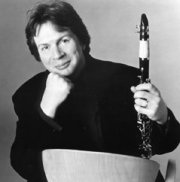
Clarinetist Richard Stoltzman brought music from heaven.
But something unusual happened on Saturday evening – an incident that, while marring the performance somewhat, also taught a profound lesson. Are you familiar with the Mozart A Major Clarinet Concerto? You may think not, but if you saw the movie, “Out of Africa,” starring Meryl Streep, then you have heard it. Remember when she and Robert Redford were sitting on the porch of a house in Africa, listening to a windup gramophone? The beautiful clarinet music being played was from the Mozart.
When Barlow Bradford and Mr. Stoltzman entered the stage, the hush of the audience gave way to a racket coming from outside the Tabernacle. Brother Bradford hesitated in hopes it would subside but we soon realized we were hearing the sound of a rock group performing at the Olympic Medals Plaza a couple of blocks away. It was obviously not going to go away and so there was nothing to do but proceed with the concert.
Most of the time it wasn’t too distracting. But when the slow movement started – the soft and peaceful portion used in “Out of Africa” – it was impossible to tune out. Yet here was the lesson – perhaps it could even be termed a revelation of sorts – for the contrast between the earthbound and that which is of heaven was so clear. The following analogy may seem exaggerated, but I am earnest about it and I believe anyone who was present that evening would agree: it was as though the pure sound of Richard’s clarinet was the precious fruit of the Tree of Life, while the background noise came from that Great and Spacious Building on the other side of the river. I suppose I shouldn’t disparage the fun they were having down there – they had no idea what they were missing. But would they have understood had they been with us? It takes patience and effort to develop an appreciation for such delicate and subtle beauty, and the world at large seems to want none of it. So it is also with the fruit of the Gospel of Jesus Christ.
This concert also provided a wonderful opportunity for the Choir to relax, sit back and enjoy the talents of the Orchestra as they performed a magnificent rendition of the Beethoven 7th Symphony.
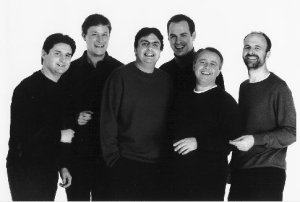
The incomparable king’singers.
The king’singers
The third Cultural Olympiad concert with the king’singers (the lower case is part of their trademark name) was perhaps the most anticipated of all. The king’singers are very popular in Utah (an illustration of the great appreciation for Choral music here). The group evolved in the late 1960’s, made up of choral scholars from Kings College of Cambridge, England. The Tabernacle Choir sang with them a few years ago and we have looked forward to their return ever since. Their tight harmonies are impeccably precise; they remind us that while the Tabernacle Choir has made great strides, there is still much we can do to improve.
We were also joined once again by the Salt Lake International Children’s Choir, which is directed by the Tabernacle Choir’s own Kathy Sorensen. Their pure-voiced singing and authentic native costumes from countries the world over were perfect for the Olympics.
The worldwide theme for this concert included quite a variety of music. The king’singers performed folk songs. The Orchestra at Temple Square even got to back them up for some jazz numbers. And the Tabernacle Choir tried an innovation you’re not likely to see at General Conference: swaying with a little shuffle step while we sang a Processional from Cameroon. Coupling the king’singers, the Children’s Choir, The Tabernacle Choir, and the Orchestra at Temple Square with Mack Wilberg’s powerful arrangements made for some of those precious moments when music seems to transcend heaven and earth. It was one of the pinnacles of our Olympic experience.
The Day-to-day
Throughout all of this, the schedule for “Light of the World” has not let up. We did four performances a week (in fact, President Hinckley even asked for three encores this past week so Olympic volunteers and others who had been unable to attend would have the opportunity). It was a very intense routine, yet it was a delight to be part of the exuberant cast and a pleasure to respond to President Hinckley’s request that we be present onstage at the end of the production as well as at the beginning.
A typical day went like this: leave work early to try and beat the Olympic traffic, head downtown, park, dress, rehearse for one of the Cultural Olympiad Concerts in the Tabernacle, walk to the Conference Center, put our music in the Little Theater, wait for our first entrance, march onstage, sing, march off and return to the Little Theater to rehearse, return backstage to await our second entrance, march on, sing, march off, return to the Tabernacle to rehearse a bit more, go home, sleep, work .repeat. It happened so many times that I began to feel a bit like Bill Murray in “Groundhog Day.” Add it all up and one could well wonder how the Choir managed to survive. Yet it did not seem like drudgery at all. Why? How have we met this challenge? Let me say a little bit about that as I wrap up my report on the Olympics.

Former Tabernacle Choir Director Jerold Ottley and wife JoAnn. The Ottleys now teach the Choir School for the Temple Square Chorale. JoAnn continues to serve as vocal coach for the Tabernacle Choir.
How We Have Survived
Not long ago I received an email from a person who is not a member of the Church. He had seen a television piece on the Choir and remarked, “I was particularly impressed with the dedication and commitment that the choir was able to require of its members. If we [speaking about a band to which he belongs] could get just a fraction of this kind of cooperation, we could certainly accomplish a great deal more.” How do you help someone unfamiliar with the Church understand that it is not a matter of what the Choir requires of its members but rather our desire to serve and give freely because of our love for the Lord and His Gospel?
The accolades for the Choir’s performances in the 2002 Salt Lake City Winter Games are arriving daily, but none have meant more than a letter from Jerold Ottley, our former director. Since his retirement, Brother Ottley and wife JoAnn have stepped behind the scenes. As instructors in the Choir School (which is held in conjunction with Choir members’ rotations through the Temple Square Chorale), they continue their immeasurable contribution to our growth and success. With Jerry’s permission, I would like to share some quotes from his letter:
“During my tenure with the Choir, I experienced many proud moments. But few have been as fulfilling as the opportunity to watch from the sidelines while you have pursued your Olympic challenges.”
“.I feel I’m witnessing the realization of President Hinckley’s prophetic vision in desired and unforeseen ways. Those of us with lesser vision are beginning to understand the potential the Prophet has encouraged us all to see.”
“Perhaps I know better than most what the rigorous schedule of events has meant to your lives, to your work, to your families, and to life’s other interests and obligations. Most of all I appreciate the potential effects on your personal welfare. It is thrilling to hear you, as individuals, bearing testimony of the Lord’s blessings in learning, comprehending and delivering a mammoth amount of music in a brutally compacted period of time. Recognition of this spiritual intervention is the fuel that has fired the success of the Choir throughout its history.”
Brother Ottley, in typical fashion, has hit the nail on the head. If there is a secret to the Mormon Tabernacle Choir’s success it is our testimony that this is God’s work and our sure knowledge that He will not let us down, but will be there to lift us when we are weary. This is how we are able to meet every challenge. I have seen it repeatedly during my years in the Choir, and this unique and intense period has been no different. The sacrifices we made were real; yet they seem almost insignificant as we ponder some of those made by the Saints in earlier times. Besides, the joy we have felt while shining the Gospel Light to the world is more than enough compensation.
Lastly, may the Lord bless and sustain the true heroes in all of this – our spouses, children and all who kept the home fires burning while we were away. We cannot thank them enough. (After reading this, my wife quipped that she is really sick of being “the wind beneath my wings!”)
As a postscript, I would like to add that since last summer, technical difficulties have prevented me from receiving feedback about my Meridian articles. That problem has been resolved, but unfortunately, emails sent in the past few months were lost when Meridian’s main server crashed a few weeks ago, so they cannot be passed along to me. So if you have had thoughts or feelings about any of my articles since (and including), “Helping to Heal Our Land,” please do not hesitate to send them again. I would love to hear from you.
2002 Meridian Magazine. All Rights Reserved.