







Good Food Reads
By Janet Peterson
Sometimes reading great writing about food is as satisfying as actually eating a delicious meal. Well – maybe reading about chocolate mousse cheesecake isn’t quite the same as eating it, but it’s definitely low-cal and low-carb. And it gives you food for thought.
Here a few samplings of good books about food for you to savor.
 What Einstein Told His Cook: Kitchen Science Explained by Robert L. Wolke (New York: W. W. Norton & Company, 2002).
Chemist and food science columnist for the The Washington Post, Robert Wolke wittily “explains the science behind both the foods themselves and the tools we use to prepare them.” Questions from real live readers of his columns provide the format for this book (i.e. “Why does my gravy turn out to be either lumpy or greasy?” “Will a potato with a green skin eventually ripen?” “In a health-food store I saw several kinds of raw sugar. How do they differ from refined sugar?”).
Just reading through the titles of the explanations puts a smile on your face: “Treacle, treacle, in the jar, how I wonder what you are,” “Fasta pasta,” “Good night, sweet rinse,” “Hominy grits does it take to educate a Yankee?” “Jekyll and Hyde in a bottle,” “A bad rap for the Tartars.”
But keep reading as you’ll learn a lot about food myths – potatoes remove salt from an oversalted soup; sea salt is saltier and better than regular salt; aluminum cookware causes Alzheimers. You’ll also understand why fish cooks faster than beef, what brining is and why it tenderizes, why deep-frying oil should be used only once.
What makes this book really delectable is Wolke’s writing. Like a box of Christmas chocolates, you keep reaching for one more and enjoying every bite of it. Taste these:
“We don’t produce nearly enough cane or beet sugar in the United States to satisfy our 275 million sweet teeth, so we have to import some. In fact, we import about sixty times more sugar than we export. But much of this imported sugar comes from countries that have never won awards for crop reliability, political stability, or love for Uncle Sam, so sugar importing has always been a bit of a gamble” (p. 25).
“Trans fatty acids are the latest villains to appear in the Frightening Fat Follies; they seem to raise the levels of LDL (“bad”) cholesterol in the blood just about as much as naturally saturated fatty acids do. Trans fatty acids don’t occur naturally in vegetable oils, but are formed when they are hydrogenated ” (p. 74).
“No, no, no. It’s not green because it’s unripe; potatoes are ready to eat at any stage of growth. And they’re not flaunting the green because they’re a traditionally Irish food. The green color is Mother Nature’s Mr. Yuk sticker, warning us of poison” (p. 117).
 Come to the Table: A Celebration of Family Life by Doris Christopher, (New York: Warner Books, 1999).
Founder and president of the Pampered Chef, Doris Christopher begins her charming book with:
“Some people preserve memories in quilts made from scraps of old baby clothes, others in snapshots they paste into scrapbooks. I store mine in oak at one end of my kitchen, perched on a pedestal and surrounded by chairs. The table: When I look at it, I see my life.
“I see my ninety-year-old grandmother in her farmhouse kitchen following a recipe that exists on no page, mixing unmeasured ingredients for the sugar cookies I’ll never quite manage to duplicate. I see my mother rushing to the sink in the kitchen of my girlhood, a hissing pressure cooker in her outstretched hands. I see velvety raspberries still warm from the sun on the table of our Michigan cottage.
“I see all this and more as I look at my table, my own private home movie coming to life in my mind’s eye” (pp. 1-2).
She describes in vivid detail her happy childhood experiences around the dinner table. As a mother and later business woman, she determined to make mealtime significant in spite of her family’s busy schedules and the fact that “the universe of [her] childhood no longer exists.” Doris draws upon the successes and traditions of other families as well. Chapter titles are simple: i.e., “Celebrations,” “Sundays,” “Teenagers and the Table,” “Holidays.”
Recognizing that “some families have lost sight of the table and its timeless ability to transform,” Doris makes a strong case for eating dinner together. In fact, she states, “I have made it my mission to help families come back to the table” (p. 6). She warmly invites readers to make dinner a high priority and to take “that first, wobbly step toward the fridge and that vaguely familiar appliance, the stove” (pp. 16-17).
No recipes are included in Come to the Table, but you’ll want to start cooking your favorites after reading it.
 The Book Lover’s Cookbook: Recipes Inspired by Celebrated Works of Literature and the Passages that Feature Them by Shaunda Kennedy Wenger and Janet Kay Jensen (New York: Ballantine Books, 2003).
The Book Lover’s Cookbook is a wonderful smorgasbord of short literary passages about food and recipes to accompany them. Since food is an essential element of life, it only follows that many writers portray their characters cooking, eating, and talking at the table. Food descriptions reveal much about people, their environment, and the relationships of various characters. Excerpts from classics to contemporary literary are featured.
Enjoy breakfast with Charlotte’s Web, Little Women, and Gone with the Wind, or break bread with Tom Sawyer, Little House on the Prairie or Walden. Delve into dessert with Jane Eyre, Anne of Green Gables, and The Lion, the Witch and the Wardrobe.
Authors Shaunda Wenger and Janet Jensen developed and titled most of the recipes themselves. Names of the recipes invite reading remembrances: Aunt Petunia’s Baked Custard Pudding, Miss Maudie’s Lane Cake, A Real Man’s Quiche, and Mammy’s Yams.
Several authors contributed comments and recipes. Included are Barbara Kingsolver’s First Frost Green-Tomato Pie (The Bean Trees), Kay Chorao’s Pig’s Chocolate Swirl Fudge Cake (Pig and Crow), and Jodi Picoult’s Amish Chicken and Dumplings (Plain Truth).
Jodi Picoult shared this insight: “When I wrote Plain Truth, I did research by living on an Amish dairy farm for a while. To pitch in, I spent a great deal of time doing what that family’s Amish women did-that is, creating the bountiful buffets of food that fill the table three times a day. Not only was I amazed by the sheer volume of food-I was struck by the way family dynamics were really brought into focus across a meal. It seemed to me that the dinner table would be the ultimate place for a power struggle between Ellie, my narrating big-city lawyer, and the Fishers-the Amish family of the girl she’d been asked to defend against a murder charge” (p. 39).
For the cook who loves to read or the reader who loves to cook, this book is a feast. Read here for a full review.
Saints Well-Seasoned: Musings on How Food Nourishes Body, Heart, and Soul, edited by Linda Hoffman Kimball (Salt Lake City: Deseret Book, 1998.)
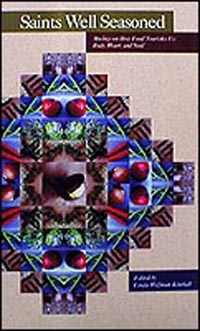 Linda Hoffman Kimball invited a number of Latter-day Saint writers to reminisce about food. In this heartwarming stew of three dozen personal essays, these writers convey some of their fondest food memories. Dean Hughes recalls the “Saturday bakery,” his Missouri ward’s venture to raise funds for a chapel; Ann Gardner Stone praises red Jell-o; Richard Cracroft reflects on Yorkshire pudding; Orson Scott Card describes Brazilian feijoada.
From the laugh aloud humor of Berniece Rabe’s “How to Kill A Turkey” to Edward Kimball’s sweet remembrances of his mother Camilla’s cinnamon rolls to Judy Dushku’s “My Sister’s Banquet” and the poignant story of her dying sister’s last meal – tuna fish casserole – you’ll be well fed (and recipes are included).
David Dollahite introduces “Ninja Pork Chops” with, “I began my Mormon culinary journey in paradise, enjoying the delectable cooking of Sister LoDonna Leininger. Ray and LoDonna Leininger took their food almost as seriously as their missionary responsibilities, and I was the happy beneficiary of both. Therefore, at the same time I was feasting on the Word, I also supped many times at the Leininger’s table before missionary lessons, home evenings, and firesides held at their home. The food was plentiful, filling, and sweet. In a word, celestial” (pp. 50-51).
Begin the new year with a few good food reads. Who knows what culinary delights they will lead to.
document.write(year); 2010 Meridian Magazine. All Rights Reserved.