








In a previous section we explored how the three temptations that Jesus withstood in the wilderness described in Matthew Chapter 4 are representative of three kinds of temptations to which all humans are susceptible, namely those of the body, mind and heart. Let’s pause to note that Luke’s account of these three temptations are not in the same order as Matthew’s, in that Luke reverses the order of the last two when compared to Matthew. The fact that the order varies has probably contributed to our failure to observe symmetries across the scriptures; also, sometimes messages can be either emphasized or obscured by poetic forms, such as those that rely on repetitions or contrasts involving synonyms.
In other words, if we look too closely for direct parallels, it is easy to miss the proverbial forest for the trees. However, knowing that ideas are connected in some fashion can help us see past the form when necessary. For example, observing that “faith, hope and charity” are sometimes clustered can help us spot references to them that are spread over multiple passages, even though they may appear using synonyms (e.g. love). Similarly, recognizing that the three temptations to body, mind and heart are often clustered helps us see the pattern even when they are portrayed using different terms or in alternate orders.
The Beatitudes
Thus, like hunting for Chiasmus or other poetic forms or word patterns in scripture, hunting for the three-temptation-patterns and the consequences for failing the tests can be like hunting for easter eggs. However, we also begin to see that what we seek is not just identifying the poisonous temptations but with increasing importance our quest for the antidotes and the blessings that flow from overcoming these temptations, as well as the covenantal penalties or consequences from succumbing. The Gospel of Matthew appears to reflect these broader interplays more clearly than elsewhere, and it shows in his account of the Sermon on the Mount. The nine beatitudes (Matt. 5:3-11), for example, can be clustered into three sets of three. The middle cluster might illustrate the idea best of the blessings that flow from not falling prey to the three temptations:
6 Blessed are they which do hunger and thirst after righteousness: for they shall be filled.
7 Blessed are the merciful: for they shall obtain mercy.
8 Blessed are the pure in heart: for they shall see God.
Looking at this group in light of the three temptations cluster (body, mind and heart), the parallels are obvious. First, those whose physical appetites are bridled—such that they hunger and thirst after righteousness—are filled. Is not this a shadow of the response that Christ gave to Satan that man shall not live by bread alone but by every word that proceedeth from the mouth of God? Second, is not mercy the opposite of unrighteous dominion, or self-centered pride? Third, is not a pure heart the natural consequence of true worship of the Father and keeping an eye single to His glory, rather than pursuing false worship of empty idols?
The Lord’s Prayer
The Lord’s Prayer, coming straight on the heels of the Beatitudes, provides similar correlations. We are taught to pray for our daily bread. We are taught to forgive our debtors (e.g. show mercy). And we are taught to praise the Father and seek for His will to be done (worship only God). With these elements, is it any wonder that we are commanded to pray always (“in this manner”) lest we enter into temptation? In fact, such prayers bolster our ability not just to resist temptation in the generic sense, but specifically in each of the three categories in which temptation will come.
Bread or Stone?
These parallels are reinforced by Jesus’ commentary that follows his instructions on prayer. Jesus, having recently been tempted to turn stone into bread, and after having taught his disciples to pray for their daily bread, asks the rhetorical question: “Or what man is there of you, whom if his son ask bread, will give him a stone?” (Matt 7:9).
Isn’t it interesting that these are the exact same elements involved in the first temptation? Jesus, who is of the House of David, and born is David’s hometown of Bethlehem, which name means “House of Bread”, elsewhere declares “I am the bread of life: he that cometh to me shall never hunger;” (John 6:35; see also verse 48-51) and yet Jesus is also a stone, the one which the builders rejected that will become the head of the corner. (Matthew 21:24; Psalm 118:22-24). There are undoubtedly multiple layers of imagery involved here, but in the specific context of temptations and the Lord’s Prayer, we are reminded that if Heavenly Father gives us a stone, we should not reject it (“lest haply ye be found even to fight against God”, Acts 5:39) and seek to turn it to bread. Rather, even though we wanted bread in that moment, we continue to rely in faith on the Lord for our daily bread and He will (still) provide.
How easy it is when we are lacking in faith to grow impatient in our temporal or physical affairs to think that we must react to fear or follow the impulse of the moment to resolve or avoid some issue or discomfort! Instead of allowing the seed of faith to grow and produce a bounteous harvest, returning a hundred-fold, we eat the seed corn out of fear that we will not otherwise (metaphorically) survive to see the fruit. Or when the firstfruits come, we consume them rapidly instead of returning a portion to the Lord in gratitude and securing the continued blessings.
Archetypal Symbolism
The recurrence of the same imagery in the Sermon on the Mount that was already presented in the temptations in the wilderness helps us realize that we are dealing with archetypal symbolism that spans specific narratives. Some archetypes are often understood at an intuitive level, regardless of whether we comprehend them conceptually. With Jesus, we may safely presume that by the time he began his mortal ministry, he understood both the imagery and what it is behind the imagery intuitively, emotionally and intellectually—indeed, that his obedience and his understanding were perfectly served by his heart, soul, mind and strength (Mark 12:30), or its modern equivalent of heart, might, mind and strength (D&C 4:2; 59:5). We may thus safely presume that when Jesus uses archetypal imagery in his teaching, he is doing so intentionally and with understanding of the layered meanings implied.[1]
With that, we return to the second temptation, of the mind, and observe how the commentary following the Lord’s Prayer helps tie the pinnacle of the temple, showing mercy in the Beatitudes, and the forgiveness of debts together. In Matthew’s narrative, right after the “Amen” of the Lord’s Prayer comes the reminder that “if ye forgive men their trespasses, your heavenly Father will also forgive you.” (Matt. 6:14). Despite the occasional crimes of passion (when chemically-induced “fight or flight” instincts may prevail), the idea of forgiveness of debts principally reflects an exercise of the mind, which forms expectations and desires outcomes above and beyond the immediate satisfaction of the body’s impulses.
Moreover, even though emotions of the heart may inspire a desire, it is the mind that ultimately shapes those emotions into a debt-structure involving ideas such as fairness or justice.[2] Human beings, as children of God formed in His image, are unique in all of creation in possessing a comprehension capable of pausing between stimulus and response and considering a possible outcome not dictated by the stimulus. Alternatively, humans are uniquely capable of advanced engineering such that a desired outcome can be achieved through mechanical means as long as no human failure or interference occurs. Put another way, only a human can anticipate that the trajectory of the Ark of the Covenant’s tipping will result in its toppling absent the application of an opposite or steadying force.
Most animals can cease fighting each other when facing a greater and/or more imminent threat. Cessation of conflict is not the same as forgiveness, nor is it forgiveness to say that the “enemy of my enemy is my friend”. Similarly, to forgive a debt that is not realistically collectible does not require much mercy. Yet modern media would suggest that these look noble and courageous compared to serving out ice-cold revenge. Expediency is not mercy. Expectations tempered by what is “realistic” may soften the resolve of a debt collector but connecting forgiveness to one’s own desire to be forgiven takes us to a different place altogether. These are dots that can only be connected in the mind, and both the Lord’s prayer and other teachings in the Sermon on the Mount help us get there and fortify disciples against such temptations.
Subordination of one’s own desired outcome requires faith, but more particularly that which faith engenders: hope. It is hope that allows one to withhold serving out justice, knowing that vengeance is the Lord’s and He will repay. We do not need to dig a pit for a neighbor who deserves it. We can walk away and trust that things will work out in the end, because God is both merciful and just.
Third Temptation – a test of love
The third temptation, by Matthew’s order, is ultimately “the big one”. It is the temptation to break the greatest of all commandments, to love and serve only God, and to do so with all of one’s body, mind and heart. The promise that the pure in heart may see God as noted in the Beatitudes, or that one can somehow “be…perfect” (Matt. 5:48) seem beyond mortal comprehension. Actually, they don’t just “seem” that way; they literally are beyond mortal comprehension, and yet fragments and beginnings of understanding may be revealed and nurtured as seeds of faith in a miraculous way. We can learn of the existence of God, by revelation from Him come to understand His attributes, and then walk the covenantal path paved with and by grace until we have knowledge of His perfections and our redemption to qualify for an inheritance—as joint heirs with Christ—of all that the Father has, a legacy destined to last through all eternity.
In contrast, the devil, whose kingdom is bound by time, not only offers rewards for this life only, but those very rewards are incomplete, superficial and by their natures produce no benefit beyond a few moments—even though they may seem like the whole world at the moment of temptations. When the devil offers Jesus “all the kingdoms of the world, and the glory of them” (Matt 4:8-9), the devil is lying, on multiple levels: Satan cannot guarantee anything contrary to God’s will; Satan cannot offer “all the kingdoms” because they do not and cannot all exist at once in a manner that one person can hold them; and the “glory” of the world’s kingdoms is superficial and non-enduring, so the possessor of anything Satan provides ends up with only a facade,[3] a “lemon” or a proverbial “money-pit.” Satan’s plan never will work because it cannot work, except temporarily in appearance and on relatively small and very limited scales (compared to what the Father offers). Satan’s treasures are only those of the earth (Luke 4:6). But all of that said, the promises and power of Satan are not trivial. To say that his plan only works on a temporary or limited basis only makes sense in contrast with the alternatives that flow from inheriting “all that the Father hath”. To those who do not see with the eye of faith, being Caesar (even just for a season) can seem like everything a person could ever want. That is why it is a temptation.
But the recognition of the flaws in Satan’s trap is mental, and although Jesus’ ability to see through these deceptions reflected his greater intelligence, in the end the ability to resist the temptation ultimately was because of his greater goodness, his pure heart. His love of his Father was strong enough to overcome all inclinations to worship lesser ideas, beings, or things. The pure love of Christ is sufficient to overcome all temporal or mental desires. The pure love of Christ is the love that Jesus has, and it is ultimately the kind of love that we can develop for him, and by extension, for our Father in Heaven and for all of His children and creations.
The Lord’s Prayer bolsters our ability to remember this, by highlighting that our faith should focus on the coming of His kingdom, and letting Him prevail—that His will may be done—but also we acknowledge that His is the kingdom and the power and glory.[4] These elements of the Lord’s Prayer help us fulfill the greatest commandment of loving and serving only God and thus turning away from false gods and false worship.
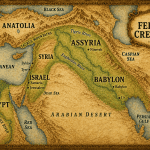
In addition to the worship elements present in both the 3rd temptation and the Lord’s Prayer, it is worth mentioning the specific imagery of the “kingdom” being also present. We are safe in presuming that this is not an accident, but we should also remember that the kingdoms referenced are not the same. As noted, Satan cannot really deliver “all the kingdoms.” Reminiscent of Nebuchanezer’s dream, the kingdom’s of the world may appear glorious for a day but in the end they are standing on feet of clay. Babel, Assyria, Babylon, Greece, Rome—all their towers and empires will fall, along with their modern equivalents; only the Kingdom of God that is yet to come has staying power, and individually we can in many ways live in that Kingdom already by our personal worship.
Our progressive journey
The fact that the Lord’s Prayer aligns so symmetrically with the three temptations narrative, and that the Sermon on the Mount follows so closely on the heels of Jesus’ experiences in the wilderness—and before that of his baptism—helps us identify the progressive nature of the journey we all take. We will discuss this journey in greater detail in later installments, but here we pause to note that because Jesus was baptized in the Jordan River near the place where it empties into the salt-saturated Dead Sea (which is—other than the ocean floors—the lowest point on earth, being nearly 1400 feet below sea level), it means that Jesus was baptized in what is symbolically at least the lowest body of freshwater on earth.
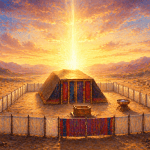
Standing in that place, just prior to baptism, Jesus represents the Second Adam, the descendant of Adam who would overcome the consequences of Adam’s expulsion from the Garden of Eden into the Lone and Dreary World. That lone and dreary world is also represented as being in the state of bondage, whether to Egypt, or Babylon, or sin and death. Israel is freed from Egypt by passing through a symbolic immersion in the Red Sea and brought into the Wilderness where they are (re)taught how to worship in the manner that will qualify them for entering into the promised land. The promised land itself is also symbolized as standing in holy places such as holy mountains or temples, or in the case of the tabernacle of Moses, the place within that portable temple called the Holy Place or rather its innermost chamber behind the veil, the Holy of Holies.
Thus, following his miraculous birth, Jesus launches his ministry by modeling the journey required of all: we leave the wicked world through a covenant of rebirth, prove ourselves in the wilderness of affliction, and are cleansed through the infinite and eternal atonement of Christ to be able to enter into the rest of the Lord, the promised land, being the symbol of His Kingdom. So the Savior travels from the lowest place on earth, through baptism into the wilderness, and overcoming temptation, leads us to the mountain, where his sermon helps re-articulate how we must all travel that very same journey.[5]
Cryptic Triptychs
This threefold imagery embodying the journey of mortality is pervasive in the scriptures, but sometimes the symbolism is not easily seen because of variations of word order, translation issues, and undoubtedly even intentional obfuscation by the adversary. Because the symbolism is not always obvious without scratching down a couple of layers, I have come to call the clustering of such symbols “Cryptic Triptychs”,[6] mostly just because I like the way it sounds.
But as another example of a cryptic triptych just encountered in Matthew, we have the three gifts presented by the wise men to baby Jesus. A simple Google search will show many observations on the symbolism of the gifts, such as showing that they reflect Jesus’ three roles as 1) the mortal son of Mary (the Myrrh used for anointing the dead and in embalming); 2) the priestly role (Frankincense is burned by the priests in the temple); and 3) the kingly role (gold is the tribute due to kings). These gifts also echo the gifts presented by the Queen of Sheba to David’s first heir, King Solomon.
In addition, we can view these tributes in light of other narratives: the progressive three temptations; the Egypt/Wilderness/Promised Land; or the Sermon on the Mount/Lord’s Prayer, each of which include a body, mind and heart element. Allowing the symbolic death of the natural man (Myrrh), offering prayers of the mind—as well as the importance of serving in priestly role without exercising unrighteous dominion—and consecrating wealth to God instead of our own pursuits (our hearts being where our treasure is), suggests that we shouldn’t only be like the little drummer boy and play for baby Jesus instead of giving gifts; we can and must give the same categories of gifts as the wise men. As we learn through the savior to resist the 3 kinds of temptations, we become qualified to present gifts (sacrifices) of the body, mind and heart. Symbolically, the wisemen are us and we are them. And as the grace of God allows us to become joint-heirs with Christ, we can literally follow Jesus into each of his 3 roles, passing through mortality to become Priests and Priestess/Kings and Queens (Rev. 5:10).
In Sum
To recap, beginning with the premise uttered by David O. McKay that the three temptations Jesus suffered in the wilderness represent three categories of temptations essentially encapsulating all the temptations that God’s children will face in mortality, we were able to subsequently explore the scriptures in Deuteronomy that Jesus uses to resist those temptations. In doing so, we came to a deeper understanding of how David O. McKay’s suggestion that the second temptation of Jesus to throw himself from the pinnacle of the temple was a temptation of the mind that echoed Israel’s and Moses’ temptation in how Moses brought forth water from the rock described in Exodus and Numbers, thus completing the picture that the three temptations cover those of the body, mind and heart.
We then move to the Sermon on the Mount and see how the Beatitudes contain echoes of these same images, and we see in particular that the Lord’s Prayer actually fortifies disciples to specifically resist those same three temptations. And we begin to see hints that this paradigm is reflected in the larger imagery of life’s journey from bondage to wilderness to the promised land.
Coming Soon….
In our next installment, we discover a relatively obscure passage in a document from the Dead Sea Scrolls that begins to tie all of these images to specific penalties or consequences encountered by Israel in the Old Testament (articulated by both Isaiah and Jeremiah) when Israel fell into these same temptation snares. The next wave of cryptic triptychs will reveal new symmetries and understanding what happened to ancient Israel and why. It will also help us see a little better what Jesus was trying to teach the people of his day and may even help us better comprehend what’s happening in our generation and our individual lives.
Notes:
[1] I have speculatively wondered, for example, whether Jesus’ quotation of Psalm 22:1 on the cross during the final moments of his crucifixion (Matt. 27:46 — “My God, my God, why hast thou forsaken me?”) was not really a question at all, but a recognition and declaration that he had arrived finally at the point articulated by the psalmist when all would appear lost, as in: this is the feeling at the place that gives meaning to those words.
[2] Paradigm-shifting understanding of how central fairness is to the human psyche that has emerged from modern research in neuroscience will be explored in later installments.
[3] Reminiscent of the story of the Potemkin Village, in which Catherine the Great, Empress of Russia, was said to have been deceived about the levels of prosperity as she toured along the Dnipro River. Her former lover, Potemkin, had erected facades of phony settlements on the riverbanks, and after the Empress passed them, they were quickly disassembled and then re-assembled farther along her route.
[4] Ascribing to the Father all of the kingdom, power and glory forever is omitted in many modern translations of the Lord’s Prayer in the Gospel of Matthew. It remains in the canonized scriptures of the Church of Jesus Christ of Latter-day Saints not just in Matthew but in 3 Nephi 13:13, where Jesus re-taught these principles, reinforcing the idea that its inclusion in the King James Version was not in error. This is reinforced by the symmetries between the Lord’s Prayer and the 3 Temptations described here. The questionable assumptions driving the temptation to exclude the phrase from modern translations are also revealing, but beyond the scope of this analysis.
[5] Strong elements of the covenantal journey in the Sermon on the Mount that reflect temple imagery are discussed elsewhere in detail by John W. Welch, The Sermon on the Mount in the Light of the Temple (2016).
[6] Things that are cryptic are secret or have hidden meanings and triptych refers to a work of art, such as an altarpiece in a medieval church, that consists of three painted or carved panels that are hinged together. For me, cryptic triptychs are clusters of three images or symbols or ideas that are not only “hinged” together in some form but are also symbolically connected to a separate cluster of three placed elsewhere.