








What happened to the body of Christ after he was killed?
This is a question that stirred me this week as I read the views of an Evangelical minister on the beliefs of the Latter-day Saints. The book is 40 Questions About Mormonism (Grand Rapids, MI: Kregel Academic, 2026) by Dr. Kyle Beshears, based on his study and many dialogues with Latter-day Saints over the years. It’s a useful book, mainly for understanding why Evangelicals have such intense differences with Latter-day Saints. It was written primarily to help Christians (a term that does not include Latter-day Saints in the author’s lexicon) to be able to better engage us and help bring us to the real Jesus, not “another Jesus” that we mistakenly worship.
Despite the critical slant he takes, he is frequently factual and reasonable in his characterizations, though often neglecting evidences and counterarguments in our favor as well as avoiding numerous topics that highlight the goodness of the Church. To me, those gaps mean that I don’t think non-Latter-day Saint readers are going to better understand who we are and why the restored Gospel of Jesus Christ is so meaningful to us, brings such joy, and is even intellectually satisfying. But 40 Questions is still well written, engaging, and I think done in good faith, in spite of my disagreements on many issues. I even dare say I congratulate him for this work and for his interest in the Church.
One of the surprises for me was just how intensely unacceptable Latter-day Saint “metaphysics” are to this Evangelical, especially the idea that spirit is a form of matter (Doctrine and Covenants 131:7–8) and that God and Christ have tangible, physical bodies (Doctrine and Covenants 130:22). Part of the objectionable metaphysics is the notion that Christ is literally the firstborn spirit Son of God (e.g., Doctrine and Covenants 93:21; Colossians 1:15; and the 1916 First Presidency statement, “The Father and the Son“) which to Beshears defies the wisdom of the creeds that require Christ to be “begotten, not made” and “consubstantial” with the Father. I’ll discuss that another time. For now, I’d like to explore the concept of the Resurrection, beginning with the question of what happened to the body of Christ? God, in Beshears’s view, must be immaterial and unlimited by the confines of a physical body that can only be in one place. This seems to require that Christ also not have a physical body. But many questions arise from such a doctrine.
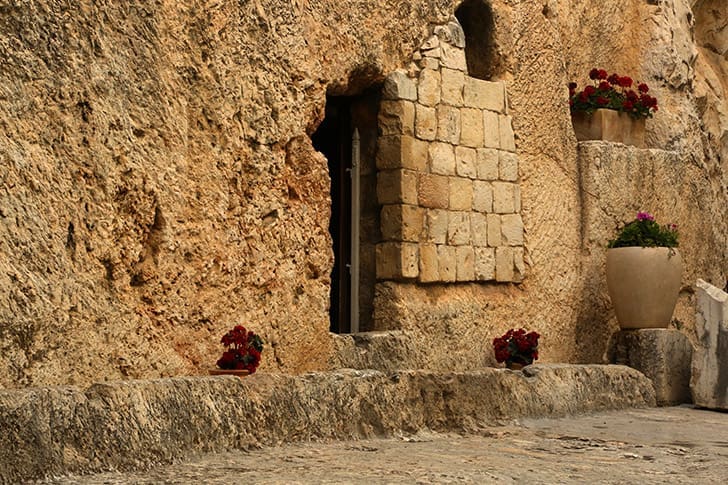
When Mary and others came to his tomb after three days, it was empty. Mary then saw Christ and apparently threw her arms around the Resurrected Lord, for He asked her to “hold me not” (more true to the Greek than the KJV’s “touch me not”) since He had not yet ascended to His Father in heaven. So apparently His body was missing because He had taken it up again. Mary was not hugging or touching an immaterial being, but the tangible Son of God.
Even in the resurrected state, having conquered all, it is clear that relative to Jesus, the Father was physically separate and remote. If He were literally One Being with the Father, there would be no need to ascend to return to Himself. No need to pray to the Father when He is alone in the Garden of Gethsemane, and no need to fast 40 days to draw closer to the Father. But now He needed to leave Mary’s arms and ascend back to His Father. With His body, of course, a body in the image of the Father, a body such that to see Christ is to see the Father, not because they are the same Being, but because the Son is in the physical image of the Father. Paul adds another perspective in Hebrews 1:3 when he declares that the Resurrected Christ is “the express image of his person,” where the Greek word translated as “express image,” χαρακτήρ (charaktēr), conveys “an exact representation of his (=God’s) nature” or person, where “nature” or “person” is ὑπόστασις (hypostasis), the underlying, fundamental or substantial nature of someone, essence, actual being, reality. (See William F. Arndt and F. Wilbur Gingrich, A Greek-English lexicon of the New Testament: and other early Christian literature.)
Shortly after Mary’s encounter with the Resurrected Lord, Christ walks with two disciples on the road to Emmaus and ends up dining with them, holding bread in His hands, breaking it, and then eating it. He showed them in multiple ways that He has a physical body — one that can walk, see, talk, hear, hold, tear, chew, and swallow. He would teach this same lesson in John 20 as He came to some disciples on the shore of Galilee and asked if they had any fish. He took that fish and dined with them, undoubtedly using His tangible hands to put it in His tangible mouth, and then surely chewed it and swallowed it. His actions again taught them a vital truth: I am the Resurrected Lord. This body is real and physical.
When He appeared to his puzzled disciples in Luke 24, they were afraid and thought He was a ghost (or spirit). The Master left no doubt about the materiality of the Resurrection and His physical body:
And he said unto them, Why are ye troubled? and why do thoughts arise in your hearts?
Behold my hands and my feet, that it is I myself: handle me, and see; for a spirit hath not flesh and bones, as ye see me have. (Luke 24:38–39)
Was Christ merely deceiving them when He spoke about having flesh and bones now, unlike a spirit and certainly unlike an immaterial being? Surely not! And then He asked for food and ate broiled fish and honeycomb before them (vv. 40–43). Three times He ate in front of others. This was not deception.
That He was certainly alive was confirmed during the 40-day ministry after the Resurrection in Acts 1:3–11, with “many infallible proofs.” Paul also mentions that He was seen by over 500 brethren at the same time (1 Corinthians 15:6) — of course, in His body. He was later seen by Stephen as he was being martyred, who saw Christ standing next to the Father (Acts 7:55–56) — two Beings, glorified, but in whose image we are created. When Christ returns, we will see Him again and know that it is Him, the living Lord, with His physical, tangible body.
When our day of resurrection comes, if we have accepted Christ, we, too will be resurrected with a glorious body like His. Will that resurrected body limit us? Does it limit Christ? Does it make Him less divine? Paul did not seem to think so:
For our conversation is in heaven; from whence also we look for the Saviour, the Lord Jesus Christ:
Who shall change our vile body, that it may be fashioned like unto his glorious body, according to the working whereby he is able even to subdue all things unto himself. (Philippians 3:20–21)
Paul says that it is through Christ’s glorious body that He is able to subdue all things. The body is a divine tool that gives Him great power. The fusion of spirit and matter in the resurrected body may be some great key to control over all forms of matter and energy, but we have no idea how this works.
Modern Science on the Nature of Matter and Modern Technology on the Limitations of a Body
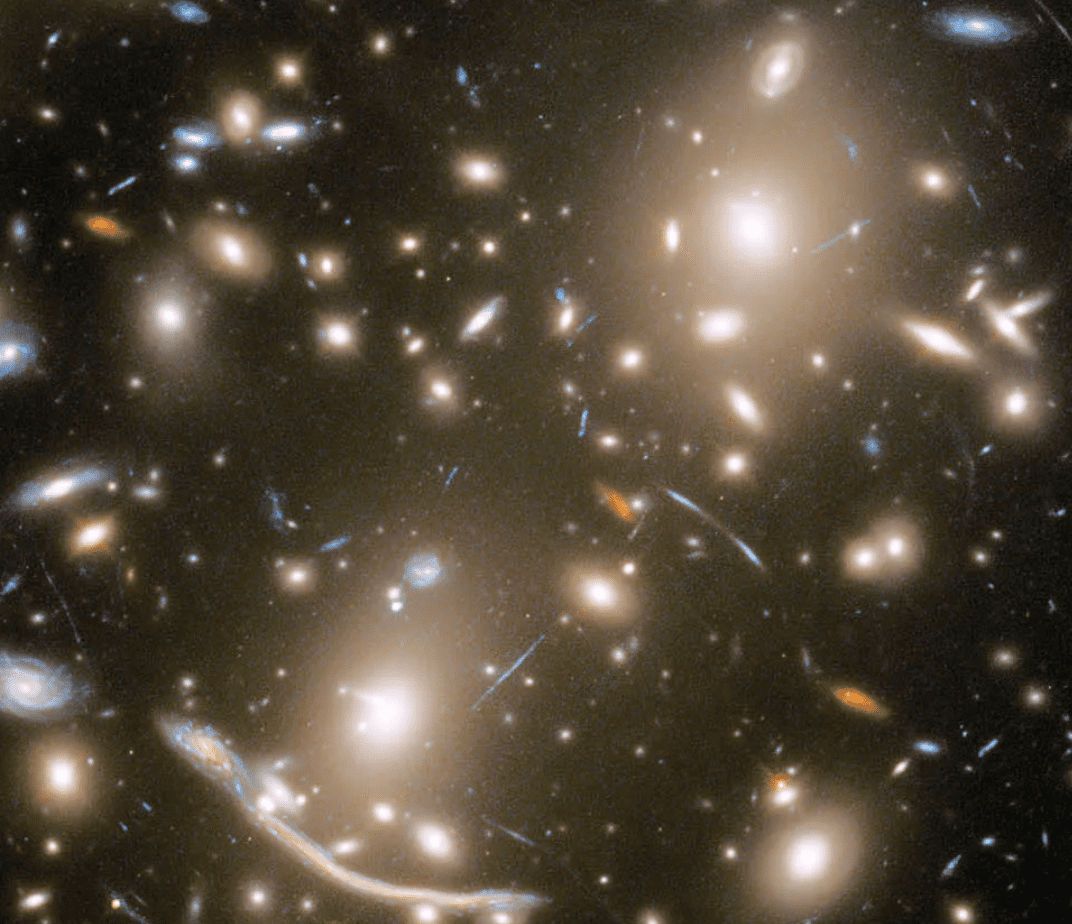
A scene of a part of the cosmos from the Hubble telescope that provides evidence of dark matter. The dark matter greatly increases the mass of a region, thus bending light from more distant galaxies and causing “gravitational lensing” (visible as arcs of light). Source: NASA.
The philosophies of men teach that a body is limiting because it is in only one place (it is also allegedly inert, not eternal, subject to change, and generally unworthy of God). This view reflects a state of knowledge somewhere in the range of the stone age to the medieval era, where you could only see and know of things in your immediate vicinity. Such old paradigms have been challenged by the minor advances in human science since then. From the world of physics, today we know that matter and energy can be equivalent or converted from one to another (Einstein’s e=mc2), that energy in all its forms is not immaterial, that matter can have wave properties as well as particle properties, that matter includes many strange types of particles such as neutrinos that only weakly or rarely interact with solid matter and bizarre forms that we only learned of recently. Recent discoveries now point to mysterious forms of matter and energy such as “dark matter” (an invisible form of matter with gravitational source that affects the motion and behavior of many galaxies) and “dark energy” (a strange force that overcomes the attractive force of gravity as it pushes galaxies away from one another). These two mysteries together comprise about 95% of the matter-energy of the cosmos. See, for example, “Dark Matter (1)” and “Dark Matter (2)” at NASA.gov; Saul Perlmutter, “Supernovae, Dark Energy, and the Accelerating Universe” at Physics Today (2003); and, for the technically minded, Gianfranco Bertone and Dan Hooper, “A History of Dark Matter” at Arxiv.org (2016). Matter and energy are vastly more complex and interesting than we ever imagined.
The late Dr. Steven H. Webb, originally an Evangelical who became Roman Catholic and eventually had much good to say about the Latter-day Saints and our doctrines, wrote Mormon Christianity: What Other Christians Can Learn From the Latter-day Saints (Oxford: Oxford Univ. Press, 2013). Webb deeply understood the beauty and significance of the metaphysics found in modern scripture and other Restoration teachings and says much that could help clarify some of the issues raised by Beshears. I appreciate, for example, how he considers the significance of advances in understanding the nature of matter:
More importantly, scientists have demonstrated that the nature of the material world is much more perplexing than anyone could have imagined prior to the twentieth century. Scientists keep discovering new forms of matter with strange names like quark-gluon plasmas and Bose-Einstein condensates, and nobody knows what dark matter is, even though it constitutes more than 80 percent of the mass of the universe. Physicists have poked so many holes in the atom that there seems to be little left of our common-sense preconceptions of what matter is. The world all around us is not as solid as it once appeared to be.
Scientists have changed their minds about matter, but have theologians? And if theologians did change their minds about matter, wouldn’t they have to change their minds about God? Not every Christian doctrine is implicated in theories about matter, but what about those that are? (Mormon Christianity, pp. 5–6, emphasis added)
For many decades we thought we had things figured out regarding the basic laws of matter and energy, only to discover that all the matter and energy we can see and can interact with or measure turns out to be only 5% of the cosmos. Perhaps there could be still other forms of fine, invisible matter or new energy forms that we still haven’t detected in our gazing of the heavens and in our experiments in labs. When we finally understand matter and energy, we may be much more ready to understand God and His nature. For now, we must trust God and not make assumptions about what He can or cannot be based on the maxims of men from ancient days before science began revealing secrets of what matter and energy are.
Advances in knowledge about matter and energy have been accompanied by profound advances in technologies that employ various properties of matter. Today a human being in a weak mortal body can sit on a chair in an isolated room and almost instantly communicate with people all over the world while observing live images not just of numerous parts of the world but of many parts of the heavens. That person may have access to hundreds of sensors or data feeds that can allow him or her to understand what is happening in the economy or the stock market, on a battlefield, on an airplane, naval vessel, or orbiting space station, and to even take actions that affect any of those. In some cases, this person may have dozens of other intelligent people working with him or her, all handling large tasks, carrying out instructions based on thousands of sources of information that are continuously updated. The fact that this person as a mortal may have many physical limitations such as bad knees, poor hearing in one ear, a need for eyeglasses, and a bad case of acne makes little difference.
When the creeds were formulated, a physical body in one place absolutely limited one’s knowledge and power — not to mention the problem in Neoplatonic philosophy of a body being made with inferior, lowly matter itself. But today, there is no valid reason to believe that the glorious tangible body of Christ is a limitation that He has long since abandoned. And there is no valid reason to think that God would have some huge advantage if He were completely immaterial. I think Paul’s views on this are more worthy of respect than those of the creeds. It’s time for Christian theology to update its views related to matter.
That person sitting on a chair in a small room can literally be in only one place at a time, while having extensive access to and influence over many places. Just based on lessons from our primitive technologies today, the idea that God must be immaterial and cannot have a physical body due to its limitations and the limitations of matter can be viewed as an archaic relic. We know a little more today, including a lot about how much we don’t know, but what we do know suggests that we need to update old metaphysical paradigms about God. A big step toward such an update has been revealed in the “metaphysics” given to Joseph Smith about the material nature of spirit, the importance of physical bodies, the lack of “immaterial matter,” etc. But for those who don’t want to listen to Joseph, at least listen to Paul: the glorious physical body of Christ (and thus of God the Father as well) adds to His power, for through the majestic tool of that body, “he is able even to subdue all things unto himself.”
Christ and the Father are real and tangible. They have glorious bodies. The Resurrected Christ was not fooling believers when He ate and swallowed food or asked them to feel his hands and his feet. We are created in their image. We may be even more fully in their image once we resurrect.
But Beshears argues that our belief in a God with a physical body is an apostate doctrine. I suggest that were it not for the heavy influence of Neoplatonic Greek philosophy in the era of Christianity, it would be difficult to see how one could read the witness of the New Testament and conclude that Christ and God are one immaterial Being and that the “image” we are created in has nothing to do with the physical appearance of Jesus Christ and the Father, whose image Christ bears. While we agree with most of the contents in the creeds, the metaphysics are not from the revelations of God.
The revelations of God show us a glorious Being with whom Moses spoke face to face (Exodus 33:11), whose feet the elders of Israel saw (Exodus 24:9–11), whose body hundreds in Israel saw while in the mortal flesh and then in the resurrected flesh, whose resurrected hands and feet his disciples felt. The witness of Stephen about Christ standing at the right hand of the Father was confirmed as a basic truth when Joseph Smith also saw two Beings standing above his head in glorious light. Beshears suggests that if verses about the arms or hands of God means that God has a body, then does a poetical metaphor (my words) about God being like a bird protecting its young mean that God has feathers and wings? He cites Psalm 91:4 for this: “He shall cover thee with his feathers, and under his wings shalt thou trust: his truth shall be thy shield and buckler.”
A quick answer to Beshears’s question “is of course not.” Readers need to recognize when poetic metaphors are being applied. The hands and feet of Christ in Jerusalem or of God on the mount don’t appear to be mere metaphors. A more thorough answer might appeal to the Book of Mormon, where Psalm 91:4 may be alluded to when the voice of Christ speaks to the Nephite peoples right after his Crucifixion, telling them “how oft would I have gathered you as a hen gathereth her chickens, and ye would not” (3 Nephi 10:4–6). They would later see and witness of the Resurrected Jesus, seeing and handling the marks in his hands and feet, and feeling the mark of a wound in his side, seeing that he is real, physical, triumphant, and glorious — that touch of poetry in the Psalms apparently having caused no confusion at all.
Modern science gives us good reasons to question archaic traditions about the inferiority of matter and the need for an immaterial God. We can rejoice in the blessings of the Restoration, including the revealed information about God as the Father of our spirits, the literal father of the Only Begotten Son, and the Being in whose image we are created.
So what happened to the body of Christ? It was not abandoned after He showed Himself to others. He ascended to heaven with it and continues to have it, a glorious tool of power and divinity. Easter is about that message, the physical resurrection and immortality of the Only Begotten Son of God, our Redeemer and Savior.
A Great Suggestion from Dr. Stephen Webb
After recognizing the beauty of the information about spirit, matter, and other deep issues revealed through Joseph Smith, Webb explains a major gap in modern mainstream Christianity that might need to be updated, and then offered a tantalizing suggestion:
Yet, for all of these reconsiderations of God and matter, the suggestion that God is material (or, more precisely put, that matter can be attributed to the divine; that is, matter, in its perfect state, can be considered one of God’s predicates or perfections) still strikes many traditional Christians as absurd if not downright horrifying. To classical theists, matter and God do not mix because matter is the source of decay, disease, and death. Matter changes, while God does not. Matter is dead, while God gives us life. Matter limits us, while God sets us free. Those are obvious truths if matter is the inert stuff that is destined to disappear when our souls enter into the afterlife. But what would happen to these assumptions if we thought that matter is more like the fields of energy that animate the whole cosmos rather than incredibly small particles held together by external forces? What would happen if we thought of matter as the stuff that makes relationships possible, including our relationship to God? What would happen if we thought that matter and spirit are just different names for the same thing, depending on how you look at it?
And if we thought about matter in all of these ways, what would happen to our understanding of God? Is it really bad theology to imagine that we will see God face to face one day? Is it really childish to think that God can actually speak as well as feel, think, act? Is it nothing more than vanity to suppose that, since God created us in his image, our existence, including our bodies, is the best clue we have to figuring out what God is like? If God looks like something (rather than being completely without form), doesn’t it stand to reason that he looks like us?
And here is the biggest “what if” question of all: What if Joseph Smith’s vision of God really does have something important to say to all Christians today? What if his insight into the materiality of the divine is what the world today most needs to hear? And what if Christian unity can be achieved by recovering the physical power and presence of the divine?
Mormonism is about much more than matter, of course. A strong case can be made for the importance of other Mormon teachings in the revival and reunification of Christianity today. (Webb, Mormon Christianity, pp. 8–9, emphasis added)
That’s a beautiful ecumenical thought that goes far beyond just tolerating Latter-day Saints. Webb recognizes that our views have something valuable to offer the rest of Christianity, something that could help Christianity improve its theology, get past archaic metaphysics that still inform some critical beliefs, and embrace the infinite potential of matter-energy that is being gradually unveiled by science.
The Resurrection of Christ makes much more sense if one doesn’t think that Christ had to dissolve that body away to return to a “superior” immaterial, formless state. Paul’s statement about the power that Christ’s resurrected body gives him makes much more sense than the archaic science that assumed immateriality is supreme. Being in the image of God makes much more sense if God has an actual image that looks like us. Eternal family relationships make sense when the myth of an immaterial destiny is dropped. And this marvelous and apparently infinite cosmos becomes a much more exciting playground to look forward to in our future lives of endless joy and wondrous work as we serve God the Father and His Only Begotten Son in ways we cannot yet begin to imagine, but ways that will certainly involve the marvels of spirit matter, tangible matter, and energy in all its forms.


Kenneth D. WrightApril 25, 2026
I have viewed "dark matter' as "matter unorganized", the matter that the Lord begins the creation process with. Dark matter is dark because it radiates no light. Clearly there is a lot of it because the Lord is continuously creating new worlds beginning with matter unorganized. So, the first commandment is " Let there be light," ... the infusion of the Light of Christ into dark matter which creates a matter which is now organized, radiates light, and is able to obey the commands of God. D&C 88:6-13
Raymond Takashi SwensonApril 22, 2026
The rejection of the physical, material resurrection of Christ by most traditional Christians shows that they prefer pagan philosophy to the plain words of the Bible. Dr. N.T. Wright, in his book Surprised by Hope, demonstrates that the Bible affirms the physical resurrection of all mankind through the power of Christ's Atonement, and that the faithful followers of Christ will live on this earth, transformed and made heavenly by God. Many traditional Christians attacked Wright for teaching that these are the simple truths taught by the Bible, and they accused him of teaching a MORMON heretical belief. He responded in the pages of First Things journal that the Mormons read the Bible more carefully than many others. The fact is, by rejecting the materiality of Christ's resurrected body, and the materiality of the Resurrection of mankind, traditional Christians have rejected the REASON for the resurrection of both Christ and mankind. Christ went to a lot of trouble to break the bonds of death and reunite all mankind with our bodies for eternity. Yet most traditional Christians CRITICIZE THE SAVIOR for putting us back in our bodies for eternity. Protestants and Catholics teach that God MADE A MISTAKE, even as they claim in their creeds that God is omniscient. They think that the philosophies of men are SMARTER than Jesus Christ. They reject the resurrection as vital to our eternal destiny. The demonstrations that Christ gave that he was fully God in his mortal body AND his resurrected body, that his body did not limit his authority over all matter and energy, is rejected by apostate Christianity. And his power as an embodied Son of God shows that the embodied Father is not limited by a body. Indeed, the BODIES of the Father and the Son enable them to FEEL empathy with all of suffering humanity. FEELING is an essential element of LOVE. How can God LOVE us if he does not FEEL with us and for us? And how can God FEEL with us if he has no physical heart, no organs of emotion?