









A lesson about desire, cliffs, and prayers that never become words.
Listen to audio version here: OTI_Dispatch07_TheBiscuitTest

Natural Bridges from Above. From the standard viewpoints, Samuel H. Boardman is impressive. The problem is that the photographs I came to find weren’t taken from the standard viewpoints. This one required a steep downclimb and a tiny sloping ledge with a long way to fall.
The last week of the expedition has been spent at the southern end of the Oregon Coast in the Samuel H. Boardman corridor.
This twelve-mile stretch is widely considered the crown jewel of the coast.
The monkey’s banana.
The horse’s apple.
The prize-winning steer at the fair.
Or, as I prefer to think of it…
The sasquatch’s private redwood grove.
The views along the Samuel H. Boardman corridor are incredible. The photographs some people produce here are even more incredible. From the standard lookouts, I was impressed. But I wasn’t seeing where those world-class images were coming from.
Since I’m a photo chaser, I had to figure it out.
So I grabbed the Nikon and started chasing. I found the elite spots for sure. But there was a catch.
Every elite photo seems to have been taken from a dangerous and hidden spot.
Trails up and down the Oregon coast—and especially here—usually entail, at some point, being right on the edge of a precipitous drop. Narrow trail. Loose dirt. Tree roots sticking out everywhere.
If you wear big floppy size-16 Bozo the Clown shoes, stay home.
I kept reminding myself to be careful. One bad step and I might unexpectedly disappear.
If you know what I mean.
My last words would probably be:
“AAAHHHHHhhhh…”

Natural Bridge Perspective. This was at the bottom of the “biscuit” section. A narrow dirt ramp covered in roots, huge drop-offs on both sides, and just enough room to stand and wonder whether the photograph would be worth it.
The Biscuit Test
To get the rare photo in Samuel H. Boardman—the real prize—you’ve got to really want it.
One evening I was standing there in the fading light (likely in poison ivy), staring at a particularly gnarly section of trail. A young guy picked his way up it without incident. As he passed, he said:
“Gotta risk it for the biscuit, man.”
Such a weird thing to say, but point taken.
How badly did I want the biscuit?
Apparently quite a bit.
Later I thought about how prayer might be like that. A biscuit.
Sounds funny. It is… and it’s not.
I feel like God respects effort and is especially sympathetic to the things we want deeply.
Strong desire. Good.
Putting in extra effort. Good.
Risking your life. Bad.
I thought about Enos and others in scripture who wanted something badly enough to wrestle with the Lord over it.
It made me want to take a closer look at the things I’m praying about. The things I’m hoping for. The things I’m working toward.
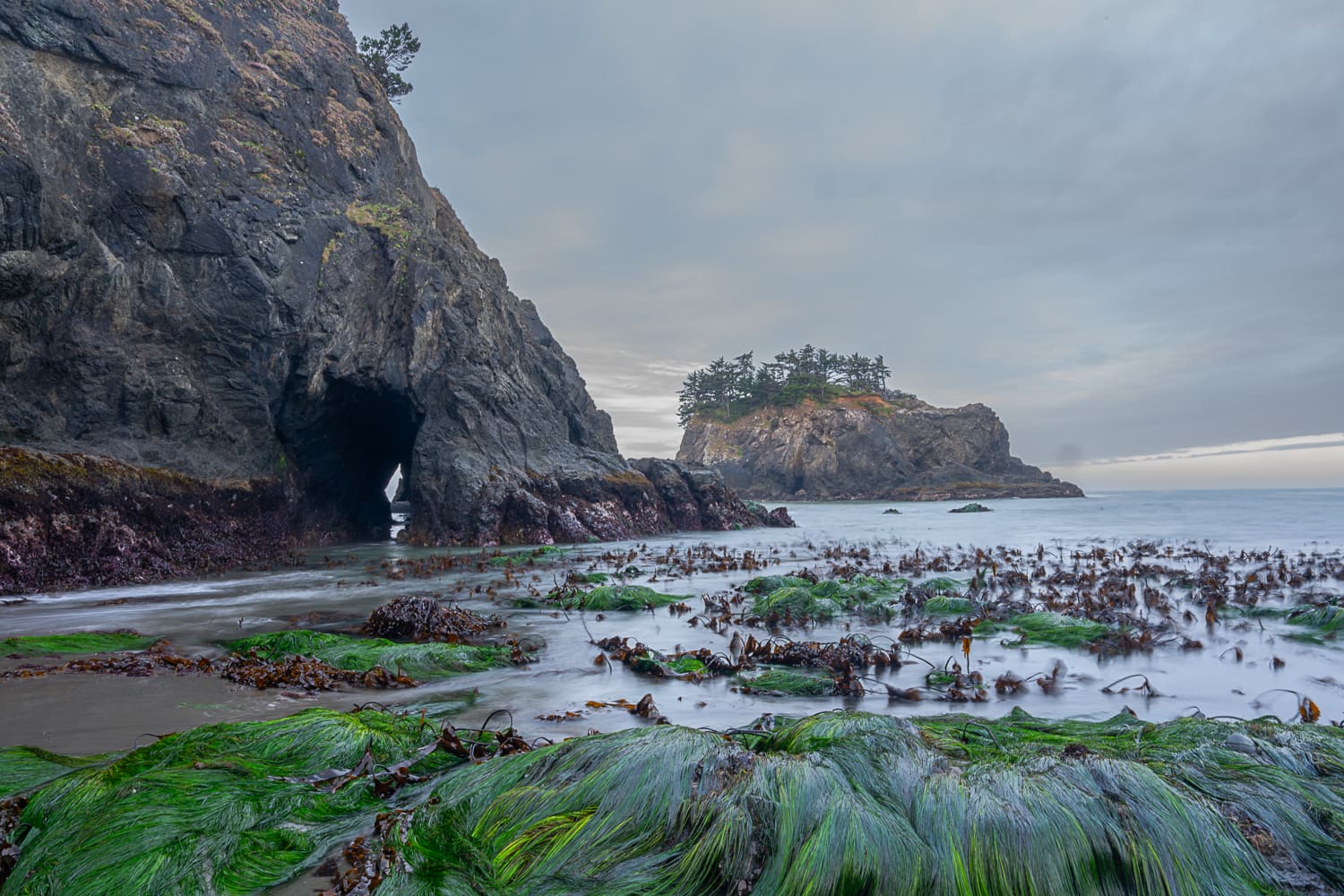
Secret Beach Seaweed. One trail led to another. Then another. Eventually I found myself wandering through sea caves at super low tide, trying to navigate the maze.
And give them the biscuit test.
The “Other” Secret Prayers
When not standing on the edge of a cliff eating a biscuit, I found time to study President Eyring’s talk from the last conference again. I listened to it over and over. I felt like there was something I wasn’t seeing.
Then it came to me in the section on secret prayers.
“The Lord has also provided us touching evidence of the power of nonverbal prayers offered within our hearts.”
“And Alma and his people did not raise their voices to the Lord their God, but did pour out their hearts to him; and he did know the thoughts of their hearts.”
He didn’t say “thoughts of their minds.”
He said:
“Thoughts of their hearts.”
That tipped me off.
President Eyring continued:
“As prophets have taught many times in the past, you may not feel like praying or you may not know what to say, but God hears the secret prayers of your heart.”
I used to think secret prayers were simply the prayers we didn’t tell anyone about except God.
Maybe it’s that.

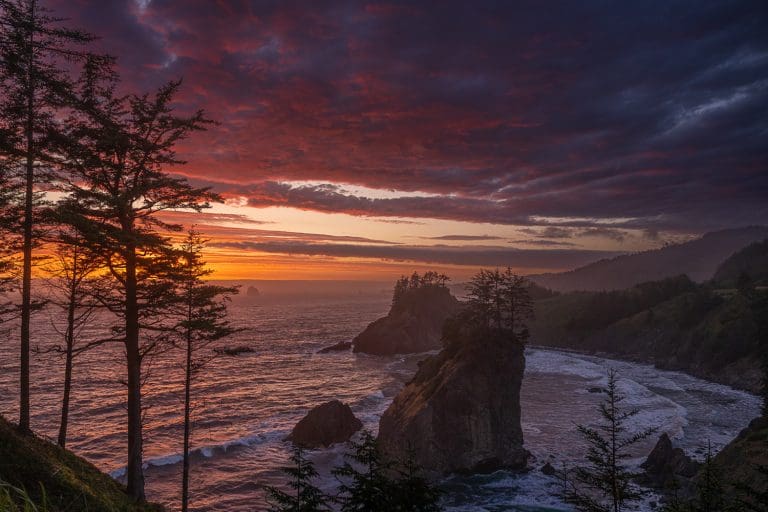
Natural Bridge Blue Hour. After several days of exploring, backtracking, and wandering through the forest, I finally started finding the angles I had been looking for.
Maybe it’s more.
I have a few things I’m working on where I don’t know what to ask. I don’t know what I don’t know. So my heart goes out to heaven constantly. Deep feelings. Prayers without words.
I don’t know what to say.
For that reason, what I’m asking is secret.
Even to me.
God is the only one who knows.
For now, I’m no longer worried about finding the right words.
Apparently God can hear prayers that never become words.

Secret Beach Unexpected. “What I’m asking is secret. Even to me.” I wasn’t looking for this photo. Hadn’t ever conceived it could exist. But it became my favorite.
And lately, those may be the ones I’ve been praying most.
I’m leaving Samuel H. Boardman and the cliffs of death behind me. Them, and maybe a discarded biscuit or two for the gulls.
Next stop: the redwoods.
Fewer cliffs.
Four-hundred-foot trees.

Arches Lookout. The photographs that first drew me to Samuel H. Boardman looked impossible. This was one of the moments that convinced me they weren’t.
We’ll see how that goes.
Note
Ocean to Ice (OTI) is a six-month, thousand-mile backpacking expedition through the Pacific Northwest and Canadian Rockies—used as a living laboratory.
I already know prayer works. This experiment is whether I can operate at a higher level with it—more consistently, deliberately, and in real time—as the world grows faster, louder, and more unpredictable.
Each week I’m sharing notes from the trail.
This week has been on the southern end of the Oregon Coast in the Samuel H. Boardman corridor.

Bonus – Trail Sign
The Oregon Coast occasionally communicates in subtle ways. This was not one of those times.





KathleenJune 4, 2026
Spectacular photos! Thank you for risking the biscuit.