






Maurine
Hello, we’re Scot and Maurine Proctor, and welcome to Meridian Magazine’s Come Follow Me podcast, where today we’re going to talk about the Book of Ruth, and 1st Samuel, chapters 1 through 3. We have special thanks today to Diana Webb, who’s the author of Biblical Lionesses: Protectors of the Covenant, and Forgotten Women of God, who’s provided notes and research to make this podcast possible today.
Now, Ruth is a happy interlude in these chapters. It’s not a story of a prophet, a war, or a dramatic intervention by the Lord, but it’s a family story, a private story in some ways, but it’s the family story of the family of the Savior. We love it because we are seeing really good people who are living the covenant at work. So this is a book that brings us joy. We see, at the outset, something that people all through the scriptures are faced with, and we are faced with it in our time as well and that is battling the climate and this interaction with the Lord in receiving rain for the lands that the people are in. This is critical for them to be able to survive.
So in this story, due to a famine, Elimelech sells his land, and he leaves Bethlehem, and he goes to Moab.
Now, I think in order to understand this, you have to understand the lands that are east of Judah, the lands that are on the other side of the Dead Sea, the other side of the River Jordan. There are three lands in a row, and one of them on the north is Ammon, and then in the middle is Moab, and at the south is Edom. Now, the land of Ammon is for the people who had descended from Ben-Ammi, who is the son of Lot by his younger daughter. Then the land of Moab are the descendants of Moab, who is the son of Lot, through his older daughter, and Edom is the land of Esau, who is the twin brother of Jacob. So that gives you a sense of those tribes, and everything in the Middle East is tribal.
Whenever we go to the Middle East, we’re always talking about tribes. And we were just in Jordan a few days ago, and Jordan is very tribal to this day, and people look at each other as to their tribes. So the sons of Elimelech take wives of the daughters of Moab, so they both marry Moabitish women, and one of those women that plays, of course, heavily into our story is Ruth, who is a Moabitish woman. The famine became so strong in the land that Elimelech dies, and then his two sons die. Naomi is left with her two daughters-in-law, Orpah and Ruth, and they’re caught in a very, very difficult situation, because women who are single in that culture are the most vulnerable of all.
Yes, to be a childless widow was to be among the lowest, most disadvantaged class in the ancient world. There was no one to support you, and you had to live on the generosity of strangers.
Naomi had no family in Moab, and no one else to help her. It was a desperate situation. From a distant, Naomi heard that God was doing good things back in Israel, that they had food to eat and she tells her daughters-in-law that they can stay there in Moab. She believed that her difficulty in life came because she had left her people. “The hand of the Lord has gone out against me”, she says. Perhaps she wondered if she had sinned by going to Moab. She’s not bitter, but she had no idea, not the slightest, of how greatly God was going to bless her in just a short time.
We see in Ruth, chapter 1, in verses 14 and 15, as they’re making this decision to part, that they lifted up their voice and wept again, and Orpah kissed her mother-in-law, but Ruth clave unto her. She said, “Behold, thy sister-in-law is gone back unto her people, and unto her gods, return thou after thy sister-in-law.” Now, this part I have studied a lot, and as I prayed about all this, I’d seen something that I’d never seen before. Oprah returns to Moab, and to her people, and to her gods. Now, what does that mean, because who are the gods in Moab?
There are three main gods in Moab. One of them is Chemish, and Chemish, that’s another name for seducer. He was their national deity, and he had a lot of influence. Now, when I say he, there really isn’t anyone. I always laugh at these idol gods because they are just made up, but people get very serious about worshiping them. This Chemish worship had spread all the way to Jerusalem, and in other lands in that area. He was a very feared god, but there was also the god of Moloch who was a fire god. He was kind of the same as Chemish, but his head was that of a calf, and he had his arms outstretched, and in those arms, they would place their children and sacrifice them. So, Moloch was this horrible god, and he, too, had been carried clear over to Jerusalem in other parts of that land in the Middle East.
Then there was a third god, Baal Peor and he was connected to licentious rites. He was a male divinity, and sometimes he was looked upon as the son, and Ashtaroth was the female deity, or Jupiter and Venus, and they were also worshipped. So when Orpah made that choice to go back to Moab and to her gods, this means that she made a choice that would last for her whole life, that would keep her away from the true God.
That makes it more powerful when Ruth says, “Entreat me not to leave thee, or to return from following after thee, for whither thou goest, I will go, and where thou lodgest, I will lodge: thy people shall be my people, and thy God, my God. Where thou diest, will I die, and there will I be buried, the Lord do so to me, and more also, if ought but death, part thee and me” (Ruth 1:16,17)
So, this choice of these two women is major, and it will also change the whole course of history. It’s this expression of loyalty from Ruth that is really breathtaking, and she is choosing Jehovah. Obviously, she’s heard enough about it from Naomi, maybe from her husband, that she realizes she is choosing another God, and, in fact, he will bless her.
They go back to Bethlehem, and Naomi says,“Call me not Naomi, call me Mara, for the Almighty hath dealt very bitterly with me” (Ruth 1:20).
In Hebrew, Naomi means sweet or pleasant, but Mara means bitter. This reply was not an accusation, only Naomi’s way of saying that she had experienced much tragedy while in Moab.
They arrived back in Bethlehem at the beginning of the barley harvest. Elimelech had a wealthy kinsman named Boaz, and his name can be translated as Mighty Man of Valor. The word kinsman means more than a relative. He is a kinsman redeemer, a special family representative, to help secure the family, especially these vulnerable ones, these widows who are coming. I think it’s very significant that the name Bethlehem, in Hebrew Bethlehem, means house of bread. In Arabic, it means house of flesh, but either way, it’s a house where there is food, a house where there is nourishment.
Ruth begins gleaning in Boaz’s fields. Now, what is gleaning? Young man moved through the fields, grasping handfuls of the grain, and cutting through the stalks with sickles. And these small bunches of grain were then bound into bundles called sheaves. You all understand that part. But as the men worked rapidly, a number of the stalks would fall to the ground, and if the men were careful and took the time, these, too, could be gathered up and put in with the sheaves. However, any stalks that dropped were allowed to remain where they fell.
In Leviticus, chapter 19, the farmers were commanded in Israel that they should not completely harvest their fields. They were commanded to cut the corners in harvesting, and always leave some behind. Also, if they happened to drop a bundle of grain, they were commanded to leave it on the ground, and to not pick it up. This was one of the social assistance programs, if you will, in Israel. So poor people, following the reapers, were permitted to glean or gather the random stocks, possibly all that stood between them and starvation. In addition, the edges of the field, where the sickle was not as easily wielded, were left unharvested. This left food for the poor, I think, is a wonderful program. It’s a wonderful way to provide for the poor and think about it.
The farmers could have generous hearts, and workers provide for themselves with dignity. Boaz tells Ruth, she need not glean in any other field. He tells the men not to touch her. He invites her to share their water vessel, and to dine with the other workers. He tells her to stay close to the other women who are reaping. In other words, he begins to watch out for her and to watch and see who she is.
Obviously, he is impressed with her work ethic and her generosity, and when he offers all of this, obviously Boaz is favoring Ruth. So, in chapter 2, verse 10, then she fell on her face and bowed herself to the ground and said unto him, “Why have I found grace in thine eyes, that thou shouldest take knowledge of me, seeing I am a stranger?” That’s basically saying, “How is it that you’re seeing me? I am nobody. I’m the least of all these.
Boaz answered and said unto her in verse 11: “It hath fully been shewed me all that thou hast done unto thy mother-in-law, since the death of thine husband, and how thou hast left thy father, and thy mother, and the land of thine nativity, and art come unto a people which thou knewest not heretofore. The Lord recompense thy work, and a full reward be given thee of the Lord God of Israel, under whose wings thou art come to trust.”
“Then she said, Let me find favor in thy sight, my lord; for that thou hast comforted me, and for that thou hast spoken friendly unto thine handmaid, though I be not like unto one of thine handmaidens” (Ruth 2:12, 13)
I am so impressed that he noticed that she had been kind to her mother-in-law. I am so impressed that that’s the kind of woman Ruth is, and this is the kind of man that Boaz is. We are now looking at righteous people, and that is such a relief after we see so many people chasing after idolatrous gods.
I think it’s fun, Maureen. We were just in Bethlehem a few weeks ago. You and I, with a group, and one of the first things that our Palestinian guide, who was born and raised in that area, said to us, was, This is the land of Ruth, and Boaz, and they speak about that to this day. It is something that impresses them, that is impressed upon their souls to this day, that they talk of Ruth and Boaz. Why has she found favor in his eyes? She doesn’t complain about all the hard things that have happened to her, but is grateful, even awestruck, by this good thing that he will let her glean. When she eats with the workers, she sits next to Boaz, and then keeps some of the food back to take to Naomi so that she might have something to eat. Isn’t that small gesture so important?
It’s interesting. When Ruth reported on her work that day she told Naomi that she had worked with Boaz and then Naomi said, “Blessed be the name of the Lord, who has not forsaken his kindness to the living and the dead.”
This is Naomi speaking. Now, remember, just a few verses earlier, when they returned to Bethlehem, she said, call me Mara. Bitterness, I have been misused by the Lord. I have been forgotten by the Lord, and now she fails to bless his name. Is this the same woman who came into town, saying, Call me Mara? Is this the same woman who said, “The Almighty hath afflicted me?” Now she sees more of God’s plan unfolding, and she can see better how all things are working together for good for those who love God. It is good, my daughter.
Naomi wants to change her fortune, and Naomi’s going to help her faithful daughter-in-law secure a husband and family. She knew that Ruth could best be taken care of if she was married, so she suggested that she appeal to Boaz for marriage. The Hebrew word for security, manowach, in verse one, is the same word for rest in Ruth 1:9, where now we hope that her daughter-in-law would find rest and security in the home of a new husband. This Hebrew word, manowach, speaks of what a home should be, a place of rest, and security, and she’s trying to help Ruth find this here under the wings of Boaz.
Now, Naomi’s suggestion to Ruth was rooted in a peculiar custom in ancient Israel. The meaning behind the Hebrew word goel, that is spelled g-o-e-l, and is sometimes translated kinsman-redeemer, had a specifically defined role in Israel’s family life. The kinsman-redeemer was responsible to buy a fellow Israelite out of slavery.(Leciticus 25:48). He was also responsible to be the avenger of blood to make sure the murderer of a family member answered to the crime. He was responsible to buy back family land that had been forfeited, and remember, Elimelech had sold his property, and he was responsible to carry on the family name by marrying a childless widow.
In this, we see that the goel, the kinsman -redeemer, was responsible to safeguard the persons, property, and the posterity of the family. Since Boaz was a recognized goel for the family of Elimelech, the deceased husband of Naomi and father-in -aw of Ruth, Ruth could appeal to him to safeguard the posterity of Elimelech’s family and take her in marriage. It may seem forward to us, but it was regarded as proper in that day. If Boaz did not fulfill his duty towards Elimelech, though he was now deceased, then the direct family name and the name of Elimelech would perish. The word here rendered redeemer, we translate literally from Hebrew, goel, and this is its proper translation. It is rendered merely kinsman in the King James version, but the function of a Goel was to make it possible for a widow, who had lost home and property, to return to her former status and security, and to perpetuate her family.
It is easy to see why the later prophets borrowed this word from the social laws of Israel, and used it to describe the functions of him who would become the divine Redeemer. Think of what he does to restore us to proper status with God, and to give us future security and eternal seed. That is just remarkable. I am in awe when I think about it.
So, Naomi instructs Ruth to make herself pretty and smelling good. “Anoint yourself, put on your best garment”, she says, and to leave Boaz alone while he ate. “do not make yourself known to the man until he has finished eating and drinking.”
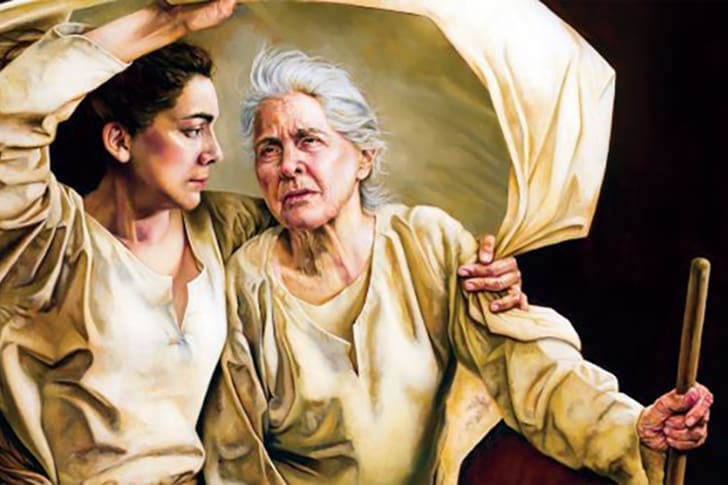
At the appropriate time, Naomi instructs Ruth to go in, uncover his feet, and lie down. In the culture of that day, this was understood as an act of total submission. In that day, she was understood to be in the role of a servant, to lay at their master’s feet and be ready for any command of the master. When Naomi told Ruth to lie down at Boaz’s feet, she told her to come to him in a totally humble submissive way. She was basically saying to Boaz, I respect you, I trust you, and I put my fate in your hands.
This is such a symbol of us coming to the feet of the Savior. We want to come to him, to lay at his feet, and to submit ourselves completely to him. It’s the same type and symbol here.
There was a good reason why Boaz slept at the threshing floor, because these were in the days of the judges when there was much political and social instability in Israel, and it wasn’t unusual for gangs of thieves to come and steal all the hard-earned grain a farmer had grown. In verse 9 of chapter 3, Boaz said, “Who art thou? And she answered, I am Ruth, the handmaid. Spread therefore thy skirt over thine handmaid, for thou art a near kinsman.”
Basically, she is submitting herself to him, and calling upon him to spread his skirt over her, which is the same as a cloak, or putting his cloak around her, and providing protection, care, and actually marrying her as a wife. Another use of the word is wing. It is, take me under your wing, and that means, protect me. “And now my daughter, fear not,” he says, “I will do to thee all that thou requirest, for all the city of my people, doth know that thou art a virtuous woman.” He would be acting as the kinsman redeemer, a goe; for her.
The only hitch is that there is a closer relative, but this relative chose not to perform the duty. Remember, he had the duty to protect the person’s property and posterity. But this closer relative wanted the land, but not the extra duties. Boaz said to the elders, and all the people, in Ruth chapter 4, verses 9 and 10, that “the name of the dead may not be cut off from among his brethren and from the gate of this place.”
He would take Ruth unto him as his wife. Boaz will be a kinsman redeemer, just as the Lord is to us. This establishes such a wonderful pattern and model for marriage. First, the love of God for Israel is mirrored in the love of a husband and a wife. The married couple are supported and are part of a larger constellation of kinsfolk and family obligation and love. This is solid and foundational in contrast to our contemporary dating culture, which is about attraction, which may come and go. That we were just in Jordan, and Jordan, when you ask about a person’s family, they say, Oh, they’re doing well, and but their family means something much larger than what we say. Their family is their uncles, their aunts, their grandparents, their children, their grandchildren, and in many cases, they all live in one house, and they leave the upper story of the house so that they can build another floor for the upcoming generation, and then they leave that with another floor so they can build for the generation beyond that. Family is extended family, and it’s everything to them. A cousin might be called a sister, just because they’re part of the family. And It’s assumed that marriage will include the non-negotiable opportunity to create offspring, and there’s a temple undertone in this whole story as well.
Jeffrey Bradshaw quotes a Catholic scholar, Gary A. Anderson:
“Anderson mentions two elements of the temple undertone that pervades this deeply spiritual book. First, he explains the significance of the fact that “Boaz, the name of our hero, also happens to be the name of one of two pillars that sat athwart the entranceway of the Temple in Jerusalem.”[vi] Then, he connects this temple allusion to the later incident at the threshing floor where Ruth asks Boaz to spread his robe over her.[vii]
“In his discussion of Ruth’s request, Anderson points out the importance of the fact that ‘the word for ‘robe’ in Hebrew happens to be the exact same word as ‘wing.’ This remarkable word play carries us back to Boaz’ blessing in chapter two: ‘May you have a full recompense from the Lord, the God of Israel under whose wings you have sought refuge.’ Taken together, Anderson’s observations make it clear that the plot line of the story of Ruth takes us on a journey from the gate of the temple where the pillar of Boaz stands to the Holy of Holies where two cherubim ‘stretch forth their wings on high’ to cover the mercy seat.”
Cherubim
Jeffrey Bradshaw said, “God commanded Moses to craft the cherubim on the Ark so that ‘their faces shall look one to another.’ [In Rabbinic literature, they are understood as being a boy and a girl. “Similarly, Boaz and Ruth, as a couple, are described in biblical Hebrew as perfectly self-similar reflections — ‘a man of worth’ and a ‘worthy woman.’
Bradshaw said, “However, I would argue, with Anderson, that the most important result of the individual development of Boaz and Ruth in the story is not their single-minded devotion to one another but rather the achievement of joint purpose in their wholehearted effort to fulfill the terms of their covenant relationship with God and their neighbors.” (Jeffrey M. Bradshaw, How Does the Book of Ruth Provide a Model for Marriage? https://latterdaysaintmag.com/how-does-the-book-of-ruth-provide-a-model-for-marriage/#_edn8)
Loyalty
This is a story of loyalty as one of the primary aspects of the covenant. God’s loyalty to us and ours to Him, so much that He would perform the atonement to make us at-one again. This is unflinching loyalty, born from allegiance to God which then becomes allegiance to one another in one another in marriage. In a covenantal marriage in the temple, we kneel across an altar, representing the altar of sacrifice, because it is the Lord’s atonement that can make us one. This is so beautiful.
In our own marriages we become One through looking together toward God, as well as in looking to each other.
Our Marriage
We have such a happy marriage, and we joke that when I am with you, I am besides myself. We would both credit this undying love and loyalty we have to each other because of our love for God.
I remember, Scot as we were coming to know each other and thinking about marriage, I had been through some hard experiences in my life, and I said, “I just don’t think God loves me.” You said, “God sent me into your life to tell you that He loves you.”
God has been the very center of our marriage. How many thousands of times have we prayed together, pouring out our hearts to Him. How could I know you better when I have heard your thousand thousand heart-felt prayers to God? How many times have we seen together God’s hand in our lives, in small ways and big ways. How many times have we lingered in the car after church so we can talk about what we’ve learned today or the sweet spirit of assurance we have felt. God feel our heart and teaches us day by day how to love each other better. My thoughts are how to comfort you when life is tough. How to serve you. How to build you and how to affirm the goodness I see in you. My job is to really see you and know who you are no matter how you are feeling on any given day.
A covenant marriage includes God at the very center and as you give your heart to Him, and are loyal to Him, so you do the same for your spouse. God teaches you love, and loyalty and fills your relationship with light.
The Meaning of Boaz and Ruth’s Story
The book of Ruth is not only a primer on marriage, but it also teaches something about the family history of Jesus Christ, who is the ultimate kinsman redeemer. We, like Ruth, are in vulnerable positions, but like Boaz there is one who comes into secure our position with God, to bring us home, to make a safe harbor for us, to watch out for us when we are stricken. Boaz and Ruth give birth to Obed, who is the father of Jessee, who is the father of David, who will become the king of all Israel and an ancestor of the Lord.
Another story of loyalty in 1 Samuel 1-3
1 Samuel starts with the story of Hannah. Diana Webb notes:
“Hannah’s story is one of quiet catastrophe – the catastrophe of empty arms, the oft-repeated and almost stereotypical catastrophe of barrenness and infertility. It is not a catastrophe to be compared with the destruction of the temple or the capture of the ark of the covenant, but to Hannah, childlessness is calamity.[i] And it doesn’t end there. Her husband’s second wife, Penninah maliciously throws salt on her raw wound and taunts her.
“This taunting is almost daily, according to the pseudepigraphal book called Biblical Antiquities, written sometime between the mid-first century and mid-second century CE. This is not scripture but paints a picture. Hannah is he beloved wife of her husband, Elkinah, but is barren, while Penninah has given him ten sons. In Biblical Antiquities, Peninnah ridicules Hannah by saying, “‘What does it profit you that Elkanah your husband loves you, for you are a dry tree? And I know that my husband will love me, because he delights in the sight of my sons standing around him like a plantation of olive trees.’”
Barrenness for Hannah is a torment and each month a renewed disappointment and a dashing of hopes.
A Visit to Shilo
6 And her adversary also provoked her sore, for to make her fret, because the Lord had shut up her womb.
7 And as he did so year by year, when she went up to the house of the Lord, so she provoked her; therefore she wept, and did not eat.
Elkanah discerned that Hannah was distressed, “her husband [said] to her, Hannah, why weepest thou? and why eatest thou not? and why is thy heart grieved? am not I better to thee than ten sons?” (1 Samuel 1:7-8). He is not childless, but she is, and he cannot give her what she yearns for.
Webb said, “Although she easily could feel that God has abandoned her, it is clear from her prayer that she has not abandoned God. Hannah is a model of devotion, worthy of emulation for her patient faith in the surety of God’s benevolence. “
At the house of Shilo, she wept and prayed, and we learn in 1 Samual 1:11
Hannah’s prayer:
11 And she vowed a vow, and said, O Lord of hosts, if thou wilt indeed look on the affliction of thine handmaid, and remember me, and not forget thine handmaid, but wilt give unto thine handmaid a man child, then I will give him unto the Lord all the days of his life, and there shall no razor come upon his head.
This is the first prayer of a women recorded in the Old Testament.
Eli, seeing her lips move, but not hearing her speak assumed she must be drunken because it was the time of a feast where this was common. She assured him she was not, but praying to the Lord and Eli said:
17 Then Eli answered and said, Go in peace: and the God of Israel grant thee thy petition that thou hast asked of him.
Samuel is born
Hannah will take him to the temple at age two when he is weaned. Imagine this woman who has longed for so many years and had empty arms, now taking this son to the sanctuary at Shilo to dedicate him to God’s service for life.
She will carry out the promise she made to God no matter what it costs her. When she returned home, the silence in her home without her baby Samuel must have been painful. She has given away her most prized possession.
Who could be joyful in these circumstances? In 1 Samuel 2, she begins with a song.
1 And Hannah prayed, and said, My heart rejoiceth in the Lord, mine horn is exalted in the Lord: my mouth is enlarged over mine enemies; because I rejoice in thy salvation.
2 There is none holy as the Lord: for there is none beside thee: neither is there any rock like our God.
3 Talk no more so exceeding proudly; let not arrogancy come out of your mouth: for the Lord is a God of knowledge, and by him actions are weighed.
Echoes of this song are remembered by Mary.
Hannah understands something. She lives in a world where nothing is beyond the reach of God’s reign. She realizes that just because she is a child of God she will not be spared the painful side of life. She knows that suffering has come close to knocking her off her feet, despite the enormity of her faith. She is assaulted by doubt, depression, and fear. She realizes that God uses the hard experiences of life to make us strong. Her own words assert that “they that stumbled are girded with strength”
Samuel is called
Could Hannah have had any understanding of who her son would be—this Samuel who would grow up as the Lord’s?
The LORD was with Samuel as he grew up, and he let none of his words fall to the ground. And all Israel from Dan to Beersheba recognized that Samuel was attested as a prophet of the LORD. He represented in the Old Testament in every role of leadership open to a Jewish man of his day—seer, priest, judge, prophet, and military leader.
So, let’s turn to 1 Samuel 3 and his calling:
1 And the child Samuel ministered unto the Lord before Eli. And the word of the Lord was precious in those days; there was no open vision .
2 And it came to pass at that time, when Eli was laid down in his place, and his eyes began to wax dim, that he could not see;
Is this a metaphor for loss of spiritual vision and understanding? “Eli’s blindness … reflects [not only] his decrepitude but [also] his incapacity for vision. … He is immersed in permanent darkness while the lad Samuel has God’s lamp burning by his bedside.
3 And ere the lamp of God went out in the temple of the Lord, where the ark of God was, and Samuel was laid down to sleep;
God’s lamp has not yet gone out, and the young ministrant will be the one to make it burn bright again.”
4 That the Lord called Samuel: and he answered, Here am I.
5 And he ran unto Eli, and said, Here am I; for thou calledst me. And he said, I called not; lie down again. And he went and lay down.
Though Eli and Samuel both slept in the Tabernacle, only Samuel heard the Lord’s voice that night
6 And the Lord called yet again, Samuel. And Samuel arose and went to Eli, and said, Here am I; for thou didst call me. And he answered, I called not, my son; lie down again.
7 Now Samuel did not yet know the Lord, neither was the word of the Lord yet revealed unto him.
8 And the Lord called Samuel again the third time. And he arose and went to Eli, and said, Here am I; for thou didst call me. And Eli perceived that the Lord had called the child.
9 Therefore Eli said unto Samuel, Go, lie down: and it shall be, if he call thee, that thou shalt say, Speak, Lord; for thy servant heareth. So Samuel went and lay down in his place.
10 And the Lord came, and stood, and called as at other times, Samuel, Samuel. Then Samuel answered, Speak; for thy servant heareth.
This is a very physical description of the Lord coming and standing by the side of Samuel. It’s very, very tender and very, very real. When Samuel answers here am I, this is a covenant phrase. The Lord says it to us. It means loving kindness. It means, I will be there for you. I will respond when you call, and look how Samuel does.
This idea of, “here am I,” we see, all through the scriptures, in Abraham, chapter 2, verse 27.
Abraham 2:27
And the Lord said: Whom shall I send? And one answered like unto the son of Man: Here am I, send me.
And in:
Isaiah 58:9 “Then shalt thou call, and the Lord shall answer; thou shalt cry, and he shall say, Here I am.”
The phrase, here am I, goes both ways. The Lord says it to us when he volunteers to come and take upon himself this mighty atonement. But we also say it to him, because we have a special relationship with him, and we know that if he asks us, we respond willingly, and without hesitation, and say, “Here am I.” He calls us and we answer. We are willing to do what he asks, even if it is very hard. We will seek to hear him. We will hear Him. We will take responsibility that he may help us to grow.
It means we are in this relationship of love, and we are someone that each can count on. And so here my, it’s this beautiful phrase that occurs again and again.
It is Abraham, Jacob, Joseph, Isaiah and Samuel. What Samuel is asked to do will rekindle some of the spirit in Israel. Next week 1 Sam. 8-10, 13,15-18
Maurine
And this will be very necessary, because as we learn in these chapters, Eli’s sons have disrespected their role with the tabernacle there. Eli has failed to reprimand them, and the Lord withdraws from those sons this opportunity. This is why Eli can no longer receive revelations. So now there is a new leader in Israel, and it is Samuel, and he will play a mighty and powerful role.
Scot
That’s all for today. This is Scot and Maurine Proctor. We’ve loved being with you. Next week, we’ll be studying first Samuel, chapters 8 through 10, 13, and 15 through 18. As always, thank you to Jenny Oaks Baker for the music that accompanies this podcast, and thanks to Michaela Proctor Hutchins our producer. See you next time and have a great week.