




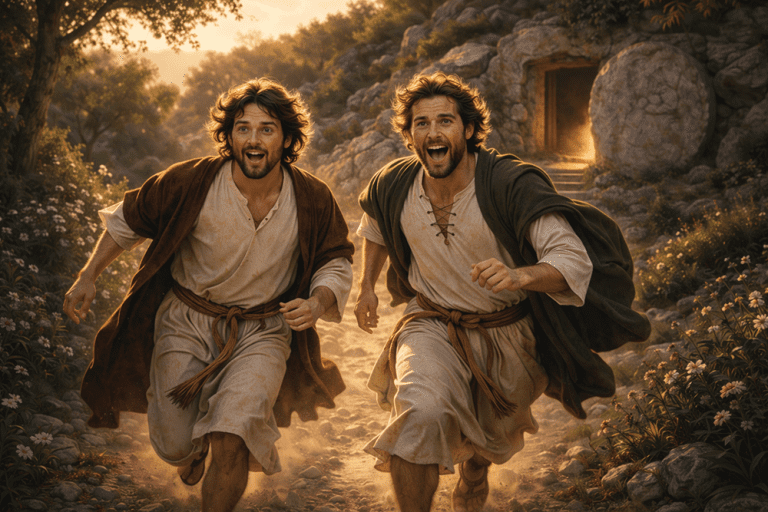


From time to time, I encounter the argument that the various witnesses to the Book of Mormon are unreliable because, unlike us modern folks, they lived in a world of unscientific superstition that left them disconnected from reality.
This has always struck me as a strange thing to say. The witnesses were early nineteenth-century farmers who spent their lives rising at sunrise, pulling up stumps, clearing rocks, plowing fields, sowing seeds, carefully nurturing crops, raising livestock, milking cows, and digging wells. They built cabins, raised barns, harvested their own food, bartered (in an often cashless economy) for what they couldn’t produce themselves, and made their clothes from plant fibers and skins. They anxiously watched the seasons and walked or rode animals out under the weather until they retired to their beds shortly after sunset, in “a world lit only by fire.”
It seems odd for them to be portrayed as estranged from everyday empirical reality by people whose lives, like mine, consist to a large extent of staring at computer and television screens in artificially air-conditioned and artificially lit homes and offices, clothed in synthetic fibers, commuting between the two in enclosed and air-conditioned mechanical vehicles while they listen to disembodied voices on the radio, chat on their cell phones, and fiddle with their apps—all of whose inner workings are largely mysterious to them—who buy their prepackaged food (with little or no regard for the time or the season) by means of plastic cards and electronic financial transfers from artificially illuminated and air-conditioned supermarkets enmeshed in international distribution networks of which they know virtually nothing, the rhythms of whose daily lives are largely unaffected by the rising and setting of the sun.
I sometimes hear much the same argument leveled against the first Christian disciples and the witnesses of the resurrection of Christ. They could easily believe that Jesus rose from the tomb—so the criticism goes—because they lived in a world in which natural laws weren’t understood and miraculous prodigies were commonplace. We moderns, by contrast, know that genuinely dead bodies don’t return to life. The bodily resurrection of Jesus, critics say, is a mere fable, arising out of what, in his powerful poem “Seven Stanzas at Easter,” the Pulitzer Prize-winning novelist John Updike (himself a believer) termed “the faded credulity of earlier ages.”
But this is fundamentally mistaken. We often experience death almost as an unexpected accident, something that commonly occurs in the antiseptic environments of modern hospitals, where it’s managed for us by calm and experienced professionals. By contrast, ancient people knew death intimately, and without the assistance of specialized undertakers and morticians. The average life expectancy for ancient people was short. They frequently died at home, without the help of anything that we would recognize as real medicine. They lacked antibiotics and anesthesia, and the simplest injuries or wounds could and did kill. Often very painfully. Families were responsible for burial and the preparations that preceded it. They were acutely aware that the dead don’t routinely return to life.
Without Christ’s intervention, taught the early Book of Mormon prophet Jacob, “this flesh must have laid down to rot and to crumble to its mother earth, to rise no more” (2 Nephi 9:7). In seventh-century Arabia, Muhammad’s enemies mocked his declarations that deceased humans would be resurrected for final divine judgment: “Who will give life to decomposed bones?” they demanded. (Qur’an 36:78, my translation)
The early third-century Latin Christian writer Tertullian, a native of what is today Tunisia in North Africa, reflected the attitude of most ancient people in a famous argument for the truth of the Christian claim about Jesus: That “the Son of God died,” he wrote in “On the Flesh of Christ, “is credible, because it is unfitting; and he was buried and rose again; it is certain, because it is impossible.”
His argument seems to reflect an idea already familiar from Aristotle’s “Rhetoric,” where that great Greek philosopher (384-322 BC) argued that a claim can sometimes be judged more credible if it is thought to be incredible—because nobody would have made something up that was plainly understood to be completely impossible. Who would have invented the idea of worshipping a disgracefully crucified Son of God? And who would have believed that a corpse could come back to life?
Well, some did. But it wouldn’t happen in their time. Instead, it was something for the far distant and miraculous future. The Book of Mormon prophets knew that all humans would eventually be resurrected to stand before God: “Our flesh,” said Jacob, “must waste away and die; nevertheless, in our bodies we shall see God” (2 Nephi 9:4). And many of the Jews in the Palestine of Jesus’ day believed in a future resurrection. It would come, they believed, at the end of history. Speaking to the bereaved sister of Lazarus, “Jesus saith unto her, Thy brother shall rise again. Martha saith unto him, I know that he shall rise again in the resurrection at the last day.” (John 11:23-24)
What they didn’t expect was that the resurrection would begin in their own day, with a single individual whom many of them had known.
But it did. And, despite the many times that Jesus spoke of his future resurrection to his followers, they didn’t really expect it. Mary Magdalene didn’t expect to see the risen Lord at the tomb; when she did, says John 20, she thought he was the gardener. And, on that first Easter Sunday, when the women who had seen two angels at Jesus’ empty tomb carried the first report of his resurrection to his disciples, Luke 24:11 records, “their words seemed to them as idle tales, and they believed them not.” The apostle Thomas had missed the resurrected Savior’s appearance to his colleagues. “Except I shall see in his hands the print of the nails,” he declared, “and put my finger into the print of the nails, and thrust my hand into his side, I will not believe.”
Soon, however, he didn’t merely believe. He knew. And the early apostles and witnesses didn’t say, “Oh. Right. Of course. Yet another inexplicable event of the kind that our credulous worldview continually expects!” The resurrection of Jesus was anything but routine or unsurprising. It changed the world. Let’s examine this in a bit of detail:
Virtually all historians, believers or not, agree that Jesus was crucified. The New Testament says that he died just prior to Passover.
One of his inner circle of twelve apostles betrayed him, nine fled at his arrest, and another — Peter — pretended not to know him. The last, John, seems to have watched events unfold from a safe distance (Luke 23:49; John 19:25-27). Thereafter, as prominent followers of a convicted and executed “criminal,” they went into hiding.
Only a few weeks later, though, the eleven surviving apostles were transformed. They even appointed a willing replacement for Judas.
What happened?
According to Acts 1:2-9, the risen Jesus trained his apostles for forty days during a series of post-resurrection appearances and then ascended into heaven. Less than two weeks later, they began their first public preaching in connection with the feast of Pentecost, seven weeks after Passover and Easter Sunday (Acts 2).
The content of their first preaching is significant. Boldly speaking for the other apostles, Peter flatly identified the residents of Jerusalem as the killers of Jesus, testifying that God had raised Jesus from the dead and identifying himself and his colleagues as witnesses to these claims (Acts 2:23-24, 32). At this point, if Peter’s assertion were false, critics could easily have exhumed Jesus’ body and ended the nonsense. But, in fact, Luke tells us that mass conversions followed the apostles’ testimony (2:41, 47).
A few days later, Peter and John were in the courtyard of the temple, again openly accusing the people of Jerusalem of having murdered Jesus (3:13-15), testifying that God had raised Jesus from the dead (3:15, 26), and identifying themselves as “witnesses” to these facts (3:15).
The chief priests and Sadducees were understandably threatened by such public challenges and, so, the two apostles were arrested and brought before Annas, Caiaphas, and other members of the city’s elite (4:1-7) — the very men who, less than two months before, had engineered the execution of Jesus.
Without hesitation, Peter testified of “Jesus Christ of Nazareth, whom ye crucified, whom God raised from the dead” (4:10).
Uncertain how to respond to this fearless defiance, the chief priests decided to “threaten” Peter and John, and to order them to speak no further about Jesus (4:17-18) — to which the two apostles replied that they would not obey the order (4:19-20). Baffled as to what to do next, Annas and Caiaphas and the others simply threatened them again and let them go (4:21).
But the little Christian movement continued its public preaching to the extent that, exasperated and “filled with indignation,” the high priest and the Sadducees had the apostles arrested and jailed. However, they were miraculously delivered from prison and immediately proceeded to the temple to preach still more (5:17-25).
So they were arrested yet again and hauled once more before the high priest and his council, where they were reminded that they had been ordered not to teach about Jesus (5:26-28).
And, yet again, the apostles were defiant and unintimidated. “We ought to obey God rather than men,” explained Peter (5:29). You killed Jesus, he said, but God raised him from the dead “and we are his witnesses of these things” (see 5:30-32).
At this point, according to Acts, the council considered killing them. But a prominent rabbi named Gamaliel stood up and strongly advised against that. So the council had them beaten yet again, and ordered them, yet again, to be quiet about Jesus (see 5:33-40).
“And they departed from the presence of the council, rejoicing that they were counted worthy to suffer shame for his name. And daily in the temple, and in every house, they ceased not to teach and preach Jesus Christ” (5:41-42).
Some will argue that this account is fiction, inspiring but wholly mythical. But its author, the evangelist Luke, seems to have been a well-educated and careful historian who based his narrative upon eyewitness interviews (Luke 1:1-4). And the New Testament doesn’t shrink from casting early church leaders in a negative light when appropriate; it feels no apparent need to glorify them by falsifying history. Furthermore, given the remarkable and well-documented growth of earliest Christianity, something very like what Luke reports must necessarily have happened.
So what transformed the fearful, cowering apostles of Passover weekend into fearless preachers of Christ’s resurrection less than two months later? There is a very obvious possible answer. Everything hinges on it.
But, before closing, let’s single out the apostle Peter for one more look at the question: Simon, as he was originally known, was born in the small village of Bethsaida at the north end of the Sea of Galilee more than 2,000 years ago. His father’s name was Jonah, and his mother’s name is lost to history.
Bethsaida’s name (“House of Fishing”) suggests its main industry. Except during religious festivals, when so many sacrificial animals were slaughtered that prices were discounted — obviously, nobody had a refrigerator — meat was expensive in first-century Palestine. So fresh, smoked, and pickled fish was a vital protein source, and fishing was a solid trade.
Simon and his brother Andrew took up the trade as well, presumably following their father. Eventually, they formed a partnership with the two sons of Zebedee, James and John. And they did well. They owned their own boats and may have had a few employees. At some point, Simon moved to another tiny shoreline town nearby, Capernaum, where the likely foundations of his small house have been located.
Mark (1:21-27), Luke (4:31-37) and John (6:24-59) report that Capernaum had a synagogue, and, thus far, the archaeological data indicate that the village’s residents followed Jewish kosher and purity rules. In this light, Peter’s reported unease at Jesus’ indifference to ritual hand-washing (Matthew 15:1-20; Mark 7:1-23) makes perfect sense, as does his exclamation, during his vision of the clean and unclean beasts, that he’d never eaten anything profane or unclean (Acts 10:9-16). So, too, does his preference for eating with Jewish Christians instead of Paul’s Gentile converts (Galatians 2:11-14).
The evidence from Capernaum strongly suggests that Peter needed to overcome his early upbringing before he was wholly able to embrace the idea of Gentile Christians, and writing his letters probably required help from better-educated assistants. An untraveled man with a rural accent (Matthew 26:73), regarded by the Jewish elite as unschooled and ordinary (Acts 2:7-8; 4:13), he and his fellow apostles were dazzled when they saw Jerusalem (Matthew 24:1).
But the most important questions still transcend archaeology: How did such a man, from such an undistinguished background, become so historically important — to the point that he even attracted the murderous attention of the Emperor Nero? What took Peter to Rome? What transformed this commonplace fisherman into an apostolic martyr?
Had he simply followed the path of his ancestors and neighbors, Simon would have grown old fishing on the lake. He might perhaps have walked the 120 miles to Jerusalem once or twice at festival season, roughly six days each way. He would have been completely forgotten at least eighteen centuries ago.
Roughly four decades after the two sets of brothers established their lakeside fishing business, just after nightfall on 18 July, A.D. 64, a fire started in a crowded Roman neighborhood near where the Coliseum now stands. Rome was mostly built of wood then and, fanned by a hot summer breeze, the flames spread rapidly. They burned for a full week, destroying ten of the city’s fourteen districts.
The Emperor Nero was trying to avoid the summer heat at his lavish villa in the seaside resort of Antium (modern Anzio), his birthplace, when the news arrived. He hurried back to direct the firefighters and provided makeshift temporary housing for scores of thousands displaced by the disaster. But then his massive ego kicked in. The destruction of most of Rome had provided him an opportunity, as he saw it, to redesign the city more to his liking, with more marble and with an enormous new imperial palace very near where the fire had started, surrounded by a huge park featuring a 120-foot-tall statue of himself.
Resentful rumors began to circulate that Nero had set the fire deliberately. So he settled on a strange new sect called “Christians” as his scapegoats. Nobody knows how many of them died — thrown to wild beasts at the circus, crucified, doused with oil and set aflame to illuminate Nero’s parties — in the horrific persecution that followed, but early Christian sources testify without dissent that Simon, who, by this time, was known as the apostle Peter, had come to Rome and that he was among Nero’s victims. There is, in fact, a strong case to be made, based upon excavations beginning in 1940, that his tomb is located precisely where tradition has long claimed it to be — directly under the high altar of St. Peter’s Basilica in Vatican City — and even that his very bones have been identified.
Simon Peter’s apparent martyrdom in Rome poses a powerful challenge, and not merely to historians.
“He was known throughout the world,” wrote the chronicler Eusebius two and a half centuries after Simon Peter’s death, “even in the western countries, and his memory among the Romans is still more alive today than the memory of all those who lived before him.”
How did Simon become famous? Why was he executed by imperial decree? For that matter, what brought this seemingly quite commonplace Galilean tradesman to Rome at all? A native speaker of Aramaic, he may have possessed some Greek. But Rome’s language was Latin, of which he probably knew relatively little. What led him to the world’s largest city — in his day, a pagan metropolis of a million inhabitants — from the backwater Jewish village of Capernaum (estimated population 1,500)? Ancient travel was uncomfortable and dangerous, hardly a vacation, and, being in his mid to late sixties, Simon was quite old for his day.
Plainly, something transformed the ordinary village fisherman Simon of Bethsaida into the courageous, far-traveling, world-historical apostle Peter. It can transform us, too, if we allow it.




Tom WilliamsApril 6, 2026
A further evidence of the reality of resurrection was cited in Matthew 27: "52 And the graves were opened; and many bodies of the saints which slept arose, 53 And came out of the graves after his resurrection, and went into the holy city, and appeared unto many. While the graves were opened by the earthquake at the moment of the Crucifixion (v. 51), the text specifies that the saints actually entered the city "after his resurrection." A parallel event occurred in the Americas and was referenced by the Savior when he appeared to the Nephites. The Jerusalem event is often described by theologians as a "special resurrection" or a precursor to the general Resurrection made possible by Christ. No doubt the Apostles knew of this "special resurrection," a further evidence of Jesus's divinity and promise, and further proof that He ushered in an era of the uniting of body and spirit, ultimately, for all Mankind.
JohnApril 5, 2026
I loved reading this. I used a similar argument, but nowhere close to being as well written , in a paper I wrote for a western religions course at a NZ university in the late 80s. The question... Who founded the Christian Community and why? The university taught that it was Paul. I challenged that position, quoting Nibley, among others, that Jesus organised his Apostles after his resurrection and the resurrection is the turning point and the whole point of the gospel. My tutor gave me a good mark, stating that although she disagreed, I had made a good argument. It still astounds me that they ignore the miraculous change to Peter and the other Apostles. Thank you for the wonderful Easter reminder.