










My wife and I came to Ohio for entirely legitimate reasons. The Rock and Roll Hall of Fame in Cleveland had been on my wife’s bucket list long enough. It was time to experience it and mark it done. We were not disappointed—few places on earth tell the story of American music with more passion or authority. The trip was a success the moment we walked through the Hall of Fame doors. But something else made the trip go from entertaining to extraordinary, and it had nothing to do with rock and roll.
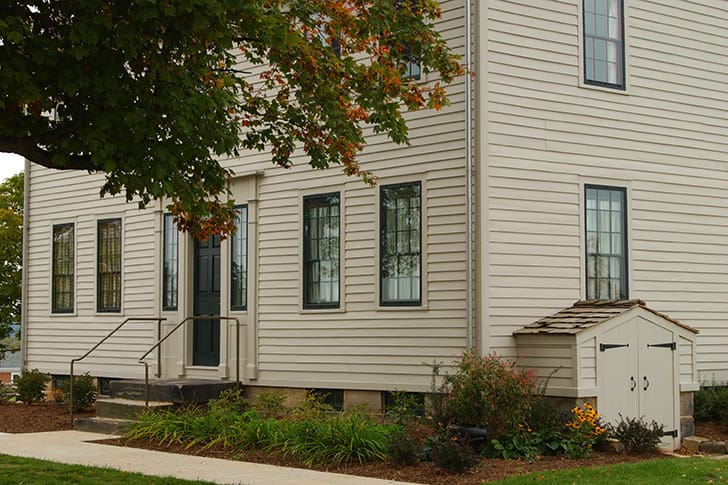
Thirty miles southeast of Cleveland, in a small Ohio town called Hiram, sits a piece of ground where something happened in the early hours of March 25, 1832, and where the ground still seems to know it. The John Johnson Farm is not a famous landmark by the world’s measure. No highway signs compete for your attention on the approach. The house sits quietly—a modest frame structure that once served as the headquarters of the early Church and a home to Joseph and Emma Smith. It was here where dozens of revelations were received, where sections of the Doctrine and Covenants were born, where the early Saints gathered to find their footing in a restoration still taking shape.
It was also here, on a cold March night, where a mob of roughly twenty-five men dragged Joseph Smith and Sidney Rigdon from their beds and into the dark of the surrounding fields.
What followed was not merely a beating. The mob had brought vials of nitric acid intended for Joseph’s throat. One vial broke against his teeth and fell away, doing no damage beyond chipping a tooth—a small mercy inside a brutal night. In their fury, the men choked Joseph until he lost consciousness, stripped him of his night clothes, scratched his bare body until he bled, then coated his skin in hot pine tar and pressed feathers into it until he was barely recognizable.
Frightened off by noises they mistook for approaching rescuers, the mob dispersed and fled before committing further violence. Somehow, Joseph found the strength to rise and make his way home. Emma, seeing him in the doorway, fainted believing he was covered in blood.
Friends spent the remainder of the night using turpentine, lard, and knives to peel the tar from Joseph and Sidney’s bodies, sometimes tearing the skin away with it. What none of them knew in those hours was that eleven-month-old Joseph Murdock Smith—one of the twins Joseph and Emma had adopted—already weakened by measles, was quietly losing his fight against the cold night air to which the attack had exposed him.
The next morning was the Sabbath. Despite everything, Joseph had a preaching appointment to keep.
And he did. In front of a congregation gathered near the Johnson home, Joseph preached as usual. Among those listening were members of the mob who had attacked him hours before. By most accounts, they were there to see what would happen when Joseph didn’t appear. But he did appear. And he did preach, calmly and surely, with no trace of pain or anger in his voice. And before the day was finished, three people were baptized into the Church.
The baby died four days later.
There, near where Joseph—still battered and in pain—had calmly preached, I felt goosebumps move across my skin. Not the mild, passing kind. The kind that come when something true reaches past the ordinary surface of a moment and touches something deeper. I am not a man who arrives easily at sentiment. A career spent looking for truth in lies teaches you quickly to be skeptical of easy emotion. But what I felt was not sentiment. It was recognition—the bone-deep awareness of being in the presence of something real.
As an adult convert to the Church, I have never felt the same natural connection to Church history as many of those born under the covenant. Yet here I was, on hallowed ground, caught in something I had not prepared for—a grief and a wonder washing over me for what Joseph Smith had endured in this place.
I knew the Prophet received critically important revelations while at the Johnson farm. But revelation can be difficult to hold in your hands. What I was experiencing was different. It was visceral. It was fizzing in my blood. I had carried a strong testimony of the gospel for twenty years. But now I found I had something more—a testimony of Joseph Smith forged not from a page but from a patch of Ohio ground that still remembered what happened there.
This is why Church history matters. Not as a collection of dates and locations to be memorized, but as a living record of what God’s work actually required of the people who pushed it forward. History experienced firsthand does something to a person a book cannot replicate. I stood where Joseph stood. I looked at the doorframe through which Joseph was dragged. I considered the ground Joseph stumbled back across in the dark. The distance between his world and mine collapsed, and what remained was the question his life put directly to mine.
I asked myself the question honestly, the way you ask a question when nobody is listening. Could I have done it? Could I have stood before a congregation the morning after such an ordeal, with my body still raw and my grief not yet formed, and preached with the calm Joseph reportedly displayed? I know I could not have done it without God. And the wondering of it—the honest reckoning with what it would have required—put iron into my testimony in a way no sacrament talk or elders quorum lesson ever could.
The Restoration did not arrive painlessly. It came through people who paid prices we often fail to consider—through mobbed homes and tarred skin and babies dying from exposure in the night and prophets who kept their preaching appointments the next morning anyway. Understanding this history in its full context, without softening the hard parts or romanticizing the sacrifice, is not a threat to faith. It is the foundation of a more honest one.
Context is everything in history. Joseph Smith was twenty-six years old when the mob came for him at the Johnson farm. He was not a distant figure in a painting. He was a young man with infants in the house, enemies who wanted him dead, and a congregation expecting him the next morning. Knowing this does not diminish what God worked through him. It makes the work more remarkable, not less.
I came to Ohio for the Rock and Roll Hall of Fame and the experience was fantastic but did not change me. What came home and stayed with me had nothing to do with rock and roll. Church history, standing on its own ground, surfaces questions your ordinary life never thinks to ask. It places you beside people who were asked to do hard things in difficult circumstances and found, somehow, a way to do them.
On an unremarkable farm near Hiram, I came to understand something about Joseph Smith I had only read before. The difference between reading about courage and standing where it happened is the difference between knowing a thing and being changed by it.





C. Diane JonesJune 3, 2026
I, too, have experienced the truth "the ground never forgets" at Carthage Jail. I believe I was born with the 'gift to know.' And yet, whiile visiting there once, I was so overcome with a power so great that I could not speak literally for hours. The ground confessed to my soul that a Prophet of God, and his brother, Hyrum, were slain there. It was so powerful and sacred, that I did not know just what to do with that experience. Even my husband who was with me wondered for hours what had happened to me. Years later, on another visit to Carthage Jail, I witnessed the very same experience happen to someone else who was visiting that sacred ground. I have no doubt that for whatever reasons, those kind of witnesses are given. And I don't know why me, but I will be forever grateful that I was one who received it!
Kate MerrillJune 3, 2026
A remarkable testimony by a fellow adult convert who has been anxiously engaged in discovering and embracing those meaningful events that shore up eternal beliefs. Continued thanks to a gifted author.