




Stepping into Moses’ Shoes: Joshua’s Divine Commission

The last chapter of the last book of the Pentateuch, the “Five Books” of Moses, tells of the departure of that titanic Old Testament figure from the midst of the wandering Camp of Israel that, under God, he had both created and led. (Of course, the account of his death raises the question of his authorship of the chapter. But that isn’t the topic of this current column.) Deuteronomy 34 begins as follows:
“And Moses went up from the plains of Moab unto the mountain of Nebo, to the top of Pisgah, that is over against Jericho. And the Lord shewed him all the land of Gilead, unto Dan, and all Naphtali, and the land of Ephraim, and Manasseh, and all the land of Judah, unto the utmost sea, and the south, and the plain of the valley of Jericho, the city of palm trees, unto Zoar. And the Lord said unto him, This is the land which I sware unto Abraham, unto Isaac, and unto Jacob, saying, I will give it unto thy seed: I have caused thee to see it with thine eyes, but thou shalt not go over thither.” (Deuteronomy 34:1-4)
Those who have stood on a clear day atop Mount Nebo (aka Mount Pisgah) in the ancient land of Moab—a mountainous region in what is today southwestern Jordan—can testify to the enormous panorama that it offers of modern-day Israel to the west, the north, and the south. It’s possible, looking across the Jordan Valley below, to see Jericho, the Dead Sea, and sometimes even Jerusalem.
But there is a curious detail to the biblical account of the “death” of Moses, found in the following verses:
“So Moses the servant of the Lord died there in the land of Moab, according to the word of the Lord. And he buried him in a valley in the land of Moab, over against Bethpeor: but no man knoweth of his sepulchre unto this day. And Moses was an hundred and twenty years old when he died: his eye was not dim, nor his natural force abated.” (Deuteronomy 34:5-7)
According to the biblical author, God himself buried Moses. But, since the narrator doesn’t know where this happened, how can he know that God was the undertaker? And, anyway, burying people seems a fairly curious activity for the Lord.
It’s interesting to observe that the Book of Mormon may know a slightly different tradition about Moses’s departure than that available to the writer of Deuteronomy 34:
“And when Alma had done this he departed out of the land of Zarahemla, as if to go into the land of Melek. And it came to pass that he was never heard of more; as to his death or burial we know not of. Behold, this we know, that he was a righteous man; and the saying went abroad in the church that he was taken up by the Spirit, or buried by the hand of the Lord, even as Moses. But behold, the scriptures saith the Lord took Moses unto himself; and we suppose that he has also received Alma in the spirit, unto himself; therefore, for this cause we know nothing concerning his death and burial.” (Alma 45:18-19)
Doctrine and Covenants 84:25 says that the Lord “took Moses out of their midst, and the Holy Priesthood also.” But the Latter-day Saint Bible Dictionary (under “Moses”) takes a very clear stand on the matter, explaining that
“As was the case with many of the ancient prophets, Moses’ ministry extended beyond the limits of his own mortal lifetime. In company with Elijah, he came to the Mount of Transfiguration and bestowed keys of the priesthood upon Peter, James, and John (Matt. 17:3–4; Mark 9:4–9; Luke 9:30; D&C 63:21; HC 3:387). From this event, which occurred before the Resurrection of Jesus, we understand that Moses was a translated being and had not died as reported in Deut. 34 (Alma 45:19). It was necessary that he be translated, in order to have a body of flesh and bones at the time of the Transfiguration, since the Resurrection had not yet taken place. Had he been a spirit only, he could not have performed the work on the mount of giving the keys to the mortal Peter, James, and John (see D&C 129).”
And, of course, Latter-day Saints understand from Doctrine and Covenants 110 that Moses came again to the earth on 3 April 1836, to the temple in Kirtland, Ohio, where he conferred the keys of the gathering of Israel upon Joseph Smith and Oliver Cowdery (D&C 110).
The ancient Hebrews, though, refugees for decades from their homes in Egypt and not yet arrived in the Promised Land, had lost one of the giants of the Bible, one of the greatest figures in all of the history of world religions. They were, no doubt, both devastated and lost: “And the children of Israel wept for Moses in the plains of Moab thirty days.” And they must have wondered: Who, if anybody, would arise to lead them? And how would he react to the assignment? How would he feel about the world-historical shoes that he would be called to fill?
My late brother told me once, and (I think) not entirely in jest, that the lowest ebb of his faith came immediately after his call to serve as a bishop. Why? Because, he said, he had always looked up to bishops and admired them. And now he himself needed to rise to the responsibility, and he wasn’t sure that he would be able to do it. Had somebody made a mistake?
I’ve wondered how Brigham Young felt about stepping into the shoes of Joseph Smith, a prophet whom he profoundly respected and of whom he considered himself a disciple. And try to imagine the feelings of the Galilean fisherman Simon bar Jonah, appointed to feed the Lord’s sheep and lead the Church after the death, resurrection, and ascension of Jesus himself. It would be perfectly astonishing, indeed superhuman, if they never felt inadequate to the responsibility. For us mortals, in fact, I suspect that, if we ever feel entirely ready for a calling in the Church, that may be excellent evidence that, in fact, we’re not.
Listen carefully to the account of the calling of Joshua to assume leadership of the Israelites in the absence of Moses:
“Now after the death of Moses the servant of the Lord it came to pass, that the Lord spake unto Joshua the son of Nun, Moses’ minister, saying, Moses my servant is dead; now therefore arise, go over this Jordan, thou, and all this people, unto the land which I do give to them, even to the children of Israel.
“Every place that the sole of your foot shall tread upon, that have I given unto you, as I said unto Moses. From the wilderness and this Lebanon even unto the great river, the river Euphrates, all the land of the Hittites, and unto the great sea toward the going down of the sun, shall be your coast.
“There shall not any man be able to stand before thee all the days of thy life: as I was with Moses, so I will be with thee: I will not fail thee, nor forsake thee.
“Be strong and of a good courage: for unto this people shalt thou divide for an inheritance the land, which I sware unto their fathers to give them. Only be thou strong and very courageous, that thou mayest observe to do according to all the law, which Moses my servant commanded thee: turn not from it to the right hand or to the left, that thou mayest prosper withersoever thou goest.
“This book of the law shall not depart out of thy mouth; but thou shalt meditate therein day and night, that thou mayest observe to do according to all that is written therein: for then thou shalt make thy way prosperous, and then thou shalt have good success.
“Have not I commanded thee? Be strong and of a good courage; be not afraid, neither be thou dismayed: for the Lord thy God is with thee whithersoever thou goest.” (Joshua 1:1-9)
In his instructions to Joshua, the Lord assures the new leader of success if he remains faithful to the teachings that he has been given, promising that he will be with him. He is bolstering Joshua’s confidence. Even so, not just once but three times, the Lord counsels him to be strong and courageous.
And, as if that weren’t enough—which, given the magnitude of the task before him, it may not have been—the people of Israel echo the Lord’s words to their new leader, promising him their faithful obedience if he is faithful to the Lord, and advising him to be both strong and brave:
“And they answered Joshua, saying, All that thou commandest us we will do, and whithersoever thou sendest us, we will go. According as we hearkened unto Moses in all things, so will we hearken unto thee: only the Lord thy God be with thee, as he was with Moses. Whosoever he be that doth rebel against thy commandment, and will not hearken unto thy words in all that thou commandest him, he shall be put to death: only be strong and of a good courage.” (Joshua 1:16-18)
The name Joshua (Yehoshua) changed over the centuries but is essentially identical to Jesus (Yeshua). Both mean something like “Yahweh (or Yehowah, i.e. Jehovah) saves.” It’s in Joshua 3 that, led by Joshua, the Israelites actually cross over the Jordan. And it’s here that I see some typological significance in their path and in the lay of the (holy) land. Consider this:
The Jordan River Valley is the lowest place on the face of the earth. The surface of the Dead Sea, into which the Jordan flows but from which it doesn’t exit, currently rests at nearly fifteen hundred feet below sea level. And in passing through the River Jordan from their homeless wanderings in the wilderness into their new divinely appointed home in the Promised Land, the Israelites can be viewed as symbolically undergoing a kind of baptism. Centuries later, John the Baptist will perform actual baptisms in the Jordan, not terribly far from the Israelites’ place of crossing.
Keeping that in mind, please recall Doctrine and Covenants 128:12-13 and the layout of our modern chapels and temples, which very commonly feature a baptismal font at their lowest points and, in temples, a symbolic (or even actual physical ascent, however slight) through the ordinances:
“To be immersed in the water and come forth out of the water is in the likeness of the resurrection of the dead in coming forth out of their graves; hence, this ordinance was instituted to form a relationship with the ordinance of baptism for the dead, being in likeness of the dead. Consequently, the baptismal font was instituted as a similitude of the grave, and was commanded to be in a place underneath where the living are wont to assemble, to show forth the living and the dead, and that all things may have their likeness, and that they may accord one with another.”
The ultimate Israelite goal, though, which will not be achieved for several centuries after the conquest of most of Canaan, is the construction and dedication of a temple in Jerusalem. And where will that temple stand? Although it is only slightly more than twenty miles from the River Jordan as the crow flies, the platform of Jerusalem’s Temple Mount sits at an altitude of nearly 2,500 feet above sea level. Thus, Isaiah’s prophetic vision of future temples in an era of millennial peace also describes the historical reality of the temple that he actually knew in his day:
“And it shall come to pass in the last days, that the mountain of the Lord’s house shall be established in the top of the mountains, and shall be exalted above the hills; and all nations shall flow unto it. And many people shall go and say, Come ye, and let us go up to the mountain of the Lord, to the house of the God of Jacob; and he will teach us of his ways, and we will walk in his paths: for out of Zion shall go forth the law, and the word of the Lord from Jerusalem.” (Isaiah 2:2-3; compare Micah 4:1-2)
It’s possible, with such facts in mind, to view the overall direction of the Israelite conquest of Canaan as suggestive of the covenant path, of entering the Kingdom of God by a symbolic baptism under the leadership of a man whose name, equivalent to “Jesus,” meant “Jehovah saves” and culminating in an ascent of the mountain of the Lord, to the temple.
A Special 35th Year Anniversary Church History Tour

Scot & Maurine Proctor have been leading Church History Tours for the past 35 years. They know and love these places and know and love the Prophet Joseph Smith. This year’s tour will be Monday, September 14, 2026, to Monday, September 28, 2026. Below is a day-by-day illustrated itinerary of this very spiritual and wonderful journey. Come and enjoy reading about and seeing these places!
We know you have always wanted to see ALL the significant early Church History sites and now is the time! Many of you have been to Nauvoo or just to Palmyra, or perhaps to Kirtland—but now you will have the opportunity to see all these sacred sites in one sweeping, panoramic view. It makes ALL the difference in understanding the early history of the Restoration and the life of the Prophet Joseph.
We have been leading this ultimate Church History tour for the past thirty-five years! We know these places and the stories that bring them alive and we love to teach and share this amazing part of our sacred heritage. If you have ever thought about going on a Church History tour, this may very well be your year, and we would love to take you with us! One year a tour participant exclaimed: “This is not the ULTIMATE Church History Tour…It is the ONLY Church History Tour!”
We will be leading this year’s tour from September 14-28, 2026. It’s the perfect time of year for this incredible tour. You will return home the Monday before October General Conference.
WARNING: This is a life-changing experience!
Below is a thorough look at what we do. Read through the daily itinerary and then consider joining us. There are available spaces at this time, but the remaining spots will sell out, so please decide right away. Pricing and contact information are located at the end of the article or you can call right now for information or booking with our agent:
Sarah, at Morris Murdock Travel: 801-483-6473.
Please note: If you would feel more comfortable, you can book the Ultimate Church History Tour with the Proctors immediately online yourself: PLEASE CLICK HERE. When you get to that page, scroll down to where it says BOOK NOW and then set up your account and get it done. As of today, there are 18 places left so please call immediately to make sure you can secure your place on this never-to-be-forgotten experience. This is one time we have room for parents who would like to bring all their adult children and spouses (this happens often)—as long as you don’t have more than eight married children!
Please read and enjoy the following detailed itinerary below.
Day 1- Monday, September 14, 2026


We all fly in from our various homes to Boston today and gather at the Embassy Suites, Boston Logan Airport. (Evening snacks included at the hotel). Tonight we will have a brief meeting where we get to meet each other for the first time. You will look around and, at first, think these are all new faces and strangers to you. That feeling won’t last for long as we quickly become like a traveling family.
Day 2 – Tuesday, September 15, 2026
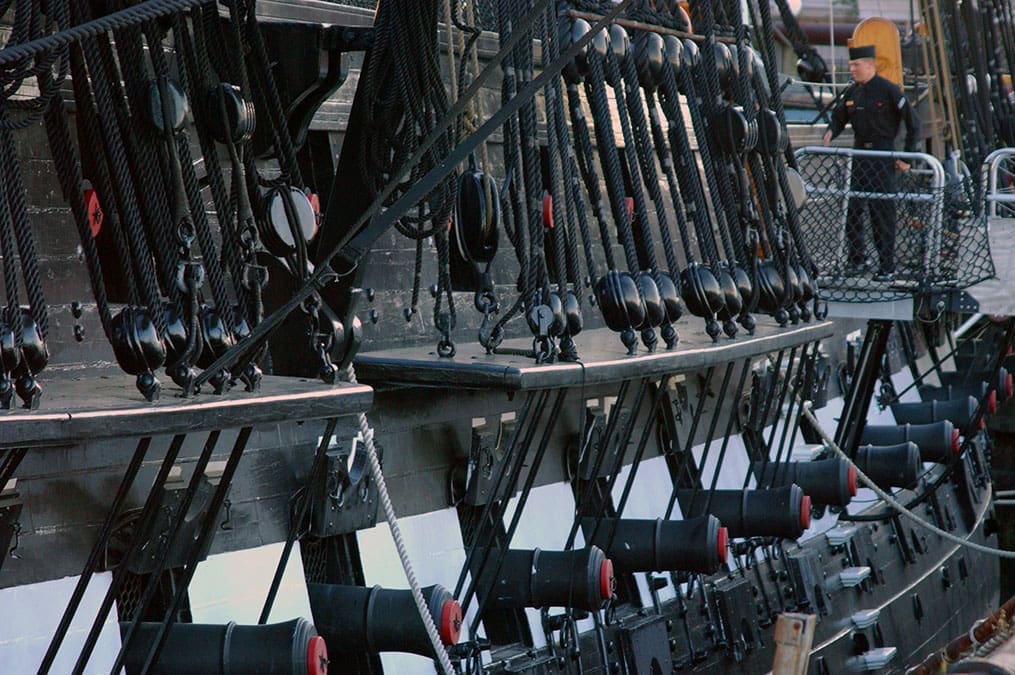 You’ll love our visit to Old Ironsides. You may even want to buy an American Flag that you get to fly over this historic ship! The Proctors have one in their family!
After breakfast, we’ll enjoy Boston, walk part of the Freedom Trail including seeing the Old North Church, and see “Old Ironsides,” the oldest commissioned warship in the world still afloat (229 years old). A memorable lecture given at Harvard Square in Cambridge will ring in your ears throughout the trip and give you new perspectives on the founding of our country and the beginnings of the Restoration. We’ll get a feeling for the American Revolution and then let you have an enjoyable hour at Quincy Market for dinner where you’ll see the famous Faneuil Hall. Built in 1742, this building hosted pre-Revolutionary protests against the Sugar and Stamp Acts and boasted speakers George Washington, Samuel Adams and later abolitionist Frederick Douglass.
Tonight we stay at the charming Colonial Inn in Concord, which dates to 1716 and weas used during the Revolutionary period by Concord Minutemen for storing arms and ammunition. It was once owned by Henry David Thoreau. (Meals: B,D)
Day 3 – Wednesday, September 16, 2026
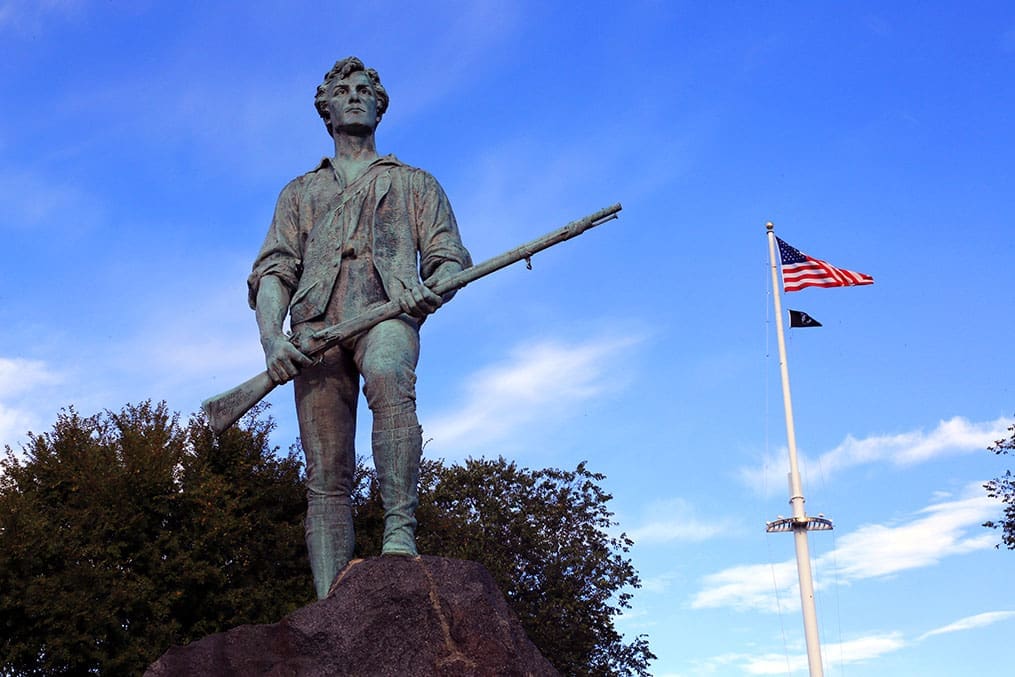 You’ll feel the spirit of the Revolution as you gaze upon the Minute Man statue here in Lexington on the Green.
This morning we will relive the first moments of the Revolutionary War and see the place where the shot was fired that was “heard around the world”. We will travel along Battle Road, stopping at various points, and even see where Paul Revere was captured by the British.

There are few places where you will feel a deeper connection to the Revolutionary War than here at the Old North Bridge in Concord.
You will come to know Lexington and Concord including hearing a moving lecture at the Old North Bridge that will help you understand those events which brought about the Independence of this great nation and set the stage for the birthplace of the Gospel of Jesus Christ in the latter days. In the afternoon we will visit Louisa May Alcott’s home and see the Sleepy Hollow Cemetery where Ralph Waldo Emerson, Nathaniel Hawthorne, Henry David Thoreau and the Alcott’s are buried. Tonight we will have a meal together at Longfellow’s Wayside Inn in Sudbury—the oldest Inn in America—established in 1716! Here we will see one of New England’s most picturesque sites and perhaps her most famous mill.
We will stay again tonight at our beautiful and historic Colonial Inn. (Meals: B, D)
Day 4 – Thursday, September 17, 2026
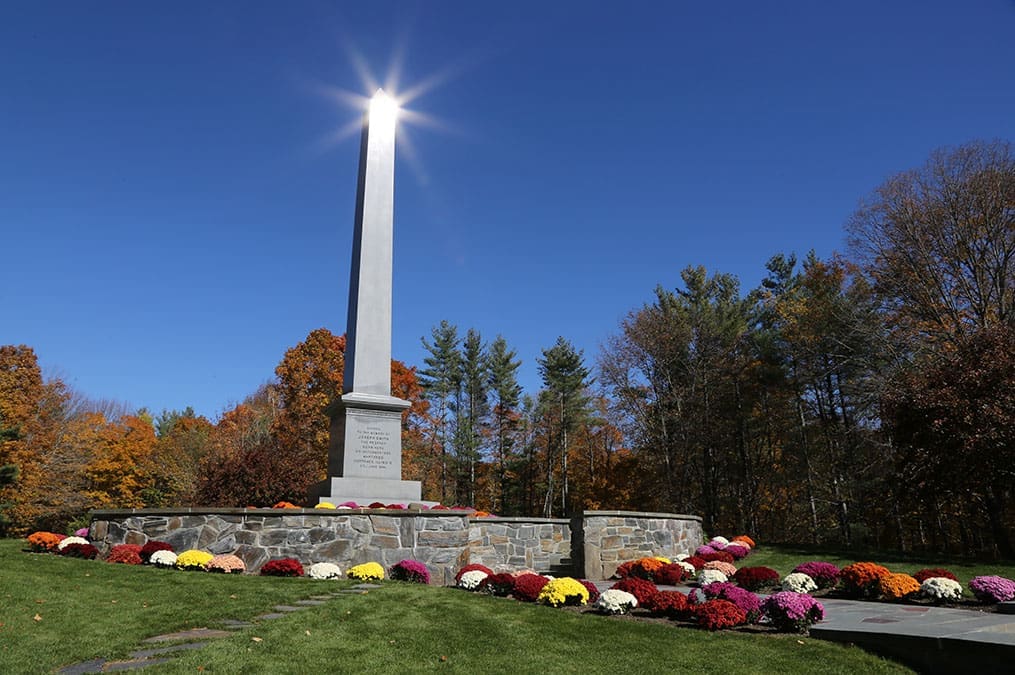 This 38 1/2 foot monument commemorates the birthplace of Joseph Smith, the Prophet.
Very early this morning we head northward on our journey into beautiful New England and for our first major Church History stop in Sharon, Vermont. Fortunately, you will experience the journey up Dairy Hill in a bus (we don’t have to hike) where we will experience strong feelings of the Spirit at the birthplace of the prophet Joseph. We will eat our lunch together on the original property where the Smiths were living. We will visit the towns of Sharon, Turnbridge, and drive past the Smith stomping grounds of Norwich and West Lebanon. Here we will get a feel for the first twenty years of marriage of Lucy Mack and Joseph Smith, Sr.
This evening we will have dinner and stay in the quaint ski resort lodging of the Best Western Inn & Suites in Rutland, VT. Rutland is only 24 miles from where Oliver Cowdery was born! (Meals B, D)
Day 5 – Friday, September 18, 2026
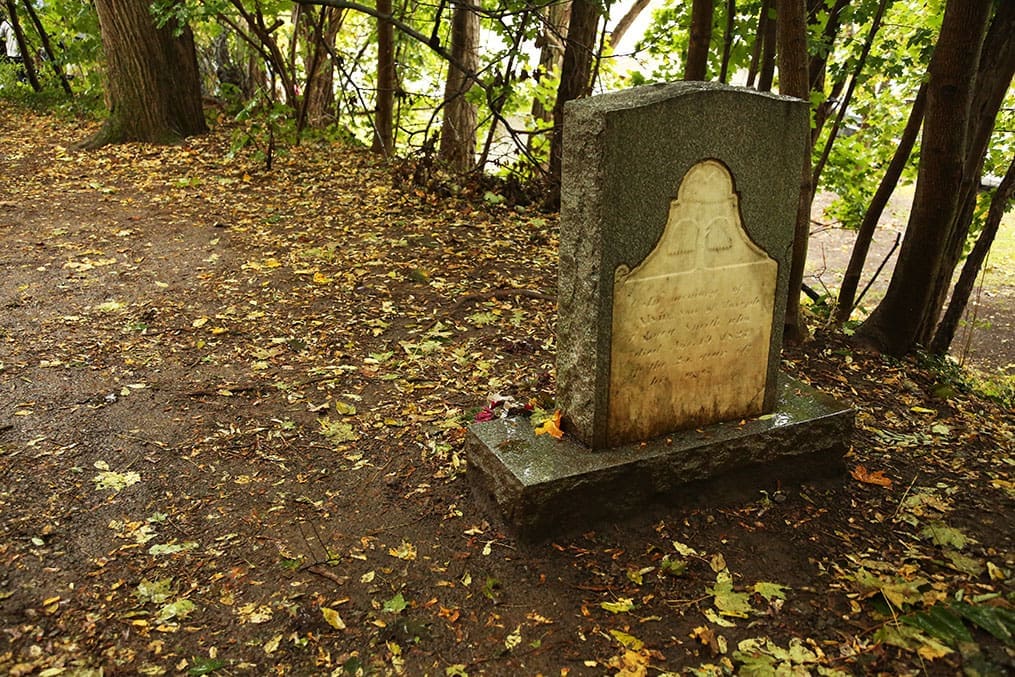 Here we walk on sacred ground at the grave of Alvin Smith.
Leaving New England the scenery changes as we wind our way south and west to fertile fields and lovely lands in Western New York. We will enjoy stories of early church leaders of the church, where they came from and how they came to know the Gospel of Jesus Christ. We will talk about what it was like for Lucy Mack Smith to make the arduous journey with eight young children more than 300 miles (without her husband) to Palmyra.
Tonight we will stay in the Woodcliff Hotel and Spa in Fairport (near Rochester), New York (right near the old Erie Canal and not too far from Palmyra) and ready ourselves for a spiritual feast tomorrow. Dinner will be at your discretion at the amazing Wegmans Food Store & Deli (you will love Wegmans—we guarantee it). (Meals: B, D)
Day 6 – Saturday, September 19, 2026
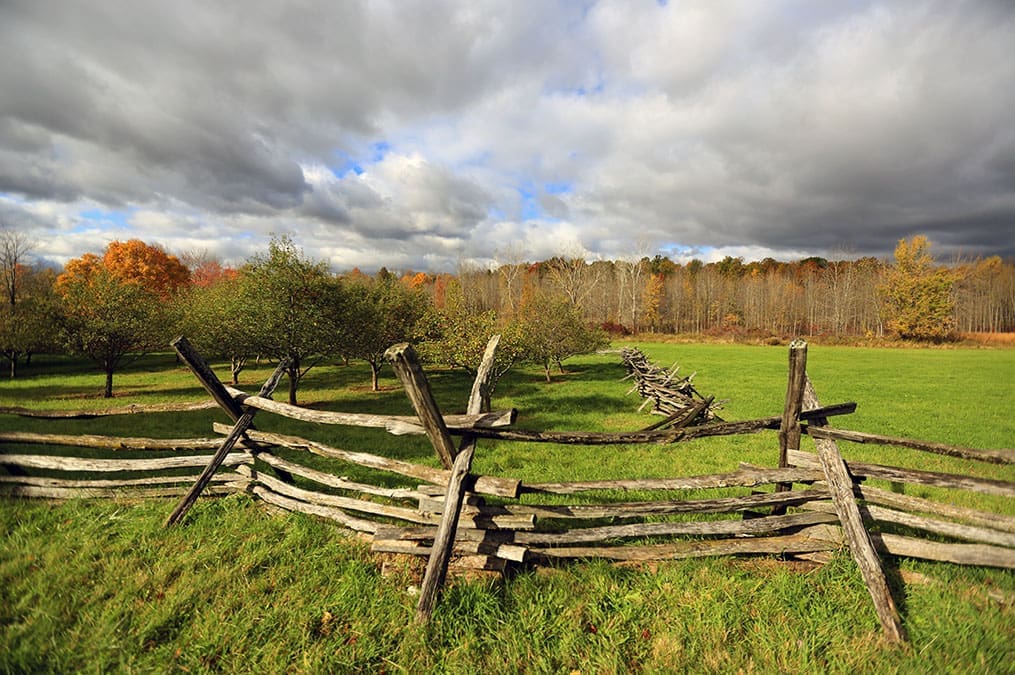 You’ll feel the Spirit here at the farm of Joseph and Lucy Smith.
We will arise early to be at the Sacred Grove and experience this, one of the most significant holy places on the earth. For many this experience is the highlight of the whole trip. We will have our own, individual quiet time in the Grove. Afterwards, we will enjoy the Smith farm, tour the Smith frame House and the Smith Log Cabin (where the Angel Moroni visited the prophet). We will also visit the Hill Cumorah, Martin Harris Farm, the E.B. Grandin Printing Complex and the downtown village of Palmyra. Our little walk up the hill to the Smith Cemetery will touch you as we gather at the grave of Alvin Smith. This afternoon we may have the opportunity of attending a session at the Palmyra Temple (be sure you bring your own temple clothes—Sarah will let us know if the scheduling works).
Dinner will be at a local restaurant before we stay again at the Woodcliff Hotel tonight.
(Meals: B, D)
Day 7 – Sunday, September 20, 2026
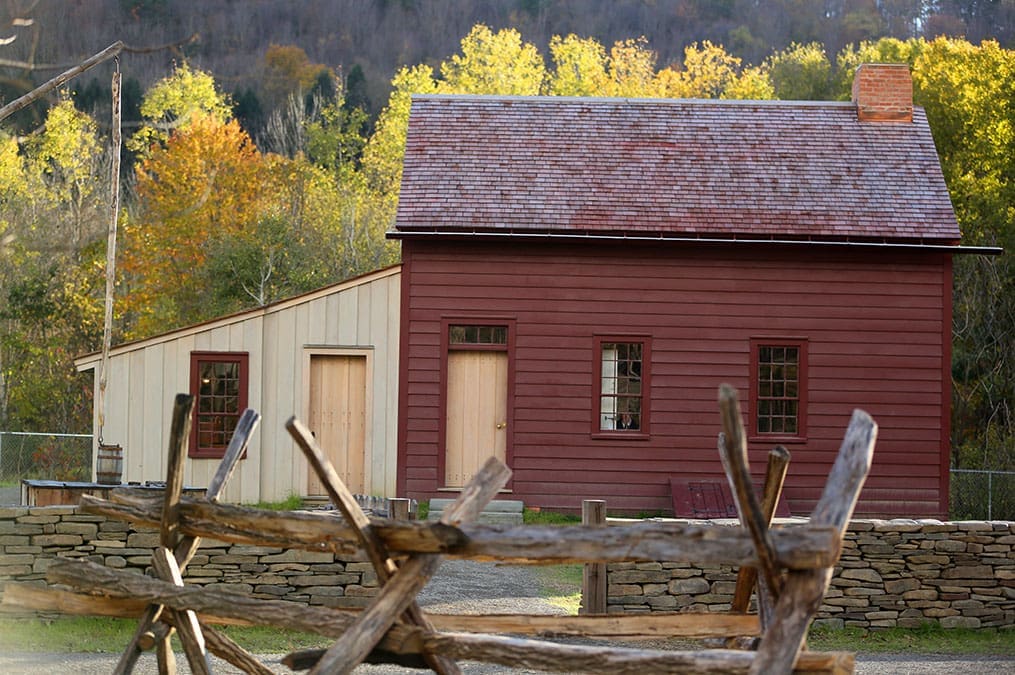
You truly have to experience this newly restored (2015) Priesthood Restoration site. It is stunning.
Today is a VERY BIG day! This morning we head to Fayette where the Whitmers lived and the Church was legally organized on Tuesday, April 6, 1830. Twenty revelations for the Doctrine and Covenants were received here or near here. This is also the place where Martin Harris, Oliver Cowdery and David Whitmer received their special witnesses of the plates. We will attend sacrament meeting at the beautiful Fayette Ward then head south to Harmony, Pennsylvania to visit the beautiful Priesthood Restoration site. For some, this is considered the most beautiful of all the Church Historical sites. Here we will see the reconstructed homes of Joseph and Emma Smith, Isaac and Elizabeth Hale, and the section of woods where John the Baptist restored the priesthood. A good part of the Book of Mormon was translated here in Joseph and Emma’s Cabin (about 70%). We will walk along the banks of the Susquehanna River where the first baptisms were performed in this dispensation. This is such a memorable afternoon and early evening!
Later this evening we check into the Double Tree Inn in Binghamton for dinner and our overnight stay. Do not miss getting your free, freshly baked famous DoubleTree 2-ounce chocolate chip cookie as we arrive. These feature 30 chocolate chips (per cookie!), a hint of lemon juice, cinnamon and coconut and are absolutely delicious. DoubleTree has distributed more than 483 million of these to date and we want to do our part to keep that number high! (Meals: B, D)
Day 8 – Monday, September 21, 2026
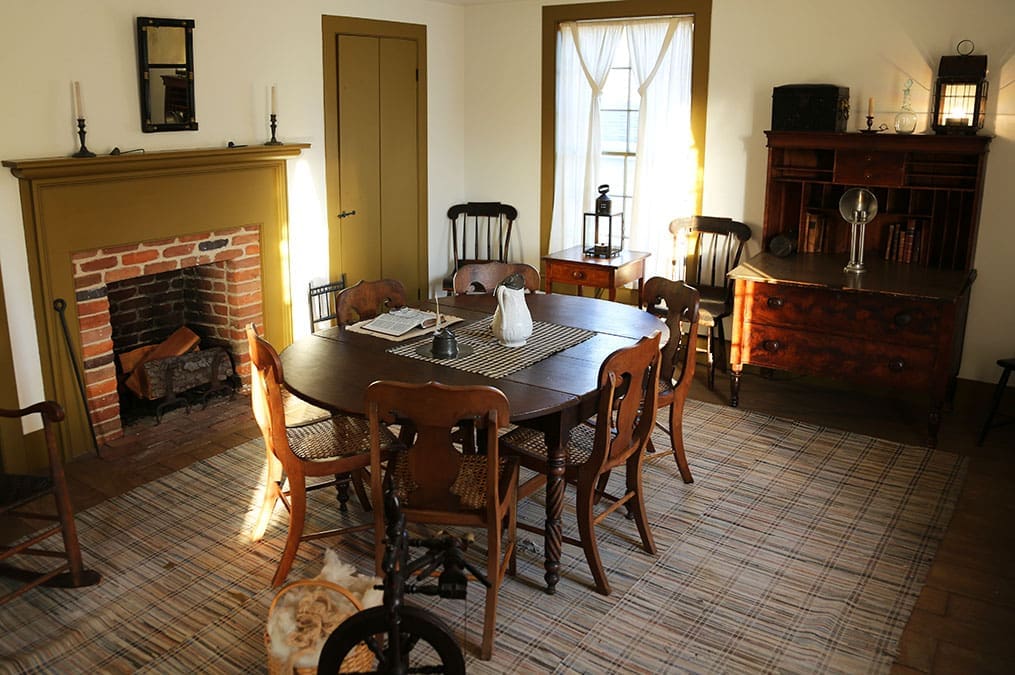 Seventeen revelations were given in this upper room of the Newel K. Whitney Store here in Kirtland.
Today we travel through some of the western regions of New York and review the missionary labors of Samuel Harrison Smith (the Prophet’s little brother) and Parley P. Pratt. The latter headed for Ohio where their labors would change the history of the Church because of the conversion of his very good friend, Sidney Rigdon. About midmorning we will make a stop in Corning, New York at the glass factory in route to Kirkland, Ohio. We reach Kirtland in the late afternoon and tour the Newell K. Whitney home and Store as well as see some of the other Kirtland sites. Be prepared for a spiritual feast at the Whitney Store.
Dinner will be at the “Olive Garden” before checking into our Hotel in Mentor (the natives do not say the “t”—it’s Menor!). (Meals: B, D)
Day 9 – Tuesday, September 22, 2026
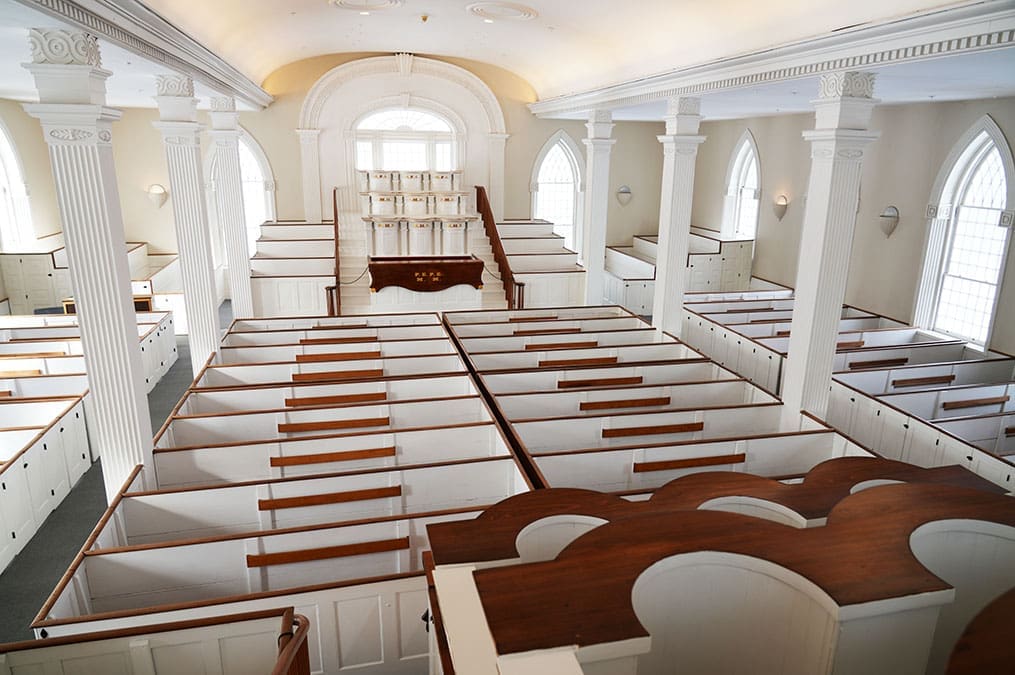 During that glorious week of the Kirtland Temple dedication in 1836 the Lord visited this room as well as numerous angels, including Moses, Elias and Elijah.
This morning Breakfast is provided at the hotel before we visit the Isaac and Lucy Morley Farm then tour the Kirtland Temple where The Lord Himself appeared as did Moses, Elias, Elijah, and numerous other angels. The script has changed a great deal since the Church purchased this historic temple March 5, 2024. You will love every minute of your time inside this sacred and holy place. We even get to go up into the third floor at the west end of the temple where Joseph had his office and saw a glorious vision of the celestial kingdom. After lunch we will travel on to the John and Elsa Johnson Farm in Hiram, Ohio where the vision of the three degrees of glory was received and at least 14 other revelations. Here the Prophet and Sidney Rigdon were mobbed, beaten and the Prophet tarred and feathered.
We travel to the heart of the Ohio Amish Country for an old-fashioned home style meal at the Dutch Valley Restaurant (eat light today because tonight, well, you can’t eat light). We stay tonight at the charming Carlisle Inn in Sugar Creek, a place where everyone begs us to stay longer! (Meals: B, D)
Day 10 – Wednesday, September 23, 2026
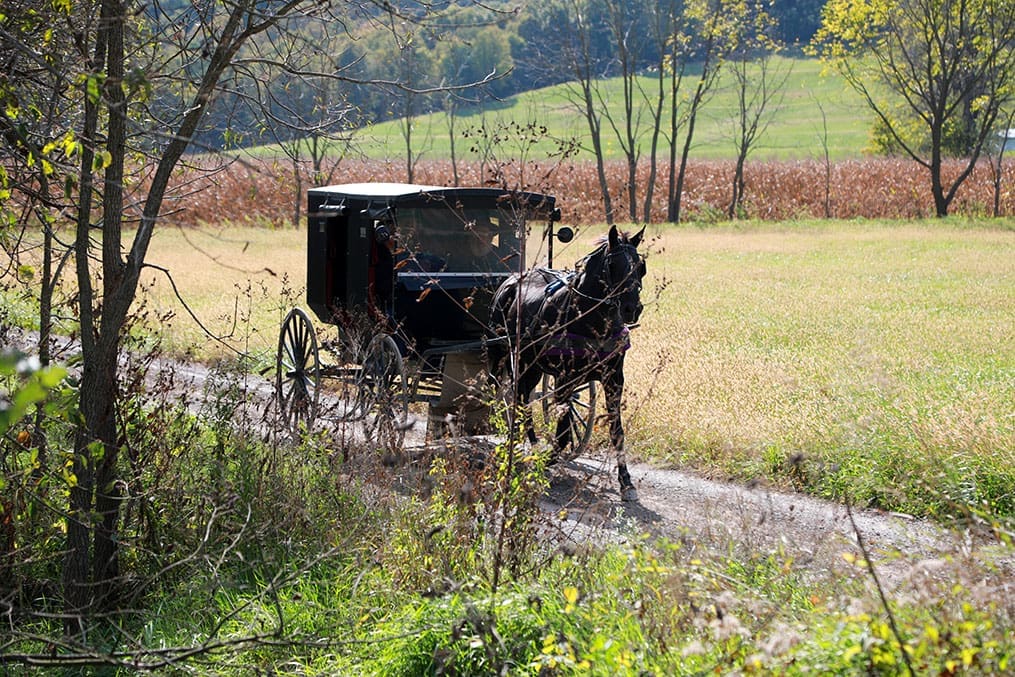 You will enjoy a buggy ride with the Amish. Holmes County Ohio boasts the largest population of Amish in the country.
This morning we will have the rare opportunity to spend more time with the Amish, touring their charming villages, seeing some of their local markets and talking to the people. You will love this experience and even have a chance to do some shopping! We will eat with one of our favorite Amish families in their home (don’t worry, they are all ready for large groups) and have another sumptuous meal together. We learn so much from the Amish.
Later this afternoon we will depart for the Cleveland airport for our flight to Kansas City. Our hotel for the next two nights is the Embassy Suites in Kansas City, Missouri. (Meals: B, D)
Day 11 – Thursday, September 24, 2026
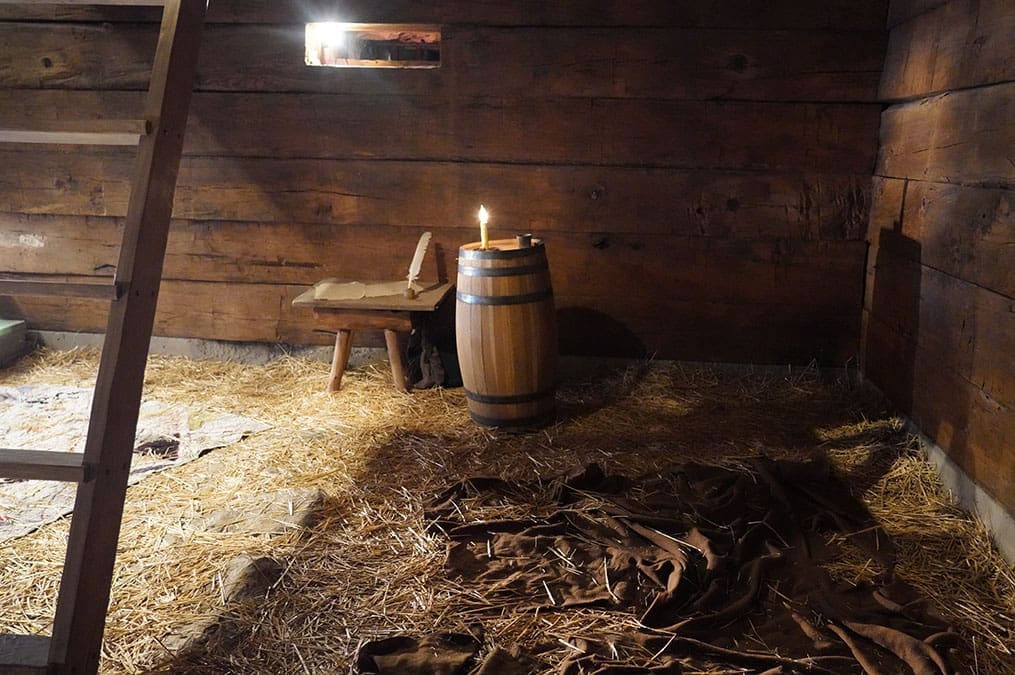
The Liberty Jail beccame a temple-prison for the Prophet Joseph.
This morning we will visit Independence, Missouri. Here we will see the original temple lot, enjoy our own Latter-day Saint Visitors’ Center and see the original Jackson County Courthouse. We then head east to visit Richmond, Missouri where two of the Three Witnesses of the Book of Mormon are buried. We then end our touring today in the Liberty Jail where the Prophet Joseph and his companions were imprisoned through the cold winter months of 1838/1839. Here we will feel the Spirit as we read the revelations and hear the voices of the past. We will also watch for the Kansas City Missouri Temple as we pass by it and see its beautiful setting in Clay County.
This evening we will have a wonderful meal either at the Cracker Barrel or a restaurant near our hotel. (Meals: B, D)
Day 12 – Friday, September 25, 2026
 For many our visit to Adam-ondi-Ahman is the highlight of our tour.
We head for our morning teaching and meditational time at a very, very special place: Adam-ondi-Ahman! Here you will learn things you’ve never known and perhaps even feel things you have never felt. This is a very sacred place that dates to the beginning of recorded time. After a wonderful lunch on your own at a local Mexican Restaurant in Gallatin, we then visit the temple site at Far West and hear some powerful stories of faith and super faith here. We then make our way east along the approximate path the Saints were driven out of Missouri.
This evening we eat dinner in Hannibal at a local Chinese Restaurant where we have taken groups for many years. We then head the last hour and 25 minutes to Nauvoo! We will be staying at the Nauvoo Family Inn and Suites for the remaining three nights of our journey. (Meals: B, D)
Day 13 – Saturday, September 26, 2026
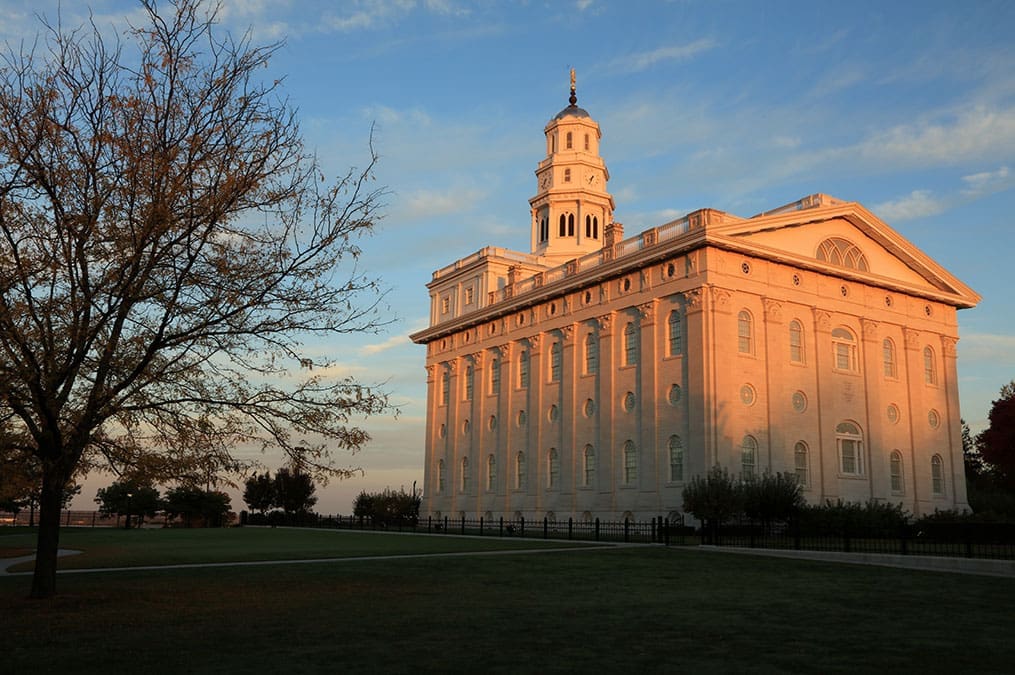 How can we ever forget that breathtaking announcement on April 4, 1999 that the Nauvoo Temple would be rebuilt?
This morning we step back in time and spend a glorious day touring the sites of Old Nauvoo—beginning with a session (either initiatory, sealing or endowment depending on availability and scheduling) in the stunning Nauvoo Temple. Today we’ll hear stories of the past and get a feel for “the City of Joseph”. We will see the moving Relief Society Gardens where thirteen monuments to women will touch your soul. We will tour Brigham Young’s home (recently renovated and redone), the Printing Complex, the Blacksmith Shop, the Seventies Hall, the Browning Gunsmith Shop and Home and as many other places as we can squeeze in—including the brand new Nauvoo Temple Visitors’ Center. You may receive a Nauvoo brick today as a souvenir from Nauvoo.
Tonight we will dine at the old Nauvoo Hotel (depending on their business situation–or some other nearby dining experience) with their wonderful all-you-can eat dinner buffet. Don’t miss their amazing cinnamon buns! (Meals: B, D)
Day 14 – Sunday, September 27, 2026
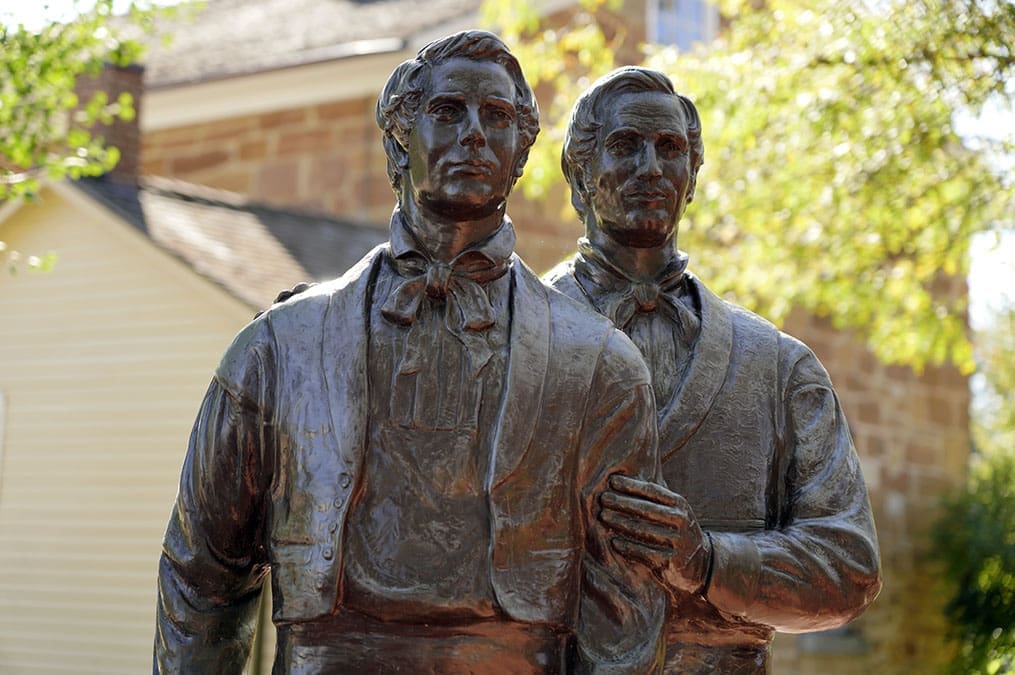
By the end of two weeks you will feel a deep love for Joseph and Hyrum.
We will attend the earliest Sacrament Meeting in the Nauvoo Ward and then tour more of Nauvoo. This afternoon we travel south and east to our final stop: The Carthage Jail. Here you will have one of the highlight experiences of the trip as we review the events of the Carthage Jail and talk about our feelings for Joseph and Hyrum. We end the tour with a group testimony meeting in Nauvoo at our hotel. (Meals: B, L)
Day 15 – Monday, September 28, 2026
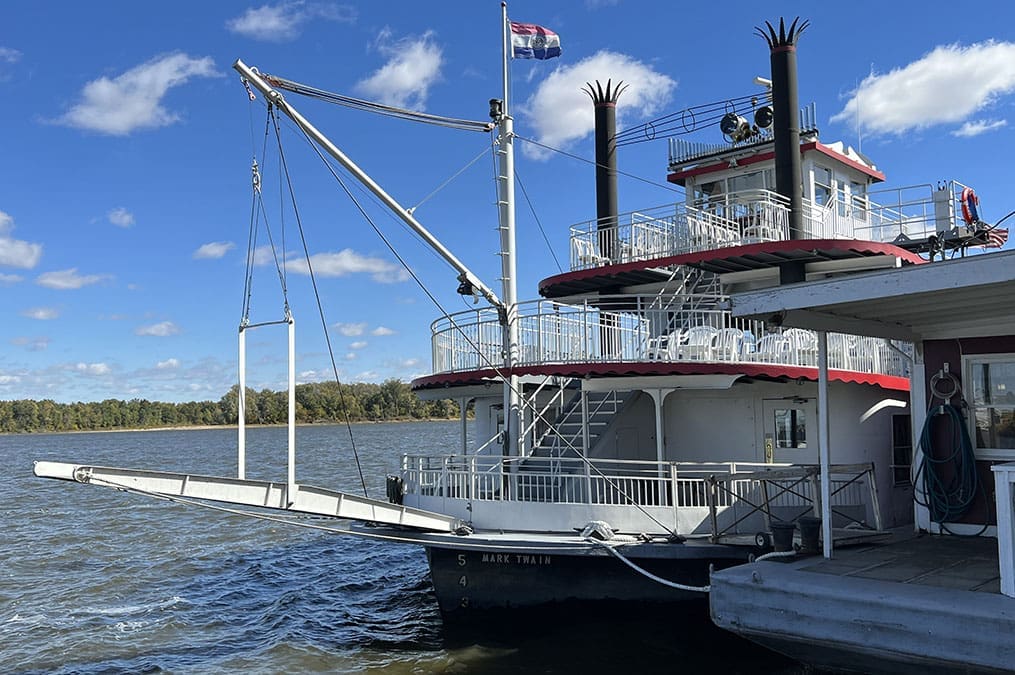
We will have a wonderful Mississippi River boat ride/lunch cruise at Hannibal, Missour–Mark Twain’s home town.
As we say our farewells to Nauvoo this morning, we continue on to Mark Twain’s Hannibal on the Mississippi River where we’ll take a special luncheon cruise on a riverboat hosted by a charming family who really take pride in this experience and make you feel so welcome. You’ll delight in hearing the stories and folklore of this mighty river. Following this special lunch, we’ll immediately head to St. Louis with a brief stopover in Historic St. Charles, Missouri, the beginning of the Lewis and Clark Expedition, May 14, 1804. It’s only a tease but you will love your approximately one hour of walking these 18th and 19th century streets and maybe get an ice cream cone (only homemade) at Kilwin’s.
Now we sadly head to our evening flights home (only about 15 minutes from St. Charles). Farewell dear friends! (B, L)
Tour Cost Per Person includes hotels, deluxe motor coach, flight from Cleveland, Ohio to Kansas City, Missouri, entrance fees, taxes & gratuities, luggage handling, daily breakfast and dinner, and a Mississippi Riverboat cruise.
Credit Card price:
- Double Occupancy $4,479 per person.
- Ask Sarah about Single or Triple occupancy pricing.
Round trip airfare from home cities is not included, but may be booked with the group or secured on an individual basis (you are welcome to use frequent flyer miles).
Please call our agent, Sarah Wangsgard, at Morris Murdock Travel direct to her office at: 801-483-6473.
Please note again: This tour will sell out; if you would like to go right online and book it yourself, PLEASE CLICK HERE. When you get to that page, scroll down to where it says BOOK NOW and then set up your account and take care of it.
A deposit of $250.00 per person is necessary to hold space. Payment arrangements can be made with final payment due 60 days prior to the tour. Cancellation insurance is available and is always recommended.
A Culmination of the Restoration
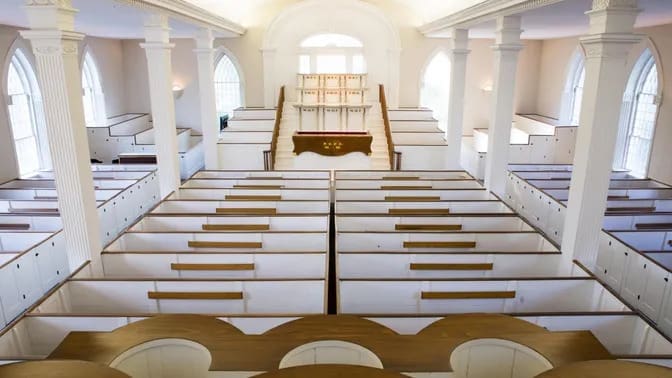
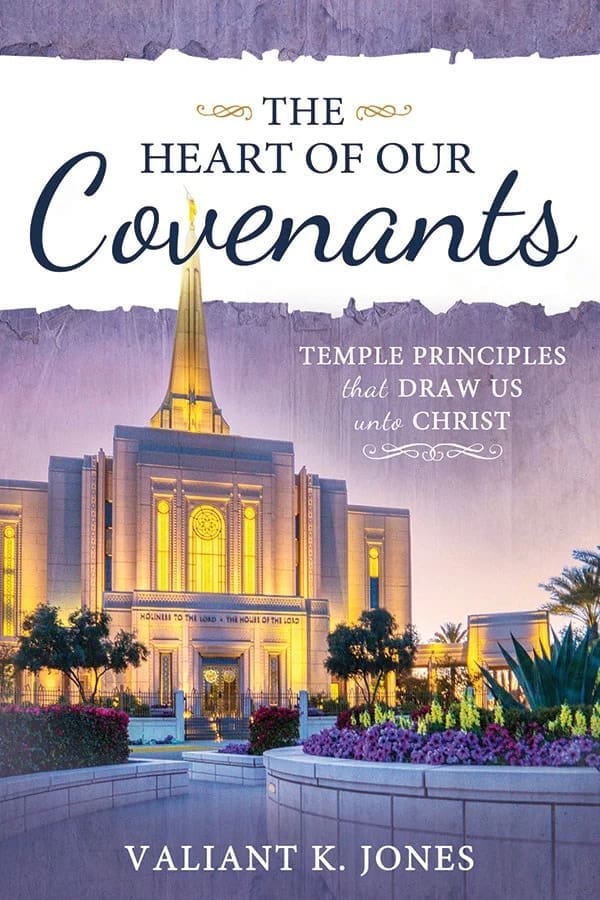
One hundred and ninety years ago, in a remarkable series of visions inside the newly dedicated Kirtland Temple, Joseph Smith and Oliver Cowdery received the keys of temple work. This series of three articles seeks to increase understanding of the priesthood keys restored on that occasion. It includes excerpts from The Heart of Our Covenants: Temple Principles that Draw Us unto Christ by Valiant K. Jones. Used by permission. See www.valiantjones.com or www.cedarfort.com.
This is part 3 of 3.
See the first part article in this series here.
See the second part article in this series here.
This series of articles has expounded on the remarkable series of visions that occurred in the Kirtland Temple on April 3, 1836. The reception of priesthood keys on this occasion was a culmination of a series of restoration experiences. The following table summarizes the most significant of the priesthood restoration events of this dispensation.
Priesthood Restoration Events for Joseph Smith and Oliver Cowdery
| Restorer | When | Where | Purpose and Keys Restored |
| John the Baptist | May 15, 1829 | On the banks of the Susquehanna River, near Harmony, Pennsylvania | Aaronic Priesthood: the keys of the ministering of angels and of repentance and baptism (see D&C 13) |
| Peter, James, and John | Most likely in late May 18291 | In the wilderness between Harmony and Colesville, Pennsylvania (see D&C 128:20) | Melchizedek Priesthood: the keys of spiritual blessings, including the Holy Ghost, and the keys of church administration (see D&C 27, 84, 107) |
| Moses | April 3, 1836 | Temple in Kirtland, Ohio | The keys of the gathering of Israel (see D&C 110) |
| Elias | April 3, 1836 | Temple in Kirtland, Ohio | The keys of the Abrahamic covenant including eternal marriage (see D&C 110) |
| Elijah | April 3, 1836 | Temple in Kirtland, Ohio | The keys of sealing for all ordinances for the living and the dead (see D&C 110) |
Let us review the succession of the receipt of these priesthood keys and see how they build on one another. John the Baptist first appeared to Joseph Smith and Oliver Cowdery to “confer the Priesthood of Aaron, which holds the keys of the ministering of angels, and of the gospel of repentance, and of baptism by immersion for the remission of sins” (D&C 13:1). Next, Peter, James, and John restored the Priesthood of Melchizedek, which holds the “keys of all the spiritual blessings of the church” (D&C 107: 18), including the gift of the Holy Ghost. They also “committed the keys of the kingdom, and a dispensation of the gospel for the last times” (D&C 27:13). Furthermore, “this greater priesthood administereth the gospel and holdeth the key of the mysteries of the kingdom, even the key of the knowledge of God” (D&C 84:19).
At this point, Joseph and Oliver possessed the keys and authority to perform all the ordinances of salvation, but they lacked the authority to spread this work of salvation globally. Moses came and filled this gap, providing “the keys of the gathering of Israel from the four parts of the earth” (D&C 110:11). Joseph and Oliver also lacked the keys and authority necessary to perform the exaltation ordinances of the endowment and eternal marriage. This was remedied with the bestowal of the keys of the Abrahamic covenant by Elias who “committed the dispensation of the gospel of Abraham” (D&C 110:12).
The keys and authority necessary to perform all ordinances had now been restored; however, this was still not enough. Up to this point, any ordinances were provisional and could only be performed for the living. Additional keys were needed to be able to seal the eternal validity of these ordinances in heaven and to make it possible to perform the same ordinances for the dead. These keys were restored by Elijah who restored keys “to turn the hearts of the fathers to the children, and the children to the fathers, lest the whole earth be smitten with a curse” (D&C 110:15).
We might ask why Jesus could not have conferred all these priesthood keys Himself. Certainly He held all priesthood keys, so surely, He could have. However, Christ respects and honors those He calls into stewardship under Him, and He provides opportunities for participation and personal growth as broadly as He can.
Similar to Joseph and Oliver, Christ’s apostles Peter, James, and John received priesthood keys from Moses and Elijah on the Mount of Transfiguration (see Mathew 17, Mark 9, and Luke 9). These two Old Testament prophets had gone to heaven without tasting death, allowing them to be able to return and corporally lay their hands on the heads of Peter, James, and John for the transmission of priesthood keys before Christ broke the bands of death and made resurrection possible. In addition, Joseph Smith has implied that John the Baptist was present.2 However, the Baptist could only have been there in spirit since he had recently died (see Matthew 14:1-12). Therefore, his presence could not have been for the transfer of his keys. That transfer of Aaronic Priesthood keys, although not recorded in the New Testament, had undoubtedly occurred while John the Baptist was living. Perhaps the Baptist came, in spirit, to the Mount of Transfiguration in order to be instructed by Jesus on the future transfer of the priesthood keys that everyone present would participate in 1800 years later: Jesus, John the Baptist, Peter, James, John, Moses, and Elijah.
We might wonder why the keys of Moses, Elias, and Elijah needed to be restored to Joseph Smith, since the work of the priesthood was already under way by the time they came. Their visits occurred in April of 1836, yet the Church had been organized in April of 1830. During the intervening six years, many members had been baptized and received the gift of the Holy Ghost, and many brethren had been ordained to the priesthood. Were these ordinances performed on earth without being sealed in heaven? Also, Samuel Smith had already been set apart in June of 1830 as the first official missionary of the Church, and he had already been sharing copies of the Book of Mormon throughout New England.3 Was this not the start of the gathering of Israel? Furthermore, Joseph Smith had received some degree of revelation regarding eternal marriage as early as 1831,4 and he performed anointings in the upper rooms of the incomplete temple in January of 1836.5
Clearly, the spirit of the restoration of the priesthood keys was already at work on the earth before Moses, Elias, and Elijah appeared. However, all of those early events were very limited in scope. Until the final restoration of the priesthood keys in the Kirtland temple, those actions and ordinances were only provisional. The Lord was laying the foundation of the restoration line upon line and precept upon precept. The work of gathering Israel and the work of forming eternal families could not expand beyond their early limited scopes until all priesthood keys were restored. In addition, the work of salvation for the dead could not and did not occur until after Elijah’s visit.
It appears that Joseph Smith was able to take those initial steps to begin the work of salvation under the authority of the Melchizedek priesthood and the mantle of his prophetic calling. This preliminary authority may have been what Joseph and Oliver received as a pronouncement from God when “the voice of God in the chamber of old Father Whitmer, in Fayette, Seneca county” (D&C 128:21) instructed them on steps to take to establish the Church. In his 1838 history, Joseph Smith placed this sacred, authorizing event shortly after the visit of John the Baptist.6 BYU professor Michael Hubbard MacKay has researched this event and suggested that it brought priesthood authority to Joseph before the bestowal of the keys of the Melchizedek Priesthood by Peter, James, and John.7
Clearly, the scope of Joseph’s early priesthood efforts was limited until he received the fulness of priesthood keys in the Kirtland temple. It is interesting to note that the quorum of the Twelve Apostles had only been established less than a year prior to the restoration of these priesthood keys, and their missionary endeavors had not yet extended beyond short, regional missions in North America. The foundation was being laid so that Joseph could share these keys with the new apostles. After these keys were restored, Joseph started sending missionaries to distant nations across the oceans.8 All of the priesthood keys necessary to direct the work of salvation for the living and the dead were once again upon the earth.
President Packer taught, “Elijah came . . . and bestowed the keys of the sealing power. Thereafter ordinances were not tentative, but permanent. The sealing power was with us. No authorization transcends it in value. That power gives substance and eternal permanence to all ordinances performed with proper authority for both the living and the dead.”9
Restored Keys Extend Christ’s Atonement to All
Because of the events at the Kirtland Temple on April 3, 1836, the restored keys of Moses, Elias, and Elijah are now carried out as a unified system of priesthood ordinances in hundreds of temples scattered throughout the world. The purpose of these keys is to expand the reach of the Atonement of Jesus Christ to everyone who has ever lived upon the earth.
The Prophet Joseph Smith explained why this work is so important: “The greatest responsibility in this world that God has laid upon us is to seek after our dead. The apostle says, ‘They without us cannot be made perfect;’ (Hebrews 11:40) for it is necessary that the sealing power should be in our hands to seal our children and our dead for the fulness of the dispensation of times . . . . It is necessary that those who are going before and those who come after us should have salvation in common with us; and thus hath God made it obligatory upon man. Hence, God said, ‘I will send you Elijah the prophet before the coming of the great and dreadful day of the Lord: he shall turn the heart of the fathers to the children, and the heart of the children to their fathers, lest I come and smite the earth with a curse.’ (Malachi 4:5.)”10
Without the keys restored by Moses, Elias, and Elijah, “the whole earth would be utterly wasted at [Christ’s] coming” (D&C 2:3). But now, through the great work of gathering Israel on both sides of the veil, and through temple work performed under the keys of Elias and Elijah for the living and the dead, the purpose of the creation of the earth is being fulfilled, and Christ will not need to smite it with a curse when He comes. Instead, He will be joyful knowing that the earth’s purpose has been fulfilled, facilitated by the restoration of priesthood keys.
These keys of the priesthood continue with us today. At the time of the death of Joseph Smith, most of the twelve apostles were away on missions. Apostle Wilford Woodruff and quorum president Brigham Young were in New England, and they met together in Boston shortly after learning of the martyrdom. Later, when President Woodruff was prophet himself, he recounted the following memory of that occasion:
“We were overwhelmed with grief and our faces were soon bathed in a flood of tears. … After we had done weeping we began to converse together concerning the death of the prophets [Joseph and Hyrum Smith]. In the course of the conversation, [Brigham] smote his hand upon his thigh and said, ‘Thank God, the keys of the kingdom are here.’ . . .
“President Young . . . referred to the last instructions at the last meeting we had with the Prophet Joseph before starting on our mission. . . . On that occasion the Prophet Joseph rose up and said to us: ‘Brethren, I have desired to live to see this temple built. I shall never live to see it, but you will. I have sealed upon your heads all the keys of the kingdom of God. I have sealed upon you every key, power, principle that the God of heaven has revealed to me. Now, no matter where I may go or what I may do, the kingdom rests upon you.’ . . .
“The keys of the kingdom of God are here, and they are going to stay here, too, until the coming of the Son of Man. Let all Israel understand that. They may not rest upon my head but a short time, but they will then rest on the head of another Apostle, and another after him, and so continue until the coming of the Lord Jesus Christ in the clouds of heaven.”11
We are blessed to have these keys with us today, held active and viable by a living prophet who is a modern apostle of Jesus Christ. It is under the direction of these keys that sacred priesthood ordinances are now performed in temples throughout the earth.
President Nelson said, “Consider how your life would be different if priesthood keys had not been restored to the earth. Without priesthood keys, you could not be endowed with the power of God. Without priesthood keys, the Church could serve only as a significant teaching and humanitarian organization but not much more. Without priesthood keys, none of us would have access to essential ordinances and covenants that bind us to our loved ones eternally and allow us eventually to live with God.
“Priesthood keys distinguish The Church of Jesus Christ of Latter-day Saints from any other organization on earth. Many other organizations can and do make your life better here in mortality. But no other organization can and will influence your life after death.
“Priesthood keys give us the authority to extend all of the blessings promised to Abraham to every covenant-keeping man and woman. Temple work makes these exquisite blessings available to all of God’s children, regardless of where or when they lived or now live. Let us rejoice that priesthood keys are once again on the earth!”12
We do rejoice! We are blessed to live in a time when these priesthood keys are active on the earth, allowing us to participate in the work of salvation and exaltation on both sides of the veil. Besides maintaining our own personal righteousness, there is no better way to show our love for Jesus Christ and to prepare for His Second Coming than to gather the children of Israel under the direction of these priesthood keys so that all have the opportunity to progress along the covenant path toward exaltation.
I Shall Love Thee Better after Death
Many poets have written about a romantic love that will last forever. Eternal love has been a topic of sonnets, songs, and poems throughout all literature. Such longings speak to one of the deepest and most profound emotions men and women experience. However, simply declaring one’s love for another person will not create a bond that will last throughout eternity. Only sealing ordinances administered through priesthood keys will do that.
In her sonnet, “How Do I Love Thee,” Elizabeth Barrett Browning wrote, “How do I love thee? Let me count the ways./ . . . I love thee with the breath,/ Smiles, tears, of all my life; and, if God choose,/ I shall but love thee better after death.13
Desires expressed in poems and songs cannot create bonds that will be sanctioned by God throughout eternity. A person may claim, “I shall but love thee better after death,” but this is only possible if two conditions are met. First, a couple must have an eternal marriage that is solemnized by an authorized temple sealer who has been set apart under the delegated authority of the living prophet of God. And second, that couple must embrace their temple covenants in such a way that those covenants start to change their natures. Only through living our temple covenants can we become sanctified in Christ and have our marriage “sealed by the holy spirit of promise” (D&C 132:7). That process may not be completed in this life, but if we will stay on the path—the covenant path—it will eventually be achieved with the help and grace of Jesus Christ.
This is why the keys of temple work matter. They create the foundation of sanctioned authority upon which eternal marriages can be established as well as the covenant environment in which eternal family relationships can flourish. In his own poetic prose, Elder Parley P. Pratt described the feelings he experienced when he first learned the doctrine of eternal families and the joy that came to him from knowing these eternal truths:
“It was Joseph Smith who taught me how to prize the endearing relationships of father and mother, husband and wife; of brother and sister, son and daughter. It was from him that I learned that the wife of my bosom might be secured to me for time and all eternity; and that the refined sympathies and affections which endeared us to each other emanated from the fountain of divine eternal love. It was from him that I learned that we might cultivate these affections and grow and increase in the same to all eternity . . . .
“I had loved before, but I knew not why. But now I loved—with a pureness—an intensity of elevated, exalted feeling, which would lift my soul from the transitory things of this groveling sphere and expand it as the ocean. I felt that God was my heavenly Father indeed; that Jesus was my brother, and that the wife of my bosom was an immortal, eternal companion . . . . I could now love with the spirit and with the understanding also.”14
This eternal love, so beautifully described by Elder Pratt, is possible because of the sacred temple keys that were restored in the Kirtland temple on April 3, 1836. What a blessing to have these keys effective today under the direction of a living prophet of God in hundreds of temples throughout the world. Like Elder Pratt, I, too, am grateful to be sealed to the wife and children of my bosom for eternity. Only in the Church of Jesus Christ of Latter-day Saints are these eternal blessings available because of the restoration of the sacred priesthood keys of temple work. This is the foundation for a love that truly will be “better after death.”
Valiant K. Jones is the author of The Heart of Our Covenants: Temple Principles that Draw Us unto Christ. For more information, see www.valiantjones.com
Footnotes
1 Larry C. Porter, “The Restoration of the Aaronic and Melchizedek Priesthoods,” Ensign, December 1996, churchofjesuschrist.org/study/ensign/1996/12/the-restoration-of-the-aaronic-and-melchizedek-priesthoods?lang=eng. In June 1829, Joseph Smith received D&C 18, which stated that Oliver Cowdery and David Whitmer were to be called as apostles (verse 9) and were to select additional members of that quorum. This implies that the Melchizedek Priesthood had already been restored by that time.
2 The Joseph Smith Translation of Mark 9:3 says, “And there appeared unto them Elias with Moses, or in other words, John the Baptist and Moses,” and under “Elias” in the Bible Dictionary says, “The curious wording of JST Mark 9:3 does not imply that the Elias at the Transfiguration was John the Baptist, but that in addition to Elijah the prophet, John the Baptist was present.”
3 Ryan Carr, “The First Latter-day Missionary,” New Era, Sept. 2004, lds.org/new-era/2004/09/the-first-latter-day-missionary?lang=eng.
4 The heading to D&C 132 says, “Evidence indicates that some of the principles involved in this revelation [on Eternal Marriage] were known by the Prophet as early as 1831.”
5 Richard O. Cowan, “The Unfolding Restoration of Temple Work,” Ensign, Dec. 2001, lds.org/ensign/2001/12/the-unfolding-restoration-of-temple-work?lang=eng.
6 Joseph Smith, History, 1838–1856, volume A-1 [23 December 1805–30 August 1834], p. 27, The Joseph Smith Papers, josephsmithpapers.org/paper-summary/history-1838-1856-volume-a-1-23-december-1805-30-august-1834/33.
7 Michael Hubbard MacKay, “Event or Process? How “the Chamber of Old Father Whitmer” Helps Us Understand Priesthood Restoration,” BYU Studies Quarterly, Vol. 60, No. 1, 2021, p. 73, byustudies.byu.edu/article/event-or-process-how-the-chamber-of-old-father-whitmer-helps-us-understand-priesthood-restoration/.
8 “Chapter 24 Truth Shall Prevail,” Saints Volume 1, site.churchofjesuschrist.org/study/history/saints-v1/24-truth-shall-prevail?lang=eng.
9 Boyd K. Packer, “Ordinances,” ibid.
10 Joseph Smith Jr., Teachings of the Prophet Joseph Smith, p. 356; see also Joseph Smith Jr., “Chapter 41: Becoming Saviors on Mount Zion,” ibid.
11 Wilford Woodruff, “The Keys of the Kingdom,” Ensign, April 2004, churchofjesuschrist.org/study/ensign/2004/04/the-keys-of-the-kingdom?lang=eng.
12 Russell M. Nelson, “Rejoice in the Gift of Priesthood Keys,” Liahona, May 2024, churchofjesuschrist.org/study/liahona/2024/05/57nelson?lang=eng.
13 Elizabeth Barrett Browning, “How Do I Love Thee? (Sonnet 43),” Academy of American Poets, accessed October 20, 2024, poets.org/poem/how-do-i-love-thee-sonnet-43.
14 Parley P. Pratt, “He Taught Me the Heavenly Order of Eternity,” Ensign, August 2015, churchofjesuschrist.org/study/ensign/2015/08/he-taught-me-the-heavenly-order-of-eternity?lang=eng; formatting modified.
Elijah, the Sealing Powers, and the Kirtland Temple
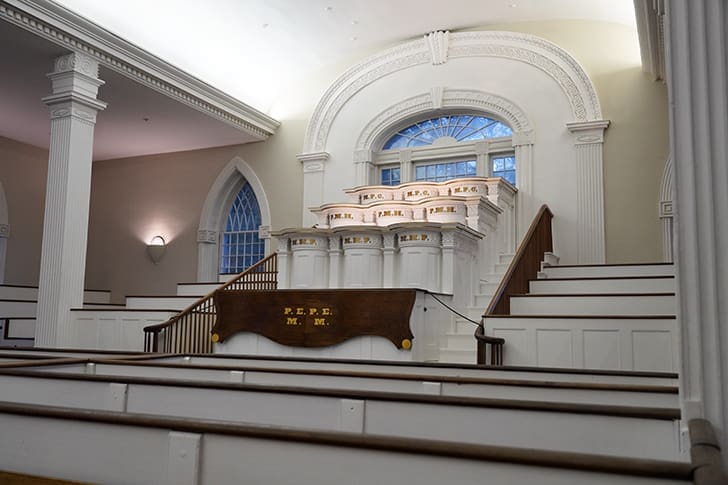
One hundred and ninety years ago, in a remarkable series of visions inside the newly dedicated Kirtland Temple, Joseph Smith and Oliver Cowdery received the keys of temple work. This series of articles seeks to increase understanding of the priesthood keys restored on that occasion. It includes excerpts from The Heart of Our Covenants: Temple Principles that Draw Us unto Christ by Valiant K. Jones. Used by permission. See www.valiantjones.com or www.cedarfort.com.
This is part 2 of 3. See the previous article in this series here
Work for the dead was not performed on the earth until after Christ initiated the preaching of the gospel to the spirits in prison at the time of His death. No proxy work for the dead could occur until after Christ opened the door for this by doing the greatest proxy work of all—atoning for our sins. Peter wrote, “For Christ also hath once suffered for sins, the just for the unjust, that he might bring us to God, being put to death in the flesh, but quickened by the Spirit: by which also he went and preached unto the spirits in prison; which sometime were disobedient . . . For for this cause was the gospel preached also to them that are dead, that they might be judged according to men in the flesh, but live according to God in the spirit” (1 Peter 3:18–20, 4:6).
President Joseph F. Smith’s vision of the spirit world makes it clear that, when Christ died, the dead “were assembled awaiting the advent of the Son of God into the spirit world” (D&C 138:16), apparently with no change in the status of each since their deaths. Christ arrived and organized the faithful to be teachers to those who were in darkness. President Smith described how the Lord initiated this work of redemption of the dead: “I perceived that the Lord went not in person among the wicked and the disobedient who had rejected the truth, to teach them; but behold, from among the righteous, he organized his forces and appointed messengers, clothed with power and authority, and commissioned them to go forth and carry the light of the gospel to them that were in darkness, even to all the spirits of men; and thus was the gospel preached to the dead. . . . Thus was it made known that our Redeemer spent his time during his sojourn in the world of spirits, instructing and preparing the faithful spirits of the prophets who had testified of him in the flesh; that they might carry the message of redemption unto all the dead” (D&C 138:29-30, 36-37).
Christ’s ministry in the spirit world had to occur before authorized proxy ordinances for the dead could be performed on earth. The Bible Dictionary entry for “Temple” confirms this, declaring: “From Adam to the time of Jesus, ordinances were performed in temples for the living only. After Jesus opened the way for the gospel to be preached in the world of spirits, ceremonial work for the dead, as well as for the living, has been done in temples on the earth by faithful members of the Church.”1
Confirming this, President Nelson taught, “From the days of Adam to the meridian of time, temple ordinances were performed for the living only. Ordinances for the dead had to await the Atonement and postmortal ministry of the Savior.”2 This same principle also was taught by President Brigham Young3 and President Joseph Fielding Smith.4 Understanding that temple ordinances were performed only for the living until after Christ’s resurrection will help us understand the keys of Elijah.
Elijah’s Keys Seal All Ordinances for the Living
We often say that Elijah brought the sealing keys of temple work for the dead, and this is true; however, since proxy temple work for the dead did not occur until after the resurrection of Jesus, what purpose did these keys fulfill in Old Testament times? The answer lies in the dual nature of these keys: They apply to ordinances performed both for the living and for the dead. Elijah’s keys seal in heaven all priesthood ordinances performed on earth, regardless of which side of the veil the souls reside on when they are named in the ordinances.
The way in which the sealing keys of Elijah were used in his day was to make sure all ordinances done for the living applied eternally. For priesthood ordinances to apply eternally, they must be performed under the direction of a prophet or apostle who holds the sealing keys of Elijah. Regarding these keys, the Prophet Joseph Smith declared, “It may seem to some to be a very bold doctrine that we talk of—a power which records or binds on earth and binds in heaven. Nevertheless, in all ages of the world, whenever the Lord has given a dispensation of the priesthood to any man by actual revelation, or any set of men, this power has always been given” (D&C 128:9).
One of the defining characteristics of the Great Apostasy was the loss of these sealing keys. The Catholic Church claims an unbroken line of authority from their popes back to Peter. However, even if the earliest popes, who were serving as bishops in Rome, could trace their priesthood ordinations to Peter, this would not be enough. All priesthood ordinances must be performed under the direction of a prophet or apostle who holds proper priesthood keys. The eventual lack of oversight by an authorized apostle on the earth who possessed the keys of Elijah means that any ordinances performed during that absence would not be recognized by God and would not be sealed in heaven. This is why Elijah had to return from heaven to restore those sealing keys to Joseph Smith.
President Boyd K. Packer described the keys of Elijah, explaining “The sealing power . . . gives substance and eternal permanence to all ordinances performed with proper authority for both the living and the dead.”5 This was first taught by Joseph Smith, who said, “Why send Elijah? Because he holds the keys of the authority to administer in all the ordinances of the priesthood; and without the authority is given, the ordinances could not be administered in righteousness.”6 As BYU professor Mark Mathews explained, “Sealing power is the authority to preside over and seal all ordinances of the temple and all ordinances for the living and the dead.”7
President Joseph Fielding Smith elaborated on this doctrine as follows: “Elijah restored to this Church . . . the keys of the sealing power; and that sealing power puts the stamp of approval upon every ordinance that is done in this Church and more particularly those that are performed in the temples of the Lord. . . . Some members of the Church have been confused in thinking that Elijah came with the keys of baptism for the dead or of salvation for the dead. Elijah’s keys were greater than that. They were the keys of sealing, and those keys of sealing pertain to the living and embrace the dead who are willing to repent.”8
President Smith also taught, “This priesthood holds the keys of binding and sealing on earth and in heaven of all the ordinances and principles pertaining to the salvation of man, that they may thus become valid in the celestial kingdom of God.”9
In summary, the way the sealing power of Elijah functions for the living is to assure that ordinances performed under proper priesthood authority on earth are recognized by God in heaven, giving them eternal permanence. For this reason, under “Elijah” in the Bible Dictionary we read, “The power of Elijah is the sealing power of the priesthood by which things bound or loosed on earth are bound or loosed in heaven. Thus the keys of this power are once again operative on the earth and are used in performing all the ordinances of the gospel for the living and the dead.”10 The way in which Elijah’s keys apply to ordinances for the dead will be discussed next.
Elijah’s Keys Extend Exalting Ordinances to the Dead
After Christ broke open the doors of spirit prison, an additional purpose for those keys became viable: The sealing keys of Elijah could then also be used to validate in heaven saving ordinances performed by proxies on earth for those who had already died without those ordinances but later repented and accepted Christ in the spirit world. During His ministry, Jesus Christ explained to Peter that he would receive the priesthood keys of the sealing power for his dispensation, saying, “And I will give thee the keys of the kingdom of heaven: and whatsoever thou shalt bind on earth shall be bound in heaven: and whatsoever thou shalt loose on earth shall be loosed in heaven” (Matthew 16:19). Christ later reiterated this, saying, “Verily I say unto you, Whatsoever ye shall bind on earth shall be bound in heaven: and whatsoever ye shall loose on earth shall be loosed in heaven” (Matthew 18:18).
Notice that the Lord told Peter, “I will give thee.” Christ fulfilled this promise when he took Peter, James, and John to the Mount of Transfiguration and presided over the transfer of priesthood keys from Moses and Elijah to these three leading apostles (see Matthew 17, Mark 9, and Luke 9). Also notice the use of the term whatsoever. Under the keys of Elijah, all saving ordinances performed on earth are sealed as permanent, eternal, and binding in heaven, as previously explained.
In addition, Peter learned that in his dispensation a particular new use for the keys of Elijah would be initiated: After the resurrection of Jesus Christ, Peter and his fellow apostles would be able to employ Elijah’s sealing keys in proxy ordinance work for the dead. It should not surprise us to find that it is an epistle from Peter that explains the preaching of the gospel in the spirit prison (see 1 Peter 3:18-20, 4:6). The foundation for Peter’s understanding of the doctrine of work for the dead undoubtedly came from his experience on the Mount of Transfiguration.
Joseph Smith likewise received a foundation for his understanding of the doctrine of work for the dead when he received from Elijah those same keys for his dispensation in the Kirtland Temple. Joseph continued to learn through revelation more about work for the dead until it became a primary focus of his life during his final years in Nauvoo. The Prophet taught how members of the Church in this last dispensation are to participate in fulfilling the mission of Elijah through the keys that the ancient Tishbite restored, declaring, “How are [the saints] to become saviors on Mount Zion? By building their temples, erecting their baptismal fonts, and going forth and receiving all the ordinances, baptisms, confirmations, washings, anointings, ordinations and sealing powers upon their heads, in behalf of all their progenitors who are dead, and redeem them that they may come forth in the first resurrection and be exalted to thrones of glory with them; and herein is the chain that binds the hearts of the fathers to the children, and the children to the fathers, which fulfills the mission of Elijah.”11
Joseph Smith also taught, “The doctrine or sealing power of Elijah is as follows: —If you have power to seal on earth and in heaven, then we should be wise. The first thing you do, go and seal on earth your sons and daughters unto yourself, and yourself unto your fathers in eternal glory.”12 Notice that the Prophet spoke of two separate sealing experiences—one to your children and another to your fathers or ancestors. The way to “seal on earth your sons and daughters unto yourself” is by being married in the temple so that your children are born in the covenant, or, if they are already born, by having them sealed to you after you are sealed to your spouse in a temple marriage. Such marriages and sealings for the living are performed under the keys of Elias. And the way to seal “yourself unto your fathers” is by performing proxy marriages and sealings for your deceased ancestors. Such ordinances for the dead are possible because of the additional keys of Elijah.
What glorious, good news we find in the combination of this gospel of Abraham and this doctrine of Elijah! A temple marriage for the living will bind a couple’s children to them eternally, for they are born in the covenant—the Abrahamic covenant. However, there is little value in being sealed to those who come in the future if we are not also sealed to those in the past through the keys of Elijah. Without this ability to form sealing links backward, the purposes of the earth would be wasted at the Lord’s second coming (see D&C 2:1-3). Joseph Smith wrote, “These are principles in relation to the dead and the living that cannot be lightly passed over, as pertaining to our salvation. For their salvation is necessary and essential to our salvation, as Paul says concerning the fathers—that they without us cannot be made perfect—neither can we without our dead be made perfect” (D&C 128:15).
Joseph exulted in the restoration of these priesthood keys in his dispensation, writing, “Let your hearts rejoice, and be exceedingly glad. Let the earth break forth into singing. Let the dead speak forth anthems of eternal praise to the King Immanuel, who hath ordained, before the world was, that which would enable us to redeem them out of their prison; for the prisoners shall go free” (D&C 128:22).
Sometimes when we want something to be held very securely, we give keys to two different individuals and require that both come and bring their separate keys to unlock a treasure. This is true of Elias and Elijah. If the keys of Elias enabled eternal marriage for the living, this only unlocked part of the treasure of eternal families. Elijah had to follow and bring his keys to not only validate ordinances for the living, but to also make proxy priesthood ordinances effective for the dead so that the living and the dead could be connected in eternal family bonds.
No wonder the building of temples and the work of salvation and exaltation for the dead is moving forward in our day at such a fantastic pace. These efforts are part of President Nelson’s invitation to “help gather Israel on both sides of the veil.”13 He has said, “That gathering is the most important thing taking place on earth today. Nothing else compares in magnitude, nothing else compares in importance, nothing else compares in majesty. And if you choose to, if you want to, you can be a big part of it. You can be a big part of something big, something grand, something majestic!”14
To be continued…
Valiant K. Jones is the author of The Heart of Our Covenants: Temple Principles that Draw Us unto Christ. For more information, see www.valiantjones.com or www.cedarfort.com.
Footnotes
1 “Temple,” Bible Dictionary, lds.org/scriptures/bd/temple?lang=eng.
2 Russell M. Nelson, “The Spirit of Elijah,” Ensign, November 1994, churchofjesuschrist.org/study/ensign/1994/11/the-spirit-of-elijah?lang=eng.
3 Brigham Young, “Our Relatives, Those Who Do the Will of God, etc.” Journal of Discourses, Vol. 4, p. 285, March 15, 1857, jod.mrm.org/4/279
4 Joseph Fielding Smith, Doctrines of Salvation, Vol. 2, pp. 320-321.
5 Boyd K. Packer, “Ordinances,” BYU Speeches, February 3, 1980, speeches.byu.edu/talks/boyd-k-packer/ordinances/.
6 Joseph Smith Jr., Teachings of the Prophet Joseph Smith, p. 172, scriptures.byu.edu/tpjs/STPJS.pdf; emphasis added.
7 Mark Mathews, “Understanding Priesthood Keys in Leadership | An Interview with Mark Mathews,” Leading Saints Podcast, Leading Saints, Sept 23, 2018, timestamp 33:44, leadingsaints.org/understanding-priesthood-keys-in-leadership/.
8 Joseph Fielding Smith, Doctrines of Salvation, Vol. 3, pp. 129-130; see also Joseph Fielding Smith, “Chapter 17: Sealing Power and Temple Blessings.” Teachings of Presidents of the Church: Joseph Fielding Smith, churchofjesuschrist.org/study/manual/teachings-of-presidents-of-the-church-joseph-fielding-smith/chapter-17-sealing-power-and-temple-blessings?lang=eng.
9 Joseph Fielding Smith, Doctrines of Salvation, Vol. 2, p. 117.
10 “Elijah,” Bible Dictionary, churchofjesuschrist.org/study/scriptures/bd/elijah?lang=eng.
11 Joseph Smith Jr., Teachings of the Prophet Joseph Smith, p. 330; see also Joseph Smith Jr., “Chapter 41: Becoming Saviors on Mount Zion,” Teachings of Presidents of the Church: Joseph Smith, churchofjesuschrist.org/study/manual/teachings-joseph-smith/chapter-41?lang=eng.
12 Joseph Smith Jr., Teachings of the Prophet Joseph Smith, p. 340; see also Joseph Smith Jr., “Chapter 26: Elijah and the Restoration of the Sealing Keys,” Teachings of Presidents of the Church: Joseph Smith, lds.org/manual/teachings-joseph-smith/chapter-26?lang=eng.
13 Russell M. Nelson, “Sisters’ Participation in the Gathering of Israel,” Ensign, November 2018,
14 Russell M. Nelson, “Hope of Israel,” ibid.
April 3, 1836: The Restoration of Temple Keys–Moses and Elias
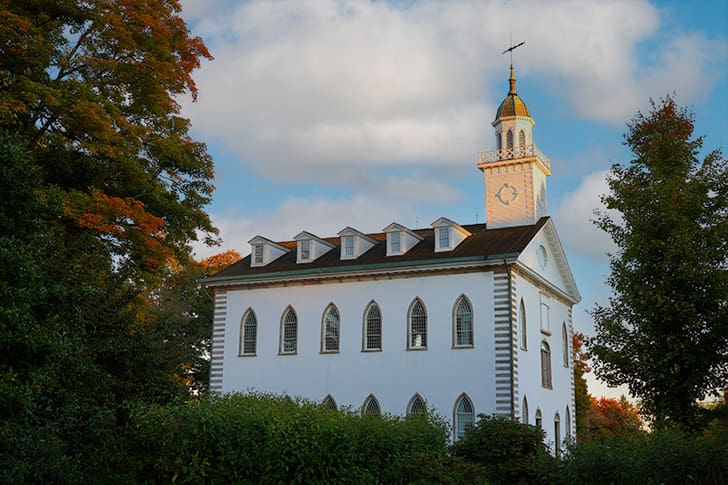
One hundred and ninety years ago, in a remarkable series of visions inside the newly dedicated Kirtland Temple, Joseph Smith and Oliver Cowdery received the keys of temple work. This series of articles seeks to increase understanding of the priesthood keys restored on that occasion.
It includes excerpts from The Heart of Our Covenants: Temple Principles that Draw Us unto Christ by Valiant K. Jones. Used by permission. See www.valiantjones.com or www.cedarfort.com.
When Jesus Christ visited the Nephites after his resurrection, He recited the words that had been given to the prophet Malachi in the old world. These included a prophecy of the future return of Elijah: “Behold, I will send you Elijah the prophet before the coming of the great and dreadful day of the Lord; and he shall turn the heart of the fathers to the children, and the heart of the children to their fathers, lest I come and smite the earth with a curse” (3 Nephi 25:5-6; see also Malachi 4:5-6). Moroni repeated this prophecy, with some modifications, when he appeared to Joseph Smith (see D&C 2 and JS-H 1:36-38).
This prophecy was fulfilled when Joseph Smith and Oliver Cowdery received a remarkable series of visions in the Kirtland Temple on April 3, 1836. The first was an appearance of Jehovah—Jesus Christ himself—who accepted the newly completed and dedicated Kirtland temple. Following this, visions of three special messengers appeared, in sequence, which Joseph described as follows:
“The heavens were again opened unto us; and Moses appeared before us, and committed unto us the keys of the gathering of Israel from the four parts of the earth, and the leading of the ten tribes from the land of the north.
“After this, Elias appeared, and committed the dispensation of the gospel of Abraham, saying that in us and our seed all generations after us should be blessed.
“After this vision had closed, another great and glorious vision burst upon us; for Elijah the prophet, who was taken to heaven without tasting death, stood before us, and said: Behold, the time has fully come, which was spoken of by the mouth of Malachi—testifying that he [Elijah] should be sent, before the great and dreadful day of the Lord come—To turn the hearts of the fathers to the children, and the children to the fathers, lest the whole earth be smitten with a curse—Therefore, the keys of this dispensation are committed into your hands; and by this ye may know that the great and dreadful day of the Lord is near, even at the doors” (D&C 110:11-16).
These three heavenly messengers bestowed upon Joseph Smith and Oliver Cowdery important priesthood keys. President Russell M. Nelson taught that priesthood keys “refer to the right to preside over priesthood authority in the name of the Lord Jesus Christ.”1 This series of articles will review the restoration of the keys of temple work that occurred on April 3, 1836, including their meaning and significance.
The Keys of the Gathering of Israel on Both Sides of the Veil
Moses was a fitting custodian of the keys of the gathering of Israel because it was he who led the children of Israel from Egypt as one body before they were dispersed. That dispersion was first into separate lands of inheritance in Canaan and later among all the nations of the earth. The keys that Moses bestowed on Joseph and Oliver authorized global missionary work, imparting priesthood power to those who would spread the gospel under the direction of all the modern prophets who have carried those keys since 1836. Every missionary of this dispensation has preached gospel truths with power and authority because of the restoration of these priesthood keys.
However, the keys restored by Moses were not given solely for the gathering of people into the gospel net of salvation. They were also given for the gathering of people to temples so that all souls born in all time periods can have the opportunity to receive the blessing of exaltation and eternal families. The keys that Moses restored prepare receptive children of God to receive the blessings of the keys of Elias and Elijah that followed. The keys of Moses needed to be imparted before temple work could begin because, as President Nelson has pointed out, the gathering of Israel occurs “on both sides of the veil.”2
When we search out the names of our ancestors, we are functioning within the spirit of the keys of Moses as much as within the spirit of keys of Elijah. The restored keys of the gathering of Israel function both on the earth and in the spirit world.
The final visitor on that important April 3rd was the prophet Elijah. His role in the restoration of the priesthood keys will be discussed in more detail later; however, the Bible Dictionary gives this summary of his keys: “Elijah held the sealing power of the Melchizedek Priesthood. He appeared on the Mount of Transfiguration in company with Moses (also translated) and conferred the keys of the priesthood on Peter, James, and John (Matt. 17:3). He appeared again, in company with Moses and others, on April 3, 1836, in the Kirtland (Ohio) Temple and conferred the same keys upon Joseph Smith and Oliver Cowdery.
All of this was in preparation for the coming of the Lord, as spoken of in Mal. 4:5–6 (D&C 110:13–16). As demonstrated by his miraculous deeds, the power of Elijah is the sealing power of the priesthood by which things bound or loosed on earth are bound or loosed in heaven. Thus the keys of this power are once again operative on the earth and are used in performing all the ordinances of the gospel for the living and the dead.”3
The keys restored by both Elijah and Moses are clear and beautiful—they make sense. However, our understanding of Elias and the keys he restored is less clear. Frankly, Elias has long been a bit of an enigma for many members of the Church. Part of this is because even his historical identity is unclear. In addition, there is the issue of Elias being both a person and a title. And what is the relationship between the keys of Elias and those of Elijah? Also, at first glance, the keys restored by Elias are not aligned in an obvious way with any particular ordinance. It is all rather confusing. The following discussion will be an attempt to shed some light on all of this.
Who Was Elias?
It is important to recognize that Elijah and Elias are the same name coming to us in English from two other languages. They are like Pedro and Pierre or Carlos and Charles. Elijah is a transliteration into English from the Hebrew form of the name, and Elias is a transliteration from the Greek form of the same name.
Hebrew, Greek, and English are all written in different alphabets or scripts, so when proper names are translated, the best available equivalent letters are typically chosen. However, sometimes adjustments are made because there is no equivalent letter or in order to make the name appear more reasonable in the new language. Thus, when doing a translation directly from Hebrew, early writers chose Elijah in English; but when early translators started with the Greek transliteration of the same name and then anglicized that, they chose Elias. Other KJV Old Testament/New Testament equivalent names include Elisha/Eliseus (Luke 4:27), Isaiah/Esaias (John 12:38), Joshua/Jesus (Acts 7:45), Judah/Judas (Matthew 1:2-3), and Noah/Noe (Matthew 24:38). Additional equivalent names include Miriam/Mary, Hannah/Anna, and Jacob/James.4
When Jesus said, as written in the KJV, “But I tell you of a truth, many widows were in Israel in the days of Elias, when the heaven was shut up three years and six months, when great famine was throughout all the land” (Luke 4:25), He was clearly referring to the Old Testament prophet we know of as Elijah the Tishbite. Likewise, when John the Baptist told the priests and Levites that he was not the Christ or Messiah, and they asked, “What then? Art thou Elias?” (John 1:21), they were asking if he was the Old Testament prophet Elijah—for they knew of the prophecy that Elijah would appear before the coming of the Messiah (see Malachi 4:5-6).
It would not be wrong for us to substitute Elijah in place of Elias in our minds wherever the latter is encountered in the KJV New Testament. In fact, most of the other English translations of the Bible use Elijah in all passages in the New Testament where the King James Version uses Elias. So first and foremost, Elias refers to Elijah the Tishbite.
In addition, Jesus referred to John the Baptist as Elias, meaning Elijah (see Matt. 11:13-14). When the angel Gabriel appeared to Zacharias and prophesied that his wife, Elizabeth, would bear a son who should be named John, the angel said of him, “And many of the children of Israel shall he turn to the Lord their God. And he shall go before him in the spirit and power of Elias [i.e., Elijah], to turn the hearts of the fathers to the children, and the disobedient to the wisdom of the just; to make ready a people prepared for the Lord” (Luke 1:16-17).
Thus, John the Baptist was to be a forerunner of the first coming of Christ “in the spirit and power of Elias [i.e., Elijah]” just as Elijah himself was to be a forerunner of the second coming of Christ. Both would prepare people’s hearts to receive Jesus Christ before He arrived. This provides the basis for the use of Elias as a title, meaning forerunner.
The Prophet Joseph Smith expounded on this second use of Elias. He taught, “The spirit of Elias is to prepare the way for a greater revelation of God…. And when God sends a man into the world to prepare for a greater work, holding the keys of the power of Elias, it was called the doctrine of Elias, even from the early ages of the world.”5
Joseph Smith used Elias in other ways as well. The Bible Dictionary summarizes all of these ways and then states, “Thus the word Elias has many applications and has been placed upon many persons as a title pertaining to both preparatory and restorative functions.”6 Apparently, the duplication of this name in two forms in the King James Bible—Elijah and Elias—provided an impetus for the Lord to inspire Joseph Smith in many ways regarding Elias and the doctrine of Elias.
For Latter-day Saints, the most important event which occurred under the name of Elias took place when the Lord sent a heavenly messenger under that appellation to Joseph Smith and Oliver Cowdery in the Kirtland temple on April 3, 1836. The Bible Dictionary says of this messenger, “A man called Elias apparently lived in mortality in the days of Abraham, who committed the dispensation of the gospel of Abraham to Joseph Smith and Oliver Cowdery…. We have no specific information as to the details of his mortal life or ministry.”7
The lack of specific information regarding this restorer of priesthood keys has led some to conjecture that this angel may have been a prophet known in the Old Testament by some other name. President Joseph Fielding Smith, as an apostle, stated8 that Elias and Noah are the same person.9 President Smith also stated that “some think him to be Melchizedek.”10 Elder Bruce R. McConkie confirmed the uncertainty of the identity of the Elias who appeared in the Kirtland temple, writing, “Whether he was Abraham or Melchizedek or some other prophet, we do not know.”11
Elder McConkie later conjectured, “Apparently this Elias lived in the day of Abraham, and may even have been Abraham himself.”12 It is also possible that the Elias who appeared in the Kirtland temple was none of these, but was a separate prophet who lived in ancient times and whose earthly name was the Hebrew equivalent of Elijah and Elias. The statement on Elias from the Bible Dictionary, cited earlier, seems to agree with this possibility.13
In addition to all these possibilities regarding the identity of Elias, I offer another proposal. It is possible that the two separate visions in the Kirtland Temple, wherein a single messenger appeared each time—the first in the name of Elias and the second in the name of Elijah—were both carried out by the same ancient prophet: Elijah the Tishbite. Perhaps he was directed by God to appear twice under his two separate but related names in order to restore two separate but related priesthood keys, both of which he held.
It is interesting to note that in the New Testament record of a similar occasion—when keys were given to Peter, James, and John on the Mount of Transfiguration—Moses and Elijah appeared together at the same time (see Matt 17:3 and Mark 9:4). Yet in the Kirtland temple, the three messengers appeared sequentially—an arrangement that would have accommodated a repeat appearance by Elijah. Also, this theory creates a stronger parallel with the New Testament record, which speaks of a visit by only those two messengers (see Matt 17:1-13, Mark 9:2-13, and Luke 9:28-26). Perhaps Joseph and Oliver also received only two messengers, with one of them appearing twice in subsequent visions. Perhaps these modern seers were so taken by the glory of their visions and so focused on the messengers’ words that they did not recognize the equality of the angels’ features in the two appearances.
God often works within the paradigms we hold ourselves to, and if Joseph Smith believed that the references to Elias and Elijah in his KJV Bible were references to two separate prophets (and some of the ways Joseph used Elias suggest that he did), then it is possible that God chose to use that paradigm to emphasize the restoration of two separate but related priesthood keys. God rarely clarifies our misunderstandings unless we ask, and it is possible that Joseph never even considered that Elias and Elijah could have been the same person.
Of course, this proposal is only a conjecture; however, there is nothing in Doctrine and Covenants 110 that is inconsistent with this theory. Joseph’s many and varied references to Elias confirm he was not settled on who Elias was. However, this does not affect his stature as a prophet; it simply makes him human. The Lord stated that the revelations in the Doctrine and Covenants “were given unto my servants in their weakness, after the manner of their language, that they might come to understanding” (D&C 1:24; see also 2 Nephi 31:3). In other words, the revelations were given in the imperfect language paradigms that Joseph comprehended so that the principles God deemed most important could be revealed.
Remember, also, that Jesus himself contributed to the complexity of this issue when he referred to John the Baptist as Elias/Elijah (see Matthew 11:7-14). Regardless of all this, if we were to take the second key-bearer at his word when he said he was Elias and then invoke the simplest interpretation of his name, we would conclude that this messenger was Elijah the Tishbite.
Regarding the identity of Elias, Elder John A. Widtsoe wrote, “When Elias, the man, lived, and what he did in his life, must for the present remain in the field of conjecture.”14 Both the Bible and the Book of Mormon refer to many unnamed prophets, confirming that ancient prophets were not always identified.15 The messenger who came as Elias to the Kirtland Temple was undoubtedly a great prophet when he lived on earth, but when he appeared to Joseph and Oliver, his mortal life and mission were secondary in importance to the keys that he was restoring. Maybe this is why the Lord provided this messenger with some anonymity by having him introduce himself as Elias.
All this aside, we must not be so concerned about the identity of Elias that we overlook his purpose. This is an issue faced by people who become attached to a particular missionary who has been teaching them the gospel. If that missionary gets transferred before their baptism, they must decide if it is the missionary or the underlying priesthood authority that matters for their baptism. So it is with Elias. His specific identity and background were not as important as his priesthood authority. Regardless of who this Elias was in mortal life, the most important thing we need to know about him is that he restored important priesthood keys to Joseph Smith and Oliver Cowdery in the Kirtland temple in 1836. That much is certain, and that part is what matters most.
Elias and the Dispensation of the Gospel of Abraham
Regarding the purpose of the heavenly messenger who came in the name of Elias, Joseph and Oliver wrote that he “committed the dispensation of the gospel of Abraham” (D&C 110:12). To understand this declaration, it is helpful to recognize that the word gospel can sometimes be used as a synonym for the word covenant16 and to understand the word dispensation in the sense of dispensing or bestowing rather than as an epoch of time on the earth. With these clarifications, this passage can be interpreted as saying that Elias “committed the bestowing of the covenant of Abraham.”
Consistent with this interpretation, the 2025 Doctrine and Covenants Seminary Teacher Manual explains: “Elias committed the dispensation of the gospel of Abraham. This includes the restoration of the Abrahamic covenant.”17 The fulness of this covenant, which includes the promises of endless posterity, priesthood power, and an eternal promised land inheritance in God’s presence,18 is bestowed through the ordinance of temple marriage. Thus, the keys restored by Elias are the keys of eternal marriage.
This link to eternal marriage becomes clearer when we consider the promise given by Elias “that in us and our seed all generations after us should be blessed.” This statement echoes the promise Abraham received that “in thy seed after thee . . . shall all the families of the earth be blessed” (Abraham 2:11). This promise could only be fulfilled through the union of Abraham with Sarah. Likewise, these same blessings are bestowed on couples married in the temple, where they are sealed together eternally and bestowed the blessing of Abraham, Isaac, and Jacob.
President Nelson confirmed this understanding of the keys of Elias, teaching, “In 1836, keys of ‘the gospel of Abraham’ were conferred (D&C 110:12). In 1843 the Lord declared to the Prophet Joseph Smith that ‘Abraham received promises concerning his seed, and of the fruit of his loins—from whose loins ye are. . . . This promise is yours also, because ye are of Abraham’ (D&C 132:30–31). . . . The ultimate blessings of the Abrahamic covenant are conferred in holy temples. These blessings allow us to come forth in the First Resurrection and inherit thrones, kingdoms, powers, principalities, and dominions, to our ‘exaltation and glory in all things’ (D&C 132:19).”19 Of course, these blessings described by President Nelson are the blessings pronounced upon every couple sealed in eternal marriage.
To paraphrase a little differently the Doctrine and Covenants 110 declaration of the keys restored by Elias, we could say that he bestowed upon Joseph and Oliver a dispensing of the same good news that many generations earlier had been given to Abraham. And what was this particular good news or gospel? It was that Joseph and Oliver now had the power to administer a binding, covenant-marriage link for men and women on earth so that all generations that would come after them would be blessed. Elder Bruce R. McConkie taught, “Elias restored the great commission, given of God to Abraham our father, whereby the seed of Abraham has power to gain eternal blessings forever through eternal marriage; that is, Elias restored the marriage discipline that had eternal efficacy, virtue, and force in the days of Abraham, Isaac, and Jacob.”20
The authority to bind couples in eternal marriage has existed since Adam, but it was strongly associated with Abraham, who was promised that his seed would be as vast as the sands of the sea (see Genesis 22:17, 32:12), so this authority was also called the good news of Abraham or the gospel of Abraham (see Abr. 2:9-11). This approach of naming a divine power after a remarkable prophet is similar to what occurred with the Melchizedek Priesthood, which also existed on the earth since Adam, but which was renamed “because Melchizedek was such a great high priest” (D&C 107:2).
Similarly, the Lord said to Abraham, “For as many as receive this Gospel shall be called after thy name, and shall be accounted thy seed, and shall rise up and bless thee, as their father” (Abraham 2:10). So the new and everlasting covenant of marriage is also called the gospel of Abraham or the Abrahamic covenant, and Elias restored the keys of this covenant.
Elder McConkie elaborated further on this role of Elias, “This Elias … ‘committed the dispensation of the gospel of Abraham’ (D&C 110:12) … meaning the great commission which God gave Abraham in his day. That commission dealt with families, those of Abraham and his seed, who were and are promised continuance ‘in the world and out of the world … as innumerable as the stars; or, if ye were to count the sand upon the seashore ye could not number them’ (D&C 132:30).
As Joseph Smith records it, what Elias actually said to him and Oliver Cowdery was that ‘in us and our seed all generations after us should be blessed’ (D&C 110:12). And so, the Lord be praised, the marriage discipline of Abraham was restored; it is the system that enables a family unit to continue in eternity; it is the system out of which eternal life grows.”21
The heavenly messenger who declared himself to be Elias restored the keys of eternal marriage. I believe these keys encompass not only the temple marriage ceremony but also the temple endowment ceremony, since the endowment prepares us for eternal marriage.22
On their own, the keys restored by Elias are limited to ceremonies performed for the living. When Elias bestowed his priesthood keys, he said, “all generations after us should be blessed.” The keys of Elias provide blessing to posterity who come after us, but they do nothing for ancestors who came before us. In order to bring the same blessings to them, additional priesthood keys were needed. The subsequent visit by Elijah restored the keys that extended those sealing ordinances to the dead—to those progenitors in the spirit world who had not entered into gospel covenants with God while they were living on the earth.
To be continued…
Valiant K. Jones is the author of The Heart of Our Covenants: Temple Principles that Draw Us unto Christ. For more information, see www.valiantjones.com or www.cedarfort.com.
1. Russell M. Nelson, “Keys of the Priesthood,” Ensign, Oct. 2005, 40.
2. Russell M. Nelson, “Hope of Israel,” Worldwide Youth Devotional June 3, 2018, Conference Center, Salt Lake City, Utah, churchofjesuschrist.org/study/broadcasts/worldwide-devotional-for-young-adults/2018/06/hope-of-israel?lang=eng; see also Russell M. Nelson, “The Gathering of Scattered Israel,” Ensign, November 2006, churchofjesuschrist.org/study/ensign/2006/11/the-gathering-of-scattered-israel?lang=eng.
3. Elijah” Bible Dictionary, lds.org/scriptures/bd/elijah?lang=eng.
4. Even though Jacob and James are equivalent names, both are used in the KJV New Testament. For an interesting discussion of these names, see gotquestions.org/James-vs-Jacob.html.
5. Joseph Smith Jr., Teachings of the Prophet Joseph Smith, pp. 335-336.
6. “Elias” Bible Dictionary, lds.org/scriptures/bd/elias?lang=eng, emphasis in the original.
7. Ibid.
8. Joseph Fielding Smith, Conference Report, April 1960, p. 72, archive.org/details/conferencereport1960a/page/n73; see also Joseph Fielding Smith, Answers to Gospel Questions, Vol. 3, pp. 139-141.
9. This conclusion is based on D&C 27:6-7, which says that Elias announced to Zacharias the birth of his future son, John the Baptist. In Luke 1:19, this birth announcement is attributed to the angel Gabriel, whom Joseph Smith declared to be Noah (see Teachings of the Prophet, p. 157). The conclusion of all of this is that Elias is Noah. However, when we remember that Elias is sometimes used as a title meaning forerunner, we realize that the scripture in D&C 27 is probably saying that the angel Gabriel was a forerunner. He was a forerunner to John the Baptist who was a forerunner to Christ. Both Gabriel and John the Baptist were each an Elias.
10. Joseph Fielding Smith, Doctrines of Salvation, Vol. 1, p. 107.
11. Bruce R. McConkie, “Elias,” Mormon Doctrine, p. 220.
12. Bruce R. McConkie, “This Final Glorious Gospel Dispensation,” Ensign, April, 1980, lds.org/ensign/1980/04/this-final-glorious-gospel-dispensation?lang=eng.
13. The Bible Dictionary statement that, “A man called Elias apparently lived in mortality in the days of Abraham” raises some questions. To suggest that this unknown man carried a name that was distinct from the name Elijah ignores the etymology of the name Elias. Remember that Elias is derived from the same Hebrew name as Elijah after passing through Greek, so it is highly unlikely that an ancient prophet would have carried the Greco-Hebrew name Elias. However, it is possible there were two separate ancient prophets with the same Hebrew name and that the Lord has chosen to distinguish them in our day by calling one Elijah and the other Elias. The Old Testament has no record of a second prophet named Elijah, but it is not unreasonable to consider that there could have been multiple men with that name. I assume that this is what the Bible Dictionary statement is suggesting as a possibility.
14. John A. Widtsoe, Evidences and Reconciliations: Aids to Faith in a Modern Day, pp. 243–244.
15. See Hosea 12:13; 1 Samuel 2:27; 1 Kings 13:1-3, 11; 1 Kings 20:13, 22; 28; 2 Kings 23:18, Zechariah 7:3; 1 Nephi 1:4.
16. In D&C 39:11 and 66:2 the Lord refers to the gospel as a covenant. These verses likely refer to the covenant called the law of the gospel; however, they also suggest that gospel and covenant can be synonyms.
17. “Lesson 124—Doctrine and Covenants 110, Part 2: The Restoration of Priesthood Keys,” Doctrine and Covenants Seminary Teacher Manual, churchofjesuschrist.org/study/manual/doctrine-and-covenants-seminary-teacher-manual-2025/393-doctrine-and-covenants-110-part-2?lang=eng.
18. Kent P. Jackson, “The Abrahamic Covenant: A Blessing for All People,” Ensign, February 1990, churchofjesuschrist.org/study/ensign/1990/02/the-abrahamic-covenant-a-blessing-for-all-people?lang=eng; see also, “The Abrahamic Covenant,” Liahona, February 2022, churchofjesuschrist.org/study/liahona/2022/02/the-abrahamic-covenant?lang=eng.
19. Russell M. Nelson, “Special Witnesses of Christ,” Ensign, April 2001, churchofjesuschrist.org/study/ensign/2001/04/special-witnesses-of-christ?lang=eng; see also Russell M. Nelson, “The Everlasting Covenant,” Ibid.
20. Bruce R. McConkie, A New Witness for the Articles of Faith, p. 508; quoted by Robert L. Millet, “The Ancient Covenant Restored,” Ensign, March 1998, lds.org/ensign/1998/03/the-ancient-covenant-restored?lang=eng. See also Bruce R. McConkie, “The Keys of the Kingdom,” Ensign, May 1983, churchofjesuschrist.org/study/ensign/1983/05/the-keys-of-the-kingdom?lang=eng.
21. Bruce R. McConkie, “This Final Glorious Gospel Dispensation,” Ibid.
22. For a discussion of how the endowment can be seen as the first part of the eternal marriage ceremony, see Valiant K. Jones, the Heart of Our Covenants, Cedar Fort, 2025, pp. 18-24.
Family Discovery Day: A Gift Passed from Generation to Generation
Elder Ronald A. Rasband of the Quorum of the Twelve Apostles, and his wife Melanie, not only spoke of a gift passed from generation to generation, but demonstrated it in an hour of conversation, interviews with their grandchildren, and scenes from the British pageant during Family Discovery Day at RootsTech 2026.
They noted that as temples are rising across the world, the Lord is eager to link together His eternal family and give us access to power beyond our own. Sister Rasband said, ”In performing crucial temple work of binding together our past, present, and future” we are “uniting families for eternity.”
Elder Rasband said, “We recognize that our faith is not ours alone. It is a gift passed from generation to generation, as we honor the sacrifices and devotion of those who came before us with testimonies often born through trial and unwavering trust in the Lord. Their stories now become linked to and a part of our own.
“Creating a heritage of faith is a sacred stewardship, as each generation strengthens the next. When we link our lives to those that came before and to those who will follow, we form a chain of faith that leads directly to Jesus Christ, giving us purpose and belonging,” noted Sister Rasband.
She pointed to Helaman 5 where Helaman had purposely taught his sons, Nephi and Lehi, about their ancestors’ faith in Jesus Christ and reminded them to “remember, remember”. “Their remembrance gave them strength in moments of peril. And their faithfulness to Christ brought heaven’s power. By living true to our commitment to Jesus Christ, we have our own link to a growing legacy of discipleship,” she said.
Elder Rasband shared two stories of faith from his own ancestors.
“In May of 1833, my fourth great grandfather, Ashael Perry, traveled from northern New York to Kirtland, Ohio. Not yet a member of the church, but yearning, yearning, to meet the prophet Joseph Smith. He arrived just as the first council convened to plan the building of the Kirtland Temple. During that meeting, many objected, because the church was too poor, and the temple project seemed so grand, but Ashael’s faith would not be deterred.
“He and a few friends quietly counted their funds, and despite the cost of their journey home, he stepped forward. My grandfather approached Joseph Smith, pulled out a $5 gold coin, and presented it to the prophet. Joseph stood before the council and held up the coin, then speaking energetically, he said that the work had commenced, and the House of the Lord would be built according to the pattern presented by the Lord Jesus Jesus Christ.
“To me, that act of humble sacrifice was more than a donation. It was a beautiful expression of my ancestors’ budding, yet profound faith. In time, the Perry family joined the church, received their blessings in the Nauvoo temple, and later crossed the plains to Utah and are buried in Springville, Utah.
He continued,“This is one of many stories in my family history that has echoed through the generations, and has touched my soul deeply and united our family. Brothers and sisters, whether you are a first generation member of the church, or a 10th generation member, you can build your family’s legacy of faith that unites and binds generations together.”
Elder Rasband shared a second story about his ancestors.
“The Prophet Malachi taught that in these latter days, the hearts of the fathers will turn to the children, and the hearts of the children will turn to their fathers. My heart, for one, has been turned to my ancestors, and I will be forever grateful for the heritage they left behind, a legacy of faith in the Lord Jesus Christ.
“My great grandmother, Sarah Elizabeth Moulton, was born in Gloucester, England, in 1837. When she was four-years-old, her family was converted to the gospel and baptized into the Church of Jesus Christ of Latter-day Saints. At that time, their great desire was to emigrate to America, to be with the majority of the saints. By 1856, the Moulton family had seven children, and 18-year-old Sarah was among them.
“With the help of the Perpetual Immigration Fund, and bits of savings in a fruit jar, the family set sail from Liverpool, England, to America. Before departing, the family was promised that if they would go to Utah, they would make the journey safely without losing even one member of the family. The Moultons arrived in America and ultimately joined the ill-fated Willie Hancart Company.
“It is difficult for me. Surrounded by the comforts and amenities of modern life to imagine the daily misery of Sarah and of the remarkable men and women who traveled with her. Can we imagine, day after day, the blistered feet and hands, the sore muscles, the dust and grit, the sunburn, flies, and mosquitoes, the ever-dwindling food stores and scarcity of water?
“By October, they were trapped in a snowstorm, below Rocky Ridge on the Sweetwater River, about 350 miles from Salt Lake City. When Brigham Young learned of the mortal danger of the struggling travelers, he quickly made a call for men, food, and supplies to leave and render assistance.
“As the rescuers finally reached the Willie Camp, they were greeted with indescribable joy and gratitude from the frozen and starving saints. When the survivors finally completed the journey and arrived in Salt Lake City, 66 of their company had died, and many suffered from frozen feet and limbs. But the promise to the Moulton family, and that blessing in England, had been fulfilled. They had not lost even one of their children, including a baby born on the ship from Liverpool.
“Gratitude and appreciation toward one of the young rescuers, John Bennett Hawkins, blossomed into romance and love for Sarah. On December 5, 1856, they were married, and later had 10 children, including my grandmother, Esther Emily. This great heritage of faith and endurance lives on in the generations that have followed the pioneers by their descendants, as well as those who have been touched by the incredible devotion to a cause greater than themselves.”
A group of performers from Nauvoo’s British pageant then performed the story of Ann and George Cannon, Sister Rasband’s ancestors. The Cannons had heard the gospel in Britian from John Taylor and yearned to come to Zion, saving for some time to make the journey. But Ann never saw the Zion she yearned for. She died on the journey and was buried at sea. Still, through her six children her faith is carried by descendants who number in the hundreds of thousands.
Share Your Ancestors’ Faith; Strengthen Your Grandchildren
So with, stories of faith behind them, the Rasbands look to their grandchildren to carry on the legacy. They were joined on the stage by many of them, including three returned missionaries who shared how knowing their ancestor’s faith had buoyed them in their lives.
Haley, a granddaughter and a returned missionary from Brazil said, “On my mission, there were moments when it got really, really tough, and I would feel the strength and the faith of my ancestors buoying me up when it got hard, and it helped me to keep going, and so for that, I feel extremely grateful.”

Ellen, another granddaughter said, “I love the temple more than anything.” She had been taught to find family names to take to the temple in ordinances ready on FamilySearch, and took that skill to Spain. “I had this friend who had just barely gotten baptized, and she wanted to go to the temple more than anything. She was able to research her ancestor’s names, and we went to the temple and I could see the joy on her face.”
Modern Pioneers
Elder Rasband said, “I have met many modern pioneers throughout the world, and I have seen that legacy carried on through them. As modern pioneers, our personal journeys may be no less daunting, but we are creating a heritage of faith for those who will follow us. As I look upon my own children and grandchildren, and at the host of God’s children across the globe, my fondest hope is that we will continue in this sacred heritage built upon the faith and teachings of Jesus Christ. Whether you have multiple generations of Latter-day Saint ancestry, or if you are the first modern pioneer in your family, build upon and continue the legacy of these great men and women who have come before us.
“What move them on? What pushed them forward? It was a sure testimony of the Lord Jesus Christ. I did not pull a handcart across the plains, but as a great grandson of pioneers, What they felt, I feel and what they knew, I know. That Jesus is the living Christ, the Son of God. I love him, and this is his church.”
See the video of this presentation here:
Wilford Woodruff and the Book of Abraham
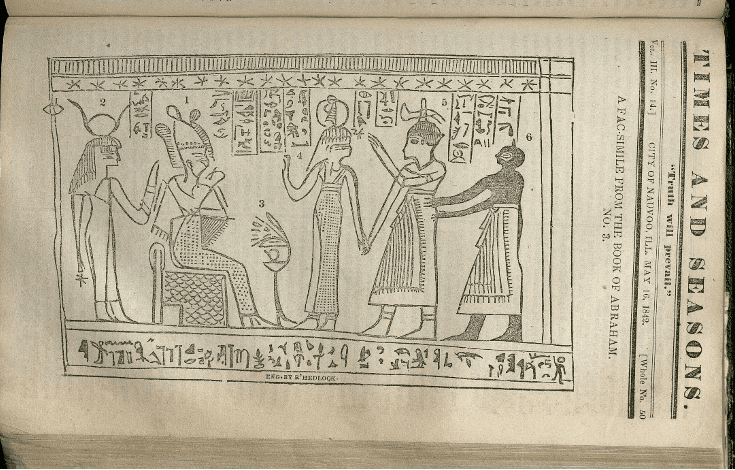
As we begin our study of the Old Testament, including the great Patriarch Abraham, and read from the Book of Abraham, it is worth pausing to consider how blessed we are to have the writings of this fabled man of God. Our gratitude for his writings, and for the prophet Joseph Smith who translated them for us, can be increased as we look at the reaction of those who first received these writings. The example of Wilford Woodruff is particularly inspiring for me.
Michael Chandler was an Ireland native who immigrated to the United States in 1828. At some point in the early 1830s he either acquired or began representing those who had acquired several Egyptian mummies and a smattering of papyri. These artifacts were taken to a number of cities where people paid to see the exhibits.[1] Eventually it was decided to sell the collection, which started to happen piece-meal. Chandler brought the dwindling collection to Ohio to see if he could finish selling it. He arrived in Kirtland in July of 1835, bringing with him four mummies, two papyrus scrolls, and a number of papyrus fragments. Chandler showed these antiquities to Joseph Smith, and the Prophet immediately translated a portion of the papyri. He felt impressed that the Saints needed to acquire these writings, so he purchased the collection from Chandler.

Soon the Prophet announced that the papyri contained the writings of Abraham and Joseph of Egypt, and he began translating the writings of Abraham. He translated much, perhaps all, of the Book of Abraham by the end of 1835. He may have even translated more of Abraham’s writings than we currently have in our Pearl of Great Price. November of 1835 seems to be the high point of translation activity. By December the Prophet began to focus on other things, and he would not return to working on the papyri until 1842.
When Joseph Smith first received the papyri, Woodruff had been a member of the Church for 18 months. Soon after his baptism on December 31, 1833, he had traveled to Kirtland in order to be part of Zion’s Camp. With this group he marched to Missouri, where he remained for some time. In January of 1835, he went on a mission to Arkansas and Tennessee. He was still on that mission when Joseph acquired the papyri and translated from it during the second half of 1835.
Woodruff returned to Kirtland a full year later in November of 1836. He learned of the great many things that had happened in Kirtland during his absence. Among the most significant of these was the translation of the Book of Abraham and the construction and dedication of the Kirtland Temple. He wrote of this in his journal entry for November 25, 1836:
After walking into the Pulpets, erected for the Priesthoods & viewing the curtains all bespeaking that grandure, solemnity & order that nothing Short of wisdom from God could invent, we then visited the upper rooms & there viewed four Egyptian Mumies & also the Book of Abram Written by his own hand & not ownly the hieroglyphicks but also many figures that this precious treasure Contains are Calculated to make a lasting impression upon the mind which is not to be erased.[2]

In Kirtland, one of the things a busy Woodruff became involved in was creating a map of the area around Kirtland. This map was created by drawing the shoreline of Lake Erie and then creating a grid system in which the names of Kirtland and all its surrounding communities. We can surmise that this was done during Woodruff’s stay in Kirtland, which lasted from November of 1836 through late May of 1837.[3] This map has an interesting tie with the Book of Abraham.
Sometime after Woodruff drew the map it was, for unknown reasons, no longer needed. Instead, when Joseph Smith or one of his associates decided to glue some of the papyri fragments to paper in an effort to preserve them, the pieces of papyrus known today as fragments II and IV were glued to Wilford’s map, which was cut into two different pieces in order to accommodate the two fragments.
About a year and a half later, on July 8, 1838, Joseph Smith received a revelation that called the Quorum of the Twelve to serve missions in Britain (see Doctrine & Covenants 118:4-5). They were instructed to leave the next spring from Far West, Missouri. By then, the Saints had fled Far West. Still, desiring to fulfill every part of the revelation, Brigham Young and 24 others, including Elder Woodruff, met in Far West and departed from there for the mission to England. It was there, in Far West, that Wilford Woodruff was ordained an apostle.
John Taylor, Wilford Woodruff, and Theodore Turley arrived in Liverpool in January of 1840.[4] While laboring in places such as Staffordshire and Herefordshire, Elder Woodruff found great success in converting large numbers of people to the Restored Gospel. He also served and found success in London. While he was there, he found experiences that drew him back to Joseph Smith’s papyri and the Book of Abraham.
One experience, at the British Museum. Is recorded in his journal on October 19th, 1840:
Though I felt interested in a visit to evry apartment of this Museum which is considerd the greatest collection in the world & open to the free inspection of the publick, yet I felt the more deeply interested in that Part Called the gallery of Antiquities esspecially the Egyptian. The Antiquities consists mostly of Greek, Roman Jewish & Egyptian, & some british…
Among the Egyptian Antiquities, is a large number of Tombs coffins, mumies, Hieroglyphics & Papyri enough if translated into the English language to make one hundred volums as large as the Bible. I felt more interested in this part than any thing I saw as they were from three to four thousand years of age, & would no doubt if translated have revealed many glorious things Sacred & historical concerning the early ages of the world Abram & the Prophets &c.
Having formed a intimate acquaintance with one of the overseers of the gallery of Antiquities, He explained many things to us concerning those things which were interesting unto us.[5]
It seems likely that the connection Woodruff made between the Egyptian antiquities and Abraham was because of that same connection having been made for him as he viewed the mummies and papyri in the Kirtland Temple. The combination of the Church’s Egyptian antiquities and the things he viewed in the British Museum seems to have sparked a deep interest in the ancient relics of Egypt for Elder Woodruff.
A few weeks later, on November 3rd, he visited the museum again. It appears that while there he communed once again with the Keeper of Egyptian Antiquities at the museum, a Mr. Palmer. We can surmise that Elder Woodruff’s relationship with this keeper had led to Mr. Palmer inviting Woodruff to return for a somewhat private tour. Of this day Elder Woodruff wrote “Elder Smith & myself again visited the British Museum. I having formed a private or intimite acquaintance with Mr W. Palmer the keeper of the Egyptian Antiquities & It being a private day not open to public exibition he accompanied us through the various appartment & spent several hours in explaining to us the most important things relating to the whole collection of Egyptian Jewish Greek & Roman antiquities which were vary interesting.”[6]
Elder Woodruff ended his British mission in April of 1841 and arrived in Nauvoo in October of that year. While Woodruff had developed a great deal of respect for Joseph Smith’s prophetic call and abilities since his conversion to the gospel, it was during the end of 1841 and the beginning of 1842 that he worked closely with the Prophet in a way that allowed him to see and comment on Joseph’s role as a seer in a more intimate way. On one occasion, Elder Woodruff wrote “The Twelve or a part of them spent the day with Joseph the Seer & he unfolded unto them many glorious things of the kingdom of God the privileges & blessings of the priesthood &c. I had the privilege of seeing for the first time in my day the URIM & THUMMIM.”[7]
At the beginning of 1842 Joseph Smith was inspired that he, John Taylor, and Wilford Woodruff should take over management of the Church’s newspaper, The Times and Seasons. It was in connection with this responsibility that Joseph Smith published his translation of the Book of Abraham in that newspaper, beginning work in February of 1842. The Prophet spent time on translating and editing the Book of Abraham during that month, though we cannot tell if the “translation” consisted of working on putting Hebrew phrases into the text, or actually translating new portions of the papyrus.[8]
We do not know the extent of Woodruff’s involvement in preparing the Book of Abraham for publication, but it is clear that he was affected in at least some ways by it. For example, on February 19th, a few days before Joseph’s journal starts to record his Book of Abraham activity, Woodruff recorded:
…The Lord is Blessing Joseph with Power to reveal the mysteries of the kingdom of God; to translate through the urim & Thummim Ancient records & Hyeroglyphics as old as Abraham or Adam, which causes our hearts to burn within us while we behold their glorious truths opened unto us.
Joseph the Seer has presented us some of the Book of Abraham which was written by his own hand but hid from the knowledge of man for the last four thousand years but has now come to light through the mercy of God. Joseph has had these records in his possession for several years but has never presented them before the world in the English language untill now. But he is now about to publish it to the world or parts of it by publishing it in the Times & Seasons, for Joseph the Seer is now the Editor of that paper & Elder Taylor assists him in writing while it has fallen to my lot to take charge of the Business part of the esstablishment.
I have had the privilege this day of assisting in setting the TIPE for printing the first peace of the BOOK OF ABRAHAM that is to be presented to the inhabitants of the EARTH in the LAST DAYS.
My Soul has been much edifyed of late from time to time in hearing Joseph the Seer convers about the mysteries of the Kingdom of God. Truly GOD is with him & is making him mighty in wisdom & knowledge & I am convinced for myself that none of the Prophets Seers or Revelators of the Earth have ever accomplished a greater work than will be accomplished in the Last days through the mercy of God By JOSEPH THE SEER.[9]
Elder Woodruff’s excitement about the Book of Abraham is readily apparent in this journal entry. His involvement in the publication of the Book of Abraham has been often overlooked. If we look to Joseph Smith’s journal to see when the prophet was working on the publication of his translation of Abraham’s writings, we see him mention working on it on February 23rd, March 1st, 4th, 8th and 9th. During this same time period Elder Woodruff mentions working in the printing office on Feb 19th, as mentioned above, and also each day from February 11th-26th. Of this stretch, Woodruff wrote that all of it was spent in the printing office and that “Nothing remarkable transpired with us during the week excepting we prepared A plate for making a cut at the commencement of the Book of Abraham which is to be published in the 9 no. of the 3 Vol of the Times & Seasons which will be interesting to many of the inhabitants of the earth.”[10] Thus it is clear that Woodruff was heavily involved in the publication of the Book of Abraham, in some aspects more than the Prophet himself was.

This continued for some time. Woodruff records that February 28th and March 3-4 were spent in the printing office. The March 1st edition of The Times and Seasons, the date representing when it was likely typeset, although the paper was not finished printing until around the 4th, contained what we now call Abraham 1:1-2:18 and Facsimile One. The successful publication of that portion of the translation was immediately followed by more publication work. March 7th to 10th, the 14th, 16th, 18th, and 19th were all spent by Woodruff working in the printing office.
Of this last day he wrote that “We struck off about 500 No of the 10 No 3 vol of Times & Seasons which contained the portion of the Book of Abraham that gave his account of Kolob, Oliblish, God siting upon his Throne The Earth, other planets & many great & glorious things as revealed to Abraham through the power of the priesthood. The truths of the Book of Abraham are truly edifying great & glorious which are among the rich treasures that are revealed unto us in the last days.”[11] The rest of the current text of the Book of Abraham, and Facsimile Two were published in this edition. It is Woodruff’s journal that lets us know that the actual publication date of the March 15th issue was March 19th.

Nothing more of that book of scripture was published in April or the first May edition of The Times and Seasons. The second May publication of the newspaper contained a printing of Facsimile Three. Woodruff worked consistently in the printing office throughout May, so he would have been a part of publishing that portion of our scripture as well. John Taylor also worked diligently on these publications along with Woodruff, as they were both overseen by Joseph Smith.
Perhaps Elders Taylor’s and Woodruff’s involvement in publishing the Book of Abraham, and the exuberance over it that Woodruff’s journal exhibits, indicates that their involvement in its canonization is not coincidental. A decade after Elder Woodruff’s visit to London, Franklin D. Richards had included transcriptions of The Times and Seasons publications of these writings of Abraham in a booklet he created in Liverpool, England which he titled The Pearl of Great Price. Copies of this booklet made its way across the plains with saints emigrating from England, and soon became known in the Salt Lake Valley. It was not until John Taylor was leading the Church in his capacity as the senior Apostle, with Wilford Woodruff filling the next-most-senior position, that the work on making this booklet into something more began in earnest.
It was on October 10, 1880, that John Taylor was formally made the President of the Church, and Wilford Woodruff was officially made the President of the Quorum of the Twelve. It was that same day that the Pearl of Great Price, including the Book of Abraham, was canonized. One would suppose that as someone who had so enthusiastically witnessed Joseph Smith’s seeric abilities as he worked on the Book of Abraham, that President Wilford Woodruff would have felt just as enthusiastic in raising his hand to support its canonization on that October day.

Kerry Muhlestein received his B.S. from BYU in Psychology with a Hebrew minor. He has taught courses in Hebrew and Religion at BYU, BYU-Hawaii and the UVSC extension center, and courses in History at Cal Poly Pomona and UCLA. He is the director of the BYU Egypt Excavation Project. He has served as the chairman of a national committee for the American Research Center in Egypt and serves on their Research Supporting Member Council. He has also served on a committee for the Society for the Study of Egyptian Antiquities, and currently serves on their Board of Trustees and as a Vice President of the organization. He is involved with the International Association of Egyptologists and has worked with Educational Testing Services on their AP World History exam. He and his wife, Julianne, are the parents of six children.
This article was published in cooperation with the Wilford Woodruff Papers Foundation. For more information on their mission to transcribe and publish all Wilford Woodruff’s writings, please visit wilfordwoodruffpapers.org.
NOTES
[1] “BYU Professor Tracing Path of Book of Abraham Papyri,” Ensign, (June, 1985), 75-76.
[2] “Journal (December 29, 1833 – January 3, 1838),” p. 113-114, The Wilford Woodruff Papers, accessed January 8, 2022, https://wilfordwoodruffpapers.org/documents/b048a7c5-6b6b-438a-bce7-262d5ba297d8/page/ed2cead6-b7f8-45f1-9c7f-5da7ec03faec
[3] Kerry Muhlestein and Alex Baugh, “Preserving the Joseph Smith Papyri Fragments: What Can We Learn from the Paper on Which the Papyri were Mounted?” The Journal of Book of Mormon and Other Restoration Scripture 22/2 (2013): 67-83.
[4] Cynthia Doxey Green, “Wilford Woodruff: Missionary in Herefordshire,” in Alexander L. Baugh and Susan Easton Black, eds., Banner of the Gospel: Wilford Woodruff (Provo and Salt Lake City: Religious Studies Center and Deseret Book Co., 2010), 149-150.
[5] The visit is recorded for the day of October 19, but this part is under his description of returning on December 9th. See “Journal (January 1, 1840 – December 31, 1840),” p. 195-196, The Wilford Woodruff Papers, accessed January 8, 2022, https://wilfordwoodruffpapers.org/documents/a304ab9d-910a-40ea-a121-858616d49cff/page/84edba5c-3797-4a31-abaf-ba4adc5093e5
[6] “Journal (January 1, 1840 – December 31, 1840),” p. 205, The Wilford Woodruff Papers, accessed January 8, 2022, https://wilfordwoodruffpapers.org/documents/a304ab9d-910a-40ea-a121-858616d49cff/page/41065e50-68db-4ded-a06d-2bff990d4a42
[7] “Journal (January 1, 1841 – December 31, 1842),” p. 122, The Wilford Woodruff Papers, accessed January 8, 2022, https://wilfordwoodruffpapers.org/documents/a9d1a2cb-18fe-445d-a5e4-350caaf63442/page/18514a77-9924-4236-8538-7c348353ff09
[8] Kerry Muhlestein and Megan Hansen, “‘The Work of Translating’: the Book of Abraham’s Translation Chronology,” in Spencer Fluhman, Brent L. Top, eds., Let Us Reason Together: Reflections on the Life of Study and Faith, Essays in Honor of Robert L. Millet, (Provo: Religious Studies Center, 2015), 139-162. Since this article, others have commented on what was translated during the Nauvoo period, but have done so without bringing any new information or analysis to the table and while avoiding interacting with the existing work already done on this topic.
[9] “Journal (January 1, 1841 – December 31, 1842),” p. 134, The Wilford Woodruff Papers, accessed January 8, 2022, https://wilfordwoodruffpapers.org/documents/3b738c16-75b7-4cb6-a0ed-1bf682fa554e/page/46a50900-b577-4e5c-9fd9-6b2347845fc1
[10] “Journal (January 1, 1841 – December 31, 1842),” p. 135, The Wilford Woodruff Papers, accessed January 8, 2022, https://wilfordwoodruffpapers.org/documents/a9d1a2cb-18fe-445d-a5e4-350caaf63442/page/2bfcc3ea-da03-47b0-b5c4-3109f47fbc67
[11] “Journal (January 1, 1841 – December 31, 1842),” p. 138, The Wilford Woodruff Papers, accessed January 8, 2022, https://wilfordwoodruffpapers.org/documents/3b738c16-75b7-4cb6-a0ed-1bf682fa554e/page/f81af798-c970-45ec-893a-aa6909c817ab
Visions of Deity in the Kirtland Temple
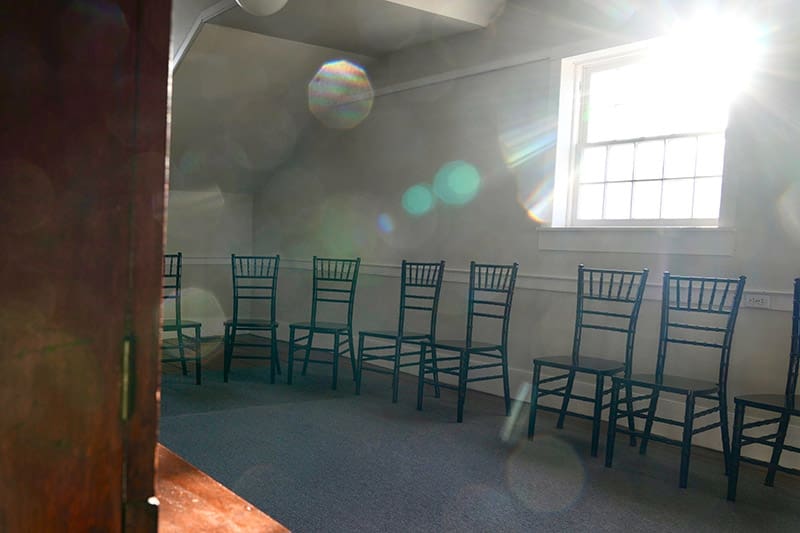
Editor’s note: This article features the chapter “Visions of Deity in the Kirtland Temple” from Karl Ricks Anderson’s book The Savior in Kirtland.
Cover photo: Joseph Smith’s office, west end of the third floor of the Kirtland Temple.
In the Kirtland Temple, visions of Deity and unparalleled spiritual manifestations flowed down upon the Saints. Most visions came during meetings as Joseph Smith conducted recently revealed sacred temple ordinances. When the Saints erected the first house of the Lord in this last dispensation, with humble faith and under direction of their prophet, they fully expected to see or feel the presence of the Savior and experience heavenly manifestations. Joseph taught the new Twelve Apostles, “All who are prepared and are sufficiently pure to abide the presence of the Saviour will see him in the solemn assembly.”1 
Letters from Church leaders indicated that ordinary Church members had been prepared to expect visions and heavenly manifestations. In one letter they wrote: “Within that house God will pour out his spirit in great majesty and glory and encircle his people with fire more gloriously and marvelously than at Pentecost because the work to be performed in the last days is greater than was in that day.”2
Modern-Day Pentecost
Because people of that period knew the Bible, they were familiar with the pentecostal period in the New Testament that surrounded the ascension of Christ and the descent of the Holy Ghost in Jerusalem. Large numbers of Jews witnessed speaking in tongues and seeing “cloven tongues like as of fire.”3 After the outpourings of the Holy Ghost, the Saints of the primitive Church had visions, participated in healings, and beheld wonders and signs. So it was in Kirtland. These modern disciples likewise experienced such spiritual manifestations.
The magnitude, depth, and variety of these manifestations in the Kirtland Temple compelled the Prophet Joseph Smith to record the following:
It was a Pentecost and an endowment indeed, long to be remembered, for the sound shall go forth from this place into all the world, and the occurrences of this day shall be handed down upon the pages of sacred history, to all generations; as the day of Pentecost, so shall this day be numbered and celebrated as a year of jubilee, and time of rejoicing to the Saints of the Most High God.4
The Lord’s inspired prophets of old foresaw and taught of future pentecostal periods such as Kirtland’s. Joel prophesied anciently: “I will pour out my spirit upon all flesh; and your sons and your daughters shall prophesy, your old men shall dream dreams, your young men shall see visions: And also upon the servants and upon the handmaids in those days will I pour out my spirit.”5
During Pentecost, Peter recognized that Joel’s prophecy had descended upon the Saints in Jerusalem. He informed the Jews: “These are not drunken, as ye suppose. . . . But this is that which was spoken by the prophet Joel.”6 The manifestations spoken of by Peter were not the complete fulfillment of Joel’s prophecy, however. As Moroni instructed young Joseph in 1823, he “quoted the second chapter of Joel, from the twenty-eighth verse to the last. He also said that this was not yet fulfilled, but was soon to be.”7
Lorenzo Snow declared that the fulfillment of Joel’s prophecy began for the Latter-day dispensation in the Kirtland Temple. He said:
[The] magnificent [Kirtland] Temple was completed and dedicated to the Lord in the presence of thousands. The day of blessings, and of rejoicings in the history of the Saints, had now arrived. . . . The youth, the middle aged, both men and women, clothed with the spirit of inspiration, would speak, as with the tongue of angels. . . . One would exercise the gift of tongues, another that of interpretation, and some would have the gift of prophecy. One would speak of the blessings of faith, another would testify of knowledge, and some would have the spirit of exhortation. Thus were their gifts exercised, and all edified together, proving they lived in the time of the fulfilment of Joel’s prophecy.8
This latter-day pentecostal manifestation indeed fulfilled Joel’s prophecy. Visions and spiritual manifestations flowed down from the heavens as he had prophesied.9 The Savior appeared in the temple in at least eight different visions (see chart, p. 229). The Father and the Son were seen together in four visions. In more than ten meetings, such as the two temple dedications, sacrament services, and priesthood leadership meetings, congregations experienced the presence of heavenly beings. Many Saints saw and heard manifestations such as the gift of tongues, sounds of a mighty wind, a pillar of fire resting upon the temple roof, prophesying, and voices of angels.
Benjamin Brown recorded that this pentecostal period was “even greater than at the day of Penti[cost].” He further elaborated, declaring:
Some have seen the heavens opend& seen the savior[;] others have seen angels on the four corners of the house of the Lord with drawn swords & also stood thick on the ridge Elisha with his chariot of Fire, Peter John & James. . . . Old father Adam was seen B[ea]utiful man his hair stood back & curled most b[ea]utiful even down on his shoulders.10
Following are accounts of visions of Deity in the Kirtland Temple on four different glorious days from January to April 1836.
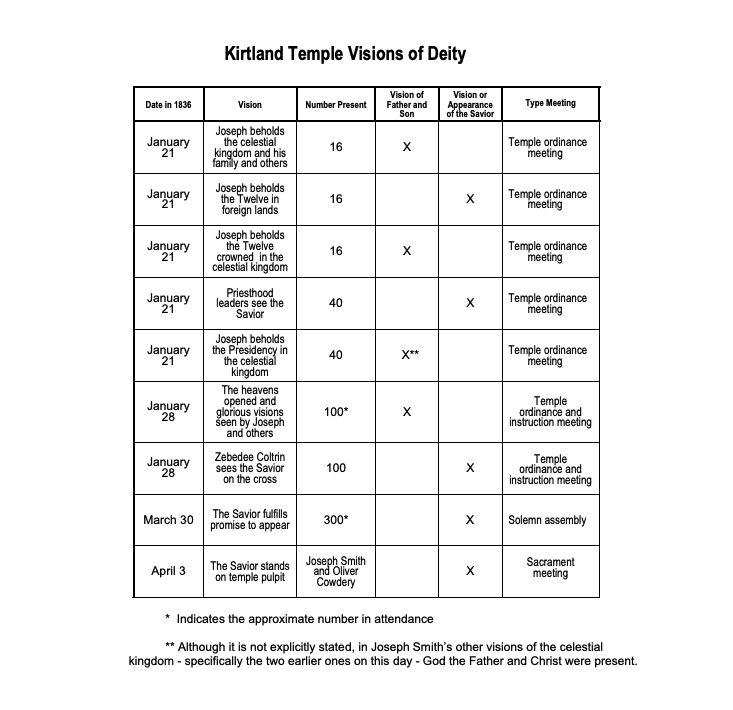
Visions of Deity, January 21, 1836
The first recorded visions of Deity in the Kirtland Temple occurred January 21, 1836, in Joseph Smith’s office on the temple’s highest level. Joseph gave detailed descriptions of at least two extended visions experienced on that remarkable day. Each vision consisted of distinct parts. The occasion for each vision was the ordinance of anointing the head with oil of the First Presidency, bishoprics, and high councilors.
Vision of the Father and the Son in the Celestial Kingdom
The promised visions began as Joseph Smith was meeting with fifteen other Church leaders.11 As the visions occurred, the Prophet introduced, for the first time in this dispensation, the ordinance of anointing with oil in a temple of the Lord. He described the start of the first vision of the day: “The heavens were opened upon us, and I beheld the celestial kingdom of God, and the glory thereof, whether in the body or out I cannot tell.
I saw the transcendent beauty of the gate through which the heirs of that kingdom will enter, which was like unto circling flames of fire;
Also the blazing throne of God, whereon was seated the Father and the Son.
I saw the beautiful streets of that kingdom, which had the appearance of being paved with gold.
I saw Father Adam and Abraham; and my father and my mother; my brother Alvin, that has long since slept.12
Vision of Christ and the Latter-day Twelve Apostles
In the next part of his visions of this day, Joseph saw the Savior weep over His discouraged band of Apostles. He recorded:
I saw the 12, apostles of the Lamb, who are now upon the earth who hold the keys of this last ministry, in foreign lands, standing together in a circle much fatiegued, with their clothes tattered and feet swolen, with their eyes cast downward, and Jesus <standing> in their midst, and they did not behold him, . . . the Saviour looked upon them and wept.13
Twelve Apostles in the Celestial Kingdom
In the concluding scene of these visions, Joseph apparently watched until the Twelve arrived at the gate to the celestial kingdom and found Father Adam acting as gatekeeper and escort of the faithful to the throne. In recording this part of the vision, Joseph stated simply, “I finally saw the 12, in the celestial Kingdom of God.”14 Nonetheless, Heber C. Kimball remembered further details of Joseph’s vision, undoubtedly told him by the Prophet:
He (Joseph) saw until they [the Twelve] had accomplished their work, and arrived at the gate of the celestial city; there Father Adam stood and opened the gate to them, and as they entered he embraced them one by one and kissed them. He then led them to the throne of God, and then the Savior embraced each one of them and kissed them, and crowned each one of them in the presence of God. He saw that they all had beautiful heads of hair and all looked alike. The impression this vision left on Brother Joseph’s mind was of so acute a nature, that he never could refrain from weeping while rehearsing it.15
Vision of Christ with the High Councils of Kirtland and Zion
Later on January 21, the high councilors of Kirtland and Zion joined the ones already in the meeting, which increased attendance to forty brethren. These brethren also participated in visions of Deity that day. Joseph recorded:
The vision of heaven . . . <was> opened to these also, some of them saw the face of the Saviour, and others were ministered unto by holy angels, and the spirit of propesey and revelation was poured out in mighty power, and loud hosanahs and glory to God in the highest, saluted the heavens for we all communed with the h[e]avenly hosts.16
According to Joseph, “Some of them saw the face of the Savior.” This probably indicates that at least three17 other Church leaders besides Joseph became eyewitnesses to Christ’s existence and leadership of the Church.18
Vision of the Presidency in the Celestial Kingdom
During this final meeting of leaders that now included the high councilors of Kirtland and Zion, Joseph Smith beheld his third vision of the celestial kingdom that day. This time he saw many of those forty brethren, including the presidency, in that celestial setting. He stated: “I saw in my vision all of the presidency in the Celistial Kingdom of God, and, many others who were present.”19 In each of his two other visions of the celestial kingdom that day, the Prophet had seen the Father and the Son and also men who were assisting Joseph in leading the Church, many of whom were present in the meetings. In the first of those visions, Joseph saw God’s throne, the Father and the Son, and others, including his father, who had just anointed him. In the next vision, he saw the Twelve being embraced by the Savior in the presence of the Father. In the third vision, he sees the presidency there with other leaders who are with him in the meeting. Although he didn’t state it directly, it is probable that this final vision also included the Father and Son, because that was the pattern set in the two other visions.
Apparently because of the sacred nature of the visions, Oliver Cowdery, who was present at the meeting, did not record many details. He leaves us wishing for more details, however, with what he did write: “The glorious scene is too great to be described in this book, therefore, I only say, that the heavens were opened to many, and great and marvelous things were shown.”20
God the Father and Christ Seen in Meeting of Quorums, January 28, 1836
Seven days following the incredible visions of January 21, Joseph Smith and his counselors instructed high priests, seventies, and elders assembled in the Kirtland Temple. The leaders introduced to this group the ancient ordinance of anointing with oil. In addition, Joseph Smith conducted the procedure of sealing blessings given them in the anointing. During the proceedings, marvelous visions were distilled upon the priesthood quorums. In this meeting, Zebedee Coltrin saw the Savior. The Prophet recorded this and other visions: “Elder Roger Orton saw a mighty angel riding upon a horse of fire, with a flaming sword in his hand, followed by five others, encircle the house, and protect the Saints, even the Lord’s anointed, from the power of Satan and a host of evil spirits, which were striving to disturb the Saints.
“President William Smith, one of the Twelve, saw the heavens opened, and the Lord’s host protecting the Lord’s anointed.
“President Zebedee Coltrin, one of the seven presidents of the Seventy, saw the Savior extended before him, as upon the cross, and a little after, crowned with glory upon his head above the b[r]ightness of the sun.”21
Harrison Burgess added that Joseph Smith also saw the Savior. In his autobiography, Harrison vividly recalled that in the middle of the meeting, “Joseph exclaimed aloud, ‘I behold the Saviour, the Son of God.’”22 He recorded the following:
The Lord blessed His people abundantly in that Temple with the Spirit of prophecy, the ministering of angels, visions, etc. I will here relate a vision which was shown to me. It was near the close of the endowments. I was in a meeting for instruction in the upper part of the Temple, with about a hundred of the High Priests, Seventies and Elders. The Saints felt to shout “Hosannah!” and the Spirit of God rested upon me in mighty power and I beheld the room lighted up with a peculiar light such as I had never seen before. It was soft and clear and the room looked to me as though it had neither roof nor floor to the building and I beheld the Prophet Joseph and Hyrum Smith and Roger Orton enveloped in the light: Joseph exclaimed aloud, “I behold the Savior, the Son of God.” Hyrum said, “I behold the angels of heaven.” Brother Orton exclaimed, “I behold the chariots of Israel.”23
Two journal accounts lead to a conclusion that both the Father and the Son appeared in vision in this meeting. In an 1879 Sunday meeting, Harrison supplemented his journal account by adding that Joseph Smith also saw God the Father at that time. Charles Lowell Walker, one of the Church’s foremost diary keepers, heard Harrison say that Joseph saw both the Father and the Son. Charles then carefully recorded Harrison’s words in his journal entry:
Br Harrison Burgess spoke of the first Endowments given in the Kirtland Temple and that all the quorums met at one time in the Attic; Joseph and Hyrum met with them. He said that all at once there was a Heavenly and Divine Atmosphere surrounded them, and it seemed as if the rafters and Beams were all gone and Joseph gazing up said, I See the Son of God sitting at the right hand of the Father. Hyrum at the same instant said, I behold the Angels of Heaven, and Roger Orton said, I see the Horses and Chariots of Heaven.24
Although Joseph omitted in his journal account that he saw a vision of Deity, he did record that he saw “a glorious vision.”25 In his journal Harrison concluded that all present experienced the power of God. He wrote, “All who were in the room felt the power of God to that degree that many prophesied, and the power of God was made manifest, . . . the remembrance of which I shall never forget while I live upon the earth.”26
Another account attests to both the Father and the Son appearing, probably on this day. David Patten, a member of the Quorum of the Twelve Apostles, also attended. David visited Abraham Smoot, a recent convert, in Kentucky within weeks of the temple dedication and told him about seeing God the Father and Jesus Christ in vision. Wilford Woodruff recorded his account:
He [Abraham Smoot] had Been with Elder Patten & his wife for several days. Br Smoot related the news to me from Br Patten which was glorious in the first degree. He gave me an account of the endowment at Kirtland Ohio. The heavens Was opened unto them. Angels & Jesus Christ was seen of them sitting at the right hand of the father.27
Joseph Smith described how the impact of the vision stayed with him during the night: “After these quorums were dismissed, I retired to my home, filled with the Spirit, and my soul cried hosanna to God and the Lamb, through the silent watches of the night; and while my eyes were closed in sleep, the visions of the Lord were sweet unto me, and His glory was round about me. Praise the Lord.”28
Divine Presence Felt in Dedicatory Services, March 27, 1836
Many journals testifying of heavenly manifestations on the day the temple was dedicated made reference to a divine presence. In what may have been a reference to Deity, Nancy Tracy recorded that “the heavenly influence rested down upon that house. . . . Heavenly Beings appeared to many. . . . It was heaven on earth.”29
Eliza R. Snow stated that “an abiding holy heavenly influence was realized.”30 In another account she wrote that the whole congregation felt the presence of divinity: “The ceremonies of that dedication may be rehearsed, but no mortal language can describe the heavenly manifestations of that memorable day. Angels appeared to some, while a sense of divine presence was realized by all present, and each heart was filled with ‘joy inexpressible and full of glory.’”31
Other spiritual manifestations were evident. Participants such as Benjamin Brown testified: “There the Spirit of the Lord, as on the day of Pentecost, was profusely poured out. . . .
“We had a most glorious and never-to-be-forgotten time. Angels were seen by numbers present.”32 A heavenly messenger who Joseph Smith said was Peter and who had “come to accept the dedication” was seen entering the temple and sat between Frederick G. Williams and Joseph Smith Sr.33 It seems that on the day of dedication, the Savior sent Peter, the presiding Apostle of the prior dispensation, to visibly accept the dedication. Then, a week later, Christ Himself appeared.
The Pentecost Continues in Priesthood Meeting, March 27, 1836
At a priesthood meeting held in the temple the evening of the temple dedication, additional pentecostal manifestations were given to the Saints. Benjamin Brown recorded:
Sunday Evening . . . Joseph spoke . . . & told them the day of Penticost was continued the . . . Brethren began to
. . . prophesy many prophesied in the name of the Lord then began speaking in tongues and it filled as it were the whole house, perhaps there were forty speaking at once Cloven tongues of fire was seen to sit on many of them an hand was seen laid upon one when he spake in tongues . . . many Visions seen, one saw a [pillar] or cloud rest down upon the house bright as when the sun shines on a cloud like as gold, two others saw three personages hovering in the room with bright keys in their hands, and also a bright chain in their hands. . . .. . . The west end of the House was illuminated by a light from heaven seen on the outside by many. . . .
Father Stephens saw . . . two rows of Angels through the House, at another time the glory of God came down on the Elders from the head down half way.34
Joseph Smith recorded the events of this evening meeting. He made a note about personally beholding a pillar of fire, writing:
All the congregation simultaneously arose, being moved upon by an invisible power; many began to speak in tongues and prophesy; others saw glorious visions; and I beheld the Temple was filled with angels, which fact I declared to the congregation. The people of the neighborhood came running together (hearing an unusual sound within, and seeing a bright light like a pillar of fire resting upon the Temple), and were astonished at what was taking place.35
Oliver Cowdery, present on the evening of the dedication, saw the glory of God descend upon the temple. He recorded:
In the evening I met with the officers of the church in the Lord’s house. The Spirit was poured out—I saw the glory of God, like a great cloud, come down and rest upon the house, and fill the same like a mighty rushing wind. I also saw cloven tongues, like as of fire rest upon many, (for there were 316 present,) while they spake with other tongues and prophesied.36
On the day of dedication, the Lord indeed rewarded His valiant people by opening the heavens.37 These Saints, in addition to building the Kirtland Temple, had sanctified their lives so that “the Son of Man might have a place to manifest himself to his people.”38
The Savior Appears at the Solemn Assembly in the Kirtland Temple, March 30, 1836
Joseph Smith, upon convening the long-awaited solemn assembly, said, “The presidency, the 12, the seventies, the high . . . councils, the Bishops and their entire quorums, the Elders, and all the official members in this stake of Zion amounting to about 300 met in the temple of the Lord.”39 Heber C. Kimball remembered the procedure followed in the solemn assembly:
When the Prophet Joseph had finished the endowments of the First Presidency, the Twelve and the Presiding Bishops, the First Presidency proceeded to lay hands upon each one of them to seal and confirm the anointing; and at the close of each blessing the whole of the quorums responded to it with a loud shout of Hosanna! Hosanna! etc.
While these things were being attended to the beloved disciple John was seen in our midst by the Prophet Joseph, Oliver Cowdery and others. After this all the quorums arose in order, together with the three Presidencies; and the Twelve then presented themselves separately and individually before the First Presidency, with hands uplifted towards heaven, and asked of God whatever they felt to desire; and after each individual petition the whole of the quorums answered aloud Amen! Hosanna! Hosanna! Hosanna! To God and the Lamb, forever and ever, amen and amen.
. . . As a reward for their preparation, the Prophet promised, “All who are prepared, and are sufficiently pure to abide the presence of the Savior, will see Him in the solemn assembly.”40
The reward came to those who were prepared. The Savior appeared to some of the priesthood as described by Joseph:
The brethren continued exhorting, prophesying, and speaking in tongues until five o’clock in the morning. The Savior made His appearance to some, while angels ministered to others, and it was a Pentecost and an endowment indeed, long to be remembered, for the sound shall go forth from this place into all the world, and the occurrences of this day shall be handed down upon the pages of sacred history, to all generations; as the day of Pentecost, so shall this day be numbered and celebrated as a year of jubilee, and time of rejoicing to the Saints of the Most High God.41
Benjamin Brown recorded additional details of these and other spiritual manifestations in a letter to his wife. He mentioned two brethren who saw Christ. Although he wrote without punctuation and in seemingly disjointed thoughts, he provides a more complete account. He wrote: “Many Prop[h]esys [were] given & speaking in tongues . . . two corums continued all night in the House the twelve guarded it the Heavens was opened two saw the savior some saw chariots and other thing[s] one lay about half an hour & saw from Eternity to Eternity many Miracilous Experiences told Many Visions told.”42
Vision of Christ, Moses, Elias, and Elijah, April 3, 1836
The pinnacle of all the holy events transpiring in Kirtland and possibly even in the history of the young latter-day Church was reached with the supernal visions of this day. The Savior Jesus Christ—followed by Moses, Elias, and Elijah—stood before Joseph Smith and Oliver Cowdery to instruct them and to bestow on them long-awaited priesthood keys and authority to carry out the missions of the Church. Joseph’s journal relates that as he and Oliver rose from prayer, Christ stood before them in His full glory. After testifying of Himself and His resurrection, He acknowledged His acceptance of His house, the temple. He then promised to appear again to His faithful servants. Joseph testified:
We saw the Lord standing upon the breastwork of the pulpit, before us. . . . His eyes were as a flame of fire; the hair of his head was white like the pure snow; his countenance shone above the brightness of the sun; and his voice was as the sound of the rushing of great waters, even the voice of Jehovah, saying: I am the first and the last; I am he who liveth, I am he who was slain; I am your advocate with the Father. . . . I have accepted this house. . . . I will appear unto my servants, and speak unto them with mine own voice, if my people will keep my commandments, and do not pollute this holy house.43
Joseph and Oliver related this vision to other early leaders. In turn, William W. Phelps told his wife of the vision, saying, “On Sunday, April 3, the twelve held meeting and administered the sacrament. It was a glorious time. The curtains were dropt in the afternoon. And there was a manifestation of the Lord to Br Joseph and Oliver, [by] which they [learned] thus the great & terrible day of the Lord as mentioned by Mal[a]chi, was near, even at the doors.”44
Lorenzo Snow remembered the testimonies of Joseph and Oliver almost fifty years later. He said, “Those who saw Him testify to this fact.”45 He made particular reference to his association with Joseph and Oliver and to their vision. He said, “There were two persons [Joseph Smith and Oliver Cowdery] with whom I was very well acquainted who saw [Christ] . . . in the Temple in Kirtland, Ohio.”46 Lorenzo was so well acquainted with the vision that he gave these details: “They were sitting side by side, as my brethren are sitting here on this stand, and the Son of God appeared to them.” Lorenzo had obviously heard them relate the vision in 1836. He knew which pulpit Christ stood upon. He later said, “I have preached from that pulpit many times.”47 In relating his feelings in his journal, he tells of the first time he preached from the pulpit:
No language can describe my feelings when, for the first time, I stood up in one of those pulpits to address an audience—a pulpit on the breastwork of which, only a short time before, this holy Personage stood—‘his hair as white as pure snow, his eyes as a flame of fire’—where also Moses, Elias and Elijah came and committed the keys of their dispensations to Joseph Smith.48
The appearance of these divine heavenly visitors was even stamped on the memory of children. Mary Ann Stearnes Winters, a stalwart Utah pioneer, always remembered how, when she was a child, her mother showed her the exact spot where the Savior stood. She said, “Mother took me to the stand and showed me the place on the pulpit where the Savior had stood when He appeared to the Prophet, and where afterwards Moses and Elias came and delivered the keys for the gathering of the Saints (Israel), and the redemption of the dead.”49
Seemingly, the non-LDS community was aware of the Savior’s visit. One week after this vision of Christ, Lucius Parsons, a local resident, wrote of it to his sister: “They report that the Savior appeared personally with angels and endowed the Elders with powers to work Miracles.”50
Orson Pratt, who no doubt was present on April 3, 1836, concluded that this vision of Christ, Moses, Elias, and Elijah in itself rewarded the Saints for all they had endured in building the temple. He said:
Then you see that even this one revelation, which God gave in that Temple, paid the people for the toil they had endured in erecting it. What a satisfaction it was to them to know that angels administered in that Temple! What a satisfaction it was for them to go into that Temple and have the heavens opened to them so that they could gaze on the glory of God! What a satisfaction it was for them to know that the Lord accepted, as His own, the house which they had built according to the pattern which He had given! And what a satisfaction it was for them to know that they loved God by keeping His commandments!51
The Voice of God
Other manifestations experienced by the early Saints in the Kirtland Temple were preserved. For example, Warren Snow testified: “I have seen the power of God manifested. . . . I remember when receiving my endowments in the Temple at Kirtland, I heard the voice of God as plain as I hear my own, and this testimony I have borne for thirty-one years.”52
That We Might Know Jesus Christ
Through visions, appearances, manifestations, and an infusion of glory, the Lord bestowed His divine love upon His new Saints. With His voice from the heavens, He defined the path to be taken for His children to return and dwell with Him forever. When the accounts of the visions are read through spiritual eyes, a sense of overwhelming love seems to draw us closer to the Savior. From the Kirtland Temple, there comes an assurance that the crucified Savior truly did rise from the tomb. As He declared to Joseph and Oliver, He was slain, was resurrected, bears our sins, and truly is our advocate with the Father.53
Footnotes
1. Dean C. Jessee, Mark Ashurst-McGee, and Richard L. Jensen, eds.,Journals, 1832–1839, vol. 1 of the Journals series of The Joseph Smith Papers, edited by Dean C. Jessee, Ronald K. Esplin, and Richard Lyman Bushman (Salt Lake City: Church Historian’s Press, 2008), 99.
2. Sidney Rigdon, Newel K. Whitney, and Oliver Cowdery, May 6, 1834, in Stanley R. Gunn, Oliver Cowdery: Second Elder and Scribe (Salt Lake City: Bookcraft, 1962),101.
3. Acts 2:3.
4. Joseph Smith, History of The Church of Jesus Christ of Latter-day Saints, ed. B. H. Roberts, 7 vols., 2d ed. rev. (Salt Lake City: The Church of Jesus Christ of Latter-day Saints, 1932–51), 2:432–33; Jessee, Ashurst-McGee, and Jensen, Journals, 1:216.
5. Joel 2:28–29.
6. Acts 2:15–16.
7. Joseph Smith–History 1:41.
8. Eliza R. Snow Smith, Biography and Family Record of Lorenzo Snow (Salt Lake City: Deseret News, 1884), 144–45; Joel 2:28–29.
9. Joel’s prophecy was fulfilled in Peter’s day as well as in the Kirtland Temple, but its further fulfillment continues today. President Henry B. Eyring, in speaking to religious educators stated that Joel gave “a promise of an outpouring of the Spirit. It was quoted by Peter and by Moroni. . . . This is not poetry, nor is it allegory; it is description of reality as it will be. Some of it will happen so gradually that you may not notice it. Some has already begun across the Church and we may not have seen the blessing developing. . . .
“That scripture does not say that your sons and your daughters may claim the gift of prophecy by the Spirit. It says that they will. It doesn’t say that your young men may see visions. It says that they will. And it will come because the Lord will pour out His Spirit upon all flesh. Not only will the youth you love and serve have the Spirit poured out on them, but so will the people around them and those who lead them” (“Raising Expectations,” CES Satellite Training Broadcast, August 2004; in author’s possession).
10. Benjamin Brown, in Steven C. Harper, “‘A Pentecost and Endowment Indeed’: Six Eyewitness Accounts of the Kirtland Temple Experience,” in Opening the Heavens: Accounts of Divine Manifestations, 1820–1844, ed. John W. Welch and Erick B. Carlson (Provo, Utah: Brigham Young University Press; Salt Lake City: Deseret Book, 2005), 335; paragraphing altered. The events described here seem to describe happenings in the solemn assembly held March 30, 1836. However, this part of Brown’s record is disjointed; therefore, it is not possible to link it to one particular meeting with certainty.
11. These men were his five counselors and the presidents of the Church in Missouri, his scribe, and the bishoprics of the Church in Ohio and Missouri.
12. Doctrine & Covenants 137:1–5.
13. Jessee, Ashurst-McGee, and Jensen, Journals, 1:168.
14. Jessee, Ashurst-McGee, and Jensen, Journals, 1:168.
15. Heber C. Kimball, in Orson F. Whitney, Life of Heber C. Kimball (Salt Lake City: Bookcraft, 1945), 93–94. It is assumed that this account relates to the January 21 visions for the following reasons: (1) Accounts of both Joseph and Heber refer to the gate through which the faithful enter the celestial kingdom. (2) This vision is the final scene of Joseph’s extended vision. In Heber’s account he said this scene was preceded by Joseph seeing the Twelve “in a far distant land . . . their clothes all ragged, and their knees and feet sore. They formed into a circle, and all stood with their eyes fixed upon the ground. The Savior appeared and stood in their midst and wept over them” (Heber C. Kimball, in Whitney, Life of Heber C. Kimball, 93). (3) Joseph sees the throne of God. (4) Christ is present at the throne. (5) Adam is part of the vision. In recording this vision in his journal, Joseph Smith also recorded seeing Michael (Personal Writings of Joseph Smith, comp. Dean C. Jessee, rev. ed. [Salt Lake City: Deseret Book, 2002], 175). Doctrine & Covenants 137 follows the current edition of the History of the Church (2:380), which simplifies Joseph Smith’s journal by eliminating “and Michael” after Abraham. Perhaps this was done because the editors knew that Michael was another name for Adam. Heber C. Kimball’s account gives Adam, or Michael, the double roles of gatekeeper and the one who escorts the faithful to the throne. This double role may account for his double mention in the Prophet’s report of the vision.
16. Jessee, Ashurst-McGee, and Jensen, Journals, 1:170; Doctrine & Covenants 137.
17. Although it is not known how many leaders saw the Savior, Joseph’s use of the word some would probably indicate more than two.
18. Newel Knight, a member of the high council in Zion, may have been one who saw the Savior in this meeting. He is a witness of Christ because he saw both the Father and the Son in a vision in June 1830 in Fayette, New York (History of the Church, 1:85). He is not listed as a witness in this book, however, because no record exists of his bearing witness of this vision in Kirtland.
19. Jessee, Ashurst-McGee, and Jensen, Journals, 1:170. In recording these visions, Joseph was characteristically succinct, leaving others to fill in details such as Heber C. Kimball provided for the second vision of the day. For this third vision no additional details have surfaced.
20. Leonard J. Arrington,“Oliver Cowdery’s Kirtland, Ohio, ‘Sketch Book,’” BYU Studies 12, no. 4 (1972): 419.
21. History of the Church, 2:386–87; Ashurst-McGee, and Jensen, Journals, 1:174–75.
22. Harrison Burgess, Autobiography, in Windows: A Mormon Family, comp. and ed. Kenneth Glyn Hales (Tucson, Ariz.: Skyline Printing, 1985), 102–3. The account Harrison recorded does not specify a date for the meeting he described; however, a careful comparison of the events correlates with the January 28 meeting. No other meeting during this period comes close. Both Joseph Smith (History of the Church, 2:386) and Harrison identify the meeting location as the attic of the temple. Both indicate that Roger Orton saw a vision of heavenly horses in the meeting. Both say Hyrum Smith was present. Both indicate that the Melchizedek Priesthood quorums were present. Both refer to endowments or anointings given in the meeting. Both describe a heavenly atmosphere that surrounded them. Both specifically mention that instruction was received in the meeting.
23. Harrison Burgess, “Sketch of a Well-Spent Life,” in Labors in the Vineyard in Classic Experiences and Adventures (Salt Lake City: Bookcraft, 1969), 67; History of the Church, 2:387.
24. Diary of Charles Lowell Walker, ed. A. Karl Larson and Katharine Miles Larson, 2 vols. (Logan: Utah State University Press, 1980), 2:483. Harrison Burgess does not give the date of this meeting, but because its details correlate with Joseph Smith’s account of the January 28meeting, we can conclude that Harrison’s recollection was from the same meeting (see 234n22).
25. History of the Church, 2:387; Jessee, Ashurst-McGee, and Jensen, Journals, 1:175.
26. Burgess, Windows, 102–3.
27. Wilford Woodruff, Wilford Woodruff’s Journal, 1833–1898, ed. Scott G. Kenney, typescript, 9 vols. (Midvale, Utah: Signature Books, 1983–85), 1:67. David Patten does not specify the date of the vision; however, the account seems to correlate more closely with January 28 than with any other meeting because David and the others of the Twelve were not present on January 21, when Joseph saw both the Father and the Son, but David and other members of the Twelve were present on January 28. Therefore, if we assume that the word “them” includes David Patten, this vision probably occurred January 28. The word also implies that more witnesses saw the Father and the Son in the vision.
28. History of the Church, 2:387; Jessee, Ashurst-McGee, and Jensen, Journals, 1:175.
29. Nancy Naomi Alexander Tracy, Autobiography, typescript, 9–10, L. Tom Perry Special Collections, Harold B. Lee Library, Brigham Young University, Provo, Utah; hereafter cited as BYU Special Collections.
30. Eliza R. Snow, an Immortal: Selected Writings of Eliza R. Snow, ed. Nicholas G. Morgan Sr. (Salt Lake City: Nicholas G. Morgan Sr. Foundation, 1957), 63.
31. Edward W. Tullidge, The Women of Mormondom (New York: Tullidge& Crandall, 1877; repr., Salt Lake City: n.p., 1975), 95.
32. Benjamin Brown, Testimonies for the Truth: A Record of Manifestations of the Power of God, Miraculous and Providential, Witnessed in the Travels and Experience of Benjamin Brown, High Priest in the Church of Jesus Christ of Latter-day Saints, Pastor of the London, Reading, Kent, and Essex Conferences (Liverpool: S. W. Richards, 1853), 6.
33. Carter, “Truman Angell Autobiography,” 10:198; Truman O. Angell, Journal 5, typescript, BYU Special Collections; Heber C. Kimball 1801–1868, Journal Excerpts (1833–1837), Church History Library; Heber C. Kimball, in Whitney, Life of Heber C. Kimball, 91.
34. Benjamin Brown, Harper, in Welch and Carlson, Opening the Heavens, 336–37.
35. History of the Church, 2:428.
36. Arrington,“Oliver Cowdery’s ‘Sketch Book,’” 426.
37. Accounts for the two meetings on dedication day indicate that the Savior might have been present, although unseen, as indicated in chapter 9 regarding a meeting with the Smith family attended by Mary Elizabeth Lightner in 1831 (see pp. 172–73 herein). In that meeting, Joseph Smith announced, “The Savior has been in your midst. . . . [But] there is a veil over your eyes for you could not endure to look upon Him” (Mary Elizabeth Rollins Lightner, typescript, April 14, 1905, 1, BYU Special Collections). That could account for the outward manifestations and sense of the divine reported on dedication day.
38. Doctrine & Covenants 109:5.
39. Jessee, Ashurst-McGee, and Jensen, Journals, 1:213.
40. History of the Church, 2:310; Karen Lynn Davidson, David J. Whittaker, Mark Ashurst-McGee, and Richard L. Jensen, eds.,Histories, 1832–1844, vol. 1 of the Histories series of The Joseph Smith Papers, edited by Dean C. Jessee, Ronald K. Esplin, and Richard Lyman Bushman (Salt Lake City: Church Historian’s Press, 2012), 1:123.
41. History of the Church, 2:432–33; Jessee, Ashurst-McGee, and Jensen, Journals, 1:215–16.
42. Benjamin Brown, Harper, in Opening the Heavens, 337. Benjamin Brown attributes these events to a meeting on March 29, 1836, but the events he describes seem more compatible with a March 30, 1836, meeting. Some problems exist in his account, however. Benjamin says the Twelve guarded the temple, but the Twelve were not present on March 29 to guard the temple. He first dates the meeting on April 29 and then changes it to March 29. If he confused the month, he could have confused the day, especially in light of the fact that his letter is somewhat disjointed at the end. Benjamin would not have been in attendance on March 29. The March 30 meeting is more in line with Joseph’s account because he makes reference to greater spiritual manifestations and pentecostal events on March 30 than he does on March 29 (History of the Church, 2:428–33). Because the March 29 meeting continued all night, Benjamin could have begun his entry with the March 29 meeting and then continued it into the March 30 meeting. Therefore, it is likely these events took place March 30, not March 29.
43. Doctrine & Covenants110:2–4, 7–8.
44. William W. Phelps, Journal, April 1836 (letter 27), 3, William Wines Phelps (1792–1872) Papers, Vault MSS 810, BYU Special Collections.
45. Lorenzo Snow, in Journal of Discourses, 23:342.
46. Snow, in Journal of Discourses, 23:291.
47. Lorenzo Snow, discourse at the Brigham City Tabernacle, March 6, 1887, reported by John Burroughs, in Collected Discourses: Delivered by Wilford Woodruff, His Two Counselors, the Twelve Apostles, and Others, comp. and ed. Brian H. Stuy, 5 vols. (Burbank, Calif.: B. H. S. Publishing, 1987–92), 1:28.
48. Snow Smith, Biography and Family Record, 11–12.
49. Relief Society Magazine 3, no. 8 (August 1916), 432.
50. Lucius Pomeroy Parsons to Pamelia Parsons, April 10, 1836, Church History Library, in Harper, in Opening the Heavens, 329. Parson’s letter does not identify in which meeting the Savior appeared. He wrote in the letter that the manifestation occurred “behind the curtains.” He dated the time for the meeting as being “of late” and around the time of the solemn assembly (March 30, 1836). It is concluded that it was the April 3 meeting because this was the only vision of Christ in the Kirtland Temple that occurred behind the dropped curtains with angels (likely a reference to Moses, Elias, and Elijah).
51. Orson Pratt, in Journal of Discourses, 13:359.
52. Millennial Star 26 (January 23, 1864): 51.
53. Doctrine & Covenants 110:4–5.
Face to Face: How Hebrew Reveals Women’s Priesthood Power

The following was originally published on Public Square Magazine. To visit their website, CLICK HERE.
In English, idioms appear only occasionally as colorful expressions, but in biblical Hebrew, idioms are constant, shaping the way meaning is conveyed.
Think of the phrase “kick the bucket.” To an English speaker, it is perfectly clear that no one is literally striking a pail with their foot. To someone learning English, however, the image is more than confusing. They would have to be told that it is an idiom, a soft turn of phrase that carries a meaning larger than the literal words.
The Hebrew Bible is filled with phrases like this: to “harden the heart,” to “lift up the face,” to “walk in the way,” to “know” someone, to “cover the feet,” to “gird up the loins,” to “set the face,” or to “eat bread.” These are simple examples, yet in a conceptual language, most phrases carry layers of idiom that remain difficult for us to perceive.
Now, you can imagine how this creates a problem for our modern understanding. For those of us who speak in hard languages like English, that creates a particular challenge. Hard languages train us to expect precision, one-to-one meanings, and fixed categories. Our minds are shaped by that rigidity, so the polysemy of this biblical Hebrew can feel foreign or even flattened when we encounter it. Ancient hearers lived in the flow of those multiple meanings and felt at home in them. We, as hard-language speakers, have to work against our instincts to even begin to comprehend the depth that biblical Hebrew carried so naturally.
Soft vs. Hard Language
Soft languages like Hebrew are capacious. A single word can hold multiple meanings at once. Take the word shema. In English translations, it appears as the command “hear,” as in Shema Yisrael—“Hear, O Israel.” To the ancient ear, shema held so much more depth than the flattened translation we hear today. It carried the sense of listening with understanding and responding in obedience. The Israelites, when specifically using the word shema, could not separate hearing from doing, so when they heard the call to shema, they understood it as a summons to act.
Soft languages like Hebrew are capacious. A single word can hold multiple meanings at once.
Hard languages, like modern English, are driven by categorization. They crave exactness: this word means this and not that. This is why idioms tend to puzzle us. If we insist that shema must be only “hear,” then the depth of the word is lost. For ancient Israel, shema joined hearing, understanding, and obedience into one living act. To flatten it into a single definition cuts away the conceptual depth that gave the word its power.
English and other modern hard languages perform well when clarity and efficiency matter. But they struggle with conveying layers of meaning that soft languages carry naturally. God speaks to us according to our understanding. Isn’t it interesting that even today, He draws on the conceptual depth in these soft languages when communicating with us? Could it be that modern English is too rigid to hold the mysteries in the language of God? Perhaps God is still speaking in soft, polysemic, and conceptual terms. If so, we would want to invest effort to learn the conceptual depth by which God has always communicated. As Joseph Smith, the first prophet of The Church of Jesus Christ of Latter-day Saints, wrote to an early church editor W. W. Phelps on November 27, 1832, he offered a heartfelt plea to God: “Oh Lord God, deliver us from this prison, almost as it were, of paper, pen, and ink, and of a crooked, broken, scattered and imperfect language.” That prayer is more true for us today than it was for them then.
The Puzzle of Kenegdo
The story of Adam and Eve has been told and retold for centuries. But what many of us receive today is a story shaped by layers of tradition. Generations of interpreters passed it down through debate, dogma, and politics. Artists gave it form in iconography, each picture coloring how Eve was seen. Over time, the narrative hardened into a familiar version in which Eve was created as subordinate to Adam and both were commanded to avoid the fruit.
Linguistics tells another story. When the Hebrew text is examined diachronically, tracing the earliest layers and the way meanings shifted over time, a very different picture appears. The text itself only records Adam being directly commanded concerning the fruit (see also Moses 3:16, which is even clearer on this point). This sets the stage for a problem. Adam alone could not fulfill the divine command. The ancient oral tradition left a clue in the ṭipḥa (¶)—a cantillation mark that signals a pause in the verse. Readers in antiquity would have recognized this as a deliberate stopping point. This is the moment where Adam stands in stasis. Something more was required to move the story forward.
The very next verse introduces that solution: “It is not good that man should be alone.” The Hebrew word ṭov, usually rendered “good,” can also mean “sufficient.” In other words, Adam by himself lacked sufficiency. Ancient oral tradition and semantic studies show that ṭov often implied functionality or adequacy rather than strictly moral value.
Into this insufficiency steps the figure we too quickly name Eve. The text first introduces her as ezer. Most translations reduce this word to “help,” but that translation obscures the deeper meaning. Hebrew has other words for ordinary “help.” Ezer is different. It appears only 21 times in the Hebrew Bible, and in nearly every case, it is bound to salvation or deliverance (Exodus 18:4; Deuteronomy 33:7; Psalm 33:20). Eve enters the story as ezer, the one who brings salvation to the problem Adam could not solve.
Her title is extended with the word kenegdo. Translations often render it as “meet” or “fit,” as in “an help meet for him.” This choice at least hints at equality, which was remarkable in the world of the translators at the time. But it still falls short of what the Hebrew conveys. Kenegdo literally means “standing opposite of” or “face-to-face with.” It’s an idiom that, taken at face value, describes one who stands across from another as an equal counterpart. Yet, as with all idioms, its real meaning lies in the depth of the concept it conveys.
Each time God entrusts a servant, the language is “face to face.” Jacob names the place Peniel because he saw God “face to face” and his life was preserved. Moses speaks with the Lord “face to face, as a man speaketh unto his friend” at the moment of his prophetic calling. The Levites stand before the Lord face to face to minister, signifying presence and commission. In each of these earliest instances and many more, the idiom marks the moment of authorization. Understanding the nature of soft language, to stand face to face is to receive priesthood.
Adam was not authorized to move forward in the story. Eve enters as the one who bears authorization. She stands face to face, fulfilling the very definition of priesthood. This idiom is difficult for hard-language speakers to grasp, yet in the Hebrew Bible it is unmistakably tied to authority.
Adam was not authorized to move forward in the story. Eve enters as the one who bears authorization. She stands face to face, fulfilling the very definition of priesthood.
The garden scene follows the same pattern. Eve is introduced not as subordinate but as salvation, as a priestly partner, as the one authorized to open the way forward. Let’s reiterate that one more time. Priesthood, at its core, is the authority of God given to act where others cannot. The narrative of Genesis sets up Adam in a position where he cannot move forward, bound by the command he received. Into that insufficiency enters Eve. She is introduced as ezer, the one who brings salvation, and as kenegdo, the one who stands face to face. The language ties her directly to the priesthood idiom that will echo throughout the Old Testament. This is not a derivative gift but the very solution God placed at the heart of the temple narrative.
Standing Face to Face in Nauvoo
The idiom of priesthood begins in Eden, but it does not end there. Eve as ezer kenegdo, standing face to face and embodying salvation and priesthood, is reborn in that same language when Joseph Smith restored the Relief Society, a women’s group of Latter-day Saints, in Nauvoo, Illinois. The archetype did not just disappear. Joseph Smith reestablished the Eden pattern when he invited women into the temple ritual.
In the Kirtland Temple, the first temple of the Church of Jesus Christ, women had no organized ritual role. They witnessed, sang, and rejoiced at visions, but the temple order remained incomplete. By the time the Latter-day Saints had moved to Nauvoo, three years after the Kirtland Temple, questions about women’s authority had come to the forefront of Joseph Smith’s mind. In March 1842, he organized women into the Relief Society. Emma Smith was sustained as president, fulfilling the earlier revelation that she was to be an “Elect Lady.” To the women gathered, Joseph Smith declared, “I now turn the key to you in the name of God.”
Week after week, Joseph Smith expanded their charge. He taught that women could heal, prophesy, and bless with divine sanction. He even described their role as “to save,” echoing the ancient role of ezer in Eden. Eliza R. Snow recorded that Joseph Smith promised the sisters they would form “a kingdom of priests as in Enoch’s day.” The culmination of this vision came in the Nauvoo Temple, where women participated alongside men in the ordinance they called “the endowment.” They clothed themselves in the same garments, entered the same covenants, and received the same blessings.
This was the difference between Kirtland and Nauvoo. In Kirtland, women stood as witnesses. In Nauvoo, they stood face to face with men in ritual, equal counterparts in the order of the priesthood, clothed in the same robes, speaking the same covenants. That balance echoes all the way back to Eden. Eve was the one who moved creation forward, standing as salvation, ezer kenegdo, face to face with Adam when he could go no further. In Nauvoo, women once again stood in that role. They moved salvation forward, clothed in priesthood, equal in covenant, bearing authority in the same idiom restored. The archetype of Eve was never a symbol frozen in the past. It was restored as living practice, carried into the temple, where women and men stood together as counterparts in the image of God.
Equal counterparts in the order of the priesthood, clothed in the same robes, speaking the same covenants. That balance echoes all the way back to Eden. Eve was the one who moved creation forward.
The temple is not finished. Its forms unfold in time, line upon line, precept upon precept. What Eden revealed in Eve as ezer kenegdo—salvation standing face to face—was restored again in Nauvoo, where women received what Joseph Smith called “keys.” There they receive the same endowment of priesthood power, and the same promises of future blessing and authority from God beside their brethren. Yet that restoration itself remains incomplete. The archetype of Eve continues to rise. Revelation never arrives in a single moment. Joseph Smith taught that light comes in increments, the way morning breaks upon the horizon. In the same way, the role of women as priestly partners was glimpsed in Eden, renewed in Nauvoo, and will be revealed with greater clarity as time moves forward. The archetype of Eve is not locked in the past. It is the pattern of the Elohim themselves, the image of God, male and female, and it continues to unfold.
If the garden was the beginning, and Nauvoo was a renewal, then the future still holds further unveiling. The temple is the vessel of that unveiling, carrying us deeper into the truths that were spoken from the beginning. We can trust that revelation will not stop. It will grow, it will deepen, and it will carry us into the fullness of what it means to stand face to face with God, as Adam and Eve once did.
To visit the Public Square Magazine website, CLICK HERE.
Come Follow Me Podcast #40: “I Will Order All Things for Your Good”, Doctrine and Covenants 111-114

Scot
As you begin this week’s reading assignment, and you don’t skip over the headnotes in Section 111, you realize this revelation was given in Salem, Massachusetts. Isn’t the central leadership of the Church in Kirtland, Ohio? What is the First Presidency doing in Salem nearly 650 miles to the east and a whopping 1,500 miles from Western Missouri? Isn’t this the same city of the famous Salem Witch Trials 144 years before in 1692? This will all make sense as we study together this week.
Maurine
Welcome to Meridian Magazine’s Come Follow Me Podcast. We are Scot and Maurine Proctor and this week we have been reading section 111 through 114 of the Doctrine and Covenants with the lesson entitled “I Will Order All Things for Your Good.” Just a quick reminder, the 2026 Old Testament Come Follow Me Calendar has just arrived and we are thrilled. The photography is gorgeous and the aids to your Come Follow Me studies this next year will be wonderful. This is a beautiful, full-color wall calendar with images from Egypt, Israel, and other places. This will help bring the Old Testament to life for you, your family, your friends, your ministering families and your Christmas gift-giving list. Order yours today at latterdaysaintmag.com/2026 That’s latterdaysaintmag.com/2026. You’ll love having this hanging in your home or office.
Scot
Before we answer the questions about Salem, Massachusetts, Maurine, there are two very important events we have to talk about that happened in February 1835 in Kirtland. You remember Zion’s Camp March with its 202 men, 11 women and 7 children? Well, after the horrible attack of the cholera where 68 were afflicted and 14 passed away (including one of the women) the main body returned to Ohio. This had been a great test of their faith, some were disappointed in the whole thing. They didn’t get it. Sometime later the Prophet Joseph said: “Brethren, some of you are angry with me, because you did not fight in Missouri; but let me tell you, God did not want you to fight. He could not organize His kingdom with twelve men to open the Gospel door to the nations of the earth, and with seventy men under their direction to follow in their tracks, unless He took them from a body of men who had offered their lives, and who had made as great a sacrifice as did Abraham. Now the Lord has got His Twelve and His Seventy.” (From Elder Joseph Young’s Account, History of the Church, Vol. 2, p. 182, footnote 4)
Eight of the original twelve apostles were with Zion’s Camp March and all of the Seventy were chosen from that company!
Maurine
On Saturday, February 14, 1835 in the Printing Office located just adjacent to and behind the construction site of the Kirtland Temple, the First Presidency and the Three Witnesses and some select men from Zion’s Camp gathered. Though the charge to find the Twelve had been given to the Three Witnesses in 1829, the Prophet Joseph had consistently said that the time was not right yet. Now, he said, the time had come and the callings were to be made. The Twelve who were chosen, in order of their appointments were: Lyman Johnson, Brigham Young, Heber C. Kimball, Orson Hyde, David W. Patten, Luke Johnson, William McLellin, John F. Boynton, Orson Pratt, William Smith, Thomas B. Marsh and lastly, Parley P. Pratt. The average age of the Twelve was 28! And how did they determine seniority in the Twelve since they were all called at the same time? It was by age. David Patten wasn’t sure whether he was born in 1799 or 1800—but he knew the date was November 14. That was common in those days. He thought he was 34 or 35 years old. This did make a difference because Thomas B. Marsh’s birthdate was 13 days earlier but he knew his was in the year 1800. Thomas became the senior member of the Twelve, therefore, the President of the Quorum—although later it was discovered that David was actually 13 days older.
Scot
And Oliver Cowdery gave the Twelve a solemn charge. Here is a portion of that charge:
“You have been ordained to this holy Priesthood, you have received it from those who have the power and authority from an angel; you are to preach the Gospel to every nation… Let your ministry be first. Remember, the souls of men are committed to your charge; and if you mind your calling, you shall always prosper… it is necessary that you receive a testimony from heaven for yourselves; so that you can bear testimony to the truth of the Book of Mormon, and that you have seen the face of God… Never cease striving until you have seen God face to face… You are as one; you are equal in bearing the keys of the Kingdom to all nations. You are called to preach the Gospel of the Son of God to the nations of the earth; it is the will of your heavenly Father, that you proclaim His Gospel to the ends of the earth and the islands of the sea…Be zealous to save souls. The soul of one man is as precious as the soul of another…[Oliver] then took them separately by the hand, and said, “Do you with full purpose of heart take part in this ministry, to proclaim the Gospel with all diligence, with these your brethren, according to the tenor and intent of the charge you have received?” Each of them answered in the affirmative.” (See History of the Church, Vol. 2, pp. 194-980)
Maurine
That is quite the charge. And you have to remember again, these were very young men for such a task! Four of the Twelve were only 23 years old! And the First Quorum of the Seventy was organized exactly two weeks later, on Saturday, February 28, 1835. Out of small things proceedeth that which is great! And we see it here. I was especially moved by the Twelve bearing the keys of the Kingdom to all nations. That reminded me of Elder Russell M. Nelson when, as a young apostle, he was given the charge over Eastern Europe. And this was when most of those countries were in the Soviet Bloc! Biographer Sheri Dew wrote:
“For the better part of five years, Elder Nelson traipsed back and forth across the Atlantic Ocean seeking meetings with government officials and trying to further the Church’s interests in Poland, Czechoslovakia, Yugoslavia, Bulgaria, Romania, Hungary, the German Democratic Republic, Turkey, Estonia, Ukraine, and the Soviet Union. And that didn’t count the trips to Washington, DC, to meet with ambassadors and other dignitaries from the countries he supervised.
Scot
“He was never wanted and rarely welcome. Many government leaders wouldn’t even give appointments to a man who professed faith in God. Over time, he was both thwarted in his efforts and helped along the way; treated poorly in some circumstances and graciously in others; spied on by secret police and later greeted as friends by officials who got to know him; and treated suspiciously in some corners while being sought for medical consultation by others. Some trips seemed utterly futile, while on others, doors opened he could never have predicted or planned for. Each of these countries was different,” Elder Nelson later reflected. “But the message to me was the same: ‘Work your heart out, Russ. Take the risks. Then when you can’t go any further, I’ll help you.’”
“The message in Bulgaria as well as every other country was the same: “We are not here to do anything but bless the lives of your people,” Elder Nelson summarized. “Our missionaries look at themselves as young and inexperienced in the ways of the world, and of course, initially they are. When they finally realize how helpful they can be, they become an entirely different brand of missionary. The gospel has the power to help people progress, grow, and deal with whatever challenges they’re facing.” Elder Nelson delivered this truth over and over again between 1985 and the early 1990s. During a six-year period he went to the former USSR twenty-seven times and to other eastern bloc countries several dozen times.”
Maurine
“When later asked what he learned from the assignment to open the countries in Eastern Europe for the preaching of the gospel, particularly in light of the many stops and starts, failed meetings, and ups and downs, Elder Nelson replied simply: “The Lord likes effort. He could have said to Moses, ‘I’ll meet you halfway.’ But Moses had to go all the way to the top of Mount Sinai. He required effort from Moses and Joshua and Joseph Smith and from all of the subsequent Presidents of the Church. He requires effort from bishops and stake Relief Society presidents and elders quorum presidents. There is always a test. Are you willing to do really hard things? Once you’ve shown you’re willing to do your part, He will help you.”” (Insights from a Prophet’s Life, Russell M. Nelson, by Sheri Dew, Chapter 40)
And here are these young apostles in the early days of the Church: 27-year-old Parley P. Pratt opened Canada to the Gospel—with apostolic keys, and Heber C. Kimball with Orson Hyde opened the British Isles, again, with apostolic keys.
Scot
Maurine, every time we visit the Latter-day Saints in various nations, as you know, these precious ones are aware of the apostles visits to their countries. Many of them know the very place where their country was dedicated by an apostle. They know many of the miraculous stories of the apostles’ visits. This has become part of their spiritual heritage and foundation.
Now, before we talk more about the mission of the Twelve, it’s important to answer that question about what the First Presidency was doing in Salem, Massachusetts. Look at the date of Section 111—August 6, 1836. This is just over four months after the dedication of the Kirtland Temple. This was indeed a miracle to get this temple completed, but it didn’t come without a heavy price. The cost by most accounts was over $40,000 which, with inflation, would be an equivalent worth of at least $1.2 million dollars in our day’s money. This left the Church in extreme debt. The brethren had heard from one member of the Church that a widow who lived in Salem, had a large amount of treasure hidden in her basement and it would be available to the church. The hope for financial relief was powerful and the brethren thought they would give this venture a try.
Maurine
Salem was an extremely prosperous port city. It had been 14 decades since the Salem Witch Trials where 200 were accused, 30 were found guilty and 19 were executed–14 women and 5 men—including John Proctor. On a personal note, I thought it was funny, Scot, because people ask you all the time if you are related to the famous John Proctor of the Salem Witch Trials and you did the research and you are related to him—but only because you are married to me! That made us both laugh so much.
But, again, Salem had a huge trade in tea, silks, spices, porcelain, ivory and gold dust with China, India and Malaysia. One historian wrote, “Boston was the Spain, Salem the Portugal, in the race for Oriental opulence.” Salem’s hugely profitable trade transformed this New England seaport into a global powerhouse and by this time, the wealthiest city per capita in the United States. (see Stewart, Doug, Smithsonian Magazine, June 2004, Salem Sets Sail). All of this certainly attracted the interest of the brethren in coming here to seek for financial relief.
Scot
The Prophet sought revelation on where they should stay while they were in Salem and if their journey was pleasing to the Lord. They had not found the treasure and were quite disappointed. Look at Section 111, verse 8:
8 And the place where it is my will that you should tarry, for the main, shall be signalized unto you by the peace and power of my Spirit, that shall flow unto you.
I love that verse because we learn so much about the workings of the Spirit of the Lord. I love the word “signalized”—signalized unto you by the peace and power of my Spirit, that shall flow unto you. Those are all very descriptive. Have you ever been in a fast and testimony meeting and you had no plans to bear your testimony and then you get the signal from the Spirit? You hear it all the time from fellow ward members, “I wasn’t planning on bearing my testimony, but I feel like my heart is going to burst and I just had to get up and testify…you know the routine. It happens all the time. And that word flow certainly speaks to my heart.
Maurine
The brethren found lodgings on Union Street, which is a short street, about 750 feet long, in the heart of Salem. It was only a five-minute walk from there to the East India Marine Society Museum. The brethren did go there and learned more about the ancient inhabitants of the area. This museum, established in 1799, is now the Peabody Essex Museum, the oldest continuously operated museum in the United States. In Joseph’s day it had more than 4,000 curios collected by world-traveling sea captains and traders. Now it contains more than one million works of art in 24 historic buildings and a library of 1.4 million books.
In verse 9 of Section 111 we read:
And inquire diligently concerning the more ancient inhabitants and founders of this city;
10 For there are more treasures than one for you in this city. (D&C 111:9-10)
The brethren did not find the money they were looking for to help alleviate the debt pain they were feeling, but Joseph was able to seek more information about his own family lines who had come here—and perhaps this helped lay the foundation, in Joseph’s mind, for future revelations on the great work for the dead. Some may look at this venture as a failure, but the Lord assured them:
I, the Lord your God, am not displeased with your coming this journey, notwithstanding your follies. (D&C 111:1)
Scot
Now, you remember that the Prophet Joseph called Heber C. Kimball to open Great Britain to the preaching of the Gospel. When Heber left for that first mission, he would be leaving his family destitute. Robert B. Thompson, who happened by the Kimballs’ partly opened door described the scene of their parting:
Heber “was pouring out his soul [to God] that he would…make him useful wherever his lot should be cast…that He…would supply the wants of his wife and little ones in his absence…He then…laid his hands upon their heads individually, leaving a father’s blessing upon them and…which thus engaged his voice was almost lost in the sobs of those around, who tried in vain to suppress them. The idea of being separated from their protector and father for so long a time was indeed painful. He proceeded, but his heart was too much affected to do so regularly. His emotions were great, and he was obliged to stop at intervals, while the big tears rolled down his cheeks.” (Proctor, Maurine Jensen and Proctor, Scot Facer, The Gathering, Mormon Pioneers on the Trail to Zion, Salt Lake City, Deseret Book, 1996, p. 17)
Maurine
Heber was joined on this mission by fellow apostle Orson Hyde, and friends Willard Richards, Joseph Fielding, and three other converts from Parley Pratt’s mission to Canada, John Goodson, Isaac Russell and John Snider. All of these latter five missionaries had British roots. They made the crossing to England under July’s fair skies in a quick eighteen days on the packet ship Garrick, perhaps not aware that the mission they undertook would turn a throng of people with British accents into American pioneers. When the missionaries came up the River Mersey and were let down on a small boat from the Garrick due to the tide, they were within six or seven feet of the shore and Heber, feeling the joy and urgency of his mission, leaped onto the pier. The missionaries were overcome by the great contrast in Liverpool of wealth and poverty. They would look one way and see how wealth and luxury abounded and the other way with penury and want.
Scot
The elders joined in prayer to seek the guidance of their Heavenly Father in how to start so great a task as to open the restored Gospel of Jesus Christ to so great a nation. They felt inspired and directed by the Spirit to begin thirty-one miles to the north in Preston, Lancashire, England, where Joseph Fielding’s brother, James lived and preached. Now, you have to remember, young, eighteen-year-old Queen Victoria had just been crowned on June 20, 1837, just a month before the missionaries reached that Liverpool dock. The missionaries arrived in Preston, on Saturday, July 22, the holiday before a Monday parliamentary election. Released from labor at the textile mills and breweries for the day, people crowded the streets, bearing the colorful ribbons of the candidates they supported. Bands played, and political banners flew with an air of gaiety. Just as the missionaries’ coach arrived, a flag was, I believe, Providentially unfurled over their heads reading “Truth Will Prevail” in large, gilt letters. Seeing this, the missionaries cried aloud as if with one voice, “Amen! Thanks be to God. Truth will prevail!” Joseph Fielding went to stay with his brother, James and the other missionaries took lodgings at a flat on the corner of Fox and St. Wilfrid Streets. The next day would be Sunday, July 23, 1837—and Heber would preach the first sermon at the Obelisk in the Marketplace in Preston. On this same day, in Kirtland, Joseph Smith received Section 112 of the Doctrine and Covenants—a revelation directed to Thomas B. Marsh and the twelve.
Maurine
The missionaries found great success this first week especially preaching to the congregation of James Fielding in his Vauxall Chapel that very Sabbath day. They told the Brits of the Restoration of the Gospel in America and the return of priesthood keys from the heavens and the reception of the Book of Mormon. Many in the crowds of listeners were overcome with excitement and joy. By that next Sunday, July 30, 1837, nine candidates were prepared for baptism.
Now, you know that the Adversary, Satan, was not going to let this group get away without some major opposition. He, the devil, could see what would happen if he did not stop this great work and the preaching of the true Gospel of Jesus Christ to the people of England. So, just as there had been an outpouring of light, so the forces of darkness conspired against the work. That early Sunday morning, the day those first baptisms would be performed, Isaac Russell came upstairs from his room to ask for a blessing from Heber because he was tormented by devils. Heber knew Russell had complained of such troubles before and was not certain he fully believed him, yet he began to give a blessing.
Scot
Heber later wrote: “I was struck with a great force by some invisible power and fell senseless on the floor as if I had been shot, and the first thing that I recollected was, that I was supported by Brothers Hyde and Russell, who were beseeching the throne of grace in my behalf. They then laid me on the bed, but my agony was so great that I could not endure, and I was obliged to get out, and fell on my knees and began to pray. I then sat on the bed and could distinctly see the evil spirits, who foamed and gnashed their teeth upon us. We gazed upon them about an hour and a half by Willard’s watch. We saw the devils coming in legions, [thousands of them] with their leaders…They came towards us like armies rushing to battle.”
“They appeared to be men of full stature, possessing every form and feature of men in the flesh, who were angry and desperate; and I shall never forget the vindicative malignity depicted on their countenances as they looked me in the eye…I felt excessive pain, and was in the greatest distress for some time. I cannot even look back on the scene without feelings of horror; yet by it I learned the power of the adversary, his enmity against the servants of God, and got some understanding of the invisible world. We distinctly heard those spirits talk and express their wrath and hellish designs against us.”
Maurine
Orson Hyde later wrote a letter to Heber of this experience: “After you were overcome by them and had fallen, their awful rush upon me with knives, threats, imprecations and hellish grins, amply convinced me that they were no friends of mine…I stood between you and the devils and fought them and contended with them face to face, until they began to diminish in number to retreat from the room. The last imp that left turned round to me as he was going out and said, as if to apologize, and appease my determined opposition to them, ‘I never said anything against you!’ I replied to him thus: ‘It matters not to me whether you have or have not; you are a liar from the beginning! In the name of Jesus Christ, depart!” He immediately left, and the room was clear.” (Whitney, Orson F., Life of Heber C. Kimball, Bookcraft, Salt Lake City, 1945, pp. 129-31)
Now, we have been to those First Lodgings in Preston many times, Scot, and we even take our groups there and tell them this story while gazing up at the very windows of the room where this horrible experience took place. But why would we want to give you all these details? Why the description of this scene of darkness?
Scot
I like what Heber said about this, “yet by [this experience] I learned the power of the adversary.” The Prophet Joseph was shown the same thing in his training sessions with the Angel Moroni. “Now I will show you,” Moroni taught Joseph, “the distance between light and darkness, and the operation of a good spirit and an evil one. An evil spirit will try to crowd your mind with every evil and wicked thing to keep every good thought and feeling out of your mind, but you must keep your mind always staid upon God, that no evil may come into your heart.”
“The angel showed him, by contrast, the difference between good and evil, and likewise the consequences of both obedience and disobedience to the commandments of God, in such a striking manner, that the impression was always vivid in his memory until the very end of his days; and in giving a relation of this circumstance, not long prior to his death, he remarked that ever afterwards he was willing to keep the commandments of God.” (Revised and Enhanced History of Joseph Smith by His Mother, Proctor and Proctor, Bookcraft, Salt Lake City, 1996, p. 109)
Maurine
Heber Kimball was concerned about this experience with darkness and years later was talking to the Prophet Joseph about that day in Preston. “Was there anything wrong with me that I should have such a manifestation?” he asked Joseph.
“No, Brother Heber,” he replied, “at that time you were nigh unto the Lord; there was only a veil between you and Him, but you could not see Him. When I heard of [this experience in Preston], it gave me great joy, for I then knew that the work of God had taken root in that land. It was this that caused the devil to make a struggle to kill you.”
Joseph then related some of his own experience, in many contests he had had with the evil one, and said, “The nearer a person approached the Lord, a greater power will be manifested by the adversary to prevent the accomplishment of His purposes.” (Life of Heber C. Kimball, pp. 131-32)
I do think, Scot, this is something we all need to be aware of. Let me be clear, the adversary, Satan, Lucifer, the Prince of Darkness, hates and spurns this work. He hates Jesus Christ. He hates the work of salvation. He hates families and women and babies. He hates holders of the priesthood. He hates marriage. He hates the scriptures. He hates the prophets. He hates the temple. He will do anything to thwart us from this work.
Scot
And we must shore ourselves up by staying as close to the Lord and to His Church and His prophets as we possibly can. President Nelson said, “But in coming days, it will not be possible to survive spiritually without the guiding, directing, comforting, and constant influence of the Holy Ghost.” (Nelson, Russell M., Revelation for the Church, Revelation for our Lives, General Conference, April 2018) Oh, how we all need this in our lives. And back to that Sunday morning, July 30, 1837 in Preston, England: The missionaries had nine people ready for baptism. And because of the holiday and the Sabbath, hundreds, if not thousands, by some accounts, were gathered at Avenham Park along the banks of the River Ribble when the missionaries came for the baptisms. Two of the converts, George D. Watt and Henry Clegg raced to the river, by tradition, across the bridge there, to see who would be first to be baptized.
Maurine
The exuberant run was a moment in history not lost on its participants. They ran because the silence of centuries when humanity concocted their own religions had ended and God had spoken again. They ran because the priesthood and power and pattern of the ancient church had been restored. They ran because even if their ministers scowled, they had felt the Spirit whispering to them that God knew them intimately and loved them. George Watt, who was twenty-two years younger than Clegg and had youth on his side, won the race. Imagine that scene as those American missionaries entered the waters of the River Ribble with George Watt and Henry Clegg and seven others and raised their arms one by one to the square and boldly baptized them with power and authority from heaven. Hundreds looked on. It was a scene never to be forgotten.
Scot
And I know you remember, Maurine, when I, too, had my own race across that same bridge at the River Ribble there in Preston. I raced our daughter, Michaela, age 12. She had the advantage of youth and well, I had the advantage of age. Youth won out that day, but I loved the experience and the memory. On the same day that the missionaries began preaching in England, Joseph received a revelation concerning the Twelve Apostles. The Lord said in verse 10 of Section 112:
10 Be thou humble; and the Lord thy God shall lead thee by the hand, and give thee answer to thy prayers.
This is given to the Twelve but is said unto us all. Spencer W. Kimball taught:
“When one becomes conscious of his great humility, he’s already lost it. When one begins boasting of his humility, it has already become pride, the antithesis of humility. Humility is repentant and seeks not to justify its follies. It is forgiving of others… Let us not forget to be humble, to remember where our blessings, gifts, and accomplishments really come from. Humility will bring us closer to Christ.” (Spencer W. Kimball, Humility, BYU Speeches, January 16, 1963)
Maurine
And further counsel is given to the Twelve in verse 14:
14 Now, I say unto you, and what I say unto you, I say unto all the Twelve [and this is also unto us all]: Arise and gird up your loins, take up your cross, follow me, and feed my sheep.
Now, first of all, the term “girt up your loins” is so common to us as Latter-day Saints because we sing it in one of our favorite hymns: “Gird up your loins, fresh courage take, Our God will never us forsake.”
But what does it really mean? In ancient times men and women wore long tunics and if they were worn regularly, the person would not be able to do any heavy labor or fight in battle. If you were told to ‘gird up your loins’ you would tuck up the traditional long robe into a girdle, or a belt, so that it would not hamper you from physical activity. The term was a way of saying: “Get ready for hard work and be ready for battle.”
Scot
That’s right. And what does it mean to “take up your cross”? The Prophet Joseph gives the answer in the revealed translation of Matthew 16:24: “And now for a man to take up his cross, is to deny himself all ungodliness, and every worldly lust, and keep my commandments.” (JST Matt. 16:26)
The Book of Mormon expands this doctrine even further in Moroni 10: 32:
32 Yea, come unto Christ, and be perfected in him, and deny yourselves of all ungodliness; and if ye shall deny yourselves of all ungodliness, and love God with all your might, mind and strength, then is his grace sufficient for you, that by his grace ye may be perfect in Christ; and if by the grace of God ye are perfect in Christ, ye can in nowise deny the power of God.
Maurine
Then Moroni goes on in verse 33, of chapter 10:
33 And again, if ye by the grace of God are perfect in Christ, and deny not his power, then are ye sanctified in Christ by the grace of God, through the shedding of the blood of Christ, which is in the covenant of the Father unto the remission of your sins, that ye become holy, without spot.
The Lord is asking us to get ready to work and to work hard and to get ready for battle, because, as we saw in Preston, England at the First Lodgings, it IS a battle. And He then asks us to take up our cross—meaning to deny ourselves of all the things of this world. We are truly not to incorporate Babylon or Babylonian thinking into our souls, whatsoever. We are to keep all His commandments and then we come unto Christ and love Him with all our might, mind and strength. And it is through the merits and mercy of Jesus Christ, and by His grace that we are not only saved, but we are perfected in Him and sanctified in Him. And we, through Him, can become Holy, without spot. That is not only the charge to the Twelve, it is the charge to us all.
Scot
That’s all for today. We’ve loved being with you. Next week our lesson will cover Doctrine and Covenants, Sections 115-120 and is entitled: “His Sacrifice Shall Be More Sacred unto Me Than His Increase.” May the Lord’s choicest blessings be upon you this very week. Our thanks to Jenny Oaks Baker for the inspiring music and to our producer, Michaela Proctor Hutchins. See you next time.
“Come, Thou Fount of Every Blessing” Performed by Jenny Oaks Baker. Used with permission ©2003 Shadow Mountain Records