







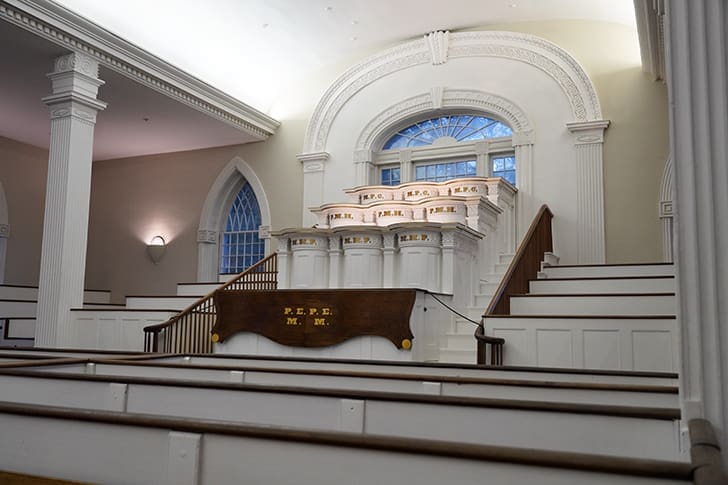


One hundred and ninety years ago, in a remarkable series of visions inside the newly dedicated Kirtland Temple, Joseph Smith and Oliver Cowdery received the keys of temple work. This series of articles seeks to increase understanding of the priesthood keys restored on that occasion. It includes excerpts from The Heart of Our Covenants: Temple Principles that Draw Us unto Christ by Valiant K. Jones. Used by permission. See www.valiantjones.com or www.cedarfort.com.
This is part 2 of 3. See the previous article in this series here
Work for the dead was not performed on the earth until after Christ initiated the preaching of the gospel to the spirits in prison at the time of His death. No proxy work for the dead could occur until after Christ opened the door for this by doing the greatest proxy work of all—atoning for our sins. Peter wrote, “For Christ also hath once suffered for sins, the just for the unjust, that he might bring us to God, being put to death in the flesh, but quickened by the Spirit: by which also he went and preached unto the spirits in prison; which sometime were disobedient . . . For for this cause was the gospel preached also to them that are dead, that they might be judged according to men in the flesh, but live according to God in the spirit” (1 Peter 3:18–20, 4:6).
President Joseph F. Smith’s vision of the spirit world makes it clear that, when Christ died, the dead “were assembled awaiting the advent of the Son of God into the spirit world” (D&C 138:16), apparently with no change in the status of each since their deaths. Christ arrived and organized the faithful to be teachers to those who were in darkness. President Smith described how the Lord initiated this work of redemption of the dead: “I perceived that the Lord went not in person among the wicked and the disobedient who had rejected the truth, to teach them; but behold, from among the righteous, he organized his forces and appointed messengers, clothed with power and authority, and commissioned them to go forth and carry the light of the gospel to them that were in darkness, even to all the spirits of men; and thus was the gospel preached to the dead. . . . Thus was it made known that our Redeemer spent his time during his sojourn in the world of spirits, instructing and preparing the faithful spirits of the prophets who had testified of him in the flesh; that they might carry the message of redemption unto all the dead” (D&C 138:29-30, 36-37).
Christ’s ministry in the spirit world had to occur before authorized proxy ordinances for the dead could be performed on earth. The Bible Dictionary entry for “Temple” confirms this, declaring: “From Adam to the time of Jesus, ordinances were performed in temples for the living only. After Jesus opened the way for the gospel to be preached in the world of spirits, ceremonial work for the dead, as well as for the living, has been done in temples on the earth by faithful members of the Church.”1
Confirming this, President Nelson taught, “From the days of Adam to the meridian of time, temple ordinances were performed for the living only. Ordinances for the dead had to await the Atonement and postmortal ministry of the Savior.”2 This same principle also was taught by President Brigham Young3 and President Joseph Fielding Smith.4 Understanding that temple ordinances were performed only for the living until after Christ’s resurrection will help us understand the keys of Elijah.
Elijah’s Keys Seal All Ordinances for the Living
We often say that Elijah brought the sealing keys of temple work for the dead, and this is true; however, since proxy temple work for the dead did not occur until after the resurrection of Jesus, what purpose did these keys fulfill in Old Testament times? The answer lies in the dual nature of these keys: They apply to ordinances performed both for the living and for the dead. Elijah’s keys seal in heaven all priesthood ordinances performed on earth, regardless of which side of the veil the souls reside on when they are named in the ordinances.
The way in which the sealing keys of Elijah were used in his day was to make sure all ordinances done for the living applied eternally. For priesthood ordinances to apply eternally, they must be performed under the direction of a prophet or apostle who holds the sealing keys of Elijah. Regarding these keys, the Prophet Joseph Smith declared, “It may seem to some to be a very bold doctrine that we talk of—a power which records or binds on earth and binds in heaven. Nevertheless, in all ages of the world, whenever the Lord has given a dispensation of the priesthood to any man by actual revelation, or any set of men, this power has always been given” (D&C 128:9).
One of the defining characteristics of the Great Apostasy was the loss of these sealing keys. The Catholic Church claims an unbroken line of authority from their popes back to Peter. However, even if the earliest popes, who were serving as bishops in Rome, could trace their priesthood ordinations to Peter, this would not be enough. All priesthood ordinances must be performed under the direction of a prophet or apostle who holds proper priesthood keys. The eventual lack of oversight by an authorized apostle on the earth who possessed the keys of Elijah means that any ordinances performed during that absence would not be recognized by God and would not be sealed in heaven. This is why Elijah had to return from heaven to restore those sealing keys to Joseph Smith.
President Boyd K. Packer described the keys of Elijah, explaining “The sealing power . . . gives substance and eternal permanence to all ordinances performed with proper authority for both the living and the dead.”5 This was first taught by Joseph Smith, who said, “Why send Elijah? Because he holds the keys of the authority to administer in all the ordinances of the priesthood; and without the authority is given, the ordinances could not be administered in righteousness.”6 As BYU professor Mark Mathews explained, “Sealing power is the authority to preside over and seal all ordinances of the temple and all ordinances for the living and the dead.”7
President Joseph Fielding Smith elaborated on this doctrine as follows: “Elijah restored to this Church . . . the keys of the sealing power; and that sealing power puts the stamp of approval upon every ordinance that is done in this Church and more particularly those that are performed in the temples of the Lord. . . . Some members of the Church have been confused in thinking that Elijah came with the keys of baptism for the dead or of salvation for the dead. Elijah’s keys were greater than that. They were the keys of sealing, and those keys of sealing pertain to the living and embrace the dead who are willing to repent.”8
President Smith also taught, “This priesthood holds the keys of binding and sealing on earth and in heaven of all the ordinances and principles pertaining to the salvation of man, that they may thus become valid in the celestial kingdom of God.”9
In summary, the way the sealing power of Elijah functions for the living is to assure that ordinances performed under proper priesthood authority on earth are recognized by God in heaven, giving them eternal permanence. For this reason, under “Elijah” in the Bible Dictionary we read, “The power of Elijah is the sealing power of the priesthood by which things bound or loosed on earth are bound or loosed in heaven. Thus the keys of this power are once again operative on the earth and are used in performing all the ordinances of the gospel for the living and the dead.”10 The way in which Elijah’s keys apply to ordinances for the dead will be discussed next.
Elijah’s Keys Extend Exalting Ordinances to the Dead
After Christ broke open the doors of spirit prison, an additional purpose for those keys became viable: The sealing keys of Elijah could then also be used to validate in heaven saving ordinances performed by proxies on earth for those who had already died without those ordinances but later repented and accepted Christ in the spirit world. During His ministry, Jesus Christ explained to Peter that he would receive the priesthood keys of the sealing power for his dispensation, saying, “And I will give thee the keys of the kingdom of heaven: and whatsoever thou shalt bind on earth shall be bound in heaven: and whatsoever thou shalt loose on earth shall be loosed in heaven” (Matthew 16:19). Christ later reiterated this, saying, “Verily I say unto you, Whatsoever ye shall bind on earth shall be bound in heaven: and whatsoever ye shall loose on earth shall be loosed in heaven” (Matthew 18:18).
Notice that the Lord told Peter, “I will give thee.” Christ fulfilled this promise when he took Peter, James, and John to the Mount of Transfiguration and presided over the transfer of priesthood keys from Moses and Elijah to these three leading apostles (see Matthew 17, Mark 9, and Luke 9). Also notice the use of the term whatsoever. Under the keys of Elijah, all saving ordinances performed on earth are sealed as permanent, eternal, and binding in heaven, as previously explained.
In addition, Peter learned that in his dispensation a particular new use for the keys of Elijah would be initiated: After the resurrection of Jesus Christ, Peter and his fellow apostles would be able to employ Elijah’s sealing keys in proxy ordinance work for the dead. It should not surprise us to find that it is an epistle from Peter that explains the preaching of the gospel in the spirit prison (see 1 Peter 3:18-20, 4:6). The foundation for Peter’s understanding of the doctrine of work for the dead undoubtedly came from his experience on the Mount of Transfiguration.
Joseph Smith likewise received a foundation for his understanding of the doctrine of work for the dead when he received from Elijah those same keys for his dispensation in the Kirtland Temple. Joseph continued to learn through revelation more about work for the dead until it became a primary focus of his life during his final years in Nauvoo. The Prophet taught how members of the Church in this last dispensation are to participate in fulfilling the mission of Elijah through the keys that the ancient Tishbite restored, declaring, “How are [the saints] to become saviors on Mount Zion? By building their temples, erecting their baptismal fonts, and going forth and receiving all the ordinances, baptisms, confirmations, washings, anointings, ordinations and sealing powers upon their heads, in behalf of all their progenitors who are dead, and redeem them that they may come forth in the first resurrection and be exalted to thrones of glory with them; and herein is the chain that binds the hearts of the fathers to the children, and the children to the fathers, which fulfills the mission of Elijah.”11
Joseph Smith also taught, “The doctrine or sealing power of Elijah is as follows: —If you have power to seal on earth and in heaven, then we should be wise. The first thing you do, go and seal on earth your sons and daughters unto yourself, and yourself unto your fathers in eternal glory.”12 Notice that the Prophet spoke of two separate sealing experiences—one to your children and another to your fathers or ancestors. The way to “seal on earth your sons and daughters unto yourself” is by being married in the temple so that your children are born in the covenant, or, if they are already born, by having them sealed to you after you are sealed to your spouse in a temple marriage. Such marriages and sealings for the living are performed under the keys of Elias. And the way to seal “yourself unto your fathers” is by performing proxy marriages and sealings for your deceased ancestors. Such ordinances for the dead are possible because of the additional keys of Elijah.
What glorious, good news we find in the combination of this gospel of Abraham and this doctrine of Elijah! A temple marriage for the living will bind a couple’s children to them eternally, for they are born in the covenant—the Abrahamic covenant. However, there is little value in being sealed to those who come in the future if we are not also sealed to those in the past through the keys of Elijah. Without this ability to form sealing links backward, the purposes of the earth would be wasted at the Lord’s second coming (see D&C 2:1-3). Joseph Smith wrote, “These are principles in relation to the dead and the living that cannot be lightly passed over, as pertaining to our salvation. For their salvation is necessary and essential to our salvation, as Paul says concerning the fathers—that they without us cannot be made perfect—neither can we without our dead be made perfect” (D&C 128:15).
Joseph exulted in the restoration of these priesthood keys in his dispensation, writing, “Let your hearts rejoice, and be exceedingly glad. Let the earth break forth into singing. Let the dead speak forth anthems of eternal praise to the King Immanuel, who hath ordained, before the world was, that which would enable us to redeem them out of their prison; for the prisoners shall go free” (D&C 128:22).
Sometimes when we want something to be held very securely, we give keys to two different individuals and require that both come and bring their separate keys to unlock a treasure. This is true of Elias and Elijah. If the keys of Elias enabled eternal marriage for the living, this only unlocked part of the treasure of eternal families. Elijah had to follow and bring his keys to not only validate ordinances for the living, but to also make proxy priesthood ordinances effective for the dead so that the living and the dead could be connected in eternal family bonds.
No wonder the building of temples and the work of salvation and exaltation for the dead is moving forward in our day at such a fantastic pace. These efforts are part of President Nelson’s invitation to “help gather Israel on both sides of the veil.”13 He has said, “That gathering is the most important thing taking place on earth today. Nothing else compares in magnitude, nothing else compares in importance, nothing else compares in majesty. And if you choose to, if you want to, you can be a big part of it. You can be a big part of something big, something grand, something majestic!”14
To be continued…
Valiant K. Jones is the author of The Heart of Our Covenants: Temple Principles that Draw Us unto Christ. For more information, see www.valiantjones.com or www.cedarfort.com.
Footnotes
1 “Temple,” Bible Dictionary, lds.org/scriptures/bd/temple?lang=eng.
2 Russell M. Nelson, “The Spirit of Elijah,” Ensign, November 1994, churchofjesuschrist.org/study/ensign/1994/11/the-spirit-of-elijah?lang=eng.
3 Brigham Young, “Our Relatives, Those Who Do the Will of God, etc.” Journal of Discourses, Vol. 4, p. 285, March 15, 1857, jod.mrm.org/4/279
4 Joseph Fielding Smith, Doctrines of Salvation, Vol. 2, pp. 320-321.
5 Boyd K. Packer, “Ordinances,” BYU Speeches, February 3, 1980, speeches.byu.edu/talks/boyd-k-packer/ordinances/.
6 Joseph Smith Jr., Teachings of the Prophet Joseph Smith, p. 172, scriptures.byu.edu/tpjs/STPJS.pdf; emphasis added.
7 Mark Mathews, “Understanding Priesthood Keys in Leadership | An Interview with Mark Mathews,” Leading Saints Podcast, Leading Saints, Sept 23, 2018, timestamp 33:44, leadingsaints.org/understanding-priesthood-keys-in-leadership/.
8 Joseph Fielding Smith, Doctrines of Salvation, Vol. 3, pp. 129-130; see also Joseph Fielding Smith, “Chapter 17: Sealing Power and Temple Blessings.” Teachings of Presidents of the Church: Joseph Fielding Smith, churchofjesuschrist.org/study/manual/teachings-of-presidents-of-the-church-joseph-fielding-smith/chapter-17-sealing-power-and-temple-blessings?lang=eng.
9 Joseph Fielding Smith, Doctrines of Salvation, Vol. 2, p. 117.
10 “Elijah,” Bible Dictionary, churchofjesuschrist.org/study/scriptures/bd/elijah?lang=eng.
11 Joseph Smith Jr., Teachings of the Prophet Joseph Smith, p. 330; see also Joseph Smith Jr., “Chapter 41: Becoming Saviors on Mount Zion,” Teachings of Presidents of the Church: Joseph Smith, churchofjesuschrist.org/study/manual/teachings-joseph-smith/chapter-41?lang=eng.
12 Joseph Smith Jr., Teachings of the Prophet Joseph Smith, p. 340; see also Joseph Smith Jr., “Chapter 26: Elijah and the Restoration of the Sealing Keys,” Teachings of Presidents of the Church: Joseph Smith, lds.org/manual/teachings-joseph-smith/chapter-26?lang=eng.
13 Russell M. Nelson, “Sisters’ Participation in the Gathering of Israel,” Ensign, November 2018,
14 Russell M. Nelson, “Hope of Israel,” ibid.





GaleApril 15, 2026
The appearance of Christ, Elijah, Moses and Elias and the conferring of keys in the Kirtland Temple occurred fittingly on the Jewish holy day of Bikkurim--First Fruits--during Passover week. Passover week contains 3 holy days: the sacrifice of the Paschal lamb, the Feast of Unleavened Bread, and First Fruits--the offering of the first of the spring harvest of grain. Jews could not eat from the first harvest until this offering was made in the temple. It guaranteed a perfect harvest for the coming year and occurred on the day Christ rose from the dead. Through His resurrection, Christ guaranteed a perfect harvest of souls--everyone would be resurrected. The sealing power enables covenants to last eternally.