









Joseph Smith’s Birthday Party: Who Would Come?
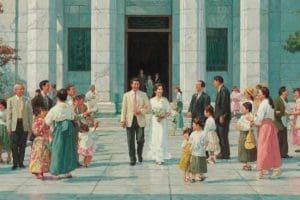
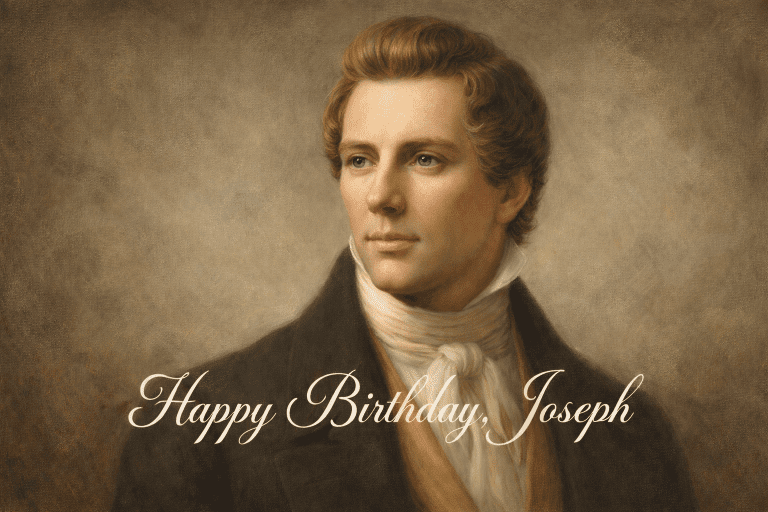
When Joseph Smith met Moroni for the first time, Moroni told him that his name “should be had for good and evil among all nations” (Joseph Smith—History 1:33). I decided to have a birthday party for Joseph on December 23, 2025. He will be 220 years old. I sent invitations to people who said good about him. Here is a sampling of the people who came.
William W. Phelps: Brother Joseph!
Joseph: Brother Phelps!
William W. Phelps: I wanted to be the first at this celebration because of the false witness I bore against you in Missouri. As I said in my letter to you in 1838: “I am as the prodigal Son…. I have been greatly abased and humbled…. I know my situation, you know it, and God knows it, and I want to be saved if my friends will help me…. I have done wrong and I am sorry. The beam is in my own eye…. I ask forgiveness in the name of Jesus Christ of all the saints…. I want your fellowship”1
Joseph: Of course, you are welcome here. I’m sure you remember my words: “Come on, dear brother, since the war is past, for friends at first, are friends again at last”2
William W. Phelps: And I hope you remember the words I wrote about you: “Praise to the man who communed with Jehovah! Jesus anointed that Prophet and Seer. Blessed to open the last dispensation, kings shall extol him, and nations revere”3
…
Miriam Stowell: Hello, Joseph. It’s Miriam Stowell. I am here with my sister, Rhoda.
Joseph: Thank you for coming. I remember you both. When I was working for your father, there was a court case against me in 1830, and you two were called to testify about my character.
Rhoda Stowell: Yes. When we were summoned as witnesses, we were interviewed separately. They asked us about your behavior towards us both in public and private. We told them that you always treated us respectfully. Your accusers realized they had no case, and the charges were dropped.4
Joseph: Thank you. I am grateful to you both.
….
Matthew L. Davis: Hello, Joseph. I was a journalist from New York. I attended a sermon you gave in February of 1840 in Washington, D.C., and met you briefly. You impressed me so much that I wrote about meeting you in a letter to my wife. I told her that you were a “plain, sensible, strong-minded man [and that] everything [you] said [was] in a manner to leave an impression that [you were] sincere.” I told her you didn’t use levity or fanaticism. I said you were dignified in your deportment.” I remember that you had “a ready sense of humor.” I watched you interact with the people there. I saw you “stand up for the rights of others to practice their religion free of violence and discrimination.”5
Joseph: Thank you. Those are kind words.
…
Peter Hardeman Burnett: Joseph, it is so nice to see you again.
Joseph: Peter Burnett! Thank you for coming.
Peter Hardeman Burnett: “I well remember the first time I saw you. It was at Far West, and I heard you preach two sermons. I was so impressed that in June 1839, I acted as your defense attorney.
Joseph: Yes. I recall your bravery, your willingness to defend me with your pistol if necessary.
Peter Hardeman Burnett: That is true. I was a young attorney assisting Alexander Doniphan. We were afraid you might be mobbed, forcibly seized, and hung. I gave some introductory remarks in defense of you and the others who had been kept in Liberty Jail. After Doniphan’s closing remarks in your defense, the “maddened crowd,” which “foamed and gnashed their teeth,” acted in a wild and threatening manner. As tension mounted, “I slipped [my] hand down upon [my] pistol, determined “to spend [my] life, if necessary, to protect [your life]”6
….
Alexander Donaphan: I am here too, Joseph.
Joseph: Why, it’s Brigadier General Alexander Donaphan! Thank you for saving my life when General Lucas held a kangaroo court and declared me, along with my brother Hyrum, Sidney Rigdon, Lyman Wight, Alexander McRae, and Caleb Baldwin guilty of treason. I know you refused to shoot us, saying something like: “It is cold blooded murder. I will not obey your order. … [I]f you execute these men, I will hold you responsible before an earthly tribunal, so help me God”.7
Alexander Donaphan: Of course, I defended you. You were “a peaceable, sober, industrious, and law-abiding people.”8
Joseph: Thank you both for your heroic stance. History remembers, and I will always remember your valiant service.
….
William S. West: Hello, Joseph. You probably don’t remember me. My name is William S. West.
Joseph: Yes, Mr. West, I do remember you. I think you visited me in Kirtland. Did we not have a conversation about the mummies and scrolls and the writings of Abraham?
William S. West: We did. But what stayed with me, and what I wrote a pamphlet about, was the record of Joseph, who was sold into Egypt. I remember you told me that it contained “important information respecting the creation, the fall of man, the deluge, the patriarchs, the Book of Mormon, the lost tribes, the gathering, the end of the world, the judgment, etc. etc.”9 I understand that because of persecution you never finished translating Joseph’s writings and that they were never published.
Joseph: Yes, you are correct. However, in the Lord’s timing, the record of Joseph will be translated and published for the world to read.
William S. West: I look forward to that opportunity. Happy Birthday.
Joseph: Thank you for coming.
….
Mary B. Noble: Hello, Brother Joseph. When I was twenty-three, you came to my father’s home in Avon, New York. The year was 1834. “I can truly say at the first sight that I had a testimony within my bosom that [you were] a man chosen of God to bring forth a great work in the last days.” Your words were “meat and drink to me…. The principles [you] bore of the truth of the Book of Mormon… made a lasting impression upon my mind…. Never did I hear preaching sound so glorious to me as that did. I realized it was the truth of heaven, for I had a testimony of it myself.”10
….
Harold Bloom: Hello, Joseph. I am Harold Bloom. I was born in 1930 and spent my career as a professor of humanities at Yale University. When I heard about this birthday celebration, I wanted to share what I wrote about you.
Joseph: Pleased to meet you, Professor Bloom. Did you write for good or for ill?
Harold Bloom: In the essay I wrote about you, I think I used the phrase “religious genius” about ten times. “As a Jewish Gnostic, I am in no position to judge [you] as a revelator, but as a student of the American imagination I observe that [your] achievement as national prophet and seer is unique in our history. Ralph Waldo Emerson and Walt Whitman were great writers, Jonathan Edwards and Horace Bushnell major theologians, William James a superb psychologist, and all these are crucial figures in the spiritual history of our country. [You] did not excel as a writer or as a theologian, let alone as psychologist and philosopher. But [you were] an authentic religious genius, and surpassed all Americans, before or since, in the possession and expression of what could be called the religion-making imagination.”11
Joseph: Those of generous words. Thank you for coming.
….
Mercy Fielding Thompson: I was baptized in Canada when I was twenty-nine. “I [saw you] under a great variety of circumstances, in public, in domestic and social life and in sacred places. I saw [you] by the bedside of Emma… in sickness, exhibiting all the solicitude and sympathy possible for the tenderest of hearts and the most affectionate of natures to feel. You were also there at the deathbed of my beloved companion…. [Your] tears of love and sympathy freely flowed…. [There were times,] I [saw you] as if carried away by the power of God beyond all mortal conception, when speaking to the Saints in their public gatherings; and in less public places I have heard [you explain] to the brethren and sisters the glorious principles of the gospel, as no man could, except by prophetic power…. Yet you were unassuming as a child.”12
Joseph: Thank you, Sister Mercy. Your husband, Robert, was my scribe and clerk, a man to be trusted. When he died in 1841, we mourned his passing. We missed him. He was a bright and capable man, the co-editor of the Times and Seasons newspaper. And you, Mercy, thank you for your faithful and dedicated service to the gospel of Jesus Christ throughout your life.
….
Robert V. Remini: Hello, Joseph. My name is Robert Remini. I was a history professor at the University of Illinois at Chicago. I wrote a book about you in 2002, titled Joseph Smith. In it, I wrote that you were “unquestionably the most important reformer and innovator in American religious history.”
Joseph: I thank you for that praise, but you know that everything I was able to do, for example, read and dictate the text of the Book of Mormon to my scribes, was by the gift, power, and mercy of God. When God calls a person to do His will, He qualifies them to do it. Such was my blessing.
Robert V. Remini: Yes. I know that about you. I wrote that you were “a man of compelling charisma, charm, and persuasiveness, a man absolutely convinced that his religious authority came directly from God.”13
….
Three officers of the law: Joseph, we are three men who were sent to arrest you at your parents’ home. Our names are not in any historical accounts, and we still want to go unnamed. Here is our story. We burst into the home, and your mother said: “Gentlemen, suffer me to make you acquainted with Joseph Smith, the Prophet.” [We] stared at [you] as if [you] were a spectre. [You] smiled, and stepping towards [us], gave each [of us your] hand, in a manner which convinced [us] that [you were] neither guilty nor yet a hypocrite.” You then sat with us and explained your situation to us in some detail. Then you stood up and said, “Mother, I believe I will go home now—Emma will be expecting me.” Two of us sprang to our feet and offered to go with you to protect you. As we talked amongst ourselves, we said:
1st Officer. “Did you not feel strangely when Smith took you by the hand? I never felt so in my life.”
2nd Officer. “I could not move. I would not harm a hair of that man’s head for the whole world.”
3rd Officer. “This is the last time you will catch me coming to kill Joe Smith, or the Mormons either.”
1st Officer. “I guess this is about my last expedition against this place. I never saw a more harmless, innocent appearing man than the ‘Mormon’ Prophet.”14
Joseph: Thank you for your courageous actions, and thank you for coming.
….
George Manwaring: Hello, Joseph. I am George Manwaring. I never met you in life, as I was born ten years after you and Hyrum were martyred. Although I had only a few weeks of formal schooling, the Lord blessed me to become a music teacher, stenographer, poet, and penman. My Father in Heaven gave me the gift to write hymns. Five of my hymns are in the hymnbook that is in use today. I wrote “Joseph Smith’s First Prayer.” The inspiration for the song came as I contemplated C.C.A. Christiansen’s painting, ”The Vision,” which shows the Father and Son appearing to you. Even though I was blessed to write the words, they fill me with awe every time I think of them.15
Joseph: Thank you, Brother Manwaring, and “awe” is the correct word. I have found it beyond human verbal expression to describe the experience. But you did well. It was a lovely morning in the spring of 1820. I did kneel. The forces of the adversary did fill my soul with deep despair until the light came and dispelled the darkness. I did see God the Father and His Son, and rapture did fill my bosom.
….
It has been an enlightening opportunity to celebrate Joseph’s birthday. As Apostle Franklin D. Richards wrote in the preface to the Pearl of Great Price, 1851 edition: “As impervious as the minds of men may be at present to these convictions, the day is not far distant when sinners, as well as Saints, will know that JOSEPH SMITH was one of the greatest men that ever lived upon the earth, and that under God he was the Prophet and founder of the dispensation of the fulness of times, in which will be gathered together in one all things which are in Christ, both which are in heaven and which are on earth.”
If any of you who read my articles are interested, I have compiled 102 of the essays I wrote for Meridian Magazine into a book, Brass Tacks 2.0. It is available on Amazon.
End Notes
1. Joseph Smith Papers, Documents, Volume 7: September 1839–January 1841, ed. Matthew C. Godfrey and others [2018], 304–5.
2. Teachings of Presidents of the Church: Joseph Smith [2007], 398.
3. Hymns, 27.
4. https://www.fairlatterdaysaints.org/answers/Joseph_Smith%27s_family_as_trustworthy_and_hard-working.
6. Peter Hardeman Burnett, Recollections and Opinions of an Old Pioneer (New York: D. Appleton and Co., 1880), 56–57, [ca. June 1838; Far West, Missouri].
7. History of the Church, 3:190–91.
8. https://bhroberts.org/records/dAzxtc-bSQXKk/alexander_doniphan_describes_the_mormon_missouri_war
9. William S. West, A Few Interesting Facts Respecting the Rise, Progress, and Pretentions of the Mormons, Warren, Ohio, 1837, 16.
11. https://yalereview.org/article/harold-bloom-on-joseph-smith
14. History of Joseph Smith by His Mother Lucy Mack Smith, 254-255.





Karen Ririe KratzerDecember 23, 2025
At the sacred time when celebrating God’s gift of his beloved son, thank you Sister Linford for your inspired tribute honoring Brother Joseph on his birthday. l have no recollection of not believing his words and miraculous real life experiences leading him to become the first prophet of the restoration of the Church of and gospel of Jesus Christ; thank-you for sharing well known and not often quoted testimonies of the American prophet.
Marilynne LinfordDecember 23, 2025
My apologies to C. C. A. Christensen for spelling his name wrong.