








Four modern Minutemen dressed in black and hefting serious weapons stood at the ready near the entrance to the CIA, only a mile down the road from my house in McLean, VA. It was the day after a team of Navy Seals took out Osama Bin Laden–and while the country wrapped itself in flags to celebrate the promised takedown of this man behind 9/11, these soldiers stood as reminders of continued U.S. vigilance against others who would do us harm. But this intense scene in my own neighborhood also reawakened emotions from that day ten years ago when the world changed.
I was simply making the bed on the morning of 9/11, tucking in sheets at the right front corner. My back was to the TV when I heard commentators talking about a plane that had hit a building, and I turned around to see black smoke around one of New York’s Twin Towers. I thought, “Are you kidding? Who flies into a building?”
Then someone pointed out the sudden appearance of another plane, and I looked up just as a plane flew near the second tower. From my angle, I couldn’t see the plane hit the tower; it just seemed to disappear behind it. Strangely, it never reappeared on the other side. Although Matt Lauer of NBC was now talking about a terrorist act, I still didn’t get it. There was nothing in my 52 years of experience to help me put this into context. My mind and my imagination could not comprehend that people had deliberately flown not one, but two planes into buildings on purpose. No, this was just a terrible accident–and where in the world did that other plane go?
Such denial would be my method of coping throughout much of that day. I sat down on the bed, simultaneously transfixed and bewildered by replays from different angles of a plane clearly crashing into the South Tower. The words of an old ‘60s song played in my head: Something’s happening here; What it is, ain’t exactly clear. On every TV channel, grave faces spoke grave words.
What surprised me most of all was that I wasn’t panicked, although now I realize I was probably in shock. Denial convinced me that despite the ominous blackness pouring out of both towers, the people on those floors were probably making their way to the exit stairwells—or walking up to the top where a helicopter could rescue them. Hadn’t I seen this in the movies? And since most of the early TV footage showed the towers from a distance, I had no idea at first of the panic in the streets below.
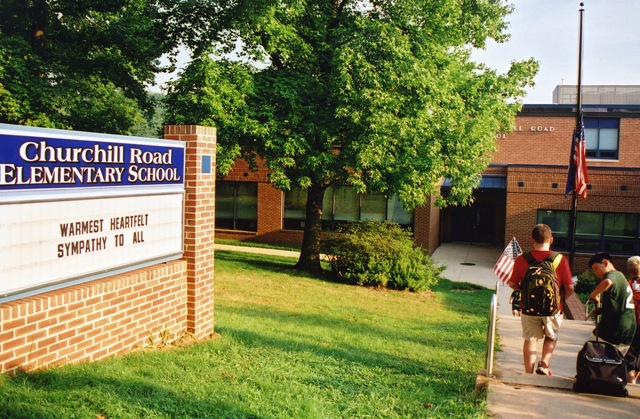
I moved to the living room couch to watch, or rather I should say, stare in disbelief. Meanwhile, mothers from my daughter’s school started calling me, as the room mother, to ask if they should go to the school and pick up their children. After all, the school is just across the street from the CIA and there is no back way out of the campus. I called the administration and learned that students would be excused, although school would continue. Everyone was trying to remain calm. I passed that information along to the other moms and let them decide.
I chose not to go, applauding myself for staying so calm and reasonable. I now realize that I was simply too hypnotized by the stunning images on TV to even move, much less go pick up my own daughter. New York, after all, seemed pretty far away.
But the Pentagon didn’t. When the third plane crashed into it just 25 minutes away from where I was sitting, it jolted me at last from my TV stupor; I was no longer an observer but a participant. The newscasters sounded more alarmed as they discussed a missing fourth plane. Was it heading for the U.S. Capitol Building? The White House? The CIA? No one knew, but it was out there ready to rain carnage on someone else.
That missing plane, I kept thinking, could be roving over my own neighborhood right now. I took some comfort in thinking that military jets would be scrambled by now, but that solace evaporated when I considered what shooting down an errant plane would mean to those of us below. Now I was more than scared. I felt a rising sense of dread and terror, just what the bad guys in those planes wanted me to feel. It was so visceral my stomach hurt, and it intensified with an overwhelming sense of everything out of control. Chaos unfolded with images of desperate people that would not be rescued, buildings that simply disappeared, mushrooming clouds that ate skyscrapers, and sinister dust that settled on firemen’s stupefied faces. Only slowly did my mind and my eyes get in sync—and the surreal become real.
Finally, from a place I don’t quite understand, a powerful survival instinct grabbed me––Move! In emergency mode at last, I grabbed the car keys and careened up to my daughter’s school on two wheels, only to learn she was one of the last to be picked up. “What took you so long, Mom?” she asked.
My husband and I tried to reason our way through the aftermath. What should we be doing now? Where are the emergency kits and exactly what did we put in them? Should we call our family and let them know our plans? Do we have any plans? And the biggest question of all: Is it over?
The days following 9/11 were frightening as well. The Leave-it-to-Beaver world of my youth was hijacked forever along with those four planes and nothing seemed safe. The sound of any plane put me on high alert, an unusual state for a 1950s Air Force brat like me who grew up loving the rumble and shake of planes overhead. But after 9/11, the feelings and images evoked by seeing a plane made me freeze. I just wanted it to go away. Yet the eerie silence that ensued after civilian flights were cancelled was broken for several days and nights by military jets that came out of nowhere to streak above our home. During my own first flight after the event, I paid closer attention to other passengers, briefcases, and backpacks.
In many ways, I also quickly learned how limited my personal resources were for dealing with a major crisis. Though I had stored food, water, and medicine, my supply wasn’t adequate for any kind of lengthy shelter-in-place scenario. I had to replace maps that were so old George Washington could have used them and I kept my gas tank filled.
Although I personally did not know anyone who died or was injured on 9/11, I felt connected to each one. In the Washington D.C. area, there was a bittersweet healing and sense of community; everyone wanted to do something. Terrorism had come to our doorstep and we were determined not to let it change us, even if it changed aspects of the way we lived.
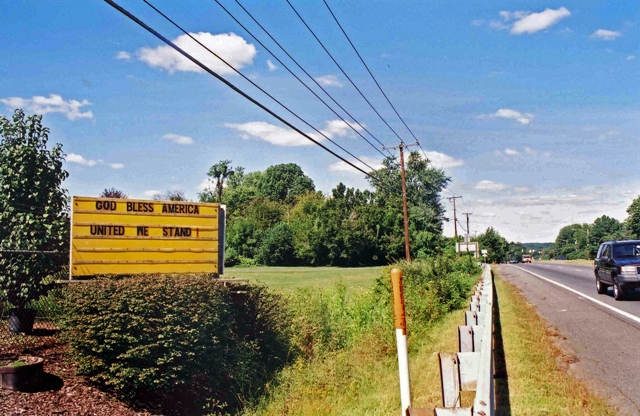
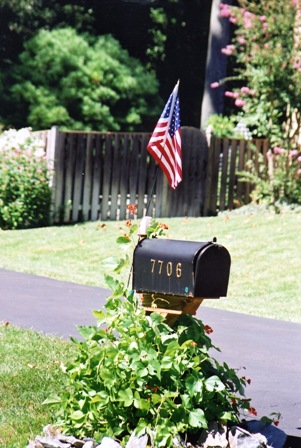
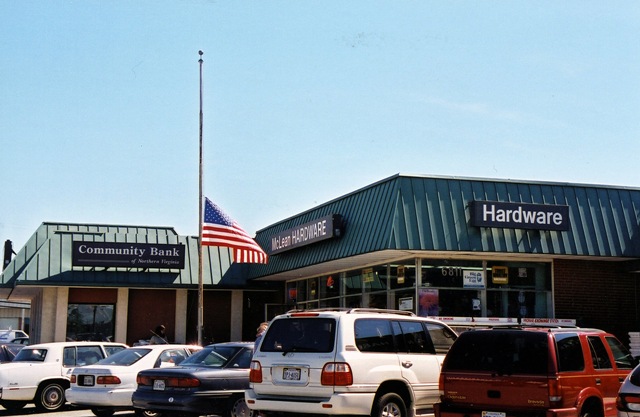
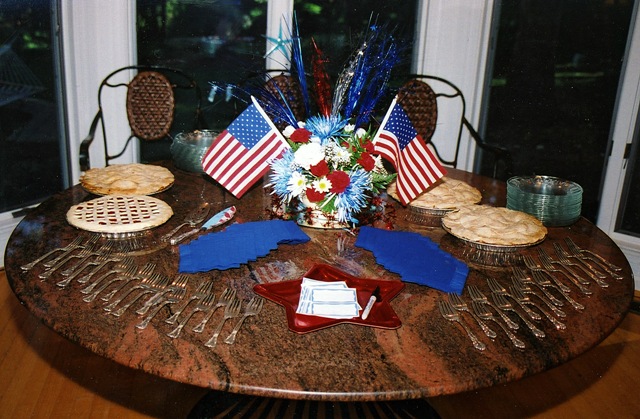 I organized a neighborhood meeting to talk about security and communication, and we realized how little we really knew each other. How then could we expect to count on each other in an emergency, to be each other’s keeper? I also hung the flag outside my home and took pictures of flags around town at half-staff.
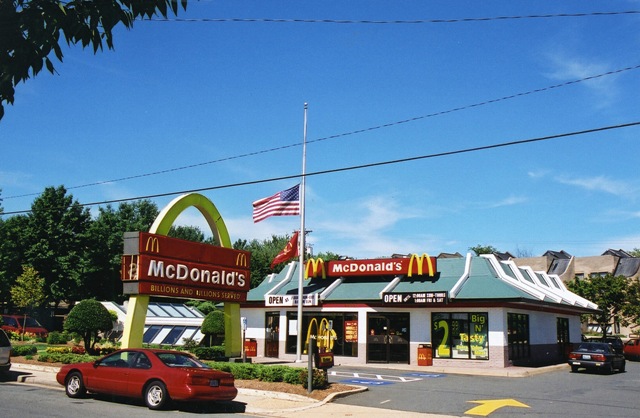
I even felt connected to those brave early responders who gave me such a sense of pride in my countrymen and who showed me that goodness and humanity still existed. They exemplified writer Ambrose Redmoon’s philosophy that “courage is not the absence of fear, but rather the judgment that something else is more important than fear.”
Looking back now, I believe two lessons I learned from the events of 9/11 have particularly helped me refocus my priorities. First, I had to come to grips with the profound truth that incomprehensible evil really exists and that I needed to learn how to deal with it. Never again would a crisis immobilize me like a deer in the headlights. Our family lives today with optimism and hope partly because we listened to the advice of our government and church to get prepared, and we are now equipped with emergency plans and supplies to help us act rather than react during stressful times. Knowing we are more in control and self-sufficient was a pretty good feeling during the recent week that the eastern seaboard experienced both an earthquake and a hurricane. Our gas tank remains full.
The second lesson is a corollary to the first. Our family does not live with fear because we learned that true peace of mind during tough times does not really come from supplies of wheat and duct tape; it comes from adequate spiritual preparation. For us, that meant seeking a deeper understanding of prayer and God’s plan for us as a family, developing more gratitude for His tender mercies, seeking opportunities to serve, and recommitting to endure to the end. We took to heart the words of Elder M. Russell Ballard: “This is not a time for the spiritually faint of heart.” * Like building a year’s supply of food, such preparation has also taken time and thought over these years, and it is from this core of strength that our family is able to welcome each unpredictable day believing that all is well—ultimately—no matter what happens.
***
* M. Russell Ballard, The Truth of God Shall Go Forth, General Conference, October 2008.


