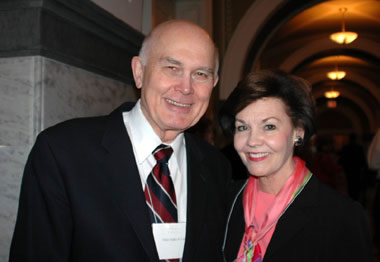






Editor’s Note: The “Worlds of Joseph Smith Symposium,” at the Library of Congress in Washington, D.C. on May 6-7, featured scholars from many faiths and backgrounds who discussed the Mormon prophet from five perspectives or “worlds.” At each session, a scholar presented a paper to which three others responded. These articles present highlights from each session. To read the report on Session I, click here. To read the report on Session II, click here: Session III: Joseph Smith in a Personal World Introduction of Speaker: Cecil O. Samuelson, President of Brigham Young University Speaker: Elder Dallin H. Oaks, Quorum of the Twelve, Church of Jesus Christ of Latter-day Saints The third session of the Joseph Smith Symposium featured Elder Dallin H. Oaks, who discussed how his personal understanding of Joseph Smith – both as a man and as a prophet – has developed through years of study and experience. In particular, Elder Oaks focused on Joseph Smith’s prophetic leadership and his teachings on revelation, especially as they affect each person’s life. The belief in modern-day revelation, Elder Oaks said, continues to set Mormons apart from other religious traditions. Moreover, he believes it is the key to the uniqueness of Joseph Smith’s message. “By revelation, I mean God’s communication to man – to prophets and to every one of us,” Elder Oaks said, adding that Joseph Smith’s role as a prophet meant he was “one who speaks for God in revealing Divine Truth to others.” Revelation the Foundation Underpinning all church doctrine and governance, Elder Oaks explained, is the principle of revelation, which is also “fundamental to personal conversion, personal decision-making, and how we understand and apply the inspired texts we call scriptures.” He cited an example of how personal revelation had worked in his own life by recalling that he and his wife prayed for an entire weekend before making the decision to leave his Chicago law firm and become a professor at The University of Chicago Law School. Sometimes such personal revelation is manifested by “flashes of enlightenment,” he said, and Joseph Smith taught that each person has access to such spiritual guidance. This prayerful approach to decision-making, he pointed out, was quite different from the reasoned dialogue approach he used to decide issues in his legal profession. Another kind of revelation, but on a different level, is prophetic revelation, Elder Oaks said. Here the “prophet-leader” receives and reveals God’s truths or commandments on behalf of the people. Elder Oaks cited Amos 3:7 to remind the audience that “the Lord God will do nothing, but he revealeth his secret unto his servants the prophets.” It was Joseph Smith’s prophetic ability to communicate with God that Elder Oaks believes answers the question of how such an “ignorant” young man accomplished all that he did. “Perhaps it is time,” said Elder Oaks, “. for educated non-believers to take the unlearned Joseph Smith seriously and to ask the question, ‘Where did his genius come from?'”
Personal Influence of Joseph Smith’s Teachings Among the principles Joseph Smith taught that have particularly resonated with Elder Oaks and have “grounded” him in the Christian faith are the Fatherhood of God and the brotherhood of man; the mission of Jesus Christ as described in both the New Testament and the Book of Mormon; the individual potential of every person before, during, and after this earthly life; the eternal significance of learning; and the Word of Wisdom. The way that Joseph Smith taught these principles, Elder Oaks said, was by being a personal leader who encouraged individual relationships with God. This approach still influences the way today’s missionary effort is directed – to individuals and not to groups. “For us, each individual must decide for himself or herself, without pressure from group or higher authority,” Elder Oaks emphasized. He also counseled that people should wait to be baptized “until they know by personal revelation that the message is true and that this Church is still led by a prophet.” Likewise, Elder Oaks said one of the Church’s Articles of Faith supports and defends freedom of choice for others: We claim the privilege of worshiping Almighty God according to the dictates of our own conscience, and allow all men the same privilege, let them worship how, where, or what they may (11th Article of Faith). He added that Joseph Smith recognized that “the same tyranny that would trample on the rights of believers who were unpopular and too weak to defend themselves would trample on the rights of Mormons.” Researching Joseph Smith Elder Oaks described the prophet he has come to know as a charismatic and gifted man of the frontier – physical, approachable, and loved – yet one who also knew pain and great hardship. Despite these difficulties, Joseph Smith’s accomplishments during his 38 years on earth are staggering, and Elder Oaks pointed out that Joseph Smith translated the Book of Mormon and received more than half of the revelations in the Doctrine and Covenants by the time he was 25. Several aspects of Joseph Smith’s life so intrigued Elder Oaks when he lived in Illinois as a law student and later as a law professor, that he began his own investigation into the legal issues behind several notable cases. These included the trial of the five men accused of murdering Joseph Smith, the Prophet’s handling of various property conveyances, and Mayor Joseph Smith’s suppression (along with that of the Nauvoo City Council) of an opposition newspaper. Elder Oaks could find nothing “that reflected dishonor” on the prophet, and in a subsequent law review article regarding the newspaper case, Elder Oaks discussed how the guarantee of freedom of the press in the United States Constitution “was not declared applicable to the actions of city and state governments until 1931, and then only by a 5-to-4 Court’s reliance on a constitutional amendment adopted in 1868.” He advised those who would condemn Joseph Smith for his actions to “judge the actions of our predecessors on the basis of the laws and commandments and circumstances of their day, not ours.” The Impact of Joseph Smith in the Developing World Elder Oaks’ study of Joseph Smith was given a new direction during a two-year assignment to the Philippines with his wife, Kristin. As he interacted with people he met and grew to love, he saw for himself the power of Joseph Smith’s message not only in that country, but also among other developing nations. “The most important ingredient at work in the remarkable growth and staying power of our church in the Philippines is the doctrine of our church and the investigator’s personal conversion to it,” Elder Oaks said. Primary among these doctrines is that of ongoing revelation, which Elder Oaks believes helps people discover the truth for themselves “rather than by depending on others of greater education or standing.” He said the poor and disadvantaged learn they are “children of a Heavenly Father who loves them and has a plan for them” and that their physical or economic circumstances do not limit them spiritually. They are inspired by Joseph Smith’s teachings on self-improvement and encouraged by his emphasis on the worth of every man and woman – who each had identity and purpose before this life and will likewise have it in the world to come. Elder Oaks added that the Book of Mormon, as a second witness of the Gospel of Jesus Christ, reaffirms this worth by describing all men as being equal before God: “Ye shall not esteem one flesh above another or one man shall not think himself above another.” (Mosiah 23:7) What Elder Oaks has seen the Book of Mormon offer to the people of the Philippines who have withstood over 400 years of rule by other countries is hope and comfort as they now struggle to shake off what he called a “culture of dependency.” He said that through a prophet of the Lord, many Filipinos have learned to take responsibility for their own lives and those of their families, plus they are applying the principles of honesty and integrity to strengthen their spiritual lives and to build up their local communities. Understanding the Scriptures through Revelation In his concluding remarks, Elder Oaks counseled that the present canon of scriptures, “which are the revelations of the past,” cannot be understood today “without openness to the revelations of the present” in their reading and interpretation. He explained that an open scriptural canon leads to a fuller understanding of the gospel, whether through “new additions to the body of scriptures” or through “new revelations on the meaning of scriptures previously canonized.” Such public revelations often clarify doctrine for the entire Church. Revelations that are private, on the other hand, can provide individuals with their own insight on the scriptures or give them direction on personal matters. But Elder Oaks noted that it takes the Spirit of God to discern meaning and that “while Latter-day Saints rely on scholars and scholarship, that reliance is preliminary in method and secondary in authority.” In particular, he cautioned about authoritative commentaries, which he said “are not a substitute for the scriptures any more than a good cookbook is a substitute for food.” No Comments | Post or read comments FEATURES |

June 4, 2026
June 4, 2026