








Reviews of Two Pioneer-based Films
By Thomas C. Baggaley
It’s July and our thoughts turn once again to our heritage and those who worked so hard to build the foundations of the good life we enjoy. Right on cue, several films focusing on that pioneer heritage have been released or are scheduled to be released in the next month. This week, I’ve chosen to focus on two of these films which were recently released on video/DVD: Kels Goodman’s Handcart and T. C. Christensen’s A Pioneer Miracle.
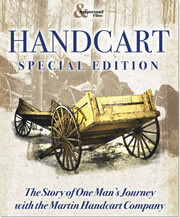
Handcart
 It’s going to take a little bit of the music from Mission: Impossible to get us in the mood for this one. Dum, dum, da-da, dum, dum, da-da… Got it? Okay, here goes:
Hello, Mr. Goodman. I hope you are well. Your mission, should you choose to accept it, is to make a film based on the experiences of the ill-fated Martin handcart company. We realize that this may not seem like an overwhelming challenge – after all, many have wondered for years why Hollywood hasn’t already made an epic motion picture based on the handcart companies. In fact, aside from Brigham Young: Frontiersman, (1940) surprisingly, the Mormon exodus has been largely untapped as a resource for potential major motion picture materials. (We’re not counting Legacy and other such films produced by the church, since although they are excellent films, they have never received widespread theatrical distribution.) Of course, your task is not really as simple as it might sound at first.
First of all, you are to make the feature-length film with a paltry budget of just over $300,000 – including marketing. What’s more, just as you are about to complete funding for the film and begin shooting, one of your major investors will back out, leaving you beginning shooting with only $30,000 in your pocket and scrambling to fill in the gap. Plus, you will find it necessary to adjust your shooting schedule around the weather and the 2002 Olympics, since it will be basically impossible to find any shooting locations or the extras you will need while the games are happening.
Because of the multi-national nature of the handcart company, your actors will need to pull off a variety of accents from various parts of Europe, but most of them must also be willing to work for free. Even with a large number of volunteers working on the film, you will run out of money before the film is completed to your satisfaction. Finally, not only will you produce and direct the film, but after the film is shot, you will be responsible for distributing the film – using your garage as a base for storing the prints of the film as you personally will need to call the various theater owners nationwide and convince them that Handcart will bring them a reasonable profit.
Should you fail in your mission (or be captured) the secretary and millions of Latter-day Saints worldwide will disavow any knowledge of you or your film (since you also will have basically no promotional budget to let them know about it). Good luck!
I have to wonder if Kels Goodman had known what he was getting into when he started working on Handcart if he would have ever undertaken this ambitious task. But he had to have had some kind of idea that he was attempting the near impossible – if only because of the expectations that accompany such a project. An epic film based on the trials of the Martin and Willey handcart companies has all the earmarks of a multi-million dollar epic studio picture, not an independently produced and distributed film with approximately the same budget as God’s Army. It screams for a cast of hundreds (if not thousands) and gorgeous panoramic Dances With Wolves-like shots accompanied by the best, richest, fullest orchestral score money can buy. (Is John Williams or Jerry Goldsmith available? Have you reserved studio time with the London Symphony?)
I’m not going to kid you by saying that Goodman miraculously succeeded in living up to these expectations. Handcart has several glaring weaknesses. But it is safe to say that in several respects, Goodman and company have accomplished more than you would have ever thought possible looking at the project on paper.
Goodman comes from a background as a director of photography, and you can tell he’s a good one. The film has a very good look to it, albeit a little different than the typical film. The film is presented in “anamorphic widescreen,” which to the uninitiated means that they used a special lens (called an anamorphic lens) to allow them to shoot the film in widescreen while using 16 mm film (giving that epic widescreen Hollywood look without the cost of more expensive film). The result is that the screen is even wider than the typical theatrical release, and what this means for the DVD is that the black bars at the top and bottom of your screen are even larger than usual. Once you get used to it, this is not a distraction, and it does allow Goodman to use some impressive shots that he would have been unable to get any other way.
Jaelan Petrie (Missy, Domestic Dispute) stars in the film as Samuel Hunter, a young man from Iowa City who joins the church and the Martin Handcart company not because he is converted to the gospel, but because he is attracted to a young British woman named Abigail Shipe (played by Stephanie Albach in her first starring role). Both of the leads (especially Petrie) give admirable performances, if not up to the level of a Heather Beers (in Charly). The rest of the cast, in general, is not as strong as some of the other LDS-themed films released lately, but there are some very nice performances from Chris Kendrick as “Moose,” Joel Bishop as “Edward Martin” and Scott Christopher (best known as the UPN “Movie Guy.”) in a very small role as “Robert Quincy”. Probably the biggest distraction in the film occurs whenever a character is given dialogue which is taken directly from pioneer accounts, such as Brigham Young’s conference talk. The actual language in these talks is so different from the rest of the dialogue in the film and so foreign to the way that we talk today, that none of the actors seems able to make the dialogue seem a natural part of the movie. In fact, ironically, it is those events that are taken from real history that seem least natural in the film.
 Perhaps the film’s biggest strength is also its biggest weakness – and that is the ambitious nature of the entire project. It leads the filmmakers to do some amazing things that just make your jaw drop sometimes when you are watching it, especially when you realize that they really are making this film on a shoestring budget. On the other hand, there are times when perhaps they overstep their budgetary limitations and it comes back to haunt them. For instance, watching the film I never really felt like I got a sense of the truly freezing conditions and suffering that the handcart pioneers faced, as it would have taken a much larger budget for special effects or perhaps the blessing of a blizzard during shooting to pull some of that off.
Also, Goodman and composer Eric M. Hanson are to be commended for an admirable effort to provide an orchestral score for a film that really needed one, but because they didn’t have the budget for first-class recording conditions and professional studio musicians, at times the score’s weaknesses, including an occasional out-of-tune note and an overall amateurish sounding recording, are a distraction in the film and certainly do not measure up to the weight of the expectations for such a score built up by decades of Hollywood westerns from The Magnificent Seven to Dances with Wolves. In this case, they might have been better served to stick with acoustic guitar or something else less ambitious.
All of the film’s budget-related weaknesses aside, this is a good story and an enjoyable film to watch. Having seen several versions of the film in its development, beginning with a rough-cut showing of the film nearly three months before its theatrical release, it has been fun and interesting for me to see how it improves dramatically with each version – the story made a little tighter, with subplots and elements of the film that don’t work so well in the overall film being cut back. Goodman has totally re-edited the film for the DVD release, making about 100 changes including some added footage, so in some respects, this is a different (and better) film than the one that admittedly very few people had the opportunity to see in the theaters.
The DVD has several special features, including a “making of” documentary that is a real gem – worth the price of the DVD by itself. Instead of spending an inordinate amount of time going through all of the technical details of pre-production, production and post-production like countless other “making of” documentaries before it, this one focuses on the people making the film, revealing a fun and interesting side of the filmmakers involved. It is a very candid production and very enjoyable to watch. I just hope they don’t use it to prosecute.
Other features include the usual director’s commentary – featuring Goodman, who has a quirky sense of humor, eating ice cream while commenting on the film – deleted scenes, outtakes, trailers and various shots of the development of the artwork for the film’s poster.
A Pioneer Miracle
 A Pioneer Miracle is another film which is beautifully shot and told. It is a short film (14 minutes long) and as such, it is a direct-to-video release. T. C. Christensen’s previous films as a director include Bug Off!, Touch of the Master’s Hand and The Pump, but members will probably most be familiar with his work as a cinematographer for Kieth Merrill’s The Testaments: Of One Fold and One Shepherd and for Lee Groberg’s Latter-day Saint-themed PBS documentaries American Prophet: The Story of Joseph Smith and Trail of Hope: The Story of the Mormon Trail. The film is based on the real life story of Belle Richards, who at the age of eight, disobeyed her father and put herself and her baby brother in grave danger. Both were miraculously rescued and she never told anyone until years later, when – through another miraculous circumstance – her father learned the truth.
 The film has a kind of reenactment feel to it – similar to what you might see in a documentary. Caitlin E. J. Meyer (Little Secrets) captures your heart as the eight-year-old Belle, and all of the acting is excellently subtle and very understated. The story is very lovingly handled, and you can tell that Christensen is very close to the story, having often heard this story about his Aunt Belle in his family while growing up. Many of the extras involved in the film are actual descendants of Belle Richards and one of the purposes of the film seems to be preserving her memory and heritage for the generations to come.
The DVD includes a documentary about the actual woman, “Remembering Belle,” and a “Director’s Notes” interview with T. C. Christensen in lieu of a director’s commentary track. Even those viewers who aren’t descendants of Belle Richards will appreciate its beautiful story and testimony.
————————-
2003 Meridian Magazine. All Rights Reserved.


