



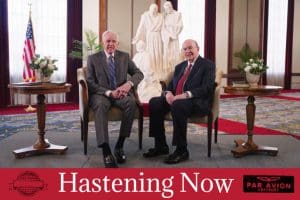






Do we look to our church leaders as a men and women who set the ultimate example for us to follow? Sometimes we may think he/she should be practically perfect, and when we discover a flaw, however shallow or deep, we might be bothered enough that our view of the Church becomes negative or our testimonies falter.
Of course we’ve been told “no one is perfect,” so why do we still hold our leaders to that impossible standard? Perhaps we do not understand the true meaning of perfection.
Elder Russell M. Nelson said, “In Matt. 5:48, the term perfect was translated from the Greek teleios, which means complete.’ Teleios is an adjective derived from the noun telos, which means end.’ The infinitive form of the verb is teleiono, which means to reach a distant end, to be fully developed, to consummate, or to finish.’ Please note that the word does not imply freedom from error’; it implies achieving a distant objective.'”[i]
What “distant objective” are we trying to achieve . . .? Eternal life.
So now that we know that it’s impossible to become perfect in mortality, and perfection is impossible in the next life without the mercy of the Savior and His Atoning Sacrifice, we can better accept flaws in our leaders. Past, present, and future flaws.
If you or I were called to a leadership position, all of our flaws would accompany us as well. Yes, we’d aspire to the fulfill our new duties and prayerfully approach each task, thus giving us the opportunity to serve those we’ve been called to serve. When we accept a leadership position, we take upon the mantle of that calling. And when a prophet becomes a prophet, he takes upon the mantle of leadership, flaws and all.
Nephi explains that when a prophet speaks, he is speaking for God. The prophet is not saying “be ye therefore perfect even as I am.” The prophet is giving us the message the Lord would have us hear through the power of the Holy Ghost: “When a man speaketh by the power of the Holy Ghost the power of the Holy Ghost carrieth it unto the hearts of the children of men” (2 Nephi 33:1).
Most significantly, Nephi doesn’t speak as a perfect man. He writes in weakness, as a flawed man, who is speaking on behalf of the Lord: “And the words which I have written in weakness will be made strong unto them; for it persuadeth them to do good” (2 Nephi 33:4). As a leader and a prophet, Nephi does not set himself above his congregation. He knows his faults, and he recognizes them openly: “I have been commanded of him to write these things notwithstanding my weakness” (v. 11).
Even the Savior had not “attained eternal perfection” until after His resurrection.[ii] Christ needed to be resurrected before he achieved eternal perfection: “I would that ye should be perfect even as I, or your Father who is in heaven is perfect” (3 Nephi 12:48). Before Christ’s crucifixion, He said that on “the third day I shall be perfected.” This refers to eternal perfection, which only follows His resurrection, and was achieved through the act of the Atonement.
Our prophets love us, and our leaders love us. This is part of their mantle as they act and serve in the name of the Lord. They serve with pure hearts, despite their shortcomings. Nephi explains why he’s written down the counseling of the Lord and the history of his people: “I esteem it as of great worth, and especially unto my people. For I pray continually for them by day, and mine eyes water my pillow by night, because of them; and I cry unto my God in faith, and I know that he will hear my cry” (2 Nephi 33:3).
Our prophets and leaders, too, will stand before the judgment bar to answer for their actions, just like each of us. Nephi clarifies, “you and I shall stand face to face before his bar; and ye shall now that I have been commanded of him to write these things, notwithstanding my weakness” (2 Nephi 33: 11). It’s bit intimidating to imagine the Savior asking Nephi what he did with the revelations given to him, then turning to me and asking what I did with those teachings.
Heather B. Moore is the author of Women of the Book of Mormon and Christ’s Gifts to Women, Her recent release is the Biblical novel, Esther the Queen: www.hbmoore.com


MaureenJuly 26, 2013
Brilliant. Such a vital reminder. Thank you Heather.
DarcyJuly 25, 2013
When the Savior, Jesus Christ said "Be ye there for perfect" He meant have a pure heart and prove we believe in him and love him by obeying his commandments perfectly while here in this mortality. Living up to every covenant we make in the temple perfectly. Yes we can attain perfection while in this mortality. Why would the Lord tell us in the scriptures That Adams son Seth was perfect while Seth was living in this mortality? There are far too many false interpretations going around in the church today. We need to be very careful to not think of the God of this world as an ordinary man in any way at all or to miss read and undermine His council. He created this world we live on. He is the son of God. We must be very care full to not teach false doctrine.