









One Last Miracle for Lavell
by Thomas C. Baggaley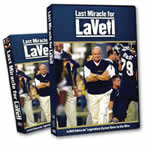 I love sports, especially BYU football, but I really don’t like most sports documentaries – especially when they are of the NFL Films variety. I’m just not interested in watching a documentary comprised of 90% slow motion footage and 10% a narrator showing off his knowledge of the thesaurus while trying to hype up some athletic event that is already over and everyone already knows the result. The result is corny at best. If you want to know what I’m talking about, just take a peek at the special bonus footage on the Last Miracle for LaVell DVD that Excel Entertainment released last month. I have fond memories of the four games which are highlighted in this footage (the 1980 “Miracle Bowl” – yes I DID watch the entire game that night, Jim McMahon’s final game in the 1981 Holiday Bowl, the 1983 Holiday Bowl victory which featured the winning reception by quarterback Steve Young, and of course the 1984 National Championship-clinching Holiday Bowl victory) but the short mini-documentaries on these games included in the DVD are almost unwatchable. The closest they come to entertaining is during the 1980 “Miracle Bowl” footage, when the Cougars begin their comeback in the last 5 minutes of the game and some music begins to play that is reminiscent of some lone gunman in a classic western right out of High Noon. And that just cracked me up.
The reason I say this is to contrast with the main feature on the DVD – the actual Last Miracle for LaVell documentary, which I found to be a very interesting viewing. At first you’ve got to wonder, how interesting can a documentary about a season where the team lost half of its games be? Wouldn’t it be better to chronicle the entire 1984 national championship season or any number of other seasons where the team soared to new winning heights and national prestige? Perhaps that’s what filmmaker Kevin Mitchell thought (or at least hoped) he was going to be doing when he started to record footage of a team with high expectations and the added motivation of winning for a legendary coach in his final season.
But after watching the documentary, I have to say I think I’d rather see a documentary about this 6-6 team than one of the winning seasons. In a way it’s more compelling to hear and see the players deal with losses, unfulfilled expectations and the desire to send their coach out on a winning note.
Dealing with Adversity
Any time I’ve heard LaVell Edwards talk, he’s talked about dealing with adversity. I’ve heard him use examples from Steve Young’s loss to Georgia, in which he threw several interceptions in the first half, to Sean Covey’s disappointment at being replaced as the starting quarterback by eventual Heisman Trophy winner Ty Detmer. But it always seems his talks have carried the same general theme – what to do when things don’t go the way you’d hoped or planned. In a way, this theme epitomizes his final season as a head coach, and this documentary gives you a look inside the locker room and on the sideline to see how Coach Edwards teaches this important life’s lesson to his players. This was a season where the players had many opportunities to “dial it in” and give up. But, as a credit to their coaching and to the character of these players, they never did.
The documentary is well-produced. Commentary by the players is insightful and helps to develop a simple, understandable story line. Especially interesting to me was the opportunity to hear some of LaVell’s before-game and half-time pep talks, something I’m sure many a BYU fan has wished for the opportunity to experience and also something that, I think, helps to give further insight into the character of this man as a coach and a teacher. (And all through his career he kept telling the marching band he would slip out of the locker room to hear the halftime show – but maybe that was after giving his speech.) The only thing that seems to be missing is footage of LaVell being interviewed himself. Although the story is about him, it is told mostly by the people around him – the players and other coaches.
Happily, Mitchell seems to find the right balance as to how much of which games to show in the documentary as well. He doesn’t overdo it with the slow motion (for which I am VERY grateful), and really the games are just a backdrop for the real story – the players and coaches and how they dealt with both the successes and the disappointments as well as the reality of saying goodbye to and honoring a coach they all had grown to love. By the same token, the season did provide some very exciting games, with some amazing comebacks, and Mitchell appropriately dwells a little bit longer on these, so those who are most interested in seeing footage from these memorable games themselves will not be disappointed.
In the end, I really only have one major complaint about the DVD (besides the silliness of the bonus footage), and that is the recording of the fight song that plays over the opening menu. Surely there is a better recording available than the one they used! It sounds like someone just stuck a microphone into the middle of the band near the woodwinds and percussion. It is seriously the worst recording of the fight song I have ever heard. On the other hand, if that’s my main complaint about this DVD, you’ve got to know that on the whole, I’m pretty pleased with the documentary. It keeps you entertained, rarely dragging despite it’s nearly two-hour length, and provides some good insight for fans of LaVell Edwards and Brigham Young University football.
2003 Meridian Magazine. All Rights Reserved.


