








Saints and Soldiers and The Work and the Glory: A Study in LDS Cinema Contrasts
By Thomas C. Baggaley
Recently, two of the more popular titles to come out of LDS Cinema were released on DVD and video by Excel Entertainment (which is now a division of Deseret Book). I always enjoy the opportunity to revisit films when their home video release comes out, because it lets me see how my perspective on these films might have changed as time goes on. In this case, it was an extra treat for me, because the two films being released were Saints and Soldiers and The Work and the Glory.
Saints and Soldiers is a film that I have been following with keen interest since the beginning of its theatrical run last fall. In my opinion, it is one of the better made films to come out of the LDS Cinema movement, and it has been interesting to watch how the film has been received during its lengthy tour from theater to theater across the United States. The Work and the Glory, on the other hand, had a relatively short theatrical run. It really was not all that long ago when the film was first released – well after the release of Saints and Soldiers – yet The Work and the Glory was first of these two films to hit the video store shelves. That is not to say that The Work and the Glory was not well received or did not receive the kind of exposure that Saints and Soldiers did. On the contrary, The Work and the Glory actually played more weeks on more screens than any LDS Cinema film had since The Other Side of Heaven.
The approach to marketing and distributing these two films was very different. While Saints and Soldiers moved methodically from theater to theater, counting a great deal on word of mouth about the film to spread ahead of its arrival in many areas across the country, The Work and the Glory‘s distribution was a relative blitzkrieg – to use a World War II term for the wrong film. The Work and the Glory opened in most of the theaters it would play in outside of Utah in a single weekend in January. There was a relatively smaller bulk release to other theaters (mostly in the Midwest) in March and it did occasionally open in a theater or two here or there after that, but the approach seems to have been to make a couple of big pushes, get it onto as many screens as possible at a time and then move the film quickly into video and DVD distribution, which is where most of the income from film production comes nowadays anyway.
I was unable to review The Work and the Glory when it first came out, so I am excited to be able to do so now, and at the same time, revisit Saints and Soldiers. It’s an interesting combination. On the surface, as far as LDS Cinema films go, these two are polar opposites of each other – and not just because of the contrasting ways in which they were distributed. Saints and Soldiers is a war film. It is certainly the most action-packed LDS Cinema film to hit theaters. The Work and the Glory‘s main storyline is a romance. What conflict there is in the story more often gets played out in verbal arguments than with fisticuffs. Saints and Soldiers received an R rating at first from the MPAA (although its final PG-13 rating is probably much more deserved – see my article). The Work and the Glory very well could have received a G rating (although it ended up with a PG). Saints and Soldiers is set in the 20th Century. The Work and the Glory takes place in the 19th. The Work and the Glory is about members of the Church in the early days of the Restoration. Saints and Soldiers only has one LDS character, and he is not even directly identified as LDS – you just know he is because he’s from Snowflake, Arizona, served a mission in Germany and doesn’t smoke or drink coffee.
Yet these films have more in common that you would think. Both have principal characters named “Nathan.” Both were adapted from popular LDS market books. Both were inspired by real people and real events from history. Both present gospel truths in a very subtle, understated way. Both, at their core, are stories about faith: Where does it come from? What is its value? And how does a person of faith deal with the “slings and arrows of outrageous fortune” that affect us all?
The Work and the Glory
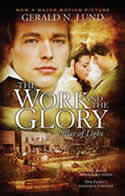
The Work and the Glory is the most expensive LDS Cinema production to date. Its $7.4 million budget eclipses even previous record-holder The Other Side of Heaven. That producer Scott Swofford and screenwriter/director Russ Holt did not shirk on the expenses is evident in the presence of some quality, experienced actors with faces viewers might recognize from shows like Desperate Housewives and Everwood (Steed family matriarch MaryAnn Steed, played by Brenda Strong), Smallville (Eric Johnson, who played Joshua Steed), ER and the TV movie Judas, (Jonathan Scarfe-Joseph Smith) and films like Cheaper by the Dozen (Tiffany DuPont-Lydia McBride) and The Aviator (Sam Hennings-Benjamin Steed). The film also has a very polished look to it, again evidence not only of the generous (at least for LDS Cinema) budget, but also the talented and experienced eyes of director of photography T. C. Christensen.
In case you haven’t seen the film yet, The Work and the Glory is set at the beginning of the Restoration. It tells the story of the Steeds, a family of Vermont farmers who move to upstate New York and buy the farm next to the one owned by Martin Harris. They need some help clearing their land so they can get the planting done on time, so Mr. Harris suggests they hire a couple of brothers he is acquainted with: Hyrum and Joseph Smith. It is not long before the family gets caught up in the religious turmoil surrounding the prophet and his family. Meanwhile, two of the Steed brothers, Joshua and Nathan, develop a romantic interest in Lydia McBride, the daughter of a storekeeper in town. The older one, Joshua, has fallen under the influence of some of the more disreputable characters around town, however, and that, combined with brothers’ rivalry over Lydia and the family members’ varying acceptance of the experiences recounted by Joseph Smith and his brother Hyrum, threatens to tear the family apart.
Beyond its professional look, the thing I liked best about this film was the simple, understated way that it dealt with Joseph Smith’s experiences. Johnathan Scarfe presented as believable and human a portrayal of the prophet as I have seen, really capturing his natural charisma and goodness – at least as I have imagined them. Miraculous events such as the first vision and even the attack on the prophet in the woods as he went to get the gold plates were not overly dramatized – which in my mind is how it should be as so often even the most dramatic of miracles really seem to happen in a deceptively natural way. I really appreciated the sensitive handling of such sacred events.
On the other hand, this also leads to what I feel might be the film’s greatest weakness. This is a long film, made longer by its relatively slow pacing. Yet little actually happens in what is supposed to be the film’s main story line. What does happen is a little too understated. I wanted more. Joseph Smith is actually supposed to be a background character in this story, not its protagonist, yet his familiar-to-us experiences end up being the most interesting things that happen in the film. While his story should not overshadow that of the primary characters, the main story line doesn’t consistently give enough to hold the viewer’s interest.
Watching the film, I kept getting the feeling that many of what could have been the most interesting, character-revealing scenes had been simply skipped over. Holt indicated that when he first started to adapt the novel, he started with a four-hour script. I wonder if he shouldn’t have left in some of the best things he cut out, because in the end, I was left with the feeling that there wasn’t enough of the story left to fill the amount of time it took to tell it.
Part of the problem is that the film has a surprising lack of focus. At first, it seems to be about the older Steed brother, and then the focus switched to the younger brother, Nathan, who up to that point had seemed almost a non-participant in the story. At other times, the film could have been about Joseph Smith or Benjamin Steed (the father of the family). Any one of these characters would have made a good primary protagonist, and I assume that the filmmakers intended to make young Nathan Steed and his romance with Lydia the main story, but if that was the case, they would have been better served to have focused the movie on that primary relationship and made developing and expanding on that part of the story their most important aim, cutting back on the other subplots as needed to keep the film a reasonable length and keep the focus on the romance.
Having multiple subplots works fine in a 400-page novel, because there is time to develop all of the characters and subplots adequately. But in a two-hour film, it is much harder to pull off and often leaves most if not all of the story lines unfulfilled.
As a result, the film lacks the drama that I would like to have seen in it. That does not mean that I didn’t like it. I wanted it to be a remarkable film, and instead I felt like it was pleasant, professionally made but not as memorable as I would have hoped. It seemed the whole story was just exposition for the movies to come. In a way, that’s okay, because the filmmakers are just getting started on this project. Future films will allow for more character development – much like what happens in a television series where it’s okay to have an ensemble of major characters because there’s time over several episodes to develop all of them. The next two films have already begun production, this time with highly acclaimed director Sterling VanWagenen at the helm. I believe these upcoming installments have the potential to be very, very good. VanWagenen is one of the best LDS directors around, and with each film the cast and crew should be more experienced and more comfortable with their roles. When the saga is complete, I think a lot of LDS families are going to want to have this film sitting right next to the others in their home library.
Saints and Soldiers
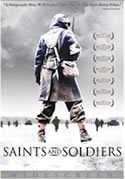
I am not a real fan of war films. Explosive special effects and lots of blood and death just aren’t the first things I look for in a movie. Ever since I first saw Saints and Soldiers, I’ve appreciated that fact that it wasn’t really a war film – it was a “people film” that happened to be set during a war. The entertainment industry should be hoping that not too many people see this film or they might start coming to expect all such films to be as well conceived, and then screenwriters will have to start writing real scripts instead of choreographing a few lengthy action scenes with eye-popping special effects, tossing in a couple of “Take that you bad guy” one-liners and calling it good.
It’s a cycle that Hollywood seems to keep going through. Every once in a while, they’ll make a special effects breakthrough (like the use of computer generated images – CGI), and then for the next few years all the films seem so fascinated with this new toy that they can’t bother to spend any time actually developing a story. Then, eventually, audiences are no longer awed by the new spectacle, so then they do some more experimentation and find some other way to do things you’ve “never seen before,” and the whole cycle starts all over again. In my childhood it was the disaster films of the 70’s, followed by the science fiction/fantasy and superhero films of the late 70’s and early 80’s. More recently it was … oh yeah, the disaster films, science fiction/fantasy and superhero films of the late 90’s and the new millennium. We’ve seen it all before. It’s just packaged a little different each time.
Is it just me, or is the CGI in a lot of films still a little bit too cartoonish? In some ways, it’s almost a step backwards in visual effects. When it comes right down to it, I’ll take the special effects of the first Star Wars trilogy over the effects of the second one any day. They just seem much more real – involve you much more in the action than the computer-drawn images we’re supposed to believe today. And besides, when filmmakers actually had limits on what they could do, instead of being able to use the computer to create about anything they could imagine, it seems they were forced to be more creative and as a result made better films.
That, I think, is one of the big differences for films like Saints and Soldiers. Director Ryan Little and producer Adam Abel have proven that it doesn’t take a multimillion dollar effects budget to make a good film – even one set during wartime with plenty of action. Who would’ve thought you could have made a war film for under a million dollars? On the other hand, maybe the film’s small budget actually turned into its strength, because the filmmakers had to rely on other things to carry the film – little things like a good story and well developed characters.
For those who haven’t seen the film yet, Saints and Soldiers is the story of four American soldiers who are caught behind enemy lines after escaping the Massacre at Malmedy. At first they intend to just hide out and try to survive until they can be rescued by the advancing Allied forces. However, when they run across British Airman Oberon Winley (played by Kirby Heyborne), they find that he has important intelligence that must reach the Allies or many lives could be lost, which means they have to make their way back to friendly territory as quickly as possible. To complicate matters, Corporal Nathan “Deacon” Greer (the LDS character in the film played by Corbin Allred who before his mission starred in the television series Teen Angel), is showing signs of losing his mind – he is unable to sleep and keeps seeing and hearing things – and he has their only gun. That’s the setting for the film. The story is really woven in the interaction between these characters as they try to make their way to safety.
The film looks every bit as good as The Work and the Glory on an eighth of the budget – credit Little, who not only directed by doubled as cinematographer for the film. When I first saw the film, I thought that the one thing that I wished was that the filmmakers could have afforded a full orchestral score, but in watching it again, I was impressed by the work of composers J Bateman and Bart K. Hendrickson. I still feel it’s impossible to capture the range of expression and feeling of a full orchestra with such limited resources, but they did as good a job as anyone in capturing the mood of the film, producing a sound that is well beyond the realm of a “cheap synth score.”
I still feel that the acting in the film is excellent. The cast, which includes Allred, Heyborne (The R.M., Sons of Provo), Lawrence Bagby (TV’s Buffy the Vampire Slayer, I Will Go and Do), Alexander Niver (TV’s Charles in Charge) and Peter Holden (Out of Step, various TV appearances), is top notch. At times, Heyborne is a little bit too “David Niven” in his role as Oberon Winley and Bagby’s Southern accent sometimes goes a little over the top as well, but it’s not to the point of distraction (and Heyborne’s British accent is much better than some high-profile actors have been able to accomplish – Kevin Costner in Robin Hood: Prince of Thieves, for example). Anyway, some of the best acting and most powerful moments in the film occur when nothing is being said at all. Whether you like war movies or not, if you like excellent, well-made films with character-driven stories about faith and friendship, stories that manage to be uplifting, even among the tragedies of war, I think you’ll like this movie.
Upcoming LDS Cinema
As of the time I am writing this, for the first time in 3 1/2 years, there is not a single LDS Cinema film playing in any theater in the United States that I am aware of. Does this mean that the movement is coming to an end? Hardly. In addition to the two The Work and the Glory sequels currently in production, Richard Dutcher is currently completing his God’s Army sequel (suddenly LDS Cinema is producing sequels!) and the HaleStorm guys are producing three different films: Church Ball, Mobsters and Mormons and Suits on the Loose. I’m especially looking forward to seeing Mobsters and Mormons. Written and directed by John Moyer, the writer of The Singles Ward and The R.M., I was privileged to read an earlier version of the script some time ago. I’ve also read some of Moyer’s other scripts, and this is by far the best of them.
Other upcoming LDS Cinema productions include Passage to Zarahemla, a film written and directed by Chris Heimerdinger (author of the Tennis Shoes Among the Nephites series of books – and yes, this film involves time travel too, although the story is not a part of the Tennis Shoes series) and Piccadilly Cowboy a feature shot entirely in England produced and directed by first-timer Tyler Ford and starring Jaelan Petrie (Handcart, Missy) and several other quality actors.
I still hold out hope for Peter Johnson’s A Voice from the Dust: Journey to the Promised Land and Dutcher’s The Prophet, although last I heard both projects were still searching for investors to finish funding. Those are a couple of films that deserve to be made, and knowing a little about the plans behind them, I feel they will be excellent when they are finally completed. It would also be nice to see Gary Rogers get a chance to make the next in his series of Book of Mormon Movie films. I think he learned a lot with his first endeavor, and a second go around would be vastly improved.
On the direct-to-video front, Dennis Agle and company are hard at work on the next of their Liken the Scriptures series of Joseph and the Amazing Technicolor Dreamcoat-inspired musicals. I have yet to see their latest, based on the story of David and Goliath and featuring former NBA star and current Latter-day Saint singer Thurl Bailey as Goliath, so I can’t give a review of it, but the series has always been very entertaining and the word is that their next production will be about the story of Abinadi, King Noah and Alma the Elder. Another direct-to-video film I’m looking forward to seeing is American Mormon, featuring quite humorous man-on-the-street interviews by Daryn Tufts, who has had minor roles in several of the HaleStorm productions, and has written quite a bit of comedy for the LDS market, including the scripts for several of the Pearl Awards shows which have won regional Emmys.
So Latter-day Saint audiences have a lot to look forward to. The movement is alive and well and the quality of these films keeps improving. It’s going to be a lot of fun to watch.
The Work and the Glory is rated PG for mild thematic elements and violence and Saints and Soldiers is rated PG-13 for war violence and related images. Both films can be found wherever LDS videos and DVDs are sold.


