








I have a vivid memory from thirty-three years ago of a short getaway my wife and I took from our home in Southern California to Sausalito, a charming town across the bay from San Francisco. I know exactly how long ago it was because of what happened on the day we were to return home. That morning, we were told we could not drive back because a massively destructive earthquake had struck the Los Angeles area while we slept. The shaking had mangled roads and freeways, severing the connections we had always taken for granted.
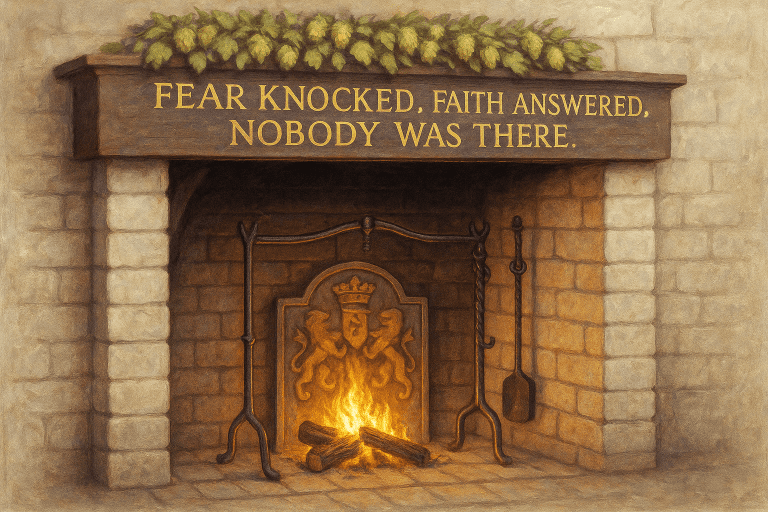
Yet the memory that has lingered with me most is not the news of the earthquake, but a moment from a few evenings earlier. We had taken the short drive from Sausalito to Muir Beach and spent the night at the Pelican Inn, a rustic yet romantic place built to capture the feeling of a 16th-century English inn. The place was almost hidden, tucked at the end of a winding road where sea-blown fog drifted among pines and alders. Inside, the main room glowed with warmth from a massive stone fireplace framed by weathered timbers. And there, carved into the beam above the hearth, I encountered a phrase that has never left me—Fear Knocked, Faith Answered, Nobody Was There.

Life provides no shortage of moments when fear seems to knock at the door of our hearts. The earthquake itself was a stark reminder of how quickly the foundations of what we assume to be solid can shift beneath us. But fear rarely comes only in natural disasters. It knocks in the doctor’s office when we receive unwelcome news. It knocks in the late-night worry over a struggling child. It knocks in seasons of financial hardship, in loneliness, and in uncertainty about the future.
Fear is one of the adversary’s most common tools. It corrodes trust, clouds vision, and narrows our sense of God’s possibilities for us. In scripture, fear is often the prelude to doubt—Peter stepping out of the boat in faith upon the water until he saw the wind boisterous and began to sink. The Savior’s gentle rebuke, O thou of little faith, wherefore didst thou doubt? (Matthew 14:30-31), reminds us fear is not just an emotional response but a spiritual crossroad—will we give way to despair, or will we let faith answer?
The phrase above the fireplace at the Pelican Inn captures something profound. Faith does not argue with fear. It does not reason with fear. It simply answers. Faith stands at the threshold of our souls and declares that Christ is already there—that He has overcome the world (John 16:33). When faith answers the door, fear finds no foothold. 
The Apostle Paul declared, God hath not given us the spirit of fear; but of power, and of love, and of a sound mind (2 Timothy 1:7). In Latter-day Saint understanding, this power comes through our covenants with God, through the presence of the Holy Ghost, and through the enabling grace of Jesus Christ. We are not left to muster faith in isolation; we are invited to exercise it in partnership with Heaven.
To the early Saints, who faced expulsion, mobs, and relentless uncertainty, the Lord’s words in Doctrine and Covenants 6:34 were clear:Therefore, fear not, little flock; do good; let earth and hell combine against you, for if ye are built upon my rock, they cannot prevail. Anchored in Christ, their faith made fear powerless.
That final phrase—Nobody was there—is what lingers most deeply. When fear knocked and faith answered, there was nothing left of fear. No adversary. No phantom. No weight pressing upon the soul. The knocking was hollow, empty. This is not just poetic imagery—it is spiritual reality.
The Lord Himself assures us, If ye are prepared ye shall not fear (D&C 38:30). Preparedness in this sense is more than food storage or financial prudence, though those matter. It is spiritual preparation: daily prayer, scripture study, temple worship, repentance, service, and keeping our covenants. These actions invite the companionship of the Spirit, who drives out fear and fills us with peace. When fear comes knocking, it finds no vacancy in a heart already filled with Christ.
The words above that old fireplace are not simply a clever homily—they describe a pattern we see again and again in scripture and in the lives of disciples. When young Nephi faced his brothers’ anger and threats, fear must have pressed upon him. Yet his answer was faith, I was led by the Spirit, not knowing beforehand the things which I should do (1 Nephi 4:6). Because faith answered, the fear that could have paralyzed him vanished, and Nephi was enabled to accomplish what seemed impossible.
Likewise, the stripling warriors in Alma’s record could have easily succumbed to terror as they marched into battle, inexperienced and vastly outnumbered. Instead, they had been taught by their mothers that if they did not doubt, God would deliver them (Alma 56:47). Their faith answered the knock of fear, and the result was miraculous preservation. Fear could not stand where faith stood firm.
Modern prophets echo this same truth. President Russell M. Nelson has taught, Faith in Jesus Christ is the greatest power available to us in this life. All things are possible to them that believe. When we let that kind of faith answer the door, the adversary’s whispers of fear dissolve into nothingness—nobody was there. Elder Jeffrey R. Holland has likewise reminded us that despair and fear are never the Lord’s message, declaring, Faith is always pointed toward the future. When faith looks forward with trust in Christ, fear has no substance.
This principle blesses us in the quiet trials of daily life as much as in dramatic moments of history. Fear of the future is answered when we, like Nephi, trust the Lord to guide us one step at a time. Fear of inadequacy is answered when we remember the Lord’s promise to make weak things strong (Ether 12:27). Fear of death is answered in Alma’s testimony of the Resurrection and in the Savior’s assurance that whoso believeth in me, though he were dead, yet shall he live (John 11:25). Each time faith responds, fear is revealed as hollow—a knock without presence, a shadow without form.
That quiet evening at the Pelican Inn impressed upon me a truth I have seen confirmed again and again. Fear will always knock, but it does not have to take up residence. We choose who answers the door. In the end, the engraving on the old timber above the fireplace was not a quaint proverb; it was a sermon—Fear knocked. Faith answered. Nobody was there.
In the light of the restored gospel, this truth shines brighter still. For those who covenant with Christ, who cling to Him with faith and trust, fear will never endure. It is always fleeting, always temporary, always powerless against the love of God.


Mark StoddardAugust 27, 2025
No fear of Paul writing a good article. Faith put to action is always the bottom line.
Steve DoneganAugust 27, 2025
This reminds me of a story I read long ago about a girl, 4 or 5 years old, who, when interviewed by her church for baptism, answered one of their questions this way: When the devil would come knocking at the door of my heart, I wasn't strong enough to keep him out. But now, I send Jesus to the door, and He's strong enough!