




A Special 35th Year Anniversary Church History Tour

Scot & Maurine Proctor have been leading Church History Tours for the past 35 years. They know and love these places and know and love the Prophet Joseph Smith. This year’s tour will be Monday, September 14, 2026, to Monday, September 28, 2026. Below is a day-by-day illustrated itinerary of this very spiritual and wonderful journey. Come and enjoy reading about and seeing these places!
We know you have always wanted to see ALL the significant early Church History sites and now is the time! Many of you have been to Nauvoo or just to Palmyra, or perhaps to Kirtland—but now you will have the opportunity to see all these sacred sites in one sweeping, panoramic view. It makes ALL the difference in understanding the early history of the Restoration and the life of the Prophet Joseph.
We have been leading this ultimate Church History tour for the past thirty-five years! We know these places and the stories that bring them alive and we love to teach and share this amazing part of our sacred heritage. If you have ever thought about going on a Church History tour, this may very well be your year, and we would love to take you with us! One year a tour participant exclaimed: “This is not the ULTIMATE Church History Tour…It is the ONLY Church History Tour!”
We will be leading this year’s tour from September 14-28, 2026. It’s the perfect time of year for this incredible tour. You will return home the Monday before October General Conference.
WARNING: This is a life-changing experience!
Below is a thorough look at what we do. Read through the daily itinerary and then consider joining us. There are available spaces at this time, but the remaining spots will sell out, so please decide right away. Pricing and contact information are located at the end of the article or you can call right now for information or booking with our agent:
Sarah, at Morris Murdock Travel: 801-483-6473.
Please note: If you would feel more comfortable, you can book the Ultimate Church History Tour with the Proctors immediately online yourself: PLEASE CLICK HERE. When you get to that page, scroll down to where it says BOOK NOW and then set up your account and get it done. As of today, there are 18 places left so please call immediately to make sure you can secure your place on this never-to-be-forgotten experience. This is one time we have room for parents who would like to bring all their adult children and spouses (this happens often)—as long as you don’t have more than eight married children!
Please read and enjoy the following detailed itinerary below.
Day 1- Monday, September 14, 2026


We all fly in from our various homes to Boston today and gather at the Embassy Suites, Boston Logan Airport. (Evening snacks included at the hotel). Tonight we will have a brief meeting where we get to meet each other for the first time. You will look around and, at first, think these are all new faces and strangers to you. That feeling won’t last for long as we quickly become like a traveling family.
Day 2 – Tuesday, September 15, 2026
 You’ll love our visit to Old Ironsides. You may even want to buy an American Flag that you get to fly over this historic ship! The Proctors have one in their family!
After breakfast, we’ll enjoy Boston, walk part of the Freedom Trail including seeing the Old North Church, and see “Old Ironsides,” the oldest commissioned warship in the world still afloat (229 years old). A memorable lecture given at Harvard Square in Cambridge will ring in your ears throughout the trip and give you new perspectives on the founding of our country and the beginnings of the Restoration. We’ll get a feeling for the American Revolution and then let you have an enjoyable hour at Quincy Market for dinner where you’ll see the famous Faneuil Hall. Built in 1742, this building hosted pre-Revolutionary protests against the Sugar and Stamp Acts and boasted speakers George Washington, Samuel Adams and later abolitionist Frederick Douglass.
Tonight we stay at the charming Colonial Inn in Concord, which dates to 1716 and weas used during the Revolutionary period by Concord Minutemen for storing arms and ammunition. It was once owned by Henry David Thoreau. (Meals: B,D)
Day 3 – Wednesday, September 16, 2026
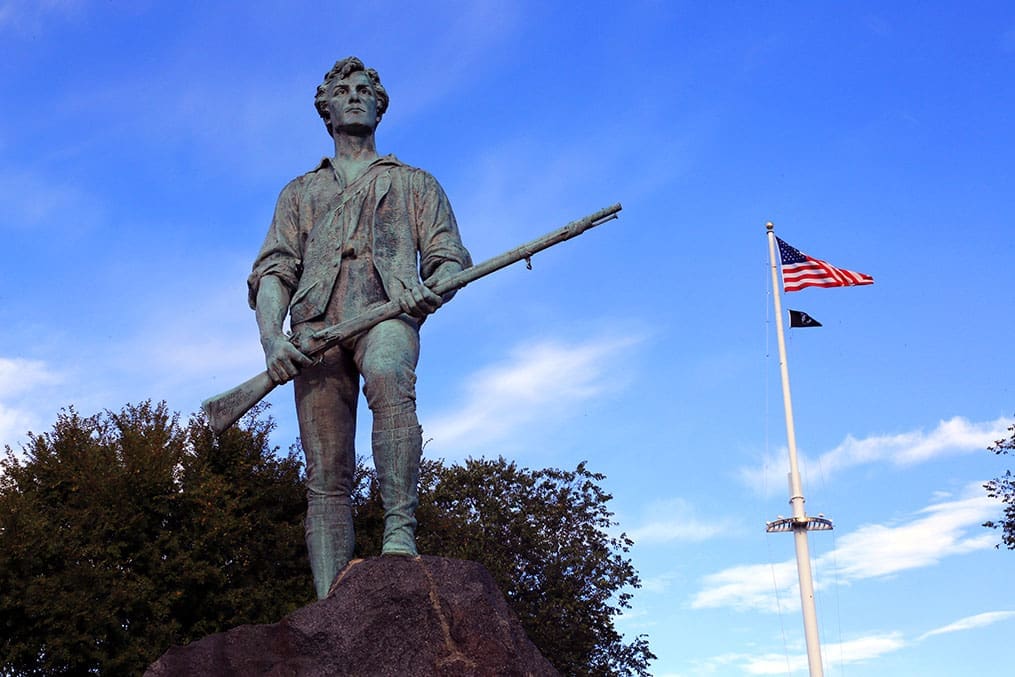 You’ll feel the spirit of the Revolution as you gaze upon the Minute Man statue here in Lexington on the Green.
This morning we will relive the first moments of the Revolutionary War and see the place where the shot was fired that was “heard around the world”. We will travel along Battle Road, stopping at various points, and even see where Paul Revere was captured by the British.

There are few places where you will feel a deeper connection to the Revolutionary War than here at the Old North Bridge in Concord.
You will come to know Lexington and Concord including hearing a moving lecture at the Old North Bridge that will help you understand those events which brought about the Independence of this great nation and set the stage for the birthplace of the Gospel of Jesus Christ in the latter days. In the afternoon we will visit Louisa May Alcott’s home and see the Sleepy Hollow Cemetery where Ralph Waldo Emerson, Nathaniel Hawthorne, Henry David Thoreau and the Alcott’s are buried. Tonight we will have a meal together at Longfellow’s Wayside Inn in Sudbury—the oldest Inn in America—established in 1716! Here we will see one of New England’s most picturesque sites and perhaps her most famous mill.
We will stay again tonight at our beautiful and historic Colonial Inn. (Meals: B, D)
Day 4 – Thursday, September 17, 2026
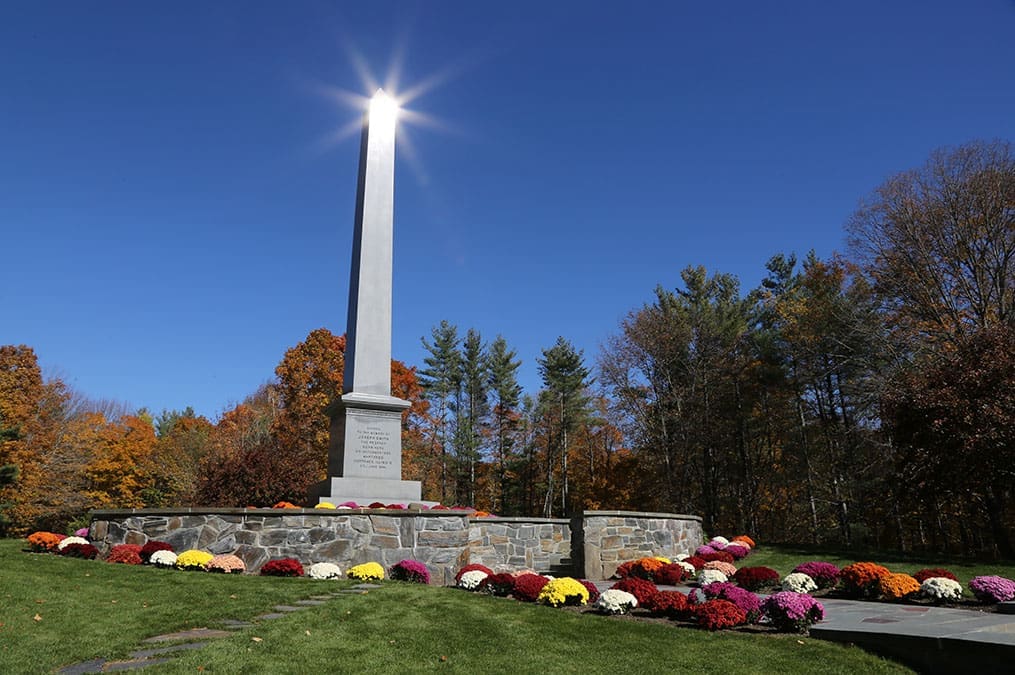 This 38 1/2 foot monument commemorates the birthplace of Joseph Smith, the Prophet.
Very early this morning we head northward on our journey into beautiful New England and for our first major Church History stop in Sharon, Vermont. Fortunately, you will experience the journey up Dairy Hill in a bus (we don’t have to hike) where we will experience strong feelings of the Spirit at the birthplace of the prophet Joseph. We will eat our lunch together on the original property where the Smiths were living. We will visit the towns of Sharon, Turnbridge, and drive past the Smith stomping grounds of Norwich and West Lebanon. Here we will get a feel for the first twenty years of marriage of Lucy Mack and Joseph Smith, Sr.
This evening we will have dinner and stay in the quaint ski resort lodging of the Best Western Inn & Suites in Rutland, VT. Rutland is only 24 miles from where Oliver Cowdery was born! (Meals B, D)
Day 5 – Friday, September 18, 2026
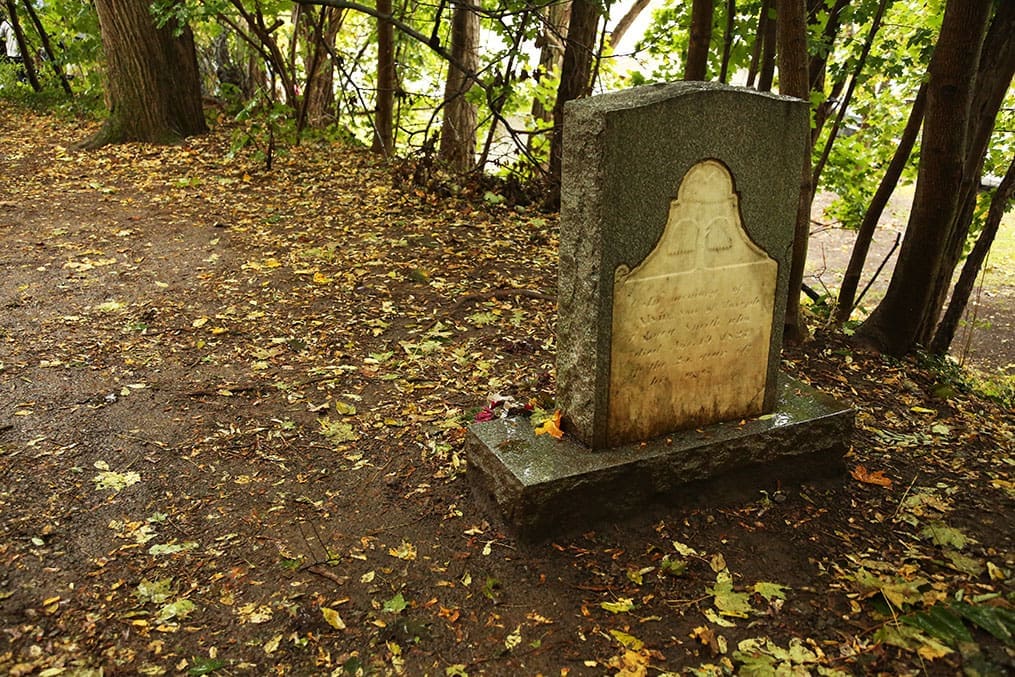 Here we walk on sacred ground at the grave of Alvin Smith.
Leaving New England the scenery changes as we wind our way south and west to fertile fields and lovely lands in Western New York. We will enjoy stories of early church leaders of the church, where they came from and how they came to know the Gospel of Jesus Christ. We will talk about what it was like for Lucy Mack Smith to make the arduous journey with eight young children more than 300 miles (without her husband) to Palmyra.
Tonight we will stay in the Woodcliff Hotel and Spa in Fairport (near Rochester), New York (right near the old Erie Canal and not too far from Palmyra) and ready ourselves for a spiritual feast tomorrow. Dinner will be at your discretion at the amazing Wegmans Food Store & Deli (you will love Wegmans—we guarantee it). (Meals: B, D)
Day 6 – Saturday, September 19, 2026
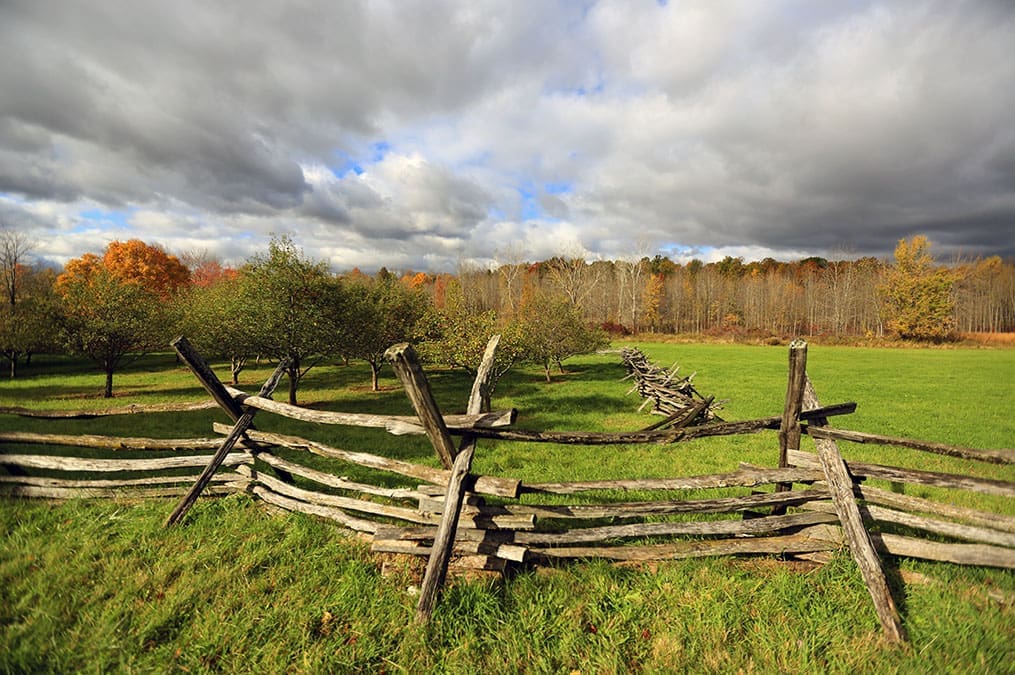 You’ll feel the Spirit here at the farm of Joseph and Lucy Smith.
We will arise early to be at the Sacred Grove and experience this, one of the most significant holy places on the earth. For many this experience is the highlight of the whole trip. We will have our own, individual quiet time in the Grove. Afterwards, we will enjoy the Smith farm, tour the Smith frame House and the Smith Log Cabin (where the Angel Moroni visited the prophet). We will also visit the Hill Cumorah, Martin Harris Farm, the E.B. Grandin Printing Complex and the downtown village of Palmyra. Our little walk up the hill to the Smith Cemetery will touch you as we gather at the grave of Alvin Smith. This afternoon we may have the opportunity of attending a session at the Palmyra Temple (be sure you bring your own temple clothes—Sarah will let us know if the scheduling works).
Dinner will be at a local restaurant before we stay again at the Woodcliff Hotel tonight.
(Meals: B, D)
Day 7 – Sunday, September 20, 2026
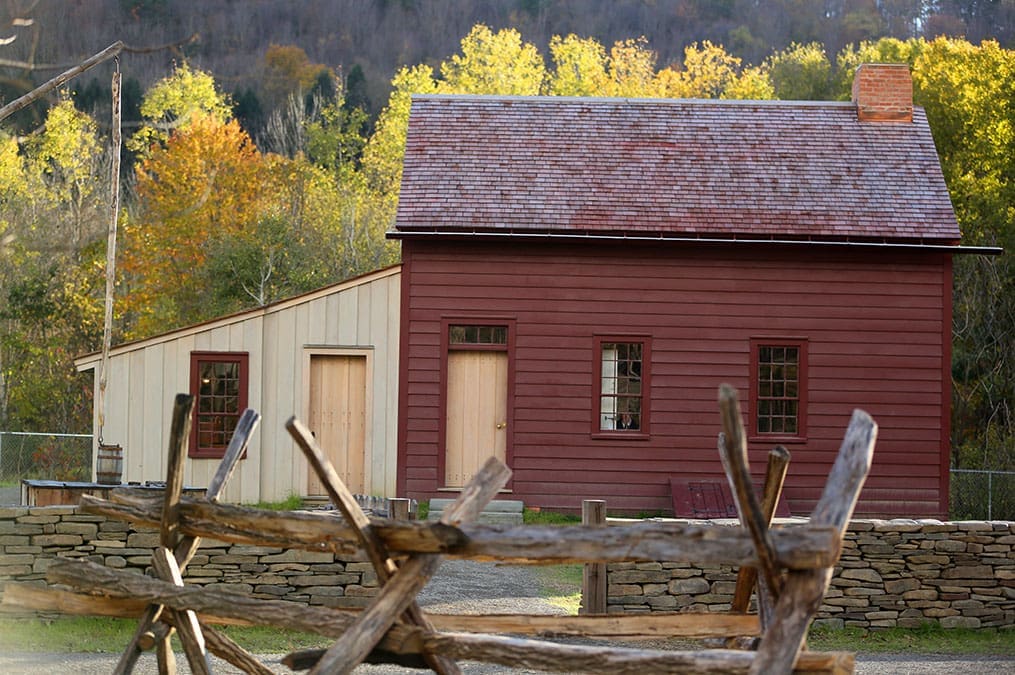
You truly have to experience this newly restored (2015) Priesthood Restoration site. It is stunning.
Today is a VERY BIG day! This morning we head to Fayette where the Whitmers lived and the Church was legally organized on Tuesday, April 6, 1830. Twenty revelations for the Doctrine and Covenants were received here or near here. This is also the place where Martin Harris, Oliver Cowdery and David Whitmer received their special witnesses of the plates. We will attend sacrament meeting at the beautiful Fayette Ward then head south to Harmony, Pennsylvania to visit the beautiful Priesthood Restoration site. For some, this is considered the most beautiful of all the Church Historical sites. Here we will see the reconstructed homes of Joseph and Emma Smith, Isaac and Elizabeth Hale, and the section of woods where John the Baptist restored the priesthood. A good part of the Book of Mormon was translated here in Joseph and Emma’s Cabin (about 70%). We will walk along the banks of the Susquehanna River where the first baptisms were performed in this dispensation. This is such a memorable afternoon and early evening!
Later this evening we check into the Double Tree Inn in Binghamton for dinner and our overnight stay. Do not miss getting your free, freshly baked famous DoubleTree 2-ounce chocolate chip cookie as we arrive. These feature 30 chocolate chips (per cookie!), a hint of lemon juice, cinnamon and coconut and are absolutely delicious. DoubleTree has distributed more than 483 million of these to date and we want to do our part to keep that number high! (Meals: B, D)
Day 8 – Monday, September 21, 2026
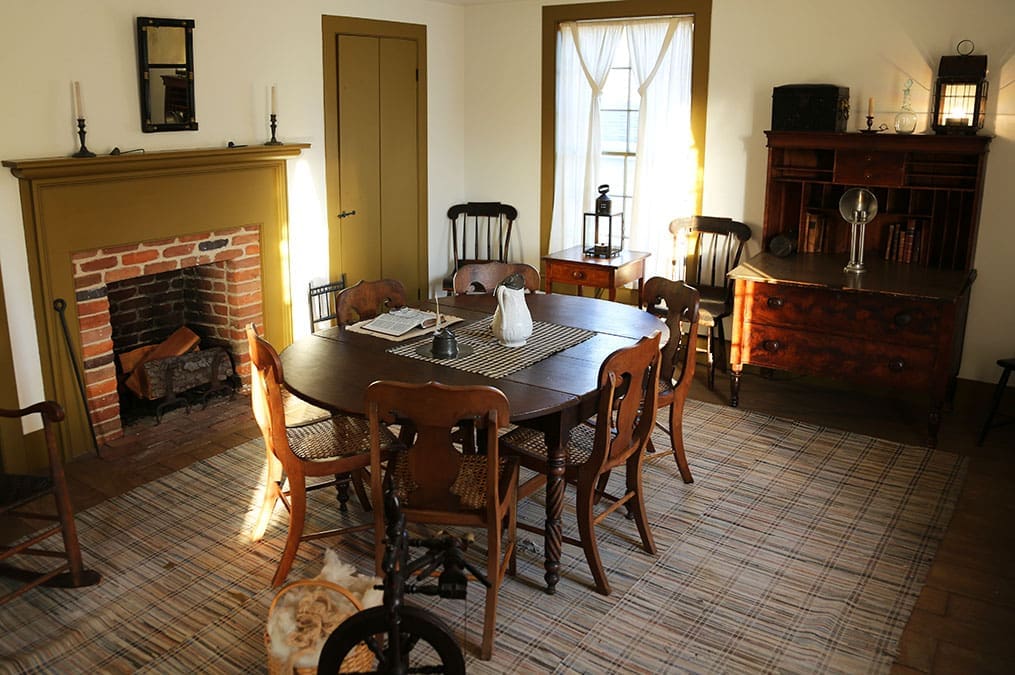 Seventeen revelations were given in this upper room of the Newel K. Whitney Store here in Kirtland.
Today we travel through some of the western regions of New York and review the missionary labors of Samuel Harrison Smith (the Prophet’s little brother) and Parley P. Pratt. The latter headed for Ohio where their labors would change the history of the Church because of the conversion of his very good friend, Sidney Rigdon. About midmorning we will make a stop in Corning, New York at the glass factory in route to Kirkland, Ohio. We reach Kirtland in the late afternoon and tour the Newell K. Whitney home and Store as well as see some of the other Kirtland sites. Be prepared for a spiritual feast at the Whitney Store.
Dinner will be at the “Olive Garden” before checking into our Hotel in Mentor (the natives do not say the “t”—it’s Menor!). (Meals: B, D)
Day 9 – Tuesday, September 22, 2026
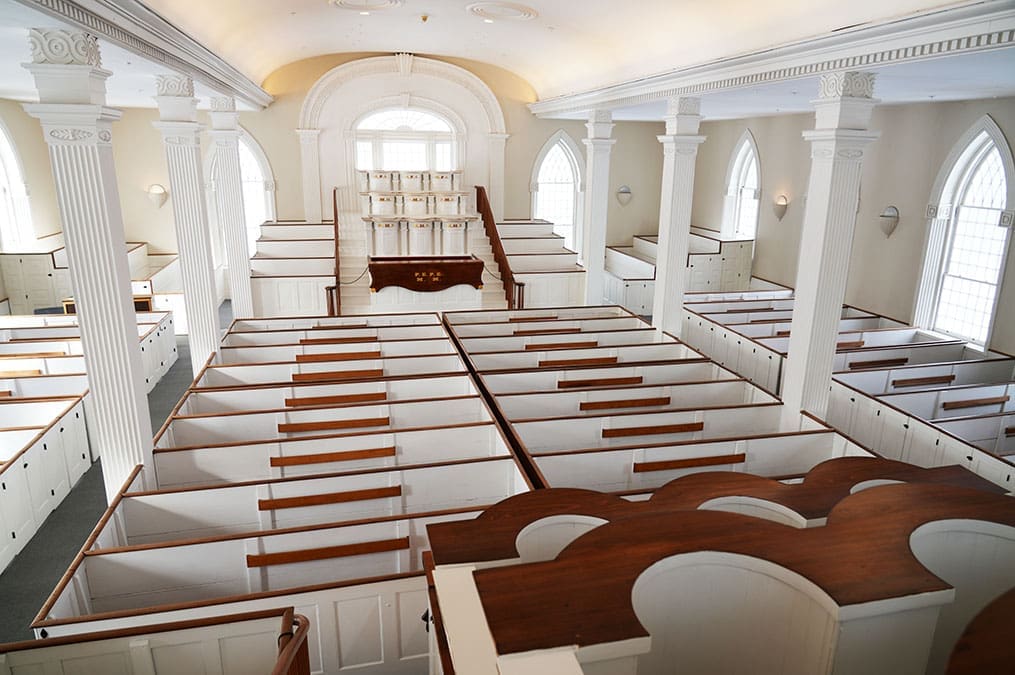 During that glorious week of the Kirtland Temple dedication in 1836 the Lord visited this room as well as numerous angels, including Moses, Elias and Elijah.
This morning Breakfast is provided at the hotel before we visit the Isaac and Lucy Morley Farm then tour the Kirtland Temple where The Lord Himself appeared as did Moses, Elias, Elijah, and numerous other angels. The script has changed a great deal since the Church purchased this historic temple March 5, 2024. You will love every minute of your time inside this sacred and holy place. We even get to go up into the third floor at the west end of the temple where Joseph had his office and saw a glorious vision of the celestial kingdom. After lunch we will travel on to the John and Elsa Johnson Farm in Hiram, Ohio where the vision of the three degrees of glory was received and at least 14 other revelations. Here the Prophet and Sidney Rigdon were mobbed, beaten and the Prophet tarred and feathered.
We travel to the heart of the Ohio Amish Country for an old-fashioned home style meal at the Dutch Valley Restaurant (eat light today because tonight, well, you can’t eat light). We stay tonight at the charming Carlisle Inn in Sugar Creek, a place where everyone begs us to stay longer! (Meals: B, D)
Day 10 – Wednesday, September 23, 2026
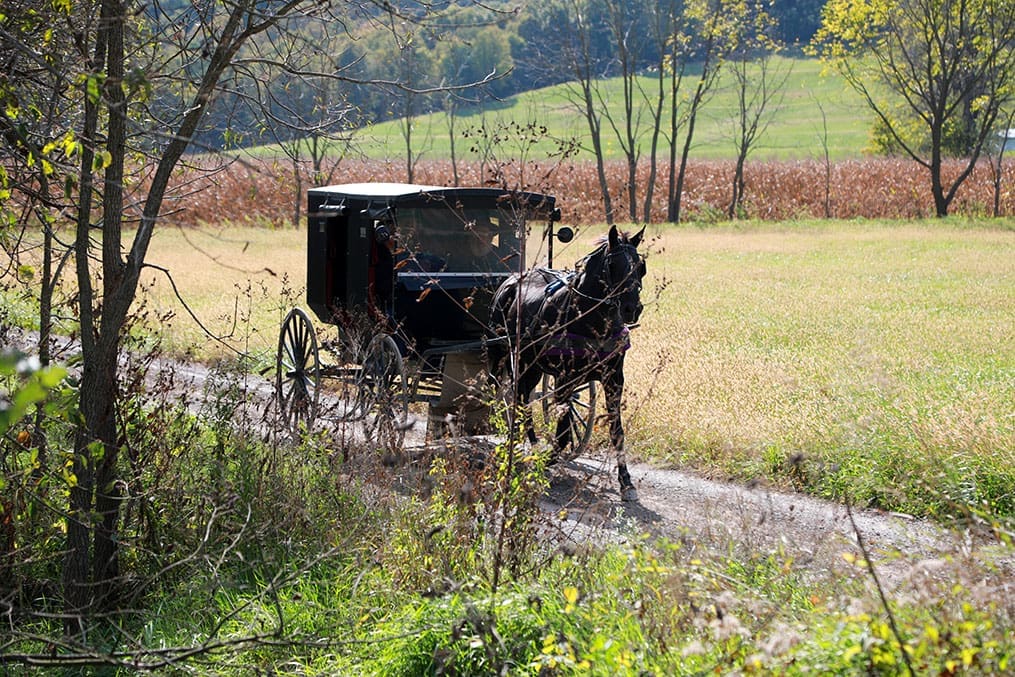 You will enjoy a buggy ride with the Amish. Holmes County Ohio boasts the largest population of Amish in the country.
This morning we will have the rare opportunity to spend more time with the Amish, touring their charming villages, seeing some of their local markets and talking to the people. You will love this experience and even have a chance to do some shopping! We will eat with one of our favorite Amish families in their home (don’t worry, they are all ready for large groups) and have another sumptuous meal together. We learn so much from the Amish.
Later this afternoon we will depart for the Cleveland airport for our flight to Kansas City. Our hotel for the next two nights is the Embassy Suites in Kansas City, Missouri. (Meals: B, D)
Day 11 – Thursday, September 24, 2026
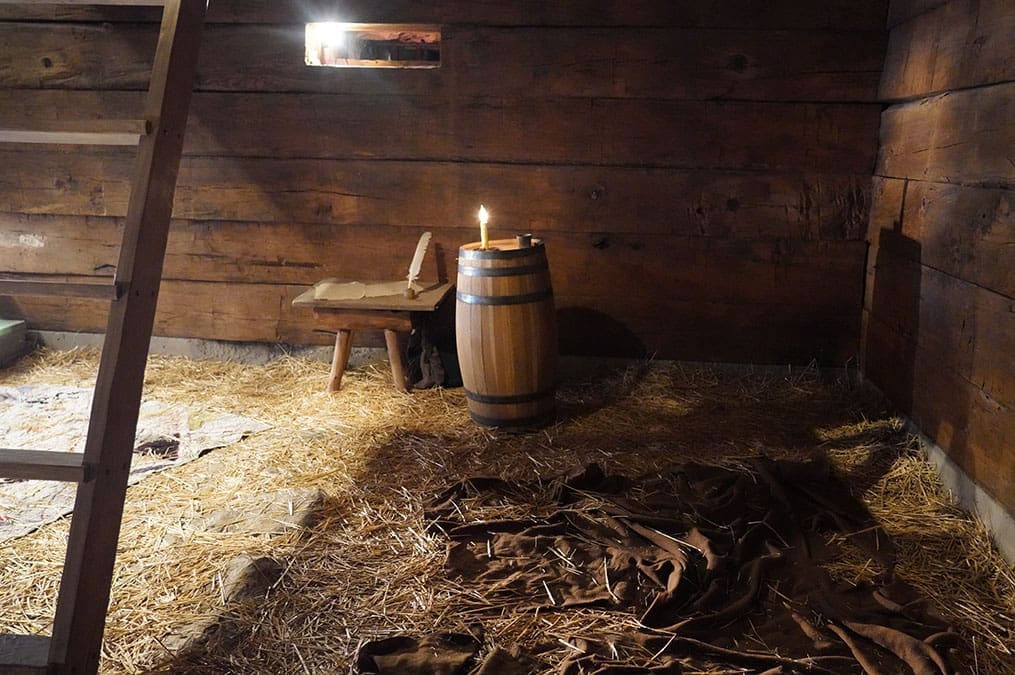
The Liberty Jail beccame a temple-prison for the Prophet Joseph.
This morning we will visit Independence, Missouri. Here we will see the original temple lot, enjoy our own Latter-day Saint Visitors’ Center and see the original Jackson County Courthouse. We then head east to visit Richmond, Missouri where two of the Three Witnesses of the Book of Mormon are buried. We then end our touring today in the Liberty Jail where the Prophet Joseph and his companions were imprisoned through the cold winter months of 1838/1839. Here we will feel the Spirit as we read the revelations and hear the voices of the past. We will also watch for the Kansas City Missouri Temple as we pass by it and see its beautiful setting in Clay County.
This evening we will have a wonderful meal either at the Cracker Barrel or a restaurant near our hotel. (Meals: B, D)
Day 12 – Friday, September 25, 2026
 For many our visit to Adam-ondi-Ahman is the highlight of our tour.
We head for our morning teaching and meditational time at a very, very special place: Adam-ondi-Ahman! Here you will learn things you’ve never known and perhaps even feel things you have never felt. This is a very sacred place that dates to the beginning of recorded time. After a wonderful lunch on your own at a local Mexican Restaurant in Gallatin, we then visit the temple site at Far West and hear some powerful stories of faith and super faith here. We then make our way east along the approximate path the Saints were driven out of Missouri.
This evening we eat dinner in Hannibal at a local Chinese Restaurant where we have taken groups for many years. We then head the last hour and 25 minutes to Nauvoo! We will be staying at the Nauvoo Family Inn and Suites for the remaining three nights of our journey. (Meals: B, D)
Day 13 – Saturday, September 26, 2026
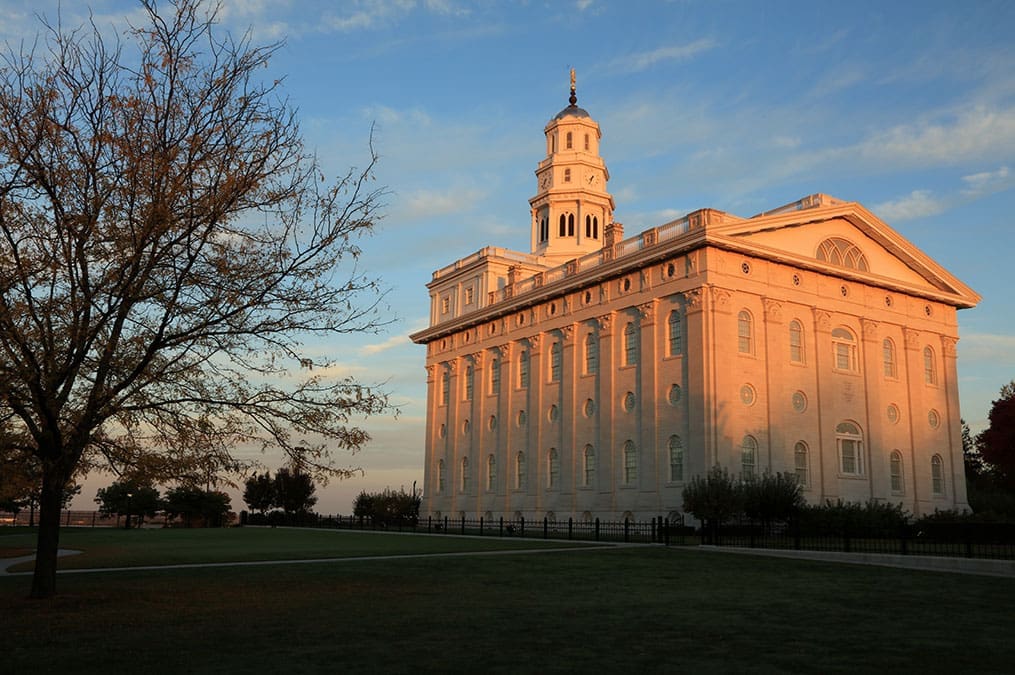 How can we ever forget that breathtaking announcement on April 4, 1999 that the Nauvoo Temple would be rebuilt?
This morning we step back in time and spend a glorious day touring the sites of Old Nauvoo—beginning with a session (either initiatory, sealing or endowment depending on availability and scheduling) in the stunning Nauvoo Temple. Today we’ll hear stories of the past and get a feel for “the City of Joseph”. We will see the moving Relief Society Gardens where thirteen monuments to women will touch your soul. We will tour Brigham Young’s home (recently renovated and redone), the Printing Complex, the Blacksmith Shop, the Seventies Hall, the Browning Gunsmith Shop and Home and as many other places as we can squeeze in—including the brand new Nauvoo Temple Visitors’ Center. You may receive a Nauvoo brick today as a souvenir from Nauvoo.
Tonight we will dine at the old Nauvoo Hotel (depending on their business situation–or some other nearby dining experience) with their wonderful all-you-can eat dinner buffet. Don’t miss their amazing cinnamon buns! (Meals: B, D)
Day 14 – Sunday, September 27, 2026
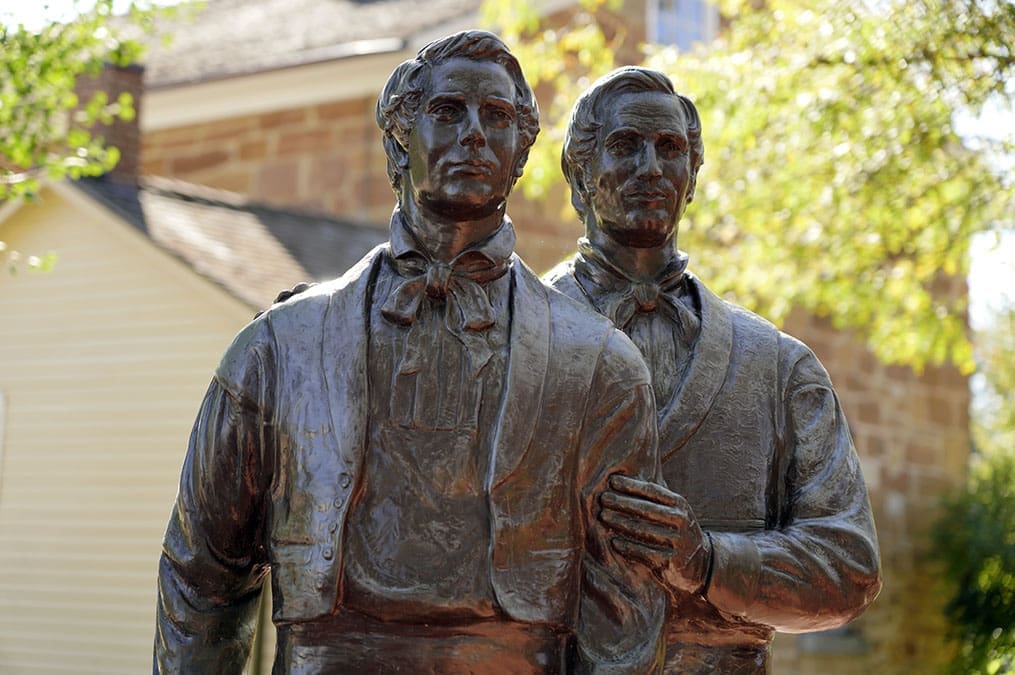
By the end of two weeks you will feel a deep love for Joseph and Hyrum.
We will attend the earliest Sacrament Meeting in the Nauvoo Ward and then tour more of Nauvoo. This afternoon we travel south and east to our final stop: The Carthage Jail. Here you will have one of the highlight experiences of the trip as we review the events of the Carthage Jail and talk about our feelings for Joseph and Hyrum. We end the tour with a group testimony meeting in Nauvoo at our hotel. (Meals: B, L)
Day 15 – Monday, September 28, 2026
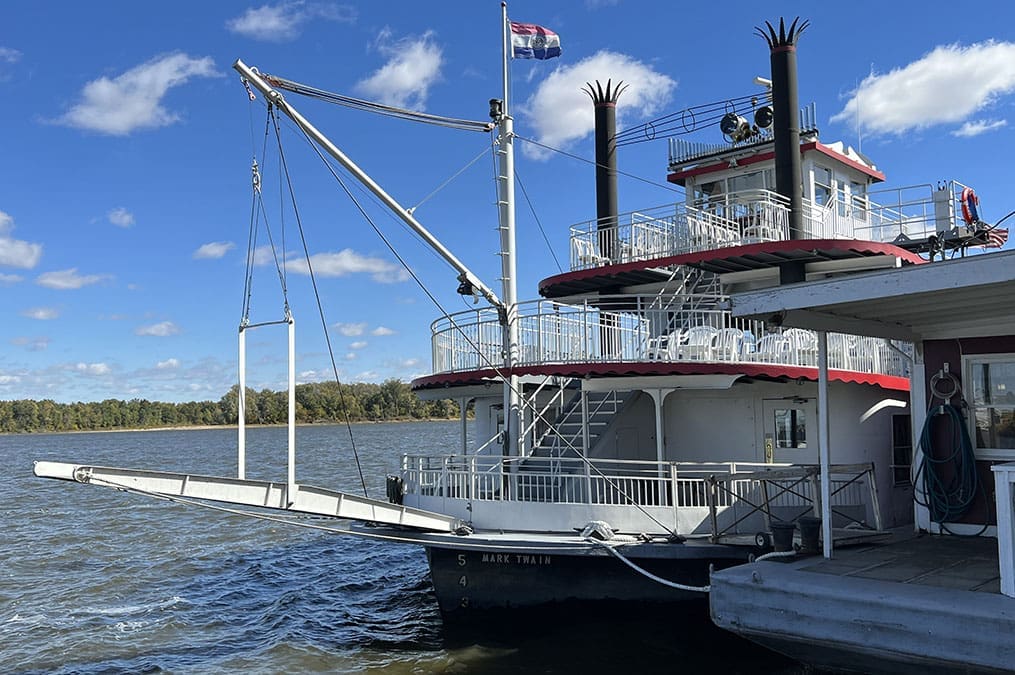
We will have a wonderful Mississippi River boat ride/lunch cruise at Hannibal, Missour–Mark Twain’s home town.
As we say our farewells to Nauvoo this morning, we continue on to Mark Twain’s Hannibal on the Mississippi River where we’ll take a special luncheon cruise on a riverboat hosted by a charming family who really take pride in this experience and make you feel so welcome. You’ll delight in hearing the stories and folklore of this mighty river. Following this special lunch, we’ll immediately head to St. Louis with a brief stopover in Historic St. Charles, Missouri, the beginning of the Lewis and Clark Expedition, May 14, 1804. It’s only a tease but you will love your approximately one hour of walking these 18th and 19th century streets and maybe get an ice cream cone (only homemade) at Kilwin’s.
Now we sadly head to our evening flights home (only about 15 minutes from St. Charles). Farewell dear friends! (B, L)
Tour Cost Per Person includes hotels, deluxe motor coach, flight from Cleveland, Ohio to Kansas City, Missouri, entrance fees, taxes & gratuities, luggage handling, daily breakfast and dinner, and a Mississippi Riverboat cruise.
Credit Card price:
- Double Occupancy $4,479 per person.
- Ask Sarah about Single or Triple occupancy pricing.
Round trip airfare from home cities is not included, but may be booked with the group or secured on an individual basis (you are welcome to use frequent flyer miles).
Please call our agent, Sarah Wangsgard, at Morris Murdock Travel direct to her office at: 801-483-6473.
Please note again: This tour will sell out; if you would like to go right online and book it yourself, PLEASE CLICK HERE. When you get to that page, scroll down to where it says BOOK NOW and then set up your account and take care of it.
A deposit of $250.00 per person is necessary to hold space. Payment arrangements can be made with final payment due 60 days prior to the tour. Cancellation insurance is available and is always recommended.
Unprecedented: A New Temple Square Visitors’ Center that Is Unlike Any Other

(Be sure and see the video at the end of the article to enjoy a lovely tour of the new Visitors’ Center.)
“For years, every generation has asked, how do we share the story of who we are as a people? How do we share the story of temples? And every generation has tried a different method,” said Emily Utt, a curator of historic sites for The Church of Jesus Christ of Latter-day Saints.
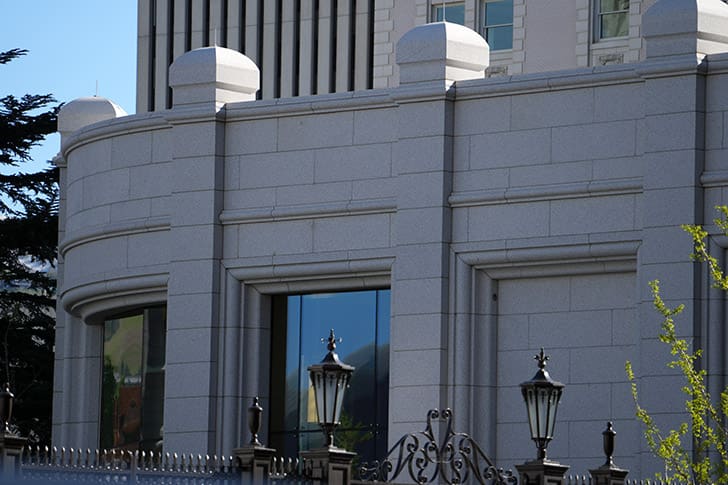
A sneak peek into the new 39,800 square foot Visitors’ Center at Temple Square reveals a refreshing answer to how to tell our story. For years visitors to Temple Square have asked two questions. “Do Latter-day Saints believe in Jesus Christ and what goes on inside your temples?
This new visitors’ center answers both questions masterfully, but the second question in a way that is utterly new.

“You may think you have been to a visitors’ center before, but this is not that. This is an experience like you have never had before,” said Emily Bell Freeman, Young Women’s General President.”
Approaching Temple Square from South Temple, it is easy to see that the new Visitors’ Center consists of two wings separated by a garden that allows a clear view of the temple beyond them. Beneath that garden and connecting the two wings is a sweeping lower level where the South Visitors’ Center stood before it was demolished.

It is in that underground area that visitors find the surprise. Here are exhibits, scale models of temples from around the world, but what’s unique is an exact replica of the rooms that are actually inside a temple, including a recommend desk, a baptistry, an instruction room, a celestial room and a sealing room.
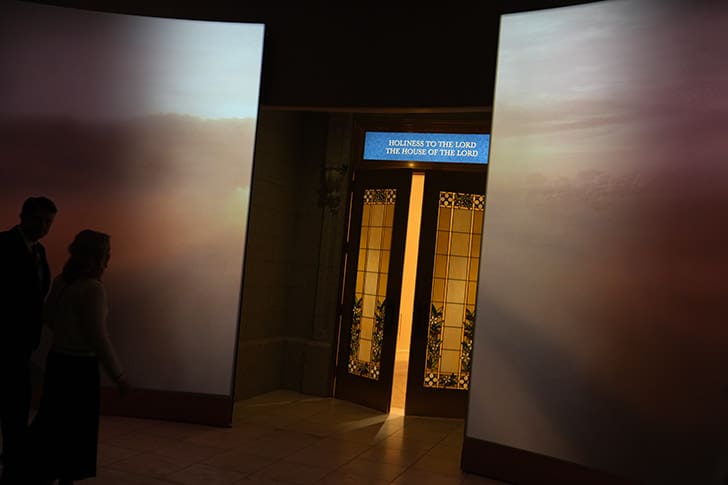
This means that this visitors’ center with these replica rooms will become a perpetual temple open house.
When the Salt Lake Temple has its open house from April to October in 2027, with visitors expected in the range of 3 to 5 million and a daily attendance of 20,000 to 29,000, that is not the end of visitors to Temple Square seeing what a temple looks like. While these replica rooms, are not the Salt Lake Temple, they look like the inspiring rooms of other temples.
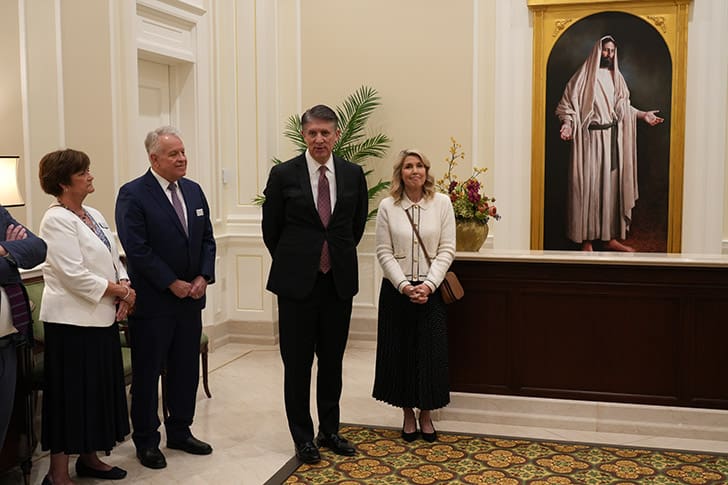
Elder Matthew S. Holland said, “Because Latter-day Saints consider their temples a sacred space, people naturally wonder what goes on inside of them.” They will always be able to not only find out, but see for themselves, on Temple Square.

The Salt Lake Temple open house in 2027 will mark the first time in history the temple has been open to the public.
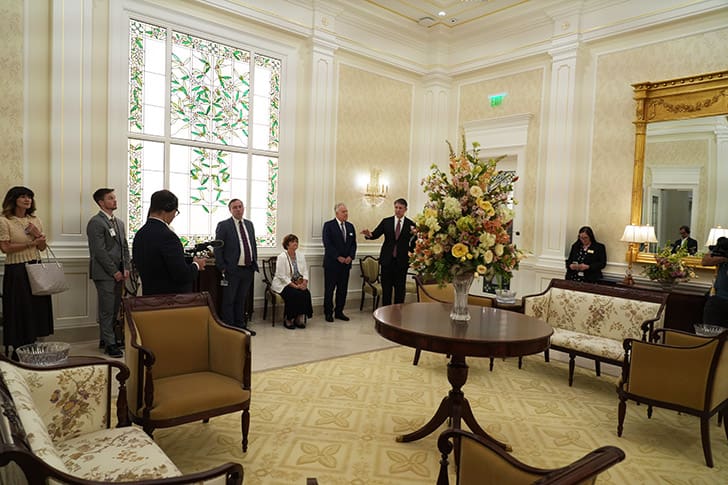
President Dieter F. Uchtdorf, acting president of the church’s Quorum of the Twelve Apostles emphasized, “I think it is wonderful that we have now this openness of showing what is happening so no one can feel that we’re keeping anything hidden, because there’s nothing to hide.”
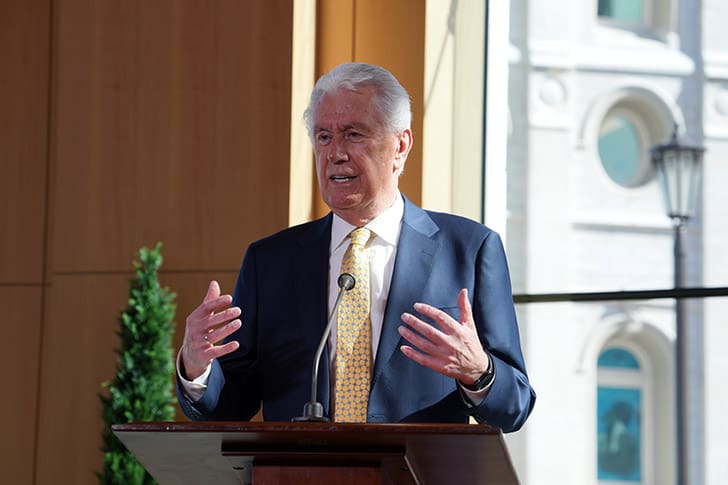
He said, “This morning, I was able to dedicate this visitors’ center and consecrate it to the purpose of proclaiming the gospel of Jesus Christ to all those who come…which is joyful.
Eager to Come to Temple Square
As President Uchtdorf stood next to the Christus statue skirted by windows that opened to an imposing view of the temple, he said, “The openness is also reflected here with all these windows and the glass, the wood, and the temple behind us, and the statue of Jesus Christ, right here.
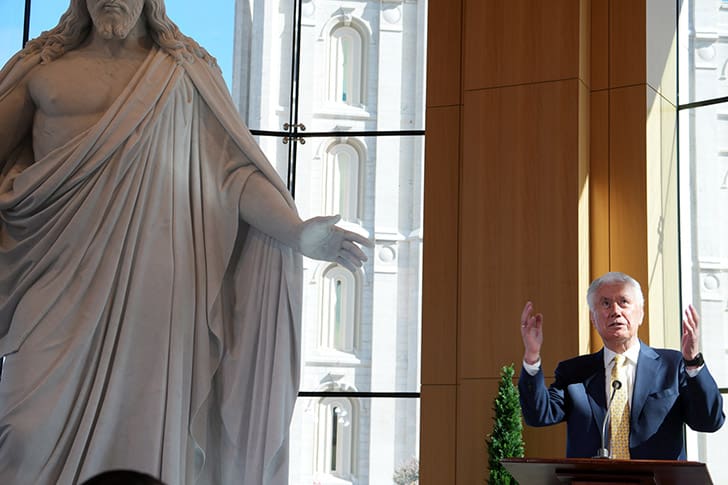
“It reminds me when we all see this beautiful material, almost the highest level of quality you can imagine, how did this all come about? It came about because of a small group of people, many years ago, who found a way to worship God in a similar way as it was done when Jesus Christ walked the earth. That is what we call the Restoration”
“These people came together in the Eastern part of the United States, and unfortunately, they weren’t very welcomed there, so they looked for a place far away from circumstances of persecution.”
“Four days after they arrived here, they decided, this is the spot to build a House of the Lord. These people came in with hand carts. They came in oxen-drawn wagons. They lived in log houses…with no firm floor, dirt floors. These people, settled here and within a few years, still living in those houses, built this temple. Since they were not in business of building this temple for 40 years, they were…interrupted by other things–an army coming in trying to straighten them out. In the meantime, they also built the tabernacle which is right next to us.
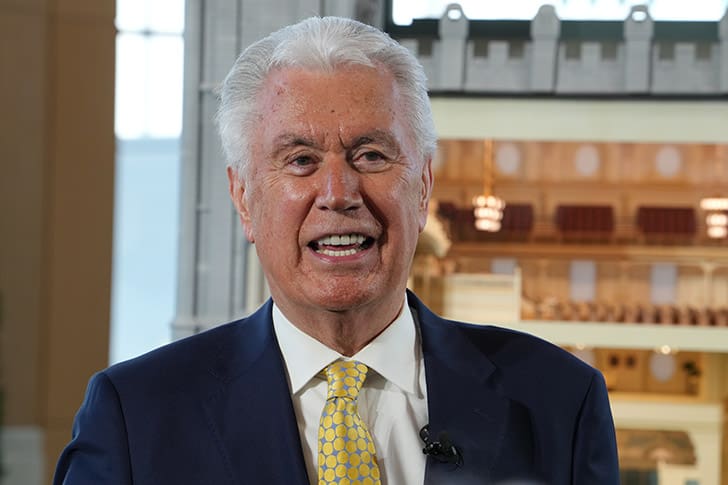
“So you see, those people, living here in those simple circumstances, built this majestic building. Why? Because of their conviction and faith in Jesus Christ.”
President Uchtdorf said, that conviction moved them then and “that is what moves us now.”
He also said of the remarkable feat of shoring up and renovating the Salt Lake Temple and building this new visitor’s center, “It’s a beautiful time, when we see how everything falls in place.”
A Blending of the Old and the New
Amy Christensen, of Jacobsen Construction that has been the contractor on the temple and visitors’ center, said that in their 104-year history as a company, this has been an unprecedented project for them to work on the temple project.
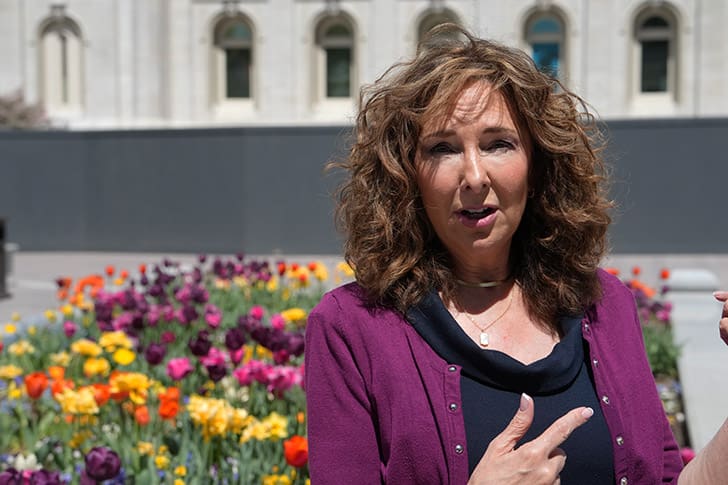
“There have been over a thousand people at any given time working a day on this project, six days a week, with a 20-hour staggered work schedule going on as different people come and go. It’s a lot of dedicated time to this project, and there are 10 work packages here, so it’s 10 construction projects in one.”
While upgrading the temple and building the visitors’ center with its exact replica of rooms in a temple, the most advanced pioneering technology was used, but there was always a nod to the pioneer past.
Until, the seismic upgrade of the temple, it has been standing on the adobe foundation, laid by the pioneers, though some portions had been repaired. Now, like the spiritual heritage of the Latter-day Saints, the temple is standing on many layers of foundational strength.
“It’s amazing to see what original innovations were done on this structure at time,” said Christensen. “It was state of the art, absolutely. As we stand on the shoulders of those original construction builders, we feel like we’re partners through the generations with them and pioneering a new generation of people who want to come, participate, and be inside the temple, and keep it safe for many generations to come.”
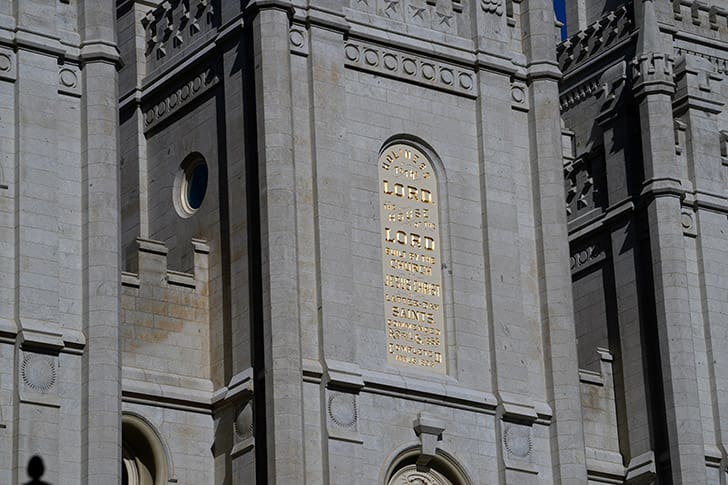
She noted that many of the workers on the temple and visitors’ center construction site had ancestors who had worked on the original Salt Lake Temple, and some of them are also working in the same skill set.
“There’s an absolute connection to the pioneers. A lot of old photographs and history have been studied to review back as much as possible the look and feel of the temple interior and to repurpose and reuse many things that were in the temple before. Even art glass has been restored, though some of it has been moved so it can be seen by more people.”
Only Dreamed of
Emily Utt noted that in 1852 while the temple was only partially constructed, the pioneers built a wall around the square to define the sacred center. “I love that this wall is still here to show you are now entering sacred space.”
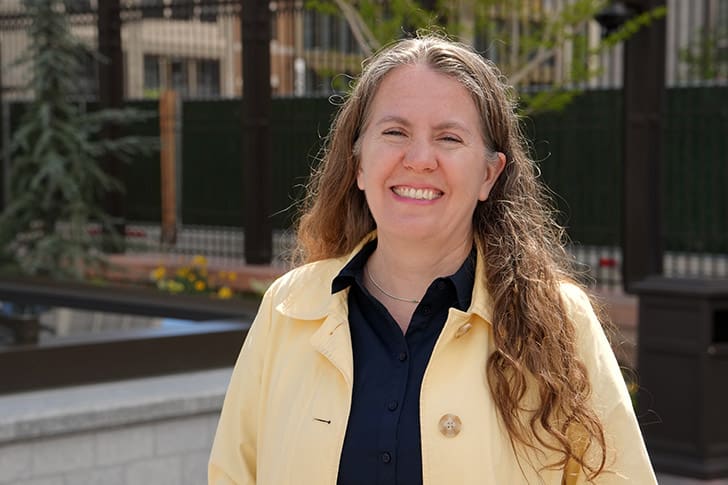
Yet, what the new visitors’ center does with its remarkable technology, is something that could have only been dreamed of in earlier years. Utt said, in the 19th century when people came to Temple Square and wanted to learn about what the Latter-day Saints believed, they’d have to ask a gardener. Then in 1902, a little bureau of information was opened on one corner of the square. Then in the 1960’s they built the North Visitors’ Center and put a Christus in it followed by the building of a South Visitors’ Centeri n the 70’s.
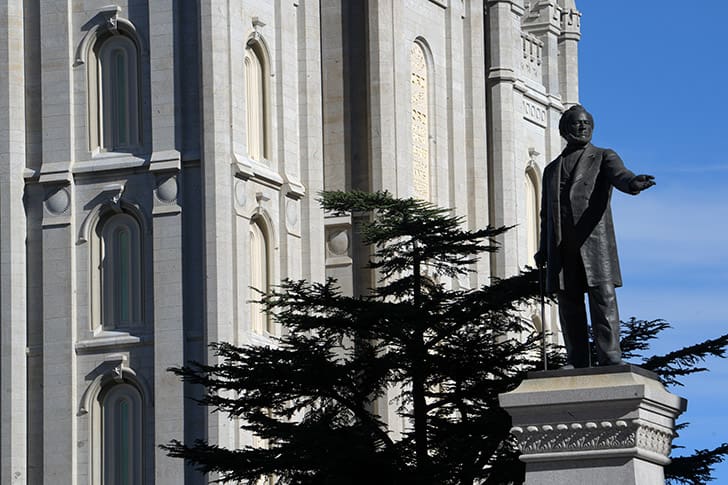
Yet, Utt said, “Since we are always working on being open and transparent, we have technology now that we could only have dreamed of in the 60’s. We can tell our story better than ever before.
What You’ll Find in the Visitors’ Center
In the east wing of the Visitor’s Center is an exact scale model, made to the minute detail to look like the inside of the renovated Salt Lake temple. One wall of the temple moves down to reveal this interior. Then the back of the temple also moves so the two new wings of the temple, much of it underground. can be seen. This is a 100,000 square feet addition.
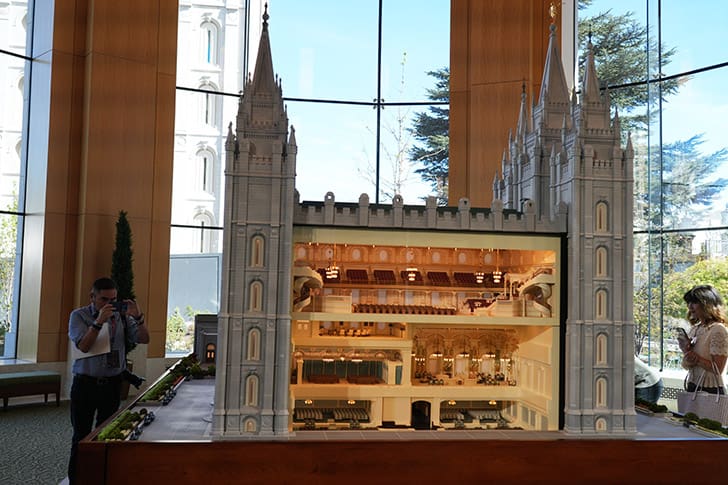
These wings have glass roofs, so someone entering this section of the temple can look up and see the rising temple above them. In addition, this area also includes special rooms where friends and family of those getting sealed, who cannot go in, have a place to sit and enjoy the spirit of the temple.
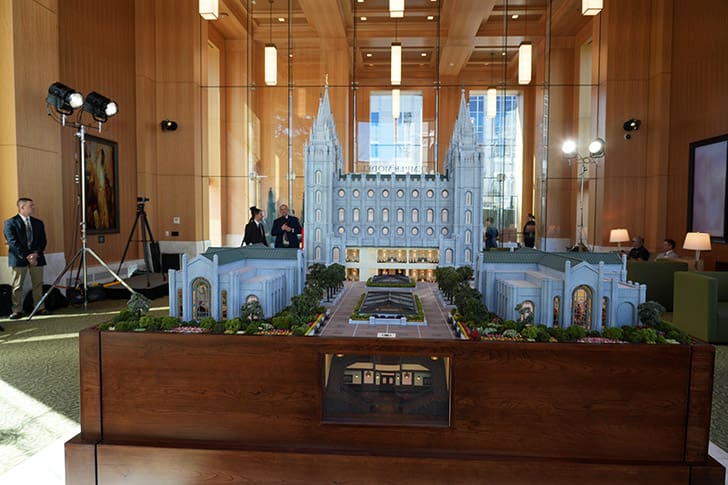
In total, the new temple will have 23 sealing rooms, a large number that President Russell M. Nelson had insisted on for a temple at the center of Christendom.
Moving to the lower level is a display of models of 11 temples from around the world with electronic signs in English, Spanish and Mandarin. They lead to a large, interactive, lighted globe, showing temples dotting the earth. Touch a glowing dot on the globe where a temple is located, and a photo of a temple emerges.

The centerpiece of the hall is the “Come Unto Me” statue of Christ, made of marble from the same quarry where the famous statue of David was drawn. The statue by artist Christian Holt, captures both the divinity of Christ and his reach out for every person.
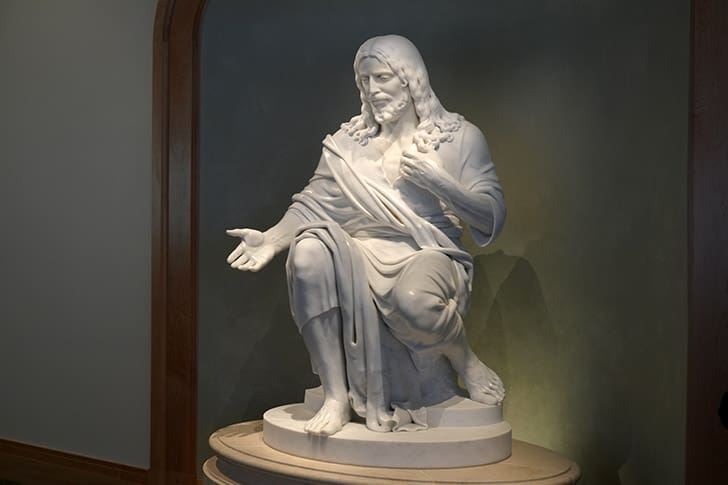
The hall then leads to a media wall of photos, videos and audio, that illustrate caring for others. The church, regarding all people as children of God, seeks to reach out with a humanitarian hand to all people.

Beyond the visitors’ center guests can see landscaped gardens with sculptors which give a glimpse into sacred moments in the ministry of Christ and sacred moments like the reception of the priesthood powers and keys.
A Time of Excitement
For those who have waited what seems like a very long time to be able to be on Temple Square and see the visitors’ center and be closer to the temple, this is an exciting time. This project is a monument to cutting edge effort, cooperation and coming together to do something truly magnificent.
With the replicas of the rooms of a temple in the visitor’s center, this is a first experience in opening up the rooms of a temple more broadly while maintaining the sacred space of the temple itself.
What You Need to Know
The visitors’ center will be open May 18, with anyone able to come through the doors to visit. However, to see the replica rooms requires a reservation which can be made at TempleSquare.org. The experience takes about 30 minutes. As of this writing, the first two weeks were already booked.
How and When to Visit the Temple Square Visitors’ Center
- Hours: Beginning May 18, 2026, the Temple Square Visitors’ Center will be open every day from 9 a.m. to 9 p.m.
- Tickets: Admission to the center is free. While no ticket is required for entry, a reservation is required for the 30-minute “Inside a Temple” tour. Reservations can be made through the Temple Square app (Apple, Android) or at TempleSquare.org.
- Parking: Free parking is available at the Conference Center with validation; City Creek parking is also available south of Temple Square (first two hours free).
- Public transit: The Temple Square TRAX station provides direct access.
- Accessibility: The visitors’ center is compliant with the Americans with Disabilities Act and fully accessible to all visitors.
Two Josephs Across the Centuries: The Strong Prophetic Ties between Joseph of Israel and Joseph Smith
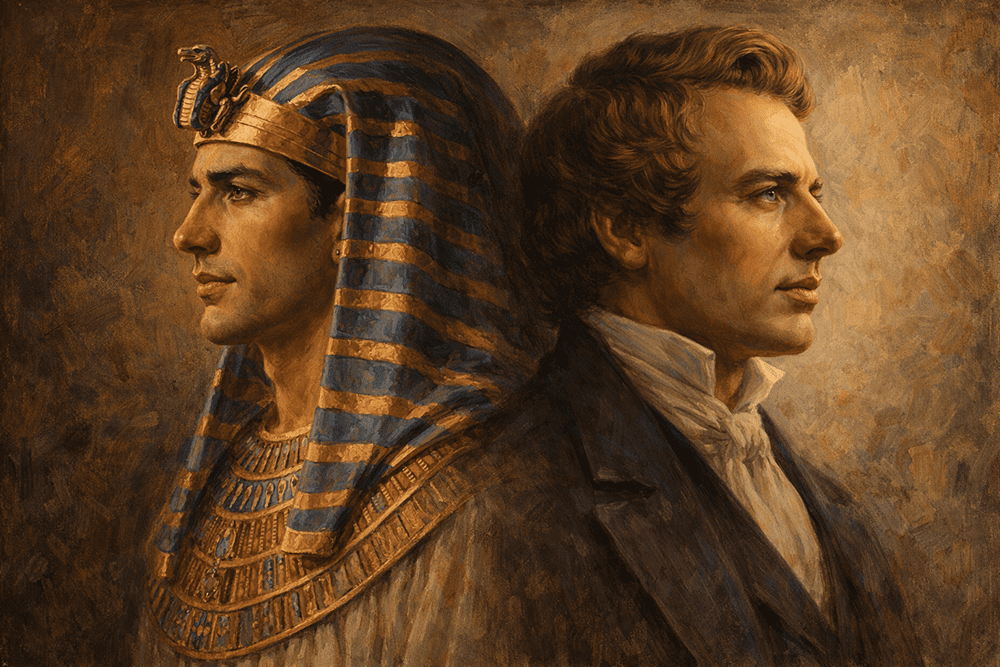
Sacred history sometimes unfolds with a symmetry inviting to careful attention. One such pattern appears in the prophetic link between Joseph of Egypt and Joseph Smith. Latter day Saint scripture presents this relationship not as coincidence but as part of a divine design reaching across millennia. The idea emerges in the Joseph Smith Translation of Genesis 50 and receives powerful reinforcement in the Book of Mormon, particularly in 2 Nephi 3. When the passages are read together, they present a compelling vision of prophecy fulfilled through lineage, revelation, and the restoration of sacred records.
Joseph of Egypt already stands as one of the great figures of the Old Testament. His story carries the drama of betrayal, endurance, and eventual deliverance. Sold into slavery by his own brothers, he rose through years of hardship to become a trusted leader in Egypt. Through revelation and wisdom he prepared the land for famine and preserved the family of Jacob during a time of desperate need.
However, Latter day Saint scripture adds another dimension to Joseph’s prophetic role. According to the Joseph Smith Translation of Genesis 50, Joseph did not look only to the immediate future of his people. He also saw far down the corridors of time. In this vision he spoke of a latter day seer who would arise from among his own descendants. That seer would bear Joseph’s name. His mission would involve bringing forth the word of God and helping restore truth obscured over the centuries.
The prophecy becomes even more specific. The future seer’s father would also be named Joseph. The Lord would raise him up to perform a work of great value for the house of Israel. His words would bring people to the knowledge of the covenants made with their fathers. Those familiar with the life of Joseph Smith cannot miss the striking parallels.
The Book of Mormon strengthens this prophetic connection in a remarkable way. In 2 Nephi 3, the prophet Lehi gathers his sons and speaks directly to his youngest son, who is also named Joseph. In this intimate setting Lehi recalls the prophecy of Joseph of Egypt. The ancient patriarch, Lehi explains, foresaw a latter day seer among his descendants. This seer would bring forth long hidden sacred records.
The passage then moves from prediction to purpose. The records brought forth by this latter day Joseph would work together with the Bible to establish the truth of God’s word. They would restore plain and precious lost teachings. They would also help convince scattered Israel of the covenants made with their fathers. This is not a vague forecast. The prophecy identifies lineage, mission, and even name. It describes a seer whose work would center on scripture, revelation, and the gathering of Israel.
Joseph Smith’s life aligns closely with this description. Born in 1805 to Joseph Smith Sr., he emerged from a family line identified in Latter day Saint patriarchal blessings with the tribe of Ephraim, the son of Joseph of Egypt. Through divine guidance he translated the Book of Mormon from ancient plates and published it in 1830. Latter day Saints view this moment as the opening chapter of the Restoration.
The connection between the two Josephs becomes even more meaningful when their roles are considered side by side. Joseph of Egypt preserved physical life during a season of famine. By preparing the storehouses of Egypt, he ensured his family and many others survived a devastating crisis.
Joseph Smith entered a different kind of famine. The spiritual landscape of the nineteenth century included deep religious yearning but also widespread confusion about doctrine, authority, and revelation. Through the coming forth of the Book of Mormon and the restoration of priesthood authority, Joseph Smith helped reopen channels of revelation we see as essential to the gospel of Jesus Christ.
Another shared element in their stories involves adversity. Joseph of Egypt endured betrayal by those closest to him. He faced slavery, false accusation, and imprisonment before his calling became widely known. Joseph Smith encountered relentless opposition during his ministry. Mobs drove him and his followers from their homes more than once. The hardships of his life formed part of the larger narrative surrounding the Restoration. These parallels do not suggest identical experiences. But they do reveal a pattern in which God prepares chosen servants through trial before placing them in positions of sacred responsibility.
The prophecy in 2 Nephi 3 also emphasizes the gathering of Israel. Joseph of Egypt preserved the house of Jacob in his generation. Joseph Smith taught extensively about the gathering of Israel in the latter days. Missionary work, temple covenants, and renewed attention to the promises made to Abraham have all become central elements of Latter day Saint belief and practice.
Seen through this lens, the prophecy concerning the latter day Joseph forms more than an interesting historical detail. It places the Restoration within a much longer sacred narrative. The covenant promises made to the ancient patriarchs continue to unfold in later generations.
For Latter day Saints, the connection between Joseph of Egypt and Joseph Smith illustrates how prophecy and fulfillment can span vast stretches of time. A patriarch in ancient Egypt looked forward to a future servant who would help restore God’s word. Centuries later, a young man in rural New York stepped into the role and began a work which continues to shape the faith of millions.
This prophetic thread invites a deeper appreciation for the unity of scripture. The Old Testament, the Book of Mormon, and modern revelation do not stand as isolated witnesses. They join together in telling a single unfolding story of covenant and redemption.
When those passages are read together, the voice of Joseph of Egypt reaches across the centuries with quiet certainty. The Lord would raise up a seer named Joseph. Through him sacred records would come forth and the knowledge of God’s covenants would expand again among His people.
History has now provided the name that prophecy anticipated.
The Joseph Smith Translation: Of the Lineage of Abraham

Latter-day Saints (LDS) are more aware of the significance of Abraham and the Abrahamic covenant than any other people in the world. Yet consistently we fail to appreciate the importance of that covenant as made by the Lord with Abraham. Those covenantal blessings are foundational to the Gospel of Jesus Christ, and they continue to echo through the millennia within the ceremonies of all LDS Temples. Within those sacred walls faithful Saints are promised to have all the blessings of Abraham, Isaac, and Jacob as rightful heirs.
President Russell M. Nelson has expressed “The fulfillment of the ancient Abrahamic covenant is only feasible because of the Lord Jesus Christ.”1 What were the promises made to Abraham? Again, from President Nelson:2
- Jesus the Christ would be born through Abraham’s lineage.
- Abraham’s posterity would be numerous, entitled to an eternal increase, and also entitled to bear the priesthood.
- Abraham would become a father of many nations. (Genesis 17; Galatians 3; Abraham 2)
- Certain lands would be inherited by his posterity. (Genesis 17; Galatians 3; Abraham 2)
- All nations of the earth would be blessed by his seed. (Genesis 17:7; Acts 3:25; 1 Nephi 15:18; 22:9; 3 Nephi 20:25, 27)
- And that covenant would be everlasting—even through “a thousand generations.” (Deut. 7:9; 1 Chron. 16:15; Psalm 105:8)
Using The Joseph Smith Translation, Red-Letter Editions, Old Testament,3 and other prophetic utterances we will endeavor to discover more about Abraham and our personal relationship with the covenantal promises he received from God.
Let us first observe the promises made to Abraham as recorded in The Joseph Smith Translation.
Genesis, Chapter 18 Genesis, Chapter 17
1 And when Abram was ninety years and nine years old,
and nine, the Lord appeared to Abram, Andandsaid unto him, I,amthe Almighty God, give unto thee a commandment that thou shalt walk uprightlywalkbefore me, And beand be thouperfect.2 And I will make my covenant between me and thee, and will multiply thee exceedingly.
3 And Abram fell on his face, and called upon the name of the Lord; And and God talked with him, saying, my people have gone astray from my precepts, and have not kept mine ordinances, which I gave unto their fathers; And they have not observed mine anointing, and the burial or baptism wherewith I commanded them; but have turned from the commandment, And taken unto themselves the washing of children, and the blood of sprinkling, And have said that the blood of the righteous Able was shed for sins, and have not known wherein they are accountable before me.
4 But as for thee,
As for me, behold, I will make my Covenantmy covenant iswith thee, and thou shalt be a father of many Nations.nations. And this covenant I make, that thy children may be known among all Nations.
These verses are a marvelous example of the Prophet Joseph Smith exercising his role as a Seer, a Revelator, and a Translator. We learn in these initial verses that a renewal and reinstitution of God’s covenantal blessings was necessary at Abraham’s time because of the wickedness of the people. Abraham was one of the few righteous persons of his day and being faithful to God, and of the direct lineage of Adam, he had the right to the Priesthood and all its attendant blessings.
Because of his faithfulness, God chose Abraham and made a covenant with him resulting in a new dispensation and a restoration of the Gospel with him becoming the “father of many Nations.” God continued speaking to Abraham saying:
5 Neither shall thy name any more be called Abram, but thy name shall be Abraham; for a Father
fatherof many Nations nations have I made thee.6 And I will make thee exceeding fruitful, And
andI will make Nationsnationsof thee; Andandkings shall come upoutof thee, and of thy seed.7 And I will establish a
mycovenant of circumcision with thee, And it shall be my covenant between me and thee and thy seed after thee, in their generations that thou mayest know forever, that children are not accountable before me, until they are eight years old And thou shalt observe to keep all my covenants wherein I covenanted with thy Fathers; and thou shalt keep the commandments which I have given thee with mine own mouth, And I will be a God unto thee and thy seed after thee;for an everlasting covenant, to be a God unto thee, and to thy seed after thee.8 And I will give unto thee and to thy seed after thee, a
theland wherein thou art a stranger; Allallthe land of Canaan, for an everlasting possession; and I will be their God.
While circumcision at 8 days old became the token of the covenant between God and His chosen people at that time, there is a related piece of knowledge found in verse 7 when God said to Abraham “children are not accountable before me, until they are eight years old.” This was recorded by the Prophet Joseph around February-March 1831. In all of scripture, the age of accountability appears only here and in D&C 68:27, which is dated 1 November 1831.
Once again, we see the probable influence of the JST on the Doctrine & Covenants. While The Book of Mormon informs us that children are to be baptized, it never states the age when that is to be done.
God then promises Abraham that the land of Canaan will belong to him and his posterity as “an everlasting possession; and I will be their God.” The land of Canaan includes the present-day boundaries of the country of Israel, and more. It might also be interesting to the reader at this point to note that the Hebrew language has its roots in the language of Canaan as it was spoken at the time of Abraham, but that is another story.
God goes further and informs Abraham in verses 15-17, that he and Sarah would be blessed with a child, Isaac, and through his posterity Abraham’s blessings would be fulfilled. Abraham is 99 at this time and Sarah is 90. Abraham and Hagar’s son Ishmael was 13 (Genesis 17:25). By the time Isaac was born Abraham had turned 100.
15 And God said unto Abraham, as
Asfor Sarai thy wife, thou shalt not call her name Sarai, but Sarah thou shalt callshallher name.be.16 And I will bless her, and I will give thee a Son
son alsoof her; yea, I will bless her, and she shall be blessed; the Mother of Nations;a mother of nations;Kings andkings ofpeople shall be of her.17 Then Abraham fell on
uponhis face, And rejoiced,and laughed, and said in his heart, there shallShalla child be born unto him that is an hundred years old. Andand shallSarah, that is Ninety ninety years shallold,bear.
God later reiterated His blessing to Abraham and his posterity after trying his faith when He asked him to sacrifice his son Isaac, then a young man, symbolic of God’s own sacrifice of His son Jesus the Christ. The angel of the Lord said to Abraham:
Genesis, Chapter 23 Genesis, Chapter 22
15 And the Angel angel of the Lord called unto Abraham out of Heaven heaven the second time,
16 And said, thus saith the Lord, I have sworn by myself, that By myself have I sworn, saith the LORD, for because thou hast done this thing, and hast not withheld thy son, thine only Isaac, from me; son;
17 That in blessings blessing I will bless thee; and in multiplying I will multiply thy seed as the stars of Heaven, the heaven, and as the sand which is upon the sea shore; and thy seed shall possess the gate of his enemies;
18 And in thy Seed seed shall all the Nations nations of the Earth earth be blessed; because thou hast obeyed my voice.
From the biblical record we learn that lineage has always played a key part in God’s plan for spreading His gospel to the known world of all dispensations. I have often contemplated the Lord’s frequent references to a lineage of “chosen people.” The Bible, The Book of Mormon, other Latter-day scriptures, and countless references by leading authorities in the Church are rife with the concept of a select or chosen people upon whom God will pour out His greatest blessings.
Those blessings always come with the caveat that all who receive them must undergo select ordinances and make and keep certain sacred covenants as determined by Him. They become responsible to share their knowledge of Him and those covenants and blessings with those both inside and outside the lineage of Abraham. This universal sharing of Abrahamic covenants and blessings have become increasingly important in these latter-days because of the prophetic mandate given to gather all of Israel, on both sides of the grave, in preparation for the Lord’s return.
So, who are Abraham’s lineage today? As modern-day covenant Israel, Latter-day Saints are literally of the lineage of Abraham or adopted into the house of Israel, as reflected in their patriarchal blessings. To date, most LDS are from Joseph through his sons Ephraim or Manasseh. If you have deceased LDS ancestors who received Patriarchal Blessings, you can access those blessings through your personal Church website, and you will find a varied declaration of lineage among them.
My own LDS ancestors have declarations of lineage including Joseph, Ephraim, Manasseh, and Levi. Sister Wendy Nelson,4 wife of President Nelson, once spoke of finding all the tribes of Israel but Levi, represented in Russia as declared in their patriarchal blessings. When she and President Nelson went on to Armenia, they found a young missionary from Chandler, Arizona who was of the tribe of Levi.
Children in some families have declarations of lineage that are not the same. I am aware of a family with three daughters and one son, where three of the siblings were through Ephraim while one daughter was through Judah. While the preferred lineage for an individual is the Lord’s decision and is revealed through his patriarchs, why the determination of that declaration is given for a specific individual is not known.
However, the effect of scattered Israel upon the people of the world through the millennia is a direct fulfillment of the blessings given to Abraham. Whether persons are literal descendants of Israel or adopted into the house of Israel has no bearing on their receiving equally all the blessings of Abraham, Isaac, and Jacob.
President Russell M. Nelson has taught:
“Some of us are the literal seed of Abraham; others are gathered into his family by adoption. The Lord makes no distinction. Together we receive these promised blessings—if we seek the Lord and obey His commandments. But if we don’t, we lose the blessings of the covenant. To assist us, His Church provides patriarchal blessings to give each recipient a vision for his or her future as well as a connection with the past, even a declaration of lineage back to Abraham, Isaac, and Jacob.”
President Nelson also taught:5
“Now do you see the importance of your patriarchal blessing? I hope each one of you has obtained one. It is precious. It is personal scripture to you. It declares your special lineage. It reminds you of your linkage with the past. And it will help you realize your future potential. Literally, you can lay claim upon the Lord for fulfillment of those blessings through your faithfulness.
Are you Hebrew? Yes, as scriptures define the term. You are related to Abraham, who was the great “Eber” from which the term Hebrew was derived (see Genesis 10:21, 14:13; see also 2 Corinthians 11:22).
Are you Jewish? That precious lineage may be claimed if your ancestors are from the loins of Judah. But most of us are of the lineage of Joseph through Ephraim or Manasseh. That was the lineage selected to pioneer the gathering of Israel, the seed to lead throughout the world in blessing all the nations of the earth.
Can you trace your lineage to Egypt? If your patriarchal blessing indicates that you are of the lineage of Joseph, Ephraim, Manasseh, or other descendants of Israel, yes, you may claim Egyptian ancestry.
Now you can better understand this revelation given through the Prophet Joseph Smith. It applies to each one of us. He said:
‘Thus saith the Lord unto you, with whom the priesthood hath continued through the lineage of your fathers—
For ye are lawful heirs, according to the flesh, and have been hid from the world with Christ in God—
Therefore your life and the priesthood have remained, and must needs remain through you and your lineage until the restoration of all things spoken by the mouths of all the holy prophets since the world began.
Therefore, blessed are ye if ye continue in my goodness, a light unto the Gentiles, and through this priesthood, a savior unto my people Israel.’ [D&C 86:8–11]
‘And as I said unto Abraham concerning the kindreds of the earth, even so I say unto my servant Joseph [Smith]: In thee and in thy seed shall the kindred of the earth be blessed.’ [D&C 124:58; see also D&C 110:12]
‘Wherefore, our father hath not spoken of our seed alone, but also of all the house of Israel, pointing to the covenant which should be fulfilled in the latter days; which covenant the Lord made to our father Abraham, saying: In thy seed shall all the kindreds of the earth be blessed.’ [1 Nephi 15:18]”
The Gospel Study Guide – Patriarchal Blessings,7 found on the LDS Church website declares:
Every patriarchal blessing contains a declaration of lineage. When God’s children are baptized and become members of The Church of Jesus Christ of Latter-day Saints, they inherit the promises God made to Abraham and his posterity if they remain righteous (see Abraham 2:9–11). While a person may descend through more than one family line from the house of Israel, one specific tribe is normally identified, confirming that the individual has a family connection to Abraham.
Whether this declaration means that a person is a literal descendant by blood or through spiritual adoption is not important (see Abraham 2:10). This declaration of lineage shows a family line through which the individual can inherit the promised blessings of Abraham. It also reminds a faithful person of the spiritual responsibilities he or she has as a descendant of Abraham (see Abraham 2:11).
Israel is an interesting and unique moniker for a chosen people. Covenant Israel today are the people who have been chosen by the Lord to take His restored Gospel to all the world. Today when we use the term Israel, we usually think of the Jews who inhabit the land of Israel. However, the Jews are only one of the 12 tribes of Israel. After Jacob, Isaac’s son, wrestled with the Lord, the Lord changed his name to Israel.
It is important to note that it was after Jacob made the covenant (the Abrahamic covenant) with the Lord that his name was changed. This subtle name change is frequently reflected in the prophetic voices of biblical prophets such as Isaiah, Jeremiah, Ezekial, and others. In those biblical passages a reference to Jacob often refers to those of the 12 tribes who were yet to make the new covenant, particularly the Jews. Today the house of Israel are those who have accepted the restored Gospel and entered into the restored, Abrahamic covenant. It is perfectly proper for Latter-day Saints to be called Israel because of their lineage and the restored Abrahamic covenant which they have taken upon themselves.
While scriptural records focus on an ancient people referred to as Israel, all who willingly accept and keep those covenants are brought under the umbrella of those blessings and become part of His chosen people, the house of Israel. They become chosen through their exercise of faith by accepting the Lord and his Gospel, then entering into his Kingdom through baptism by one having authority. They go on, striving to keep all those covenants given them.
One reason direct lineage plays into this concept of a chosen people is that beginning with Adam and his posterity, they were the only people who, through Priesthood authority, were taught the truth and given the ordinances and covenants essential to exaltation. All who accepted the truth and entered into the Lord’s Kingdom on earth were subsequently commanded to share it with all the known world.
From Adam to Enoch, Enoch to Noah, Noah to Abraham, Abraham to Moses, Moses to Jesus Christ, and finally from Jesus Christ to Joseph Smith those covenants had to be reinstituted and revitalized each time because of the follies and wickedness of people, but they remained essentially the same. The lineage of Abraham has always been given a divine mandate through the Lord’s prophets to share the knowledge of God, His ordinances and covenants, with all who would listen and accept them.
Elder David A. Bednar has taught:8
How do these promises and blessings relate to us today? Either by literal lineage or adoption, every man and boy within the sound of my voice tonight is a rightful heir to the promises made by God to Abraham. We are the seed of Abraham. One of the primary reasons we receive a patriarchal blessing is to help us more fully understand who we are as the posterity of Abraham and to recognize the responsibility that rests upon us.
We conclude our observations of our relationship with the Abrahamic Covenant with the simple declaration that all who make and keep their covenants including baptism and those administered in the Holy Temple, will receive as heirs all the blessings of Abraham, Isaac, and Jacob as taught by Joseph Smith, the Prophet, Seer, Revelator, and Translator.
1. “Covenants - Literal Israel”, By Elder Russell M. Nelson, Of the Quorum of the Twelve Apostles, General Conference, October 2011.
2. Ibid.
3. To view the alterations made by the Prophet Joseph Smith using The Joseph Smith Translation, Red-Letter Edition, Old Testament and/or New Testament, the reader may obtain the least expensive copies at https://jstrle.com/. They can be purchased through almost all bookstores, but at a more substantial cost. Recent changes have resulted in a two-volume Old Testament edition containing all the books of the Old Testament including 13 that Joseph Smith did not alter. A single-volume edition is still available but does not contain the text of those 13 volumes.
4. Hope of Israel, President Russell M. Nelson and Sister Wendy W. Nelson, Worldwide Youth Devotional • June 3, 2018, Conference Center, Salt Lake City, Utah.
5. “Covenants - Literal Israel”, By Elder Russell M. Nelson, Of the Quorum of the Twelve Apostles, General Conference, October 2011.
7. Gospel Study Guide, Patriarchal Blessings
8. Elder David A. Bednar; General Conference, “Becoming a Missionary”; October 2005
Dews of Heaven Podcast: Enter Into Your Exaltation

We end this year’s study of the Doctrine and Covenants and the temple with this episode, bringing us back full circle to the main point of the Restoration: to bring us all to the veil and into the presence of our Heavenly Father.

Come Follow Me Podcast: The Martyrdom: a Day of Tears, Sections 135-136

Scot
Maurine and I lead a church history tour every year. We’ve done this for 30 years. We take our many participants through two days of Revolutionary War and the foundations of freedom. Then we go to Sharon, Vermont and begin Joseph Smith’s life chronologically and naturally we end the two weeks in the Carthage Jail. It’s an unbelievable experience. We always have a testimony meeting that last day after the emotional experience of the Carthage Jail. I’ll never forget one year, one of the brothers on the tour, who had been especially attentive throughout that two-week period, said emphatically in his testimony, while still on the Jail grounds, “I’m so angry. I’m just so angry!” Since we had never heard that as part of a testimony before and he gave a rather long pause, I cut in and asked aloud, “Why?” He said, “Because they killed him. They killed Joseph Smith. It was unjust. It was wrong. It was so wrong. I’m just so angry.” And that was his final testimony. And it stuck with me. Let’s explore the historical, emotional and passionate ending of Joseph and Hyrum Smith’s lives today.
Maurine
Welcome to Meridian Magazine’s Come Follow Me podcast. We are Scot and Maurine Proctor and we are delighted to be with you again today and share our witnesses and testimonies of the Prophet Joseph Smith. Will you share this podcast with your family and friends? It’s easy, just tell them to go to latterdaysaintmag.com/podcast or tell them to go to any of their favorite podcast platforms and just search for Meridian Magazine Come Follow Me.
And with the gift-giving season starting, will you put on your list the Come Follow Me Old Testament Calendar with its stunning photos of the ancient lands of the Old Testament. Not only does this calendar help you keep track of your Come Follow Me readings, it also is like a piece of artwork on the wall that changes monthly. If you have many friends that you want to remember with something meaningful, and you want to make your shopping easy, order many of these. It is flat rate shipping for as many as you order if you live in the United States. Buy your calendars at latterdaysaintmag.com/2026. That’s latterdaysaintmag.com/2026 And thank you for your support in this regard—this is one more way we help to pay for Meridian Magazine and this podcast.
Scot
It’s hard to believe that through all these podcasts this year, we are coming to the end of our studies of the Doctrine and Covenants, well, or the end of this year’s study of this sacred volume of scripture. And that naturally leads us to the Carthage Jail. How can we possibly describe in 30 or 40 minutes all the events that led to the martyrdom of the Prophet Joseph Smith? It’s impossible. But we do take our people to the Carthage Jail. And when we’re there, we do give about a 20-30 minute lecture which is full of emotion and passion and power, as we bear our testimonies of the Prophet Joseph.
We hope that through these past 48 podcasts this year on the Doctrine and Covenants, that you have come to know that we know that this great work is true. We love the Restoration of the gospel of Jesus Christ. We love the Prophet Joseph Smith, and his wife, Emma and his family. We love those early heroes of the restoration. We love Brigham Young and Mary Ann Angell. We love John Taylor and Wilford Woodruff and Parley P. Pratt and Eliza R. Snow and Mary Fielding Smith and Mercy Fielding Thompson. These are our friends and our heroes.
Maurine
And it makes us emotional to think of coming to the end of this year of study. But what are all the things that led to Joseph’s martyrdom in Carthage? There are so many things that go into this and most of the time people think that Joseph was brought to Carthage because of plural marriage. That just isn’t the case. It was hardly known publicly by that time, but among the apostates who participated in the conspiracy to kill Joseph, it certainly may have played a role, but it wasn’t the major role.
By this point, Joseph Smith had known for some time that his life was coming close to an end. He knew at least as early as March 1829 that the possibility of the martyrdom was there. In Doctrine and Covenants, Section Five, Verse 22, it says:
22 And that you be firm in keeping the commandments wherewith I have commanded you; and if you do this, behold I grant unto you eternal life, even if you should be slain. (Doctrine and Covenants 5:22)
So, this is 15-plus years before the martyrdom. I think Joseph always had a sense that he would have to seal his testimony with his blood. And to get some personal insight into Joseph. He had one fear about dying, and that is he did not want to be hanged.
Scot
I think each one of us has some particular way of dying that we would not like to face. I know for you Maurine, you would not like to be burned to death. And I have a particular aversion to drowning because I witnessed my own brother drown and that was a very traumatic experience for me. But I think all of us have some kind of fear, but Joseph’s fear was to be hanged. He just did not want to be hanged. We will keep that in mind.
For the last two years of Joseph’s life, from the spring of 1842 on until June of 1844. Joseph was revealing things as fast as he possibly could. I think he had a sense that he needed to download all of his knowledge, all of the revelations, everything that he knew, so that he would leave no pages unturned, and no i’s undotted and no t’s uncrossed. Of course, among those things, was the organization of the Relief Society on March 17 1842.
Maurine
This was critical, and by May the 4th, 1842, just 48 days after the Relief Society was organized, Joseph revealed the temple endowment for the first time. By the spring of 1844, he was meeting with the Twelve in the red brick store in Nauvoo , and there he gave them instructions, and he gave them all the keys that had been given to him by all the angelic ministers who had come to him. He wanted to lay clearly and squarely upon the shoulders of the Twelve all of the keys so that he did not carry them alone. And if he were to be slain, which he would be in a matter of about two months, all the keys would be borne off by the Twelve apostles. So, this was critically important that these meetings took place, and we actually have a recording of Wilford Woodruff’s voice on a brand-new technology which used wax drums to record voices. This was near the end of his life and it is fantastic to listen to. The recording is more than 120 years old and is very crackly and hard to understand but it is very discernable.
Scot
And I think it is fantastic that we get to hear his actual voice that he gave us his eyewitness, in-person testimony of Joseph Smith in those meetings. Now, when I was growing up, I always liked to imitate sounds and voices. My brother, Kirk, was much better at voices, but my specialty was sounds. I have a variety of things that I can do. I’m not sure my ability to imitate sound is a great gift, but it does allow me to have perfect pitch and to hear and understand languages very quickly. When we’re on the church history tour and I’m speaking over a microphone or in our little headphones, I give that particular imitation of Wilford Woodruff and that recording and it goes something like this:
“I bear my testimony that Joseph Smith was a true prophet of God to lay the foundation of His Church and Kingdom in the last dispensation and the fulness of time. The Prophet Joseph Smith laid down his life for the word of God. In all his testimony to us the power of God was visibly manifest in the Prophet Joseph.”
Joseph laid his hands upon each member of the Twelve at this time in April 1844 and gave each of them ALL of the keys that he held. He gave them the charge that they were to bear off the kingdom on their shoulders now or they would be damned.
Maurine
Now, the enemies of the church thought if they could kill Joseph, they would kill what was then called “Mormonism.” They would kill the progress of The Church of Jesus Christ of Latter-day Saints altogether. Nauvoo had become a bustling city in Western Illinois to rival Chicago in size. The people were industrious and they, the enemies of the Church had to shut the Saints down. And of course, they were very much wrong, but they pursued that Satan-inspired course anyway. A number of things happened in rapid succession, and one of the most notable was on Friday, June 7th, 1844. A series of apostates got together, including most notably William Law, former counselor in the First Presidency, and his brother Wilson Law, Charles and Robert Foster and Francis and Chauncey Higbee—all of whom were disaffected from the Church and in full-blown apostasy—and they began a newspaper, the Nauvoo Expositor, in the heart of the city of Nauvoo.
That first issue was over 12,500 words, most of which were lying and slanderous, charging Joseph with a series of abominations. The apostate board hoped to whip up hatred toward the prophet as they charged him with deceptive practices, whoredoms and pretended celestial marriage, false doctrines, evil doings, and political power mongering in his bid for President of the United States.
The apostates who published the Nauvoo Expositor hoped to political and socially destroy Joseph Smith by exposing him to public outrage and legal jeopardy. Their newspaper was desiged to strip him of credibility, portray him as a religious tyrant and ignite statewide fury—especially by denouncing plural marriage, condemning the Nauvoo courts, attacking the Council of Fifty, and accusing Joseph of abusing civil and ecclesiastical authority. In short, the Expositor was created as a deliberate instrument to break Joseph’s political influence, destroy his prophetic authority, and set in motion events that would lead to his arrest and downfall.
Scot
Now, Joseph was the mayor of Nauvoo at this time. So, on Saturday, June 8 and Monday, June 10, Joseph gathered the city council together to discuss this nuisance in the city limits. They spent hours in those two days of meetings deliberating what to do. In their Nauvoo city charter, there was a directive that said that if there was a nuisance inside the city limits, and that nuisance was dangerous to the safety of the community or of its citizens, that that nuisance could be removed.
Remember, these very Saints had experienced the violence in Missouri and Ohio and, with tensions now escalating in Nauvoo, the council members were concerned about the Expositor’s potential to incite further violence against both the Saints and the owners of the press. “Additionally, in the honor culture of 19th-century America, men were expected to respond to public attacks on their character, a social norm that made it difficult to let offenses pass.
With the sanction of the city council, Joseph Smith ordered a marshal, with the assistance of the Nauvoo Legion, to destroy the printing press. On Monday evening, June 10, the marshal and his posse of approximately 100 men removed the press, scattered the type, and burned the remaining copies of the newspaper.
The Nauvoo City Council had reason to believe their actions were legal. The First Amendment to the United States Constitution, which prohibits government interference with the press, applied only to the federal government, not state and local governments, until after the passage of the Fourteenth Amendment in 1868.” (Article, Nauvoo Expositor, Church of Jesus Christ website: https://www.churchofjesuschrist.org/study/history/topics/nauvoo-expositor?lang=eng)
Maurine
Many legal scholars have concluded that the Nauvoo City Council acted legally to destroy copies of the newspaper but may have exceeded its authority by destroying the press itself.
Now the destruction of the Expositor fanned the flames of controversy and would not pass without answer. In neighboring Warsaw, Illinois, just about 17 miles to the south, a leading anti-Mormon newspaper editor named Thomas Sharp seized this opportunity to rally and mobilize Hancock County citizens against the Saints. Mr. Sharp had always had a chip on his shoulder since the beleaguered Latter-day Saints arrived on the eastern shores of the Mississippi River and they would not take advantage of his offers to sell them large tracts of land in and around Warsaw. His newspaper published this call to action on Wednesday, June 12:
“War and extermination is inevitable! Citizens ARISE, ONE and ALL!!!—Can you stand by, and suffer such INFERNAL DEVILS! TO ROB men of their property and RIGHTS, without avenging them. We have not time for comment, every man will make his own. LET IT BE MADE WITH POWDER AND BALL!!!” (Warsaw Signal, June 12, 1844, p. 2)
One note here, Scot. I think it’s fascinating that Joseph Smith was a candidate for President of the United States at this time and he sent ten of the Twelve apostles out on missions, campaigning for him and proselyting, but mainly, I think Joseph was getting them out of the way so they, too, would not be harmed or killed.
Scot
At this crucial and fever-pitched juncture, Illinois Governor Thomas Ford stepped in to try to prevent a civil war. He reviewed the Nauvoo City charter and the city council’s justifications for putting this newspaper to an end. He decided to charge Joseph and Hyrum on a charge of inciting a riot and said they needed to stand trial at Carthage, the county seat for Hancock County and claimed by some to be “the only safe place in Hancock County for Joseph Smith.” Governor Ford gave Joseph his sacred word of honor and personal promise that he would assure Joseph’s safety.
Joseph could see what all this was leading to. So, while legal preparations were being made, Joseph was making his own plans. Joseph said, “The way is open. It is clear to my mind what to do. All they want is Hyrum and myself…We will cross the river tonight and go away to the west.” (History of the Church, 6: 545-46) Joseph had prophesied years before that “the Saints would continue to suffer much affliction…and some of you will live to go and assist in making settlements and build cities and see the Saints become a mighty people in the midst of the Rocky Mountains.” (Ibid, 5:85)
On Monday, June 17, an affidavit was signed by Stephen Markam, a faithful, trusted friend and bodyguard of the Prophet Joseph, that mobs were gathering from Warsaw and potentially from Missouri to imminently launch an all-out attack on Nauvoo.
Maurine
On Tuesday, June 18, Joseph issued this official statement as mayor of Nauvoo:
From the newspapers around us, and the current reports as brought in from the surrounding country, I have good reason to fear that a mob is organizing to come upon this city, and plunder and destroy said city, as well as murder the citizens; and by virtue of the authority vested in me as Mayor, and to preserve the city and the lives of the citizens, I do hereby declare the said city, within the limits of its incorporation, under martial law. The officers, therefore, of the Nauvoo Legion, the police as well as all others, will strictly see that no persons or property pass in or out of the city without due orders.
On June 20, Robert Foster wrote to John Proctor, one of your relatives, Scot, the following: “There are thousands of armed men ready now and thousands more coming from Missouri and the country around.” (Ibid, 6:520)
Later that evening Joseph said to a number of friends present: “I advised my brother Hyrum to take his family on the next steamboat and go to Cincinnati. Hyrum replied, “Joseph, I can’t leave you.” Whereupon I said to the company present, “I wish I could get Hyrum out of the way, so that he may live to avenge my blood, and I will stay with you and see it out.” (Ibid, 6:520)
As many of you know, Hyrum was not only the Patriarch of the Church at that time, but he had been ordained on January 25, 1841 as Assistant President of the Church, a position only truly held by Hyrum and Oliver Cowdery before him.
Scot
That’s right. Biographer Edward Tullidge gives us some interesting insight here:
Concerning the statement in the text about the Prophet’s desire to have Hyrum live, and the purpose of it, Tullidege recorded it this way: “I want Hyrum to live to lead the Church, but he is determined not to leave me” (Tullidge, p. 491)…[T]here is evidence in addition to his statement that the Prophet did desire Hyrum Smith to succeed him in the presidency of the Church, and even “ordained” him to take that place. At the October conference following the martyrdom of the two brothers, President Brigham Young said: “Did Joseph ordain any man to take his place? He did. Who was it? It was Hyrum. But Hyrum fell a martyr before Joseph did” (Times and Seasons Vol. 5, page 683; see also History of the Church, 6:546, footnote 2)
With all of this going on, during the late evening of Saturday, June 22, Hyrum determined to never leave Joseph’s side, Joseph and Hyrum made their way to the river. Aaron Johnson lived a few hundred yards to the west of Joseph and Emma, right on the Mississippi River bank, and he loaned the brethren a leaky skiff to row across the river to the island near the Iowa side. Ever Joseph’s loyal friend, Porter Rockwell took the oars and Willard Richards, a member of the Twelve and secretary/scribe to Joseph, volunteered to come with them.
Maurine
During that very night when they were hiding out on that island and were making plans to go to the west, messages were being sent across the river by rowboat such as, “Joseph. Don’t leave us now.” “Joseph, you are a coward for leaving.” “Joseph, why would you leave us at this most critical hour?”
On Sunday, June 23 a sheriff’s posse arrived in Nauvoo to arrest Joseph, but they could not find him.
On the island, “Joseph said to [Porter] Rockwell [his most trusted bodyguard], “What shall I do?” Rockwell replied, “You are the oldest and ought to know best; and as you make your bed, I will lie with you.” Joseph then turned to Hyrum, who was talking with [Reynolds] Cahoon, and said, “Brother Hyrum, you are the oldest, what shall we do?” Hyrum said, “Let us go back and give ourselves up, and see the thing out.” After studying a few moments, Joseph said, “If you go back, I will go with you, but we shall be butchered.” Hyrum said, “No, no; let us go back and put our trust in God, and we shall not be harmed. The Lord is in it. If we live or have to die, we will be reconciled to our fate.” (History of the Church, 6:549-50) Joseph said to Hyram, if my life is of no worth to my friends, it is of no worth to me.” They then made the fateful decision to return to Nauvoo and give themselves up to “the law.”
Scot
Now, even though Joseph and Hyrum were the only ones under arrest, many of the other brethren went with them to Carthage, including Willard Richards, and John Taylor, with Steven Markham, Dan Jones, John Fullmer and Cyrus Wheelock coming thereafter. At 6:30 AM on Monday, June 24, Joseph said goodbye to his family. Both Joseph and Emma wept as he departed. They had been through this kind of thing together many times before. Joseph stopped by the temple construction site, where the temple was about nine feet above the ground, looked out over the beautiful city and that view of the horseshoe bend of the river and said, “This is the loveliest place and the best people under the heavens; little do they know the trials that await them.”
When they were 4 miles outside of Nauvoo, they were stopped and word had come from the Governor to ask Joseph to return to Nauvoo and give orders to have the Nauvoo Legion give up all their state arms. At this point, the Nauvoo Legion may have numbered upwards of 5,000. To put this in perspective, the standing army of the United States at that time was only 8,573 men. This was a formidable force in Nauvoo and the governor was trying to avert an all-out war—and—more importantly for him, to make the way easier for the murder of the Prophet and his brother.
Joseph returned and gave orders for the Legion to disarm, which they did. Joseph was able to say farewell to his family one last time. He hugged four-months pregnant Emma and their four other children. They had now lost six of their children. Emma said to Joseph through her tears, “You will return, won’t you Joseph?” He could not answer her. As he got up on his horse she held his leg and said, “YOU WILL RETURN, won’t you Joseph?” Both began to weep—and Joseph turned his face towards Carthage.
Maurine
As they were heading towards Carthage on the 26 1/2 mile journey from Nauvoo, Joseph stopped at one point, and he looked out over a beautiful parcel of land and fields. And the men said, “Come, why are we waiting here? Let’s be going on.” And Joseph said, “”If some of you had got such a farm and knew you would not see it any more, you would want to take a good look at it for the last time.” (Ibid, 6:558)
As they continued on, Joseph said ““I am going like a lamb to the slaughter, but I am calm as a summer’s morning. I have a conscience void of offense toward God and toward all men. If they take my life I shall die an innocent man, and my blood shall cry from the ground for vengeance, and it shall be said of me ‘He was murdered in cold blood!’ ” We sometimes speculate that he may have intimated: “I am going like THE lamb to the slaughter.” Either way, he truly was going to be slaughtered and he knew it. They finally arrived at Carthage just before midnight, and over fourteen hundred Illinois militia had gathered there, drinking and brawling a good portion of the day as they awaited for the arrival of their prey.
Now the charge of causing a riot would allow for bail and many of the brethren were charged with this for a total bail of $7,500. The money was gathered quickly. Then, on Tuesday, June 25, the diabolical apostate, Wilson Law, was able to get the charge for Joseph and Hyrum changed to treason. This offense did not allow for bail and was punishable by hanging. Joseph did not like this at all.
Scot
Now Joseph, Hyrum, Willard Richards and John Taylor, the latter two the only members of the Twelve in Nauvoo, were in the jail together. A few others came to be with them, Stephen Markham, John Fullmer, Cyrus Wheelock and Dan Jones.
Both Joseph and Hyrum bore a faithful testimony to the Latter-day work, and the coming forth of the Book of Mormon, and prophesied of the triumph of the Gospel over all the earth, exhorting the brethren present to faithfulness and persevering diligence in proclaiming the Gospel, building up the Temple, and performing all the duties connected with our holy religion. (Ibid, 6:610)
During that last night, Wednesday, June 26 into Thursday, June 27, the brethren had been moved to the jailer’s bedroom in the southeast corner upstairs of the building. The jailer, knowing these were not dangerous or guilty men, thought they would be safer upstairs above the ground and away from close visual examination from the outside.
Late that evening Joseph said, “I would like to see my family again,” and “I would to God that I could preach to the Saints in Nauvoo once more.”
Dan Jones and John Fullmer lay next to Joseph Smith on the floor of the bedroom. Joseph whispered to Dan, “Are you afraid to die?” Dan said, “Has that time come, think you? Engaged in such a cause I do not think that death would have many terrors.” Joseph replied, “You will yet see Wales, and fulfill the mission appointed you before you die.” (Ibid, 6: 601)
Maurine
Dan Jones left the jail the next morning to seek legal counsel for Joseph for the trial coming on Saturday. As he went through the south door of the jail to exit, he passed Frank Worrell, the head of the Carthage Greys. Worrell said, “We have had too much trouble to bring old Joe here to let him ever escape alive, and unless you want to die with him you better leave before sundown…you’ll see that I can prophesy better than Old Joe.” (Letter from Dan Jones to Thomas Bullock, January 20, 1855, as quoted in “The Martyrdom of Joseph and Hyrum Smith,” BYU Studies, Winter 1984, p. 102)
Dan Jones was never allowed back in the jail. It saved his life. He was even chased by a mob with balls flying all around him but he was never hit. He did go on to fill many missions to Wales and brought many thousands of his fellow Welsh into the Church.
Joseph was writing letters that morning, seeking help and sending his final farewell to Emma:
June 27, 1844. 8:20 AM.
… Dear Emma, I am very much resigned to my lot, knowing I am justified, and have done the best that could be done. Give my love to the children and all my friends, Mr. Brewer, and all who inquire after me; and as for treason, I know that I have not committed any, and they cannot prove anything of the kind, so you need not have any fears that anything can happen to us on that account. May God bless you all. Amen.” (History of the Church, 6:605)
Scot
Governor Ford had visited the brothers in the jail that day and reassured them of his commitment and promise of their safety. Of course, he was in on the conspiracy. Of course, he knew what was about to happen that very day. He left with his own men and headed for Nauvoo so that he could be out of the way of the violence.
The jailer suggested they might want to move into the dungeon for safety. Joseph asked Willard Richards if he would go with him into the dungeon. Willard responded:
“Brother Joseph you did not ask me to cross the river with you—you did not ask me to come to Carthage—you did not ask me to come to jail with you—and do you think I would forsake you now? But I will tell you what I will do; if you are condemned to be hung for treason, I will be hung in your stead, and you shall go free.” Joseph said “You cannot.” The doctor replied, “I will.” (Ibid, 6:616) Willard knew of Joseph’s fear of hanging and was willing to be hanged in his place. That is so tender.
Now that day, had worn on and the men were feeling rather depressed. It was very hot in the jail. The windows were open. Joseph and Hyrum and Willard and John were the only ones left in the jail. Joseph said, Brother John, sing for me that new hymn that’s been circulating in Nauvoo, the new hymn that was Joseph’s favorite, A Poor Wayfaring Man of Grief. And so, John Taylor with his beautiful British tenor voice, sang all seven verses of that hymn. At the end of that Joseph said, Oh, brother, John, sing it for us again. John said, “I don’t feel much like singing.” Hyrum said, “Start singing and you’ll feel like singing.” And so he did. He sang all seven verses again, and this really buoyed the spirits of Joseph and Hyrum and I’m sure Willard Richards as well and even John Taylor.
Maurine
But now, it was just past five o’clock on Thursday, June 27 1844, as a mob of between 150 and 200 men started towards the jail. Their faces were painted black as if they could disguise themselves so that they would not be known, but they were known of God. Some of them were apostates from the Church and had once sat in sweet counsel with the Prophet himself. Worrell and his Carthage Greys put up no resistance. They fired some shots up into the air, and then many of the mob ran up the stairs and the slaughter began.
The first shot that was fired was to destroy the latch on the door that was already not working. Joseph and Hyrum braced themselves against the door pushing with all their might to hold it shut. The second shot that was fired came right through the door and struck Hyrum in the left bridge of the nose near his left eye. He was also hit in the chest and again in the throat and in his leg. He fell back and cried, “I am a dead man.” Joseph cried out, “Oh, my dear brother Hyrum!” Now, remember, Hyrum was the assistant president of the Church and if he would have died second, he would have been, according to their understanding, the president of the Church for a few seconds.
Scot
Willard Richards and John Taylor were on either side of the Smiths with hickory canes or what Willard Richards called his rascal beater. And there they thought they could beat the rifles barrels down as best they could and parry them off. As John Taylor was trying to parry the rifles, he could see that this was not helping enough. And so. John went towards the window directly across the room from the door, and there, I think he was trying to make an escape through the window or see if that was possible and draw fire away from Joseph. As he got to the window, he was hit once in the wrist and then again, this time in the chest as he was in the window. This ball hit and pulverized his pocket watch and the force of that ball hitting him knocked him back into the room. He was hit again in the thigh, which, as he reported, dropped him like a bird that had been shot. While on the floor, he was hit again in the hip and took a chunk out the size of a man’s hand and blew blood all over the eastern wall of the jail. In that condition, he rolled under the bed to try to escape further injury.
Maurine
Now at this point, the most interesting thing happens. Joseph turned calmly. I think that says a lot about Joseph. He knew of course what was going to happen but in the midst of all this, he turned calmly. How could that possibly be? That is astounding. He went for the window, perhaps to draw fire away from Willard Richards. Of course, the balls were flying around in every direction, and hitting everywhere but Joseph came to the window. And he was hit once from behind in the back once in the shoulder blade, and once in the front in the sternum and once in the chest on the right side. And as he fell through the window, or leaped, he cried out, “Oh, Lord, my God!” This was a clarion call for help to any who were of the Masonic order. There were many Masons in the mob and obviously they broke their covenants that day. Joseph fell the 15 ½ feet to the ground. A cry went out, “He’s leaped the window!” The mob hurried out of the landing and down the stairs. Willard Richards looked out the window and saw him as his eyes closed, and he saw his beloved prophet for the last time on this earth. The mob fired on Joseph and shot him in a brutal manner many times after he was dead.
Willard Richards was trying to escape at this point or go out of the room and as he began to leave the room he heard Brother Taylor say, “Take me with you.” He carried Brother Taylor and brought him into the dungeon and covered him with a straw mattress. He said, ‘Brother John, I want you to live so that you can tell the world what happened here.” You have to understand, Willard Richards was the largest target in the jail. He weighed 300 pounds. But Joseph had told him two years before “the time would come when the balls would fly around him like hail, and he should see his friends fall on the right side and on the left, but that there should not be a hole in his garment.” (Ibid, 6:619) Miraculously, Willard Richards was spared with only his earlobe grazed by a ball.
Scot
At this point, right as the mob came back up the stairs and they were looking around the jailer’s bedroom for the others so they can kill the witnesses, a lone horseman came riding into town at breakneck speed crying at the top of his lungs, “The Mormons are coming! The Mormons are coming.” And we know from the Smith family records that this was Joseph and Hyrum’s brother, Samuel Harrison Smith! He had ridden the 26 ½ miles from Nauvoo to Carthage and had out ridden the mob, but during that chase, he had received an injury in his side and he said to his mother, Lucy Mack Smith, “I have a dreadful distress in my side ever since I was chased by the mob.” Thirty-three days later, Samuel Harrison Smith died as well.
With Samuel’s warning, the mob scattered. It was not true, however, as the Saints would not seek revenge. A note was sent to Nauvoo from Elder Richards, “Joseph and Hyrum are dead. Taylor wounded…I am well. Our guard was forced, as we believe, by a band of Missourians from 100 to 200. The job was done in an instant, and the party fled towards Nauvoo…the citizens are afraid of the Mormons attacking them. I promise them no!” (Ibid, 6:621-622)
Maurine
John Taylor wrote: “I felt a dull, lonely, sickening sensation at the news. When I reflected that our noble chieftain, the Prophet of the living God, had fallen, and that I had seen his brother in the cold embrace of death, it seemed as though there was a void or vacuum in the great field of human existence to me, and a dark gloomy chasm in the kingdom, and that we were left alone. Oh, how lonely was the feeling! How cold, barren and desolate! In the midst of difficulties he was always the first in motion; in critical positions his counsel was always sought. As our Prophet he approached our God, and obtained for us his will; but now our Prophet, our counselor, our general, our leader, was gone, and amid the fiery ordeal that we then had to pass through, we were left alone without his aid, and as our future guide for things spiritual or temporal, and for all things pertaining to this world, or the next, he had spoken for the last time on earth.” (See John Taylor, Martyrdom Account, pp. 48–53, Joseph Smith Papers)
Now you think about this from the perspective of a mother, from this precious Lucy Mack Smith. By the time Samuel died a few weeks later, she had lost seven of her eight sons. She had lost her husband. She had lost three daughters-in-law. She had lost three sons-in-law, and she had lost 15 grandchildren! Her heart was truly broken.
Scot
Lucy recorded: “After the corpses were washed and dressed in their burial clothes, we were allowed to see them. I had for a long time braced every nerve, roused every energy of my soul, and called upon God to strengthen me, but when I entered the room and saw my murdered sons extended both at once before my eyes and heard the sobs and groans of my family and the cries of “Father! Husband! Brothers!” from the lips of their wives, children, brothers, and sisters, it was too much; I sank back, crying to the Lord in the agony of my soul, “My God, my God, why hast thou forsaken this family!” A voice replied, “I have taken them to myself, that they might have rest.” Emma was carried back to her room almost in a state of insensibility…
“Oh! at the moment how my mind flew through every scene of sorrow and distress which we had passed, together, in which they had shown the innocence and sympathy which filled their guileless hearts. As I looked upon their peaceful, smiling countenances, I seemed almost to hear them say, “Mother, weep not for us, we have overcome the world by love; we carried to them the gospel, that their souls might be saved; they slew us for our testimony, and thus placed us beyond their power; their ascendancy is for a moment, ours is an eternal triumph.”
“I then thought upon the promise which I had received in Missouri, that in five years Joseph should have power over all his enemies. The time had elapsed and the promise was fulfilled.”
Maurine
We testify with every fiber of our beings that Joseph Smith was and is a prophet of God. We testify that He did indeed see God the Father and His Son Jesus Christ in the grove. We testify that Joseph was the instrument that brought forth the Book of Mormon and through whom the holy priesthoods were restored to the earth. We testify that the fulness of the Gospel of Jesus Christ has been brought back to the earth and that we have a living Prophet today, even Russell M. Nelson. We testify that this great book of Doctrine and Covenants is true. We blessed beyond measure to live in these latter days.
Scot
That’s all for today. We’ve loved being with you. Next week we will talk about the last sections in the Doctrine and Covenants, Sections 137 and 138, with the lesson, “The Vision of the Redemption of the Dead.” Thanks to Jenny Oaks Baker for the music and to Michaela Proctor Hutchins for producing this show. Have a wonderful week and see you next time.
“Come, Thou Fount of Every Blessing” Performed by Jenny Oaks Baker. Used with permission © 2003 Shadow Mountain Records
Podcast: Heaven, Law, and Love: Joseph Smith’s Astonishing Teachings on Eternity” Doctrine and Covenants 129-132

Maurine
The lesson we study today has some of the most transcendent and astonishing teachings that Joseph Smith gave us, opening our ideas to what really is in the eternities and how we can obtain the blessings we desire. We will also be talking about what is sometimes a challenging principle, that has puzzled many for a lifetime, and at least once, led me to tears—plural marriage. Stay tuned.
Scot
Hello, we’re Scot and Maurine Proctor and welcome to Meridian Magazine’s Come, Follow Me podcast where today we discuss Sections 129-132 of the Doctrine and Covenants, a scripture so rich that we could go on and on.
It is so good to get your Christmas shopping finished, early, and this year we suggest the Come Follow Me Old Testament calendar for 2026 that features some of Scot’s beautiful photography. This calendar is not only luscious to look at and something classy for your wall, but it is also keeps you up week by week on your Come Follow me reading assignments. This is a great gift for brothers and sisters to whom you minister, for family, or anyone you want to remember in a meaningful way. See them at latterdaysaintmag.com/2026. That’s latterdaysaintmag.com/2026.
Maurine
Want to know more about heaven? In these next sections, we get glimpses. Joseph tells us in Section 129, about two types of beings in heaven. The first are resurrected personages having bodies of flesh and bone, and the other the spirits of just men made perfect, who have not yet been resurrected. This is a prelude, however, to the next thing taught, which is more rare knowledge, and therefore for a purpose. We know this section was given sometime before 27 June, 1839, because on that date Wilford Woodruff recorded it in his journal as the Prophet had revealed it to members of the First Presidency and the Quorum of the Twelve before they left on their missions to England. Wilford Woodruff drew tiny symbolic keys by his recording.
Steven Harper notes, “In April 1842, [Joseph] introduced the principles recorded in [the section]— to the Relief Society. The following month he gave the Saints a temple preparation sermon, including the explanation that there are “certain signs and words by which false spirts and personages may be detected from true—which cannot be revealed to the Elders till the Temple is completed.” (Steven C. Harper, Making Sense of the Doctrine and Covenants). In May, a few of the Church leaders were given a temporary endowment in the top floor of his redbrick store.
Scot
In other words, Section 129 needs the addition of temple understanding to be fully clear, but its essence is how to detect a false messenger from a true one who claims to be representing God with a message for you. This is something Joseph would have had to know, for we learned in Section 128, for instance that the devil had appeared to him on the banks of the Susquehanna disguised as an angel of light.
The instructions were offer to shake his hand. If he is an angel, “he will do so and you will feel his hand. If he be the spirit of a just man made perfect he will come in his glory; for that is the only way he can appear”, but he will not move. An interesting note here, is that a resurrected being can withhold his glory, but a just man made perfect cannot. Think of Christ on the road to Emmaus with his two traveling companions. He was a resurrected being, but they only saw him as a man, because He withheld His glory.
Maurine
However, when the devil comes as an angel of light, seeking to deceive you, “he will offer his hand, and you will not feel anything; you may therefore detect him (vv. 5-8). This is a very esoteric piece of knowledge—unless you need it, which Joseph assumed his followers did. That gives you something to ponder.
More opens to our view in Section 130. On Saturday, 1 April 1843, Joseph Smith went to preach to a congregation of Saints in Ramus, taking along Orson Hyde and William Clayton to act as scribe. That morning, Orson Hyde preached to the congregation, taking as his text three scriptures and said that the Savior “will appear on a white horse as a warrior, and maybe we shall have some of the same spirit. Our God is a warrior. (John xiv, 23.) It is our privilege to have the Father and Son dwelling in our hearts.”
Scot
Joseph later wrote that after the morning meeting, “we dined with my sister Sophronia McCleary, when I told Elder Hyde that I was going to offer some corrections to his sermon this morning. He replied, “They shall be thankfully received.” That afternoon and evening in his talks he gave the information that became Section 130.
Joseph taught from the personal knowledge of having seen the Savior several times, “When the Savior shall appear we shall see him as he is. We shall see that he is a man like ourselves” (v.1). In other words, we are not of a different species than God. We are not His creatures, nor His subjects, nor His possessions, but His children at a different stage of progression. By the grace of God, we are in a developmental period to grow to be like Him, and become “partakers of the divine nature” (2 Peter 1:4). That is much to comprehend, but that invitation through the Spirit is open to us.
Maurine
“And that same sociality which exists among us here will exist among us there, only it will be coupled with eternal glory, which glory we do not now enjoy” (v. 2). H. Dean Garrett and Stephen E. Robinson note, “”Sociality” is not a word normally used to describe relationships between beings of different species. When Christ comes again…we will be his friends and family, for friendship and family relations are the highest and greatest expressions of sociality. Moreover, life in the resurrection will be much like righteous living is here and now, with similar types of activities and relationships. Our existence then will still be recognizable as a glorified extension of the best of human life as we know it in mortality.
“Orson Pratt taught that ‘a saint, who is one in deed and in truth, does not look for an immaterial heaven, but he expects a heaven with lands, houses, cities, vegetation, rivers, and animals; with thrones, temples, palaces, kings, princes, priests, and angels; with food, raiment, musical instruments, etc; all of which are material. Indeed, the Saints’ heaven is a redeemed, glorified, celestial, material creation, inhabited by glorified material beings, male and female, organized into families, embracing all the relationships of husbands and wives, parents and children, where sorrow, crying, pain, and death will be known no more.’” (H. Dean Garrett, Stephen E. Robinson, Commentary on the Doctrine and Covenants, Vol. 4, Salt Lake City, Deseret Book)
Scot
Orson Hyde, at the morning meeting, had interpreted John 14:23 incorrectly. The verse in John reads: “Jesus answered and said unto him, If a man love me, he will keep my words: and my Father will love him, and we will come unto him, and make our abode with him. He read it that the Father and the Son can actually personally dwell in our heart.
Joseph corrects this in verse 3 of Section 130: “John 14:23—The appearing of the Father and the Son, in that verse, is a personal appearance; and the idea that the Father and the Son dwell in a man’s heart is an old sectarian notion, and is false.”
What’s even more telling is what Joseph told the Twelve four years earlier, concerning the text of John 14:23. “Now what is this other Comforter? It is no more nor less than the Lord Jesus Christ Himself; and this is the sum and substance of the whole matter; that when any man obtains this last Comforter, he will have the personage of Jesus Christ to attend him, or appear unto him from time to time, and even He will manifest the Father unto him.” (See Ehat and Cook, Words of Joseph Smith, 44; see also Woodford, “Historical Development,” 2:1703.)
Maurine
That promise is breathtaking. Now Joseph answers a question about time: “Is not the reckoning of God’s atime, angel’s time, prophet’s time, and man’s time, according to the planet on which they reside?” Look at the interesting assumption there. God lives on a planet. Yes, He does. Joseph already knew this from translating the book of Abraham: “Kolob was after the manner of the Lord, according to its times and seasons in the revolutions thereof; that one revolution was a day unto the Lord, after his manner of reckoning, it being one thousand years according to the time appointed unto that whereon thou standest” (Abraham 3:4)
Now we know that we live on a planet whose time is reckoned by our revolution around the sun, making 365 days to our year. But a day unto the Lord, is a thousand years to us. Planets orbit their suns in different times. This answer to this question, however, opens a whole new door of understanding.
Scot
“Yes. But there are no angels who minister to this earth but those who do belong or have belonged to it. But they reside in the presence of God, on a globe like a sea of glass and fire, where all things for their glory are manifest, past, present, and future and are continually before the Lord. The place where God resides is a great Urim and Thummim.”
Garrett and Robinson write. “The planet on which God dwells has already passed through a process of change similar to death and resurrection and has been glorified in the same way that the earth will eventually be glorified.14 This great change in glory will dissolve the heavens and melt the very elements “with fervent heat” (see 2 Peter 3:12). Just as sand becomes glass when heated and purified, so the earth, when glorified, will be a new, celestial globe “sanctified and immortal” (v. 9) like that upon which God now dwells. According to Brigham Young, “This earth, when it becomes purified and sanctified, or celestialized, will become like a sea of glass; and a person, by looking into it, can know things past, present, and to come; though none but celestialized beings can enjoy this privilege. They will look into the earth, and the things they desire to know will be exhibited to them, the same as the face is seen by looking into a mirror.”
Maurine
That the past, present, and future are continually before the Lord, is hard to comprehend for us in our linear, time-bound experience where we can’t remember yesterday accurately and the future is only vague shadows. Garrett and Robinson again: “While there is time with God (v. 4), it is not time as we mortals now perceive it. He sees our time as one great, eternal ‘now’ present before him. With God, the past is not yet over, and the future is already known. Thus, all things over which he presides are known perfectly by him, and all knowledge for the maximum glorification of his children and of their worlds is before him (Moses 1:39; D&C 76:43). God does not calculate, plot, or guess the future. Neither does he extrapolate it from what he knows about the past and present. The future is present before him, already known in infinite detail.”
Of course, that is why we can perfectly trust Him when He gives us counsel for which we cannot see the reason. The natural man wants to demand an explanation, but God rarely gives them. Perhaps that is because we just couldn’t comprehend and we can’t see all the conditions that play into leading us to what will bring us joy.
Scot
I remember Maurine, you told me a story about a 16-year-old boy, Marty, who just loved boats and his Sunday School teacher knew that. When Marty came to class on Sunday, the teacher had a stack of magazines about boats there, and Marty started looking at them and became quickly engrossed. Then the teacher asked for Marty to put the magazines down so they could have an opening prayer. Marty was too caught up to do it. The teacher then held up a sign that he had made previous to the class period that said, “Marty, put down the magazines so we can have the prayer.” The lesson that day was how God can see all things, but it was couched as if the Lord knows us so well, He can see what lies ahead. That is false. The truth is what we have been saying. You and I may not fathom how this can be but the past, present and future are continually before Him. You can absolutely trust a Father whose knowledge is so crystalline.
Maurine
Joseph tells us, “I was once praying very earnestly to know the time of the coming of the Son of Man, when I heard a voice repeat the following:
“Joseph, my son, if thou livest until thou art eighty-five years old, thou shalt see the face of the Son of Man; therefore let this suffice, and trouble me no more on this matter” (vv. 14, 15). Since Joseph Smith didn’t live to be 85, the conditions upon which this was given were not met, but this is not surprising. God, who knows all things, appears to make this deliberately vague.
We live in a day where there is much speculation about the time of the Second Coming—and we can see tangibly that the world is in tumult—but no one, not even the head of this dispensation was given that specific information.
Scot
Now two gems: “Whatever principle of intelligence we attain unto in this life, it will rise with us in the resurrection. And if a person gains more knowledge and intelligence in this life through his diligence and obedience than another, he will have so much the advantage in the world to come” (vv. 18, 19). What a glorious thought. We get to keep what we have learned, and remember what we think we have forgotten. Our minds will be expanded, and that yearning to understand more will be fulfilled.
Right now is a moment in eternity, and not a time to waste. We are surrounded by distractions. We fritter our time away, looking for some relief from stress. We fill our minds with cotton candy instead of meat. As we do not take seriously the striving for knowledge, we waste away our potential and our lives are caught in the thick of thin things.
Maurine
I like that word diligence applied to learning. In spiritual learning, the more you learn, the more you see. You and I have spent much time in seeking spiritual knowledge, and the more you dig, the more gold you find.
Now this, “There is a law, irrevocably decreed in heaven before the foundations of this world, upon which all blessings are predicated—And when we obtain any blessing from God, it is by obedience to that law upon which it is predicated.
Scot
What this means is described by Garrett and Robinson, “God’s universe is not random or arbitrary. There is a plan by which he governs all things, from the motions of the planets (D&C 88:42) to the salvation of his children (Article of Faith 3). God’s plan, or law, has many provisions, principles, promises, conditions, requirements, and consequences, but it is the same for all existence. It is the same for all men and women. It is irrevocable.
“Among other things, this doctrine denies the belief of some churches in the arbitrary grace of God, the idea that God treats some people differently than others—saving these or damning those—simply because he feels like it and for no special reason. The rules and principles of mortality and eternity were established before we ever came here, and they are the same for everyone. Considering the whole of our existence and all stages of life, the playing field is absolutely level, and the rules will never be changed in the middle of the game (see Abraham 3:25).” God is God because he perfectly understands and lives the law. We must too, to be like Him.
Maurine
Section 132 is beyond glorious in laying out that eternity is a family affair, and just as we have a Heavenly Father and Mother bound in marriage, so we can be sealed and bound to our spouses forever. But I didn’t always feel this way about this section. When I was in college, I was falling in love with a young man and things were growing serious. One day he wrote me a note and signed it, Doctrine and Covenants Section 132 with his name. Of course, I went immediately to that section and read the whole thing, but instead of being overjoyed that he was indicating we should think about an eternal marriage, I came away in tears. Since that long ago time, my tears have dried up and I realized that I had come away with false assumptions reading this section. I assumed that eternal marriage and plural marriage were one thing and that if you were sealed, at some point in the next life polygamy would be a requirement. Before we start this discussion about Section 132, I want to tell you what I wished I’d known when I first read it.
The Introduction to Official Declaration 1 in the latest version of the scriptures makes it clear. “The Bible and the Book of Mormon teach that monogamy is God’s standard for marriage unless He declares otherwise.” Jacob told the Nephites, “Wherefore, my brethren, hear me, and hearken to the word of the Lord: For there shall not any man among you have save it be one wife; and concubines he shall have none…For if I will, saith the Lord of Hosts, raise up seed unto me, I will command my people; otherwise they shall hearken unto these things.” So there are special cases, when the Lord commands it to raise up seed, but it is not the usual practice.
Scot
Valerie Hudson Cassler said this, “the Lord says in Doctrine and Covenants 49:16 “Wherefore, it is lawful that he [man] should have one wife, and they twain shall be one flesh, and all this that the earth might answer the end of its creation.” In the beginning, when the earth was empty and sorely needed replenishing, God gave Adam but one wife, Eve, that the pattern of his law of marriage might be set from the dawn of time in the very first human marriage on earth (see also Moses 5:3). Joseph Smith said, “ I have constantly said no man shall have but one wife at a time, unless the Lord directs otherwise.” Bruce R. McConkie concurs: “According to the Lord’s law of marriage, it is lawful that a man have only one wife at a time, unless by revelation the Lord commands plurality of wives in the new and everlasting covenant.” Of course, taking a plurality of wives outside of the new and everlasting covenant, outside of being commanded to do so by the Lord, is always a grievous sin.” (Valerie Hudson, “Polygamy”( https://www.squaretwo.org/Sq2ArticleCasslerPolygamy.html)
Maurine
Not only that but Joseph Smith himself did not say that God’s people would have to live polygamy to be exalted. With this, and much of the research on polygamy to follow, we depend on the work of Brian and Laura Hales, who has passed away, and if you have questions or want to explore further, you can at their website which is josephsmithspolygamy.org They report the following.
Here’s Wilford Woodruff: “When asked: ‘Did Joseph Smith ever teach at Nauvoo or anywhere else during his lifetime, that in order for a man to be exalted in the hereafter, he must have more than one wife,” He answered, “ I don’t know that I ever heard him make use of that expression.”
Bathsheba Smith: “When asked: “Did Joseph Smith teach you that a man must have more than one wife to be exalted?” Nauvoo polygamist and Apostle George A Smith’s wife Bathsheba Smith responded: “I never heard of that.”
Joseph C. Kingsbury “Did Joseph Smith ever teach that a man could not be exalted in the hereafter unless he had more wives than one?” Kingsbury replied: “No sir. He did not teach me that.” Kingsbury also recalled: “I heard it preached from the stand that a man could be exalted in eternity with one wife.”
Scot
After researching the topic deeply, Brian Hales concludes that polygamy was commanded for these possible reasons. It was a specific trial for a time and place. It may have been part of the restitution of all things. It was to multiply and replenish the earth.
I wonder, Who knows but that the Lord had to have certain of His children born to be a large enough group to carry off the restoration? A few years ago, we attended the Lucy Mack and Joseph Smith Sr. family reunion, and there we learned that there was a vast difference in the downline between Joseph Smith and his brother Hyrum. When it was practiced, Joseph’s posterity did not participate in polygamy and Hyrum’s did. Joseph only has between 1800 and 2000 people in his downline while Hyrum has nearly 30,000.
We’ve done firesides all over the church in the United States on Joseph Smith, and once in awhile we’ve asked the audience how many had ancestors who were polygamous. Where there are fewer converts, it was often the majority of the people.
Maurine
A significant comment was made by Elder Quentin L. Cook and published in the July 2020 Ensign. He said, “In the senior councils of the church, there’s a feeling that plural marriage, as it was practiced, served its purpose. We should honor those Saints, but that purpose has been accomplished. Now, there are unanswered questions. But I want you to know that we have a loving Heavenly Father who has a perfect plan, that His plan is one of happiness, and that we have a Savior who did everything for us. We can trust in Them.”
A fourth reason for polygamy is certainly to allow all worthy men and women to be sealed in marriage and become candidates for exaltation. We had just been taught in Section 131 that: “In the celestial glory there are three heavens or degrees;
“And in order to obtain the highest, a man must enter into this order of the priesthood [meaning the new and everlasting covenant of marriage]
“And if he does not, he cannot obtain it.” (vv. 1-3).
Scot
If the irrevocable law is that all must enter into the covenant of marriage to enter the highest degree of the Celestial kingdom, of course, the Lord, who loves His children will provide the way open for them. What we believe is that “Vicarious (and living) ordinances prior to the resurrection will assure that all worthy beings are sealed to joyful marriages they have chosen.” For all the reasons we’ve stated, neither woman nor men should fear eternal polygamy.
Here’s the context on Section 132. The Prophet Joseph Smith recorded this section on 12 July 1843, but he had known about it much earlier, perhaps, while translating the Old Testament in the spring of 1831. Since some of the Old Testament patriarchs practiced plural marriage, the prophet asked for a justification or more knowledge of this. Even so, the revelation was not recorded at that time and was not publicly announced until August 1852 in the Utah Territory.
On that 12 July 1843 morning, the prophet Joseph Smith met with his brother Hyrum and his clerk, William Clayton where they talked about the difficulties, Emma, Joseph’s wife, was having about accepting and living the practice. Hyrum said that Joseph should dictate the revelation because he believed that if he took it to Emma she would believe it. Joseph said, in effect, you do not know Emma as well as I do. Joseph was right, because not only did Emma not accept it, but she apparently burned the revelation, but other copies had been created. She had stood by Joseph while he took other wives in the spring, but had changed her mind by this July date.
Maurine
Let’s turn to the revelation for a moment, and then return to some of the questions. This section can be divided into three parts. As this section opens, it is clear that Joseph has asked about those in the Old Testament who had many wives, but the Lord gives a bigger answer. It is like when Joseph went into the grove to see which Church he should join and is given the immense response or the First Vision; or when he is 17 and is seeking forgiveness for his sins, and is given that, but so much more because Moroni visits him and shows him where to find the plates. What is opened to Joseph is about eternal marriage, of which polygamy is only a subset when rarely commanded.
So the first part of this section is about eternal marriage and sealing. The Lord is revealing the new and everlasting covenant whose astounding promise for those who enter it is this: “Then shall they be gods, because they have no end; therefore shall they be from everlasting to everlasting, because they continue; then shall they be above all, because all things are subject unto them. Then shall they be gods, because they have all power, and the angels are subject unto them” (v. 20).
Scot
An important note here is that everything in the gospel is new and everlasting. It is new and everlasting because it is divine truth which does not grow old. All the covenants and the ordinances of the gospel are part of the new and everlasting covenant, not just marriage. It is a covenant within the new and everlasting covenant or the fulness of the gospel.
The promise to those who marry “by the new and everlasting covenant, and it is sealed unto them by the Holy Spirit of promise” is that they shall “come forth in the first resurrection; and shall inherit thrones, kingdoms, principalities, and powers, dominions, all heights and depths.” This promise is incomprehensible to us—we say it but we can’t fathom it– in our mortal and limited state, but we do know the very center of what these gifts are contingent upon.
The Lord says, “But if ye receive me in the world, then shall ye know me, and shall receive your exaltation; that where I am ye shall be also…This is eternal lives—to know the only true God, and Jesus Christ whom he hath sent. I am he. Receive ye, therefore, my law (vv. 22,23).
Maurine
It is significant that in our temples we make these eternal marriage covenants over an altar that symbolizes Christ’s great sacrifice for us. In order to receive these promises, we are literally sacrificing our old rebellious, resistant selves for promises that are so immense our eyes cannot see nor our hearts comprehend. Our marriage is a three way commitment of unity and power. Just as the Lord’s atonement was a whole-souled sacrifice to make us one with Him and our Father again, so it is what makes us one with our eternal companions. The root of atonement, of course, is at-one-ment.
Elder Bruce C. Hafen, speaking of a time when he was sealing a couple, said, “I invited them to the altar, and as the groom took the bride by the hand, I realized that they were about to place upon that altar of sacrifice their own broken hearts and contrite spirits—an offering of themselves to each other and to God in emulation of Christ’s sacrifice for them.”
This sealing power is bound by the sacrifice of the Savior. Kneeling by that altar makes it clear to us.
Scot
I once had a young inactive Latter-day Saint couple say to me of their marriage, “We don’t need to be sealed. God wouldn’t separate us in the hereafter because we love each other.” Actually, God’s house is a house of order and He offers these eternal blessings to us through his authority and his law. He is clear, “If a man marry him a wife in the world, and he marry her not by me nor by my word, and he covenant with her so long as he is in the world and she with him, their covenant and marriage are not of force when they are out of the world; therefore, they are not bound by any law when they are out of the world” (v. 15).
So, to have our family connections eternal, we follow the law. Generously, the Lord gives us every opportunity for these blessings. He knows we live in a messy world where all have not had the same opportunity, including those who have lived on this earth before the Restoration, those whose lives take turns or have disappointments they couldn’t have anticipated. All the righteous who want these temple blessings will be afforded them.
Maurine
Now the second part of Section 132, beginning with verse 34, begins to discuss polygamy. Critics will say that Joseph introduced polygamy for his own interests, but they ignore the statements from Joseph’s own contemporaries about his extreme hesitancy. Benjamin F. Johnson remembered that Joseph “put it off” and waited until an angel with a drawn sword stood before him and declared that if he longer delayed fulfilling that command he would slay him.” Lorenzo Snow recalled that the Prophet “hesitated and deferred from time to time” and he “foresaw the trouble that would follow and sought to turn away from the commandment.” Erastus Snow reported that the angel accused the Prophet of “being neglectful in the discharge of his duties” and spoke “of Joseph having to plead on his knees before the Angel for his Life.” (See josephsmithspolygamy.org https://josephsmithspolygamy.org/beginnings-mormon-polygamy/)Apparently the angel visited him three times between 1834 and 1842.
Scot
Think, Joseph had weathered all things; he had learned to follow the Lord’s commandments through the greatest difficulties, when to do so seemed to put him and his people at risk. When it seemed impossible to build a temple in poverty and without skills in Kirtland, he led out. When people were apostatizing in Kirtland in 1837, he sent his most loyal lieutenants to England on a mission. Even as they were driven from Far West, he followed the Lord’s command to send the Twelve to England. He built again in Nauvoo and began building that temple, all to follow the Lord. He did the Lord’s will at all hazards, but this was truly difficult for him.
It was clear to Joseph that it would be disrupting and troubling to his family, to Emma’s heart and to the Saints who would be asked to live this principle. For it he endured, mockery, opposition, ostracism, persecution, beatings imprisonment and murder. He once said, “Many men will say, ‘I will never forsake you, but will stand by you at all times.’ But the moment you teach them some of the mysteries of the kingdom of God that are retained in the heavens, and are to be revealed to the children of men when they are prepared for them, they will be the first to stone you and put you to death. It was this same principle that crucified the Lord Jesus Christ, and will cause the people to kill the prophets in this generation (Orson F. Whitney, Life of Heber C. Kimball, p. 322).
Maurine
To help both his potential plural brides and other leaders with their initial heartbreak and bewilderment, Joseph promised them that they, too, would have spiritual witnesses.
Joseph proposed a plural marriage to Lucy Walker in 1842 and she wrote, “My astonishment knew no bounds. This announcement was indeed a thunderbolt to me. She said, “I thought I prayed sincerely but was so unwilling to consider the matter favorably that I fear I did not pray in faith for light.” She went through excruciating bouts of what she called ‘darkness,’ praying, like Christ, ‘Oh let this bitter cup pass. And thus, I prayed in the agony of my soul…It was near dawn after another sleepless night. While on my knees in fervent supplication, my room became filled with a holy influence. To me it was a comparison like the brilliant sunshine bursting through the darkest cloud… My soul was filled with a calm sweet peace that I never knew. Supreme happiness took possession of my whole being and I received a powerful and irresistible testimony.” (Lucy Walker Kimball, Autobiographical Sketch, Church History Library, Salt Lake City}.
Scot
Heber C. Kimball became sick and overwhelmed with anxiety when Joseph commanded Heber to take another wife without disclosing it to his wife Vilate. His daughter, Helen Kimball, wrote of it. “Finally . . . his misery became so unbearable that it was impossible to control his feelings. He became sick in body, but his mental wretchedness was too great to allow of his retiring at night, and instead of going to bed he would walk the floor; and the agony of his mind was so terrible that he would wring his hands and weep, beseeching the Lord with his whole soul to be merciful and reveal to his wife the cause of his great sorrow, for he himself could not break his vow of secrecy. His anguish and my mother’s were indescribable and when unable to endure it longer, she retired to her room, where with a broken and contrite heart, she poured out her grief to [God]. She returned to my father, saying, Heber, what you have kept from me the Lord has shown me. She related the scene to me and to many others, and told me she never saw so happy a man as father was, when she described the vision and told him she was satisfied and knew it was from God.” (Helen Mar Whitney, Women’s Exponent 10 (Octobe 15, 1881): 74.
Maurine
Mary Elizabeth Lightner Rollins had a unique experience. When Joseph talked to her about it, he said, “’Pray earnestly, for the angel said to me you should have a witness’…I made it a subject of prayer, and I worried about it because I did not dare to speak to a living being except Brigham Young. I went out and got between three haystacks where no one could see me…I knelt down and if ever a poor mortal prayed, I did. A few nights after that an angel of the Lord came to me and if ever a thrill went through a mortal, it went through me. I gazed upon the clothes and figure but the eyes were like lightning. They pierced me from the crown of my head to the soles of my feet. I was frightened almost to death for a moment. I tried to waken my aunt but I could not. The angel leaned over me and the light was very great although it was night.
“Joseph came up the next Sabbath. He said, ‘Have you had a witness yet?’ ‘No.’ ‘Well,’ said he, ‘the angel expressly told me you should have.’ Said I, ‘I have not had a witness, but I have seen something I have never seen before. I saw an angel, and I was frightened almost to death. I did not speak.’ He studied a while and put his elbows on his knees and his face in his hands. He looked up and said, ‘How could you have been such a coward?’ Said I, ‘I was weak.’ ‘Did you think to say, “Father, help me?”’ ‘No.’ ‘Well, if you had just said that, your mouth would have been opened for that was the angel of the living God. He came to you with more knowledge, intelligence and light than I ever dared to reveal.’ I said, ‘If that was an angel of light, why did he not speak to me?’ ‘You covered your face.’ Said I, ‘Will it ever come again?’ He thought for a moment and said, ‘No, not the same one, but if you are faithful you shall see greater things than that.’” (from Mary Elizabeth Lightner Rollins family records).
Scot
Questions swirl around Joseph’s involvement with polygamy, so, let me answer a few quickly to the best of our knowledge. He doesn’t personally leave us a record of his own thoughts and feelings. First, it appears we see three kinds of plural marriages in Joseph’s life—eternity only, time and eternity and time only. There is no polyandry, in other words a woman taking two husbands and living conjugally with both. Those instances where Joseph is sealed to married women, it is usually that their husbands are not members or believers, and the sealing blessings are being extended to them. It was a practice throughout the nineteenth century to sometimes seal single women to Joseph or Brigham so that they could have the sealing blessings.
Second, Joseph apparently has no children from these unions. There have been candidates over the years and family traditions that some one was a son or daughter of Joseph, but that has not borne out in DNA tests. To this point, the only children that we know he had is with Emma.
Third, as we see with the example with Heber C. Kimball, in the Nauvoo period, plural marriage was very much under the radar with a secrecy that the Lord demanded.
What we can say, looking back at that time is that we recognize that those who participated faced an Abrahamic test, including Joseph, and we acknowledge their sacrifice.
Maurine
That’s all for today. This has been Scot and Maurine Proctor with Meridian Magazine’s Come Follow Me podcast. Next week we’ll study Doctrine and Covenants 133-134, “Prepare Ye for the Coming of the Bridegroom.” Thanks to Jenny Oaks Baker for the music and to Michaela Proctor Hutchins who produces this show.
“Come, Thou Fount of Every Blessing” Performed by Jenny Oaks Baker. Used with permission © 2003 Shadow Mountain Records
Come Follow Me Podcast #44: “A Voice of Gladness for the Living and the Dead”, Doctrine and Covenants 125-128

Scot
As the Restoration of the Fulness of the Gospel continued to unfold in the early 1840’s, one revealed doctrine thrilled the Latter-day Saints beyond imagination. Yes, there were some references to this doctrine in the Holy Bible, but no Christian denomination at that time understood it, and none practiced it. When the Prophet Joseph first made public this amazing truth on Saturday, August 15, 1840, many of the Saints present were so excited, they immediately ran to the Mississippi River to begin the practice. And what is this doctrine? Baptism for the Dead. Today we’ll talk about this glorious truth in detail.
Maurine
Welcome to Meridian Magazine’s Come Follow Me Podcast. We are Scot and Maurine Proctor and we are so happy to be with you again this week. Before we start, let’s remind you that we have created a beautiful Come Follow Me wall calendar for next year’s study of the Old Testament. Each page is a stunning photograph from the Old Testament lands, inviting you scene-by-scene into an ancient world where our favorite biblical stories happened. And week by week the Come Follow Me study lessons are shown to help you keep track of your studies. It’s just a beautiful and significant gift and perfect for all the people you love this Christmas. See it at latterdaysaintmag.com/2026, that’s latterdaysaintmag.com/2026.
Welcome to Meridian Magazine’s Come Follow Me Podcast. We are Scot and Maurine Proctor and we are delighted to be with you again this week as we give our 145th Podcast. We love being with you each week and are excited to cover sections 125 through 128 of the Doctrine and Covenants today with the lesson entitled “A Voice of Gladness for the Living and the Dead.”
As many of you know, Scot has created what he calls The Kirtland Diary for Thoughts and Personal Revelation. This provides daily space to write down thoughts and ideas, insights, revelation or just appointments and birthdays. You have to know that Scot has been passionate about photo-documenting the Church History sites for all of his adult life. He has pulled out all the stops on The Kirtland Diary and given his warmest, best, most moving pictures of Kirtland and Hiram, Ohio. This is a perfect gift for children, grandchildren, ministering families and just friends on your gift-giving list. Come and see The Kirtland Diary at latterdaysaintmag.com/Kirtland that’s simply latterdaysaintmag.com/Kirtland
Scot
In order to understand the coming forth of this most wonderful doctrine of salvation for the dead, we first have to go back in time about 17 years—to the late fall of 1823. As you well remember, some six weeks after young Joseph was told about the plates by the Angel Moroni, Alvin, Joseph’s oldest brother and dearest friend, took ill and within a short time he passed away. He left the family devastated by his absence. They could hardly look upon his place at the table without bursting into tears. And what hurt even more, the Presbyterian minister said at his funeral that because Alvin had not been baptized, he would be forever damned. All of this combined caused Lucy Mack Smith to write:
“Thus was our happiness blasted in a moment. When we least expected the blow, it came upon us. The poisoned shaft entered our very hearts’ core and diffused to deadly effect throughout our veins. We were for a time almost swallowed up in grief, so much so that it seemed impossible for us to interest ourselves at all about the concerns of life.” (Revised and Enhanced History of Joseph Smith by His Mother, Edited by Scot Facer Proctor and Maurine Jensen Proctor, Bookcraft, Salt Lake City, 1996, p. 119.)
Maurine
The Prophet Joseph later wrote: “Alvin, my oldest brother—I remember well the pangs of sorrow that swelled my youthful bosom and almost burst my tender heart when he died. He was the oldest and noblest of my father’s family. He was one of the noblest of the sons of men. Shall his name not be recorded in this book [the Book of the Law of the Lord]?” (Ibid, p. 120)
Now, fast forward to January 21, 1836, when, on that occasion in his office on the third floor of the Kirtland Temple, Joseph was shown a vision of the celestial kingdom.
2 I saw the transcendent beauty of the gate through which the heirs of that kingdom will enter, which was like unto circling flames of fire;
3 Also the blazing throne of God, whereon was seated the Father and the Son.
4 I saw the beautiful streets of that kingdom, which had the appearance of being paved with gold.
5 I saw Father Adam and Abraham; and my father and my mother; my brother Alvin, that has long since slept;
6 And marveled how it was that he had obtained an inheritance in that kingdom, seeing that he had departed this life before the Lord had set his hand to gather Israel the second time, and had not been baptized for the remission of sins. (D&C 137 2-6)
Scot
And you can see that this experience began to open Joseph’s heart and mind to the doctrine that was revealed to him and made public by him just four years later. In the 1836 vision the voice of the Lord said:
7 … All who have died without a knowledge of this gospel, who would have received it if they had been permitted to tarry, shall be heirs of the celestial kingdom of God; (D&C 137:7)
As Joseph continued to study the scriptures and to ask the Lord questions, this doctrine and ordinance would be restored.
Now, for you and me, this doctrine is quite easy to understand and we can look at it logically through the scriptures. 1) The worth of souls is great in the sight of God (see D&C 18:10) and 2) no unclean thing can enter the Father’s presence (See 1 Nephi 10:21; Alma 11:37; Alma 40:26; 3 Nephi 27:19; and Moses 6:57, for example) and 3) baptism, which makes one clean, is required for entrance into the heavenly kingdom of God for all who have reached the age of accountability or who are capable of sin in all ages of the world, and 4) untold millions and billions of our Heavenly Father’s children have gone to the grave without having been baptized by one who has the proper authority and many of these have never heard of Jesus Christ.
Maurine
As President Joseph Fielding Smith taught: “Baptism is literally, as well as a figure of the resurrection, a transplanting, or resurrection from one life to another—the life of sin to the life of spiritual life.” (Teachings of the Presidents, Joseph Fielding Smith, Chapter 13, p. 173)
And ALL (except for little children and those not capable of sin) must receive this ordinance.
What happens to all the untold billions of our Heavenly Father’s children who died knowing nothing of Jesus or of His sacred ordinances? Are they all to be forever damned as the preacher said of Alvin Smith?
Of course not!
And, of course, we have this wonderful passage in 1 Corinthians, chapter 15 verse 29:
29 Else what shall they do which are baptized for the dead, if the dead rise not at all? why are they then baptized for the dead?
Scot
Maurine, I have to cut in here for a couple of footnotes to what we’re saying. I wanted to see what the Christian world says about this verse in 1 Corinthians. What do their brightest and most notable say in their commentaries? Here are some few explanations they give.
This one is from Matthew Henry’s Concise Commentary on the Bible:
“Perhaps baptism is used here in a figure, for afflictions, sufferings, and martyrdom…What is, or will become of those who have suffered many and great injuries, and have even lost their lives, for this doctrine of the resurrection, if the dead rise not at all? Whatever the meaning may be, doubtless the apostle’s argument was understood by the Corinthians.”
And here’s an explanation from Barnes Notes on the Bible:
“There remain two other opinions, both of which are plausible, and one of which is probably the true one. One is, that the word baptized is used here as it is in Matthew 20:22-23; Mark 10:39; Luke 12:50, in the sense of being overwhelmed with calamities, trials, and sufferings; and as meaning that the apostles and others were subjected to great trials on account of the dead, that is, in the hope of the resurrection; or with the expectation that the dead would rise.”
Maurine
In Meyer’s New Testament Commentary he wrote:
Luther’s explanation, adopted again recently by Ewald and others, that “to confirm the resurrection, the Christians had themselves baptized over the graves of the dead…
And the Benson Commentary states:
“[S]ome, “In token of their embracing the Christian faith in the room of the dead, who are just fallen in the cause of Christ, but are yet supported by a succession of new converts, who immediately offer themselves to fill up their places, as ranks of soldiers that advance to combat in the room of their companions, who have just been slain in their sight.”
And the Bibleref.com site finishes the confusion with this commentary:
“Nothing in any of Paul’s writings, or elsewhere in the Bible, suggests there is value in being baptized on behalf of another person, living or dead. The New Testament is clear that individuals are responsible to God for their own sin and their own personal faith in Christ for the forgiveness of that sin.”
Scot
Now, let’s hear from Elder Bruce R. McConkie’s commentary on this same verse:
“Based on the eternal principle of vicarious service, the Lord has ordained baptism for the dead as the means whereby all his worthy children of all ages can become heirs of salvation in his kingdom. Baptism is the gate to the celestial kingdom, and except a man be born again of water and of the Spirit he cannot gain an inheritance in that heavenly world. (John 3:3-5.) Obviously, during the frequent periods of apostate darkness when the gospel light does not shine, and also in those geographical areas where legal administrators are not found, hosts of people live and die without ever entering in at the gate of baptism so as to be on the path leading to eternal life. For them a just God has ordained baptism for the dead, a vicarious-proxy labor. (D&C 124:28-36; 127; 128; 1 Cor. 15:29)” (Mormon Doctrine, 2nd ed., p. 73.)
“Baptism for the dead is thus one of the signs of the true Church. Where a people have the knowledge of this doctrine, together with the power and authority from God to perform the saving ordinances involved, there is the Church and kingdom of God on earth; and where these are not, there the Church and kingdom of God is not.” (McConkie, Bruce R., Doctrinal New Testament Commentary, Volume 2, p. 395)
Maurine
This all brings us back to the very next verse in 1 Corinthians, just eight words:
30 And why stand we in jeopardy every hour? (1 Corinthians 15:30)
We know that God’s work and His glory is to bring to pass “the immortality and eternal life of man.” (See Moses 1:39) We know that He will do everything possible to offer salvation without money or price to all who will accept the Savior Jesus Christ and follow His commandments and ordinances.
Scot
Now, fast forward to Saturday, August 15, 1840. We talked last week about the conditions in Nauvoo in those early days. There were mosquito-infested swamps in the Nauvoo Flats and many people were dying of malaria. Seymour Brunson, a personal friend of the Prophet Joseph, had passed away.
“At the funeral, Joseph offered words of comfort to Seymour’s widow, Harriet, and the thousands of Saints in the congregation. As he spoke, he looked at Jane Neyman, whose teenage son Cyrus had died before being baptized.
“Knowing that Jane was worried about the welfare of her son’s soul, Joseph decided to share what the Lord had taught him about the salvation of those, like his own brother Alvin, who had died without baptism.
Maurine
“Opening the Bible, Joseph read the words of the apostle Paul to the Corinthians: “Else what shall they do which are baptized for the dead, if the dead rise not at all? Why are they then baptized for the dead?” He noted that Paul’s words were evidence that a living person could be baptized vicariously for a deceased person, extending the benefits of baptism to those who were dead in body but whose spirits lived on.
“Joseph said God’s plan of salvation was designed to save all those who were willing to obey the law of God, including the countless people who had died never knowing about Jesus Christ or His teachings.
“Shortly after the sermon, Jane went to the river with an elder of the church and was baptized for Cyrus. When Joseph heard about the baptism later that evening, he asked what words the elder had used in the ordinance. When they were repeated back to him, Joseph confirmed that the elder had performed the baptism correctly.” (Saints, The Story of The Church of Jesus Christ in the Latter Days, Volume 1, The Standard of Truth, 1815-1846, Chapter 35, pp. 421-22)
Scot
What’s wonderful about this scene is the not only the faith of Harriet Brunson and Jane Neyman, but hundreds of others, in the next few days, enthusiastically went to the river and in some cases RAN to the river, to be baptized in behalf of their beloved ancestors, parents, children or brothers and sisters who had died not receiving the ordinance of baptism in this life.
And, Maurine, one of the most touching of these is Emma herself. She went down to the river and was baptized for her precious older sister, Phoebe Elizabeth Hale. Phoebe had married Denison Root in 1819 and then given birth to eight children. They were married 17 years, then Phoebe passed away on Christmas Day in 1836 just eleven months after her youngest child’s birth. In many ways, this may have been Emma’s “Alvin Experience” and weighed upon her. So, with great delight she was baptized by one who had authority for and in behalf of her dear Sister, Phoebe. And numerous stories could be told about others who joyfully performed this ordinance in behalf of loved ones who had passed.
Maurine
Now, you can imagine with so many Latter-day Saints going down to the river or to nearby streams and performing these baptisms for the dead, that the possibility of poor record keeping or having no witnesses might become an issue—and it did. By January of 1841, just five months after that first public announcement of the doctrine, Joseph received a revelation that baptisms for the dead were intended to be performed only in temples. This presented a challenge because the Nauvoo Temple would not be fully completed and dedicated until May 1, 1846 when most of the Saints would have already left the city to go west.
At that October, 1841 conference—what we would call General Conference—the prophet announced that no further baptisms were authorized until the font in the Nauvoo Temple was completed. The Saints went to with their might. They installed a beautiful hand-carved wooden font in the temple’s basement, enclosed by a temporary frame structure. Brigham Young dedicated the baptismal font in a public meeting on Monday, November 8, 1841. Thousands of proxy baptisms would be performed here before the entire temple was dedicated.
Scot
With any new doctrine or practice or ordinance in this dispensation, there is often instruction, commentary and explanation that follows. In the midst of all this excitement, look at the Chronology a little more closely to understand the context of this revelation [we can ad hoc some more details as needed]:
15 August 1840
Baptism for the Dead is taught publicly at Seymour Brunson’s funeral.
14 September 1840
Joseph Smith, Sr. passes away.
16 December 1840
Charter for the city of Nauvoo, the Nauvoo Legion and university is granted
4 Feb 1841
Joseph is commissioned Lt-General of the Nauvoo Legion
6 Apr 1841
The Cornerstone is laid for the Nauvoo Temple
Maurine
4 June 1841
Joseph is arrested on old Missouri charges
9 June 1841
Two-day trial begins at Monmouth, Illinois before Judge Stephen Douglas
7 Aug 1841
Don Carlos, Joseph’s younger brother, passes away at age 25.
15 Aug 1841
Joseph and Emma’s 14-month-old son, Don Carlos, passes away.
8 Nov 1841
The baptismal font is dedicated in the Nauvoo Temple
Scot
6 Feb 1842
Emma and Joseph have a stillborn son.
17 Mar 1842
The Female Relief Society of Nauvoo is organized with Emma as President
4 May 1842
The Temple Endowment is first introduced in this dispensation
6 May 1842
An assassination attempt on former Governor Lilburn W. Boggs in Missouri leads to accusations of Joseph Smith and Orrin Porter Rockwell
19 May 1842
Joseph is elected Mayor of Nauvoo
Maurine
8 Aug 1842
Joseph is arrested for alleged complicity in the Boggs assassination attempt
Later August 1842
Joseph goes into hiding
1 Sept 1842
Joseph writes an epistle while in hiding which becomes Section 127
6 Sept 1842
Joseph writes a second epistle to the Saints, in hiding, which becomes Section 128
And we could fill events and happenings between every line we have just reviewed. The work on the Nauvoo Temple was accelerating. The Twelve were in England much of this time and their many converts began arriving in Nauvoo—at first many families at a time, and then a steady flow of hundreds at a time. Nauvoo was becoming a bustling city that rivaled Chicago in size.
Scot
And the Lord, in His infinite mercy and wisdom, was providing the saving ordinances to not only the Living, but also to those who had passed beyond the veil. Jesus Christ continued to give aid and comfort and revelation to the prophet Joseph.
2 “And as for the perils which I am called to pass through,” Joseph wrote to the Saints, “they seem but a small thing to me, as the envy and wrath of man have been my common lot all the days of my life; and for what cause it seems mysterious, unless I was ordained from before the foundation of the world for some good end, or bad, as you may choose to call it. Judge ye for yourselves. God knoweth all these things, whether it be good or bad. But nevertheless, deep water is what I am wont to swim in. It all has become a second nature to me…
3 Let all the saints rejoice, therefore, and be exceedingly glad; for Israel’s God is their God, and he will mete out a just recompense of reward upon the heads of all their oppressors.
Maurine
Here’s a quick note, something to pay attention to in your studies of the Prophets of the Church. Notice verse 1 in section 128:
1 As I stated to you in my letter before I left my place, that I would write to you from time to time and give you information in relation to many subjects, I now resume the subject of the baptism for the dead, as that subject seems to occupy my mind, and press itself upon my feelings the strongest, since I have been pursued by my enemies. (D&C 128:1, emphasis added)
Whenever you hear the President of the Church use these kinds of words, like occupying his mind or pressing feelings—you can expect revelation.
Joseph would give us all the ordinances and instructions for the temple during this 1842 to 1844 period.
Scot
Here’s President Spencer W. Kimball during his first conference, during a training session of the Regional Representatives, April 4, 1974:
“Now, all of you have much to do with the missionary work of the Church in stakes or missions. May I now discuss with you some of the things which have been uppermost in my mind.” (As reported in the October 1974 Ensign, When the World Will Be Converted)
President Kimball became known for his constant push of missionary work and taking the Gospel to all the world.
And from President Russell M. Nelson, listen carefully:
“One of the things the Spirit has repeatedly impressed upon my mind since my new calling as President of the Church is how willing the Lord is to reveal His mind and will. The privilege of receiving revelation is one of the greatest gifts of God to His children.” (Revelation for the Church, Revelation for our Lives, April 2018, General Conference)
Look how he has since asked us to learn how to Hear Him and to seek for and receive personal revelation.
Maurine
Back to Nauvoo. When news of the assassination attempt of former Governor Lilburn W. Boggs reached Nauvoo and Joseph’s ears about May 14, 1842, things became more tense than ever. The initial suspect in the shooting was a silversmith named Tompkins in Independence, Missouri, but guess who stepped in to make sure Tompkins was acquitted? A citizens committee headed by one General Samuel D. Lucas—the same notorious man in Far West who had sentenced Joseph Smith and his companion prisoners to be shot in the town square the next morning.
Now Scot, let’s put all this in further context to gain a greater understanding of the Prophet Joseph in these last years of his life in Nauvoo before the Martyrdom. I think sometimes we, as tourists, go to Nauvoo and we do the pioneer games with our children, we take a carriage ride and hear stories of faith, we see the Temple upon the hill overlooking the horseshoe bend of the river and we get such a picture of peace and calm and serenity and the perfect retreat for the Latter-day Saints.
Scot
Right! But from the middle of May, 1842 on to the end of his life, add this truth to your imagination: Because of the constant prowl of Missourians and ne’er do wells who wanted to arrest Joseph or kidnap him and take him over the river to Missouri—remember, Missouri is just over 12 miles downriver—Joseph was seldom walking the streets of Nauvoo without ten, twenty or even thirty armed guards around him. His life was always threatened and his bodyguards were there to keep him safe.
And David Kilbourne, the postmaster directly across the river at Montrose, Iowa, sent a letter to Governor Thomas Reynolds of Missouri, saying: “that he “should not entertain a doubt that [the assassination attempt] was done by some of Joe’s minions at his instigation.”
Maurine
And the former Mayor of Nauvoo and member of the Church, John C. Bennett, had been excommunicated for immoral behavior and now had turned actively and aggressively against Joseph and the Church. He began to publish false claims against the Prophet and against Porter Rockwell starting rumors that spread far and wide very quickly. All of this combined to make things extremely dangerous for Joseph. By the first of August, 1842, warrants were issued by Governor Carlin of Illinois for Joseph Smith and Porter Rockwell. Adams County undersheriff, Thomas King, and his men arrived in Nauvoo on August 8 to make the arrests. Joseph had been arrested by Thomas King the year before and had been acquitted by Circuit Court Judge Stephen A. Douglas. On this round, Joseph was saved by a writ of habeas corpus under authority of the city charter of Nauvoo.
Habeas corpus is a recourse in law through which a person can report an unlawful detention or imprisonment to a court and request that the court order the custodian of the person, usually a prison official, to bring the prisoner to court, to determine whether the detention is lawful. In this case, it probably saved Joseph’s life—and it enraged Governor Carlin who felt undermined by a city charter over his executive office.
Scot
So, you can see with all this going on and attempts of extradition of Joseph to Missouri, he had to make a careful plan. As author Morris Thurston relates in a BYU Studies article: “On August 11, [Joseph] called an unusual council meeting after nightfall on a small island in the Mississippi River between Nauvoo and Montrose, Illinois. His wife Emma, his brother Hyrum, and other Church leaders and Mormon lawmen, including Newell K. Whitney, George Miller, William Law, William Clayton, and Dimick Huntington, set off from the Nauvoo shore in a skiff. Shortly after they arrived on the island, Joseph Smith and Erastus H. Derby arrived in a skiff from the Iowa side. There in the darkness they discussed the state of affairs and what to do about them. Judge James H. Ralston of Quincy, Illinois, and lawyer Stephen W. Powers of Keokuk, Iowa, were nearby, having promised to stay vigilant and to provide legal assistance on both sides of the river as needed by the Mormon prophet.”
Joseph determined to go into hiding. This helps you understand the first sentence in Section 127:
1 Forasmuch as the Lord has revealed unto me that my enemies, both in Missouri and this State, were again in the pursuit of me; and inasmuch as they pursue me without a cause, and have not the least shadow or coloring of justice or right on their side in the getting up of their prosecutions against me; and inasmuch as their pretensions are all founded in falsehood of the blackest dye, I have thought it expedient and wisdom in me to leave the place for a short season, for my own safety and the safety of this people.
Maurine
Joseph went into hiding for a number of weeks. He had a secret, hidden room for emergencies beneath his own dining room in the old homestead where his family was living at the time. But he would spend time in various safe houses and locations in Latter-day Saint communities in Illinois and Iowa and in the attic of Edward Hunter’s home in Nauvoo. Edward and Ann Hunter’s home was located just below the temple construction site on the slope coming down from “the bluff” to “the flats” of Nauvoo.
Remember, this is hot, humid Nauvoo where the temperatures can soar to over 100 degrees and the humidity be 95 – 99%. This is late August and early September. Joseph is hiding in the attic of the Hunter’s home. Where does all the heat of the house go in a setting like that? To the basement? No! To the attic. So, amidst all the strife and the possees coming after Joseph and the fear for his own safety and being separated from his precious family, he writes the following words:
22 Brethren, shall we not go on in so great a cause? Go forward and not backward. Courage, brethren; and on, on to the victory!
Isn’t that just stunning?! In that setting—he calls for courage and reminds us of this great cause.
Scot
Maurine, you know this, but when we took our four grandsons this past June to Nauvoo, this was our morning and evening ritual after our prayers with them. We put our hands all in at once and then folded them together like a cinnamon roll and said, “Shall we not go on in so great a cause?!” This really bound us together.
And I have to say, it would be hard for any person to not be discouraged or at least extremely worried in the circumstances he found himself in, but then look what he does: He reviews some of the major blessings of the unfolding restoration:
20 And again, what do we hear? Glad tidings from Cumorah! Moroni, an angel from heaven, declaring the fulfilment of the prophets—the book to be revealed.
[so there he reminds us of the coming forth of the Book of Mormon, given to Joseph by an angel of the Lord]
A voice of the Lord in the wilderness of Fayette, Seneca county, declaring the three witnesses to bear record of the book!
[There’s the reminder of the fulfillment of prophecies that three witnesses would be shown the plates by heavenly means and that this, indeed, did take place.]
Maurine
The voice of Michael on the banks of the Susquehanna, detecting the devil when he appeared as an angel of light! The voice of Peter, James, and John in the wilderness between Harmony, Susquehanna county, and Colesville, Broome county, on the Susquehanna river, declaring themselves as possessing the keys of the kingdom, and of the dispensation of the fulness of times!
[This was the reference to the restoration of the Melchizedek Priesthood and the apostolic keys being given by the ancient apostles and that Satan was thwarted by Mighty Michael himself to stop it]
21 And again, the voice of God in the chamber of old Father Whitmer, in Fayette, Seneca county, and at sundry times, and in divers places through all the travels and tribulations of this Church of Jesus Christ of Latter-day Saints!
[That’s a fascinating reference to something we do not know about: the voice of God in the chamber of old Father Whitmer. And he says it quite casually like Amulek in the Book of Mormon who, when he introduces himself, talks of his ancestor, Aminadi, “and it was that same Aminadi who interpreted the writing which was upon the wall of the temple, which was written by the finger of God.” (Alma 10:2) What?! We know nothing about this story!
Scot
And the voice of Michael, the archangel; the voice of Gabriel, and of Raphael, and of divers angels, from Michael or Adam down to the present time, all declaring their dispensation, their rights, their keys, their honors, their majesty and glory, and the power of their priesthood; giving line upon line, precept upon precept; here a little, and there a little; giving us consolation by holding forth that which is to come, confirming our hope! (D&C 128:20-21)
This method of communication and teaching that Joseph is using is brilliant. In hard or extremely difficult times, remind yourself of all the things that YOU DO KNOW and this will draw you closer to the Lord and His Spirit, yes, even “confirming our hope!” Nephi used the same method as he tried to get his brothers to help him build the ship. He reminded them no less than ten times of the things that he knew they knew. (See 1 Nephi 17: 17-48 and count the times Nephi says: Ye know or Ye also know)
Maurine
It’s a great teaching approach when a child is discouraged or has lost her way to remind her what she already knows. Start with the simplest things: “Darling, you know that you have had your prayers answered in the past, like at girl’s camp. You know that the priesthood works, remember when Daddy was healed from that horrible brown recluse spider bite? You know that the Spirit is real, remember our family home evening when we were talking about your great grandmother and you felt that feeling of love in your heart?” See, the Lord wants us to never forget our roots, never forget His teachings, His foundational truths—and as we remember, we will be lifted out of immediate darkness and discouragement.
Scot
And I know that this doctrine, this most glorious and beautiful doctrine and ordinance of Baptism for the Dead is part of the fulness of the Gospel of Jesus Christ. This is a sure sign of the character and nature of the God we worship that He is bringing about the salvation of His children on both sides of the veil. It brings us such joy to talk about these things. And we have to end this podcast with a tender story from our family.
Maurine
In 2007 we spent the entire summer in the British Isles with our two youngest daughters, Mariah, age 17, and Michaela, age 12. We were mainly doing family history research and just immersing ourselves in our ancestral homelands. These islands are very dear to our hearts. We planned one morning to do baptisms for the dead in the Preston England Temple. This would be Michaela’s first time to experience this. I remember as we went in the door to the temple, it was like we were going through a waterfall of the Spirit. We all felt it. The temple workers were so kind to us as visitors from America. Every part of the experience was wonderful and we were able to do a number of baptisms and confirmations, this same ordinance that had been revealed to Joseph Smith in Nauvoo.
Scot
On the way out of the baptistry area, just before leaving the temple, this kind, courteous, wonderful older English brother stopped our two girls to talk to them. He taught us all something we will never forget. In his beautiful English accent he said, “You know, I spent my career with the Royal Air Force and one of my duties on occasion was to stand near the Queen as she would lay a wreath on the tomb of the unknown soldier. And you know what? That’s all she could do for the dead—she could only lay a symbolic wreath of flowers as thanks—but what you two have done here today in the temple is provide real saving ordinances for the dead. This is something that really counts. You have done more than the Queen of England for the dead. And I thank you for your service here this morning.” He then kind of stepped back and saluted our daughters and said, “Thank you again.”
And so it is, in the ongoing restoration of the fulness of the gospel of Jesus Christ in these latter days, one of the great and wonderful truths restored is that all who have ever lived on this earth will have the opportunity to accept the ordinances of baptism and the laying on of hands for the gift of the Holy Ghost whether in this life or in the next. That is stunning.
[Together] Shall we not go on in so great a cause?!
Maurine
That’s all for today. We have loved being with you and talking about these great truths for Sections 127 and 128. Next week’s lesson will cover Doctrine and Covenants Sections 129-132 entitled: “When We Obtain Any Blessing from God, It Is by Obedience” Our sincere thanks to Jenny Oaks Baker for the beautiful music and to Michaela Proctor Hutchins, our daughter and the wonderful young 12-year-old who grew up and now produces this show. Have a wonderful week and see you next time.
“Come, Thou Fount of Every Blessing” Performed by Jenny Oaks Baker. Used with permission © 2003 Shadow Mountain Records
What Is FAIR? Inside the 2025 Conference on Latter-day Saint Apologetics
I well remember the very first annual conference convened by what was then called the Foundation for Apologetic Information and Research, or FAIR. It was in 1999. All of the speakers, I think, stayed at the home of FAIR’s then-president, in Ben Lomond, California, not far from Santa Cruz. And then, for the next couple of days, we trooped dutifully over to a nearby Latter-day Saint chapel, where we delivered presentations to each other. There were very few in the audience beyond the speakers themselves, who, when they weren’t actually presenting their remarks, did double-duty as listeners. The meeting was held in the chapel’s Relief Society room, which was entirely adequate for the size of the gathering.
The organization has come a very long way since then. For one thing, “FAIR” is now its actual name, and no longer merely an acronym for its real title. (And it now has a motto: “Faithful Answers, Informed Response,” which, when examined, seems curiously reminiscent of, well, “FAIR.”) For another, the annual meeting now attracts audiences in the hundreds, as well as additional viewers online.
For those who take an interest in the issues and controversies that always swirl around the Restoration of the Gospel of Jesus Christ, as for those who are interested in defending its claims, the annual FAIR Conference has become one of the most anticipated events in Latter-day Saint apologetics and scholarship. It brings top scholars, speakers, and faithful members together to explore Gospel questions, to tackle tough issues, and to strengthen testimonies. Over the years, subjects have ranged across such fields as history, science, archaeology, philosophy, sociology, law, and theology, all presented in an accessible manner by thoughtful people who seek to help defend the Gospel and share evidence of its truth. It’s a good place to look for answers, either for yourself or for loved ones who might be encountering challenges to their faith. It’s also an excellent place, simply, to deepen your understanding of the restored Gospel and its history.
Some Latter-day Saints are put off by the term “apologetics,” which—although fairly common among our Protestant and Catholic fellow-Christians—is rarely used among us. They wonder why anybody should feel the need to “apologize” for the doctrines of the Restoration.
But this is to misunderstand the word. The original sense of the English verb “to apologize” isn’t to say “I’m sorry.” That meaning appears to come later. The original sense is “to defend.” It comes from the Greek word “apologia,” which refers to “a speech in defense”—for example, in a trial. A classic example is Plato’s “Apology,” in which Plato recounts the remarks that his teacher, Socrates, gave to his accusers in Athens in 399 BC. They are anything but an “apology” in our modern sense. Rather, they are a (genial but still rather defiant) defense of the actions and the mode of life for which he had been brought to trial.
In the New Testament, the classic passage about apologetics is 1 Peter 3:15, though I’ll quote the following verse (3:16) as well:
“Be ready always to give an answer to every man that asketh you a reason of the hope that is in you with meekness and fear: Having a good conscience; that, whereas they speak evil of you, as of evildoers, they may be ashamed that falsely accuse your good conversation in Christ.”
That’s the King James version of the passage. It’s important, I think, to know that the Greek word that the King James translators rendered as “answer” is nothing other than “apologia.” Thus, Peter is saying that Christian believers should “be ready always to give a defense to every man that asketh you a reason of the hope that is in you.” Accordingly, and for the sake of clarity—King James words like “fear” and “conversation” can confuse modern readers—I also quote 1 Peter 3:15-16 in the Common English Bible translation:
“Whenever anyone asks you to speak of your hope, be ready to defend it. Yet do this with respectful humility, maintaining a good conscience. Act in this way so that those who malign your good lifestyle in Christ may be ashamed when they slander you.”
So do we have an obligation to prepare ourselves to defend the claims of the Gospel? Not everybody is called, of course, to be a scholarly advocate of the Restoration. Still, if, as President David O. McKay taught, every member of the Church should be a missionary, all of us should try to equip ourselves to justify our beliefs to those with whom we come in contact. When asked why we believe what we believe, we shouldn’t just stand there, tongue-tied. In a famous essay of his called “The Weight of Glory,” C. S. Lewis—who, in my judgment, has no serious rival as the most prominent Christian apologist of the twentieth century—put it in rather military terms and had special reference to philosophy, but I think that his point can easily be applied more generally. Here is what he said:
“To be ignorant and simple now—not to be able to meet the enemies on their own ground—would be to throw down our weapons, and to betray our uneducated brethren who have, under God, no defense but us against the intellectual attacks of the heathen. Good philosophy must exist, if for no other reason, because bad philosophy needs to be answered.”
This year’s FAIR Conference, the twenty-seventh in a row, will be held—curious as it may sound!— in the Show Barn at Thanksgiving Point (2975 Thanksgiving Wy, Lehi, UT 84043). An evening session on Wednesday, 6 August, will open the conference: Aaron Sherinian is a public affairs professional with extensive international experience who currently serves as the Managing Director of the Church Communication Department for the Church of Jesus Christ of Latter-day Saints. He will deliver remarks that evening under the title “Fluent in Our Faith: Identifying Evidence of the Glad Tidings of the Gospel in Our Everyday Reality.”
Thereafter, on Thursday and Friday (7-8 August), sessions will run from 9 AM until roughly 5 PM. The topics covered will range widely, from questions of gender equality in the Church, faith crises, the Church and child abuse, coping with life’s disappointment, and peacemaking through a Mesoamerican approach to the Urim and Thummim. Other topics will include the role of women in defending the Church, working through times of “spiritual silence,” a case for “contention,” the lived experience of Latter-day Saint women, and concepts of doctrinal purity and doctrinal drift, as well as mathematical modeling of the plates of the Book of Mormon. One interesting speaker, scheduled for Thursday, will be Brandon Mull, The New York Times bestselling author of the “Fablehaven,” “Dragonwatch,” “Beyonders,” “Five Kingdoms,” and “Candy Shop War” series.
It must candidly be admitted, though, that I’ll be the concluding speaker at the final session of the conference on Friday. Conference organizers have adopted the custom of having me conclude the conference because it’s an effective tool for reducing grief and separation anxiety at the close of excellent meetings that will not reconvene for a full year. My remarks help to ease conference patrons back into the routine and humdrum world of ordinary life.
I will be addressing the question of “Brigham Young and Slavery” and, to a lesser degree, Brigham Young and race. The topic seems to me an important one for several reasons. First of all, believing Latter-day Saints regard him as an apostle of the Lord Jesus Christ and as a prophet, a seer, and a revelator. The line of priesthood authority that leads the Church of Jesus Christ of Latter-day Saints even today comes, overwhelmingly, through him. The mode of apostolic presidency that we still follow is rooted in the succession of the Twelve, led by Brigham Young, to the leadership of the Church after the deaths of Joseph and Hyrum Smith in 1844.
And yet we can’t avoid the fact that President Young said some things about race that make us wince uncomfortably in the twenty-first century. Indeed, to make matters even worse, he presided as territorial governor of Deseret over the enactment of an 1852 law that established and legally recognized slavery.
Or did he? Very recent scholarship has carefully examined that law and has overturned much of what I, at least, had ignorantly assumed about it. (Part of our modern problem is our simplistic and uninformed understanding of how labor and employment were categorized in antebellum America.)
I propose to share some of the results of this recent scholarship that, I believe, greatly reduce (although they don’t altogether eliminate) the challenges posed to contemporary Latter-day Saints by Brigham Young’s racial attitudes—and that have furnished weapons to critics of the Church for at least the past century.
The scholarship to which I refer wasn’t created with apologetic intent, but I intend to turn it in that direction. I will cite not only the conclusions of the scholars, with whom I believe my own conclusions will be consistent, but statements of Brigham Young and others who were directly involved in the discussions of race, slavery, and servitude that threatened to divide the Church and its settlements in the Great Basin West prior to Abraham Lincoln’s Emancipation Proclamation, which rendered some of the relevant issues moot. For me, this new scholarship has been deeply helpful, and I think that some of its results need to reach a general audience.
Elder Neal A. Maxwell (1926-2004), formerly a member of the Quorum of the Twelve Apostles, was very fond of something that the late English Anglican philosopher, theologian, and biblical scholar Austin Farrer wrote about C. S. Lewis. Elder Maxwell cited it often and, since then, it has become a favorite among Latter-day Saint defenders of the faith:
“Though argument does not create conviction,” Farrer wrote, “lack of it destroys belief. What seems to be proved may not be embraced; but what no one shows the ability to defend is quickly abandoned. Rational argument does not create belief, but it maintains a climate in which belief may flourish.”
I invite you to participate in the 2025 FAIR Conference, whether in person or online. For registration, the full program, and other details, see here: https://www.fairlatterdaysaints.org/conference/august-2025-fair-conference.
Joseph Smith was Not the Only One Who Anxiously Searched for Truth

Author Ted Gibbons passed away after a long battle with cancer. In honor of his memory and the wonderful insights he shared here on Meridian, we will continue to publish his work periodically.
The era of the restoration was a time of searching. The Father and the Son, as they responded to the prayer of Joseph Smith in the Sacred Grove, were responding to the prayers and longings of innumerable others, both living and dead. Among mortals, many were convinced that pure Biblical Christianity was not to be found on the earth, and were hoping for a restoration of the true principles of religion. George Q. Cannon spoke of this:
The Latter-day Saints throughout these valleys, from north to south, have been gathered without much, if any, trouble on the part of the Elders, for the word of God has come to them in the power and demonstration of the Holy Ghost, and they have been convinced of the truth very frequently before they scarcely heard it. This is very remarkable–remarkable how the hearts of the people have been prepared to receive the Elders, how their minds have been softened, and how willingly they have received the truth and borne testimony to it, when they heard it. I remember well my own mother’s experience. I was a little boy sitting beside her the first time she saw an Elder. She had never heard of the Latter-day Saints or “Mormons,” she did not know that he was one; she did not even know that he was a professor of religion; but she had been waiting for something. My father and mother were both Episcopalians, but they had no faith in the system, it was cold and inanimate, there was nothing lifelike or godlike about it. When he left the house she said to me, “George, that is a man of God.” She had a testimony to that effect, although, as I have said, she did not know he was even a professor of religion. That Elder was President Taylor. And when he began to talk afterwards regarding the principles of the Gospel, she was ready to be baptized, for it was that for which she had been waiting, her heart was prepared for it, and there are thousands and thousands of such instances among the people called Latter-day Saints. God prepared their hearts beforehand, and the Elders found them without much difficulty (Journal of Discourses, Vol.22, p.322 -323).
In 1848 the Millennial Star reported comments from the poet John Greenleaf Whittier, who had listened to the preaching of two Mormon Elders. He identified what he considered to be the cause of such surprising success by the ministers of this new church.
In listening to the modern prophets, I discovered, as I think, the great secret of their success in making converts. They speak to a common feeling; they minister to a universal want. They contrast strongly the miraculous power of the Gospel in the apostolic time with the present state of nominal Christianity. They ask for the signs of divine power; the faith overcoming all things, which opened the prison doors of the apostles, gave them power over the elements, which rebuked diseases and death itself and made visible to all the presence of the living God. They ask for any declaration in the scriptures that this miraculous power of faith was to be confined to the first confession of Christianity. They speak a language of hope and promise to the weak, weary hearts, tossed and troubled, who have wandered from sect to sect, seeking in vain for the primal manifestations of the divine power (The Latter-day Saints Millennial Star, Vol. 10, pp. 302-303).
It seems clear to me that
there are many yet on the earth among all sects, parties, and denominations, who are blinded by the subtle craftiness of men, whereby they lie in wait to deceive, and who are only kept from the truth because they know not where to find it– (D&C 123:12).
We ought to be engaged as much as possible in helping them find it. We must let them hear the voice of Christ in our testimonies and in the scriptures and in the whisperings of the Holy Spirit, “for [the] elect hear [his] voice and harden not their hearts . . .” (D&C 29:7).
FEATURES