











This was originally published by Public Square Magazine. To read more from them, CLICK HERE.
When I was thirteen, my father and I would watch Saturday morning cartoons. It was like a comforting ritual. It was on one of those quiet, gentle mornings that my world was shattered. There was a pound on the door. I opened it and was surprised to find officers with weapons drawn, the air thick with confusion and accusation. Together we woke the rest of the family. Together we watched strangers go through our home. It was not long after that my father was arrested.
For four long years, the courthouse became my second home. Week after week I sat on wooden benches, praying my father would not be swallowed by a witch hunt of lies. And then, one summer afternoon, the world became still. The jury declared him guilty of a crime he did not commit. I left the courtroom without saying goodbye.
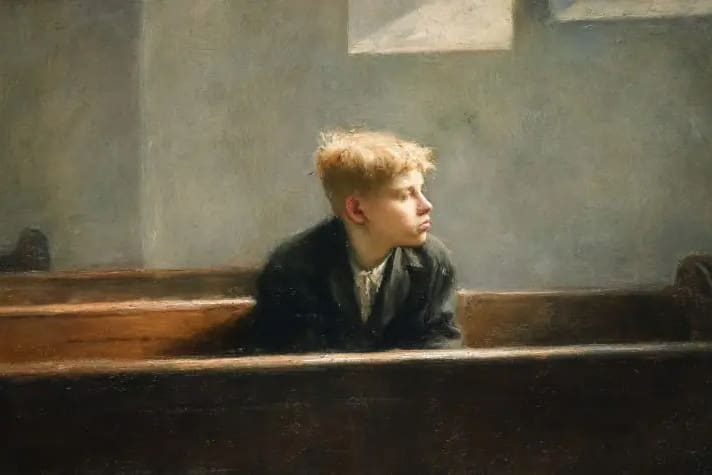
A few weeks later, I sat in church, trying to do anything to fill the void in my heart. A teenage girl—about my age—was speaking to the congregation about the power of God to answer prayers. She spoke about how she lost her keys, searched everywhere, and finally prayed to know where her keys were. “As soon as I prayed,” she said, “I knew exactly where they were.”
I remember sitting there absolutely stunned. My father had been convicted and sentenced just days before, after years of prayers. Why had heaven opened for her but not for me? Surely a set of keys was not more deserving than a boy in need of a father. Was her need somehow greater than mine?
Why does God answer some prayers and not others? Why did Christ heal one soul but walk past another? Why does relief come to some but not to me, even when I know He can give it? These are mysteries I do not pretend to solve.
Could it be, however, that the mystery itself is a whisper of grace—the quiet grace that sustains us while we wait for the answer to such questions? As we wait for our own “miracle”?
Why had heaven opened for her but not for me?
Scripture is chock full of miracles. One of my favorites is the healing of the woman with an issue of blood. We celebrate the moment she touched Christ’s garment and was healed as a miracle. Rightfully so. But if we read too quickly, we miss the first miracle—the miracle that actually made the second possible. She waited. Twelve long years she waited. Twelve years of loss, exhaustion, and likely pleading with heaven, asking, “Why not now?” Bitterness could have understandably taken root. Yet when her moment came, she was not hardened. She still believed. She still approached the Savior and reached. Her waiting had not destroyed her; it had prepared her.
She waited twelve years. Joseph waited thirteen years in slavery and prison. Abraham waited twenty-five years for Isaac. Moses waited forty years to reach the promised land—and died before entering. Adam waited one hundred and thirty years for Seth after losing Abel by the hand of Cain. The woman at the well waited through five husbands before meeting the Messiah and finally feeling seen. I waited four years for my father.
It seems that the Lord has always asked His children to wait. Why would we be an exception?
What are we doing to protect the sacred time we are given while waiting?
The idea of waiting through seemingly unanswered prayers is woven into the path of every disciple. If we pay attention, we begin to see that “waiting on the Lord” is itself a great miracle, like the parting of the Red Sea. In my own life, as I waited for my father’s innocence to be restored, I felt Christ carry me from day to day. The miracle I longed for never came—but a different one did, one more precious to me now. In the waiting, I learned who God was. In the waiting, He found me. In the waiting, He pulled me from dark depths, sustained me, and pushed me back home. How many miracles do we overlook because we are looking for a different one?
Hebrew has a beautiful way of providing new insights into words and meanings. I am no linguist, just a student, but one Hebrew word for “wait” is qavah. It appears in the psalmist’s cry, “Let none that wait on thee be ashamed.” The same root word can also mean “expect” and is often associated with tension-filled waiting for the expected promises of the Lord to be fulfilled. For example, Isaiah uses qavah to foreshadow the long-awaited gathering of Israel, “I will wait for the Lord, who is hiding His face from the house of Jacob, and I will put my trust in Him.” (Isaiah 8:17). The word is derived from a concept of binding two things together in a cord, pulled tight with expectation and anticipation. We are able to wait on the Lord for salvation, or healing, or redemption, or whatever it is we are waiting for because those specific concepts are concomitant with the promises of God. We cannot have healing without the Healer, or salvation without the Savior, or redemption without the Redeemer. Qavah is not the uncertainty of wondering if something will happen, but the quiet assurance that it will.
Another Hebrew word for “wait” is yachal—often translated to “hope.” It is the word used by Job in his famous lament, “Though He slay me, yet will I hope in Him.” (Job 13:15). The connection between waiting and hoping amidst suffering paints a picture of responsibility. Hope is not merely the denial of suffering, but the denial of despair amidst suffering. We must guard the sacred time we spend waiting, protecting the heart from bitterness and bolstering our faith until the dawn of our miracle comes. One’s integrity does not shine until it is tested. The time to shine is in the waiting. So, what are we doing to protect the sacred time we are given while waiting?
The woman with the issue of blood waited in this way. She took responsibility for her waiting. She did not let resentment in, like poison. She protected the fragile place between promise and fulfillment, and when the Savior walked by, she was ready. Waiting, then, mustn’t be a passive suspension of time but a deliberate intention of the soul. Whether we think of qavah—the expectation of God’s promises—or yachal—hope amidst suffering—we discover that waiting is itself a form of discipleship. It is the space where character is shaped, where trust is tested, and where our deepest commitments are revealed. We wait not because we are uncertain, but because we are tethered to something sure, the sure foundation of a promise made by Christ. In the quiet stretch between promise and fulfillment, we learn who we are becoming. And perhaps that is the quiet miracle of waiting: it gathers us, guards us, and prepares us to become the person we were always meant to become.





Rochelle HaleMay 4, 2026
It sounds like your father's "innocence was restored." I hope so. It also sounds like you were able to weather the storms during this difficult time in your family. We attend a "Come, Follow Me" study group. Often, friends have shared faith-promoting or special experiences. One wife took me aside and told me that her husband feels bad because he has never had these experiences. This man has been in ward leadership and a seminary and institute teacher. I suggested that he has probably had many experiences, particularly through gospel study, that the rest of us haven't had. One of the earliest miracles I experienced was going on a mission without family support. From the first impressions to serve to arriving in the mission field was about four months. I had some savings, but my bishop told me there were ward members who would make up the difference. Part way through my mission, our expenses were drastically reduced due to an economic depression where I was serving. I had a surplus in my bank account when I returned home. I gave it to the bishop to help another missionary. The amount was roughly equivalent to what I had started with, so I actually had been able to finance most of my mission myself. Another recent miracle was caring for my elderly mother. Her illness was sudden, but we didn't expect her to pass away. Nevertheless, we soon learned we had to address not only her medical care, but housing (she couldn't go home), and possibly a funeral. I was cleaning her apartment one day, after several weeks of earnest prayer and seeking guidance, when a phone call answered several of our questions and gave us direction that we needed in many ways. I know the Lord had directed that "angel" to call me. Later, when we did have to deal with funeral arrangements, I felt led to a certain mortuary. They were so kind from the get-go and walked us through the process. They did not know our budget, but final expenses were almost to the penny exactly what we could spend.