










A New Short Film on Angel.com
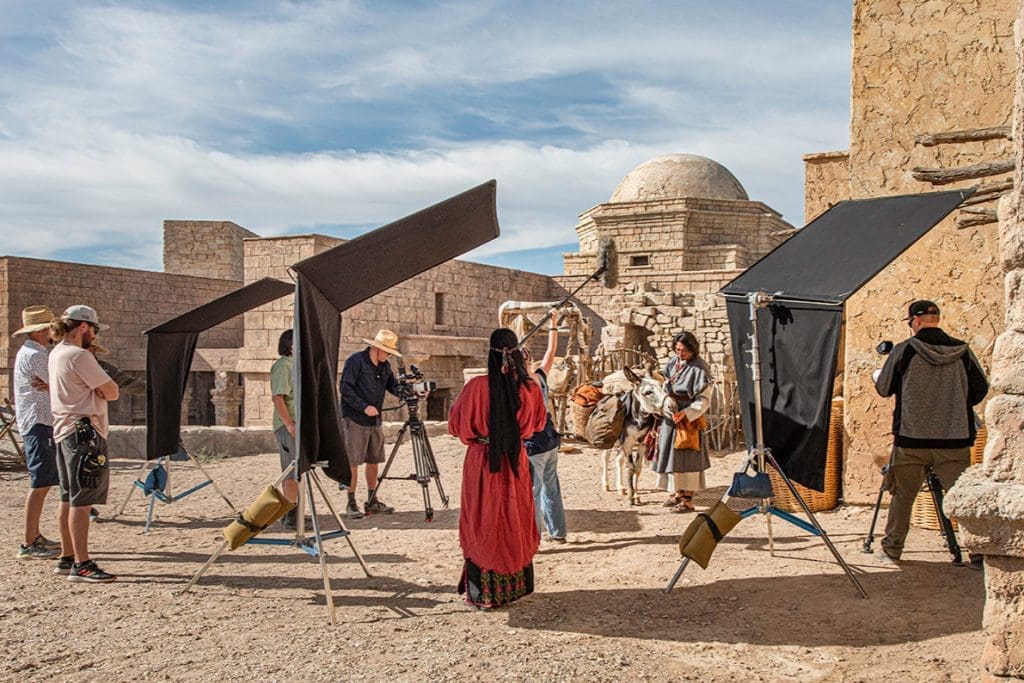
On the Jerusalem set in Goshen, Utah—about 50 miles south of Salt Lake City—the smell of the air has a hint of dust and donkey.
Stone walls look rough under the beating sun, and shadows pool in the alleys.
Roman guards are laughing and mingling with merchants and pilgrims.
It could be first-century Judea.
It is, in fact, a meticulously recreated film set owned by The Church of Jesus Christ of Latter-day Saints, and writer-director James Dalrymple from Emmaus Road Media is here filming The Good Samaritan—the first entry in a series on The Parables of Jesus reimagining the New Testament parables.
Why This Parable, Right Now?
For Dalrymple, the parables of Jesus aren’t Sunday-school illustrations—they’re navigational tools for “how do we live life in trying to follow Christ?” He argues they feel especially urgent now.
“I’m bombarded by a polarization in politics,” he has said. “I’m bombarded by signs of the times. I’m bombarded by wars and rumors of wars… the anger and the frustration and the anxiety that has become part of our world.”
The Good Samaritan, then, is his answer to that bombardment. It’s not “loud” or divisive—but it is on film, and shows the consequence of human choice.
From Abstraction to Humanity
The film’s central move is specificity—Dalrymple takes Luke 10’s outline and fills in what the Gospels leave implied.
The traveler has a name, a family, a purpose.
He’s selling wares to help his village. He has a wife and child, whom he loves and interacts with before he sets out on his journey.
Producer Howard Collette frames this added context: “[We] add some backstory to [the parable] so we can put ourselves in the minds and the hearts of the people back in the first century. It brings it alive. It makes it believable. And it allows us to have emotions that would have been similar to theirs.”
Dalrymple doesn’t soften the violence, either. The attack scene is visceral—stunt work, choreographed, with makeup and wardrobe tracking the traveler’s injury so the body we see in the dirt resembles what we might expect—someone truly beaten and broken. As an audience, this helps us get into the mindset of true sympathy and empathy for the traveler: when the priest and Levite “pass by,” they walk past someone truly broken open, and we feel it.
The film’s theological engine?
“What in terms of importance is most important?” Dalrymple asks.
“And I think [it] falls in every case on ministering or in healing, in helping over policy, practice, and procedure.”
The Samaritan as Unlikely Savior
The cultural friction embedded in the original parable isn’t softened here. In first-century context, Samaritans and Jews carried centuries of religious, ethnic, and political mistrust.
“[The] person that we think would have animosity towards someone from another race, the Samaritan, makes the choice, the human choice, to help and serve and minister,” Dalrymple says. His Samaritan arrives not as an archetype but as a man with his own schedule and his own anxieties—which makes the choice to stop more costly (and much more meaningful).
Dalrymple also reads the Samaritan as a quiet symbol of Christ: crossing social boundaries to offer mercy, just as Christians believe Jesus condescended and crossed the boundary between divine and human.
The Emmaus Road Approach
Emmaus Road Media takes its name from the road where disciples recognized Jesus as he walked beside them, their “hearts burning within them.” That image animates everything the studio does.
First assistant Jon Farrell left a Hollywood career—Pixar, DreamWorks, seven years across both—because something was missing. “I wanted to work on things that had a lasting impact,” he has said. The parables are “timeless stories that Jesus told almost two thousand years ago, and yet they’re so timely.” The aim is to bring them “to [audiences] in a medium that they consume on the daily.”
But Farrell is careful to separate reach from glory. “Although I would love this to go big,” he says, “the glory is… the Lord’s.”
The Good Samaritan is only the beginning. Emmaus Road Media is currently on location in Morocco, filming The Ten Virgins, the series’ second entry. Farrell, writing from a quiet hotel room in Ouarzazate on a Sunday morning, put the sacrifice plainly: most of the crew is missing family milestones — birthdays, ordinary weekends — to be there. “We do it,” he wrote, “because of a deep conviction and belief in the material.” In Morocco, wandering a 500-year-old synagogue and its oil lamp market, that conviction took on added meaning. The team found themselves asking how much oil a wedding torch would actually hold, how long it would burn, and what it means to relight a lamp that has gone out in the dark. That’s just a small indication of the interpretive instinct Emmaus Road Media brings to these parables.

Success Measured in Spirit
Dalrymple’s benchmark for this first parable film is intentionally non-commercial. “My measure of success is if I can tell a story that someone feels the spirit of it, then I’ve been successful,” he says.
Collette puts it more plainly: if the film “doesn’t inspire them to make a change in their lives, to do something better, or to just do a raw change… it’s just another movie.”
The film seems to earn that ambition in its quiet moments: a hand laid on a wounded body, cleansing liquid poured on a broken body, a cloak adjusted against the cold breeze, a willing helper literally carrying the broken body and soul of another to be cared for and healed. These seemingly simple scenes help the parable come to life and help us feel the import of the message.
In this modern moment saturated with unmitigated noise, The Good Samaritan does something almost countercultural—it slows down, it looks, and it makes us ask ourselves: Who is my neighbor?




Richard FMay 5, 2026
Very excited to see the development and reinterpretation of the great parables of Christ. Good luck to the team!