









Over a lifetime, we come to understand our every choice leaves a mark. Some bring peace; others linger as regret. No matter how carefully we justify ourselves, there are moments of honest clarity when we recognize how much we need mercy — moments when excuses fall away and we see ourselves as we truly are. The gospel of Jesus Christ speaks directly to those moments. It does not pretend we are without fault — instead it offers us redemption for our faults.
Scripture often teaches through sermons and miracles, but sometimes it teaches through a single human exchange, brief and unsettling, revealing eternal truth more plainly than words alone. On the morning of the Crucifixion, while crowds argued and a governor hesitated, one man waited in a Roman cell expecting justice in its harshest form. Instead, he was given mercy he had done nothing to deserve.
His name was Barabbas.
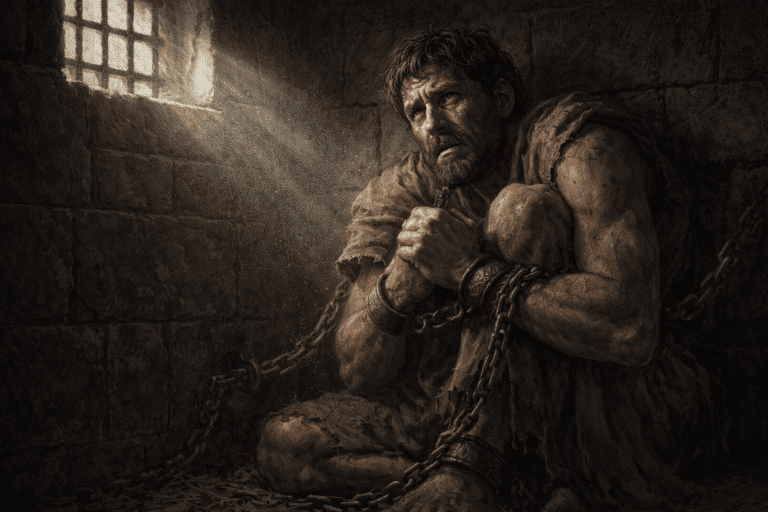
Barabbas, a notorious prisoner guilty of rebellion, robbery, and murder, may have spent his last hours in a kind of numb dread, the sort that comes when you have run out of options and the consequences you earned are finally here. A man facing Roman execution would have heard the sounds of the city above him, the shuffle of guards, the heavy finality in the air. Maybe he tried to rehearse bravado, telling himself he could meet death like a fighter, yet the body betrays the soul when the end feels close. His mind might have swung between rage at Rome, regret he would never admit out loud, and the sinking realization that his choices had brought him to a cell where tomorrow had been taken away.
Then the impossible happened. Footsteps, keys, his name spoken, not to be dragged out to die, but to be released. Confusion would have hit first, then a rush of disbelief, the heart pounding as if the body could not decide whether this was deliverance or another trick. And when he learned that Jesus of Nazareth was the one being handed over instead, the shock might have turned to something heavier than gratitude, something that landed in the chest like a stone. He knew what he had done. He knew he belonged on that cross. To walk out into daylight because an innocent man was taking his place would have felt like being handed a life that did not fit him, like wearing a clean robe over filthy skin.
What do you do with a gift you did not earn, purchased by a goodness you did not possess?
Perhaps he avoided looking back as he left, or perhaps he could not stop looking back, haunted by the thought that his freedom had a name and a face. If Barabbas had any honesty left in him, he may have sensed that he had just become a living witness of mercy, and that the rest of his life would now ask a question he could not ignore. What do you do with a gift you did not earn, purchased by a goodness you did not possess?
Barabbas steps into the story of Jesus Christ for only a few brief verses, yet his presence is unforgettable. He is the prisoner whose chains are removed while the Savior is led away. He is the guilty man released while the Innocent One is condemned. As Latter-day Saints, Barabbas matters because his experience puts a living face on substitution, mercy, and the unsettling generosity of grace. His story also presses a personal question — what do we do with freedom we did not earn?
All four Gospels record Barabbas as being freed instead of Jesus during the Roman practice of releasing a prisoner at the feast. Matthew calls him a notable prisoner. Mark explains he had taken part in an uprising and had committed murder. Luke describes him as someone imprisoned for rebellion and murder. John calls him a robber. Put together, the picture is not flattering or vague. Barabbas was not in prison for a minor mistake. He was known for violence and unrest, and the authorities saw him as dangerous.
Even his name adds a striking layer. Barabbas is commonly understood to mean “son of the father.” In fact, many biblical scholars believe Barabbas’s first name was also Jesus, making him Jesus Barabbas, which means Jesus, son of the father, creating a powerful ironic contrast with Jesus of Nazareth, the true Son of God, whom the crowd chose to crucify instead. While most manuscripts simply say Barabbas, some ancient copies of Matthew’s Gospel include the name Jesus for him, a detail often noted in footnotes of modern Bibles.
In that crowded moment outside Pilate’s judgment seat, the people rejected the true Son of the Father and chose a man whose life represented the turmoil and brokenness they hoped to escape. They demanded the release of someone who fit their expectations of power and resistance, and they rejected the Messiah whose kingdom would be built through meekness, purity, and truth.
Barabbas is important because he acts out one of the central truths of the gospel in plain sight. Jesus Christ stands in the place of sinners. In a very literal way, Barabbas lived because Jesus died. Barabbas did not argue his way out of prison. He did not repay what he owed. There is no record of him proving his goodness or making promises to change before or after his release. He was simply freed because someone else was chosen to suffer the penalty.
This is the miracle of the Atonement. It does not merely assist the innocent. It rescues the guilty.
As members of the Church of Jesus Christ of Latter-day Saints, this moment teaches something about every one of us. In a sense, we are all like Barabbas. We have all sinned and fallen short. We all carry stains we cannot scrub out by ourselves. We all face consequences we cannot undo by our own strength. Yet through the mercy of Jesus Christ, a door opens which we did not have the power to open ourselves. We walk into light we did not earn. We are given a future we did not deserve. This is the miracle of the Atonement. It does not merely assist the innocent. It rescues the guilty.
The setting makes the lesson even sharper. The exchange takes place at Passover, a feast tied to deliverance through sacrifice. Ancient Israel had been spared through the sign of a lamb, and the memory of freedom was bound to blood and covenant. Here, at the very season celebrating redemption, the Redeemer is condemned and a condemned man is released. The Lamb of God is led to the cross, and a murderer is handed life. The timing is not accidental. It underscores the price of salvation and the seriousness of what Christ offers.
Barabbas also exposes something uncomfortable about human nature. The Gospels show religious leaders stirred the crowd, and the crowd chose the man they wanted instead of the Savior they needed. Pilate offered them a choice, and they chose anger over holiness, force over faith, spectacle over sanctification. It is easy to judge the crowd, but the story is not preserved so we can feel superior. It is preserved so we can recognize temptation in ourselves. The world still offers substitutes for Christ, voices promising quick relief or the thrill of power or the satisfaction of revenge. Those substitutes may look bold and decisive, but they do not heal the soul. They only trade one prison for another.
Then comes the question many people ask: what happened to Barabbas after he gained his freedom? The honest answer is the scriptures do not tell us. The biblical record closes his story at the very moment his life opens up. Later traditions and legends have tried to fill in the silence, but nothing about his later life can be confirmed from the scriptural accounts. He walks out of prison and out of the narrative.
Mercy is not permission to stay the same. Mercy is power to change.
This missing ending is not a flaw. It is part of the message. Barabbas disappears so the reader can step into his place. His freedom is the kind of gift demanding a response. It is one thing to be released from chains. It is another thing to become a new person. Mercy is not permission to stay the same. Mercy is power to change.
Barabbas was freed from Roman punishment, but every soul still needs to be freed from something deeper. Sin binds the heart. Pride locks the mind. Bitterness turns the spirit into stone. Shame convinces people they are beyond hope. Christ does not merely open a cell door and wave us onward. He offers cleansing, healing, and a new life. He offers grace that not only pardons but transforms. This is why repentance is not a punishment. It is a pathway to peace. It is the process of letting the Savior remake what we cannot fix alone.
So Barabbas stands as more than a historical footnote. He is a living parable in flesh and blood. A man who deserved death walked away while the sinless Son of God was crucified. The story stops before we can see whether Barabbas fell back into darkness or turned toward the light. That silence invites each disciple to write the rest with their own choices.
We have all been offered mercy through Jesus Christ. We have all been spared in ways we do not fully understand. We have all been given another day, another chance, another invitation to come unto Him. The question is what we will do with that freedom. Will we run back to the old life, chasing the same appetites and resentments that made us prisoners? Or will we turn toward the Redeemer who took our place and learn to live as true sons and daughters of the Father?
Barabbas leaves the page, but the invitation stays. Christ bore the cross, and we are free to follow Him.


MaryannMarch 30, 2026
Hmmmm....There is a key element missing in this comparison. Barabbas was not free spiritually---that comes only through repentance. Yes, he could walk away and live his life. But that is not the same as being truly saved by our Savior. Escaping consequences is temporary, and only become permanent through repentance and changing our lives through the power of Christ.
KathleenMarch 25, 2026
Thank you for bringing to mind someone that at least I, hardly think about. Your perspective through Barabbas increases my gratitude for our Savior at this wonderful celebratory time of year.