









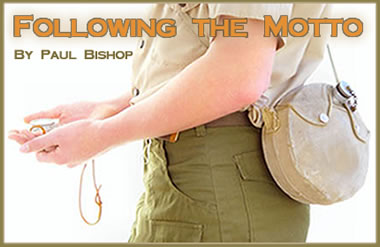
One of the great things about the Boy Scouts of America is the universality of the sentiments expressed in the Scout law and oath. Who can argue with, trustworthy, loyal, helpful, friendly, courteous, kind, obedient, cheerful, thrifty, brave, clean, and reverent; or the importance of promising to do your duty to God and country, helping other people at all times, and living physically strong, mentally awake, and morally straight? The sentiments expressed in these BSA guidelines could provide the basis for almost any general conference talk.
In these latter-days, however, while the Scout law and oath resonate with the principals necessary for living life as the Lord intended, it is the Scout motto – be prepared — to which we must pay attention. In many ways, by following the edicts of the Scout law and oath, we are preparing ourselves spiritually — thus adhering to the motto. But the act of being prepared goes beyond spiritual and ethical aspects.
Words of the Prophets
In his address to the priesthood in October 2005, President Hinckley spoke extensively about the natural disasters occurring around the world and the wonderful response provided by Latter-day Saints in providing goods, financial donations, prayers and fasting, and in thousands and thousands of hours of actual hands on service – all of the volunteers missionaries by their very example.
President Hinckley specifically stated these disasters are not punishment from the Lord. It further follows the personal tragedies such as sickness, injury, terminal illness, financial setbacks, or the loss of loved ones, are not castigations from the Lord directed specifically at individuals.
Having stressed this belief, however, President Hinckley further counseled us by affirming the reality of the many calamities and catastrophes that have occurred throughout the history of our world. Pointing to the warnings of the prophets recorded in scripture of natural disasters past and yet to come, President Hinckley referred to Matthew 24, where the Lord says:
- “Ye shall hear of wars and rumors of wars.”
- “For nations shall rise against nation, and kingdom against kingdom: and there shall be famine and pestilences, and earthquakes, in divers places.”
- “All these are the beginning of sorrows.”
- “And woe unto them that are with child, and to them that give suck in those days.”
- “For then shall be great tribulation, such as was not since the beginning of the world to this time, no, nor ever shall be.”
President Hinckley further cites 3 Nephi, which records with savage grace the almost inconceivable destruction of the Western Hemisphere at the time of the Savior’s death in Jerusalem; and D&C 88, which goes further to give us these ominous words of revelation:
And also cometh the testimony of the voice of thunderings, and the voice of lightnings, and the voice of tempests, and the voice of the waves of the sea heaving themselves beyond their bounds.”
And how prescient is this description when we compare it to the visual images of the recent tsunami and hurricanes?
Should We be Scared?
President Hinckley reminds us “somebody has said it was not raining when Noah built the ark. But he built it, and the rains came.” If what the world has experienced in the past was all foretold, what can we do about the calamities to come?
Is the best thing to make a sign bearing the words “The End Is Near” and march around town filled with doom and gloom? Should we cower in our basements, or huddle under dining room tables practicing drop, duck, and cover drills with our families? Or should we follow the guidance of the prophet by applying the Boy Scout motto, “Be Prepared”?
We do not know the form of the future calamities we will face either individually or as a world body, yet the prophets have warned us there will be calamities. Although the prospect of future calamities can certainly be cause for worry, the Lord has provided us the key to calmly facing these calamities with the direction, “If ye are prepared ye shall not fear” (D&C 38:30).
Process vs. Event
Preparation is the key to so many aspects of our lives. In our church callings, preparation inevitably leads to success. Gospel doctrine teachers, seminary teachers, and youth teachers learn very quickly that the demands of preparation reap immediate rewards through the effectiveness of their lessons. Home teachers and visiting teachers will have far higher impact upon the individuals within their stewardship if they prayerfully prepare a simple lesson rather than trying to read the latest Ensign issue while driving to their appointment.
Every youth knows the feeling in the pit of his stomach when he enters the classroom to take a test for which he hasn’t studied. Had he prepared, the feeling of confidence alone would be worth several right answers.
To be successful, preparation must be engaged as a ongoing process not a single event. How many of you have earthquake kits in which you keep extra clothing for your kids? If you had to use the clothing today, would each set of clothing become a hand-me-down and leave your oldest child standing naked? How about the clothing placed in the kit for the husband who has stopped his workout regime and come off his diet – will he be able to get those jeans you placed in the kit for him buttoned?
Are we rotating our food stores as needed? Or when we go to use them will time have destroyed and spoiled what we are relying on for our very survival?
Do you have a family plan in case of an emergency? Do you have a predetermined gathering place? If cell phones and other communication fail, do you know what to do?
Have you ever talked about any of this with your families? Have you ever practiced your emergency plan, or participated in the Church’s emergency preparedness activities?
Real Life
Within my police unit, we often participate in in-service training – learning new techniques and practicing tried and true procedures. The serving of search warrants is something we do regularly. Most of them are simply executed and uneventful, yet each event has to be approached as if we are going to find ourselves in the line of fire.
Recently, we were gearing up to serve a search and arrest warrant at an upscale condominium owned by a 69-year-old celebrity doctor. While known as Dr. Happy for liberally providing prescription drugs to well known individuals from the music and movie industries, he had no prior record. He had no guns registered in his name. He was the personal physician to several high profile icons. On paper, this looked like the simplest of operations.
For some reason – most likely the small still voice that talks to our hearts – I realized my team was not taking the process of preparing for the warrant service seriously. I called a team meeting, and we talked over all of the things that could go wrong.
By the time we left to serve the warrant everyone was prepared to follow the safety procedures. We were all wearing bulletproof vests; we had both the battering ram and our trusty Arkansas toothpick (a long metal spike); we knew who would do what if the suspect did not open the door, or if everything hit the fan and somebody got hurt.
Everyone on the entry team had an assignment and knew what would be expected of them.
Needless to say this turned out to be one of the most dangerous warrants we had ever served. We had to blow the door of its hinges with the ram. When the door flew backward, it smashed a collection of glass vases to smithereens, showering glass shards everywhere.
The first detectives through the door, barking commands, saw the suspect and his roommate running naked for the back rooms of the condo. They gave chase and were able to tackle the roommate and take him into custody. The main suspect fought ferociously – possibly due to drug ingestion – but was finally taken down and restrained in the doorway to his bedroom.
Once the dust and glass had settled, we saw on the floor of the bedroom – about three feet away from where the suspect was captured – an illegal, fully automatic, Uzi submachine gun loaded with armor piercing bullets. If we hadn’t been prepared, some of us would have died that day.
Because we were prepared, everyone went home safe and the bad guys hit the slammer. However, because preparation is an ongoing process and not a single event, the next morning we began the preparations for the next search warrant by debriefing the events of the day before and discussing what we did right and what we could do better.
How many of us are complacent in our physical preparations? How many of us need a wake-up call to get back onboard the process of preparation using single events – the putting together of an earthquake kit, or the making of a family emergency plan – to build on? To be successful, we need to schedule the updating of our supplies and the practicing of our emergency plans – both being wonderful events for family home evenings.
Spiritual Preparation
Preparation is also not just a physical process or storing, planning, or practicing. It can also be a series of spiritual events. We prepare ourselves by reading the scriptures, attending church, doing service, and magnifying of church callings.
I have an LDS acquaintance who is a bestselling mainstream science fiction author. I am actually in awe of this man’s intellect. His grasp of concepts, his ability to touch on the core of difficult issues, and the clarity with which he presents his thoughts in writing places him at a genius level. In his books, he creates worlds of wild imagination against which he plays out dramatic scenarios involving his characters in many of the real challenges we face on earth today. His favorite computer game is one in which he can create maps and design mystical, magical, and unknown lands, which are then built, populated, and played out.
So, what is the point of all this fictional world-building? Whether he realizes it or not (and somehow I’m sure he does), I believe he is preparing – practicing, in case he is able to attain a celestial level where these skills will be needed.
Certainly he is an exception. For most of us this ephemeral type of preparation is not demanded or necessary. However, the Lord has blessed us each with special gifts. Author and financial motivator Robert Kiyosaki calls this our inner genius, and then goes on to break the word into a concept of self-actualization – finding the genius-in-us. What is demanded of us is to discover this special gift, this individual genius, inside us and be prepared to use it when the Lord requires.
Organizing Ourselves
In the words of revelation found in D&C 109, the Lord tells us, “Organize yourselves; prepare every needful thing.” Encouraging the preparations to assure disaster survival has been at the forefront of the Church’s teaching since its founding. President Hinckley has advised us to “set aside some water, basic food, medicine, and clothing to keep us warm,” and to “have a little money laid aside in case of a rainy day.”
These are well worn sentiments, but they continue to be at the heart of the process that is preparation. Furthermore, prayer is what keeps the heart of preparation beating. It is a two-fold process, both physical and spiritual. By being aware of staying in the light of the Lord, if we keep his commandments, if we share his gospel, if we listen to the counsel of the prophets and act accordingly, we will not only be prepared for the coming tribulations, but we shall also be prepared any time the Lord needs us.


