









In the last two columns we’ve covered quite a bit of ground. We’ve looked at some historical perspectives on food, stretching from the advent of agriculture to Great Depression recipes. We’ve explored our food sources using Twinkies and polycultural farms as the scaffolding. Now in this third and final installment of columns about the food we eat, we’re taking a look at a couple of vastly different, maybe even diametrically opposed, methods of menu selection. (If you’re looking for further reading on the topic, How to Pick a Peach by Russ Parsons, which I reviewed in my first column for Meridian Magazine, would also be an excellent resource on food selection, particularly fresh produce.)
We’ll end this series on edibles with two of my favorite children’s books that center around food in charmingly whimsical ways and demonstrate how visually beautiful and interesting food can be.
“Reclaim our health and happiness as eaters”
In Defense of Food
By Michael Pollan
In Defense of Food is Mr. Pollan’s shorter, simpler follow-up to his earlier book Omnivore’s Dilemma (reviewed in my last column). It is specifically geared to help answer the question “Now what?” After learning a great deal about the modern food industry, both conventional and organic, including much that is somewhat disturbing, it can be overwhelming to try to process the new information and still come up with something to eat for dinner. This book reads like an addendum to Omnivore’s Dilemma on how best to apply your newly gained knowledge and eat better.
 The book is divided into three broad sections. The first delves into “nutritionism” which Mr. Pollan defines as a reductionist ideology that views foods as the sum of their nutrient parts. He postulates that this has led our current society to a greater dependence on food professionals and nutrition experts than previous generations. Nutritionism is also at least partly responsible for the shift to processed foods that can be nutritionally “enhanced” and, as a result, marketed as more healthful. Mr. Pollan documents the changing health fads of nutritionism over the past several decades: low-fat, then low-carb, animal fats are bad…wait – now they’re good! It can be dizzying trying to keep up with the latest pronouncements.
Next, Mr. Pollan deconstructs “the Western diet” and its effects on people in cultures around the world. Rather than looking at the specific nutritional composition of individual foods, he addresses the larger dietary patterns that change when, for example, a native or aboriginal people adopt Western eating habits, and points out the medical problems that inevitably follow. He boils these deleterious shifts down to five general trends: 1) from whole foods to refined; 2) from complexity to simplicity; 3) from quality to quantity; 4) from leaves to seeds; and 5) from food culture to food science.
Finally, Mr. Pollan presents some general rules on making food choices. He describes it as more of an “algorithmic” approach than a strict listing of appropriate and healthful foods. Simply stated in seven words, his basic rules are: “Eat food. Not too much. Mostly plants.” He elaborates on each of the three aspects with counsel like “Don’t eat anything your great-grandmother wouldn’t recognize as food,” “You are what what you eat eats too” and “Do all your eating at a table.” Each suggestion is explained in greater detail, but my favorite part is that they provide simple, actionable statements. Adopting even just one or two of Mr. Pollan’s guidelines will result in better, more healthful eating.
“A practical guidebook to giving in to temptation…smartly”
Eat This, Not That!
By David Zinczenko with Matt Goulding
Not quite the polar opposite of the previous book, but coming very close, Eat This, Not That! embraces our industrial food system and attempts to provide its readers the tools needed to navigate it better. Mr. Zinczenko uses a visually arresting, eye-catching format. Bright colors, arrows, and geometric shapes with tidbits of information are organized on every page with full-color photographs of the food in question. Calorie counts, and grams of fat, sodium, sugar, and fiber figure heavily into his formula of which foods should be avoided and which are “healthier” options.
 Granted, some of the “better” food choices would be really laughable if they were seriously being promoted as healthful, but Mr. Zinczenko freely acknowledges that in some categories the options are “bad” or “really bad.
” He argues that “if you’re going to indulge, why not do it intelligently?” For example, a classic banana split from Baskin-Robbins has almost twice the calories, fat and sugar as the comparably sized banana split from Dairy Queen. It’s certainly not a health food, but if you are armed with that information you can make a choice that will have a real impact on your caloric intake. Likewise, if you’re sitting in a parking lot between a McDonald’s and a Burger King on your lunch break, it may be of value to know that a Big Mac has 230 fewer calories and 19 fewer grams of fat than a Whopper with Cheese.
Several of the brief chapters have an “expose” feel to them. “The Truth about Your Food” dissects some common misconceptions about diet soda, free-range meat, and energy drinks, among others. Mr. Zinczenko highlights “The Best and Worst Changes in the Food Industry” in another chapter, mentioning the White House garden, calorie count laws passed in several states and cities, and rising obesity rates in 23 of 50 states (and the other 27 states just held steady – not a single state’s obesity rates dropped!). Lists feature heavily throughout the book: “10 Foods for a Longer, Healthier Life,” “The 20 Worst Foods in America,” “13 Restaurant Industry Secrets.”
In one chapter Mr. Zinczenko grades 56 restaurant chains, both fast-food and sit-down types, on a scale from A (excellent) to F (failing). While only five earn scores in the “A” range, he reserves the failing grade for those national chains who refuse to disclose nutritional information and repeatedly skewers them for their lack of transparency (I.H.O.P. and T.G.I. Friday’s to name a couple). He claims at least partial credit for shaming other chains (like Olive Garden and Red Lobster) into providing nutritional data in recent years.
Additional sections are devoted to comparisons of brand name foods on our supermarket shelves, special occasion eating, and kids foods, including separate grades for restaurants’ kids’ menus, encouragement to eat “colorfully,” and another list – this one “6 Rules of Good Nutrition.”
I particularly liked the fresh produce section with the easy-to-read chart on when fruits and veggies are freshest and how to best keep them at home. The last chapter, “Your Save-Money Shopping Guide,” provides quick tips for cutting the grocery bill as well as yummy-sounding recipes that save money and cut calories. If you’re looking for a way to cut back without completely changing the way you buy, prepare and eat your food, Eat This, Not That! is a good place to start.
“Every single color is important”
I Can Eat a Rainbow
By Annabel Karmel
 This is a fun, fun book! Each two-page spread displays dozens of foods in a single color with clever illustrations, eye-catching layouts, and cute animals made of food – I love the little frogs made of fava beans, peas and parsley on the “Green” page and the bunny with an apple body, strawberry head and raspberry paws on the “Red” page. Ms. Karmel slips in interesting facts for kids, for example, that hummus is made of chickpeas, and anthropomorphizes carrots and eggplants with silly faces. Both common and exotic fruits and veggies are included: the “Orange” pages highlight carrots, oranges, mangoes, pumpkins, apricots, peppers and kumquats. There is also a brief introduction for adults with suggestions on talking with children about foods and some food-related activities to try. This book is probably not for the youngest babies as the pages can be pretty busy, but a definite winner for older young ones (my almost-two-year-old and four-year-old love it).
“Five turtles, six penguins, seven fish…”
Food for Thought
By Saxton Freymann and Joost Elffers
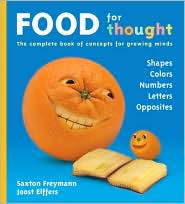 This colorful and engaging book covers five basic topics for children (shapes, colors, numbers, letters, and opposites) using fruits and vegetables to provide the visuals. Creativity just oozes off every page! I especially love the “Opposites” section. Whether it’s mushroom people balancing on a broccoli and rhubarb teeter-totter to illustrate “up” vs. “down” or a huge melon cat staring down at a little radish dog, the images were intriguing, original, and humorous. Mr Freymann is particularly good at combining unlikely pairings to create a scene: a portobello mushroom top, pearl onions, broccoli, beans and artichokes became an owl and its nest for the ”O” page.
Yellow bell peppers, brussel sprouts and bok choy make up the seven fish in the “Numbers” section. The first and shortest section, “Shapes,” was the weakest and least inspiring – the images used to demonstrate certain shapes just didn’t seem to register with my kids – but every subsequent section got better and better. With its bright colors, simple lines, and amazing attention to detail, this book will interest children of all ages.
**************************
We’re at the end of our exploration of food, so now what topic(s) would you like to learn more about? What’s currently on your reading list? I’d love to swap book recommendations with you! Come find me on goodreads.com or email suggestions, comments, and feedback to egeddesbooks (at) gmail (dot) com.


