






by Robb Cundick
Pictures by Debra Gehris
At last we have reached the final installment of my account of the Mormon Tabernacle Choir’s 2003 tour – an arduous journey that began at the Interlochen Festival in northern Michigan and finished at Tanglewood in western Massachusetts. At the conclusion of Part II we had just finished performing for nearly 700,000 at the Charles River Esplanade on Independence Day in Boston. You’ll recall that we sang Monday in Newark, Tuesday at Saratoga, Wednesday in New York City, Thursday at a dress rehearsal in Boston, and Friday for the Esplanade concert. As long as we were on a roll, why not skip down to Wolf Trap – just outside Washington, D.C. – for a concert on Saturday night?
But D.C. was too far to travel by bus with any expectation of making it in time. The solution? .Our own Amtrak train! Though the station was only a 6-minute walk, it took 20 minutes just to get the whole choir down the hotel escalator. Bringing up the rear, I reached the station only to find the cars full until I reached the next to last of the ten cars! I frowned to myself because this was one of two that had been earmarked for people who wanted to stay up and talk – the last thing I wanted to do that night. Thankfully, by the time we pulled out of the station at 1 a.m. everyone was so tired they just did their best to sleep the entire way. Someone later said they walked the length of the train and saw bodies laid out in every conceivable position – some even stretched across the aisle!
The train maneuver worked really well. We arrived Saturday morning at 7:30 a.m., an hour ahead of schedule for a change. Another bus company would transport us that day; the buses that had carried us since the start of the tour would arrive later that day from Boston.
We had free time until 4:30 that afternoon but I had a compelling reason to skip my chance at more sleep: my son and his family were still in town. (It was great timing since they were moving to California the next day.) The early arrival meant I could join them for a session in the Washington Temple followed by a priceless visit with my two grandchildren. It is always wonderful to leave the temple with an insight you didn’t have before. Although – given the circumstances – it was hard to remain alert that morning, I nevertheless felt very attuned to the spirit. As I contrasted this experience with my recent visit to the Sacred Grove, I realized that despite the uniqueness of that opportunity, what I was feeling here at the temple was every bit as meaningful – even more so, in fact, because I was sharing it with my family. So while a trip to Palmyra is a wonderful experience, the temples multiplying throughout the world are bringing “sacred groves” a lot closer to home for most of us.
Wolf Trap
Located just outside Washington, D.C., near Vienna, Virginia is our country’s only national park for the performing arts. If you watch public television you’ve probably seen a performance at Wolf Trap. It reminded me of Saratoga – only the performance shell was lined with cherry wood panels, which gave it an added touch of class. Here, on the evening, of July 5th, we would face the most uncomfortable performance conditions of the tour – temperatures were in the high 90’s with the humidity up there as well. I was not only concerned for us but for the audience. Would their discomfort leave them with less enthusiasm? During the sound check, the lawn at the rear of the amphitheatre was opened to concertgoers who had been waiting just out of sight. As they streamed down the grassy slope their eagerness was apparent. It was like a land rush! Many literally ran to stake out their spot.
As I got up to leave for the pre-concert break I saw familiar faces – Scot and Maurine Proctor of Meridian Magazine. Meridian Magazine has carried a number of my articles over the last two years and yet I had never met the Proctors in person. Though we’ve become well acquainted through email and phone calls, there’s always something missing until you’ve had the chance to smile, shake hands and exchange greetings. I am so grateful to them creating a light upon a hill on the Internet with their magazine.
As it turned out I needn’t have worried about the difficult performance conditions. The choir sang with great energy and the friendly and receptive audience responded in kind. The crowd on the lawn and in the covered seats was nearly 6,000! Once again we received great press: the Washington Post subtitled their brief but laudatory review, “At Wolf Trap, the Mormon Tabernacle Choir Shines in a World of Song.”
At the Jefferson Monument
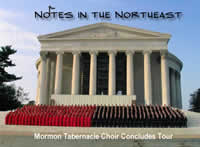
Sunday, July 6th we were up early to do filming at the Jefferson Memorial. (The Choir leadership and Bonneville Communications, producer of Music and the Spoken Word, thought that filming the Choir at a national monument was too important to pass up despite needing to get us up early yet again.). It seems like the phrase “the experience of a lifetime” has received so much use as of late that it threatens to become a clich. To stand on the memorial’s front steps and sing patriotic songs while looking across the tidal basin at the Washington Monument was yet another singular and stirring experience.

During a break, Brother Jessop suggested that we step inside to sing. With so many singers surrounding the lofty statue of Thomas Jefferson, you can imagine the rich resonance that filled the domed chamber. We had just finished, “God Bless America,” when a uniformed government employee stepped up and told us that singing is not allowed within the memorial. It might have been easy to feel indignant, but the absurdity of “America’s Choir” not being welcome to sing a patriotic song there just struck my funny bone. Craig – always a gentleman – apologized with a smile and explained that he hadn’t been aware of the rule, and that was that.

We next returned to the hotel for our second sacrament meeting of the tour. Since there wasn’t a room at the hotel large enough to accommodate everyone, there were two separate meetings. Elder Jeffrey Swinton, an Area Authority Seventy, spoke at the one I attended. (He and his wife, Heidi, came with us because she is writing a book about the Choir.) Elder Swinton said he was amazed at the Choir’s spiritual and emotional energy and he had enjoyed the opportunity to listen to our daily conversation. “Many of you didn’t know who I was, so you were not guarded in the things you may have had to say. But none of you have said anything that was the least bit negative. I was surprised!” He was particularly impressed with the attitude of the 100 singers who were consigned to the tent in Boston, “You sang in the tent while the rest of the choir was outside receiving the credit. You were Aaron while the rest were Moses, yet I didn’t hear one complaint.”
The Wanamaker Organ
That afternoon we had time for short stops at the Lincoln Monument and the Washington Temple Visitors Center before heading on to Philadelphia for Monday’s concert. There was nothing scheduled Monday morning and since I had previously seen the historical sights I decided to do something a bit out of the ordinary. Did you know Philadelphia boasts one of the world’s largest pipe organs? And it’s located in a department store, of all places!

One of the attractions at the 1904 St. Louis World’s Fair was a massive pipe organ. In 1911, a prominent Philadelphia merchant named John Wanamaker purchased the organ and had it installed in his department store for the entertainment of shoppers. It has remained a fixture there ever since. While attending school at the Curtis Institute of Music, Tabernacle Organist Richard Elliott served as an assistant organist at the Wanamaker Department Store. And so it was that Rick was able to make arrangements for several of us to see the organ and take turns standing behind current Wanamaker Grand Court Organist Peter Richard Conte as he played his morning recital.
Mr. Conte was delighted to have both Rick and senior Tabernacle organist John Longhurst there, and he invited each to take a “test drive.” This was the first time I have seen John or Rick seem a little intimidated by an organ, but we were thrilled to watch and listen as they each took their turn at the immense console. Rick said the instrument has changed substantially since he was there. Lord & Taylor has since purchased the store; and they put substantial resources into restoring and refurbishing the organ.

As the playing continued I took a walk around the store. I chuckled to myself when I overheard two employees talking about the performance by “that Mormon Tabernacle Choir dude.” But what a great idea to put a pipe organ in a department store, making its music accessible to those who might not normally be exposed to it. It’s not likely to happen on such a large scale elsewhere, though – the Wanamaker Organ is currently valued in excess of $57 million!
Wave That Baton, Coach!
Our concert at Philadelphia‘s outdoor Mann Theater was the first where there were lots of empty seats. Even so, there were probably more than two thousand in attendance. This was our final opportunity to sing the tour program since our last concert would feature different music, so we really put our all into it. There was also a surprise at the end: one of the encores featured Andy Reid, head coach of the Philadelphia Eagles football team and a member of the Church, who came onstage to lead us in the Eagles’ Fight Song.
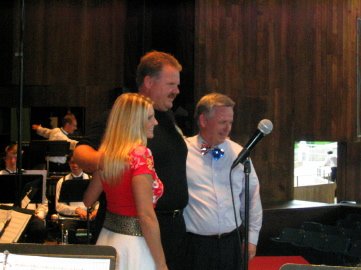
When he joined us earlier for a dry run, Brother Reid looked like he felt as out of place on the conductor’s podium as I would feel suited up in an Eagles uniform. His wife, Tammy, stood nearby and we could tell she had some conducting experience because she was giving him pointers. When Andy rejoined us at the end of the concert, Tammy or someone else had given him a crash course – he was much more at ease and beat a steady rhythm. He seemed to enjoy himself immensely. The audience cheered wildly and it was a riot to see him return to the stage for a formal bow with Craig and Mack. It was a plus for the Choir too-seven TV stations that night carried footage of the coach conducting the Choir and Orchestra!
Preparing for Tanglewood
After two weeks of intense touring, why would the Choir suddenly find itself with four days between concerts? The answer to this question lies in the magnitude of the final opportunity before us: a chance to sing at the Tanglewood Music Festival with the Boston Symphony Orchestra and guest conductor Rafael Frhbeck de Burgos.
Located in the lush, green Berkshire Hills of western Massachusetts, Tanglewood has served as the Boston Symphony’s summer home since the Tappan family donated the 210-acre estate in 1937. Craig Jessop called it the “Super Bowl” of music festivals; it now draws over 350,000 people each summer. Since the Boston Symphony is the only major east coast orchestra with which the Mormon Tabernacle Choir has never appeared, it was time to rectify the situation!
click to enlarge
But a performance with the Boston Symphony is not something you throw together in a day, and the piece we would perform together, Johannes Brahms’ Ein Deutsches Requiem, (sung entirely in German) would require substantial rehearsal time. The very evening we arrived after our last long bus ride, Maestro Frhbeck de Burgos spent 2 hours with us. The next day (Wednesday, July 9), we rehearsed 90 minutes with Craig and Mack, then another 2 hours with the Maestro; this time joined by the symphony.
Born in Burgos, Spain, in 1933, Rafael Frbeck de Burgos has enjoyed a distinguished musical career conducting symphony orchestras throughout the world. He has conducted virtually all the major orchestras in the United States and Canada, and is the newly named principal conductor of the Orchestra Sinfonica Nazionale de la RAI in Turin, Italy. It was a delight for us to work with him. He knew Brahms’ Requiem so thoroughly that he didn’t use a score. Craig remarked that, “No one knows the structure and compositional elements [of the Requiem] better than this man .his interpretation of the piece has been a new revelation to me.”
Though not especially tall, Rafael Frbeck de Burgos’ commanding presence on the podium and the great sweep of his baton made him seem so. What most impressed me was the delight on his face as he drew each desired musical nuance from us. He would open his mouth – its corners raised slightly in a gentle smile – then close his eyes and slowly tilt his head backwards. He looked as though he were drinking a stream of nectar or relishing the fragrance of a flower. His love for the piece matched ours, for it is a favorite of the Choir and carries highly emotional memories. We were set to record it under Robert Shaw in 1999 but had to carry on without him when he passed away just weeks beforehand. We also sang a movement from it at the devotional following 9/11. And then to be joined together with the refined artistry of the Boston Symphony Orchestra – how could things get any better than this?
click to enlarge
Though our guests found interesting things to see and do in and around Springfield, Massachusetts where we stayed, those four days were so busy there was no time for the choir to join them. We were also to perform Leonard Bernstein’s Chichester Psalms, with Dr. Jessop conducting. It is a very difficult piece with rapid, complicated rhythms; and it is sung in Hebrew, adding an additional challenge. Our own ensemble from the Orchestra at Temple Square joined by three musicians from the Tanglewood Music School and Rick Elliott at the organ provided the accompaniment. Again, additional rehearsal was needed to refine the piece to the standard we desired for Tanglewood.

Finishing Up
Thursday night we held a farewell dinner to thank the many people who had made the tour a success. It was especially touching to see our ten bus drivers stand for a round of applause. They all have become warm friends of the Choir; and one – speaking for the group – said they had never worked with an organization that exhibited such great love and were such a joy to be with. Looking at their smiles, I had the sense that this experience had affected them profoundly. I only hope that at least some of them will find their way to one of our chapels some day and discover that the same spirit prevails in Latter-day Saint congregations everywhere.
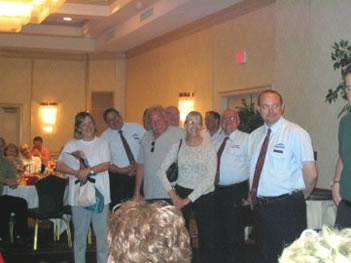
President Christensen also announced that there would be a final late night reception that evening, which reminds me of a funny incident. There were three or four evenings when we had time to enjoy such a reception with refreshments and the opportunity to socialize. The only drawback was how quickly the food disappeared. When the President made such an announcement on an earlier night, Choir member Ken Evans raised his hand and said, “President – if you run out of food, I have half a suitcase full of cookies up in my room left over from last time!” .So that’s where the food had been going! President Mac laughed so hard that he was speechless!
The Grand Finale
The concert Friday night – the final one of the tour – was everything I hoped it would be. Though several choir members had to sit out due to a bronchial infection that was making the rounds, the advantage of having 360 singers is that when some are down, many others are up. Though I struggled with hoarseness at some points in the tour, on this night my voice was in great shape. Chichester Psalms was superb, the only exception being a short section where we weren’t quite together. Benjamin Goldsmith, a boy soprano from the Metropolitan Opera who joined us in the second movement, sang with such clarity, purity and innocence as to be utterly angelic.
You can always tell when you’re performing for an audience that is musically sophisticated because no one gives in to the urge to applaud between the movements of an extended work. The listeners’ complete attentiveness allowed the Brahms to flow from beginning to end with divine splendor. I felt totally immersed in it and wished that it hadn’t gone by so quickly. After the final note there were a few precious seconds when total silence reigned and everyone shared the impact of what had gone before – no one wanting to be first to break the trance. Though a standing ovation is the exception among such seasoned concertgoers, they did eventually rise to their feet. A determined group of them kept the applause going for four curtain calls.
Final Thoughts
You might expect we’d have a few days off after arriving home, but Sunday, July 13 – the day after we returned – it was back to the Tabernacle for Music and the Spoken Word. Week by week it has proceeded without pause for 74 years, and this broadcast marked the beginning of the 75th. President Hinckley delivered a taped congratulation at its conclusion, and then surprised us with a personal appearance. Speaking of the tour, he thanked us for performing, “under adverse circumstances and [with a smile and a twinkle in his eye] under the whip of this, your boss (pointing to President Mac Christensen).” “Craig and Mack [Wilberg] have worked you too hard – I’m just afraid someone will want to unionize you!” How honored we felt by his expression of love and his heartwarming humor. He had come to the Tabernacle to bid us farewell before the tour and now to welcome us home.

Our Northeastern Tour has been a great mental, physical and vocal challenge. The bus travel alone spanned over 4,000 miles (well over a thousand miles more than the Southern States tour two years ago). I returned to work and immediately joked with my boss that I needed a vacation! But there has undoubtedly never been a tour where we have performed before even a fraction of the people we sang for this time. The ever-increasing pace of the Lord’s work requires the greatest possible use of the Choir’s time and energy. A fellow second tenor told me, “I’ve discovered [on this tour] that I can do just fine on five hours sleep!” But the answer to that, I think, is that normally we couldn’t. It is only through the Lord’s blessings that we have been able to accomplish so much in such a short period of time. And when we reflect upon the love and the atonement of our Savior, Jesus Christ – he for whom we have performed these labors – such sacrifice seems small indeed.
2003 Meridian Magazine. All Rights Reserved.