





The Spectral Preacher
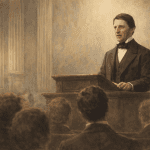
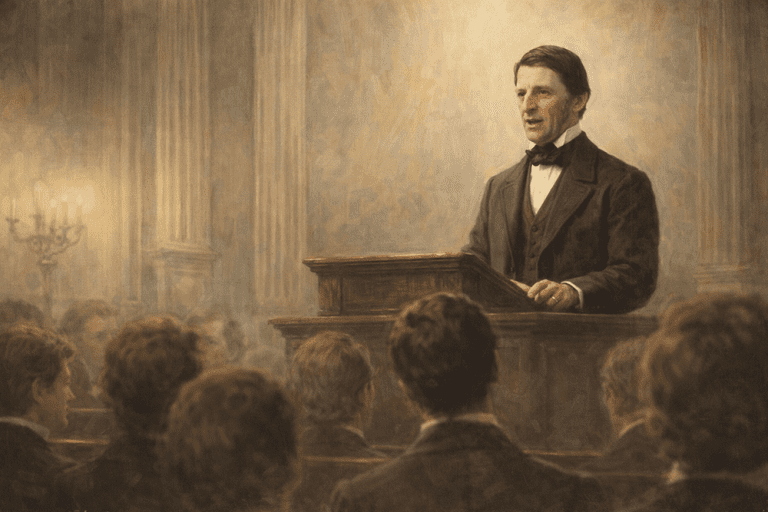
In 1838, Ralph Waldo Emerson stood before the graduating divinity students at Harvard and said aloud what most of them had only whispered over supper. Christianity, he told them, had become a cold hearth, a place where men gathered to describe the fire that once burned there. The living flame had been swept into labeled jars, catalogued and safe. He wrote plainly: “Men have come to speak of the revelation as somewhat long ago given and done, as if God were dead.”1
Then he described a preacher he had heard:
“A snow storm was falling around us. The snow storm was real; the preacher merely spectral.”
The storm had weight. It pressed against the windows and piled on the sills. The sermon had none. And why? Because the man behind the pulpit spoke of God the way a docent speaks of a pharaoh’s sarcophagus: with reverence for something safely entombed. Religion had become a thing under glass. And like all things under glass, it was perfectly preserved and perfectly dead. Emerson named the sickness with a surgeon’s hand: “The stationariness of religion; the assumption that the age of inspiration is past, that the Bible is closed; the fear of degrading the character of Jesus by representing him as a man; indicate with sufficient clearness the falsehood of our theology.”
“It is the office of a true teacher to show us that God is, not was; that He speaketh, not spake.”
His plea could not have been plainer: “It is the office of a true teacher to show us that God is, not was; that He speaketh, not spake.” He wanted faith with mountain wind in it, faith that left frost on the beard and breath in the lungs. He wanted, in short, a religion that could catch cold. He wanted what he called “the true Christianity,—a faith like Christ’s in the infinitude of man.” And he cried out to those young ministers: “The need was never greater of new revelation than now.”
The Boy in the Grove
What Emerson searched for among the elms of Cambridge, a boy in upstate New York had already encountered. Joseph Smith refused to live on second-hand bread, or, for that matter, second-hand fire. He would not sit politely before the ash of ancient miracles and call it warmth. He walked into a grove of hardwood trees and discovered that God is, not was. That He speaketh, not spake. Christianity stepped out of the glass case and back into the weather, where breath clouds and hands tremble.
We are not curators of vanished wonders. We are summoned into the same column of light.
A God with a body you could see overthrew the pale philosophies. A new book of scripture proved that heaven had not gone mute. Priesthood authority returned to the earth. The heavens that Emerson’s Harvard had declared sealed were torn open; not like a page turned, but like a veil rent. The Restoration did not erase the past; it returned the present tense to religion. We are not curators of vanished wonders. We are summoned into the same column of light. Not to admire it, but to stand within it.
Emerson had waited for a teacher who could prove that God is, not was. That teacher came from a grove of sugar maples, not a divinity school.
The Spirit Does Not Float
The Restoration did not merely announce that God still speaks. It revealed the manner of His speaking, and what His voice does to the body that receives it.
We have a habit of imagining the Holy Ghost as a kind of warm glow, a spiritual quilt draped over the shoulders. Parley P. Pratt would have none of it. Spirit, he insisted, is matter. And the Holy Ghost acts upon the whole man, flesh and sinew:
“The gift of the Holy Ghost… quickens all the intellectual faculties… develops beauty of person, form and features… gives tone to the nerves… In short, it is, as it were, marrow to the bone, joy to the heart, light to the eyes, music to the ears, and life to the whole being.”2
“Tone to the nerves.” “Marrow to the bone.” This is resurrection in rehearsal: the body remembering its future. The Spirit does not hover over the body like morning fog over a millpond. He fills it. He crowds out falsehood the way daylight crowds out a candle. He clears the eyes. He wakes the sleeper to his own royalty. When scripture promises that the Spirit “quickeneth all things” (Moses 6:61), it is not promising that we shall become less human. It promises we shall be human at last, human in full measure, human as the word was always meant to sound. To be filled with the Holy Ghost is the discovery of what we were built for.
This is what Emerson’s spectral preacher lacked. He was, in the most precise sense, a geographer of the divine. That is to say, a man who has mapped every road to a country he has never entered.
Newborn Bards of the Holy Ghost
Emerson did more than diagnose the disease. He glimpsed the cure. His charge to those young ministers remains one of the most stirring sentences in American letters:
“Yourself a newborn bard of the Holy Ghost,—cast behind you all conformity, and acquaint men at first hand with Deity.”
The person who has truly seen God cannot remain silent… The vision demands a voice the way a bell demands its tongue.
A bard is not an echo. A bard is a maker. He does not merely respond to the world; he addresses it truthfully, the way a king addresses a court or a father addresses a son. Emerson understood this: “Always the seer is a sayer.” The person who has truly seen God cannot remain silent, not because the vision demands self-expression, but because truth, once received, demands truthful address. The vision demands a voice the way a bell demands its tongue. This is not performance. It is the only honest way to live in a world where God has spoken.
Orson Pratt explained the inner workings of how this becomes possible:
“Without the aid of the Holy Ghost… a person would have but very little power to change his mind… Hence, it is infinitely important that the affections and desires should be… changed and renewed… To thus renew the mind of man is the work of the Holy Ghost.”3
Here lies the bard’s fire: the power to rewrite the inner script. With the Spirit, we gain the strength to dislike what once dazzled us and to love what once seemed dull. We stop living borrowed lives. We become first-hand witnesses of the Light. Emerson’s “bard” is not a poet in the literary sense alone. He is anyone who has met the living God and refuses to pretend the meeting never happened.
You Cannot Breathe Once a Week
A bard cannot speak without breath. And this life demands more than occasional spiritual oxygen; it demands an entire atmosphere. So the sacramental promise comes with its solemn beauty: that they may always have his Spirit to be with them.
If Emerson diagnosed the death of the soul, President Nelson provides the emergency oxygen for its resuscitation. He has warned with prophetic urgency: “But in coming days, it will not be possible to survive spiritually without the guiding, directing, comforting, and constant influence of the Holy Ghost.”4
Note the word survive. Not thrive. Not excel. Survive. The days ahead will not permit a casual acquaintance with the Spirit. A guest appearance will not do. Only a dwelling Companion can sustain us. A man cannot live on oxygen delivered only on Sundays. The lungs do not work that way. Neither does the soul.
But we must be careful here. The Spirit is not a resource to be managed or a fuel to be topped off. He is a Person, and what President Nelson is describing is not a maintenance schedule but the terms of a relationship. We do not survive the coming days by optimizing our spiritual intake. We survive by remaining in genuine communion with a Being who knows us, addresses us, and will not be reduced to a mechanism. The Holy Ghost does not fill us the way air fills a tank. He fills us the way a true companion fills a life: by being present, by being known, and by being welcomed home. A tank, after all, does not mourn the air when it is empty.
And because He is a Person, He possesses a divine delicacy: He respects the agency of the human soul with a quiet, perfect reverence. He does not intrude where He is not invited, nor does He remain where He is ignored. Elder David A. Bednar has warned that the Spirit speaks quietly and withdraws quietly.5 When we distance Him, He recedes—not out of divine sulking, but out of a profound respect for our choice to walk alone. This is the physics of the spiritual life, as real as gravity. Distance from God is not a sentence passed down from a bench; it is a condition simply lived. Emerson’s spectral preacher had no fire because he had no ongoing encounter with the living God. He was running on the fumes of a revelation he had only read about. We cannot afford to repeat his error. To be bards, to love well and speak truly, we must carry the air of Zion into the smoke of Babylon.
Rekindling the Fire on the Altar
Emerson closed his address with a plea that still burns:
“And now let us do what we can to rekindle the smouldering, nigh quenched fire on the altar.”
He looked westward with longing:
“I look for the hour when that supreme Beauty, which ravished the souls of those eastern men, and chiefly of those Hebrews, and through their lips spoke oracles to all time, shall speak in the West also.”
He looked for a “new Teacher” who would show the shining laws come full circle. He could not have known that the Teacher had already come, that a fourteen-year-old boy had already knelt among the trees and seen the heavens open. But we know. We have the fire Emerson longed for. The question is whether we will carry it or merely label it and set it behind glass again.
The world is filled with people who are solid enough to buy groceries and sign documents, yet who have somehow misplaced the one self that was supposed to do the living. They live on borrowed routines. They call numbness normal. Emerson saw them filling the pews of New England. They fill ours too, if we are not careful.
But we know something older and truer. The Restoration is the announcement that the famine is over. The Holy Ghost is the marrow that wakes the sleeper. The vow is never to return to sleep.
Holiness is not an exception to being human. It is what humanity looks like when nothing is withheld.
Emerson’s charge belongs to us now. Yourself a newborn bard of the Holy Ghost. Acquaint men at first hand with Deity. Do not speak of God as if He were dead.
“Ye are gods; and all of you are children of the most High” (Psalm 82:6). Holiness is not an exception to being human. It is what humanity looks like when nothing is withheld. We were not fashioned to be shadows, nor built for the long defeat of numbness and borrowed days. We were made for the column of light: and that, when we step into it, is what burns. The fire does not ask to be studied. It asks for wood.
Footnotes
1 Ralph Waldo Emerson, “An Address” (also known as The Divinity School Address), delivered at the Harvard Divinity School, Cambridge, MA, July 15, 1838, in The Complete Works of Ralph Waldo Emerson, ed. Edward Waldo Emerson (Boston: Houghton Mifflin, 1903), 1:132–151; see also https://emersoncentral.com/texts/nature-addresses-lectures/addresses/divinity-school-address/
2 Parley P. Pratt, Key to the Science of Theology (Liverpool: F. D. Richards, 1855; repr., Salt Lake City: Deseret Book, 1965), 101–2.
3 Orson Pratt, The Essential Orson Pratt, ed. Breck England (Salt Lake City: Signature Books, 1991), 28–29.
4 Russell M. Nelson, “Revelation for the Church, Revelation for Our Lives,” Ensign, May 2018.
5 David A. Bednar, “That They May Always Have His Spirit to Be with Them,” Ensign 36, no. 5 (May 2006): 29–32.