








Edited by Roy A. Prete
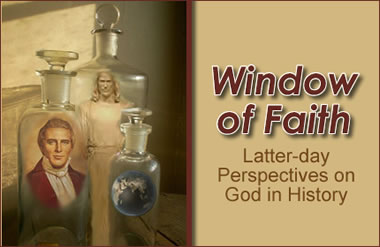
Editor’s note: This is the first of a two-part article giving excerpts from Window of Faith, a work of Latter-day scholars that explore the fascinating concept of God’s role in human history.
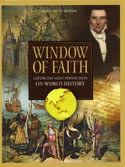
Is there a divine purpose in history? What special insights do Latter-day Saints have regarding the role of God in history? In the new book Window of Faith ? a pioneer work of scholarship, based on prophetic statements ? LDS scholars offer numerous insights into the role of God in history.
Modern prophets and apostles have long identified the divine hand at work in several aspects of Western history, such as the intellectual awakening and flowering of the arts in the Renaissance, the discovery of America, the religious renewal of the Reformation, the development of representative constitutional government and individual rights in Britain, and the rise of freedom in America, to mention but a few. The providential rise of freedom in America has long been identified as a necessary step in preparation for the Restoration of the gospel.
But as The Church of Jesus Christ of Latter-day Saints extends its reach across more and more of the earth, broader themes emerge:
A theme of prime importance is the development of freedom in the Western world ? in the United States, in particular, but also in other countries ? and its spread in one form or another to the peoples of the earth, facilitating the spread of the gospel across the world.
A second theme that has taken on greater importance is the unparalleled disbursement from heaven of scientific and technical knowledge in the modern era, which has blessed all of mankind and greatly accelerated the Lord’s work, providing systems of transportation and communication for a worldwide church and information technology for vastly expanded family history research and temple work.
A third major theme has been the rapid progress of the Church since 1945, allowing it to assume by degrees its worldwide mission of spreading the gospel, “unto the ends of the earth, as the stone which is cut out of the mountain without hands shall roll forth, until it has filled the whole earth” (D&C 65:4; see also Daniel 2:44-45). Following the turbulent events of the early twentieth century, the world has been prepared to receive the gospel through the spread of freedom, and also by other means.
This book represents an approach to world history for Latter-day Saints which recognizes the hand of God in the historical process. It views the unfolding of history within the perspective of Heavenly Father’s plan for the salvation of his children.
The thesis of the work is that God, working through human agents, has shaped world history for the accomplishment of His purposes. In the great work of salvation, chief among God’s purposes in the modern era are the Restoration of the gospel and its dissemination to the all the world in preparation for the Second Coming of the Messiah (see D&C 1:1-23, 34-36; 65:1-6). The Millennial reign will thus be ushered in during which the great redemptive work of administering saving ordinances for the untold myriads who have lived on earth without a knowledge of the gospel will be accomplished.”
As the work of the Lord’s church progresses, the gathering of the House of Israel according to God’s ancient covenants is being accomplished in its spiritual dimension, while the literal gathering of the House of Israel continues to unfold. Our Father in Heaven is the God of the whole earth and has not worked with just one people, but, as ancient and modern prophets have indicated, He has guided the destinies of all peoples and has given them light and knowledge as He has seen fit.
Ever respecting the agency of man, He has shaped to His purposes the destinies of mankind, for, as Moroni declared, ‘the eternal purposes of the Lord shall roll on, until all his promises shall be fulfilled’ (Mormon 8:22).
Elder Alexander B. Morrison on “God in History”
The first chapter in this volume of 27 chapters is a keynote address, “God in History,” by Elder Alexander B. Morrison, Emeritus Seventy. It was delivered at a pre-publication symposium held at BYU, February 5-6, 2003.
Emphasizing the subjective nature of historical exploration, Elder Morrison affirmed the role of God in history, but ? urging humility on the part of the researcher ? he cautioned against attributing either too much or too little to the divine influence.
He said that the historian wishing to explore God’s role in human history should investigate several principles, among them:
His love for all His children,
the principles of agency and freedom,
the concept of progress,
the centrality of Christ in the divine plan, and
the importance of prophets as a source in learning the divine will” (13).
God’s intervention is most particularly visible, he concluded, “in every moment of the existence of the [Lord’s] Church” (11)
The rest of the volume is divided into four parts, which deal with specific themes. The first two parts, “A Marvelous Work and a Wonder,” and “Philosophical and Theological Underpinnings,” are excerpted below. For specific treatment of the historical sections, “Preparing the Way,” and “To All the World,” see part two of this article.
“A Marvelous Work and a Wonder”
This section of the book discusses overt ways in which God has intervened in history. Drawing on a vast erudition in both early Christian studies and those of the Restoration, John W. Welch lays the groundwork for the discussion of providential history in exploring “Early Mormonism and Early Christianity: Some Providential Similarities.” He points out the similarities of revelations that heralded the original church and the restored gospel, the subsequent apostolic ministries and the growth patterns of the two new churches. All these things, Welch says, “would suggest the role of the divine hand” in the formation of the original church and the church as set forth in the latter days.
In the chapter, “The Restoration in the Lord’s Plan,” Richard O. Cowan, a noted scholar of Latter-day Saint history in the twentieth century, carries the discussion one step further, placing the Restoration of the gospel in the context of previous cycles of apostasy and restoration. Tracing the events of the Restoration, he observes that unlike earlier dispensations, this one will not fall away, but is intended to prepare the way for the millennial reign, which will complete the work of salvation on the earth.
In contrast to this glorious outcome, Richard E. Bennett ? the foremost scholar of the Mormon Exodus ? and Amber J. Seidel explore, within the context of existing Protestant concepts, the views of Joseph Smith and early missionaries on the Apostasy in the period up to 1834.
In their chapter, “A World in Darkness: Early Latter-day Understanding of the Apostasy, 1830-34,” they conclude that the apostasy was seen by early church leaders not only as an apostasy from the Christian Church, with the corruption of doctrine, ordinances and practices, but as an apostasy from the concept of Israel as the Lord’s covenant people.
Against this conceptual backdrop, the quest for a new Zion society becomes of much greater significance. In his chapter, “A Place Prepared: Joseph, Brigham and the Quest for Promised Refuge in the West,” Ronald K. Esplin, a noted scholar of nineteenth century Latter-day Saint Church history, has taken up the theme of the westward migration ? which, in the words of President Wilford Woodruff, “was the main Key of the Mormon history of the nineteenth century.” Esplin argues that under successive prophetic leaders the Saints were more led than driven to the Rocky Mountains.
As identified in scripture, one of the Lord’s great objectives in the era of the Restoration is to bring to pass the gathering of the House of Israel. The coming forth of the Book of Mormon is a sign that “the work of the Father hath already commenced unto the fulfilling of the covenant which he hath made unto the people who are of the house of Israel” (3 Nephi 21: 7). The covenant relationship of Old Testament history is thus now blended with the history of the so-called Gentile nations, with the apparent result that God’s intervention in their affairs is more visible, in many instances, than in ages past.
The chapter by Victor L. Ludlow, lifelong scholar of Hebrew and Arab studies, is entitled, “The Scattering and Gathering of Israel: God’s Covenant with Abraham Remembered through the Ages.” His writings are a vital part of any attempt to understand God’s dealings with the whole of the human family in the modern period (13-15).
“Philosophical and Theological Underpinnings”
When we introduce the idea of God as an active participant in the historical process, we introduce all of the age-old theological and philosophical questions relating to the relationship between God and Man, for God is “the same yesterday, today, and forever” (Mormon 9:9), and what is history but the forward moving through time of the tapestry of human events. Part 2 of this volume is thus intended to deal with basic issues which derive from such an approach.
The first chapter in this section, “Merging the Secular and the Spiritual,” is intended to define the scope of the book, to deal with methodological issues, and to outline the major themes (121). This approach relies not only on the material record and empirical research, but also on the principle of divine revelation from God. It uses statements of his prophetic spokesmen as interpretive texts (126).
But, given the fallibility of human beings, including prophets and apostles, the chapter suggests that in matters of history as well as doctrine, we need to rely on two or more prophetic statements ? for as the Apostle Paul states, “In the mouth of two or three witnesses shall every word be established” (2 Corinthians 13:1; see also D&C 6:28).
In the next chapter, “Providential History: The Need for Continuing Revelation,” Brian Q. Cannon, a noted BYU historian and director of the Charles Redd Center for Western Studies, traces the secularization of history writing since the eighteenth century and the repeated and various attempts by believing Christians to reestablish providential history as a viable genre of historical study.
Providential historians have sought to understand the cosmic role of a sovereign deity in historical development, but successive schools among them have been relegated, in the absence of any further knowledge through revelation to using the Bible [merely] as a moral guide in their appraisal of human conduct.
To establish a framework for a Latter-day Saint appreciation of the divine role in human affairs, Byron R. Merrill (from a background in law and religion) considers in the following chapter the vital principles of “Agency and Freedom in the Divine Plan.” Because the principles of agency and freedom frequently affect the nature and extent of divine involvement in human affairs, an appreciation of these principles is crucial to any understanding of God’s often apparent, but sometimes invisible, role in human history.
The next chapter, “How Has God Intervened in History?,” asks an important question that can be answered, at least in part, from scripture and the statements of modern prophets. To establish the spiritual context, the plan of God in the premortal world for the salvation of His children must be considered, as well as the consequences of the War in Heaven.
As a loving Father, God continues to watch over His children, but intervenes in visibly overt ways only as they have faith. Means by which God has interacted in the affairs of men include the Creation, the revelation of His gospel to our first parents and succeeding generations, through gospel covenants and covenant peoples, and in the preservation of scripture.
God’s hand may also be discerned in whom He sends at specific times and places for particular missions, in the light of Christ to which all people have access, in the migration of covenant peoples, in the raising up of lands of liberty, in the outpouring of scientific and technological knowledge, and, in dramatic fashion, in the calling of a modern prophet in this dispensation. Finally, we must recognize that divine retribution may be involved in selected destructions, which people frequently bring upon themselves when they become totally steeped in evil.
A more difficult question relates to when God will or will not intervene in human affairs, for this is a matter involving not only the purposes and will of God, but the agency of man and the exercise of His faith. Drawing insights from Latter-day Saint theology on the purposes of mortality, Craig J. Ostler (a recognized doctrinal scholar) attempts to address the issue in his chapter, “Earthquakes, Wars, Holocausts, Disease and Inhumanity: Why Doesn’t God Intervene?”
His treatment helps us see things from the Lord’s point of view, taking into consideration the Atonement of Christ, the principle of agency, and the need for humans to be tested in a variety of circumstances.
The question of God’s interaction with the major religions of the world is the subject of Roger R. Keller’s chapter, “Why Study World Religions?” An expert on world religions, Keller bases his thesis on prophetic statements, including the First Presidency letter of 1978, which states that God has inspired many of the great philosophical and religious leaders of the world.
Latter-day Saints, who wish to share the gospel with other peoples, would do well to know of their beliefs, and can also sharpen their appreciation of various dimensions of their own heritage through comparative study.
Modern prophets and apostles have affirmed that the great outpouring of knowledge in modern times is from God. In the final chapter in Part 2, Sherilyn Farnes and Roy A. Prete explore “The Discovery Process: Spiritual and Secular Parallels,” by which all the great scientific and technological advances have come in the modern era.
They and conclude that the discovery process is similar in many respects to the process of revelation in the spiritual realm, and that all of these advances have come from the Lord for the benefit of mankind and the building up of His church. They are part of the promised endowment of knowledge of this, the dispensation of the fulness of times” (121-23).
Readers will be amazed to learn that according to one study, as many as 83 percent of scientists receive help from sudden insights and alogical thinking – what they termed hunches (235). This may include things familiar to spiritual truth seekers such as flashes of insight, as in the case of James Watt (who had an idea on how to improve the steam engine on a Sunday afternoon stroll), or Charles H. Townes, who invented the laser as he sat on a park bench in Washington, D.C.
Insights may also come following arduous seeking and persistent pondering, as in the case of Edison as he sought a better process for making carbolic acid ? and sometimes in dreams, as in those of Friedrich Auguste Kekul on the molecular structure of benzene.
Sometimes discovery is serendipitous, such as in the discovery of penicillin by Sir Alexander Fleming, who stumbled onto the discovery as he did other work in his lab. As Louis Pasteur observed, after having unwittingly discovered the vaccination for chicken cholera, “Chance favors only the prepared mind.”
The comparison between spiritual discovery and its more secular cousin is apparent, suggesting that God is the active force in both processes. (234-44)
The second half of the book seeks to explore the history of the modern age and dilemmas of the twentieth century from an LDS perspective. An overview will be posted in Meridian next week.
The Book
Roy A. Prete, ed., Brian Q. Cannon, Richard O. Cowan, D. Mark Prescott, Craig J. Ostler, Associate Eds., Window of Faith: Latter-day Saint Perspectives on World History (Provo, Utah: Religious Studies Center Brigham Young University, 2005), 585 pp., ISBN 0-8425-2610-2, [distributed by Covenant Communications, American Fork, Utah; Deseret Book, Salt Lake City, Utah, $49.95; and Seagull Books (discount available)]
Public Lecture at BYU, October 31, 2005
Roy A. Prete, PhD, Assoc. Professor of History, “Providential History: A Latter-day Saint Perspective,” Monday, October 31, 2005, 3:00- 3:50 pm, Harold B. Lee Library Auditorium, BYU, Provo, Utah.


