









All Rights Reserved
click on pictures to enlarge
Editor’s Note: Thirty years ago, on April 6, 1973, LDS missionaries came to Viet Nam, just days after the United States military had left.
“I make no defense of the war from this pulpit. . . . I seek only to call your attention to that silver thread, small but radiant with hope, shining through the dark tapestry of war – namely, the establishment of a bridgehead, small and frail now; but which somehow, under the mysterious ways of God, will be strengthened, and from which someday shall spring forth a great work affecting for good the lives of large numbers of our Father’s children who live in that part of the world. Of that I have a certain faith” ( Hinckley, Gordon B., Conference Report, Apr. 1968, p. 24).
That part of the world was Vietnam, and, for those of us who remember the place and time, we do it with deep and poignant sorrow. Yet, for those of us who recognize God’s great love for each of his children, when we look beyond that dark time, we see how from the ashes the shining purposes of the Lord began to be accomplished in a small jungle kingdom.
It began in 1962 with the organization of an LDS serviceman’s group. That year was blessed with two Vietnamese converts. By 1966, the escalation of the war had brought more than 2,000 members of the Church into South Vietnam and their association with the Vietnamese brought many teaching opportunities. The church began to grow.
In Salt Lake City, church leadership kept a vigilant watch over the membership in that country. In October 1966, it sent Elders Gordon B. Hinckley and Marion D. Hanks to visit and conduct meetings among the membership there. President David O. McKay had authorized Elder Hinckley to dedicate Vietnam to missionary work if he felt prompted to do so.
In a meeting held at Saigon’s Caravelle Hotel, Elder Hinckley “offered a beautiful, exceptionally appropriate dedicatory prayer: “‘We have seen in other parts of Asia,'” he prayed, “‘the manner in which thou hast turned the hand and the work of the adversary to the good and the blessing of many of thy children. And now we call upon thee at this time that thou wilt similarly pour out thy Spirit upon this land'” He pleaded with the Lord that there might be peace, and that freedom-loving men might be allowed their free agency. He asked that an added measure of the Lord’s Spirit might be poured out upon both the nonmembers and those who already had the gospel, that the people might be more willing to listen to the message of the Savior, and that the members would be more eager to share the gospel. He also asked the Lord to “‘open the way for the coming of missionaries, and make their labors fruitful of great and everlasting good in the lives of the people.'” (R. Lanier Britsch and Richard C. Holloman Jr., “The Church’s Years in Vietnam,” Ensign, Aug. 1980, p. 25).
In 1968, at the height of the war’s escalation, there were more than 5,000 LDS servicemen in Vietnam and a growing population of Vietnamese converts. By 1971 three districts of the Church functioned under the Hong Kong Mission.
That year, William S. Bradshaw was called to be the president of that mission. He said, “At the time I became Mission President in 1971, the U.S. was in the process of stepping down, of scaling down, so the people were leaving. It was a constant struggle to keep the groups organized. A great deal of time was spent in reorganizing the various groups.
“In 1972, near the end of the year, we (the U.S. government) announced that by the first of March (1973) we would withdraw all our personnel and leave the war to the South Vietnamese. I started to get letters of inquiry from the Church. One of the letters came from Elder Hinckley who had missionary responsibilities in that area. He wrote and said, ‘What is going to happen to the branch in Saigon?’
“I needed to write a letter of recommendation and tell them what I would do.
“I went in February to Saigon. I went up on that very same roof where Elder Hinckley dedicated the country for missionary work. I prayed and asked for guidance. I had the very strong impression that we should go ahead and send missionaries. That we didn’t need to worry about their safety.
“I wrote a personal letter to Elder Hinckley and told him what I felt. I got a letter back saying he had read the letter to the First Presidency and the Twelve and that they were giving me permission to send missionaries. The letter said I should get permission from their parents.”
President Bradshaw chose four elders from his mission, Colin Van Orman, James Christensen, David Posey, and Richard Holloman. He wrote to their parents.

Elders Posey, Holloman, VanOrman with
President William Bradshaw in front of chapel
Richard Holloman had grown up in a military family and they were keenly aware of the conflict in Vietnam. His mother, Ann Holloman, wrote,
“The Hong Kong Mission President wrote us a letter asking for permission to send our son to Vietnam which was then a part of that mission. We were stunned. We had not long since returned from an assignment to Okinawa where many of the wounded from the Vietnam war were brought to the hospital. Bombers could be heard taking off regularly for runs over Vietnam. We saw spy planes scooting around. Shooting and bombing was still going on in the outskirts of Saigon. And now they wanted to send our son there!
“We had thought it a hard thing to bear to let him go to Hong Kong – the other side of the world. When he received his Patriarchal Blessing about one and a half years before he received his mission call, he had been told that he would be given the opportunity to teach about Christ to those who knew not of him. He was warned, that though some would be converted, there would be some who would be vengeful and hateful and attempt to harm him to keep him from accomplishing his mission. But, he was promised that if he would be faithful, and look upon them with his countenance lit up by the Spirit of the Lord, fear would take hold of them and they would dare not molest him. He would be allowed to go in peace and safety to deliver his message. When his call came to go to Hong Kong, we could see the prophetic implications from his blessing.
“When the time came to put him on the plane, our human hearts were heavy and fearful, and we really didn’t want him to actually go.
“But now, here was the real thing. Vietnam!! Who was friendly and who not? And to have to learn another difficult language, on site, without any prior preparation. We questioned the Lord: “What could He be thinking? Why us? Why our eldest?
“But as we reread the letter from the mission president, and reread the Patriarchal
Blessing, our testimonies burst back into flame, and we knew it was the Lord calling him, not just the man assigned to be the mission president.
“The Lord had warned us, but also given a promise. We had to have confidence in our son to be worthy of that promise. So, we wrote the mission president that we trusted and sustained his inspiration under his calling, and gave our permission. We were reminded that the Lord had said there is no greater love that one can show than to lay down one’s life for a friend. Though we prayed hard and often that our son might not be called upon to lay down his life, if it became the Lord’s will, we would try to be at peace knowing that he was doing what the Lord had assigned him to do.”
“The other parents also agreed and wrote their permission. “I sort of thought the aerograms were tear-stained,” President Bradshaw said.
“The night before I left Hong Kong,” Richard Holloman said, “I went with my companion to Victoria Peak and looked over Hong Kong. I had great anticipation to go to Vietnam and start afresh but I had no idea what it was going to be like.
“My parents, especially my mom, had written a letter full of faith that we would be protected and the Lord’s will would be done. I felt very at peace to go. I felt very much protected. I felt as if I was prepared for it.”
President Bradshaw said, “I decided April 6 would be a good time to do such a thing, so on April 6, 1973, the four elders and I got on a plane and went from Hong Kong to Saigon.”
The Church had procured a villa, formerly owned by French residents, for use as a meeting house and the elders’ living quarters. The branch members met them there. Colin Van Orman remembers they were “warmly received.”
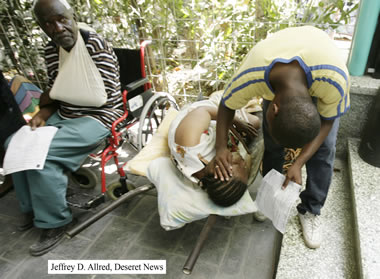
Primary being conducted outside the chapel
Richard Holloman recalls, “It felt like something out of the Book of Mormon. That we had been prayed for, for so long. That our going was an answer to prayer by the Saints. That they had very much wanted to have the full-time missionaries come and seriously take up the work that the servicemen had not been able to do. Just going to the chapel and having the members so overjoyed to have us there, I felt like I was living scripture.”
After a meal, provided by the branch, President Bradshaw and the missionaries retired to their quarters where the president advised and gave the young elders counsel.
President Bradshaw said, “There was just this great feeling. We grabbed each other and started to laugh and jump up and down. We thought it was just the most terrific experience that the Church had in a long time.”
“I felt like I was in the most spiritual place I could be on the earth,” Richard Holloman said. “I felt like it was the right place, the right time, the right people. That it was all arranged as if it was a plan coming to pass.”
President Bradshaw also took the four missionaries to the Caravelle Hotel where President Hinckley dedicated Vietnam to the preaching of the gospel.
“We took some pictures and had a very spiritual moment there on the roof,” Richard Holloman said.

Elder Christensen and Elder VanOrman with
Sister Bradshaw on the roof of the Caravelle Hotel
“Just to know,” Colin Van Orman said, “when we were on top of that hotel, that was the place where he had been to dedicate the land. It was a wonderful experience.”
President Bradshaw said, “When I left a couple of days later, they said, ‘When you come back, we’ll take you around our city.’ I was worried somewhat. I knew where the black markets in Saigon were. I knew where all the brothels were that serviced military people. And the little kids without arms and legs selling cigarettes. There could have been a lot of ill-will against young Americans who were the same age as soldiers.”
The missionaries didn’t feel as if they were in danger. Colin Van Orman remembered the rumble of the B-52s and recalled being warned away from certain areas and cautioned about straying from the roads at night because of the suspected Viet Cong presence, but he always felt safe.
Richard Holloman said, “When we first got there, we stayed as a foursome for a number of weeks. Everywhere we went there were machine gun nests at the intersections and barbed wire. You felt like you were in a war zone.” He also recalled, in the morning, feeling the concussion from bombs being dropped in nearby Cambodia.
“Knowing there were people who weren’t very happy that the Americans had left, I sensed a resentment or a feeling that we would have been at risk if we weren’t protected. We could have been easy targets.”
Beyond noting those things, the missionaries didn’t have time to feel threatened. Their first responsibility was to learn the language. As part of their assignment to the Hong Kong Mission, the elders had been required to learn Chinese. But, now, in Vietnam, they had to start over again. President Bradshaw remembered, “Colin Van Orman had only a couple of months left on his mission, so he was learning a new language on the very end. That was an extraordinary thing to ask someone to do.”
“It was a real pioneering effort,” recalled James Christensen. “We had no senior companions teaching us or helping us with the language. We didn’t have any language books. There weren’t any published language books. We were all brand new at it, all four of us. We visited the local Catholic missionaries and a set of Protestant missionaries who loaned us some of their books. We got a few government books.
“We ended up hiring Pauline Ben. She was a Chinese girl who lived in the branch.”
President Bradshaw remembered Sister Ben. “Her native language was Mandarin but she knew Vietnamese and she knew English and French and she started to teach them Vietnamese partly with reference to Cantonese.”
“We soon learned the Lord’s economy was far superior to our own expectations.” Ann Holloman wrote, “The lady who taught them the Vietnamese language was Chinese, and because they had learned the Chinese language first, she was able to teach them more easily than she could have from English, which she did not speak.”
James Christensen said, “We met every day for three to four hours in the morning with Pauline. She’d come and we’d sit on the porch of the old French villa that was the Church and she’d teach us language.
“The language came very quickly. We were very blessed.”
Ann Holloman, mother, wrote, “Our son sent home many little notebooks filled with every new word he would encounter. It seemed to us like a difficult language as he explained that the same word could mean different things when spoken with different tones.
“We had a letter from one of his converts, expressing surprise at his skill, saying that to hear him on the telephone, one would have to think him a native.
“Our son worked hard on his language skills and acknowledges that surely he was given the gift of tongues because the Lord blessed his efforts.”
“By the time I left (six months later),” James Christensen said, “we were teaching several of the discussions, giving talks in the church, all in a language we had learned, essentially, on our own with Sister Ben’s help and without any training and largely without books or materials.”
After the daily language lesson, the missionaries went out onto the street and tried to make it work.
“The first week or so,” James Christensen said, “we spent a lot of time jumping on buses and traveling out to the end of the bus lines and then riding the bus back to town, trying to get the lay of the land and figure out what was going on. The four of us did everything we could to figure out where things were.”
“We had a lot of referrals and people to look up. A lot of good teaching opportunities,” Colin Van Orman said.
“Missionary work in Saigon was extraordinary,” President Bradshaw said. “Better than Wilford Woodruff on John Benbow’s farm in England.”
James Christensen said, “The way we found people was through the cards that had been filled out at Temple Square. Vietnamese men who were working in the army would pass through Salt Lake and fill out these cards. Hundreds and hundreds, if not thousands of the cards.
“We’d go look these people up, if we could find them, and introduce ourselves as missionaries from the Church. If they indicated to us that they were interested, we’d say, ‘Okay, that’s good, we’ll come back to you when we know how to talk.’
“In a few circumstances, we’d get Vietnamese members from the branch who would go out and help us. They would interpret while we tried to teach but we only did that in a few cases.”
President Bradshaw recalled the missionaries’ favorite proselyting tactic. “It was to stand on a street corner with a map in their hands and look lost. Within sixty seconds, someone would come up and say, ‘Can I help you? Where are you heading? I’ll show you the way.’ That way, they’d wangle an invitation to the person’s home.
“They taught families. They had a lot more success teaching families than we did in Hong Kong. They were teaching a lot of lessons.”
While the work was flourishing, the missionaries felt handicapped by their lack of even the most essential materials like scriptures and discussions.
James Christensen said, “We spent every Sunday afternoon translating materials into Vietnamese. We were not the primary translators. There was a Sister Vy and President The, who was the president of the branch, would stay after church all Sunday afternoon. The two of them, together with the four missionaries, would work on translating materials. We didn’t have discussions translated. We didn’t have any of the tracts translated. The Book of Mormon had not been translated. The hymns had not been translated.

Sister Vy teaching a Sunday School lesson
“The first hymn that we translated was Love at Home. For a few weeks after we translated that, because we felt such a real need to get the Book of Mormon and some of these tracts translated, we ended up using that same hymn over and over at church. We sang Love at Home for opening hymn, Sacrament hymn, and closing hymn for several weeks while we spent our time in translation in other areas.
“When we got the first several chapters of Nephi translated, we ran those off on a mimeograph machine and carried those copies around. That’s what we used to teach with.
“We also carried around with us a French copy of the Book of Mormon and the French Bible because most of the middle-aged people could speak and read French. The young people couldn’t, but the people in their 30s, 40s, 50s and on had some proficiency in French. We would go teach people with a set of French scriptures in front of us, speaking in Vietnamese, and we would have our English scriptures with us to follow along with the French. We would have these two sets of scriptures in two different languages while we taught them in a third. If we got real excited, we would lapse into Chinese.”
“In some ways, we flew by the seat of our pants,” President Bradshaw said. “I’m glad we did. For two years, lots of people joined the church and we had an active branch.”
Because the LDS servicemen had been withdrawn from Vietnam, most of the members were Vietnamese. Yet, there were some American civilian members left in Vietnam. One couple, Lester and Yvonne Bush, were actively involved in the branch. Brother Bush, a physician attached to the U.S. Embassy, had been set apart as a counselor to Branch President The. President Bradshaw said, “Yvonne spent more hours than anyone could imagine, helping more people in that branch. The Bushes devotion to the Church was extraordinary. It wouldn’t have happened so well had they not been there.”

Elder VanOrman and President The with two investigators in chapel
James Christensen remembers those of the branch and the Vietnamese people, in general, with tenderness. ” This was a very humble people, the Vietnamese. These were people who had really been beat up. I don’t think there was a family we knew who hadn’t lost a father or husband or son or two or three. Everyone had lost lots of people.
“One was the woman who would come and cook for us every day. This was a woman who had several children at home, who was not a member of the Church, who lived in just a little lean-to of boards that had been stuck up against a concrete building out on the outskirts of Saigon. She would show up every morning between seven and seven-thirty. She wouldn’t turn around and go home until after 7:30. She considered it a huge honor to be helping us and to be working with us.
“I remember sitting around with her after dinner and saying, ‘We’d love to teach you.’ She’d say, ‘Oh, no, no. I’m not worthy. You’re not looking for people like me to teach.
You’re looking for people who are more important.’
“That was a very common sentiment sometimes with these people. They were very humble, sweet, kind people who considered their association with the gospel and the missionaries to be a real honor. It was wonderful. And they seemed to be quite receptive to the gospel.
“We’d hold church and 3/4 of the people in the church were not members. We’d have between 40-80 people and many, many of them were not members. We’d invite someone and they’d just show up. All the time.
“They were very humble and good, sweet people.”
Ann Holloman wrote, “A few years ago I had an opportunity to attend Women’s Conference at BYU when Sister Hinckley was honored at the main fireside. She told about some of her experiences traveling with her husband.
“She said once as they took off and she looked down at the ground from which they were leaving, she turned to her husband and asked him how he could bear to leave those four little missionaries all alone in a foreign country so far from even their mission president.
“He replied he was not leaving them alone. ‘The Lord was with them.’
“Sister. Hinckley did not say it was Vietnam, but it could have been because President Hinckley, as an apostle, did go there to dedicate the land for the preaching of the gospel. I took it to be, because their mission home was in Hong Kong, many hundreds of miles away.
“In any case, surely the Lord was with them. They were able, with the Lord’s help, to reach in and lift up and out those who had been prepared to receive the gospel, many by their contact with LDS servicemen.”
Within the next year and a half, President Bradshaw had been released, as had Elders Van Orman, Christensen, Posey, and Holloman, and replaced by other missionaries. Elder Holloman served the longest in Saigon at 16 months. On April 30, 1975, just barely beyond two years of the beginning of missionary work in Saigon, South Vietnam fell to the forces of communist North Vietnam. The Saigon mission area was closed, and the missionaries withdrawn.
The current Church Almanac reports that there are approximately 100 members in Vietnam in two branches. Richard Holloman estimates that more than 90 percent of the Vietnamese members were able to escape after the Communist take-over.
President Bradshaw said, “When the two years came to an end and that chapter in the history of the Church came to an end, it was easy to feel devastated by the fact that we had to close that down.
“But the work with the Vietnamese didn’t stop. There were large numbers of ex-patriot Vietnamese in Paris and in Atlanta and especially in California, all over the place. It wasn’t long before there was an official translation of the Book of Mormon in Vietnamese. Missionaries were being called to learn to speak Vietnamese and go to Paris and go to Philadelphia and other places. There were Asian branches all over the place.
” The older couples who serve in Saigon now teach English and act as service missionaries, there’s a remnant of that work done in Vietnam so, in spite of the horrors of the war, somehow that silver strand that President Hinckley talked about hasn’t been broken.” Of the fall of South Vietnam, Richard Holloman said, “In our limited perspective, we might think that was the end of President Hinckley’s silver thread, and we might tie it off, but by no means did it break the thread. It just went off in a different pattern.”
_____________________________________________________
William Bradshaw teaches college-level Chemistry. Colin Van Orman is a physician, James Christensen, an attorney, and David Posey, a Certified Public Accountant. Brother Posey was not available for an interview at the time of this writing, but keeps in contact with his former Saigon mission companions. All currently reside in Utah.
Richard Holloman retired as a Colonel from the U.S. Air Force. Twenty years ago, he was involved in recovery efforts of American servicemen lost in Southeast Asia. He continues to work for the government and lives in Georgia.
If you are Vietnamese or if you lived or served in Vietnam between 1973 and 1975; or if you have served with LDS Vietnamese communities, Richard Holloman is anxious to hear from you. He can be reached at [email protected].
Sources:
Hinckley, Gordon B., Conference Report, Apr. 1968, p. 24
R. Lanier Britsch and Richard C. Holloman Jr., “The Church’s Years in Vietnam,” Ensign, Aug. 1980, p. 25
Interviews with
Bradshaw, William S., April 2003
Christensen, James L., April 2003
Holloman, Richard C., April 2003
Van Orman, Colin, April 2003
Letter from Holloman, Ann, April 2003


