





Dealing with the King of Gerar
Chapter 9, part 1 of The Blessings of Abraham: Becoming a Zion People
By E. Douglas Clark
Build a house … for boarding, a house that strangers may come from afar to lodge therein … And build a house to my name, for the Most High to dwell therein . that I may reveal mine ordinances therein unto my people …
Doctrine and Covenants 124:22-23, 27, 40
The morning after the great destruction, according to Genesis, “Abraham hurried back to the spot” where he had stood and pleaded for Sodom, and “as he looked down toward Sodom and Gomorrah and the whole area of the Plain, he could see only smoke over the land rising like the fumes from a kiln.” [1]
Then, adds the Joseph Smith Translation, “God spake unto Abraham, saying, I have remembered Lot, and sent him out of the midst of the overthrow, that thy brother might not be destroyed … And Abraham was comforted” (JST Gen. 19:35-36).
Lot had not been mentioned when Abraham had negotiated with God over the fate of Sodom. In fact, the Lord had gone beyond what he had agreed to by not only rescuing Lot and his family, but also by coming and comforting Abraham. Such was the friendship between the Almighty and Abraham, and such was Abraham’s friendship with his fellow men. It is “the first of several instances in the O[ld] T[estament] when a person or entire group is preserved through the protective power of a righteous individual.” [2]
Abraham was comforted with respect to Lot, but judging from the depth of his pleading for the Sodomites
just the day before, there would have been anguish in his heart at this moment when he gazed on the smoke of their destruction written in the sky. For if, as the Joseph Smith Translation tells, God spoke to Abraham to reassure him about Lot, yet no word is reported in reply by Abraham as he stares in silence, overcome at the destruction of his neighbors whom he loved.
Like his descendant Mormon (an admirer of Abraham [3] ) viewing the fallen Nephites, Abraham’s soul would have been “rent with anguish, because of the slain” who had “rejected that Jesus, who stood with open arms” (Morm. 6:16-17). Those same open arms had welcomed Abraham at the throne, and would have welcomed Abraham’s neighbors if they had only been willing to repent.
If the region had had a newspaper, the headline might well have been, as two modern writers imagine, “Sodom and Gomorrah Wiped Out in Worst Disaster Since Flood.” [4]
Even so, the region without Sodom surely was a safer and happier place, improving the moral quality of life for Abraham and his community of Zion. Why then, as Genesis relates without explanation (Gen. 20:1), and with no command of God to do so, does Abraham suddenly move?
Tradition tells that the overthrow had dramatically altered traffic patterns in the region, making it impossible for Abraham to offer his customary hospitality. [5] And seeing that travelers stopped coming “and his gold and silver did not diminish, he was grieved and distressed,” [6] exclaiming, “Why should hospitality cease from my house?” [7]
In addition, noted the nineteenth-century Russian rabbi Malbim, Abraham “desired to move about rather than dwell in one place in order to spread the knowledge of and belief in … God.” [8] Abraham’s life illustrates Joseph Smith’s statement that “a man filled with the love of God, is not content with blessing his family alone, but ranges through the whole world, anxious to bless the whole human race.” [9] This, then, would be yet another occasion in Abraham’s life when, as remembered in Jewish tradition, his “preaching was sought by others who thirsted for God’s Word, influencing him to move on to other areas … to further spread the true faith.” [10]
So, instead of simply relaxing and retiring peacefully and graciously amid his substantial wealth, Abraham does exactly the opposite of what most men would do: he moves to a place where he could again use his time, talents, and temporal wealth to bless his fellow men and preach the gospel and continue to build Zion. His motives were not money or comfort, but rather love and service.
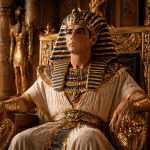
Abraham and Sarah moved south to a mountain region [11] not far from Gerar, a powerfully fortified city and one of the biggest settlements in southern Canaan [12] – another apt location to preach the gospel and bless mankind. The king of Gerar was Abimelech, who soon heard of Sarah’s dazzling beauty and had her brought to the palace to become his queen (see Gen. 20). When she asserted that she was Abraham’s sister, the king legally married her and heaped royal rewards on Abraham, [13] looking forward to consummate the marriage.
In the abbreviated Genesis account, it is not clear how long she stayed in the palace, although Nachmanides states that it was many days. [14] Whatever the exact duration, it was long enough for Abimelech to experience a sickness that prevented him from approaching Sarah, and long enough for the women of Abimelech’s household to suffer from an inability to conceive, [15] which took effect from the time Sarah entered the palace.
At some point, Abimelech had a dream in which he was told he was a dead man because he had stolen another man’s wife. Protesting that he had done innocently, God answered that he knew that and had thus prevented Abimelech from sinning against God. “Therefore I did not let you touch her. Now then, return the man’s wife; for he is a prophet” – the first occurrence of this word in the Old Testament – “and he will pray [or “intercede” (JPST Gen. 20:7)] for you and you shall live. But if you do not restore her, know that you shall surely die, you and all that are yours” (NRSV Gen. 20:7).
As Pharaoh had once done, Abimelech called Abraham and restored to him his wife, while bestowing on her a royal robe [16] and on Abraham an abundance of sheep, oxen, slaves, and a sizeable payment of silver. The king then asked for forgiveness and pleaded with Abraham to intervene to save the endangered king and his kingdom. Thus had God arranged it, so that only by Abraham’s intercession would God save Abimelech. Rabbinic tradition remembers that when Abimelech asked for forgiveness, Abraham “forgave him with a full heart.” [17]
Then, according to Genesis, “Abraham prayed to God; and God healed Abimelech, and also healed his wife and female slaves so that they bore children. For the LORD had closed fast all the wombs of the house of Abimelech because of Sarah, Abraham’s wife” (NRSV Gen. 20:17-18).
Jewish tradition even insists that Abimelech’s wife had previously been unable to bear a child, but Abraham’s prayer allowed her to do so. [18] His prayer is remembered in Jewish teaching as an illustration of the principle that “he who prays on his neighbor’s behalf, himself being in need of the very thing, is himself answered first.” [19]
Thus did another king of this world come to know the superior power of Abraham and his God. So great an impact did the event have on the king that he later approached Abraham to enter into a treaty of perpetual alliance, for, declared the king, “God is with you in all that you do; now therefore swear to me” (NRSV Gen. 21:22-23). The well where the event took place was then called the “Well of the Oath,” or Beersheba, [20] and here Abraham would reside.
Perhaps the entire encounter with Abimelech was another divinely orchestrated opportunity that opened the doors of the gospel to a kingdom by first convincing the king. And for Abraham’s forgiving and praying for Abimelech, the Patriarch is remembered in Jewish tradition as “an exemplar unto all.” [21]
The Joy of Isaac
Abraham’s prayer that the curse of barrenness be lifted from Abimelech’s house turned out to be efficacious for his own house also, demonstrating that “when one prays on behalf of another, it is more likely that God will answer his prayers on his own behalf as well.” [22] As Genesis reports, “the LORD visited [or ‘singled out’ (GTC Gen. 21:1), or ‘showed favour to’ (REB Gen. 21:1), or ‘remembered’ [23] ] Sarah as he had said, and the LORD did unto Sarah as he had spoken. For Sarah conceived, and bare Abraham a son” (Gen. 20:1-2).
Her conception had been just several months following the visit of the three messengers, [24] and had occurred, according to Jewish tradition, on the first day of the New Year, Rosh Hashanah, the day when God remembers all Israel. In synagogues on Rosh Hashanah, the story of God’s remembering Sarah is still chanted. [25]
For Sarah, it was the close of an incredibly lengthy ordeal of patience, perseverance, and trusting in the Lord. A rabbinical text states hat the Almighty rewarded Sarah as He spoke these words: “You put your trust in Me: by your life! I will remember you.” [26]
Thirty-eight long years had elapsed [27] since God’s promise to Abraham of a glorious posterity, thirty eight years since Abraham and Sarah had first rejoiced in the expectation of the fulfillment of that promise. Why the decades of waiting and the long trial of faith? The rabbis said that it was to increase Sarah’s joy when she finally was blessed with children, [28] and to deepen her and Abraham’s dependency on each other and on the Lord. [29] In the words of Hugh Nibley, “It was Abraham and Sarah,” explains Nibley, “who restored the state of our primal parents, she as well as he, for in the perfect balance they maintained, he is as dependent on her as she on him.” And “when both sides of the equation are reduced, the remainder on both sides is only a great love.” [30]
Such love had seen them through the long years of waiting for fulfillment of the divine promises, the long period during which, in the words of Kierkegaard, Abraham “had fought with that cunning power which invents everything, with that alert enemy which never slumbers, with that old man who outlives all things – he had fought with Time and preserved his faith.” [31] His aged wife, well past the season of child bearing, now miraculously bore a son in defiance of the laws of nature.
“What was beyond hope by natural processes,” noted church father John Chrysostom, “came to be, not by human processes but by divine grace.” [32] Never in the history of the world, says the Pirke de Rabbi Eliezer, had a ninety-year-old woman given birth. [33] Why did the Lord of life, the Creator of all, so arrange it? Why not grant the long-awaited son to Sarah during those many years when she could have conceived normally, without divine intervention?
The answer would become apparent many centuries later when, as church father Ambrose observed: “An aged woman who was sterile brought [Isaac] to birth according to God’s promise, so that we may believe that God has power to bring it about that even a virgin may give birth.” [34] Sarah’s miraculous conception, intentionally arranged by the Almighty as a miracle that had never been seen since the Creation, is surely one of the clearest similitudes of the birth of Him who would fulfill the promise to Abraham and Isaac that in their seed all nations of the earth would be blessed.
But there was yet another miracle, according to Soren Kierkegaard, a miracle not of biology but of faith.
In an outward respect the marvel consists of the fact that it came to pass according to their expectation, [but] in a deeper sense the miracle of faith consists in the fact that Abraham and Sarah were young enough to wish, and that faith had preserved their wish and therewith their youth. He accepted the fulfillment of the promise, he accepted it by faith, and it came to pass according to the promise and according to his faith … Then there was joy in Abraham’s house. [35]
Jewish tradition remembers that Sarah likewise was “overwhelmed with sublime happiness,” [36] while the Joseph Smith Translation of Genesis reports her exclaiming that “God has made me to rejoice; and also all that know me will rejoice with me” (JST Gen. 21:5). [37] The Hebrew word here translated as “rejoice” can also be translated as “laugh,” as most translations of Genesis do. “God has brought me laughter,” Sarah exclaims, and “everyone who hears will laugh with me.” She then adds: “Who would have said to Abraham that Sarah would suckle children?” (JPST Gen. 21:6-7). Why did she say “children” instead of “a child”? Because, according to one Jewish interpretation, she was keenly cognizant that this was the covenant son whom God would multiply into a host of covenant people, [38] a future foreshadowed not only by her words but by her very experience. In a passage clearly alluding to Sarah, the prophet Isaiah described the future of latter-day Israel:
Sing, O barren one who did not bear; burst into song and shout … Enlarge the site of your tent, and let the curtains of your habitations be stretched out … For you will spread out to the right and to the left, and your descendants will possess the nations. (NRSV Isa. 54:1-3)
It is the latter-day Zion that Isaiah describes, using their foremother Sarah as a prototype. “Isaiah used the story of Sarah’s barrenness,” explains one scholar, “as a paradigm for Zion and for the future of the people of Israel. For … Isaiah the real import of the barren matriarch is not in the past but in the future: what God did for Sarah is evidence of what he will do for his exiled people,” so that “the significance of Sarah’s story is in its relation to Zion’s story.” [39]
Like Abraham, then, Sarah foreshadows the future of her posterity as she holds her beloved infant whose features, according to Jewish tradition, were very much like those of Abraham, [40] and whose name memorializes the inexpressible joy of both his parents. His name can also be interpreted, notes the Midrash, as “law went forth to the world, or a gift was made to the world” [41] – a foreshadowing of the latter days when “out of Zion shall go forth the law” (Isa. 2:3) to bless the nations through the seed of Isaac and Abraham.
Sarah’s expression of joy would be repeated by her descendant Mary in contemplation of her own miraculous conception of the Son who would bless all nations. “Sarah’s Magnificat,” observed Christopher Wordsworth, “is a prelude” to that of Mary, “whose faith … perhaps was excited and quickened by a remembrance of what had been done by God for Sarah, and by His promise to Abraham and to his seed, to which Mary herself refers.” [42]
Sarah held in her arms, as she well knew, the son of promise, the future blessing of the world. She “feels that she is the mother of ‘sons,’ mother of an entire nation.” [43]
But it was the joyous present that now filled her great soul as she tenderly embraced and – as Genesis specifically points out – nursed her son, thanks to the youthful rejuvenation she had experienced. Sarah’s were the feelings that only a new mother can fathom, but even more; for her joy ran as deep as the longing of decades, and as deep as her sorrow at once having to abandon the idea of ever being a mother, thinking she had misunderstood the divine promises to her husband.
And if Sarah had been physically rejuvenated, so was he: “God restored him his youth,” reports the Midrash Rabbah. [44] The marvelous event would later be commemorated with coinage showing on one side an old man and a woman, and on the other a young couple. [45] Thus were their bodies renewed by the Spirit, the promise made to all who are faithful in obtaining and magnifying the higher priesthood (D&C 84:33).
The promise may include the great renewal beyond the grave when the righteous, in the words of Brigham Young, will be “clothed upon with all the beauty of resurrected saints.” [46] A Jewish midrash foretells that “in the world to come every righteous person … will be physically rejuvenated and enjoy renewed youth … Should you wonder at this, consider Abraham and Sarah” when God rejuvenated them to have a son. “So too will it be with the righteous in the world to come.” [47] Accordingly, “just as Isaac was born to Abraham and Sarah in their old age, so the righteous will be restored to the splendour of their youth in the world to come.” [48]
With the renewal of Abraham and Sarah came, in the words of Philo, “a son of their own, a reward for their high excellence, a gift from God the bountiful, surpassing all their hopes.” [49] It was the beginning of the real life of Sarah, according to Jewish tradition, the fulfillment of all her faith and dreams. [50] The news of Isaac’s birth must have been heralded quickly; as imagined by a modern writer: “Swift runners reached the outmost posts of Abraham’s pasture lands with the glad news – Abraham has a son – the Princess has borne Abraham a son!” [51]
Similarly in Christian tradition, the birth of Isaac is one of the clearest types of the birth of the Savior: according to Christopher Wordsworth, Isaac’s birth is yet “another resemblance to Him … whose Birth is the cause of joy to all.” [52] As Isaac’s birth and name were foretold in advance; as he was conceived only by miraculous means; as his coming into the world brought great joy and rejoicing; and as it made possible the blessing of all mankind – so would be the birth of Isaac’s descendant Jesus Christ, the Redeemer of the world, the Beloved Son.
Abraham “exceedingly loved” Isaac, says Josephus. [53] In fact, as a modern commentator notes, “It is doubtful that ever a son was born who was more loved than Isaac. His father and mother . no doubt, rehearsed over and over again all the great promises of God that centered in him.” [54] And just as the angel had predicted, Abraham did teach his son to keep the way of the Lord.
The Book of Jasher tells that Abraham taught Isaac “the way of the Lord to know the Lord, and the Lord was with him.” [55] Or, in the words of President Spencer W. Kimball, “Abraham built a strong spiritual reservoir for his son Isaac, a reservoir that never leaked dry.” [56] But the parental instruction of Isaac was as much a joint effort as was the mutual faith that brought about his birth in the first place; Jewish tradition remembers that Sarah “nurtured him . empowering him to become Abraham’s covenantal heir.” [57]
For his part, Isaac was, according to first-century Jewish sources, not only “a child of great bodily beauty” but also “excellence of soul.” And “showing a perfection of virtues beyond his years,” [58] he “won even more the affection and love of his parents” by the practice of “every virtue and … zeal for the worship of God.” [59]
No wonder Abraham “cherished for him a great tenderness,” being “devoted to his son with a fondness which no words can express.” [60]
1. Genesis 19:27-28, in Speiser, Genesis, 138.
2.Letellier, Day in Mamre, Night in Sodom, 136-37.
3.See, for example, Mormon 5:14, 20; 7:10. See also the prominence of Abraham and his covenant in the writings of Mormon’s beloved son Moroni, in, for example, Mormon 8:23; 9:11; Ether 13:11; and Moroni 10:31.
4.Eldad and Aumann, Chronicles, 1:3:1.
5.Ginzberg, Legends of the Jews, 1:257.
6.Levner, Legends of Israel, 79.
7.Bowker, Targums and Rabbinic Literature, 210.
8.Kasher, Encyclopedia of Biblical Interpretation, 3:84.
9.Galbraith and Smith, Scriptural Teachings of the Prophet Joseph Smith, 199.
10.Scherman and Zlotowitz, Bereishis: Genesis, 1(a):442.
11.So Jubilees 16:10 in VanderKam, Jubilees, 96.
12.Klinghoffer, Discovery of God, 187.
13.According to Jewish tradition. Ginzberg, Legends of the Jews, 1:258.
14.Nachmanides on Genesis 20:17, in Chavel, Ramban, 1:267.
15.On this point see Nachmanides reasoned discussion in Chavel, Ramban, 1:267.
16.According to Jewish tradition. See Ginzberg, Legends of the Jews, 1:260.
17.Kasher, Encyclopedia of Biblical Interpretation, 3:98.
18.See Ginzberg, Legends of the Jews, 1:261; and Kasher, Encyclopedia of Biblical Interpretation, 3:98-99.
19.Kasher, Encyclopedia of Biblical Interpretation, 3:102.
20.Kasher, Encyclopedia of Biblical Interpretation, 3:126.
21.Ginzberg, Legends of the Jews, 1:260.
22.Miller, Abraham Friend of God, 143.
23.Kasher, Encyclopedia of Biblical Interpretation, 3:100.
24.See Klinghoffer, Discovery of God, 202; and Kasher, Encyclopedia of Biblical Interpretation, 3:100-104.
25.See Klinghoffer, Discovery of God, 202; and Kasher, Encyclopedia of Biblical Interpretation, 3:100-104.
26.Kasher, Encyclopedia of Biblical Interpretation, 3:102.
27.Abraham was now one hundred years old; the promise of chosen posterity was given in Haran when he was sixty-two, according to the book of Abraham 2:14.
28.See Kasher, Encyclopedia of Biblical Interpretation, 2:103.
29.See Ginzberg, Legends of the Jews, 5:231 n. 16; Genesis Rabbah 45:4, in Neusner, Genesis Rabbah 2:148; and Midrash Rabbah on Song of Songs 2.14.8, in Freedman, Midrash Rabbah, Song of Songs, 134.
30.Nibley, Old Testament and Related Studies, 98-99.
31.Kierkegaard, Fear and Trembling, 33.
32.John Chrysostom, Homily 45 on Genesis, in Saint John Chrysostom: Homilies on Genesis 18-45, 481-82. Jewish scholars likewise note that “God’s direct providence is central to Isaac’s birth.” Tuchman and Rapoport, Passions of the Matriarchs, 51.
33.Pirke de Rabbi Eliezer 52, in Friedlander, Pirke de Rabbi Eliezer, 420-21.
34.Oden, Ancient Christian Commentary, 2:91.
35.Kierkegaard, Fear and Trembling, 33.
36.Tuchman and Rapoport, Passions of the Matriarchs, 55.
37.Compare KJV Genesis 21:6: “God hath made me to laugh, so that all that hear will laugh with me.” Both translations are possible with the Hebrew. The Peshitta (Syriac) reads here: “God has made me to rejoice today exceedingly; everyone that hears the news will rejoice exceedingly” (Gen. 21:6, in Lamsa, Holy Bible from the Ancient Eastern Text, 26). The Geneva Bible (an important early English translation) reads: “God hathe made me to reioyce: all that heare wil reioyce w me” (Gen. 21:6, in Berry, Geneva Bible, 9). The Septuagint (Greek) captures both meanings: “The Lord has made laughter for me, for whoever shall hear shall rejoice with me” (Gen. 21:6, in Brenton, Septuagint, 24). Among modern translators, E. A. Speiser captures both meanings: “God has brought me laughter; all who hear of it will rejoice with me” (Gen. 21:6, in Speiser, Genesis, 153).
38.Tuchman and Rapoport, Passions of the Matriarchs, 56.
39.Callaway, Sing O Barren One, 211. See also Motyer, The Prophecy of Isaiah, 445, commenting on Isaiah 54:1: “The picture of Sarah, the barren woman who was to bear the miracle child and become the mother of a family more numerous than the stars, provides background.”
40.See Genesis Rabbah 53:6, in Freedman, Midrash Rabbah, Genesis, 1:466.
41.Kasher, Encyclopedia of Biblical Interpretation, 3:105, translating Genesis Rabbah 53:7.
42.Wordsworth, Holy Bible, 1:94.
43.Kasher, Encyclopedia of Biblical Interpretation, 3:109, citing Hirsch.
44.Ibid., 3:24.
45.Ginzberg, Legends of the Jews, 1:206.
46.Journal of Discourses, 9:193.
47.Kasher, Encyclopedia of Biblical Interpretation, 3:26, quoting Midrash Alef Beth.
48.Sawyer, Midrash Aleph Beth, 254, Sawyer’s paraphrase of Midrash Aleph Beth 14:32, on p. 243.
49.On Abraham 43, in Philo VI, 125.
50.See Tuchman and Rapoport, Passions of the Matriarchs, 76.
51.Hayden, The Love of Abraham and Sarah, 31.
52.Wordsworth, Holy Bible, 1:94.
53.Judean Antiquities 1.222, in Feldman, Josephus, 84.
54.Morris, The Genesis Record, 367.
55.Jasher 22:40, in Noah, Book of Yashar, 62.
56.Spencer W. Kimball, “The Example of Abraham,” Ensign, June 1975, 5.
57.Tuchman and Rapoport, Passions of the Matriarchs, 81-82.
58.On Abraham 32, in Philo VI, 85.
59.Judean Antiquities 1.222, in Feldman, Josephus, 84-85.
60.On Abraham 32, in Philo VI, 85-87